A journal for storytelling, arguments, and discovery through tangential conversations.
Thursday, August 13, 2026
|
Gladys Lou
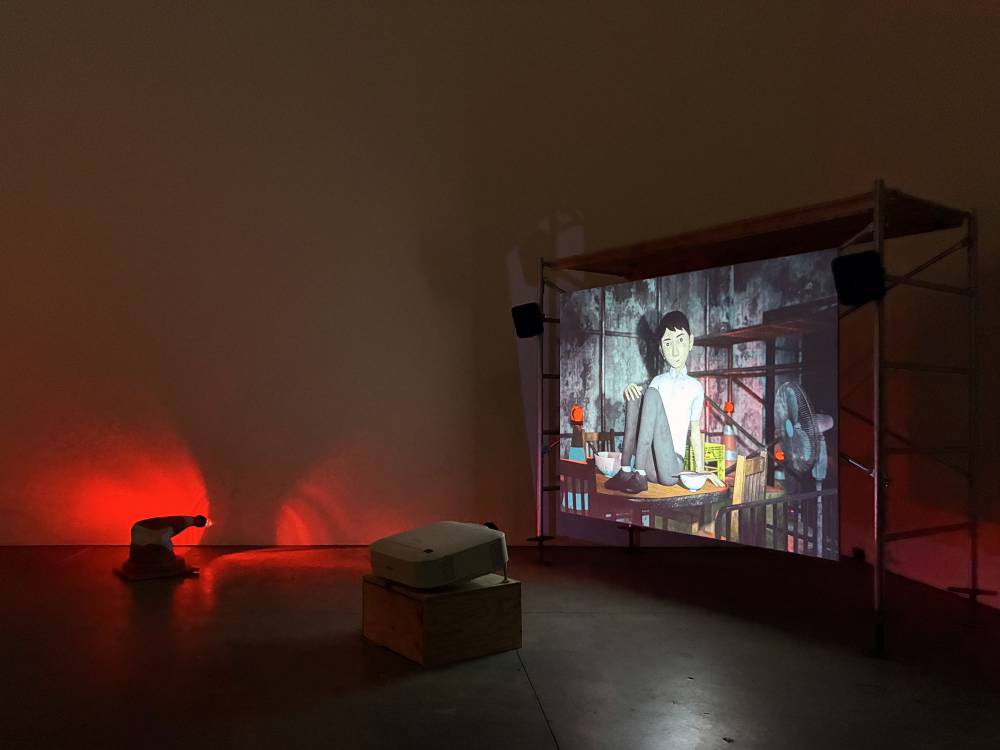
My first encounter with Poyen Wang's Night Stroll was in Greater New York 2026 at MoMA PS1, where I was instantly seduced and disturbed by its uncanny protagonist: an expressionless cartoon boy with bloodstains on his hands, lying upside down on a staircase with awkwardly twisted torso. This animated puppet looks directly into my eyes, flirting with and threatening me at the same time, reminding me of Kirsten Lepore's Hi Stranger that went viral on YouTube several years ago.
In Night Stroll, an anonymous adolescent with sealed lips, eerie gestures, and an ever-changing voice inhabits a dimly lit domestic environment inspired by Wang's memories of his childhood home in Taiwan and construction sites found across New York City.
Wednesday, March 11, 2026
|
Gladys Lou
At a moment when many artists and arts workers feel increasingly distant from the institutions that shape their professional and cultural lives—and determine their income—questions about institutional leadership and operations have taken on new urgency, especially in light of ongoing controversies around donors and financial transparency.
Institutions are sites of power and control, but also of possibility. They shape our understanding of art through the exhibitions they present and the structures they create. For many people, a public art museum is their first encounter with art and what they see there often defines what they think art is. Curator, writer, and researcher Kate Wong brings this question into the local context: why do arts institutions feel so disconnected from artists, arts workers, and communities in Toronto? This line of inquiry forms the basis of SITE Toronto, a newly formed not-for-profit that positions itself as a new kind of institution for contemporary art.
Wong’s approach to shaping SITE Toronto is informed by an awareness of what the word “institution” means: how it affects people, and how institutions, in turn, shape society alongside the communities they serve.
Wednesday, November 19, 2025
|
Gladys Lou
Hundreds of phones, tablets, and video projections flash in dissonance. Water cascades over touchscreens, tapping, swiping, and scrolling through websites and apps. This endless flow of information animates the hypnotic whiplash of Yehwan Song’s multimedia installations. A Korean-born, New York-based web artist with a background in UX/UI design, Song stages dystopian fantasies of the digital world that subvert the notion of “user-friendly.” Saturating screens with fragmented images of her own body, Song leans into glitch aesthetics (or glitches), seeking out the loopholes and flaws that most interfaces work to conceal. Through immersive installation and interactive performances, Song hacks the design logic of machines, tinkering with her websites, videos, and sculptures to expose the hidden infrastructures of digital systems.
While Donna Haraway’s Cyborg Manifesto (1985) imagines a fluid entanglement of human and machine, and Legacy Russell’s Glitch Feminism (2020) considers error and disruption as acts of resistance, Song mobilizes these ideas in the everyday mechanics of the internet.