A journal for storytelling, arguments, and discovery through tangential conversations.
Thursday, April 2, 2026
|
Abby Maxwell
“I wanted the dangerous love built on long-distance plane rides, trauma, and failed girlhood,” the unnamed narrator of Grace Byron’s Herculine confesses, walking quietly along the narrow river that runs through a patch of land in rural Indiana inhabited by 15 or 20 trans girls, inhabited, in turn, by their 15 or 20 corresponding demons. 700 miles from New York with a broken-down Honda Civic and spotty cell service, she weighs the risks of remaining long enough to trial the return to her first love, her ex-girlfriend Ash. The most notable risk is that of demon possession, which would tether her eternally to Ash’s trans separatist demon cult. “Choosing T4T was just choosing one kind of hurt over another. It’s no more valiant. It’s a survival tactic.”
Amid the onslaught of both the U.S. administration’s executive orders and Canadian provincial and federal bills directly attacking trans existence across the continent, anti-trans rhetoric has moved from the fringe into the core of right-wing political agendas and proliferates in mainstream culture. When it was released by Saga Press last October, Herculine arrived into a world infected with severe anti-trans hostility––a not uncomplicated moment for a novel populated by demonic trans girls and themes like in-fighting, identity politics, conversion therapy, and convoluted spiritualities.
Monday, March 2, 2026
|
Abby Maxwell
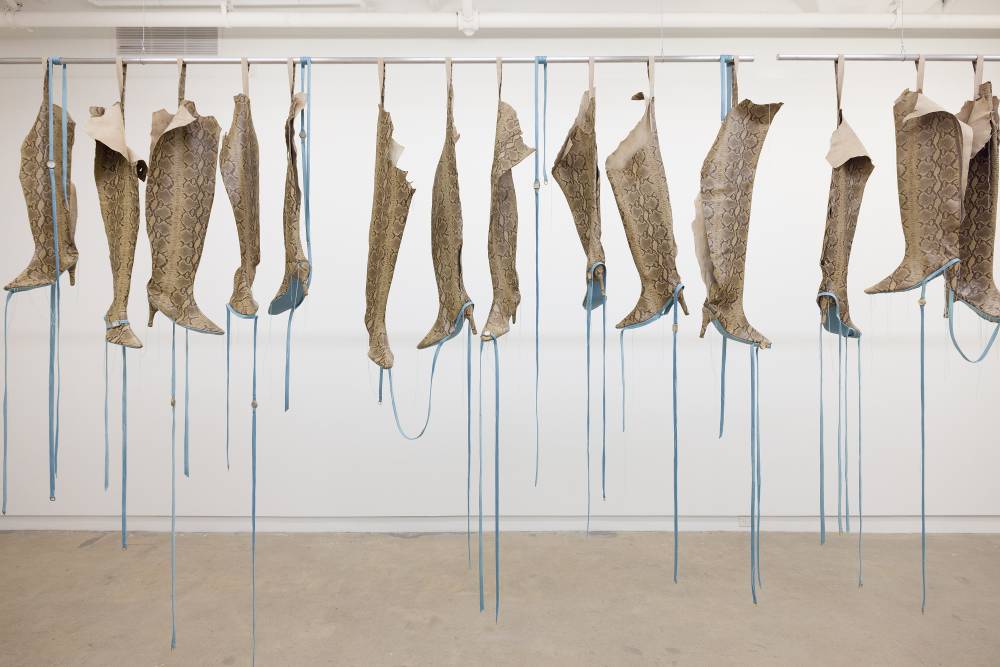
Three boots hang from the pole that greets me; something of an archway, a threshold to sidle and cross before the room comes into view. Two more poles partition the space of Split Hairs to suspend Kyle Alden Martens’ boot-sculptures––the lines of gaping bodies in an abattoir or the draped garments of a walk-in wardrobe, everything hangs in the air like open secrets.
To my left, boots of deep purple leather drip with scissors and loose threads, punctuated by three jackets sewn shut. To my right, a line of snakeskin boots with turquoise soles and dangling watches. The matter of handicraft—thimbles, scissors, thread—is taken up as adornment, but produces instead a set of signs that point to the hands (the past hands that handled the work) as the sculptures themselves point to the feet (the invocation of future feet). Time spreads out as the hanging beings encircle me, winding and unwinding on their poles, drawing little loops in air, and I am urged to go around again, to make some sense of their arrangement.
Monday, December 29, 2025
|
Abby Maxwell
The secret’s out: Canadians are feeling bad—and there’s something we all have in common. If the past few years have felt like watching this country wither and die, 2025 was lived from inside of Canada’s lifeless body.
From within the carcass of Canada and beyond, we are witnessing the collapse of colonial states—extraction projects that rely absolutely on racialized violence and ecological fallacy. Canada in 2025’s dusk is an open pit; its bones are exposed. Its skin is rotting. The nation is fantasy. What is true is this: when things fall apart, we begin to see what they are made of.

Monday, August 18, 2025
|
Abby Maxwell
It all started when I was chipping frozen milk flecks with the wrong end of the spoon into my coffee at the cabin. I left the carton outside overnight, resting in a snowbank. The cold had lured us out of bed before dawn to huddle around the wood stove. It was the morning after we harvested the rabbit from a snare fixed to a spruce branch—now a friend sat with her, dissecting her body into parts, her blood pooling onto the cardboard splayed out on the cold floor.
The icy milk chips thawed upon impact with the coffee, failing to incorporate and, instead, floating as a speckled mass of oily whiteness. It produced a reaction in the others—the visceral sort; disgust, like my own flinching, looking into the hare’s jet-black eyes or watching this friend’s hands peeling her fur off in one distorted piece. Two snow-white forms, in from the cold, on their way to feeding us.