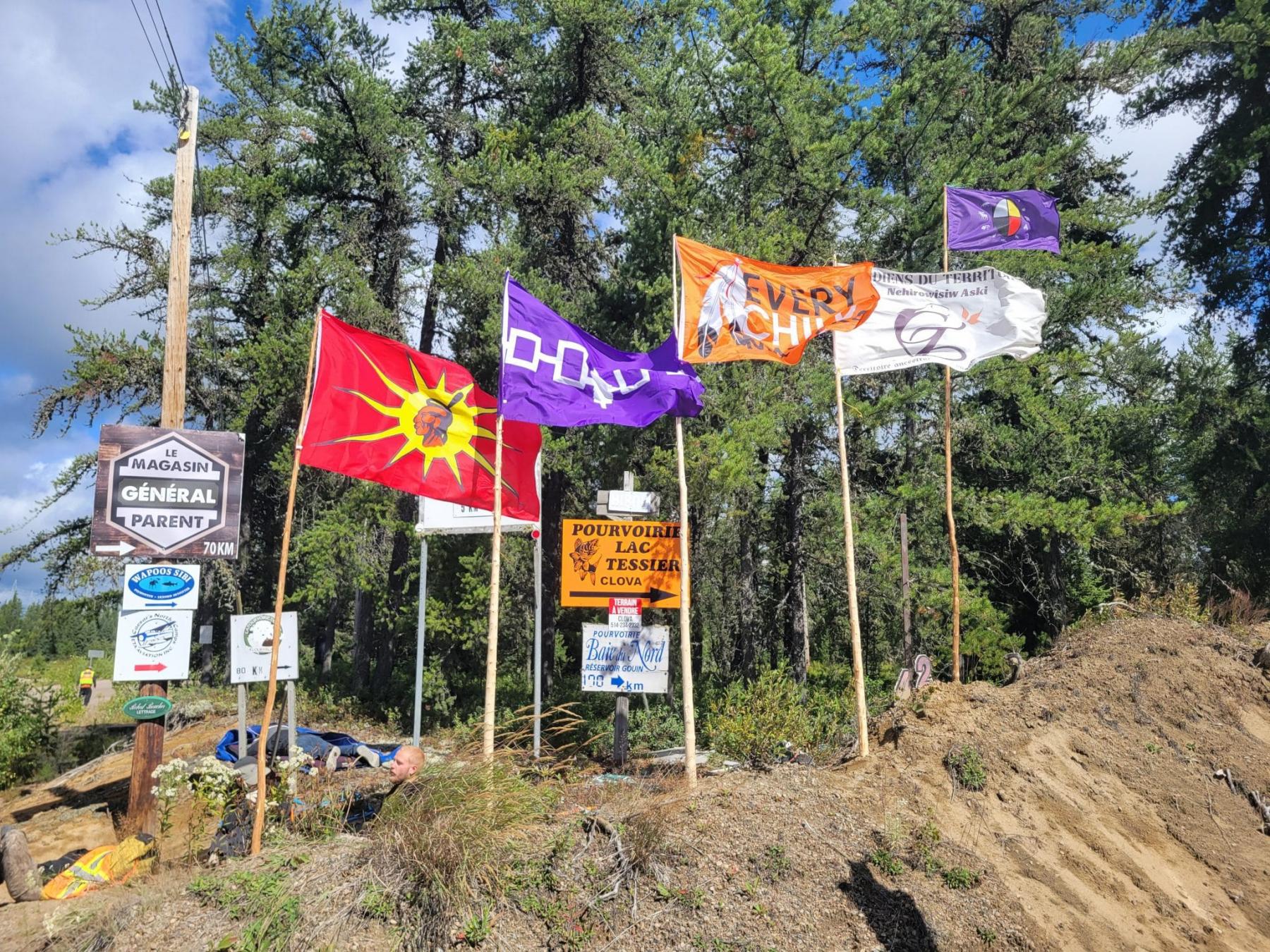
Flags erected by Nehirowisiw (Atikamekw) land defenders at km 106 of Chemin de Parent, a logging road in Quebec. Photo by Emma Bainbridge. Sourced via.
The secret’s out: Canadians are feeling bad—and there’s something we all have in common. If the past few years have felt like watching this country wither and die, 2025 was lived from inside of Canada’s lifeless body.
From within the carcass of Canada and beyond, we are witnessing the collapse of colonial states—extraction projects that rely absolutely on racialized violence and ecological fallacy. Canada in 2025’s dusk is an open pit; its bones are exposed. Its skin is rotting. The nation is fantasy. What is true is this: when things fall apart, we begin to see what they are made of.
On the official register, the ‘we’ of Canada is one that has its elbows up—this ‘we’ is an economic relation that suggests something like a people, something like a culture. But this ‘we’ crafts nothing other than legitimacy for the violence of a nation reproducing itself.
Early on in the year, the president of the United States transmitted certain threats over Truth Social: Canada will become his 51st state. Media frenzied: the so-called tariff war snowballed into the risk of actual annexation. His comments were broadcast nationwide, regurgitive, reverberant, in a blaring loop. Anything else going on in the country was buried deep beneath the heaps of that rhetoric, propelling the viral spread of an online patriotic battle cry: elbows up!
The hashtag-politic succinctly contained the paranoia of our dominant national voice—one buoyed by the common, if vague, cultures of anti-Americanism and hockey. With the federal election’s quick approach, national conversations honed in on a single question: who will defend Canada from Trump? The polls clearly favoured Pierre Polievre when the alternative had been the limp, wispy husk of Justin Trudeau and his cabinet in peril. But then, Mark Carney was chosen as the new leader of the Liberals. Unlike Polievre and his pro-Trump, populist tone, Carney was able to read the room, appealing to a centre under supposed existential threat. If elbows up was a question, the Liberals responded with the now-ubiquitous phrase, and the center of the new PM’s platform, the nation-building project.
The nation-building project requires as its foundation a generalized patriotism, deriving from the potent, if false, nostalgia for some bygone, benevolent state and the promise of social democracy. Carney’s plan relies on a liberal base attached to this sentimental image of Canada as a force of progress, civility, and unification. Bound to the urgent project of its preservation, one is made to disassociate with the damned tale of the nation’s past, the harsh, and worsening, conditions of the present, and the retracted promise of the future.
Fantasy is all that sustains such attachments. Fantasy amalgamates story and feeling, infecting the memory of both past and present, and sustaining one’s desire to be within a relation regardless of its content. As Lauren Berlant argues in Cruel Optimism, an object of desire is really “a cluster of promises we want someone or something to make to us and make possible for us.” Thus, one’s attachment to an object is always optimistic and, for Berlant, becomes cruel when such promises are revealed as false or impossible. Despite the brutal content of such a relation, its structure contains “a sustaining inclination to return to the scene of fantasy that enables you to expect that this time, nearness to this thing will help you or a world to become different in just the right way.” And, in remaining attached, you are cordoned off from exploring other formations. The object of desire becomes “an obstacle to your flourishing,” veiling the experience of reality and blocking access to other modes of relation. The nation, then, is a cluster of unkept promises, and a cluster of people unable to imagine their way out—towards other possible structures for collective life.
Trump’s threat set the scene for a theatrics of primal Canadian feeling: we are not you, we are not you, we are our own thing, we are our own thing. In its mythos, Canada is produced against the United States—our alleged Other, our shadowy figure, that big bad not us that enables an us to cohere. Our greedy, aggressive neighbour to the South is everything Canada defines itself against, thus alleging a set of “Canadian values” that construct our “self-image of sweet reasonableness and sensible compromise…[which is] almost the exact opposite of what the historical evidence of this country discloses.”
So, desperate to preserve this beloved, if cruel, national object from its encroaching Other, Canadians elected a banker to take the helm. The racial capitalist logic of Carney’s crisis plan— essentially, building Canada into an economic superpower—fits neatly into this year of ongoing, full-fledged Canadian support and propagandizing for US-Israeli genocide in Palestine; multivalent attacks on migrant rights, trans rights, and unions; escalated counterinsurgency; further violations of Indigenous sovereignty; police murders; the poisoned drug crisis, intensified climate disaster; decaying public infrastructure, and on and on.
The nation-building project—meaning escalated austerity, an exorbitant defence and security budget, and a roster of zombified extraction projects—is made possible by the narrative that elbows up invokes. We are under attack and, thus, our self-defence is just, even if our self-defence happens to target everyone but the president of the United States. As the narrative spins policy, the actual Others haunting the colonial operation called Canada are revealed, one by one. The nation-building project functions to further dispossess and immobilize Indigenous people, racialized people, migrants, and the working class—while also constructing them as scapegoats. The nation is a set of stories that “mythologize and justify the brutalities…they are as necessary as the violence.”1
As liberal Canada makes clear, the difference between liberalism and fascism is rhetorical. For any nation, deploying liberalism functions as a strategy of preservation via the absorption of the language and ideas coming from the grassroots. Thus, liberalism underwrites fascism, not only paving its way but sharing its goals: “to shore up capitalism, maintain class and surplus, and keep the markets afloat.”2
Egyptian-Canadian writer Omar El Akkad’s One Day, Everyone Will Have Always Been Against This, which came out in February, is “a breakup letter with the West and its dream of itself and for itself.” El Akkad exposes the West’s weaponized language as fostering the ongoing genocide against Palestinians by Israel. Throughout, he trespasses the soft edges of a liberal rhetoric serving to protect its own middle:
“Because it is the middle of the empire that must look upon this and say: Yes, this is tragic, but necessary, because the alternative is barbarism. The alternative to the countless killed and maimed and orphaned and left without home without school without hospital and the screaming from under the rubble and the corpses disposed of by vultures and dogs and the days-old babies left to scream and starve, is barbarism.”
The coloniality of language is also plumbed throughout Salvage: Readings from the Wreck, the newest nonfiction work by Trinidadian-Canadian poet and author Dionne Brand. As she assesses the English literary canon, Brand uncovers the insidious modes by which language and narrative produce being and, in turn, nonbeing; simultaneously constructing a subject and the subject’s outside. Thus, for Brand, any dominant construction of a ‘we’ is suspect: ‘we’ “is an administrative category; it is a gathering place of colonial/imperialist desires, and an apparatus for their workings…‘we’ binds the affective, the convivial sense of being in the world with other people to relations of ruling.”
On the official register, the ‘we’ of Canada is one that has its elbows up—this ‘we’ is an economic relation that suggests something like a people, something like a culture. But this ‘we’ crafts nothing other than legitimacy for the violence of a nation reproducing itself.
The new anthology Elbows Up! Canadian Voices of Resilience and Resistance constructs another false ‘we,’ as it provides further legitimacy to liberal Canada’s claim to sovereignty and its requisite victim narrative, diluting the very notion of resistance. “People are angry and standing together with renewed shared purpose,” the back cover blurb reads—“there appears to be a new sense of a ‘we’ emerging.” As contributor Niigaan Sinclair writes, optimistically—which one might take, instead, as a warning—“when we are Canadian, Canada grows.”
Some revolts uncoil slowly, rotting out the very core of a nation—the fiction of itself that it tells and retells, just as it draws and redraws its border.
The story of Canada was always shaky, and has always been disputed, refused, and resisted. But in 2025, in empire’s gut and hell’s basement, the illusion is a wreck of shards. A growing coalition, a world of its own, gathers around the knowledge that yes, its promise is false, yes, what actually feeds and clothes us are tendrils of the social that grow through the cracks of this country, in spite of it. As liberal Canada attempts its operation—crafting a nation in the shape of a war jet or a pipeline—the disenchanted ask ourselves: what else, how else? El Akkad writes: “Something has ended here. But something else begins. The dead dig wells in the living.”
Something has ended, but the chorus of artists, thinkers, and organizers making in spite of Canada only grows. Rejecting the project of Canada, and all its nationalist grammars of preservation and expansion, a critical assemblage of work that targets and undoes national fantasies has proliferated this year—something else begins.
The nation-building project is made suspect in Matthew Rankin’s surrealist film Universal Language, which blends Iranian new wave and Quebecois cinema with Winnipeg architectures and prairie landscapes. When it premiered in Winnipeg in late-January, the film was unexpected. An amalgam of aesthetic and linguistic worlds that both plays on and overwrites the nation’s imagined, enclosed self, Universal Language provokes in its audiences uncanny attachments and resonances. Its enthusiastic reception lays bare the existing hunger for such a form; the desire within and outside of Canada for representations of a real, shared field of living that refuses state interpellations.
As Universal Language exceeds the boundaries that emplot filmic cultures, other kinds of borderlines lose their heft. The national border is “something we have imagined. It's a calculation we have made.” One can imagine something else. In crafting a coalitional aesthetics against the nation, Universal Language produces a new narrative field that resonates widely.
In dialogue with both El Akkad and Brand, Nishnaabeg scholar and musician Leanne Betasamosake Simpson’s newest book Theory of Water: Nishnaabe Maps to the Times Ahead sharply refuses the shape of Canada. But, rather than looking past this world to map something new or better, Simpson follows Nibi/water—that “fugitive that erodes and escapes containment”—in order to articulate a liberatory theory of its anarchic movements. Theory of Water lays bare a deep, perhaps militant, practice of coalition-building across species and land formations; “an emergent theory of internationalism.” Always in resistance to a system seeking to buy, sell, speculate, arbitrate, drain, divert, dam, and contaminate it, Nibi/water is uncontainable, “raining down a quest for renewal, cycling through time and across every border.”
As Simpson writes, “Nibi is speaking through action, critiquing by making an alternative. Nibi’s theory, the theory of water, is a scathing indictment of every part of the death machine that has led to this present moment.”
Beyond the ‘we’ and its adherence to an ideal, national unity, there exists a convivial field of this place. It can be found in glimpses, at sites of collective resistance to Canada and the nation-building project. Undeterred by brutal state repression, this year has also seen potent blossoms of uprising across the country in the form of blockading, striking, and rioting. Whether it is behind the barricades at the ongoing industry blockades on Nehirowisiw Aski, Wet’suwet’en territory, or at Ada’itsx/Fairy Creek; at the anti-war blockades at port terminals and arms trade conferences; on picketlines at mass student strikes for Palestine or general strikes for labour rights; or amid the crowds at anti-pinkwashing demos or vigils for victims of murderous cops, many shapes of coalition live and grow here.
These moments are transformative: real power swells in all these sites of collective risk-taking. And, not every form of resistance can be a flood—“some revolts are incremental, eroding, melting, freezing, seeping, leaking.” Some revolts uncoil slowly, rotting out the very core of a nation—the fiction of itself that it tells and retells, just as it draws and redraws its border.