.jpg)
Exhibition view Michaëlle Sergile, And Then, Perhaps, a Memory, VOX, 2026. Photo by Michael Patten, courtesy of VOX and the artist.
Michaëlle Sergile is, at her core, an artist who thinks through materials. Her artistic practice moves between textile weaving, video archival research, wood constructions, and sound as a way of insisting that no single medium is able to hold the complexity of the things she aims to explore: history, migration and the many ways in which memories are shaped and constructed.
Sergile approaches her work with a particular interest in historical storytelling: how stories are formed, transmitted, and sometimes erased. Initially having studied psychology and sociology before turning to visual arts, she uses that foundation as a thread through her practice. Drawing from institutional archives from Canada and Haiti as well as personal VHS footage from her family, she constructs layered environments where intimate memory and official documented history coexist as parallel truths.
In her exhibition at the McCord Museum “To All Unnamed Women” she shines a light on the story of the women from the Montréal Coloured Women’s Club through a series of original tapestries on Jacquard looms. With a blend of archival research and fictional storytelling, the exhibition traces the beginnings of the first organization in Québec created by Black women, exploring the relationship between available documented history and archival violence.
Presented at VOX Contemporary Image Centre in Montréal, her most recent exhibition “And then, perhaps, a Memory” explores matters of displacement, migration and family by focusing on the commonalities and differences in the stories of 3 different Haitian women. The centerpiece of the exhibition, her largest woven piece to date, can be seen as a permeable wall—composed of interlaced photographs, shifting landscapes and fragments of text—it acts as both architecture and image. Through this work, the lives of three Haitian women who migrated to Montreal and New York are traced, showing how memory can settle unevenly across time and geographies. In the exhibition, complex wooden structures in interaction with her woven tapestries are also featured, reminding the audience of domestic facades reminiscent of Haiti and other parts of the world.
Whether in her video or woven work, a recurring technique is that of the glitch—characterized by visual distortions that abruptly interrupt images and video footage. For Sergile, the glitch is more a refusal to tell smooth historical narratives than it is an error. Time is not linear, and past, present, and future all bleed into one another. The presence of faceless and silhouetted figures in much of her work further complicates visibility by protecting personal and private histories while inviting her audience to easily project themselves into her work.
In the following conversation, we discuss the inspiration behind her latest exhibition, the evolution of her practice as well as her ongoing attempt to redefine what an archive can become.
When you move somewhere new, you don’t arrive empty. You carry a history with you. Your values, your memories, your ways of seeing the world are already formed, they’re part of your foundation. [...] There’s always that quiet tension between what you carry and what you’re becoming.
I first came to know you and your work as a curator a few years ago. I was wondering if you could talk about your entry into the art world and what initially motivated your desire to create rather than just curate.
I actually began as an artist before I ever thought of myself as a curator. And before that, I studied psychology and sociology. For a long time I thought I would become a psychologist. I enjoyed my studies and I was genuinely interested in them, but at some point I realized that it wasn’t quite right for me. I started considering art therapy, and that’s when art shifted to becoming something interesting for me.
After finishing my studies in psychology and sociology, I enrolled in a bachelor’s program in visual arts and once I started, I couldn’t stop. I felt an immediate connection and something finally clicked for me. I wasn’t thinking about grades or outcomes as I was completely absorbed in the process and I would stay in school at the strangest hours just to keep working. It felt less like an academic path and more like a necessary connection to myself.
Curation came about two years into my bachelor’s, through a conversation with Diane Gistal. I realized I wanted to work with artists rather than solely as an artist. Creating can sometimes feel isolating, you’re often alone with your ideas and not necessarily encouraged to think collectively. I began to crave that sense of exchange. More specifically, I wanted connection with other Black artists, Black cultural workers, Black thinkers. During my psychology studies, I gravitated toward figures like Frantz Fanon and sought out voices rooted in Black intellectual traditions. But when I entered art school, I felt an unexpected loneliness. The references, the histories, the frameworks we studied didn’t reflect what I was living or thinking through.
That meeting pushed me toward collaboration. It opened up the possibility of thinking beyond my own artistic practice. Instead of developing ideas alone in the studio, I could approach them collectively through writing, reading, theorizing, and building discourse with others who might be wrestling with similar questions. Curation became a way to gather people around shared concerns, to create space for dialogue instead of working in isolation.
When you started art school, what was the focus of your practice and what drew you to textile and weaving? How did that medium become central to your practice now?
When I first started studying in visual arts, I was just trying to figure out what my medium was. I actually had a background in sculpture before even thinking about textile. I was doing full human bodies, sculptures and installations where I would reproduce faces and body parts. It was completely the opposite of what I'm doing now, but I knew I was really interested in working with my hands and finding ways to create something that is not necessarily on the wall, but that can occupy a space. Later on, when I tried to connect my previous studies in psychology and sociology to visual arts—that’s when I started to think about weaving. I was obsessed with Frantz Fanon and Édouard Said, and I wanted to find a way to create a piece that talks about post-colonial studies or cultural studies. I focused on a book called Black Skin, White Mask by Frantz Fanon and I wrote the book in inclusive language, but I realized that writing was not necessarily what I wanted to do.
I love a lot of artists that work with writing as a concept, but I felt like I needed something more. Since my background was in sculpture, I needed something that was physical, that was in the space, and while I was talking with a few other students and one of my teachers, we realized how often we use the word “métissage,” which in French means the mixture of cultures, but within the word “métissage,” the way it's written, is the word “tissage,” which is weaving in English. I found it really interesting that this word that we use so often when we talk about cultural identity was also linked to a medium that I had no idea how to work with. We even thought about social fabric, we thought about how when threads can cross each other, there's an intersection, and I thought about intersectionality as well. So there were a lot of concepts that were already in this idea of rewriting a book with inclusive language that I could push a bit more with weaving. I asked a friend one night to show me how to weave on the corner of a table, she did and that's how I started. I had no background, I had no one to really teach me at a professional level, I just really watched a lot of tutorials on YouTube at night and tried to figure out how it worked, and it actually ended up working really well.
When you're looking at a weaving, or when you're looking at your clothes for instance, you can always see vertical and horizontal threads. The way I see it, the horizontal threads kind of remind me of sentences, or the act of reading something, so I tried to replicate this way of thinking with this book. With Black skin, White mask I took each sentence of the book as a thread in the weavings and I decided to weave the book on itself, and it became a really big installation where each panel of weaving in the installation was actually one chapter in the book. It was my first attempt at working with weaving, and I think it worked pretty well. I was able to do something that I was struggling to do for years, which was to merge the studies that I did in psychology with this new avenue of mine, which was visual arts.
Throughout your work there's a strong and recurring presence of archives and historical documentation particularly Haitian historical documentation, whether it's the Diaspora or from the country itself. I was wondering if you could speak about what draws you to archival material and what you hope to pull out of them.
I really like archives in general. I think it's been in my family for a really long time—both of my parents kept a lot of archives. I don't think they did it for any particular reason other than just loving their family and wanting to crystallize moments. And for me, I think it’s something similar. When we're reading books or studying any country's history, we're always going back in time. We're always going into the past to better understand the present or even the future. And I feel like it's the same with art.
I think having the possibility to work with archival images gives me access to someone's life or someone's narrative. I'm more focused on women—even though I did work on men like James Baldwin and other artists and writers—and I really like the idea of going back in time and exploring the stories of women that have not really been highlighted in history.
It’s what happened with the exhibition I did at the McCord Museum about the Coloured Women’s Club. I kept asking if they had archives on Black communities in Montreal, on how people decided to stay here or if they even had anything about the history of the porters because it is a big thing in the history of Canada. I had little information and they really tried to help me as much as they could. But I realized that this lack of information was actually the work, and finding ways to talk about women that were active during that time but that we have so little information about was what was important. I think that's also the power of archives: the power of thinking about something that might have happened and that can explain what we're living through today.
Finding people and families that might recognize some photographs that I found in the archives at the museum was also something that I was really interested in because especially for the stories of Black communities, depending on where you are growing up, it can be difficult. It can be a story of someone that has barely any archive because it was, for example, a white family that had access to everything and that donated the archives to an institution. It's interesting to see how history develops itself, but we need to have access to it and we need to be able to have conversations about the fact that we sometimes lack the information we need to be able to understand what is missing and find how we can get it back.
Your textile and weaving works are often in conversation with wooden installations. That to me, makes me think about domestic architecture and houses, especially the one in your exhibition at VOX. How do you conceive this dialogue between the two mediums? And, what are the narratives you're hoping to convey through their interactions?
I think everything for an artist is trial and error—just trying something and then seeing if it works or not. At first, I was working with metal, I thought metal and textile could be interesting. But in the end, I didn't like how the metal was so cold and it felt so disconnected to me. When I started working with wood, there was a warmth in working with that material. You can smell it and touch it and feel how soft it becomes when you're working with it. I also liked how when you're looking really close at a wood panel you can see all the grain of the wood. To me, it kind of mimics water, but also textiles, lines and threads. It felt just natural to keep pushing with that medium. And to be fully honest, I started working with a woodshop where I would design everything, and then just order it and a team would work on it. But that was only for one or two of my projects. Since I started my residency at the Darling Foundry, I figured that I might as well just push the practice and see how I can extend the way I work with wood since they have a woodshop. I started working more in their woodshop and instead of seeing wood as just a support for the weavings, and it started to become something that is more installation, like a piece of art in itself. It's not just something that holds the piece, but is also part of the piece. I really liked how when you look around Quebec, Montreal, Canada, and actually different countries like Sénégal even, there's a lot of connections that you can see in terms of architecture that remind you of home. For me, the impossibility, at least for now, of going back home always has meant that I felt like I needed something to connect with it a bit more. And seeing all the structures when I was in Senegal, or seeing them here, those were the little things that reminded me of Haiti. I wanted to push that a bit more with wood and see how I could work with a piece that would feel like a connection to home to any person that would see the work.
.jpg)
Exhibition view Michaëlle Sergile, And Then, Perhaps, a Memory, VOX, 2026. Photo by Michael Patten, courtesy of VOX and the artist.
.jpg)
Michaëlle Sergile, And Then, Perhaps, a Memory (detail), VOX, 2026. Photo by Michael Patten, courtesy of VOX and the artist.
.jpg)
Exhibition view Michaëlle Sergile, And Then, Perhaps, a Memory, VOX, 2026. Photo by Michael Patten, courtesy of VOX and the artist.
When we enter the exhibition at VOX, we immediately see the very large woven piece. In it we see multiple images, we even see photographs of some places in Haiti and even bits of text. I was wondering if you could talk about that piece and how it was composed as well as what guided you to select the different parts of it.
It is my biggest woven piece so far. I was really stubborn about it. With the way you weave on a loom, when you're weaving something it folds on itself so you can't really see the final result. The way I wove it, I didn't want to stop at all. So I kept just working on the side exactly where I was so that I could continue on another image and then switch. My idea was to force myself to not have full control because I love control. I love to manage everything and control everything. When you're weaving, especially when you can't see the extent of what you’ve done so far, you have to just let go. It was a nice little challenge for me to force myself to just take a leap of faith and just believe in the process and believe that it would somehow look like something that I wanted it to.
The whole idea was also to think about glitches and to think about different perspectives at the same time. The point is to speak about the lives of three specific women that were talking about their experiences and how they grew up in Haiti—the beautiful things that they saw in Haiti, but also the things that were a bit more difficult. I didn't want to have something that was too analytic, I wanted to have something that felt like you wake up one day and experience something and then the next morning you have another experience about something else—your day might be great or awful—and I feel like that's kind of the idea also to think about drastically switching between different perspectives. It's always nuanced and I wanted to experience that in the weaving as well while challenging myself to stop controlling everything. So this is part of the idea of changing images constantly and having, for example, one image that’s water and then plants and then fire and then writing and then it keeps switching.
My goal was just to be able to have a piece that would create a wall or a separation in the space and that had actually no wooden section or wooden support that would just hold on itself. I wanted to create something that felt like it was floating with the histories of these three women.
The first section is all woven with a jacquard loom which allows me to create weavings that are really close to photographic images but that always have a grain or a pixelized aspect to them. I pushed it as something that reminded me of a glitch. The section on the bottom is all woven with a traditional loom that’s called a jack loom. I did some plain weaving, which is using even and uneven threads that are crossing each other. I did some screen printing on top of it. I really enjoyed the difference between the two techniques because although it's very physical and it's a lot of movement, you can mix more contemporary techniques with traditional techniques. It felt like the first section is really focused on Haiti and the second section I wanted to dedicate to the places the three women migrated after leaving Haiti. And for two of them it was Montreal while for the other it was New York. The images that are on the bottom section are all images from the places they migrated.
I also liked the fact that with screen printing, when you're printing on a fabric or even any surface, it never allows you to go that deep. You won't necessarily go on the other side of the fabric or the other side of the paper. The decision to use screen printing, and the fact that the image doesn’t transfer to the other side, mirrors the experience of displacement. When you move somewhere new, you don’t arrive empty. You carry a history with you. Your values, your memories, your ways of seeing the world are already formed, they’re part of your foundation. You participate in this new country. You contribute to it. You help build and shape it. But at the same time, you remain rooted elsewhere. Those roots don’t disappear simply because you’ve crossed a border, they continue to inform who you are. And yet, this new life, even though it becomes part of you, never quite holds the same depth as the place you come from. It grows, it evolves, but it doesn’t replace the origin. There’s always that quiet tension between what you carry and what you’re becoming.
Your practice often incorporates videos, how do you think about the relationship between textile videos and wooden installation and them existing in the same space?
I don’t see these mediums as doing the same work, and that difference is precisely why I like bringing them together. A static image doesn’t operate in the same way as a moving one. With video, you can shift perspective instantly: you can zoom in, pull back and move through time. There’s a sense of something unfolding, and then disappearing. A textile or a wooden structure, on the other hand, remains. You can approach it, step away, return to it, but it holds its ground.
Sound also adds another layer. A melody can stay with you in a way that an image sometimes doesn’t. Even when a video is silent, it carries a different emotional weight than a still object. That’s part of why I wanted to collaborate with classical composer David Bontemps for this exhibition. I was interested in imagining the sound of the show: what does grief sound like? What does it mean to leave a country, not because you want to, but because you have to, and then no longer have access to it? When I think about Haiti, for example, and the buildings that have been burned, places that carried history and meaning, there’s a sense of loss that can be captured visually. But there’s also something about sound and about music that expresses what can’t be fixed in a single frame. Sound slips away but it lingers in the mind. It’s intangible, but it’s persistent.
Each medium creates a different kind of encounter. When they coexist, they produce something new: an experience that moves between the physical and the ephemeral. And I’m perfectly content if someone leaves the exhibition and the only thing that stays with them is the melody. That melody might later bring back a fragment of the textile, a moment from the video, a detail from the installation. You never really know what will remain with someone. For me personally, sound often stays the longest. It helps me process and retain what I’ve experienced. When something is tied to a melody, it tends to settle deeper in my memory.
In the screening room, there's what I interpreted as documentary archives related to Haiti alongside what appears to be political materials. How did you come up with these video installations, and how would you describe the relationship between these different registers of imagery?
I wanted to question how we come to understand a country’s history. Often, when we hear about a place especially in a political context, the narrative focuses almost exclusively on crisis, violence, or instability. Over time, that becomes the dominant image people carry. I’m not minimizing the very real and painful events that shape a country’s past. But even in the most difficult moments, life continues. There are still children, still families, still people trying to protect their small moments of joy.
Kids will always find a way to play. Families will always try to gather and to love each other. That coexistence felt important to me. In Haiti’s case, when we talk about the dictatorship, or the coup d’état, those histories are heavy and they mark us. They mark our collective memory. But at the same time, there was still beauty. There was still carnaval. There were still birthdays, music, and ordinary afternoons.
I was actually born during the coup d’état, and much of the footage comes from that period. My father was fascinated by new technologies, he filmed constantly. From 1987 to 2002, he recorded everything on VHS and when we left Haiti, he carried those tapes with him in heavy suitcases. Because my parents chose to preserve those archives, I now have access to these fragments of daily life.
Watching them gave me another understanding of that time. Yes, we left because the situation was intense—the political climate, the presence of the American army, all of that was very real. But the tapes also show my parents’ house, my uncle’s house, the architecture, the interiors, the way spaces were decorated. They show metal doors left open, birds flying in, sunlight moving through rooms. Growing up somewhere without snow, without the harshness of winter, there’s a different rhythm to life. That ease, that atmosphere, exists alongside the political turmoil.
Bringing together the protests, the political imagery, and the family archives is my way of exploring that complexity. A country is never only its crisis. There is always more than what headlines suggest. I wanted viewers to feel that tension and to understand that history contains both violence and tenderness, and that in order to truly see a place you have to be able to see both at once.
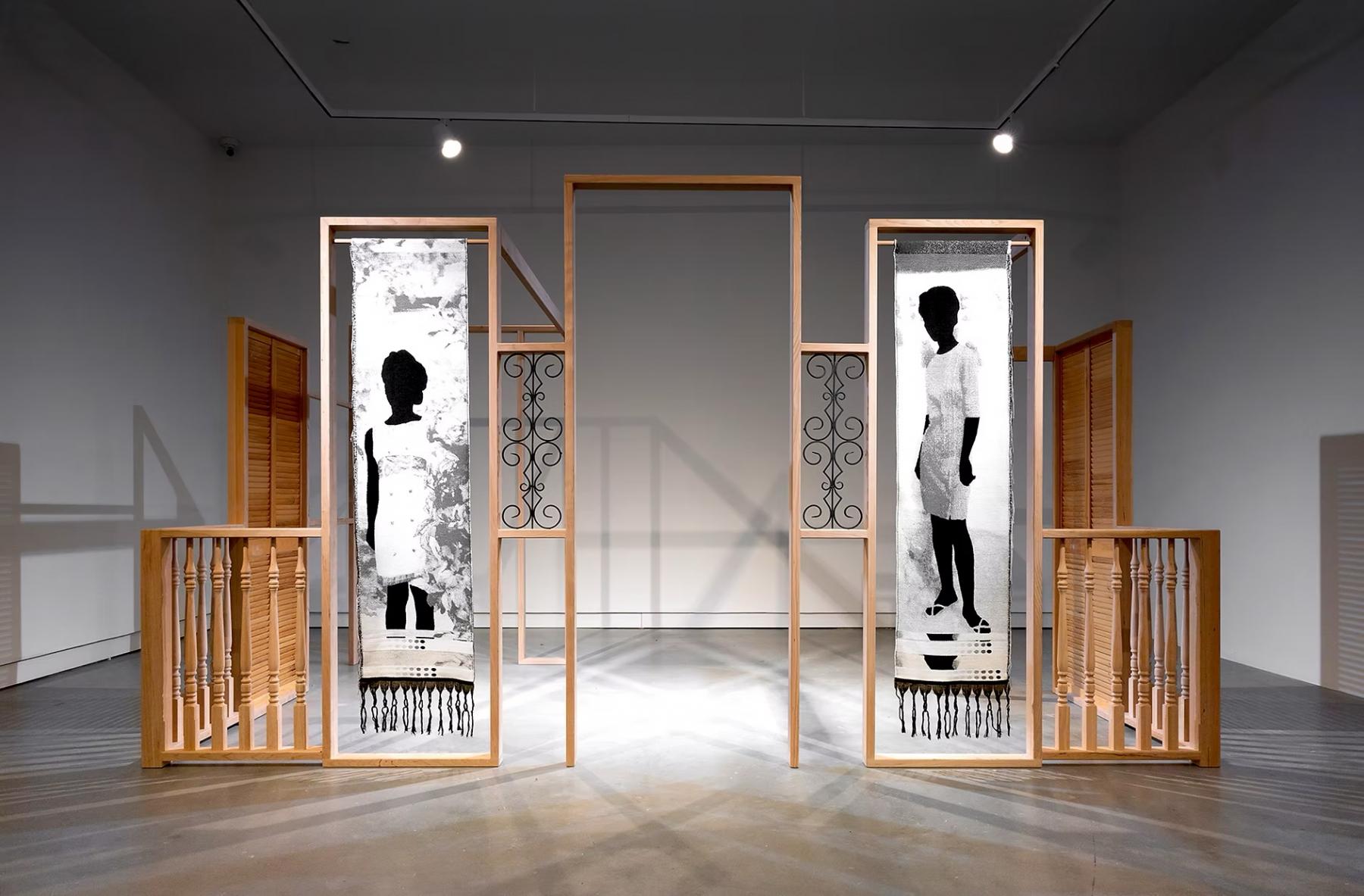
Exhibition view Michaëlle Sergile, And Then, Perhaps, a Memory, VOX, 2026. Photo by Michael Patten, courtesy of VOX and the artist.
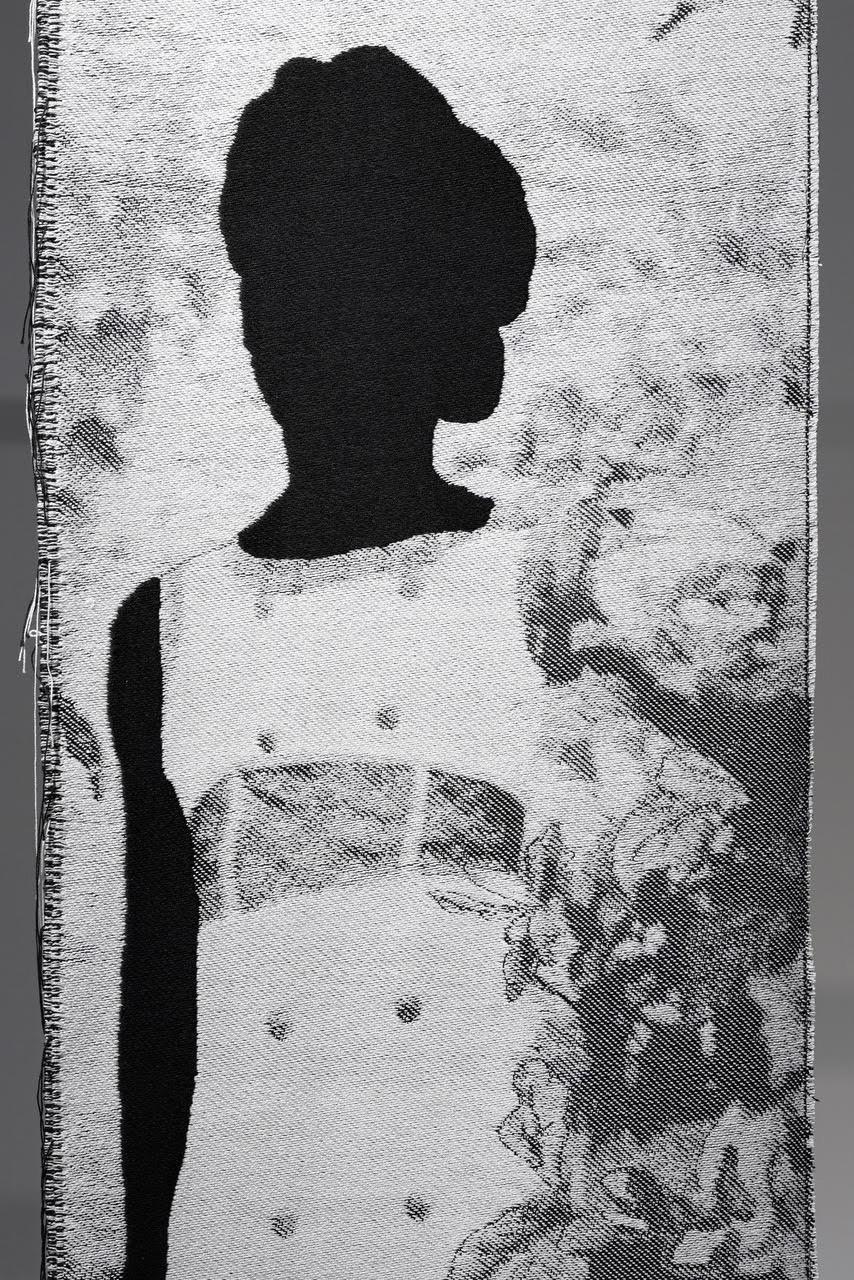
Michaëlle Sergile, And Then, Perhaps, a Memory, (detail) VOX, 2026. Photo by Michael Patten, courtesy of VOX and the artist.
Could you speak about your interest in exploration of the glitch? I was wondering what inspired you to include that in your work.
The first time I worked with glitch, it wasn't necessarily a concept, it was more of an aesthetic. I was working with archival material that kept glitching or that had an aspect that was already very grainy, which I loved for weaving because I thought it was a really nice thing to play with. That was my first attempt with a glitch. For the show at VOX, I wanted to push it a bit more and I started reading Glitch Feminism by Legacy Russell. Even though their approach is different from mine, I really wanted to have at least that ideology in my head.
For me, glitch is still something in development. I’m still figuring out what it means in my practice. But one thing that resonates deeply is how it unsettles linear time. We’re taught to understand life as past, present and future. Yet when you work with archives, those boundaries collapse. The past leaks into the present. The present reshapes the past. The future is already embedded in both. Glitch allows me to resist a straightforward narrative. It interrupts that smooth timeline. It lets you zoom in on fragments that might seem incoherent at first and moments that don’t immediately make sense. But when you step back, you realize those fragments are carrying something. They’re revealing how memory works and how history is constructed. In that way, glitch becomes a way of moving through time differently. It creates space for rupture, for overlap and for distortion. And sometimes it’s in those distortions that something truer about a person’s history can begin to surface.
Women are a central part of your work. I'm thinking of the Colored Women's Club, which I didn't even know about before I saw your show at the McCord Museum, but also the three women who anchor this current exhibition. How do you approach the historical and cultural contribution of women in your work essentially?
I think it just comes naturally. Every time we talk about a different moment in time, we talk a lot about men. And every time I'm thinking about the women. What about their wives or sisters or cousins? And even for Black history in Montreal, people talk a lot about porters, which were all men. The porters were very important in Black community's history in Montreal and Canada. They were the men that would work in the train stations and a lot of them were Black men coming from different places to work for the Canadian railroad. But we don’t really talk about the women in their lives. The porters have a legacy and a history that you're trying to understand, but then if you're focusing only on the men's history, you don’t see the full picture. The women contributed in some way. And that’s when I discovered the Colored Women's Club. Some of these women were, for example, their cousins or their wives and because their husbands were away working at the train stations, some of them decided to create a collective to help families that needed housing, financial help or even finding schools for their kids. They decided to create that little collective community together which became bigger and bigger overtime.
In many of your weavings, we don't really see the faces. They’re just silhouettes. So I was wondering what motivates that visual choice, and what does it allow you to express or not express?
I like having these black silhouettes as a possibility for people to see themselves in it as well. I started these images with family portraits and it was a way for me to keep something for myself and to not necessarily have my family photographs everywhere in the city or the country or anywhere else out in the world.
It was a way to, in one part, protect them, but also to allow other people to be able to see themselves in the same images. I think even though we might be from different countries, different cities, and different places we all have a similar idea of what a family photograph is. Having these black silhouettes gives access to someone's own interpretation of the portraits. And even though you can't see their faces, you can understand that these are certainly Black people.
I would purposely, for some of the weavings at least, choose to work with images with specific architecture or forestation so that viewers could understand that the people pictured are Black and living somewhere outside of Canada like the Caribbean for instance. Somewhere with warmth and without heavy winters. It was a way for me to just give a glimpse of who I am and who my family is, but without giving everything to the public so that they can also picture themselves in the images as well.
How do you see your work evolving in the future?
I definitely want to still work with all the mediums, like weaving, video and sound installation but I'm also questioning the way we see archives and how we define it. I think it's easy to think archives mean the past, but past can mean yesterday and past can also mean this morning. I’m trying to figure out how I can think about archives in a different way. And am I also a producer of archives myself? I’m trying to see if it could be something to push through: could it be that I'm also producing something?
I'm mixing something from the past and something that is very current, something that I created today as something that will eventually become an archive. I still need to figure out what it all means to me but I think especially now, I feel like there are a lot of artists really tackling archives and trying to find ways to define them. What I think is that I may need to push my definition of it a little bit more and I am really looking forward to doing that.
I’m also really interested in making clothing. And I don't want to just be creating something and then wearing it. I'm really intentional with the things that I'm doing, especially when I know I'm working with someone's history. So clothing is something that I really want to keep pushing and see how a piece of clothing can also tell a story on its own, but outside of an institution, outside of a museum or a gallery space, and instead on the streets.