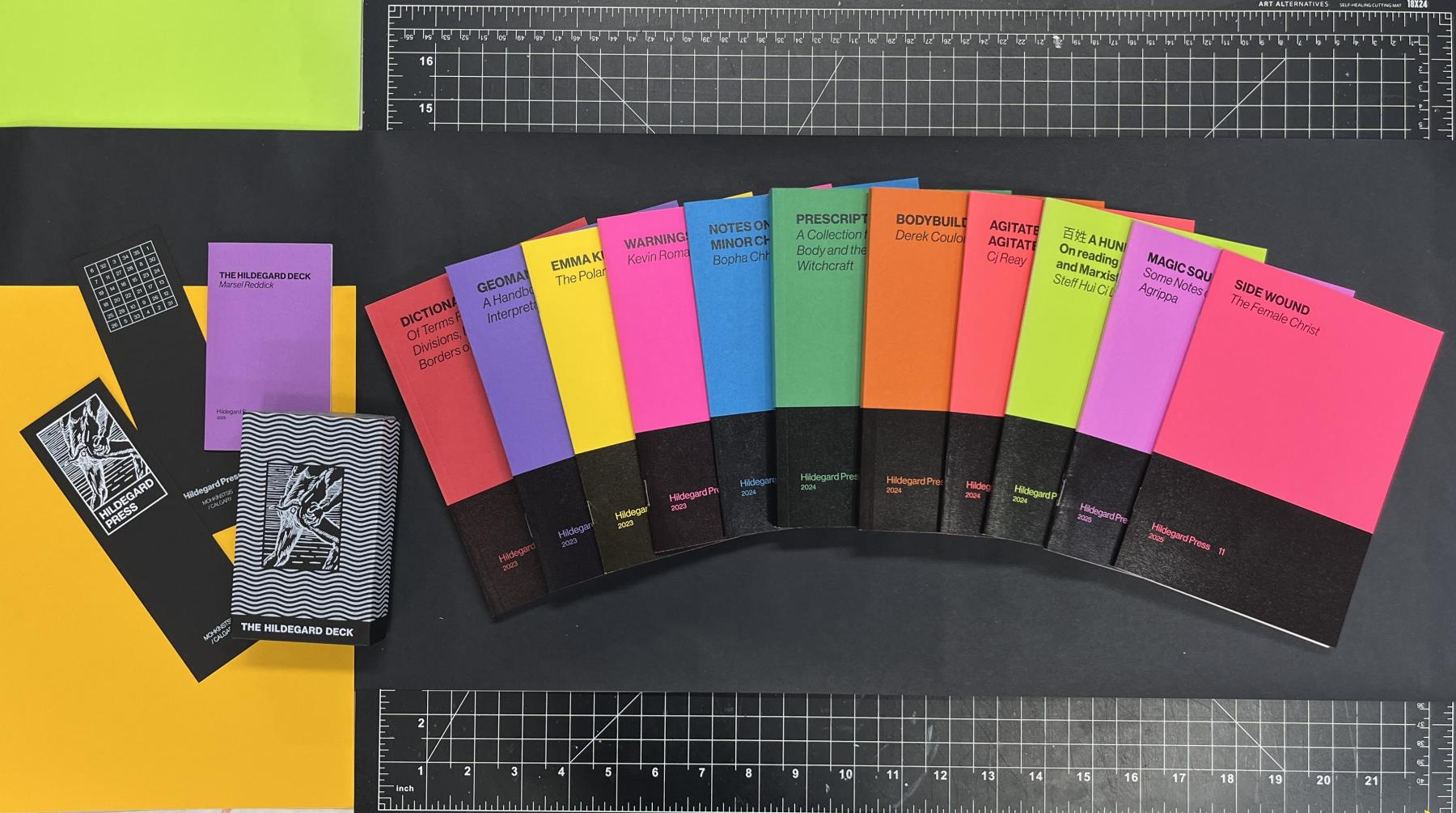
Hildegard Press editions 1-11 and "The Hildegard Deck." Courtesy of Lyndl Hall. More information on the various editions can be found here.
I once heard a biblical scholar say that the Bible is much more like a library than it is a single book. Its polyphony is the result of many writers and translators creating branching paths along interlocking bands of narrative, guidelines, genealogies, songs, laws, histories and parables. It represents the shifting textures of religious thought as they have been shaped by time and circumstance. It is a raft of contradictions and tangents. It is a compendium of drift and change. The codex currently distributed by the Gideons is constituted as much by what has been edited out or lost as much as it is by what remains on the page. It is a well used library.
Unlike the narrative mess of the Bible, Western views of the past tend to assume history as a comprehensible, narratively consistent whole. In this view of knowledge, remainders are rounded off and doubts are often squashed when they disrupt a thesis or are relegated to endnotes. In the work of Calgary-based artist Lyndl Hall, ideas, shapes, and histories have scattershot points of articulation which often run counter to the assumed wholeness of history. With enough data points one can imagine a whole— but this view always comes with the need to squint or view from a distance.
Hall launched Hildegard Press in 2023 as a way of collecting “peripheral knowledge.” This series of publications includes reference books like dictionaries and handbooks for divination as well as contributions by other artists and writers that take forms such as collage-essays, and experimental writing about the sculptures of Umberto Boccioni (BODYBUILDER, Coulombe). Each publication is packed with allusions to others. For example, Magic Squares: Some notes on the Tables of Afrippa (Hildegard Press 10, 2025) points toward entire threads of knowledge that run through multiple cultures, centuries, languages, and continents. Each entry is densely layered, revealing the volumes that always sit under other volumes.
Hall’s research-heavy practice follows fluctuating ideas about shapes as they move across the page, into space, and inform social systems. Her interest in the periphery is a deeply epistemological one. A periphery gives shape to an idea or a physical space or a group of people. With these publications, Hall is performing a circumnavigation, summoning both her conception of what is “peripheral” and its opposing centre. We spoke about her interest in premodern knowledge systems, shifting conceptions of space, and her history with publications.
Publishing has a directness that I just find really pleasurable. With the structure of the press now in place, when the book is ready to go, everything moves quite quickly, and then the book is out in the world, living its own life.
Can we start by talking about your personal history with publishing? How did you come to start making books and publications?
Sure. I always feel like I should start by saying that I’m primarily a visual artist. I’ve always seen artists’ books as an extension of my art practice. I’m interested in the ways that a book can be a depository for information adjacent to an artist’s material practice. My practice is quite research-heavy, and I struggled for a while trying to figure out how I could show that research in my visual art practice. As I did more and more research, the information started to balloon, and I began to feel that I was trying to co-opt that information into a sculpture or a drawing in a way that wasn't really working for me anymore. I wanted that work to be able to stand on its own without having a book-explanation behind it and so I got to a point where I wasn't trying to link them anymore, and the book could exist on its own regardless of my studio work.
When I formed Hildegard Press, it was to have a place for the stuff that I was finding really interesting, and to explore more deeply the histories and practices I was looking at. I liked the idea of being able to produce a series of smaller pamphlets, rather than being beholden to the wholeness of a singular artist’s book. I was also pregnant at the time with my second child, and I knew I didn't have the physical capabilities of being in the studio and doing the kind of sculptural work I had done before. But I knew I could sit on a computer and work on a layout while I held my baby. The formation of the press became a very practical way that I could still participate and explore ideas, but didn't have to physically be in the studio.
The first publication I encountered of yours was No Day Without Its Line, which is such an expansive repository of information about, among other things, the interplay between geometry, time, myth, and history. You often use questions of shape to explore the ideologies of space, and I really admire the way your work questions the division between two-dimensional and three-dimensional space. How we think about what happens on a page or a screen inevitably affects what happens in space—especially when it comes to colonial conceptions of location, centre, and periphery. I think those questions are also really important for artists making publications because they inherently question the expectation that a gallery is the ideal setting for art presentation. Can you tell me about how those questions played out in your publications and in your practice more broadly?
For my exhibition, On Fixing Position (2012) at the Burnaby Art Gallery, I made a book called There are other ways of inhabiting the world. It's a list of all of the latitude and longitudinal points of coastal locations around the world, with their longitude degrees shifted to make Vancouver zero instead of Greenwich, England. It was very much in the tradition of the artist’s publication as an unreadable book, as it is just a list of information that proposes an alternative centre to a mapping system. It was a fairly simple idea: What happens when you move a meridian? And also thinking about centers of power. That was really my first book work, but it was still working in conjunction with an exhibition.
No Day Without Its Line was the moment where I untethered the gallery-based work from the publication. There is a body of work that goes alongside that publication, but I've never actually shown it, and so the book became the sole depository for all of that thinking. I did explore it through studio work, I made weavings, cast bronze sculptures and all of these other things, but the book had done the work I wanted it to do, and it moved out into the world. I was also able to indulge myself with that book. It has an index, which it probably doesn't need; it's got a long list of citations. The footnotes are absurd, right? They're so extensive that they deliberately start to take over the text. I was thinking about all of these different layers of collecting and cataloguing knowledge. A lot of what I was doing in that publication ended up in the Hildegard Press publications, sometimes quite directly: in the smaller pamphlets, I could dig deeper into those histories and give them more space.
I like the idea of publications as a space of excess and indulging one’s ideas and impulses. Artist’s publishing is exciting to me because it can happen outside of extended art timelines and institutional gate-keeping. I came to publications through making tapes and distributing music. In that space, there was always the intention of a less mediated participation in cultural production. I still think that ethos is important as more venues—both artist-run and large-scale institutions—are scaling back on programming, and open calls are getting upwards of 250 applications for two exhibition slots.
With publications, I feel like there is just more of a quickness to it, and that I had more agency to be in control of what I was producing and where I was sending them. It wasn't so much that I was thinking about them relating or not relating to galleries or traditional institutional settings, but rather that I didn't have to think about that question at all. I found I could move faster in this other way, with this other medium (the book) and widely explore more topics that might not make any sense within a ‘professional practice.’ We’re also not beholden to any deadlines or institutional agendas, so it is possible to take time and indulge in topics of interest just to see where they might go. Publishing has a directness that I just find really pleasurable. With the structure of the press now in place, when the book is ready to go, everything moves quite quickly, and then the book is out in the world, living its own life.
The hope is that, in series, through proximity, these artists and writers start to speak to each other across the publications, confusing any idea of a central position.
With Hildegard Press, there are several structuring mechanisms at play: the idea of “peripheral knowledge” is a guiding ethos, each publication is numbered, there are multiple named contributors, and some contributions seem to be the voice of the project. Can you talk about those framing devices? Where do they come from, and what does it allow you to do with the project?
When designing the look of the press (with the help of Stephan Garneau), I was thinking about finding strange tracts or esoteric pamphlets in used bookstores. I thought the publications would be something that you pick up and think, “I have no idea what this is.” I wanted them to look like something that a small society would put out. The covers are all the same, but then the numbering positions them as part of an iterative series, each indicating to the others, even if you only have access to one part. I started with the dictionary (Dictionary: Of Terms Relating to the Edges, Divisions, Boundaries, and Borders of Things, Etc. Hildegard Press, 01, 2023), which is meant to set the tone for all the publications that come next, and then I have tried to build up a plurality of viewpoints that all take a different position on the “peripheral.” I didn't want them to look occult in any obvious way (although magical practice is a common theme), rather I wanted to present a compendium of varied knowledge.
I think I understand that impulse. Sometimes an aesthetic of “occult knowledge” participates in a kind of othering of people living in the Middle Ages (5th to 15th century CE). It can obscure the fact that these were lived practices. It wasn't a spooky alternate reality. That’s really evident when you look at the prescriptions book (Prescriptions: A Collection for Many Evils of the Body and the Mind, Also for Witchcraft. Hildegard Press, 06, 2024.) These are remedies for things like toothaches. They are very recognizable practices.
They're very practical things, right? I think we have this tendency to ask, “How could people believe these things, or how could they do these things?” But when you move into that logic system, it's very consistent; it follows its own sequence all the way through. The herbal remedies might be quite elaborate and contain ingredients we find strange, dangerous, or even mythical; some of the remedies are magical and rely on metaphysical systems for healing, but they've done their research. They write their citations down for their different recipes; there are notes and adjustments, it's a lived, used handbook that would only be used if it had some value, right? Additionally, regardless of its content, the sheer magnitude of recipes for such a range of ailments indicates the value in collecting this type of knowledge and keeping it together in one book; it is also indicative of a very human desire to stay healthy—stay alive—in a hostile world.
Yeah. I think the publications help complicate the tendency to think about these pre-modern practices as curiosities pulled out of a Victorian fog. That feels very much in keeping with your practice of shifting centres and finding a more grounded view of knowledge from the past.
With many of the publications, I don't feel like I'm writing my own thoughts, but rather that I'm acting as a collector of quite disparate information. A lot of the books have quite a large “further reading” list or a citation section, because they’re meant to be a collection of knowledge, a handbook, or a jumping-off point for deeper engagement with the ideas. I see that as setting the general parameters of the press. But because the press is not meant to be an “occult press” or a “herbal press,” I wanted to pluralize the perspectives by introducing other writers or other artists into the mix to complicate what is peripheral or at the periphery, or what is the edge, or the inside or the outside. The hope is that, in series, through proximity, these artists and writers start to speak to each other across the publications, confusing any idea of a central position.
I try to give contributors as much free rein as possible. I contact people because I know their practices and I'm excited about their work. Sometimes I propose ideas, knowing their practice, but once we begin our conversation, it really is up to them what direction they take. My main encouragement is for them to indulge in ideas that they previously have not had the space to explore. It's also a pleasurable excuse to work with people I admire and make a book for them.
I do worry sometimes that the structure of the press will overstep a contributor’s aesthetic or conceptual concerns. I try to make each publication as different as possible, depending on the artist's needs, and to let them really do whatever they want. I don't think of myself so much as an editor at that point, just a facilitator making something happen for someone. So far, it's been the most exciting part of the project and resulted in such interesting, nuanced, and varied publications. I feel a huge responsibility towards my contributors to present their work in the best possible way and distribute it as widely as possible.
I first became aware of your work through a mail art group called Undecimals. It was an artist-led initiative that focused on peer-to-peer distribution of small-scale artworks, multiples, and publications. Like so many volunteer-led initiatives, it’s now on hiatus. It makes me think about the ways that distributing work feels endlessly improvisational. How have you approached distribution with this project?
I've found it helpful to think about the project as a whole as part of my art practice, but then to think of each publication as its own thing that may or may not fit into conceptions of art publishing. There's artist culture and so many venues that cater specifically to art books, but then there's also poet culture, zine culture, occult bookstores, anarchist bookstores, experimental music venues, and a variety of independent spaces that all operate with the same ethos of supporting alternative voices. I’ve tried to present the books as possibly fitting into all of those communities, even if they’re not necessarily taken up as an “artist publication” in that space.
In terms of Canadian distribution there’s Art Metropole, which of course is such an important part of Canada's artist publishing world, but also READ Books at Emily Carr University has been an important space for the project, they have an amazing focus on artist publications, and have been a huge supporter of Hildegard Press often taking the books along with them to various Art Book Fairs. Shelf Life Books, in Calgary, has been my local spot, but further afield, the books are stocked in a variety of locations across the US, UK and Europe, many of which don’t have a focus on artist publications. As an example, a lot of the publications are currently at Wooden Shoe Books in Philadelphia, which is a completely volunteer-run anarchist bookstore. I had done a publication with Black Lodge Press (Agitate! Agitate! Agitate! Cj Reay, Hildegard Press 08, 2024), which is an anarchist press based in the UK, and the bookstore was interested in stocking it, but they also picked up a whole bunch of the other publications because much of the project was in the spirit of that location. I think what I'm trying to say is that when I stopped thinking about the publications as artist books and just thought of them as potentially fitting into all of these different communities, they've found much more surprising homes.