.jpg)
John Brady McDonald. Photo courtesy of John Brady McDonald.
John Brady McDonald is from the Muskeg Lake Cree Nation and the Mistawasis Nehiyawak. He is the great-great-great grandson of Chief Mistawasis of the Plains Cree who was considered a visionary leader and the first signatory of Treaty 6 in 1876.
McDonald is also the grandson of famed Métis leader Jim Brady, who is generally considered one of the most influential Métis leaders and activists in Saskatchewan and Alberta of his time. Brady disappeared while on a prospecting trip in June 1967. His body has yet to be recovered.
Forced to attend the Prince Albert Indian Student Residence in Prince Albert, Saskatchewan, from 1984 to 1989, McDonald has served as an activist and advocate for fellow residential school survivors.
The Nêhiyawak-Métis musician, playwright, actor, speaker, author, and visual artist discusses how his lived experience comes through in all facets of his creative work and life.
McDonald’s first book of poetry, The Glass Lodge (2004) was chosen for the First Nations Communities Read program and nominated for the Anskohk Aboriginal Book of the Year (2005). Despite The Glass Lodge being heralded as a raw, lyrical experimentation influenced by Shakespeare and Jim Morrison with some teenage goth thrown into the mix, McDonald endured 15 years of rejection letters until Childhood Thoughts and Water was published in 2020.
That was followed by his book of free verse poetry, Kitotam, which translates into English as, "He Speaks to It," in 2021; his fictional work Electricity Slides (2021), in which the protagonist confronts conformity as a means of survival; Carrying It Forward: Essays from Kistahpinanihk (2022) that honours the traditions and the languages of the two nations McDonald navigates between; Songs From the Asylum (2024) that chronicles his day job working with youth mainly as a Frontline Youth Outreach Worker on the streets of Prince Albert, Saskatchewan; and What Shade of Brown?, released in July 2025.
That of course, leads to a discussion around why it’s so difficult for racialized writers to get published in Canada and whether the sudden interest McDonald has generated since 2020 means things are changing within the old guard, or if there are simply more niche publishers creating space for ignored voices.
McDonald’s artwork has been displayed in various publications, private and permanent collections, and galleries around the world including the Canadian War Museum in Ottawa. He’s a founding member of the P.A. Lowbrow art movement and served as vice-president of the Indigenous peoples Artists Collective for almost a decade. His art also reflects very personal lived experiences.
McDonald truly believes, “Art in any form is a way for a person to leave their mark upon the world and say, ‘I was here.’”
As someone whose art styles were not held in high academic regard for decades [...] it is important for us to fill and occupy those spaces and have our work recognized as legitimate art.
You were named John Adrian McDonald by your parents, but in 2021 you legally changed your name to John Brady McDonald. Why change your name at 40-years of age?
There was a combination of factors which led to my decision to change my name. A lifetime of bullying and mockery at being named John A. McDonald was seriously taking a toll on my mental health. Being a Residential School Survivor and an advocate for survivors with the same name as the creator of the attempted genocide of my people was proving to be getting in the way of my advocacy, with people assuming I was being facetious or sarcastic, like I was choosing to have that be my name. Around the same time, communities across the country were removing or renaming their statues and monuments of Sir John A. MacDonald, and I felt the time was right to topple my own minimum, so to speak. Also, the Government of Saskatchewan had, around the same time, waived the fees to change one’s name for Residential School Survivors. The stars all seemed to align to confirm that it was time.
Jim Brady disappeared at the age of 59 while on a prospecting trip. That was 14 years before you were born. So, why was it important to ensure your grandfather got the military cenotaph headstone he deserved 58 years after he went missing?
In 2019, a group of individuals in Northern Saskatchewan began a new search for my grandfather’s remains. We as a family never had a proper memorial service or grave to visit. It had been a mission of mine to ensure that a place be made where not only our family, but also the Métis Nation as a whole, could mourn one of the greatest heroes of our people. We chose the graveyard at the Batoche National Historic Site because, as my aunt said, “he belongs to the Métis people.” We chose a simple military headstone as opposed to a grandiose memorial in line with his own humble way of living. If and when we bring him home, he now has a place to rest.
How has Jim Brady and Chief Mistawasis of the Plains Cree influenced your life’s vision and all the work that you do?
Both men used their positions as leaders for the betterment of their people, not to paint themselves in better light or to buy their way into heaven, but because it is the right thing to do. That concept and philosophy of working for others without expectation of return or reward is a principle and benchmark by which I live my life every day. Both men could have used their positions to live very comfortable lives, but both were adamant to do no such thing while others couldn’t.
You were forced to attend the Prince Albert Indian Student Residence in Prince Albert, Saskatchewan, from 1984 to 1989. You were only three years old in 1984. How did those five years at residential school impact your life? And, can you share how former residential school survivors became employees in the residential school system?
I came to live at the P.A.I.S.R through my father, who was himself a survivor of Residential School, and was hired to be one of the people to live on-site and supervise the children. I grew up in a dorm with 24 other boys and experienced everything they went through.
In the late 1960s and early 1970s, the various churches were getting out of the Residential School business, and the Federal Government began to take on operations. One of their policies was to hire Indigenous people to staff these Residential Schools, replacing the nuns and priests with Residential Schools survivors, who then took their own experiences and behaviours learned at Residential School and continued the cycle of abuse and trauma, my father included. In those years, I was robbed of my culture, my language, my connection to community and I witnessed and experienced physical, spiritual, mental, emotional and sexual abuse. My experiences have led me to become estranged from extended family, experience loss of kinship and connection, and were a huge factor in the severe substance use disorder and destructive behaviour I experienced in my teenage years.
Let’s focus on your writing. Could you describe your writing practice and how you create the ideal conditions for words to flow onto paper via typewriter and computer?
I have learned to schedule my artistic and creative endeavours seasonally. While I may write a snippet or two here and there throughout the day, I only write when there is no snow upon the ground, and I only paint when the snow arrives. I’ve arranged my writing style by the seasons, creating words when I’m surrounded by warmth, colour and life, and painting bright vivid colours when I’m surrounded by cold, snow and death. It’s allowed me to become a more disciplined writer, crafting words more diligently in the final stages.
Setting these parameters is necessary for me to ensure that what I am writing is meeting the expectations that I have set for myself as a writer, and showing respect to both my words and the situation which created them. I will fill a shoebox with scraps of paper covered in ideas, full poems and pieces of scribbled prose, then I will sit and meticulously combine them as they flow into small, black hardcover notebooks. This is the first stage of the “filtration process,” as I call it. From there, I begin to construct my books on a 1969 Remington typewriter. It’s at this point I start working on the technical aspects of each piece—is it easy to read? Will I stumble on this word or that word when performing it onstage? Is it rambling? Am I using a certain phrase or metaphor repeatedly? Does it make sense? Etc. From there, the words get committed to the computer. From time to time, to gauge response and reaction, I’ll post one or two pieces to social media.
Your first book of poetry, The Glass Lodge, published in 2004 by Kegedonce Press, was recently re-released on its 20th anniversary by Shadowpaw Press. At the time, The Glass Lodge was chosen for the First Nations Communities Read program and nominated for the Anskohk Aboriginal Book of the Year (2005).
However, that success was followed by 15 years of rejection letters until Childhood Thoughts and Water was published by BookLand Press in 2020. The collection of beat poetry, spoken word, performance art and lyrical verse journeys into the memories and events of an Urban Indigenous warrior's struggles to reconnect with a language and culture that is always almost out of reach.
Then, between 2021 and 2025 you published five books of poetry, fiction and non-fiction including your most recent book of poetry and prose, What Shade of Brown?
Why is it so difficult for racialized writers to get published in Canada? And, does your experience since 2020 mean the publishing world is becoming more inclusive of voices originating outside the white male canon?
It was difficult, in my opinion and experience, because the publishing world did not view Indigenous and racialized writers as commercially viable at that time. I’ve personally had publishers tell me straight to my face—“Canadians won’t buy this (book,)” and, of course, by “Canadians,” they meant white people. It wasn’t until many non-Indigenous/racialized publishers realized that Indigenous/racialized works were commercially viable in this country that they were willing to begin publishing our works. Now, I’m not saying all non-Indigenous publishers had this mindset, and there were several non-Indigenous/racialized publishers that did publish works by Indigenous and racialized writers, but they were certainly the exception and not the norm.
There was, obviously, the element of racism that put those barriers up, but, from my experience, it was about the publisher’s ability to earn money from our words. It took Indigenous and racialized publishing companies to kick and fight their way to the book store shelves and occupy that commercial space before many of the bigger publishers began adding Indigenous and racialized writers to their rosters, and, even then, it seemed apparent to me that they were choosing writers who were palatable to white readership.
Interestingly, perhaps ironically, several of those writers were actually revealed to be Pretendians. I would love to say that, now that we have broken through and have created this Indigenous Literary Renaissance, we will never go back to that, and, out of a sense of altruism, our words will continue to be amplified. However, I’m not naïve enough to not realize that, as soon as sales start to slip, things will begin to backslide. It’s a business, and businesses cannot survive outside of capitalism. Of course, this is just one person’s opinion.
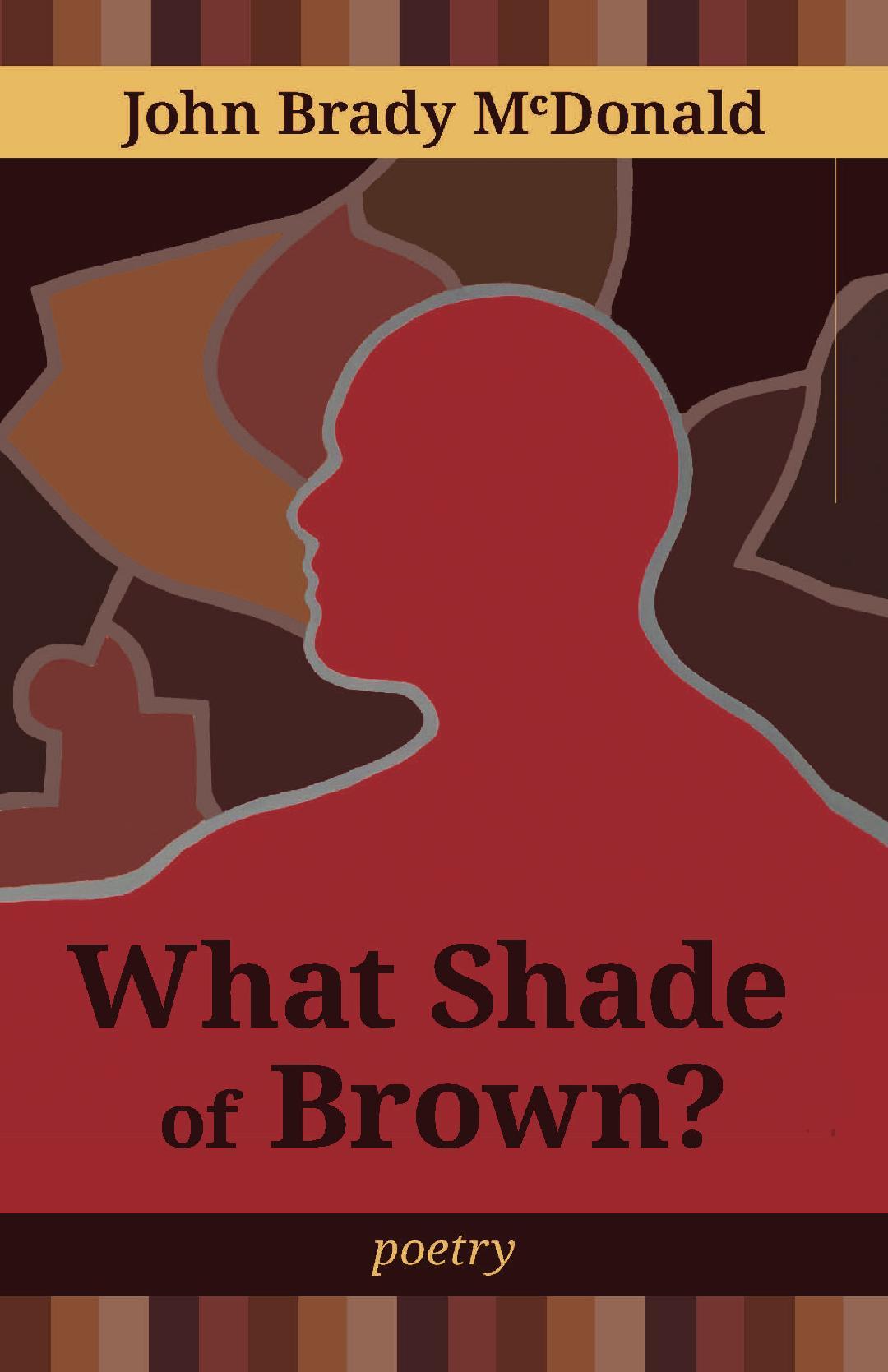
Book cover for What Shade of Brown? (2025), Radiant Press.
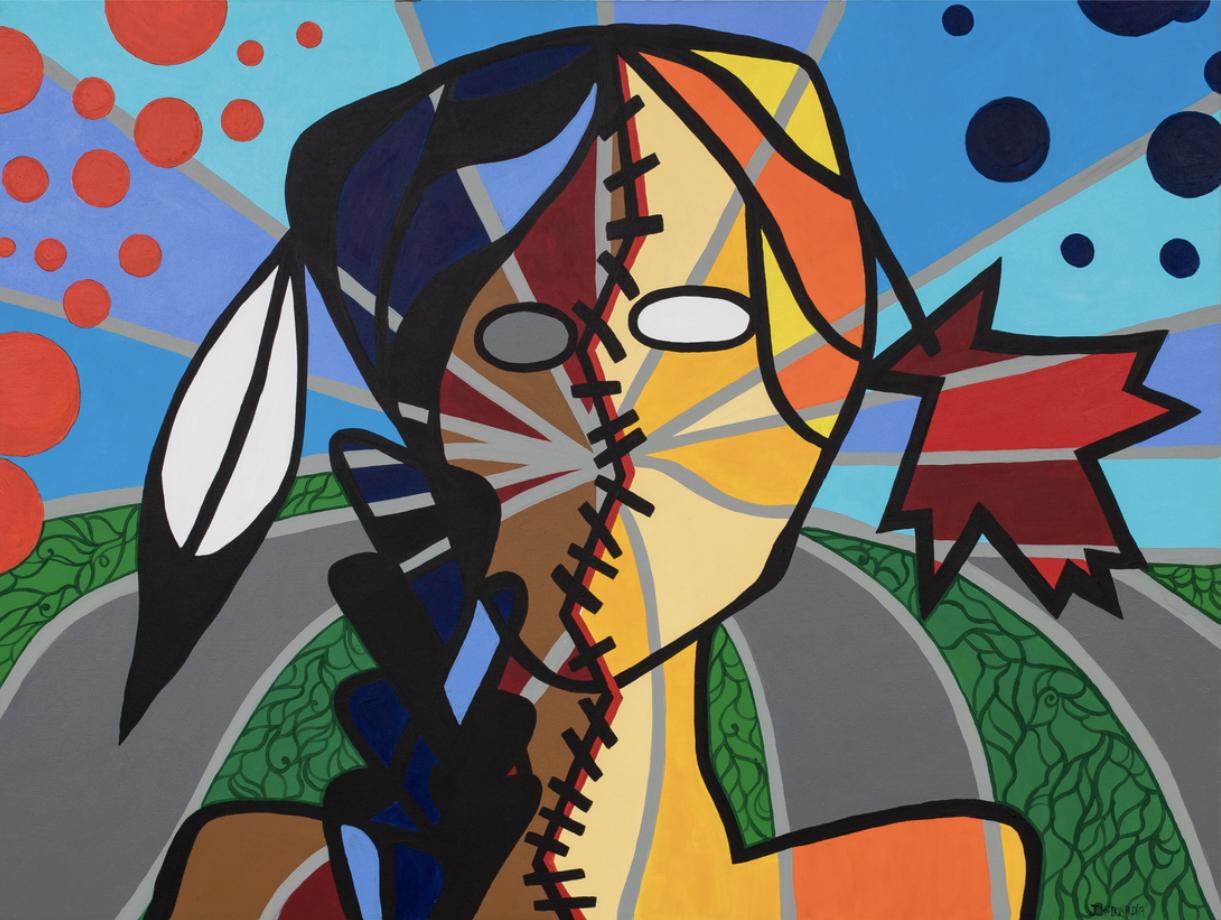
John Brady McDonald, She Wears The Scars Of Your Canada - Reconciliation, (named by Rosanna Deerchild), 2019. Acrylic on canvas, 30" x 40." Sourced via.
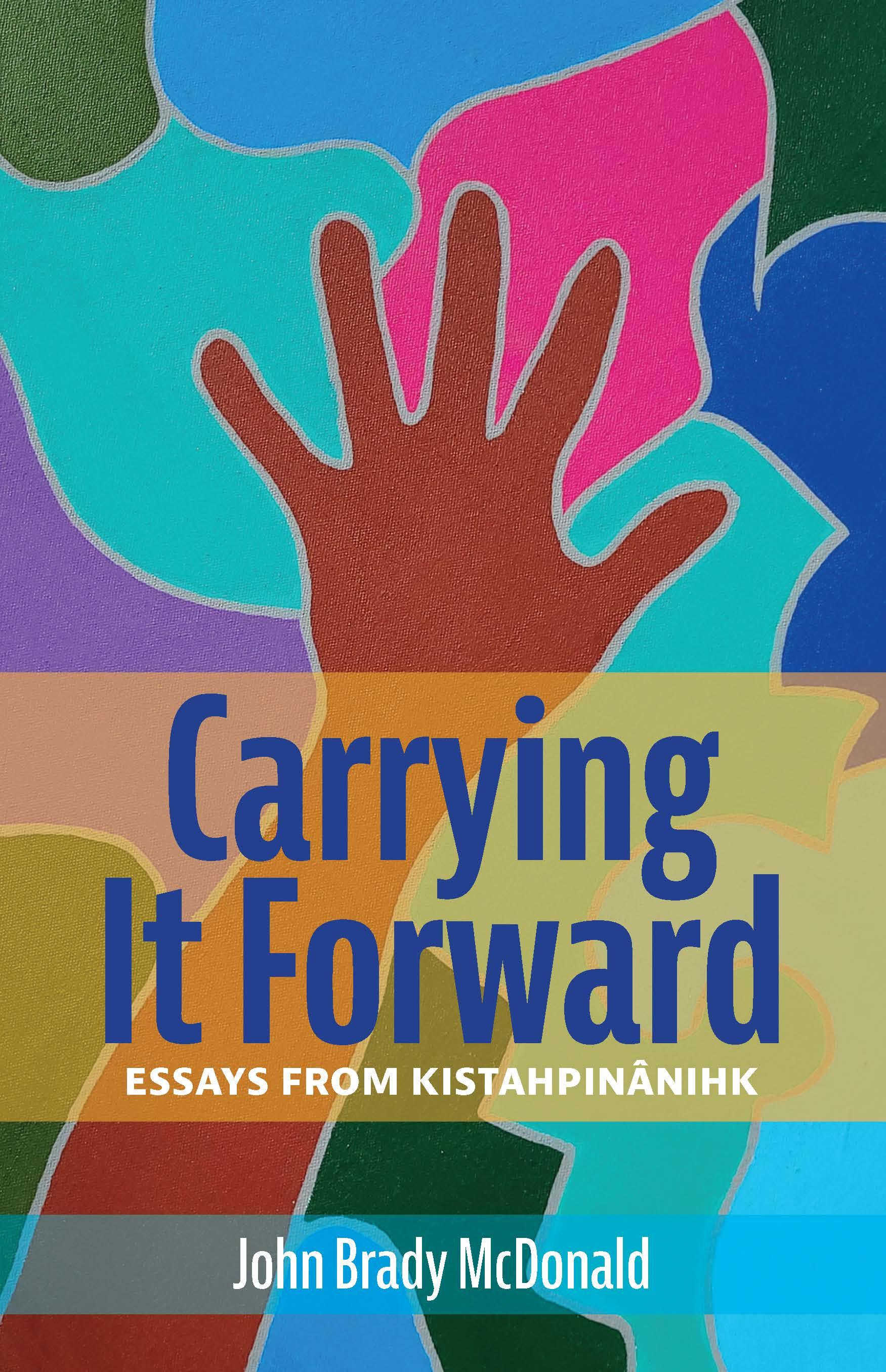
Book cover for Carrying it Forward: Essays from Kistahpinânihk (2022). Wolsak & Wynn Publishers.
What Shade of Brown?, published by Radiant Press in July 2025, uses passionate poetry and prose to explore the experience of an Indigenous person who feels not quite accepted because of his light skin and undermined by settler-colonial society. The struggle of trying to connect to your family and lost culture is reflected in the poem, What Shade of Brown?
What do you want readers to feel and take away from the impactful poem, What Shade of Brown?
This poem speaks to an issue that has been part of the Indigenous experience since Contact. Light skin is a living representation of colonization, and it has caused so much turmoil and pain in our communities, leading to ostracization, isolation and rejection.
Given the revelation of people like Buffy Saint Marie, Joseph Boyden and, most recently, Thomas King of pretending to be Indigenous people, the struggle for actual Indigenous people like me who are made to feel “less-than” has been compounded. “What Shade of Brown?” is my way of holding to account those members of our community who act as gatekeepers, determining a person’s worth, belonging or value to the community based upon the pigmentation of skin and putting the onus on them as to why. That’s the take-away I want this poem to have. Why?
Carrying It Forward: Essays from Kistahpinanihk (2022) published by Wolsak & Wynn, contains stories that honour the traditions and the languages of the two nations you navigate between. It also examines the city of Prince Albert, your experiences at residential school, northern firefighting, as well as the time you spent at Cambridge University in England where you “discovered” and “claimed” the island for the First People of the Americas in July of 2000.
These essays are filled with history, careful observation and some hard-learned lessons about racism, recovery and the ongoing tragedies facing Indigenous peoples.
What then, is your reaction to recent revelations that a number of high-profile performers and academics once claiming Indigenous heritage cannot substantiate that claim?
My reaction has been a mix of “I told you so,” “how dare you?” and “(insert expletive here).” As I said earlier, being light skinned and having to struggle my entire life with being accepted by my own community, the struggle has been made harder by these charlatans and liars. They have taken up spaces meant for Indigenous people and exploited it, to the detriment of others.
I think of Kelly Fraser, an Inuit musician who was nominated for a Juno award that was given to Buffy Sainte-Marie, and who later took her own life. Would her world have been different had Buffy not falsely filled a space not meant for her? Would she have made the choice to take her life had she won?
Personally, my first book had been in the same award competitions with Joseph Boyden, where he won awards. Had he not been there, would that book have been successful and not lead to my own 15 years in the wilderness? I also closely worked and collaborated for a decade with an artist who claimed to be Metis, but turned out not to be, and who made thousands of dollars off that claim. Pretendianism is not a victimless crime, and it has real world consequences where real people suffer.
Turning to your art, you started out as a tattoo artist, graffiti artist and comic book artist. Why is creating tangible art important to you?
I’ve tried to use my art to the best of my ability to express my views and experiences in the world and share them from what has historically been and in many ways still is a visually artistic wilderness. Being so geographically far away from major art galleries and that whole “Fine Arts” scene, the opportunities for visual artists to showcase their work in Saskatchewan can be slim. That’s why I am so grateful for groups like OSAC (Organization of Saskatchewan Arts Councils) and SK Arts (formerly the Saskatchewan Arts Board) for providing the opportunity for artists to have their work tour the province and allow others to see their work.
Art in any form is a way for a person to leave their mark upon the world and say, “I was here.” As someone whose art styles were not held in high academic regard for decades (in fact, my art style is what is known as “Lowbrow” art,) it is important for us to fill and occupy those spaces and have our work recognized as legitimate art.
You have a painting that you titled, No Thought Was Put Into This (2025). What is the story behind this painting? And, what should Settlers/Colonizers take away from this story and the painting?
This painting is a sequel of sorts to a painting commissioned by CBC Saskatchewan in regards to the first national Orange Shirt Day. It was in response to a Settler’s reaction to the fact that their plans to recognize the day had nothing whatsoever to do with the reason why we were observing the day. Their solution was to “stick some feathers on it.” Adding eagle feathers or other stereotypical Indigenous cultural iconography to things is a common way for non-Indigenous groups or individuals to say, “look, we’re committed to Truth and Reconciliation, see?” We become parsley upon their plate, little more than garnish. This painting shows what appears to be a stereotypical Indigenous image of an object (which in reality, isn’t a real thing—just a deer antler on a tree with some feathers) and these mechanical, steel-grey thingamabobs thrown in. There is no real substance to the piece, and that’s the message.
“No Thought Was Put Into This” is part of a greater response to this form of tokenism. The title actually came from a lyric in the Nirvana song, “You Know You’re Right,” which in itself speaks to the selfishness and vapid response that is often at the heart of narcissistic behaviour, and I think that it is entirely fair to say that quite often, the response to Reconciliation by Non-Indigenous groups is not one of honesty, but of painting oneself to not be the bad guy. I would hope that anyone viewing this piece will be able to see the forest for the trees, as it were, and see it for what it is: a sardonic rebuttal to an empty response.
Canadians can't say they’ve accomplished the Truth and Reconciliation Commission’s 94 Calls to action when more children are in the custody of child welfare than ever went to residential school and Indigenous women and girls are still being disappeared and murdered.
What message do you want to share with Settlers/Colonizers who don’t necessarily want to read, hear, or see the Truth before moving towards acceptance and then, Reconciliation? What stands in the way of reaching meaningful Reconciliation?
As earlier, the message I want to leave with Settlers/Colonizers of this mindset is a simple question: Why? Why do you not want to know the truth? Why is learning about, discovering, accepting and rectifying the wrongs of the past and the wrongs continuing today such a difficult thing to do? Are you afraid of finding out? If so, why? Are you worried about what you might uncover? If so, why? You just have to learn about it, accept and acknowledge that it happened, acknowledge that it is still happening to Indigenous people today, and do your very best to ensure that it stops.
We’ve had to experience it first hand. The least you can do is listen to us and stop saying things like, “no, it didn’t,” and “when can we stop saying sorry?” It’s not a big ask.