.jpg)
Book Cover for Riverwork (2026), Coach House Books.
Lucy Frost, the narrator of Lisa Robertson’s brilliant new novel Riverwork, is a woman in her sixties: she’s a self-professed “failed poet,” “a hag.” She’s a “scoffer and a scrawler,” “a fibber, and a snipper, a doubter, and a haunter of shame.” She spends her mornings slowly reading the memoirs of Chateaubriand, just ten pages at a time, such that she may experience “the sensation of personally containing the duration of the book.” She spends her afternoons cleaning the homes of Paris’s professoriate class, and her long, sleepless nights reading, sifting thru, and transcribing the notebooks and bundles of paper, the scraps and envelopes and jottings, the lists and scribbles and annotations, the files, copies, and folders left behind by her great-aunt Em, who also lived and wrote, just like her, and then, one day, mysteriously disappeared.
The subject of Em’s preoccupation, and after her, Lucy’s, is the long-absent tributary that once ran through Paris to feed the Seine, a river called the Bièvre. Once the site of dense industrialization, with mills, tanneries, and slaughterhouses built along its bed, the Bièvre was also the site where the women of Paris’s servant classes gathered to do the city’s laundry, where sex workers and vagrants roamed, and where in the spring of 1871, they all came together to organize and participate in the Paris Commune. Long since rerouted or canalized below the slabs of concrete that now comprise the city, the Bièvre too, has all but disappeared.
A central question: What doesn’t disappear? “Entire languages and cultures violently disappear,” writes Lucy. “Things disappear. People disappear.” But what resists this sentencing—what lingers, remains, repeats? What parts drip, trickle, and fester? What courses through, what makes its way, what gushes into the present, as a fragment, or a document, or a memory? “Like a language,” Lucy also writes, “a ruin speaks to say nothing disappears.” Robertson’s Riverwork is a novel about an aging woman who exhumes and sutures together a sprawling story of female dissent. Nothing, her narrator suggests—neither history nor its supposed disappearance—is ever total or complete. Always something seeps through. “Disappearance repeats in a fabric.”
Fabric (and fabrication), theft, labor politics, philosophy, architecture, ruin, ornament: this is a partial list of the many topics that appear across Robertson’s oeuvre, comprised of more than a dozen books of poetry and several essay collections. Riverwork is Robertson’s second novel, after 2020’s The Baudelaire Fractal, in which a narrator named Hazel Brown, also a poet, wakes up in a hotel room to discover that she’s the author of Charles Baudelaire’s entire corpus. As in this novel, Riverwork is densely in conversation with others. Some figures are fictional, such as The Archivist, Lucy’s nonagenarian boss; and Kemi, a Senegalese scholar of queer history and caregiver; while others resurface from history to speak through and to Lucy: Thelonious Monk, Alain Gomis, Edward Said, Chantal Ackerman, Gertrude Stein, and Jean Genet are among these interlocutors.
I had the pleasure of speaking with Robertson one afternoon early this spring. She’d just sent final proofs of her novel to the printer. We spoke on Zoom, myself in New York and Lisa in her home just outside Paris, near the banks of what remain of that river she’s so richly unearthed, the Bièvre.
[...] the ways we give space and assist one another in our work are forms of collective political action. That is the commune, and it persists despite its impossibility.
Riverwork just went to the printer! Congratulations. How do you feel?
My predominant emotion is relief. I'm very detail-oriented, so it's difficult for me to let go of a text. Because of the very intimate editorial and publication process at Coach House, I was given the space to intervene, until like, literally 15 minutes ago, when my book went to print. But that’s all over now.
I suppose I’m nervous, in the expected way, but I’m in very good hands with Coach House. The writing of Riverwork was very closely accompanied by my editor, Alana Wilcox. For two years she came to Paris on her way to the Frankfurt Book Fair, so that we could spend a couple of days’ time intensely talking about the book and working on it together. My strength as a writer is not exactly in constructing narrative, but in writing sentences and paragraphs, and in thinking about texture and pacing. Alana gave me the space to do that work and then guided me in terms of narrative structuring. I know she wouldn’t have even suggested a publication date if she didn't feel like the book was ready.
Publishing with Coach House is unusual and astonishing. The kind of attention they give is practically unheard of elsewhere.
How did you first learn about the Bièvre River? What sparked your interest?
I first learned about the Bièvre River about 25 years ago, much in the same way that the characters in Riverwork learn about it, by reading Rousseau. I was not yet living in Paris, but I was visiting frequently, and I was working on a few different projects, making digital sound recordings. One of these projects, which formed the basis of my essay “Disquiet,” that appears in Nilling, involved systematically following the early 20th century documentary photographer Atget’s movements across Paris, and making ambient recordings at the places where he would have stood to take his photographs.
At the time, I was also trying to produce recorded sound walks following the routes described in Rousseau's Reveries of a Solitary Walker. Some of those aren't really even walks. In one, he's floating on a boat in a lake in Switzerland, for example. But there are others that you can follow—the sixth walk takes you out of the city, following the banks of the Bièvre, which I had never heard of before then.
These recordings placed the site of the Bièvre in my mental landscape. And I suppose it percolated there for years and years. Then, at some point, after finishing my first novel The Baudelaire Fractal, I was having lunch with an artist friend of mine, the Vancouver-based artist Sydney Hermant, who asked me what novel I would write next. “Oh no,” I told her, “I'm not going to write another novel. I don't have an idea.” It took me until I was 55 to get the idea for The Baudelaire Fractal—ideas just don't drop out of trees! But then she asked me another question, “Why do you have to have an idea to write a novel?”
I took her prompt as a challenge, thinking that it would be interesting to start a novel not with an idea but with a site—specifically the site of this disappeared or absent river. The way into the novel would be to find the river within 19th-century and earlier French literature where it's mentioned, though not always by name.
In reading Walter Benjamin’s Arcades Project, for example, I came across the name of the 19th century French journalist Alfred Delvau, who I later learned wrote a whole book about growing up on the banks of the Bièvre River, Au bord de la Bièvre: impressions et souvenirs (1854). Benjamin (who never once mentions the Bièvre) cites Delvau’s writing about Paris’s working classes, about the small trades, and prostitution, which is what he was interested in for his Arcades Project. I read Delvau, and I read the Goncourt Brothers, Hugo, and various other 19th century accounts. In their descriptions, the Bièvre was a morbidly polluted, stinky, festering environment, teeming with transgressive, popular energy.
The river was no longer maintained after the French Revolution. The whole infrastructure of the city collapsed when the monarchy ended. The annual dredging stopped. Certain aspects of that infrastructure were never fully reestablished, neither by the Napoleonic governments, nor by the governments that came thereafter. The kinds of industry that would have been supported by the Bièvre River within the city of Paris before that—tapestry weaving or dyeing—lost their prestige after the revolution. Nobody was buying tapestries because there was no longer an aristocracy. Those class and economic changes, of course, immediately affected the site, which fell into neglect at the same time as it was industrialized. Huge weaving mills were erected, replacing small artisanal workshops. It was a place where the laboring classes lived according to their own rules.
The 19th century descriptions of the river really drew me in. The texts had such a raw, nostalgic feeling about them— they reminded me of the images of water towers by German photographers Bernd and Hilla Becher, or of the aestheticized presentation of the remnants of defunct industry in Robert Smithson’s “A Tour of the Monuments of Passaic, New Jersey” (1967). All of that retrospective documentation was already happening in the literature being written between the 1820s and the 1850s, vis-a-vis the Bièvre. That was fascinating to me.
I should say that I read most of these books in French—which meant that I was reading very slowly. My French is pretty good, but I acquired the language after I was 40, so it’s not impeccable; it’s a serviceable, bumpy French. But I've discovered how beneficial that pace is for me. The slowness of the reading makes my experience as a reader extremely visceral. I can retain what I've read because I might only be reading five to ten pages of a text a day—that's all I can handle. But that’s good, you can hold that in your mind. The combination of this difficulty and this slowness caused an intimacy with the sites the writers were describing, and it opened up my sense of narrative potential when it came to writing fragments towards my own book.
River water is a character in your book. It’s “debauched,” the narrator says. How do the other characters that appear within Riverwork, including the narrator, emerge?
It probably won't surprise you to hear that I don't really think in terms of building character. But, I do think in terms of voice. Not only narrative voice, but characters’ voices as well. Discovering what that voice is gives information about the character—about their emotional state, their history, their livelihood, their relationships.
The great aunt was the first character to arise out of my thinking about the Bièvre and my fascination with its disappeared status. The book isn’t autobiographical—nobody in my own family lived in Paris or researched the Bièvre River. But there is a person in my family history whose story parallels that of the great aunt. She was an intellectual, a teacher, and had no context for that as she aged. Like my character, her mental health suffered, and she suddenly disappeared. I remember this moment in my childhood. It was a big event. I was trying to understand, what is a disappearance? When somebody is said to have disappeared, what does that mean?
The voice of my narrator, Lucy Frost, emerged out of my thinking about these two disappearances—of the river, and of the great aunt. I also had a broad idea, almost Goth, to write in contradistinction to youth. In The Baudelaire Fractal, the voice emerged from the wit, lightness and sparkle that’s associated with youth and girlhood and becoming. For this novel, I wanted to do something very different. I wanted to write about old and aging people whose experience of life was not necessarily positive. Riverwork is a book about lastness—lateness, failure and last things. Lucy Frost is tired, insomniac, symptom-ridden. She thinks about death a lot. But she has a certain ironic distance in her voice. She doesn’t wallow but she’s world-weary. She can toy with her own dissolution.
Once I realized a few things about my narrator—that she’s older, and that she earns her way cleaning houses—her character became clearer. Lucy Frost is an aging person who has failed in her passion in life, to become a poet. She couldn’t maintain a community or publish her work and eventually her energy for it fizzled. She became a person who cleaned the homes of more successful, professional writers, as she wrote privately in notebooks; she hasn't totally given up writing, but she's given up any sort of public ambition.
The four-and-a-half years it took me to write this book paralleled my slow reading of Chateaubriand's memoirs, written near the end of his life. Not only was his health deteriorating, but his mistress was dying, and the systems of government he was passionate about were failing and he did not think well of any of the developing aspects of capitalism and social life after the failed revolutions of 1789, 1831, and 1848—He wrote these memoirs from the point of view of failure at every point. At some point, I also realized that I wanted Chateaubriand’s voice to inflect the voice of Lucy Frost. It amused me to have the morose, self-dramatizing, lofty tone with which he writes his late memoirs taken on by a cleaning person.
Only later did I discover the voice of the other characters in the book—Lucy’s client, a very elderly woman named The Archivist, and the Archivist’s private nurse, Kemi. Each character became a means for me to present different threads of my research, different chains of thought, and to bring different kinds of language together, hopefully in an energetic way.
Kemi, for instance, is a Senegalese immigrant and a doctoral student in queer studies at Paris 8 University, who, like many Senegalese immigrants living in France, supports himself as a care worker. His academic interests gave me a way to present certain threads of my research about the debauched nightlife of Baroque Paris and, for instance, Proust's failed business experiments in homosexual bordels.
The Archivist is probably the funniest of the characters. She makes gnomic pronouncements that are really off the cuff, often cosmological in nature, such as on the cosmic origins of dust, which I find quite hilarious. She’s judgmental, a know-it-all. But she’s an adept reader of character, with a certain tenderness.
How did your ongoing research on the Bièvre come to inform the novel’s organization?
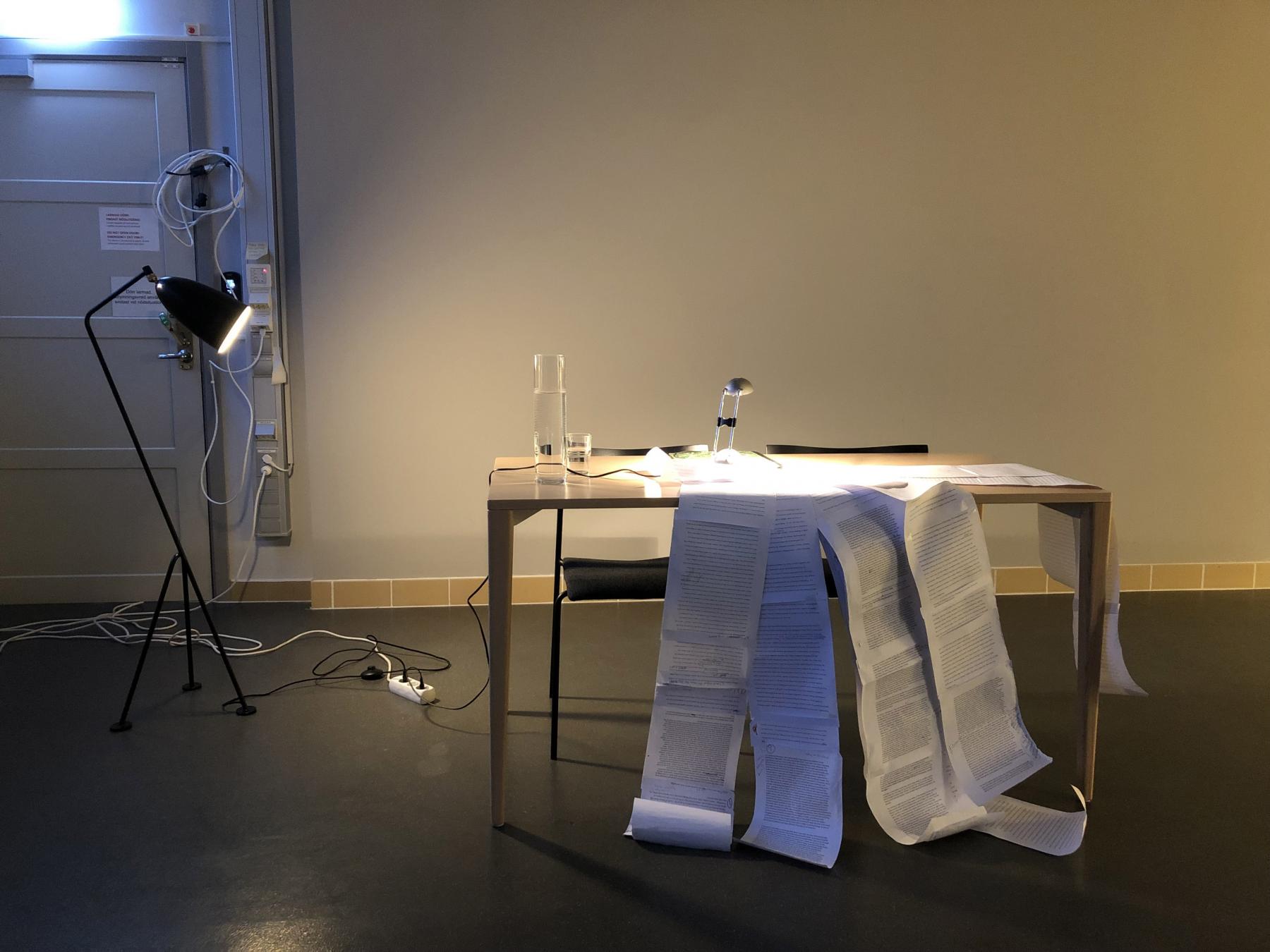
The organization came last. At first, and for a long time, I was writing fragments. Descriptions, catalogues, dreams. I didn't yet know about the characters, their relationships. I was learning the history of the river. But at a certain point, I printed out all the fragments and did the old scotch tape and scissors thing. I had something like sixteen chapters because that’s how many pages I could place along the length of the long farm table I have in my living room. Each one of these chapters grew into a long, shabby ribbon of text that eventually dangled off the table and curled onto the floor.
At some point, I placed my computer on top of the taped together text and intuitively wrote into spaces between the fragments, to build relationships and linkages, then I’d print out those new sections and immediately tape them into the text. But even then, I was going by ear, intuition, and sound. I still did not have a narrative structure. That was probably the most pleasurable, and the longest period of the composition. I absolutely adored it—the tactile, material making. I would also do readings directly from these long, crumpled fetishistic ribbon-like objects, which I carried around rolled up in a scroll. There were, of course, other pleasures: narrating the erotic story of Chateaubriand following Bassompierre following the laundress, and then all of them subsequently followed by Lucy Frost. That was fun. And writing the Archivist.
About three years ago, when Alana was coming to Paris to work with me on the book, I retyped all of what I had accumulated in the form of ribbons into a new document, so I could send it to her. It was maybe 50,000 words. Then she encouraged me to pull it apart again. It was a real construction site for almost the entire time of writing. There was no first draft, followed by a second, then a third. It was just this large-scale muscling around of chunks of text. There's a cognitive sort of muscularity you develop, constantly moving things around without knowing why exactly, building connections. That’s how I discovered the narrative form of the book, by muscling the text into different configurations and then writing into the reconfigured pieces.
Once the book had a form, it needed loads of cutting. I'm thinking of publishing a little booklet of off-cuts, because we had to take out quite a few chapters that were fun but didn’t function in terms of the book’s narrative.
What’s the difference, for you, between writing a book of poetry and a book that’s called a novel?
The big difference for me is that novel writing is about problems in the representation of time. A novel asks how different experiences of time can be brought into relationship with one another. Had this been a book of poetry, I would have left the fun stuff in. But once you've established a logic of time—or more like multiple logics of interpenetrating time, which is the case for this book—you have to attend to those logics to keep the structure afloat.
I'm not talking about causation and logical chains exactly, but instead about the opaque systems of relation between various experiences of time. In this novel, for example, there's the time of my reading through Chateaubriand; there’s also the time of the great aunt’s research in the 1920s, and the time of her life, during which she moves from France back to Canada, teaches in crappy rural schools, is institutionalized, and escapes. There are also geologies of time in the book—the time of dust, for instance, which is astral and cosmic; and the time of the Bièvre, which is an absent temporality; and then there are the times of all the literary texts, which are folded into the narrative.
That’s the intensely difficult, but stimulating and intriguing aspect of working in the form of the novel. As you discover what these wedges or layers of time are, you realize how some of the material—however fun to read, or to have written—does not serve the temporal problems that you've set up. It can be hard to let go, but you discover that just because something is possible does not mean that it's functioning in the narrative.
I’m not saying that writing a novel is more complicated than writing poetry, but that in terms of its duration—both the length of time it takes to work on a novel, and the sheer word count, the potential reading time—it’s something else. The duration opens different possibilities of continuity, recursiveness and cut.
Now I cannot imagine wanting to have such a difficult writing experience again. I'm ready for lightness. Now I just want to write trashy fashion prose.
Book cover for Riverwork, 2026, Coach House Books.
Well, this relates directly to one of the questions I wanted to ask you: What are you wearing today?
I'm wearing a Comme des Garcons smock I bought on eBay years ago. It's very early Comme—when she wasn't doing these ornately asymmetrical, slightly monstrous, beautiful things that we think of now when we think of Comme—but when her garments were more aligned with a sort of Japanese peasant or worker garment tradition. It’s a very soft cotton, and must have gone through an interesting dying process: it’s a single piece of cloth with two colors on the two faces of the textile—the outside of the cloth is dull red, and the inside is this soft, fuzzy brown.
I’m also wearing some enormous baggy pants I sewed myself, which could easily fit three or four of me into them. I found out about these Japanese sewing pattern books made by young, very interesting designers who are doing stuff inflected by designers we know well, like Yohji Yamamoto, Rei Kawakubo, Junya Watanabe, Issey Miyake, and so forth. The books include huge sheets of paper that have the pattern pieces for each of the garments printed to scale. If you pull out the sheets and then trace the various patterns for each garment onto tracing paper, you can make your own funky home sewn versions.
I love Japanese fashion, and these pants are so comfortable. I made them out of some weird striped denim I used just to try out the pattern. But once I made them, I loved them. I never moved on to the fancy Italian wool I had originally planned for them. At first, I thought I’d only ever wear these at home to clean the house and garden and sit around, but I wear them in Paris all the time. They're like the trousers of a two-year-old going to play school. But I'm an almost 65-year-old woman.
You see, I'm most enthusiastic about talking about clothes. This is the thing—this whole book, Riverwork, was just an excuse to find out about the outfits of the women participants in the Paris Commune of 1871.
Can you tell me about the laundresses—the riverworkers—whose daily labor and organizing efforts are at the heart of this book?
Well, yes! For most of the history of the city of Paris, there was no indoor plumbing, so it was impossible for people to do their laundry at home. People lived in very cramped and tiny spaces, which meant that hanging wet laundry inside was extremely unhealthy; the humidity could cause buildings to slowly rot and crumble. People had to go outside to the rivers to do their big, heavy washing.
All that washing and laundry was done by women workers who comprised the absolutely lowest of all the social classes in the city, but whose movement around the city, and whose independence in their mode of work (they were not overseen by men), made them very socially and politically astute in terms of the structure of labor in the city. Because they were river workers, they were also direct witnesses to the ecological desecration of the Bièvre.
The Bièvre was a river of fiber. This meant that a great proportion of the industry along the river was focused on cloth production, treatment, dyeing, as well as the production of paper, which was made from leftover rag scrap that was left out to macerate and rot. Once it softened, it was pulped, and the fibers were turned into paper. The smelly processes of maceration and rotting were a big part of textile production as a whole, and were used to turn the stems of flax or hemp into long bast fibers that could then be spun into thread and woven into cloth.
The Bièvre River is where all that happened. So, a lot of my research was about the forms of labor undertaken by the girls and women at the site of the river. These laundresses became exemplary for me because they were the least respected laborers in the city: being a laundress was synonymous with being a prostitute. They were loud and noisy. All the descriptions say so. What’s more, the laundresses along the Bièvre were blamed for the river’s pollution, which was not caused by laundry work, but by dyeing work and the tanneries.
I became interested in the laundresses as political agents, and traced their initiation of early ecological movements through to their participation in the Paris Commune of 1871. I also became interested in the work of specific laundresses, such as Victorine Gorget, a Black woman who co-organized the Paris Commune. There’s still no book about Victorine Gorget. I found her voice and her photograph in transcripts in police archives. I hope, now that she's in my book, that somebody will now write a book about her. They would have to go to New Caledonia to do that work. That's the penal colony to which she was exiled from France, and where she lived the rest of her life.
This politicization of laundry work, and the status of maintenance labor that holds households and cities together—not only who the workers were, but the conditions of their labor as well as their materials—became a central focus for me. It became a point of intersection with Lucy Frost’s work as a cleaner.
Riverwork ends with the sentence, “I want a commune of the impossible.” Who or what does this commune consist of?
I've been very influenced by the work of the cultural and literary historian Kristen Ross, especially her book Communal Luxury: The Political Imaginary of the Paris Commune (2015), which is about the artisans, often in the decorative arts in Paris, during the time of the 1871 commune, and their interrelationships with socialists in Britain, including William Morris.
In Ross’s earlier book, The Emergence of Social Space: Rimbaud and the Paris Commune (1988), she discusses the nearly three month period of the Paris Commune, during which the working and laboring classes in Paris took over, defended and ran the city with a completely horizontal, collective form of governance. The Communards spent much of that period teaching one another how to continue to do that political work via talks and lectures and workshops. There were constant meetings all over the city. They took over the churches. Some of these meetings were military in nature, because they had to build barricades and defend the city from the police and army. The barricades were sewn! Women sewed the sandbags used in urban defense architecture. Other meetings were about administering first aid and medicine, caring for the injured, or running daycares and looking after the children.
They lost, of course. Tens of thousands of members of the commune were slaughtered by the French army. Women members were also killed, but many of them were exiled, along with the more prestigious men, to the penal colony of New Caledonia.
The general consensus about the Paris Commune is that it failed. However, the fact is that there was a period of two-and-a-half months of total success, which proves the possibility of a participatory, horizontal system of autonomous self-governance, where people make decisions collectively, respecting one another’s personhood and livelihoods, and equitably distributing what's necessary to thrive.
Some things have persisted since the supposed failure of the commune: People today are envious about the state-sponsored daycare system in France—that’s the same childcare that was established by the Paris Commune. It survived. So did the secularization of children's education. In France, the building of free and secular public schools for children, as well as the infrastructure for childcare and pedagogical advancements were initiated by the Paris Commune.
Ross talks about how, at any point in time, there are always resurgent communes. The challenge is to recognize these moments of resurgence. In a certain way, the Paris Commune is a form of extension of the French Revolution, which is also historically narrated as a failure. And yet, there was a resurgence of an autonomous collective life outside the hierarchies of prestige and outside the impositions of capital and property. Another glorious moment of resurgence of the Commune is the student worker revolution of 1968, which happened in many places in the world at once.
There’s an incredible hopefulness in Ross’s reading of history. What has seemingly failed endures nevertheless. But it must be perceived, it must be recognized to be brought to the surface again.
Yes. Even in the particularly dire present moment, there are examples of the commune’s resurgence. I’m thinking about the organizing efforts led by students across campuses in opposition to the genocide in Gaza, and more recently, the organizing happening in cities against ICE.
Maybe this is not an accurate statement, but it seems to me unlikely that a communal workers' movement will be able to totally take over a city under current historical and political conditions. But we are still able to think about communes on different scales. There can even be a commune of two or three people, for instance, or within a neighborhood, as we saw in Minneapolis.
Because, what even is a commune? It is a way to recognize the terms of our relationship with one another as time unfolds and is lived in, with all the difficulties and joys. It is an actual, circulating politics that connects us to earlier moments and makes us aware of the radical capacities of our labor—whether that labor is doing the city's washing, or cleaning houses, or doing maintenance and care work, or doing intellectual work, which, under current conditions, is also becoming a kind of maintenance or care work.
This is already the work of a commune. We can feel like we're failing to a certain extent. And yet, the fact of our current interaction with one another—the ways we give space and assist one another in our work are forms of collective political action. That is the commune, and it persists despite its impossibility.