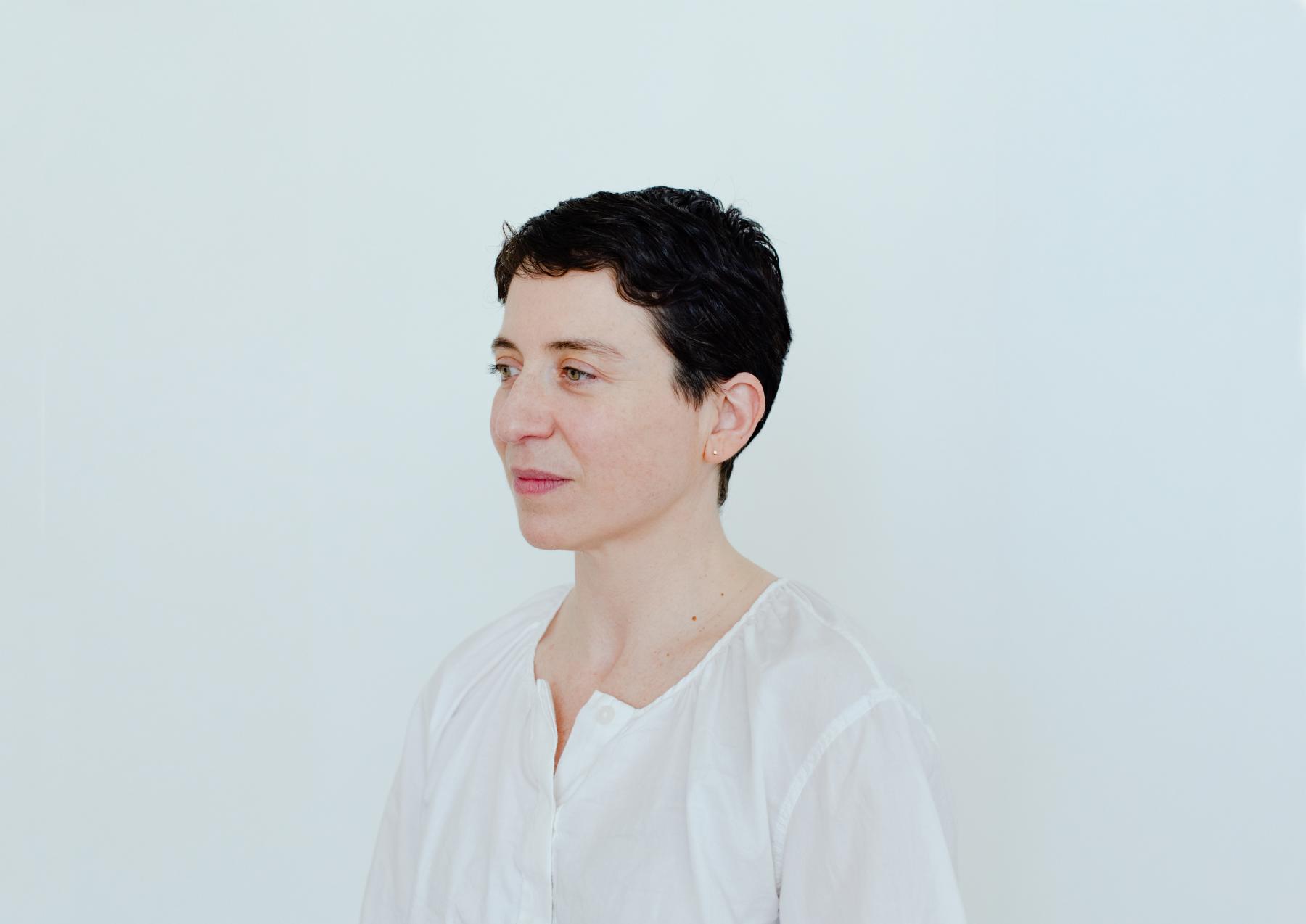
Lucy Ives. Photo by Will Matsuda.
The book I’m holding is sturdy like a rock but appears as vibrant gradation, like a spear of light in a prism or the memory of a peacock in flight. I thumb open the tome guided by one of three ribbons, each a different shade of red, to mark the start of something, or my eager return. Inside I find lines of instruction, but also many other kinds of lines, some that provide directions (“Journey inward toward new exteriors”) or pose questions (“What are the heroics of a lack of heroic qualities?”). Still others simply stretch open the mind.
I’m describing here the properties, physical and psychic, of Lucy Ives’s latest volume, three six five: prompts, acts, divinations (an inexhaustible compendium for writing), out this spring on Siglio. The book is an abundance of things, depending on how you choose to use it. Not least, it is a marvel to behold. Designed by Nathalie Kraft and featuring a suite of drawings by the artist and writer Nick Mauss, three six five aggregates more than a year’s worth of everyday ways to conjure, bend, or arrange time and language, to give shape and contour to the wild movements thought can make, when you let it.
Every time I read something by Lucy Ives I’m compelled to write. That’s true of her novels and poems just as much as the vertiginous essays in last year’s An Image of My Name Enters America, which take her readers to the brink of that genre’s form. That is just the kind of writer she is. So it made perfect sense, when, in 2021, Ives used her Instagram account to circulate prompts for writing, exercises for the mind, and ideas for working collaboratively, many of which now appear within three six five. With this publication, I’m once again provoked by Ives to consider how writing exceeds the fact of being a private symptom. It can be a way to make things, and to make things happen, a reason to gather, a defiantly social act.
I spoke with Lucy about her longstanding interest in the writing exercise or prompt, as well as the process of making this boon of a book. We also talked about her collaboration with Nick Mauss, about the past selves she writes for, and about how writing gives access to ways of living that this world so wrongly tries—but fails—to deem impossible.
It's a relief to realize that the thing we ostensibly don't care about, or don't notice, can become the most precious resource.
Do you remember your first encounter with a writing prompt?
It would have been in school. But it wasn’t until I was a teenager that I learned a prompt can be more than “what I did over summer vacation”; that it can be a game with language.
When I was 16, this kid who was into punk rock was like, “Hey, did you know there's this cool poetry thing, ‘Killing a Word’? And I was like, “No….” And he was like, “Yeah, it's super cool. You choose a word, then repeat it.” And I was like, “What happens then?” And he said, “The word will die. If you keep saying it, eventually it will stop meaning anything.” And I was like, “You can do that?” A light went on and I thought, oh, here is a way you can get around suffering—if I'm not being too dramatic. I'm not exactly a spiritual person, but there is, for me, an aspect of emotional and personal survival, which I could extend to a larger community, that is associated with this sort of practice. (“Killing a Word” is prompt 102 in three six five: prompts, acts, divinations.)
I held onto that first prompt, and over time I found that language-based prompts like this are a way of doing something that's also, simultaneously, nothing. They can help us find balance, a sense of being absorbed or held. They might help us be surprised, or love something that isn’t an object or another person, but that is instead a quality of ourselves and a quality of the world. It’s this enmeshing of the objective and the subjective that is so beautiful to me, and that I think art is good for.
Visual artists often come up with exercises I see as analogous to these writing exercises: thinking of ideas or words as material, as opposed to something that's for expression. This is part of the reason I’m very drawn to visual art. I love artists, as the poet Mei-Mei Berssenbrugge once wrote in a book title.
I first encountered your prompts—which I also think of as poems—on your Instagram account, starting in 2021 or so. How did the idea for this book come about?
I think it all started—by which I mean, the material for the book—around 2014, when I was teaching regularly. There must have been a day when I had forgotten how long the class was or we had extra time, and there was an extended, possibly awkward silence. I was like, “Now we will do a writing exercise that I've planned for a long time! It’s called…Exercise for Writing from Memory.” (This is prompt 72 in three six five.) I had everyone take out a piece of paper. I asked them to write about things that happened in the past, but in a ridiculous way, like something that happened exactly five years ago yesterday, which is a hard mental gesture to execute. At the end of the exercise, I asked everyone to describe something that they’d completely forgotten, which is, of course, impossible. I was responding to how patronizing or sentimental some writing exercises can be. I wanted it to be impossible to do the exercise “correctly.”
The next year, I invented another prompt, “A Group Novel,” which is a multi-part exercise included as an appendix in three six five. I didn't know at first if it would work, but it works! When you are done, you’ve created a novel authored by a group, and you can publish it, if you like.
I don't think of myself as the author of these exercises, exactly. They're co-created, and they aren't about me expressing myself, as much as they are ideas for organizing time and work and imagination that I thought of while working with others.
Maybe because of this, at some point I put them on Instagram. It was soon after the pandemic, and I felt out of touch. I thought posting exercises could be a way to reach people without trying to tell them something—like trying to workshop these ideas. What would people respond to? What would they pass on? In the beginning, I tried to post one a week. Then I tried to post daily, but that became exhausting. It wasn’t the right rhythm.
Lisa Pearson of Siglio press and I had worked together on an edited collection of Madeline Gins’s writing, The Saddest Thing Is That I Have Had to Use Words, and she asked if I had other projects that were a little unusual, that I wouldn't be able to find a trade publisher for. I mentioned these prompts. We decided to try it out.
three six five is a way to have a relationship with other people through the idea of the prompt. It’s also for readers who are interested in poetry in a broad sense, which I think is many people. I like the format of the book—the experience of reading the prompts together—because it becomes clear that they don't have to be used as tasks. You could “use” them the way you would use a poem, aphorism, or very short story. You can read one and think about what's happening, then you can read another. Having them in a book lets you engage with them more as literature than as something related to productivity or creativity in the way these are often iterated on social media.
I read a lot of children's literature, and to me, this book functions like a long bedtime story or episodic verse. It’s immersive.
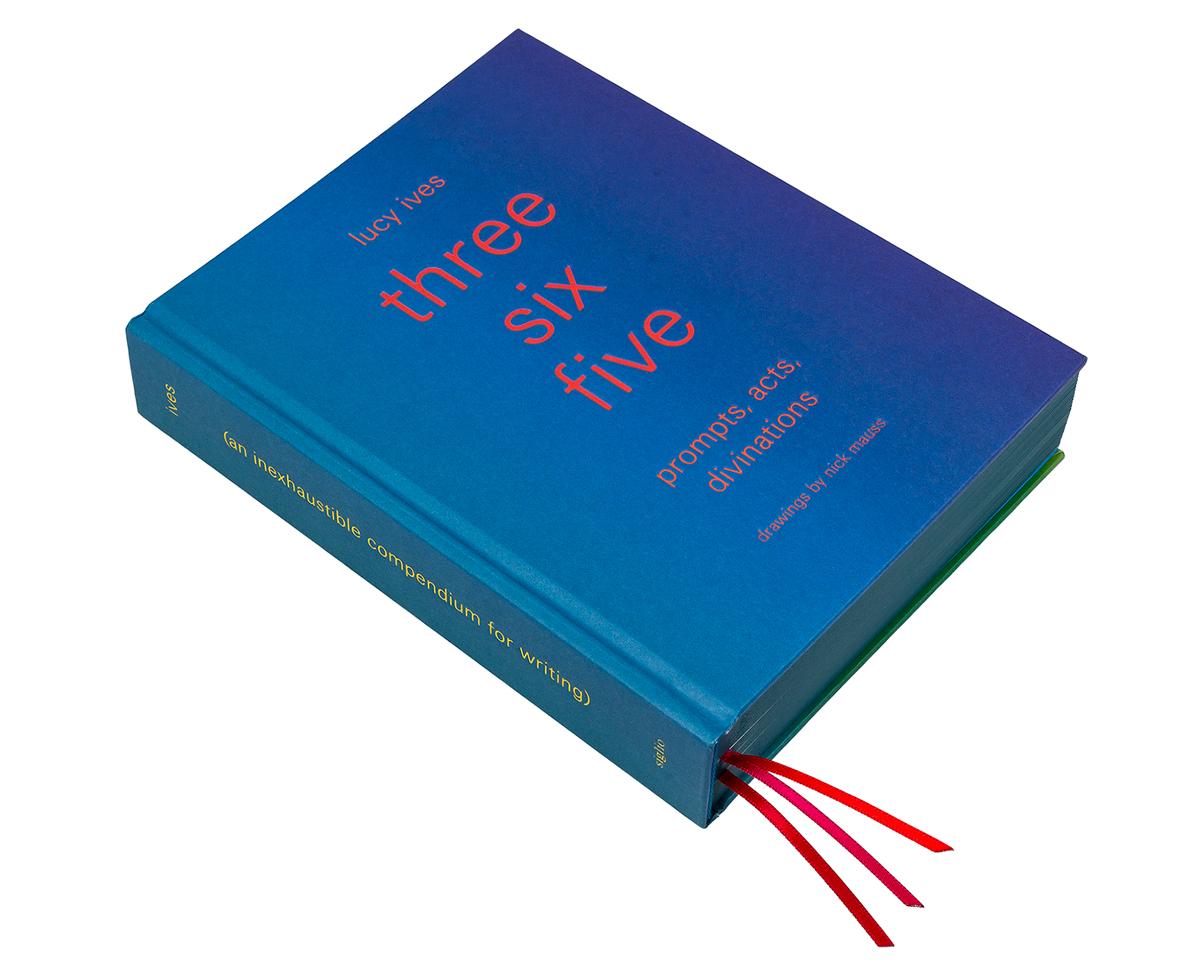
Cover of three six five: prompts, acts, divinations by Lucy Ives (Siglio, 2026). Courtesy Siglio.
Some exercises in three six five are an invitation to write, some are an invitation to do other things: go on walks, take the day off, do nothing. Long non-writing sessions lead to very short writing exercises, as well as the opposite, short spells of non-writing lead to more durational writing exercises.
What’s the relationship between writing and not writing? How, for you, does writing relate to other forms of living?
One of the things I discovered in my early 20s was that you can write things and not know what you're saying. I know that’s obvious, but I still find it profound. I learned you can say things about your life as you're living it that are true. You might not be able to read your own account correctly, or you might not understand everything right away, yet something true is still touched on. There's a form of contact.
I don't know what makes this possible. Is it a feature of language? Does it have to do with the writing utensil, the medium? Is it about doing something with your body? Is it about some inaccessible part of a person, like the soul, that is finally at liberty? You could think about this in a religious or psychoanalytic light; there are lots of different schools, but definitions don't interest me. The possibility and multifarious grace that writing engages are things I was told would not be available to me as a human. I don't know who told me that—if it was culture, America, or my family. But I do know I was told that those things weren't available. Then, through this practice, I came to see that they were.
The prompts that seem paradoxical, like, walk ten miles and write five words, or go across the room and write 10,000 words, are maybe jokes. But they are also very serious attempts to get people out of the clutches of certain ideas we have about what is consequential; getting people to see how broader social measurements we have for what matters are wildly inaccurate.
For example, we tend to think of a single sentence as inconsequential. It's like, who cares? Throw that away. But if you have the experience of taking a long walk and writing a sentence, and you feel satisfaction doing that, you might see a single sentence as really meaningful. You might see how a sentence is amazing, how it's totally worth it to walk ten miles to find it. By the same token, what if you went across your room and that act generated thousands of words? What does that tell you about just being present in your room?
How can this be? That's a thing to think about. It's a relief to realize that the thing we ostensibly don't care about, or don't notice, can become the most precious resource. These prompts might knock you off kilter a little and help you uncover something that possesses a value that can’t be measured—that refuses measurement. It’s something I discovered a while ago and found useful in terms of navigating the world. That's what I meant earlier about survival.
I’m thinking about this claim you make in the book’s introduction: “[Memory] already belongs to you. You have endless amounts. You can never run out.” It reminds me of the fact that even one’s first attempts at writing are fundamentally acts of remembering. When you first learn to write the letter A, for instance, you’re trying to recreate a shape you saw moments earlier. Do you often use prompts or exercises to produce writing? More broadly, do you think writing is always, in some way, responsive?
In my life and writing, I'm often thinking about my past self and how I could help her, how I could write something for her to read that would make her feel hopeful. I know she can't read things I write in the future until she gets to the future, but I'm always trying to write things for her anyhow, so that she can have a reason to make it here, to my present. In the past, I promised myself I would get us to this present, where we have what we need and aren’t in great confusion. I know that's a little cheesy, but that's a big reason I write. My past self is my main audience.
With this book, I wanted to say to the reader, “You have agency.” This said, you don't have to use agency to make meaning from words. You can go into the world and do stuff, or think about the past, or invent something. You can do all these things in a nonsensical way, and that can be gentle, that can be magic. You don’t have to serve reason, or, for that matter, any institutionally certified or certifiable meaning.
To go back to the practice of a young person learning the alphabet, I personally had a long period of not being literate. I didn't learn to read until I was 9. So I know the feeling of being a person who's not literate but is able to watch people read and write and observe their fluency with things that seem strange and difficult.
I'm drawn to holding on to that strangeness because I think that there's meaning and value there that isn’t reducible to semantic or linguistic meaning. There are other forms of meaning that are important, that I want us to have access to. And I do think, paradoxically, writing can give us access to those rare meanings, if we handle it thoughtfully.
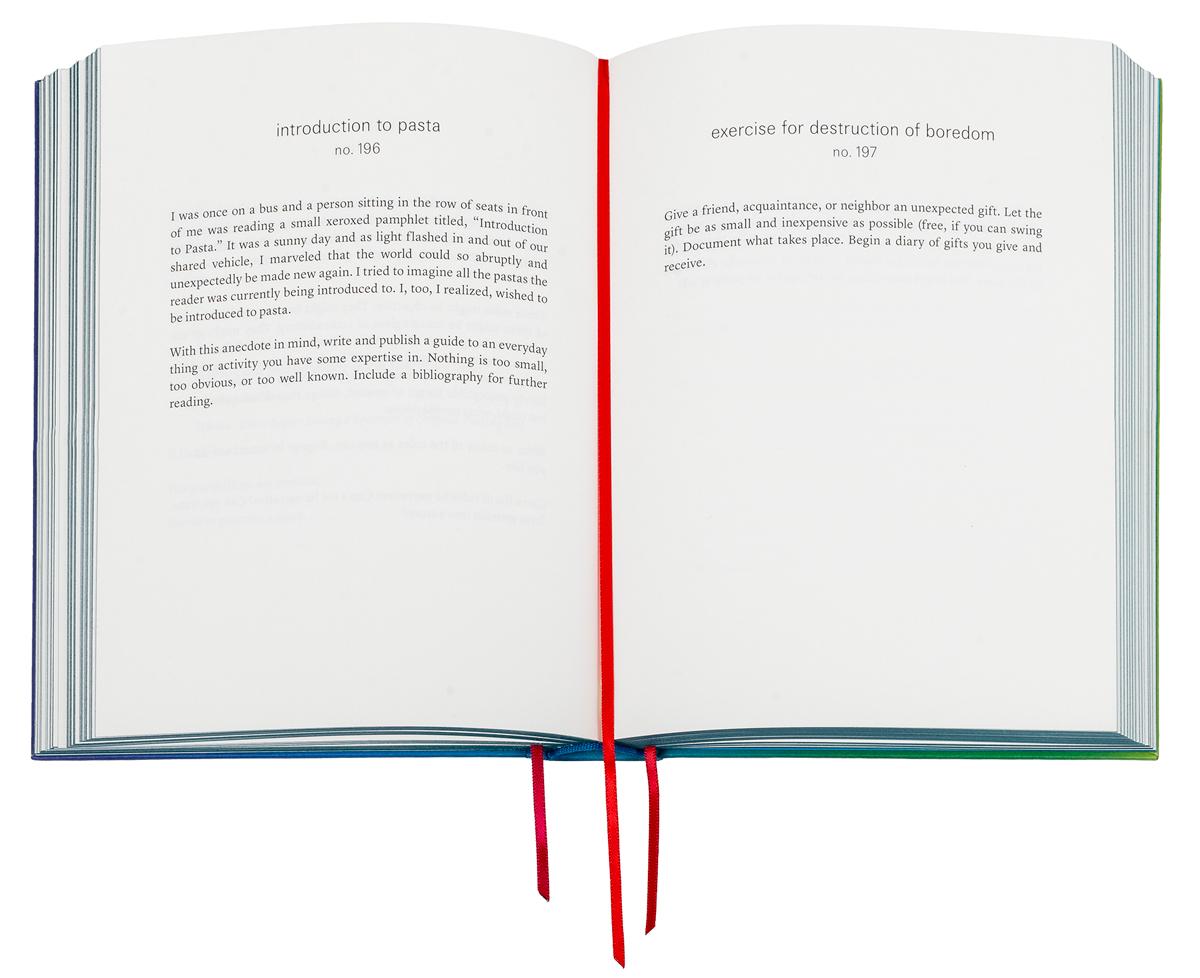
Spread from three six five: prompts, acts, divinations by Lucy Ives (Siglio, 2026). Courtesy Siglio.
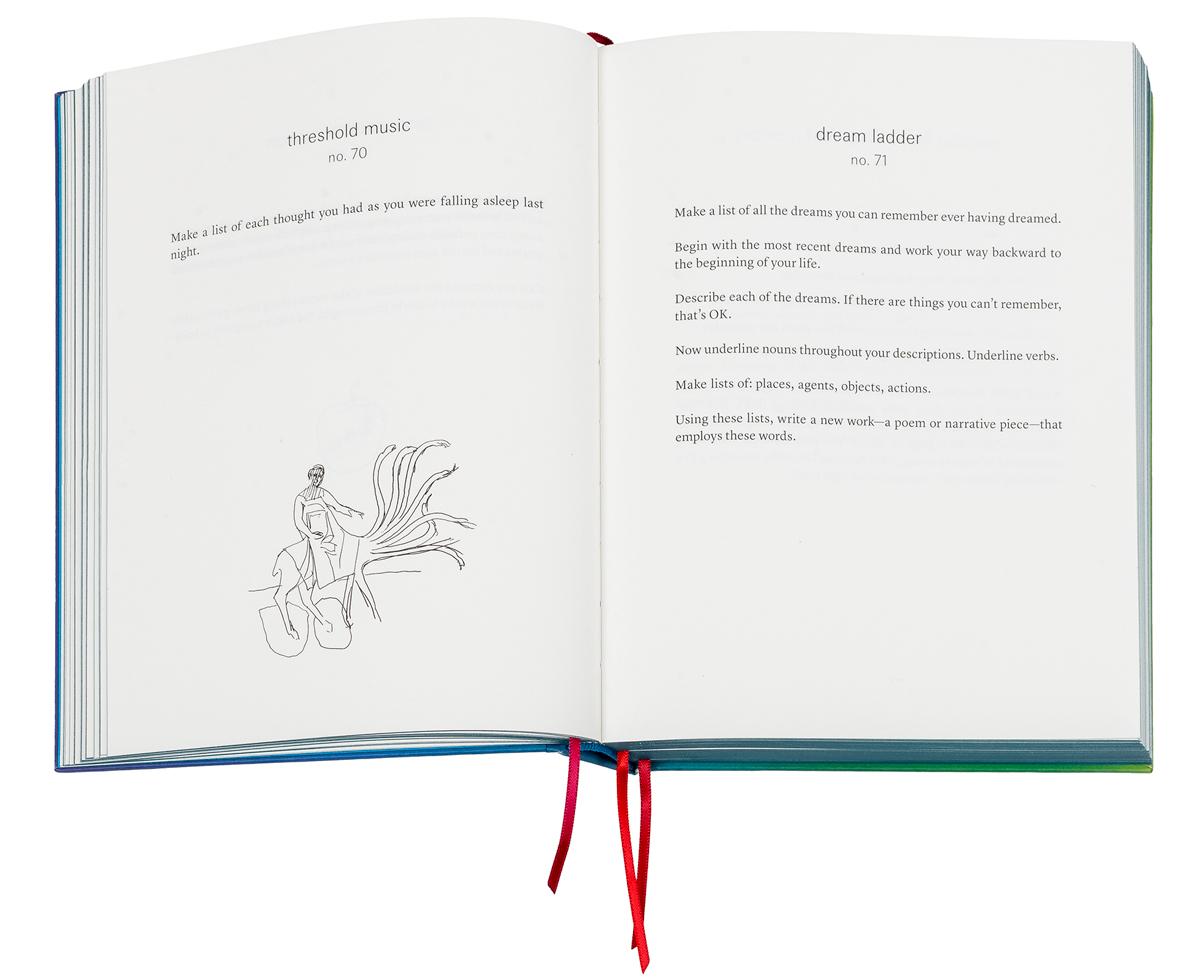
Spread from three six five: prompts, acts, divinations by Lucy Ives (Siglio, 2026). Courtesy Siglio.
This book not only encourages collaborative modes of writing and making, it is also the beautiful result of one. The artist and writer Nick Mauss contributed a suite of drawings that appear very incrementally over the course of the book. How did you and Nick come together for this project?
I've known Nick for a while, I think we met in 2011 or 2012. I admire his sensibility and the way that he works in different media. He's a person who's so careful and painstaking and simultaneously so prodigiously talented. I wrote an essay about his work once that was called, “There Once Was a Person Who Could Draw Anything,” and that's sort of how I think of Nick, like, he can draw anything, you know? He seems invincible to me.
The book didn’t begin with the idea that it would be illustrated, but when we thought to ask an artist, the first person I thought of was Nick, in part because a lot of his drawing isn't representational in the sense of photographic realism. He's a dancer and works a lot with dance, and dances in different ways. Dance creates communities and leaves an archive, in Nick’s orientation to it. It’s also a way to negotiate movement with others or across spaces.
I thought about the fact that this is a big book, and what it needs is a line that's very good at navigating complexity. I think Nick's way of drawing and thinking about lines is germane to what I'm trying to do with the book—the sort of aphoristic nature of it. What the drawings give us isn't exactly a representation of something that would be in the world. Sometimes they refer to things that are happening in the prompts, but often they seem to have just absorbed some energy that's in them.
They're beautiful, and I like them as moments that are also mysterious. It's not always clear what the thing is, and I think it's important for there to be some interpretation that's coaxed out of the person who's looking at the book. Like, do you see this shape as a door that's opening? Or a stop sign? Or an unusual birthday card? What is that thing for you? The fact that this could change over time is important to me.
Going back to childhood and literacy, that's something I remember loving as a kid—noticing myself seeing something in a book and interpreting it differently on an alternate occasion of reading. I wanted that to be possible with this book, too. If you look at the book again, it will reward you. Nick's drawings contribute to this metamorphic quality of the pages.
I like this connection: that writing, like dance, can be used to make things—even a whole archive of things—that are bigger or stranger than the self. Writing, in this sense, is freed from the task of self-expression. As a person who also enjoys purposelessness, I want to ask: When does a response to an exercise become something that resembles or is a “work”?
I can only answer this in a personal way, and the way I think about this is very old-fashioned. Like, somebody has a notebook, and sometimes they write in it, and one day, they either finish writing in the notebook, or they decide to read it, and as they're reading, they find something that surprises them, and they're like, “Oh, maybe I should do something more with this, maybe I should type this page up, because the writing has started being something independent that needs to be more alive.”
I know a lot of people, probably all people, struggle with thinking: “Is this something? Is this anything? Should I keep working on this? Is there any point? Even if it were published and people liked it, would that matter?” We all struggle with this.
But I think you can have an experience of certainty. I mean, it's probably temporary. But you can see it for a second, and you can think, “Yes, this is real. I believe in this.” Like, you've enchanted yourself so much that you start to believe your own story.
Once that happens, that's when it stops being practice or an exercise and starts to be something that approaches a work, so called. But that's just a guess.
I know people love to hate him but Lucy…I feel like you might be the new Rumi! It’s not that I find three six five to be either a very mystical or moral book, but I do think it is intensely philosophical. The exercises compiled here suggest that daily writing gives one access to any number of otherwise impossible things. How is writing similar to or different from spiritual activity?
One difference between Rumi and me (there are many!) might be that, instead of something like scripture or the soul, I’m interested in a more material notion of writing, because it is a preeminent medium for movement through the world and transformation. Mine is a secular experience of this movement and this transformation, because that’s what I’ve got. Not because I'm down on anybody's beliefs, but because I just don't have access to certain levels, like the divine—although I do go in for the irrational and the intuitive, and various hints, upheavals, and impossibilities. I'm flattered by the comparison to Rumi, so thank you. As I was saying earlier, the one thing I know about writing is that it shows me there are things in the world that, by and large, people in technocratic society are told don’t exist.
It would be difficult to enumerate all those things, but the main takeaway for me is that the self (I mean, it's an Emily Dickinson truism) is way bigger and older than we generally comprehend, and for whatever reason, I don't know if it's culture or what, we have severe and even tragic limitations in terms of sensing the vastness and diversity of the self. That vastness is a thing that makes what’s happening here on the planet a bit less overwhelmingly corrosive for me—the vastness and ancientness and plural-ness of the self. It seems that if the self is connected to the past, it's also connected to the future—and therefore aspects of the future can become accessible through writing. I don't feel comfortable saying more than that, because I can't promise anyone that they're going to be able to, like, make a lot of cash on the stock market if they do the right writing exercise. I’m not in that line of work. But I have tried to be interested in the pathologically secular world I exist in, and respect that, and not try to fake it. A teacher once told me, “Acceptance has a form.” This statement made me incredibly angry at the time, given certain human activities, but I continue to ponder it. Maybe what I ask myself is what I plan to do if acceptance, as such, is not possible. How will I meet death? What will I eat for lunch tomorrow?
These prompts represent one person’s attempt to think about agency differently, to expose herself to other, denigrated aspects of it. This is important to me as a teacher, but also as a person. Agency is troubling. It doesn't work the way we want it to.
On that note, many of the prompts invite readers to channel or spend some time with moods or thoughts that are conventionally negative, including obsession, paranoia, or conspiratorial thought. There's even a prompt called “Ugly Feelings” (no. 154). How are abhorrent feelings related to writing?
Fear and hatred can be extremely exciting emotional experiences. They make your hair do funny things, and they make you feel compelled in certain ways.
There’s a Frank O'Hara poem where he's like, “Hate is only one of many responses.” And he says, “Why be afraid of hate, it is only there / think of filth, is it really awesome / neither is hate.” I find that question useful. “Is it really awesome?” I ask myself that all the time.
Extreme feelings like fear and hate can be easy to have. They dissipate quickly, or you can stockpile them, if you want. They often feel portable, contagious, volatile. They’re everywhere.
There are other feelings more difficult to have than, say, fear or hate, feelings like disappointment, for example. Disappointment can be one of the most difficult feelings to experience, because it can range from something like, “My mom didn't love me,” to something like, “I forgot the card I need to get into the swimming pool today, so I can’t go swimming.” But it's not about getting over or blotting out these liminal feelings as much as it is actually having the experience we're already having.
This book is less about a feeling like fear than it is about a feeling like dread, less about hate than disappointment. It's about trying to find ways to turn into those feelings, or back toward them, or treat them like they're a familiar character you’re in dialogue with. When you can be in dialogue with ugly feelings, there's so much material. Once you can have that relationship, it's like a superpower. You can endlessly create from that dynamic. Now, who knows why things are like this? I don't know. Fear and hate make us do destructive, irreparable things. These other feelings that are more ambiguous and difficult can help us do other things and have other forms of agency that are challenging to have, and that people later admire. I often notice that visual artists are engaged with one or more of these difficult, ambiguous feelings to produce whatever they're doing, and it's the reason their work is so engrossing. It has those same features of ambiguity that difficult feelings have.
This book is a form of hoping—that you don't have to be those ugly feelings, because it's very hard to be them, but instead you can enter into a relationship of mourning or grief with them, a relationship of irony, or even something more joyful.
There's an exercise in the book I've never done but wish I could. It's an exercise to make a list of all the mistakes you've made in your life. (This is prompt 167 in three six five, “exercise for recovery of joy.”) I would like to be able to do that exercise. I think it would be an incredible autobiography. It's hard to explain the emotion that would accompany this writing but I have the intuition that writing something like this would give life back to me. That's the reason it’s so difficult. Because it's frightening to get life back. We’re more comfortable with having lost life, for whatever reason. I don't know why.
In My Life, Lyn Hejinian writes, “I saw my life as a struggle against my fate, that is, my personality.” I often think about the equivalence she makes here, of fate with personality, and life as that which is made despite them. Your book does a similar thing, reminding me how writing enables a liveliness that personality, or memory, or experience alone cannot. I’m sorry, this is not a question.
That’s a beautiful statement.
There's a commonplace people use about the “hand” you’re “dealt.” I think the personality Hejinian is talking is an orientation to that “hand.” It’s how you play the game. You could think about it like perspective in a video game—first or third person, for example. Fate is a format.
When a format becomes narrative, it has consequences, right? It’s particularly consequential if you don’t know what the format is and you’re stuck in the narrative. That’s what Aristotle thought theater could be good for, helping people learn about format so tragic loss would stop befalling them. In some peoples’ conception of this innovation of Western culture, you can create narratives that allow for full recognition of the format. I’m speaking broadly. Freud might have touched on this.
However, I have doubts about recognition as the thing that solves for fate. I'm not sure recognition allows us to understand the origins and consequences of action, which is another way to talk about fate. I think it's an interesting paradox that even perceiving your actions may not be enough to save you from whatever caused them or their reverberating aftermath.
These prompts represent one person’s attempt to think about agency differently, to expose herself to other, denigrated aspects of it. This is important to me as a teacher, but also as a person. Agency is troubling. It doesn't work the way we want it to.
The reason these prompts aren’t lyric poems or philosophical aphorisms is because I'm so interested in agency, in the many things it might be or become, once you begin to contemplate it in its most forgotten guises. Which are actually the only parts of it that are, in my opinion, possible and truly alive.