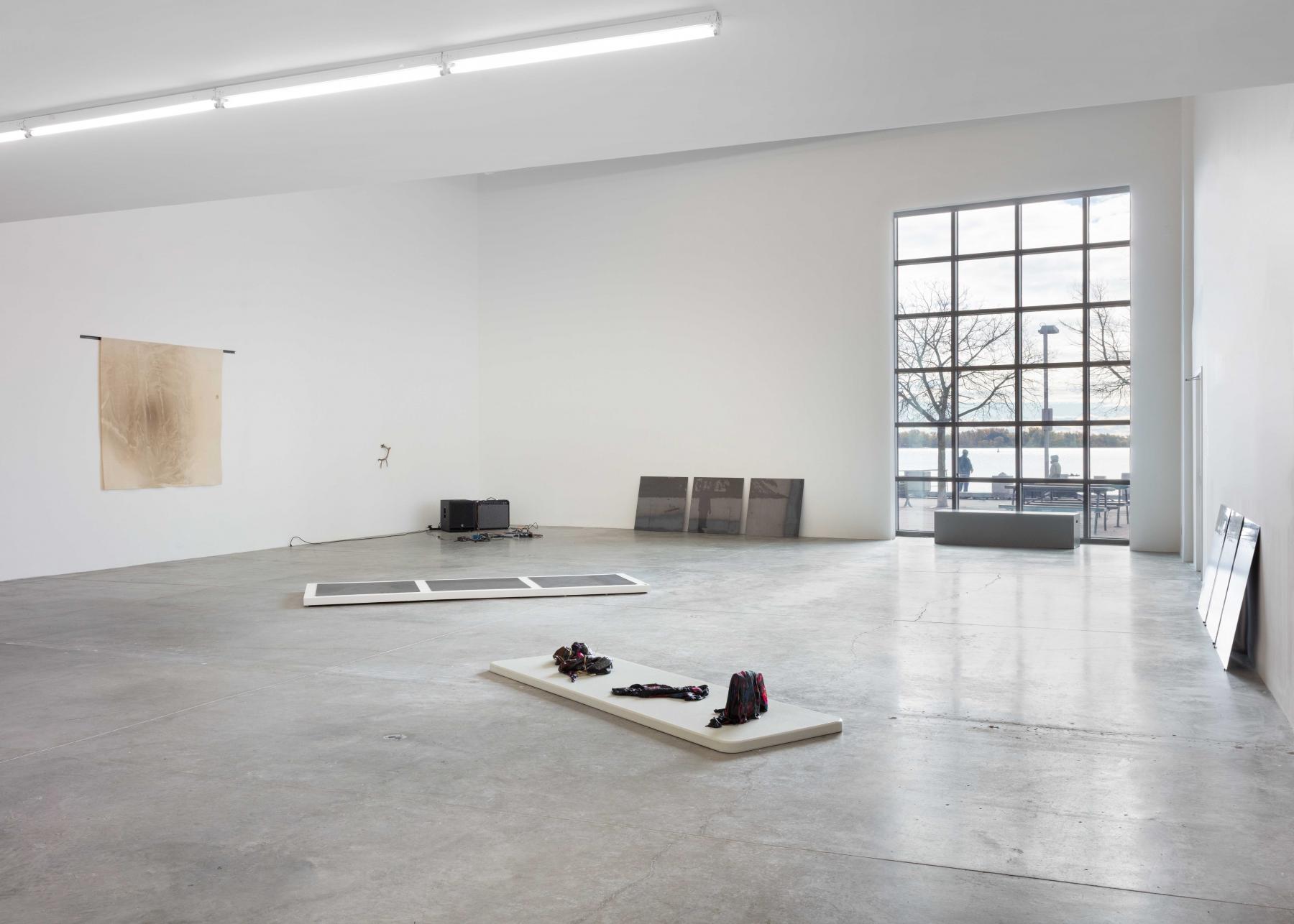
Jeneen Frei Njootli, The skies closed themselves when we averted our gaze, 2025. Installation view: The Power Plant, Toronto, 2025. Photo: LF Documentation.
On a bright February day, I arrived at the Toronto shoreline of Lake Ontario bundled in my winter layers covered in a dusting of fresh snow. I tapped the slush from my boots against the Harbourfront Centre’s doorframe to visit The Power Plant Contemporary Art Gallery. Conscious of swishing fabric and leaving melted snow in my wake, I entered Vuntut Gwitchin artist Jeneen Frei Njootli’s solo exhibition The skies closed themselves when we averted our gaze. The Power Plant exhibition brings together works from a period of over ten years, revealing the artist’s sustained engagement with the relationships between body, land, and material transformation. The first artwork I encountered, As we fly through each other (2024), is a set of work overalls that appear as if they have been hung to dry. Like many garments and objects in the artist’s practice, they have been dipped in resin, glistening as though still wet. Throughout the installation, textiles and resin are joined by other materials that have endured over the course of Njootli’s practice—such as steel, hide, and beads. Each material registers subtle shifts in atmosphere, producing surfaces that glisten, refract, or absorb the light that drenches the gallery. Working with what is available in their remote community in Yukon territory, Njootli foregrounds material as both a site of constraint and a tool for survival. Garments are cast into stillness, tools are reconfigured, and gestures from performance persist as residue within the gallery space. Sound and smell operate as equally vital extensions of the work, permeating bodies and architectures while remaining resistant to containment.
After visiting the exhibition, I connected with Njootli, who joined me virtually from their home outside of Old Crow. Before diving into the interview, we chatted about the community meeting they were attending that evening for a letter writing campaign, focused on recent events impacting Porcupine Caribou’s calving grounds. It felt fitting to informally open with their participation in and commitment to community events and Indigenous activism, which is woven throughout our interview as an embedded part of their life and art practice. Throughout our conversation, the artist’s work is situated within a constellation of influences, collaborators, and kin—positioning relationality as a foundational principle. Njootli speaks to the presence of family, children, and community within the exhibition space, challenging institutional norms around who is welcomed and how. Acts of refusal—whether through obscured visibility, distorted sound, or the withholding of documentation—become strategies of care and sovereignty. Situated within a broader network of kinship, influence, and shared knowledge, Jeneen Frei Njootli’s practice emerges not as an individual gesture, but as part of an ongoing, collective process of making and world-building.
I think we're taught in some ways that the goal is to centre your voice and be the loudest in the room, but I desire that less and less. I just feel like there's always more people to credit and different things that could be said.
The first time that I saw you perform was back in 2019 at the Art Gallery of Burlington. It’s a bit of an arbitrary time frame, but I am wondering if we can start by considering what has shifted in your practice in the last five years or so. What has changed, or what has endured?
I've really enjoyed returning to working with steel. Back then I was working with grease or impressions of my body into steel, but now I’m doing epoxy screen prints onto it. I've been thinking about the steel as land, the steel as body, and always being informed by the work of BUSH Gallery. I’m still figuring out how to collaborate with the steel, to make images, but through a different process. I've worked in a way that is photography-adjacent, but I want to just saddle up a little bit closer to it. Photography makes me so uncomfortable. I didn't trust it in 2019 and I still don’t.
Do you feel like your relationship with photography, this mistrust, is shifting a bit? Or what was it in you that sparked the curiosity in terms of working with the steel differently, moving closer to representation?
I'm pleased with the 2024 steel works in The Power Plant exhibition because they're so hard to photograph. Sometimes when people see digital documentation, these works are dismissed. But then when people encounter them in person, something else is allowed to happen, or the impact registers differently. That’s some of the feedback that I've gotten about those pieces. I'm thinking about the fugitivity of images, and thinking about making fugitive images—I have to mention theorist and critic Fred Moten here.
The steel works also came out of a period where I was trying to figure out how to make work while living in Old Crow, and I'm so grateful to Sarah Macauley of Macaulay + Co. who has really supported and helped me maintain my art practice while living so remotely. I work with what is available to me, and at times that has meant packing work in kind of sketchy cardboard boxes. I had also done this exhibition attachment (2019) with Macaulay + Co., when I started to dip things in concrete. Or, with the work Have you ever whispered under your breath, “fuck you aunty” (2024)—it’s a hanky draped over a drill, cast in resin—these are all tools for survival and for making a livelihood. I like taking something that's been on the body or in relationship to the body and then making it static in a way that doesn’t produce a legible image, but still gives that sense of its relationship to the body in movement.
All these materials that you're mentioning—whether it's the steel, or the provisional use of cardboard to ship the works, or the cement—whatever it is, these are all relatively accessible materials, they're functional. To respond to your comment about fugitivity, I was really struck by the idea that certain kinds of work can resist documentation. There's something so interesting about the way that light moves through that space at The Power Plant. The wide range of materials that you work with interact with light so differently. Some glisten, some refract, some absorb… I wonder if we could talk a little bit about the space of the gallery itself, its architecture, its place in the city. Did that site shape your decisions around the installation or around working with acoustics or choreographies?
The installation team removed the drywall that had been covering the south facing window—not all exhibitions allow for the light to pour in that same way. It was a joy to see the way that the light reflected off the lake and onto the steel works, the body of water, the body of the gallery, the body of work—which are images of regalia I made for beloved little ones—reflecting and echoing. Also how the grid of the window frames would cast a shadow at certain times on the floor in front of the triptychs. I was also really interested in working with the cracks in the concrete floor.
Oh yeah, there’s some interesting history there with different installations. I know about this because I was working at The Power Plant at the time, but the artist collective Tercerunquinto excavated a large square of the concrete to reveal the ‘foundations’ of that specific gallery in Mine (2015). A few years later, Kader Attia also inserted these large, industrial staples that ‘held’ pre-existing cracks together in The Field of Emotion (2018). I loved how the loose beads from your performance have collected in these cracks. There’s already the residue of other installations that remain in that space and you’ve now contributed to that accumulation in your own way with traces of your actions. It feels very special.
Thank you. I also want to say I loved working with the team at The Power Plant. They were so supportive and honestly, as a parent with two children—wow, what an unreal and unheard of experience to have in the art world. I had to drop out of a residency at the Banff Center recently because they changed their policy around children in studio spaces. I saw a quote—I'm trying to remember who it was from—but just about how different it is within matriarchal societies, where it's not about centering women, it's about centering children. If people say they want to support Indigenous artists, that means you also have to support children because they are our community. That's why we say ‘all my relations.’ It's actually for all of your relations, it's not just about centering the self.
In terms of thinking about the architecture, I don't know if I can talk about it without talking about my children. I think there's some museum and gallery architecture that inherently feel inhospitable. Whether it's our youth or our elders, whatever it might be, who is welcome there and how are you welcome to show up in those spaces? Grandmother Kim Wheatly, who is an Anishinaabe Elder, did a blessing in the space with me and my family, artist Lucy Raven, and the staff at The Power Plant before the exhibition opened, and one of my children was taking up so much space while Kim was talking. I tried to prepare us for going in and I just remember feeling so anxious about the acoustic space my kids were taking up while Kim welcomed me and my family and the work to these shared territories. At the end of it, she just reassured me and thanked us for being there and was like ‘your kids were perfect, that's what they're supposed to be doing.’ People want to talk about decolonizing spaces but I'm like: Let's bring a child in there and see how true that is! Let’s see how much of this is just theory or rhetoric. How welcome are children in these spaces?
I brought a caribou antler to gift to Kim and the caribou antler punched its way through my bag on the way to Toronto in three different spots. I thought, ‘oh, that alone is a sculpture’. It's this blue floral printed bag and then the caribou antler just poked its way through. I just love that—the antler not knowing how to be contained! Bringing gifts from my homeland to share was important to grounding my work here and I brought some moose that my brother and nephew hunted to share. But I also need that. I need for me and my kids to be eating our traditional food, and I'm so thankful to my family for sharing with us so that we can share with others too. That's all a part of how I think of being in this place. How do we enter a space, and how do we try to do that in a good way?
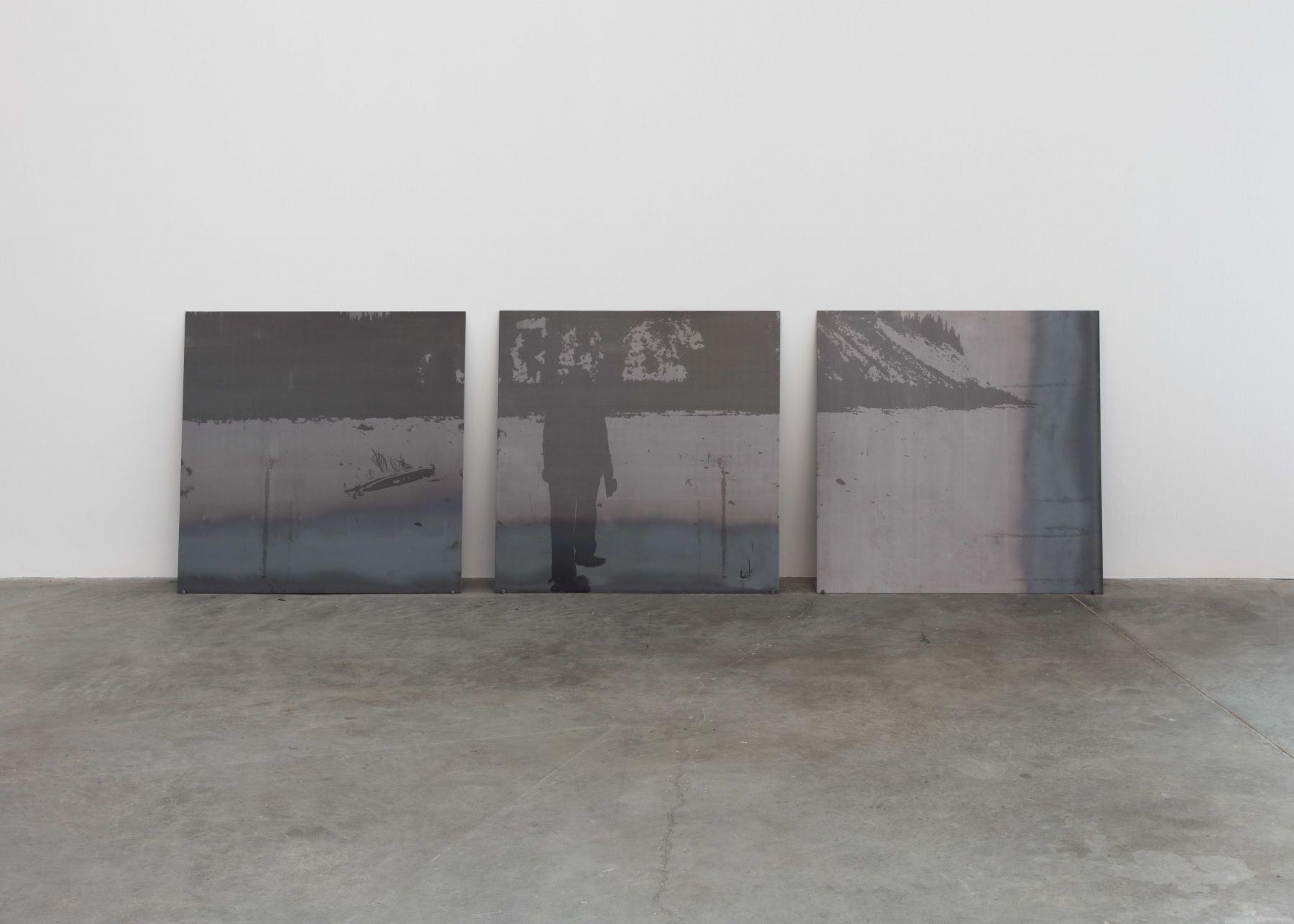
Jeneen Frei Njootli, Dreaming of new futures, greater empires have fallen, 2024. Hot rolled steel,epoxy. Courtesy the artist and Macaulay + Co. Fine Art. Installation view: The skies closedthemselves when we averted our gaze, The Power Plant, Toronto, 2025. Photo: LF Documentation.
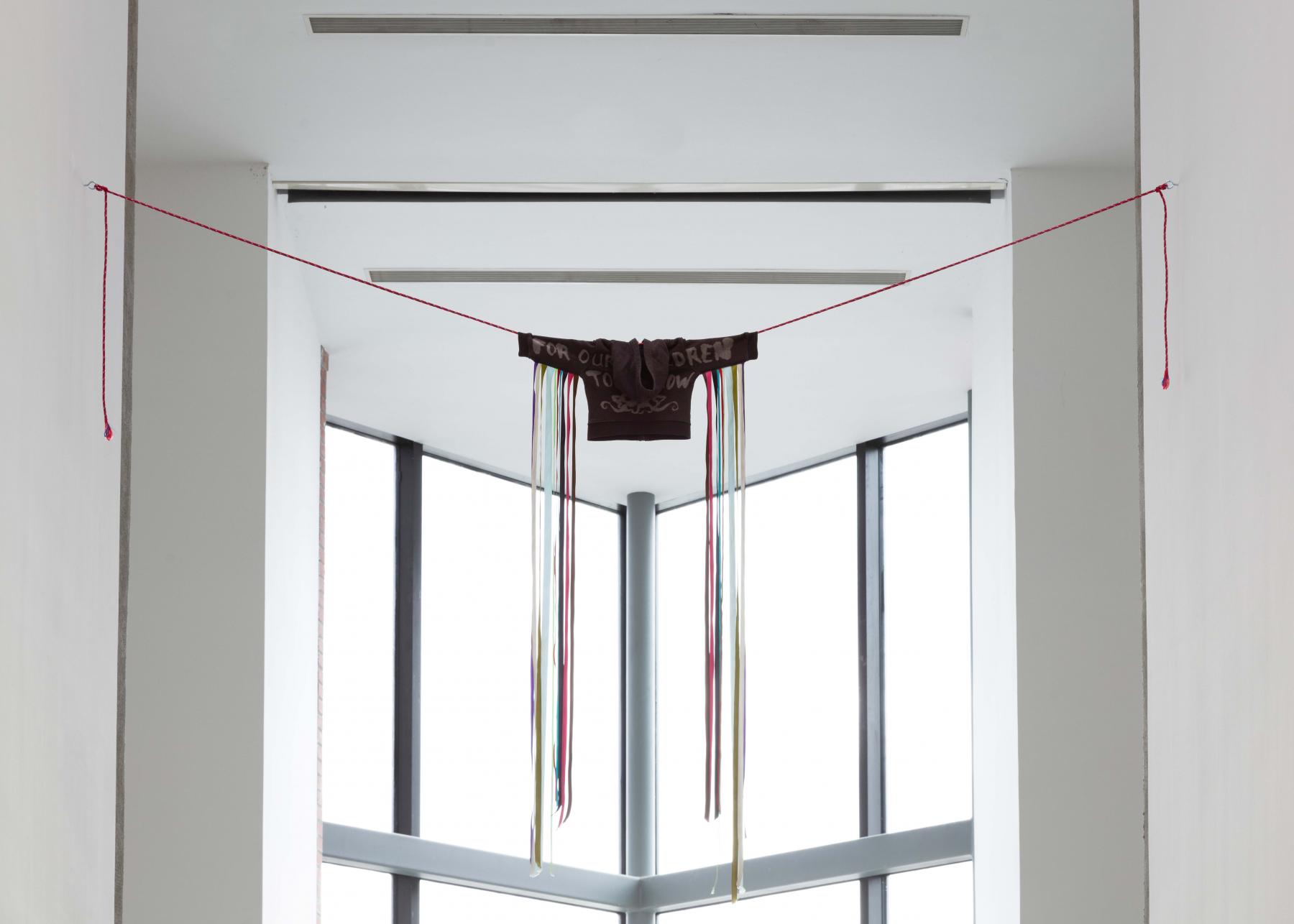
Jeneen Frei Njootli, 1973, 2025. Cotton, bleach, ribbon, rope. Courtesy the artist and Macaulay + Co.Fine Art. Installation view: The skies closed themselves when we averted our gaze, The Power Plant,Toronto, 2025. Photo: LF Documentation.
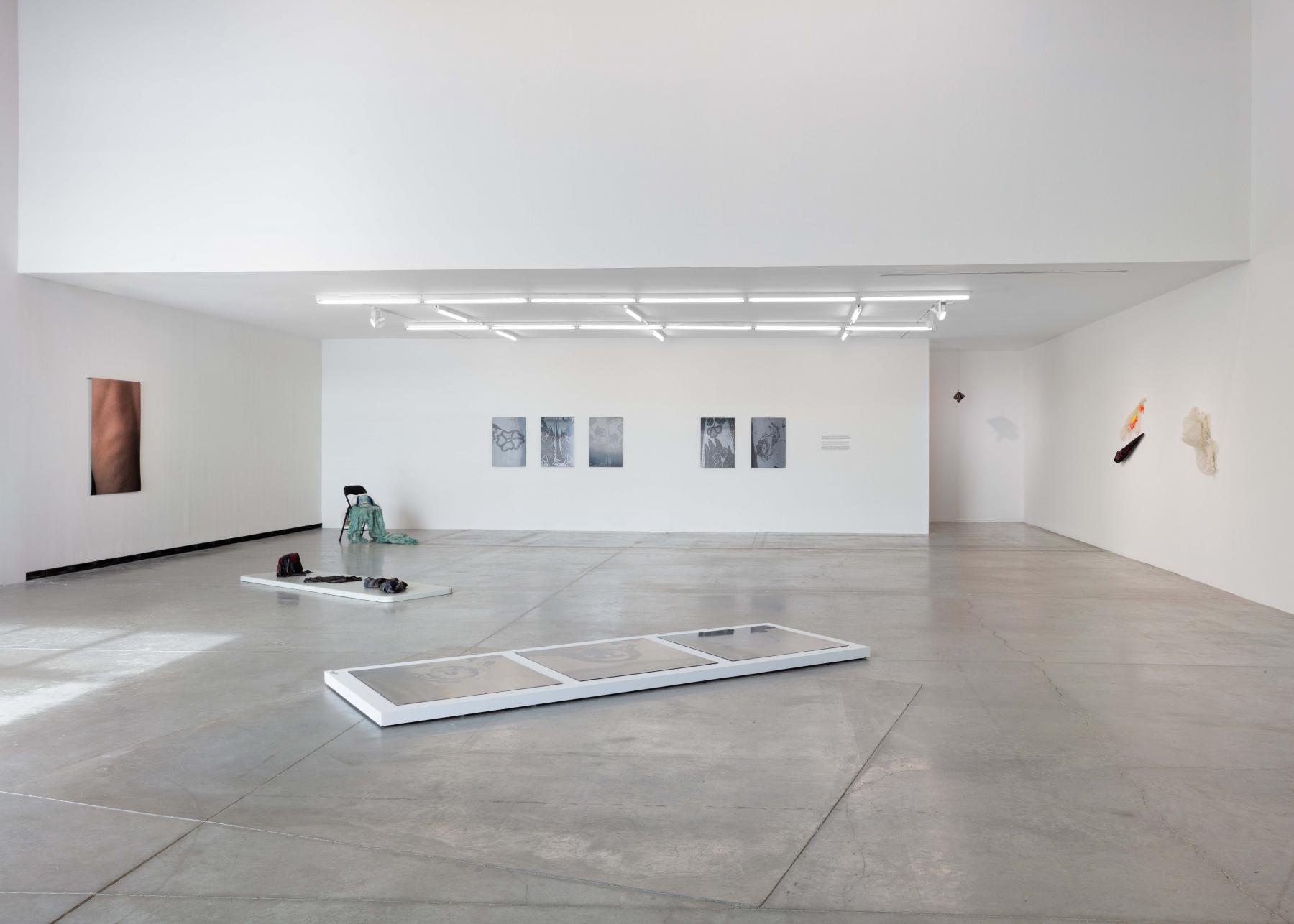
Jeneen Frei Njootli, The skies closed themselves when we averted our gaze, 2025. Installation view: The Power Plant, Toronto, 2025. Photo: LF Documentation.
I’m so glad to hear about the relational aspects of being here and realizing this work. This bleeds into my next question. Many of the artworks in the exhibition are rooted in and formed from your home community in Old Crow. How do you navigate bringing this into disparate context, or what has it felt to share this work with the community in Toronto?
It was really cool. My mom and dad both came out to support me and we went to 2 Spirited People of the First Nations, an organization with a space east of downtown Toronto. We did a public program there and my dad shared with the group. It was absolutely incredible. I have to say I felt so grateful to hear my dad share and speak like that, I wasn't sure what kind of presentation he would share. And again, relationship building involves sharing food and being with community: having some youthies or some of the people who work there just being like ‘wow, it's so it's so cool to hear an elder support two-spirit Indigenous youth’ and talk about the importance of including our rights when we're talking about the rights of Indigenous people. It's important to talk about the rights of two-spirit Indigenous people when we talk about governance and it was really validating.
I’d like to linger with this conversation about community. You recently had a conversation with writer Lauren Wetmore for the Momus podcast which was really illuminating for me in terms of understanding your relationship with writing and language. I’d encourage readers to spend time with all that you’ve so generously shared in that episode. You touch on the place of refusal in that interview, particularly in relation to Gwich’in language and community knowledge. I wonder if you can share how that translates to the material elements of your installation—deciding what is shared, what is withheld?
For years, I've made sound tools. I've turned different belongings, different items into sound tools and then I've run the resulting sound through distortion pedals, an amplifier and a subwoofer. I would sing or speak language through those belongings. The distortion shifts the intelligibility of my utterance and maybe shifts the sovereignty of making an utterance within a certain space or within another person's territory. More recently, I’ve started to work with my children in performance which is just as unwieldy as working with feedback. These two elements make the sound work and performance an exponentially more dynamic thing to navigate. Sometimes it’s stressful! (laughs) But I’m also thinking about protection and have not been working with photographers when I'm performing—to protect my children and myself, and maybe invite a viewer, listener, or witness to think about the forms of labor that are happening.
I decided to make regalia that can also be a tool of refusal, so having the fringe coverings over the face is part of that. But fringe is also traditional for us as Gwich'ins. I love how Hunkpapa Lakota artist Dana Claxton talks about fringe as a relationship to the land, to the body, to spirit. She and performance artist James Luna have had a huge impact on my practice and in performing with my son. It's so cool to invite his agency into a space that's usually so serious. Dealing with refusal as a parent and then dealing with refusal in an art space—it's a totally different thing to navigate. It's so cool that my son loves performing and loves performing with his face partially covered in fringe. I just absolutely love that it's not overstimulating, he doesn't feel claustrophobic in there—it's really special to be in that space together with him.
That's amazing! Thanks for sharing a bit about what the experience is like for him, too. It sounds like it's a really joyful way to be together.
We got to perform together at BUSH Gallery, Mackenzie Art Gallery and The Yukon Arts Centre, all in the last year.
Amazing! I’m wondering what shifts for you between the moment of performance to the durational exhibition format, where material traces are left behind.
I missed those garments that we performed in. I kind of wished I had them during the run of the exhibition at The Power Plant, but it's good that they were there. I wanted people to feel a sense of aliveness in the exhibition space, which is also why I love working with performance and having the sound from the performance in the space afterwards. To have a solo exhibition at The Power Plant is not something that I thought I would ever achieve and to get to see so many of my works from over the years together under one roof was so meaningful—it was so exciting for them to get to meet and share space. Especially installing in the clerestory space—the former coal storage.
The exhibition had an incredible constellation of work, and there's this accumulation of output from your process over several years. I wanted to ask you about revisiting works like More Than Medicine Should Burn for You (2020) and Sky Daddy Undid Their Flags and Braided Others (2020). In the narrow clerestory, these older works have been brought into dialogue with a new work, 1973 (2025). Can you talk me through that process of revisiting these older works and bringing them into dialogue with newer works, or what it’s like to see them in a new light?
Mahsi for this question. It felt emotional to get to showcase these works. They were made with such urgency and were in response to very loaded, political moments. I’m glad that they got to be together in the exhibition space. I think a lot about belonging, or what's shared and what's not shared. When I look at these works, I also see the works that are not shown, the ones I have gifted to people or have made for people that I love. I've been a kitchen table artist for many years now and although I have had certain achievements, I’m still humbled when people find things that I have made important and give them space.
I think we're taught in some ways that the goal is to centre your voice and be the loudest in the room, but I desire that less and less. I just feel like there's always more people to credit and different things that could be said. I want to acknowledge that this work is generational and it's not just me out here, we're all working in these kinship systems. So many people had to work so hard for us to have what we have now, but we are still in colonial peril. In many places the strategic violence needed to feed capitalism is ramping up. I hope that this leads more of us to a deep space of undoing, of community building, of parallel balanced systems so we can move towards wholeness. Free Palestine, Free Sudan, Free Congo, Free Cuba, Free Turtle Island.
If anyone hasn't read “The Glossary of Haunting” by Unangax̂ scholar Eve Tuck, please do. Earlier, before we started recording, you and I were talking about the fact you can stew in the darkness alone, but we really need to be leaning into community. I’m just appreciating all the ways of building community. We all need to learn how to grow food. I'm really enjoying listening to “How to Survive the End of the World” by writers, facilitators and activists Autumn Brown and adrienne maree brown, and spending time with Anishinaabe educator and artist Quill Christie-Peter's book On Wholeness: Anishinaabe Pathways to Embodiment and Collective Liberation. I want to uplift Quill in the amazing work that went into making that book—the way that she's holding space, making and building community, and challenging so many of us to dig deeper and do the work, to be part of undoing and world building.
I think it’s beautiful that you’ve organically shifted to generously sharing about the community members who are shaping you, texts that are shaping you, world events that are shaping you—and it came from this prompt to thinking about the outcomes of your practice in recent years. For some, it might seem like a meandering path, but to me, it seems like having the ability to sit with these older works gave you an opportunity to really value and celebrate those you’re in a sustained dialogue with—to recognize what has allowed you to continue making over that period of time. To me it makes sense that when we revisit the work we've been making, sometimes what comes up is just all that gratitude we have for what allows us to do that work, even if as we're doing it we're not quite sure like where it's leading…Does that resonate with you? I don’t want to project!
Wow, yes, thank you so much. I mean those works are connected to community, but were also made as a response to and processing of violence. I also want to also acknowledge Cree scholar Karyn Recollet who talks about ‘kinstillatory’ relationships with stars, and oh my gosh, there's just so many people… like curators Candice Hopkins and Dylan Robinson with their publication Soundings that just came out, it's so gorgeous. There’s my friend Anishinaabe artist Olivia Whetung—we were in grad school together, too. There’s just so many people. I think that's the goal, we're shaping and influencing each other and get to be open to that.
Thank you for calling in some of the folks who are a part of this bigger conversation for you. I want to take this as a cue to talk a little bit about one of the sculptural elements in the gallery space which hinges on this topic. There’s a plastic folding table that sits on the ground as a kind of plinth for three artworks—Polycrisis while that, hope harbours in this heart (2024), Doing butch things (2024), and Have you ever whispered under your breath, “fuck you aunty”(2024). Can you tell me a bit more about your decision to work with the folding table as an object we gather around to share meals, to have meetings, to come together in ceremony?
I was in an exhibition with artist Dayna Danger, A Fine Pointed Belonging (2019), that was curated by Genevieve Flavelle, and we made work for the exhibition space around this black folding table. We wanted to exhibit the table that we made the work with or that we made the work on. And as somebody who has done community organizing for 12 years or more, I could close and pack the biggest folding table with my eyes closed, you know? There’s a way you like, kick this hinge, kick that hinge, click that down, and then you kick it up. Folding tables are just deeply familiar to me. They feel like community, they feel like painting with youth outside, they feel like a barbecue, like a bubble party, they feel like reading important documents before a meeting, they feel like fighting for our sovereignty, they feel like cutting fish. All of those things are brought forward, and I love that the marks of the labor from the back of house crew at The Power Plant is made visible there through all the X-ACTO knife cutting marks. I'm not really a big fan of plinths. For May we all know sovereign skies (2024), I think that was the first time I felt that the work needed a plinth. Other than that, I just want everything on the floor. This work just felt so sensitive, it needed to have that space around it and that elevation, that respect. But otherwise, I've always enjoyed using fur as a plinth or a trolley or a moving cart or the collapsed table.
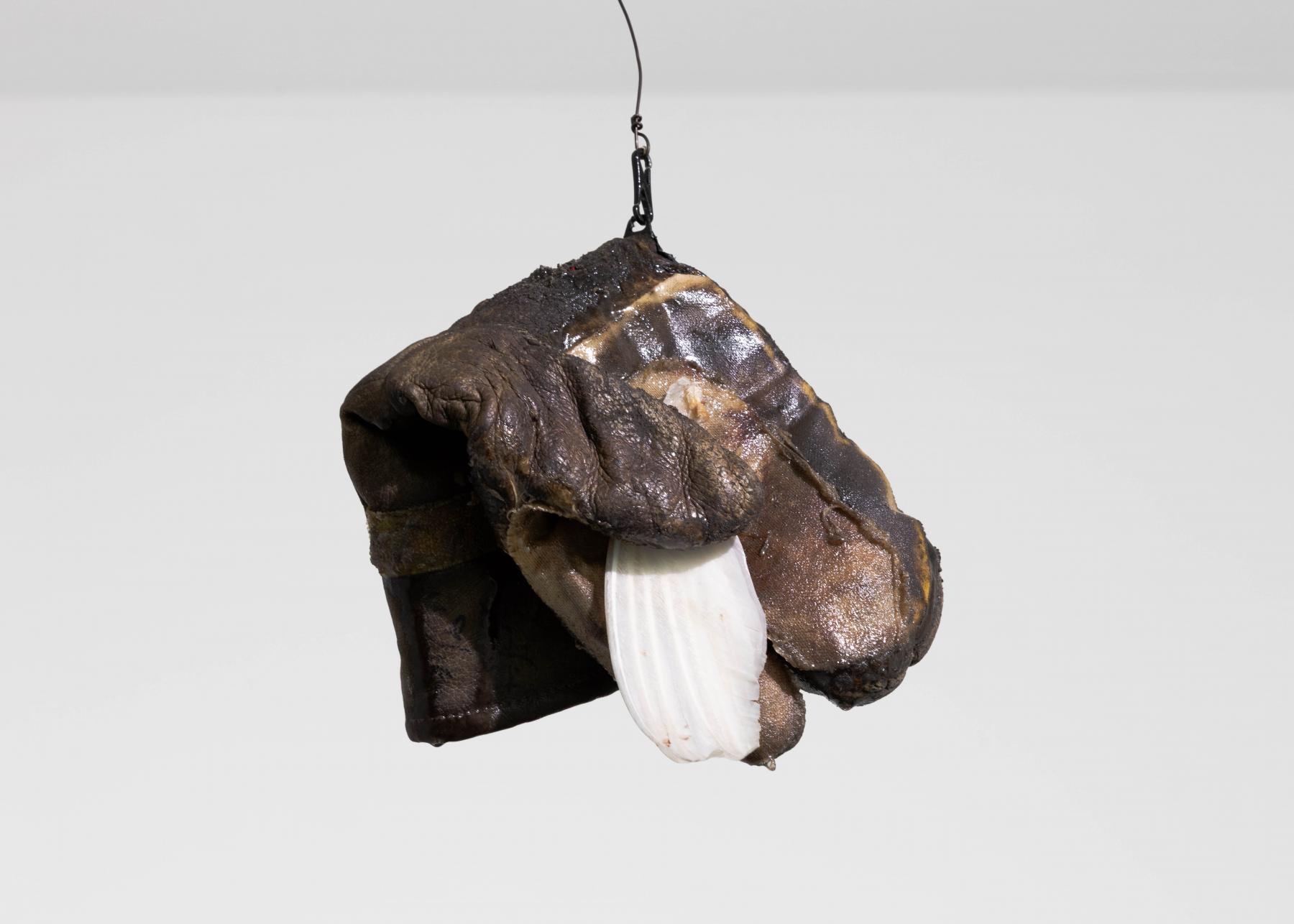
Jeneen Frei Njootli, Glove with wing, 2024. Leather and fleece. Courtesy the artist and Macaulay + Co. Fine Art. Installation view: The skies closed themselves when we averted our gaze, The Power Plant, Toronto, 2025. Photo: LF Documentation.
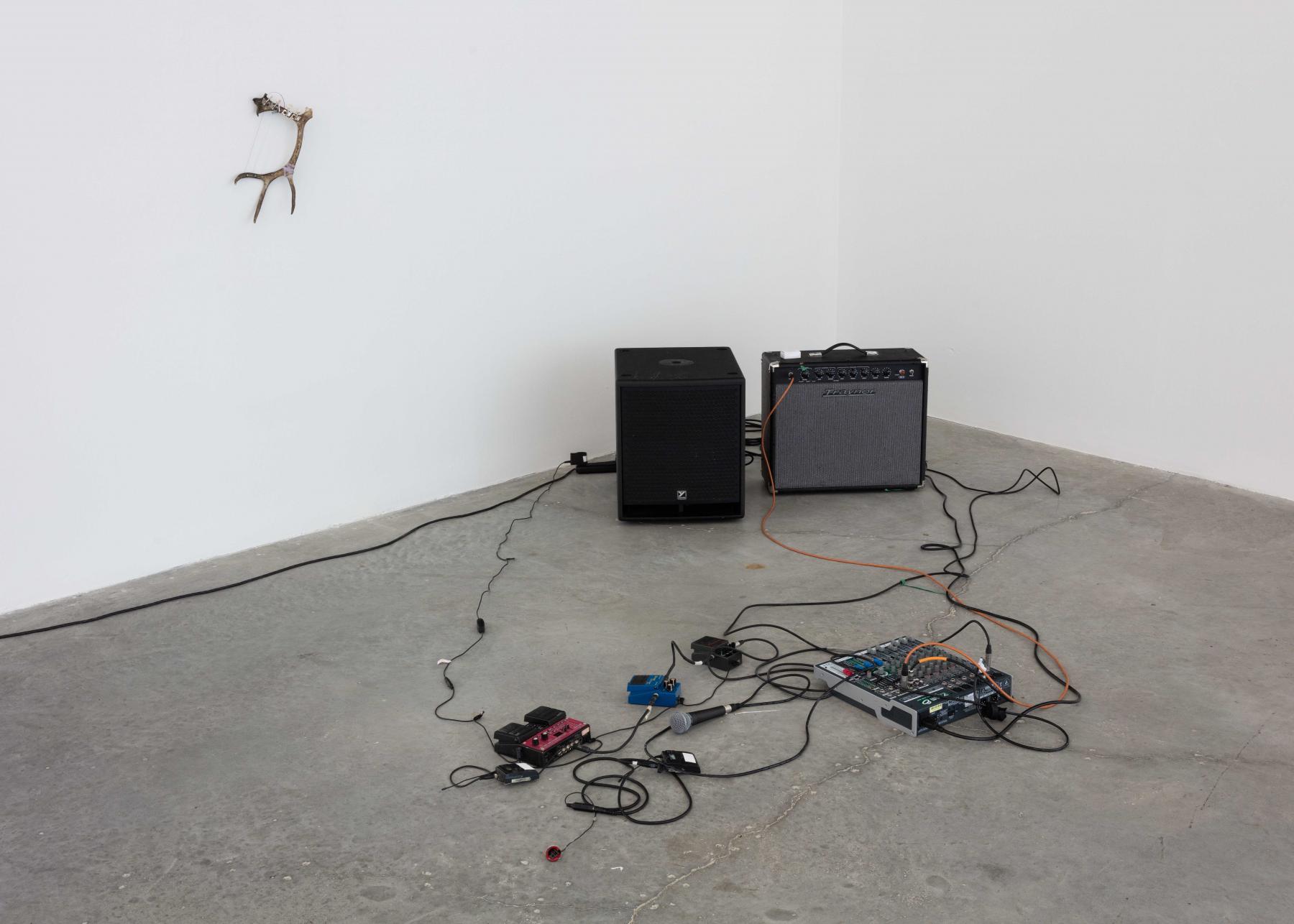
Jeneen Frei Njootli, Caribou antler fiddle, 2014. Caribou hooves, caribou rib, caribou antler, string,metal, beads, speaker cable. Courtesy John Cook. Installation view: The skies closed themselveswhen we averted our gaze, The Power Plant, Toronto, 2025. Photo: LF Documentation.
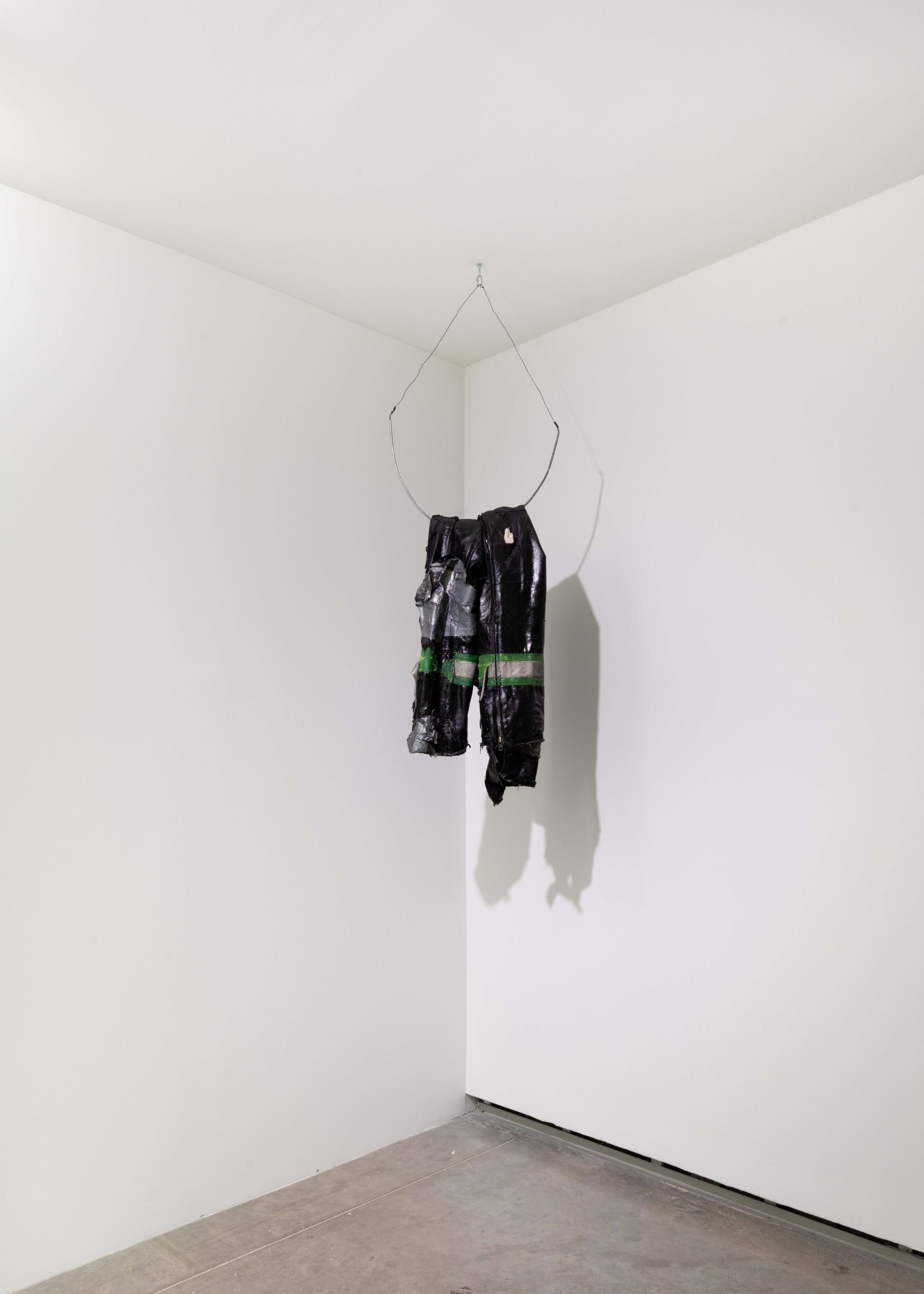
Jeneen Frei Njootli, As we fly through each other, 2024. Work overalls, resin, metal wire. Courtesy theartist and Macaulay + Co. Fine Art. Installation view: The skies closed themselves when we avertedour gaze, The Power Plant, Toronto, 2025. Photo: LF Documentation.
I feel like it really fits into your material vocabulary so well. It calls up all these things. As you were describing the kind of muscle memory of kicking in the legs of a folding table, I can feel that in my body. Let’s talk a bit more about gesture and material transformation. This kind of folding table has many possible configurations but there's also other material interactions going on in the space. I'm thinking about beads pressing into the skin, wrapping textile, piercing hide, amplifying sound… How do you think about the body, movement, and material change when you’re making work?
As I mentioned, I avoided photography by having my performances hinge on creating residue that's held in the space through gesture, or creating performances whose gesture is held in the space through residue. This is a part of image sovereignty and how Inherited (2019) was made—it’s a smoke print of a caribou that I harvested with my cousins. I was thinking about how we pull knowledge through our bodies and our relationship to time. Like I said, this work is generational and I feel like the answer to some of that is also in my titles.
I'm so glad you brought up that piece because I feel like it embodies the answer to that question.
When I first made Inherited I was a professor at UBC and the smell from the smoke was so strong in my studio that in the morning I got an incident report notification because security had to break into my studio thinking there was a fire. Smell has an ability to permeate spaces and bodies. It's so ephemeral and it's also fleeting, right? Because the work has been exposed to air for so many years now, the smell is so incredibly faint. I’ve also talked about sound’s ability to permeate spaces and bodies—like scholar Walter D. Mignolo talks about decolonial theory, and the artist collective Post Commodity has done work about that as well.
That relationship to sound and smell as immaterial things is so interesting and beautiful, alongside their relationship to time. I was thinking a lot about the seasons and cycles of time when I visited your show. It feels important that it happened in winter. Of course, the winter I know here is very different from what it must be like for you experiencing it up in the arctic circle. As we fly through each other (2024) is installed at the entrance to the main gallery, a set of work overalls that really appear as though they’ve been hung to dry, coming in wet from the snow—as if they’re frozen in a moment where they still appear wet as an effect of the resin. I was wondering if you could talk about working with resin, in particular embedding objects or garments in resin.
It snowed the day after I performed.
I mean, one day I made a series of sculptures in the winter and it was just things that I freeze fully over time and then document outside. You know, for years I made in a certain way where I was like: read these texts, go to these talks, be in your big studio, and then make art in a very academic space in a very cerebral, very referenced way. And now it's so nice to permit my practice to shift, to allow ourselves to be transformed, and to have the root not be so firmly placed in academia.
Is it more of an intuitive material exploration?
Yes, this is the material I want to use in relation to some of these belongings. Anishinaabe artist Maria Hupfield talks about thinking with your hands, and I’m allowing a little bit more of that to happen. But I mean, you've got to do a lot of planning with the epoxy work. I have to tarp the inside of a whole house so I don’t permanently alter anything inside with epoxy spray, I have to make sure that there's ventilation, I have to have consistent child care for three days to set things up, make my hanging apparatuses, prep the materials, and make the work, all so I can use my hunting rifles again, you know? I had one family member get pretty angry with me for trying to make a resin cast of one of my firearms because it's what allows me to literally put food on my table. The gun in My grandma used to check her traps with lipstick on (2022) I cast in between hunting ptarmigan. I harvested ptarmigan, I made the epoxy cast, I demolded it, I continued hunting ptarmigan. I have a system for working with the epoxy now. I have to complete the system for my livelihood. I had to rescue one firearm from my epoxy process because it was a bit too close to the heat source. I was borrowing a house to make art in, and it was minus 40 degrees out, so that one cured faster than the others. I had to abandon that work so I could save my gun.
I started casting with epoxy and that's what led to doing the epoxy prints on the steel that we started this conversation with. I had first made those images of me laying on the land in a residency at Le Frac des Pays de la Loire in response to French artist Gina Pane's art. There was an exhibition following the residency, Noise of the Flesh: Score for gina pane (2023-2024) that was curated by Mathilde Walker-Billaud. The residency was amazing—I was able to complete it from Old Crow while everybody else went to Carquefou, France. For quite a few years I just didn't want to leave Old Crow. It takes multiple days to get to Toronto, let alone over to Europe from here and it just takes up so many resources—I’m trying to be mindful. I was also at that point politically where I just really needed to be in my homelands. If I’m making work about the body and land, I will not be able to make the work that I need to if I go elsewhere. I would have loved to see more of Gina Pane's work in person and see everybody. I miss getting to talk with other artists who are invested in contemporary art in the same way that I am—or other thinkers, makers, writers, and curators—but that time will come again, you know? Anyway, I was thinking through that and made that first work in this residency with Matilde. We did a screen print of Vaseline on the steel and then sprayed it with vinegar.
I so appreciate this loop, bringing it back to those steel works we started talking about while broadening your thinking about epoxy and resin. You've been able to work with them in these very different ways to think about body and land and time. I think that's beautiful. And yeah, different seasons of life… You need to be rooted where you are right now. We’ve already spoken a little bit about the experience of light in the space of the exhibition, and how the different materials you work with respond to changing conditions. This exhibition opened in the depths of winter and as we’re connecting now, the days are slowly getting longer. I know that the sky, and particularly the night sky, have been central to your practice lately, perhaps we can close with some reflections on the coming seasonal change.
I always get a little bit sad when the light comes back. I love the night. I get anxiety about the incremental increase in sunlight. I can just settle right into winter, I can settle right into the 40 below. I really like it, it feels pretty good for me. And when the sun starts coming back I kind of grieve my relationship with the stars. I also grieve the end of hoodie season (laughs). I’m trying to build a relationship with the stars but the daylight is shifting every day where I am right now, drastically changing from two hours of daylight—and that’s not even with the sun above the horizon. Scientifically, there are three different stages of twilight and we're just in those three stages of twilight—civil, nautical, and astronomical—back-to-back for weeks. When the sun comes back, it just signals to our body that there's different things to do, there's a different busyness that's coming. I just want to stay up till two in the morning with my sewing machine, but I can’t do that in the summer.
Going back to the question about the epoxy, I just was so enamored with stillness. The objects look like they're caught in an element. For me, maybe they're small monuments about grief. They were when I made the piece Ache (2019) that's in the McMichael collection. They’re also pieces that I've made, that I've worn, that people that I love have shredded just through their own use, through their own agency, through their own relationship to the land, but then they're frozen by epoxy. Then I wonder about that relationship to the museum or the gaze of the museum visitor. There's something about authoring that stillness, but then because they're cast in epoxy too, there's this preciousness. They don't need a glass case, they're rock hard, they’re protected. It’s also about finding ways to honor or draw attention to the ways these garments hold a person's labor over time.
I'm also someone that grieves the end of winter, I hadn’t quite thought about it in terms of the loss of extended time with the stars.
I also want to acknowledge my friend Brandon Kyikavichik who I worked with on an event in my community, So’ Gatr’agwaandak, which was a celebration of Gwich’in star stories. He speaks about how Gwich’in have stories about where the stars go when the sun comes back (24 hour daylight) and how they relate to the sun coming back. This softens the grief I feel about the stars being eclipsed by light—they’re still there, you know? They're still there and we'll see them again.