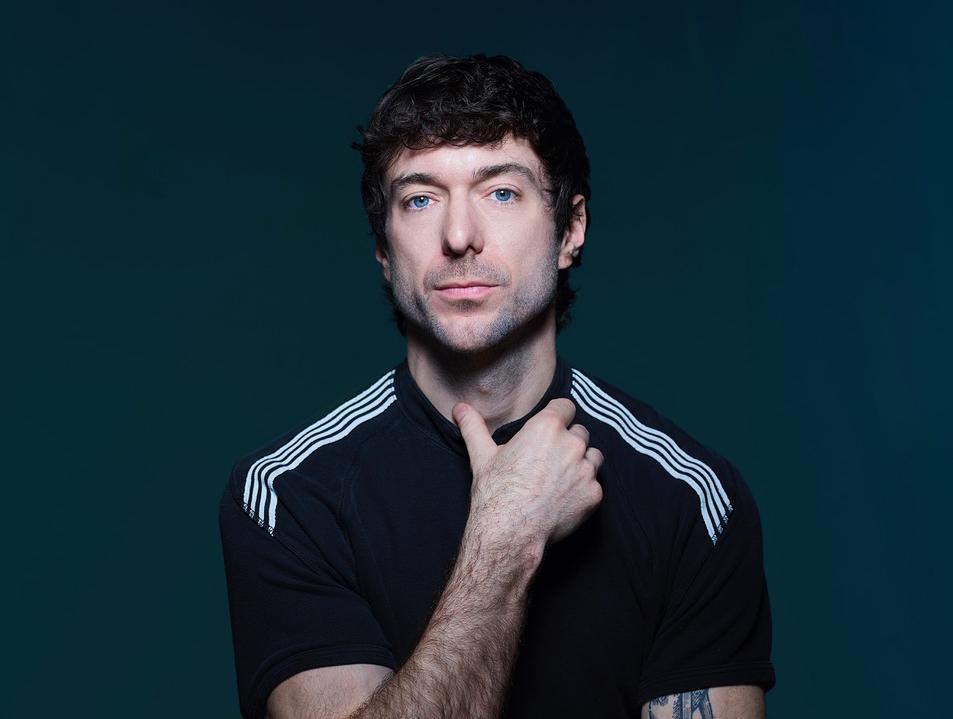
Photo of Jordan Tannahill by Laura Barisonzi
From my room in Zürich, the once-green, perfectly mowed lawn resembled a bleached carpet of parched amber. It was mid-July and the air stank dry and heavy, like a sick blend of hay, dog piss and motionlessness.
The summer’s heatwaves mirrored the opening of Jordan Tannahill’s third novel, The Living Realm (published by Farrar, Straus and Giroux). Almost every day, I wound up carrying Tannahill’s printed galleys to Männerbad Schanzengraben—a men’s-only swimming pool. The novel launches with the European droughts and the nameless, ageless narrator: an archeologist with a PhD fellowship in Berlin.
Escaping the heat dome, the narrator and his two close friends, Bridgit and Gabor, find a refuge at Teufelssee, the Devil’s lake. Fractured images of fauna and flora blend with peripheries of naked sunbathers and cruisers. Horny energy is omnipresent, yet the narrator’s cruise-verse is interrupted by a seemingly darker undercurrent. He encounters a “carbon copy” of his dead lover, Lukas. The thinning curtain between the dead and the living opens up with the cast of his former lovers appearing and disappearing.
Tannahill’s “European” novel brims with ingredients of the uncanny. The novel’s narrative momentum rises sacrilegious and pagan-like, and so does the narrator’s attempt to make sense of the ominous realm. Gentle and melancholizing, stylistically feral yet soaked with romanticism, Tannahill’s Living Realm reclaims life from the oblivion of unknowing.
At the end of the summer, I asked Tannahill about his path toward the new novel, endlessness and mortality. He told me about his admiration for a kind of Sebaldian narrator’s imagination reconstructing the deep past, like an archeologist.
Tannahill is a Canadian playwright and novelist and lives in New York. His debut novel, Liminal (2018), received France’s 2021 Prix des Jeunes Libraires. The Listeners (2021), his second novel, was short-listed for the 2021 Giller Prize and adapted into a limited series directed by Janicza Bravo for the BBC. His most recent play, Prince Faggot, ran off-Broadway for seven months in 2025. He has twice won Canada’s Governor General’s Literary Award for Drama, and his work has been presented at venues including the Young Vic Theatre and Sadler’s Wells in London, the Kitchen and Lincoln Center in New York City, and the Deutsches Theater in Berlin.
I was drawn to the idea of a cruising forest as a porous site between the living and the dead. The image of men cruising one another in the shadow of Teufelsberg, a mountain formed from the rubble of firebombed Berlin, exacted a strong pull on my imagination
Where did the idea for The Living Realm come from? And what different routes—conceptually, stylistically, or otherwise—did you take with this novel that you hadn’t explored in your previous work?
In the summer of 2021, I was dancing with my boyfriend outdoors at Berghain, because indoor events were still banned under COVID 19 restrictions, and it began to rain quite hard, and as I was soaked through and coming up on MDMA, the idea for the novel came to me over the course of an hour—the characters, the plot, the book’s thematics and tone, even the look of the book itself, what it would feel like to hold, its thinness. I spent the next four years trying to write that book, and whenever I deviated too far from that initial inspiration, like trying to extend the narrative, or take it in a different direction, the book stopped working. I realise how wanky that sounds, but that’s what happened. Really, I think a number of disparate ideas that I had gathered over months or years suddenly constellated over that hour, and perhaps the last piece of it was Teufelssee itself, where my boyfriend and I had spent the previous afternoon.
How did you arrive at the novel’s title?
The novel was titled Teufelssee throughout my writing of it, which reminded me of Mitteleuropa place name titles like Sebald’s Austerlitz, or Claudio Magris’s Danube. Ultimately, it was felt that English-language readers would struggle to remember and pronounce the German name, and so The Living Realm was pulled from a line in the novel.
The novel deals with dissolution, with the “mutation” of our earthly conception of time. It also grapples with endlessness and mortality. Why was it important for you to reconsider the value we assign to time?
I’m not entirely sure how to answer this question, other than to say, while I was in the midst of writing the novel, I read Gerard Murnane’s short story ‘First Love’, in which he writes: “Eternity is here already, and it has no mystery about it; eternity is just another name for this endless scenery where we wander from one place to another.” This seemed to concretize something for me about what I was writing. Yes. Eternity is already here. I would later use this passage of Murnane’s as the epigraph of the novel.
The narrator’s voice in The Living Realm is both horny and thought-provoking; it oscillates between something like “queer romanticism” and a kind of ballad-like prose. At the same time, there is a quintessential gentleness running through the heart of the novel. How do you navigate writing within these seemingly contradictory registers, and what allows them to coexist?
In the summer of 2021, I set out to read all of Sebald, in chronological order, and when I finished Austerlitz, I felt genuinely bereft that I would never again encounter his writing anew. I think I wanted to somehow extend the experience of reading Sebald by writing in such a way that maintained the spell he had cast on me.
As I read the novel, I was reminded of a kind of Goethean figure—not necessarily a hero, perhaps even an antihero. Someone intensely real: a queer traveller moving through the dark Germanic forests of the Schwarzwald, or Black Forest. How did you construct your protagonist, and what were you interested in making him carry?
My protagonist is a version of myself projected into the future, he’s a number of older gay men in my life, and ultimately, he’s a product of my imagination. He is a man who, on one hand, has devoted his life to reconstructing the deep past, as an archeologist, but who is forced to excavate his own past, rather against his will, after his unexpected encounters at Teufelssee.
Your narrator leads us to the Teufelssee—the Devil’s Lake—as a feral cruising ground. He describes it as something at once casual and sacred, communal and intimate. Why was it important for the novel to evoke this particular space and its paradoxical character?
I was interested in the idea of cruising as a kind of communion with the dead; of a cruising forest that somehow held the memory of every body that had ever experienced pleasure there, a porous site between the living and the dead. The image of men cruising one another in the shadow of Teufelsberg, a mountain formed from the rubble of firebombed Berlin, exacted a strong pull on my imagination. Also, while laying in the meadow at Teufelssee, in the golden light of a late August evening, I could not escape thoughts of death. There was something about the lake that made me keenly aware of time. And I wanted to look at the lake through these different timescales of geological, political, and personal history.
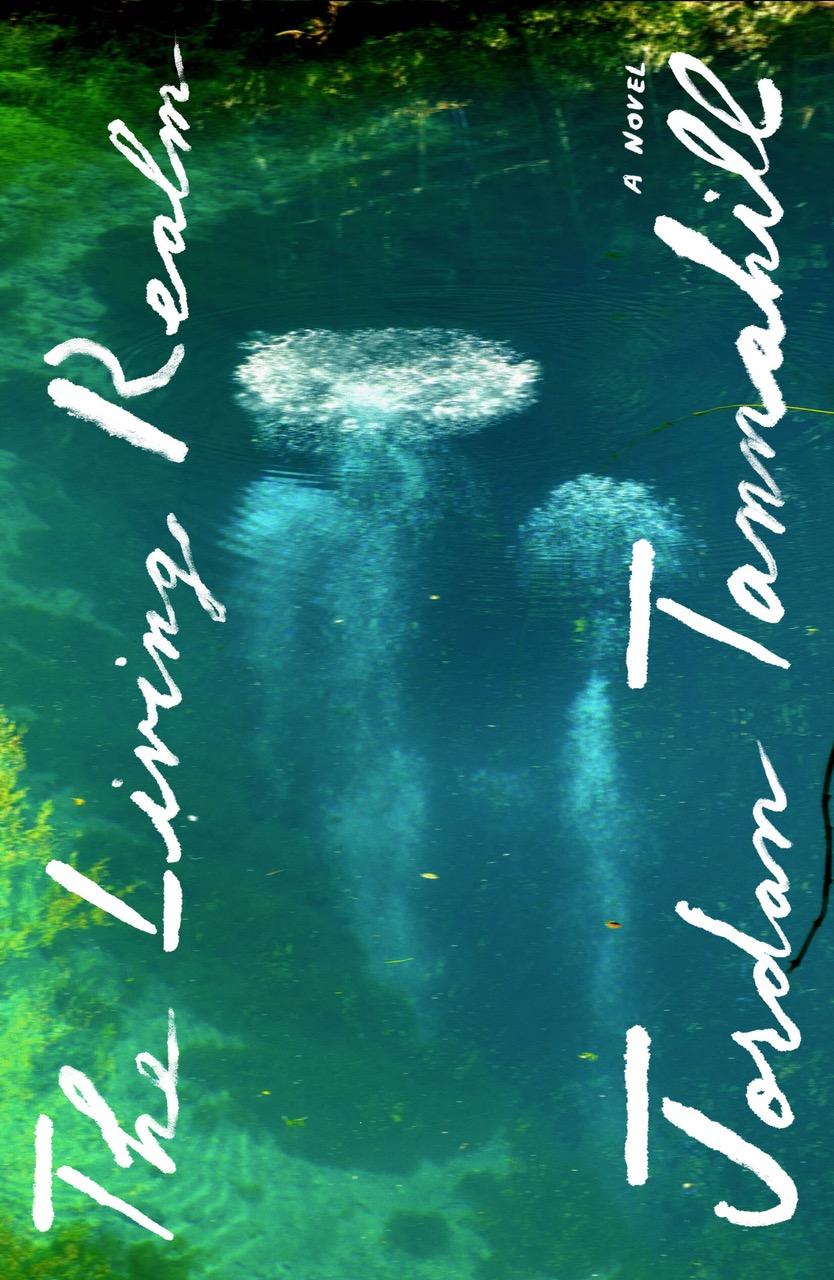
Book cover of The Living Realm, 2026, published by Farrar, Straus and Giroux
We’re in the midst of some of the worst heatwaves Europe has experienced in years. In the opening lines of the novel, the narrator describes an immense drought and its impact on the environment. Nature—and its deterioration—is a central presence throughout the book. What was the process of bringing the environment, and its decline, into the novel?
I was working on the novel throughout the drought summer of 2022, when images of Nazi battleships laying on the dried riverbed of the Danube were circulating the Internet. And now, those same images are circulating once more, as Europe again contends with record-breaking heatwaves and droughts. It was the backdrop I was writing against, and it felt important to invoke in a novel about a lake.
The narrator ruminates on his ghost-like lovers and the term “queer time.” What does this term mean to you, and what does it mean to the narrator?
Time that operates outside the bounds of linear time.
Alongside your two previous novels, you’ve written several plays/short films. How different is writing a script from writing a novel? And how does playwriting inform your prose, and vice versa?
Plays are blueprints for an event. I am writing action and images which unfold in real time before an audience. There is much that is unwritten in a play because it is completed in the act of staging; in its design, in its performance. A good novel doesn’t say everything, but it needs to say more than a play. With a novel, one is trying to unfold action and images within a reader’s mind. It is a profoundly intimate and private exchange.
Your 2025 play Prince Faggot was described by The New York Times critic Jesse Green as “thrilling and inflammatory,” and it even stirred controversy. I’m curious about your relationship to writing that generates shock, provokes debate, and leaves the reader emotionally unsettled. What novels have had that effect on you—books that made your heart almost “crush”?
Writing that has genuinely shocked or unsettled me? Off the top of my head, probably passages in Joe Orton’s diaries about sleeping with ten and eleven year old boys in Morocco; or a passage in Derek Jarman’s diaries about hopping into bed with two Greek shepherd boys and their father.
Were there any books, fiction or nonfiction, that you kept in mind while writing The Living Realm?
Pilgrim at Tinker Creek by Annie Dillard, River by Esther Kinsky, and Danube by Claudio Magris.
The final pages have a kind of hallucinatory quality. The long sentences shimmer with dreamlike passages, as though the narrator himself has become part of the fauna and flora of Teufelssee. How did you arrive at the ending of the novel, and what did that ending come to mean to you as a writer?
I suppose the ending revealed itself in the act of writing, though I did consciously want to articulate the protagonist’s relationship, in death, with the sublime immanence of all things. I don’t believe in an afterlife, as such, I think we simply return to the Earth, our atoms disperse, and are re-combinated into an infinite number of plants and animals and other beings. That is what I was trying to give language to in that culminating passage.
My wonderful editors—I’m going to shout out Jackson Howard here, in particular—encouraged me to move Elsa’s monologue to the end of the novel, and I think that also really helped unlock the full potential of the ending.
Are you currently working on a new project—a book, a play, or something else?
I have started and abandoned a few things. Mostly, I’m reading a lot at the moment. My project this week is Alain-Fournier’s The Lost Domain.