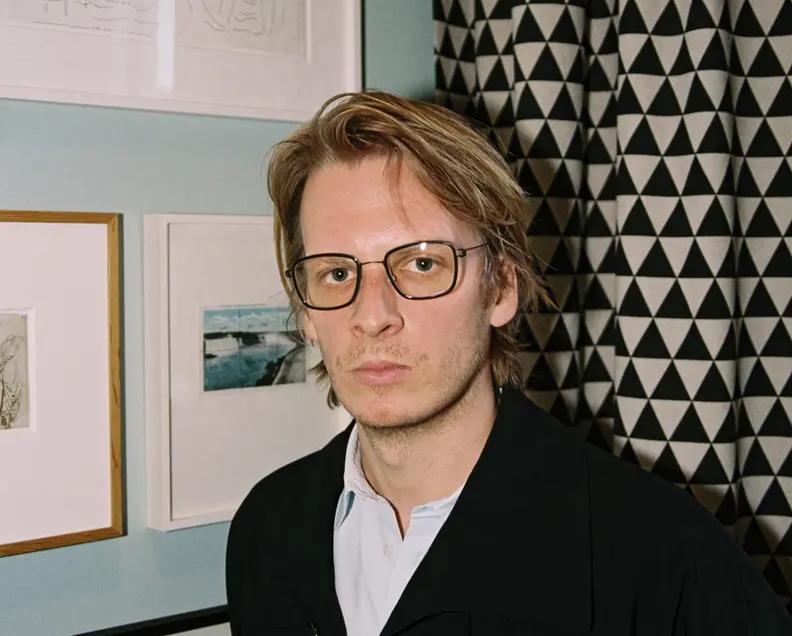
Andrew Durbin. Photo by Suzannah Pettigrew.
Prior to reading Andrew Durbin’s The Wonderful World That Almost Was, 2026 (published by Farrar, Straus and Giroux on April 14), I had frankly a very brief and limited grasp of Peter Hujar's and Paul Thek's lives and work. The art gallery I used to work for in 2022 curated an online presentation from a selection of Paul Thek’s etchings, reprinted from copper plates originally discovered in his storage unit in 1989, the year after his death. Among a few that the website presented were depictions of “Plums,” “Bouncing Earth,” “Burning Book,” and “Tarbaby.” In my role at the gallery, I had the privilege of encountering Paul Thek’s work in real life for the first time.
Artists Paul Thek and Peter Hujar were deeply captivated by rendering the evanescent beauty of the world as well as its atomization. The Wonderful World That Almost Was (2026) is its cinematic testimony, a never-before-told story of two intimately entangled artists who redefined queer art, written by Durbin. Resurrected and rendered as flash and bone, I was captivated by Durbin’s extensive account, navigating art criticism and personal narratives of the two most relevant American artists of their time. Like a cultural archeologist, Durbin sifts through the private notebooks and diaries and chats with artists’ peers to reveal one of the gay love stories of the 60s and 70s. In his deeply researched portraits of Peter Hujar and Paul Thek, Durbin is not out to expose but to understand both artists, and who and what shaped their unapologetic, truly visceral rendition of the world transpiring into their art. Durbin walks alongside them on their trips.
Composed of five consecutive parts and thirty chapters, the biography forms the collective memoiristic testimony and includes a multitude of voices—including Susan Sontag, Ann Wilson, Andy Warhol, Fran Lebowitz, John Waters, and David Wojnarowicz—that orbited around Peter and Paul. As one reads, one asks: Where was their frontier? What lands and shores have they grown close to? Who were their friends and lovers? What legacy have they left behind?
Born in Orlando and raised in South California, Durbin, the editor in chief of Frieze magazine, is the author of two novels: MacArthur Park (Nightboat Books, 2017), a finalist for the Believer Book Award, and Skyland (Nightboat Books, 2020). He also edited Fascination (Semiotext(e), 2018), Kevin Killian’s collected memoirs of gay life in 1970s Long Island by one of the leading proponents of the New Narrative movement. His writing has appeared in The New York Review of Books, the London Review of Books, The Believer, The Paris Review online, and the Los Angeles Review of Books. He lives and works in London.
Durbin, just a few days before the official release of the biography, told me about the process of his research, writing the biography and how he fell in love with many incredible people whom he interviewed. I asked him about the young generation of queer artists being aware of the legacy Hujar and Thek left behind.
A biography can only capture so much of real life, there are so many unknowns, so much that escaped the record. I loved the challenge of assembling a true story from all these disparate parts, the letters, the diaries, the memories of friends.
Your readers know you for your previously published fiction—Skyland (2020) and MacArthur Park (2017). Both novels embed the recurring topics of gay male figures asking what it means to belong to a place. Your new book is a biography. What was it like to dive into writing non-fiction this time?
It was a completely new process for me. I’ve never had to research at this scale, and unlike with a novel, I could no longer just play around and invent, I had to tell the story of these real lives; if I had a question, I had to find an answer. That said, biography, nonfiction—they’re about narrative choice and emphasis. A biography can only capture so much of real life, there are so many unknowns, so much that escaped the record. I loved the challenge of assembling a true story from all these disparate parts, the letters, the diaries, the memories of friends. It was much more creative than I realized.
In The Wonderful World That Almost Was, you excavate and “reincarnate” the lives and work of Paul Thek and Peter Hujar, as well as their friends, lovers, companions, and places that have been crucial to their artistic lives and existences through new extensive lenses. I’m curious—as the editor-in-chief of Frieze, you wrote and oversaw many cultural topics. What was the pull behind devoting your research and time to writing The Wonderful World That Almost Was? When did you decide to write the biography? And how have you approached its research, information collection, and the writing process?
Before I wrote this book, their work always raised more questions than answers. I was fascinated by them, but I knew very little about how and why they made what they made, and who they were. As a writer, I’m always drawn to those lingering questions. Once I decided to write about them, I called people who knew them—Vince Aletti, Stephen Koch, a few others. I slowly began to build a picture of their lives through the people who knew them. Eventually, I entered the archives. Every conversation, every document suggested more lines of inquiry. I followed as much as I could in the time I had. It was so much fun. One of the hardest things to do in the book was to stop researching.
The title of the biography, The Wonderful World That Almost Was, carries a tender and ephemeral promise. A twinkling of the daylight and the apprehension of fading—its inevitability, if one can be “Didionesque” here. Nevertheless, the title is a testament to one of Paul Thek’s notebooks, a kind of novel he was writing at the time (starting from 1977). This writing is addressed predominantly to Susan Sontag. How did you decide on the title?
About half-way through the process of researching and writing the book, the title seemed inevitable to me. Thek’s notebook is a proposed autofiction/treatise, only partly completed, in which he planned to write a kind of personal history of some of the most important relationships in his life up to that point. If I squinted, he was basically describing my book. And Thek’s title was so perfect; it encapsulates the mood I was aiming for.
I was particularly drawn to the parts about Paul’s and Peter’s fascination with relics/reliquaries in the catacombs of Palermo. You write: “They were obsessed with death, and if they can be said to have shared a subject, it was almost certainly death. They looked for signs of mortality everywhere in the world of the living. Peter photographed corpses in the catacombs, and the catacombs inspired Paul’s wax flesh,” [artworks]. Although they were certainly magnetized and drawn to the underworld, their work informs us about the living and the way to live on one’s own terms, unapologetically, artistically, and sexually. As you say, “Both artists, drawn to death, were also captivated by birth and renewal.” What emerged in my mind during my reading was the image of a phoenix rising from its ashes and being reborn. Their work truly outlived them. The process of self-transformation would become a habit for Paul. What are your thoughts on this as a writer?
Yes—rebirth, resurrection, renewal are important themes throughout the book. As I write in the introduction, Adam Phillips’ idea of a culture oriented toward birth—which sounds very Thekian to me—became an important organizing principle while I was writing.
While Peter’s photography was rooted in how he rendered the inner psyche of his subjects: animals (especially horses), children, his lovers and friends. How he managed to get under the skin, be intimate, not because he would judge but because he would comprehend them: “Peter had a core of sadness. Above the sadness was the anger, and above that was the absolute appreciation of beauty—of finding beauty, offbeat beauty.” Paul’s sculptural environments seemed more ephemeral, delicate, collapsing, unfinished, ungraspable and graspable only by a few who could perceive its potential at the time. They were more ideas than realized works. The sublime way he approached his art was close to the way Eva Hesse’s works spoke to the public, meaning their ephemerality. Do you encounter such ephemerality in today’s cultural sphere?
I think people are afraid of ephemerality, even though we’re surrounded by ephemera. They don’t want to think too much about the enormous loss we face every day. They were afraid of it when Thek and Hesse were making their work, and they’re afraid of it now, because ephemerality is too close to death and nobody wants to think about death. But “nothing lasts forever, other than paradise,” Thek writes. I find that so comforting. It frees you to live.
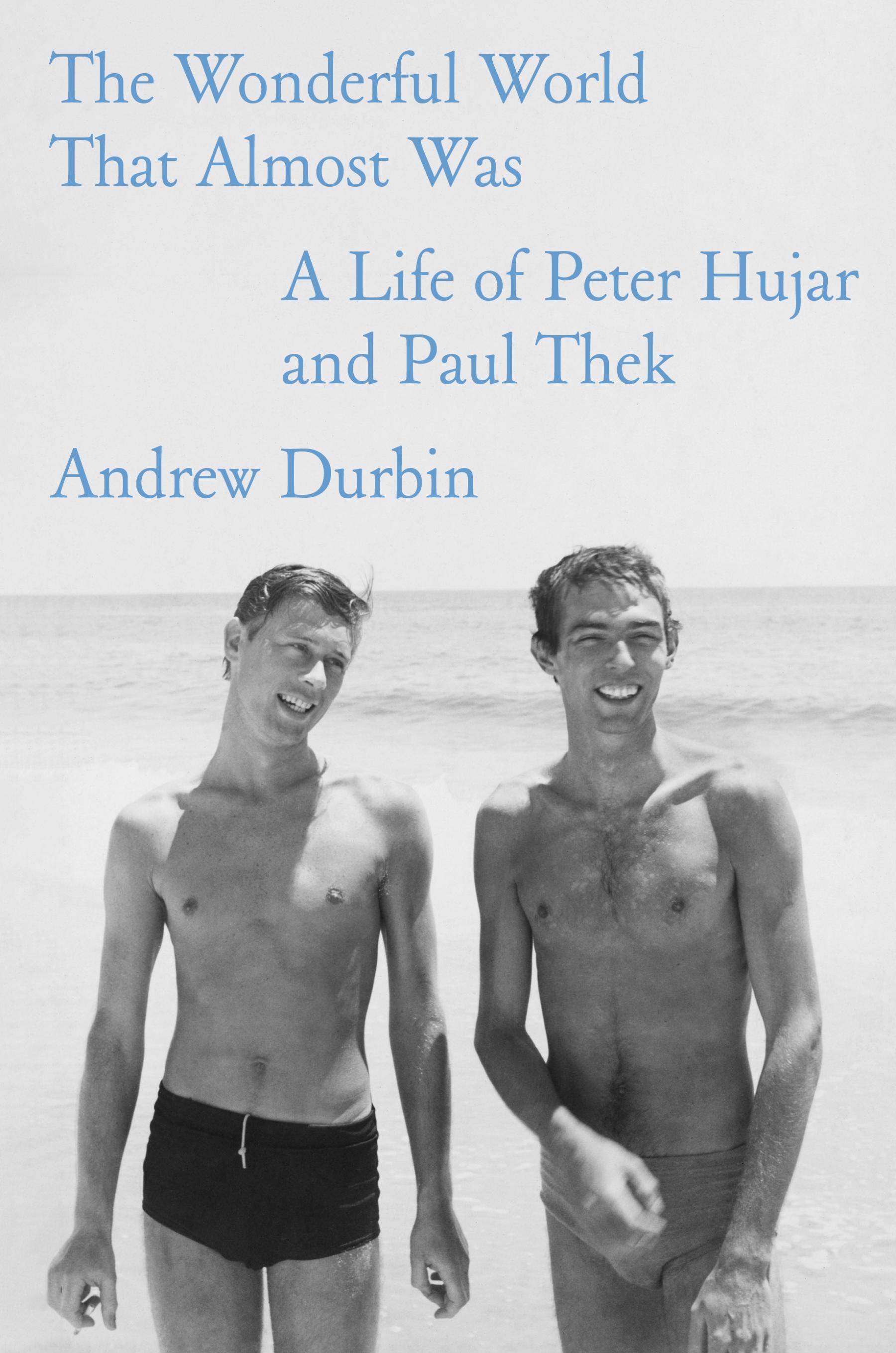
Cover for The Wonderful World That Almost Was (2026) Farrar, Straus and Giroux.
While the book is dedicated to following both artists’ figures, their love and fall, it also examines gay histories, the social upheaval of the Stonewall Riot in 1969 and the economic poverty of the 60s and 70s in the US. It has a political feel, religious background, and includes descriptions of trauma, self-destructiveness, paranoia and depression in parts. It has a psychological dimension, too. How did you navigate and balance writing about this?
I followed my artists wherever they went. When I began the book, I did so with an open mind—I didn’t know what it would and wouldn’t encapsulate. For instance, I had no idea how important the Be-Ins would be to this project, but then there they were, in Hujar’s pictures and Thek’s notebooks, and so they had to find their way in the book. Hujar and Thek lived in the world; they weren’t isolated from their times; their work thought a lot about what it meant to live, and die, in the twentieth century.
Three years ago, I traveled to Ponza. At the time, I had no clue that this remote island had been a retreat for Paul. Like many places, for Paul and Peter, their Fulbright residencies were places of creation but also their atomization. Light follows darkness. Do you believe that the true magic of their artistic work would not have developed the way it had without the sadness, depression, and losing oneself completely?
We probably overemphasize sadness and depression as generative in artist’s lives; a lot of the time, depression delays and disrupts creation, and making art is the last thing you think about.
As a reader, I was entertained by the inclusion of Fran Lebowitz’s quotes on Peter and Paul’s world. Susan Sontag wrote, “What she liked was ‘mad people,’ that is, ‘people who stand alone + burn. I’m attracted to them because they give me permission to do the same.” I wonder if, during your research, you encountered people who refused to give their take on either Paul or Peter? What emotions have the conversations about them generated for you?
A few people said no. Sometimes the “no” was really a way of asking me to woo them. But if it was a firm no, then I didn’t press any further. Most people said yes, which I am so grateful for, because the book would not exist without the support of Hujar and Thek’s friends, lovers, collaborators—especially Linda Rosenkrantz and Ann Wilson and Gary Schneider and John Erdman. Their memories, which they so graciously shared with me, were always emotional; there are conversations I had with them that will stay with me for a lifetime. I fell in love with a lot of the people I interviewed.
Although non-fiction, a memoir, the book includes, retraces and pays tribute to works of fiction that were inspired by the artistic and personal life of Peter and Paul. It’s Susan Sontag’s Notes on Camp (1964), Linda Rosenkrantz’s novel Talk (1968). You also mention William S. Burrough’s Nova Express (1964), Edmund White, and John Rechy’s City of Night (1963): “malehungry looks hidden by the darkness of the night.” Apart from being their peers, why was it essential to mention them in the biography for you?
It was important for me to bring in some first-hand accounts of the larger world Thek and Hujar lived in. All those writers bore witness to their time and wrote so clearly—and fiercely—about it. The literature of the sixties is so rich; I couldn’t resist!
Do you think the younger generation of gay and queer artists is aware, or pays attention to what their “ancestors” or “fathers” like Paul and Peter and many others achieved for them? What’s the post-Hujar and Thek legacy like for you?
I hope so. Many of my artist friends cite them as important touchstones for their own work, and Thek is regularly taught in art schools here in Europe. In fact, almost every young artist I know is obsessed with both. For a long time, it was difficult to know much about their lives, and their work was exhibited only sparingly; seeing a Hujar or Thek was a rare thing. Thankfully, that’s really changed in the past ten to fifteen years. They’ve become much more accessible. The only way to really know them is to see the work in person, and once you see their work, there is no getting over it.
Have you watched Peter Hujar’s Day (2025), directed by Ira Sachs? And if so, what did you think of it?
For the New York Review of Books, I wrote that I generally liked the film, and I liked that Sachs was willing to adapt such unconventional material. But I brought so much baggage to my viewing of it, too; I was always going to have strong opinions about how Hujar was portrayed on screen after spending so much time with his work and life. I can’t say I loved Ben Wishaw’s rendition of him, but I adored Rebecca Hall as Linda Rosenkrantz. She was spot-on.
For many years, perhaps even today, artists like Paul and Peter and many more were/seemed “stigmatized.” Do you think the biography can help dismantle it? That, to the reader and a wider public, it reveals the true essence of their work and life?
I don’t think I agree that they were “stigmatized,” necessarily, though they have certainly been side-lined or under-emphasized in most histories of twentieth century art. For a long time, nobody seemed to know what to make of them, especially Paul Thek. Mike Kelley speaks about how difficult it was for the conservative art world of the 1980s to assimilate Thek’s installations into its view of art history—his “cosmic junk piles.” But I hope my book helps to reestablish their place at the center—where they belong.
What’s the oddest place you’ve ever read? And what are the most recent books you read?
A few summers ago, I was staying alone in a hotel in a remote part of Crete. Every day, I walked about an hour through the desert to a faraway beach where about six to eight nudists, all Greek men, erected little shelters by stretching their towels over these boulders. It felt like Mars, except for the NATO jets practicing manoeuvrers overhead. At the time, I was reading Henry James’s Princess Casamassima, which I didn’t think was very good, though I was committed to finishing it. The men kept distracting me by performing these odd rituals to attract each other’s attention, since it was a gay beach and in theory we were all supposed to be having sex. I don’t remember if anyone did. Right now, I’m reading the collected stories of Katherine Anne Porter, Martin Duberman’s biography of Lincoln Kirstein, and Jean-Jacques Schul’s Dusty Pink.