.jpg)
Wayne Koestenbaum. Photo by Jan Rattia. Sourced via.
I annotated Wayne Koestenbaum’s My Lover, the Rabbi, in the middle of February, while I was visiting my boyfriend in Zürich. Each day, I walked to the library and clutched the printed galleys in my hands, sandwiched between my iPhone and a bottle of Swiss Alps water. I spent most of my time with the neurotic-and-slightly manic narrator inside the brute-concrete wing of the Swiss National Museum, or Zürich’s Landesmuseum.
From the beginning of the novel, the melody and baroqueness of Koestenbaum’s sentences (sometimes spanning across an entire page) harmonized with my view of the Crystalline-clean Limmat river that I faced. My Lover, the Rabbi, published by Farrar, Straus and Giroux, New York, on March 17, cascades the lyrical rhythm of language with overtly faggy submission and obsessive adoration toward the one and only center of the narrator’s world: the Rabbi.
Hyper-sexed, yet tender, and piercing with passion, it is laced with pompous discoveries, frisky fiction and liturgies of incubated love, reflecting darker, more decadent, gripping, yet distinctly human traits. Set between Hoboken and Charlottesville, Warsaw and the Hamptons, the ornateness of Koestenbaum’s narrator resides in his “mission” to decrypt the bond between him and the rabbi. The 400-page novel reels between flaccid and erect genitals; sermons and sinners; synagogue attractions and “kosher” trips; the rabbi’s hairy chest and narrator’s pull to absorb the unabsorbable—another human being on their own orbit.
To the readers of Dennis Cooper and Kevin Killian, or Robert Glück, Koestenbaum’s fiction adds to the legacy of extravaganza-queer writers. The author grants the reader a “gayscape” or “gayage,” of seductive, titillating litanies about a gay love between a fuckable narrator and a less fuckable rabbi. Beyond the corporeal, the novel asserts that the vast unknown of love is a force of human nature so vivid and potent that it may move or detonate mountains. Who are lovers if not another fleeting matter, someone you go into in search of yourself, or who you never wished and wanted to be?
The writing of Koestenbaum, a San Jose-born and New York-based poet, critic, fiction writer, painter, filmmaker and performer, spans more than twenty books. His devotees may be familiar with Stubble Archipelago (Semiotex(e), 2024), The Cheerful Scapegoat: Fables (Semiotex(e), 2021), Camp Marmelade (Nightboat Books, 2018), Figure It Out (Soft Skull Press, 2020), Jackie Under My Skin (Picador, 2009), Humiliation (Picador, 2011), Andy Warhol: A Biography (Open Road Media, 2015), and The Queen’s Throat: Opera, Homosexuality (Grand Central Publishing, 2001). The author’s poems and essays have appeared in Vogue US, The New Yorker, The Paris Review, and the London Review of Books. His artistic bravura extends to compelling solo exhibitions of his visual art and musical performances of his improvisatory Sprechstimme soliloquies at the Hammer Museum, Centre Pompidou, Walker Art Center and other venues. He is a distinguished professor of English, French and comparative literature at CUNY.
On Zoom, Koestenbaum and I spoke about his new nonchalantly written stream of lust and diaristic phallic adoration. Through the screen, Koestenbaum wore a Pucci-like shirt and his signature square glasses in the same hues. His ubiquitous grandeur and zeal sparked through the entire conversation and peaked when I asked him what he would wear to a fancy literati event. He confided about writers he admires and how poetry shaped his entire life.
In a dream on February 23, I kept persuading the author of yet another title. “Perhaps the book,” I said, “should be: My Boyfriend, The Architect.” When I DM-ed Koestenbaum about it, he said: “That’s astonishing!!! My husband is an architect.”
Asymmetry, like conflict or ambivalence, generates literature. I mean, literature demands asymmetry.
The lascivious sentences in My Lover, the Rabbi emanate with gay poetic gestures, like strokes of painting or a choreography of queer bodies in space between the Hoboken apartment and the Charlottesville of the financier. Your stylistic keyboard is ornate; words and sentences are opulent and baroque-injected. A mélange of jet-set queer private diaristic stories erupt from the pages. Although vividly sexual and manic, the writing never sinks or bottoms out toward the depraved or filthy. Can you tell me about the behind-the-scenes and the writing process for My Lover, the Rabbi?
Yes, thank you first for that eloquent, sparkling description. I wrote the first draft of the novel in one burst, over a period of 6 weeks in August and September 2024. I hadn't intended to write a novel; I had finished a book of poems, which has yet to come out, called The Group Tickling Experiment. I had space to think about what I wanted to write next. I had just read two novels: Maurice Blanchot's When the Time Comes, and Constance Debré's Playboy, and I wanted to write something that had honesty and directness, but also a sense of metaphysical and melancholy distance. The first sentence of the book just came to me, and I wrote it down, and I said to myself that I would write 100 sentences just like that, and that I would make a tiny little book with one sentence on each page. And each sentence would begin, “my lover, the rabbi.” I started doing that, and it grew into an actual novel, rather than, in a way, a litany or a serial poem. The novel blossomed from that original, diary-embedded outburst. The first sentence was the DNA of the whole book. And I had no notion, when I began, that there would be characters, or anything like a plot.
Writing in the first person, the narrator of the novel is ubiquitously obsessed with all the rabbi’s universe, his fixings, decor, past and present. He says, “My dislike of his body could coexist with my attachment to his body because of the extreme alchemy that his flesh made when it stamped me, sealed me, authorized me to breathe and sleep and wallow and press harder into his body.” His frantic, uncontrolled adoration—almost ceremonial—has a vector of asymmetry. All points to the rabbi, his crotch, his orbit. We don’t know much from the narrator’s background, except that his teen years were a blur and his parents were actors. At one point, I thought the narrator would devour the rabbi, that this would be the end of the rabbi. How essential was this asymmetry, this imbalance, to you? And how were those scenes driven to reach a final crescendo?
The asymmetry was essential. The core of the book was that the narrator desired the rabbi, with a ferocious, unsatisfiable intensity. An intensity that would never be, in mortal terms, met or reciprocated. On the other hand, I understood that such an intensity of desire included, as well, a measure of disgust. And so I would need to convey a sense that the narrator also feared and was repulsed by the rabbi. The core asymmetry is that the younger, unnamed narrator, with a sketchy background, with no identifiable personality traits except for his obsessiveness and a certain loftiness of language, desires this rabbi. Asymmetry, like conflict or ambivalence, generates literature. I mean, literature demands asymmetry.
The inter-connected gay quest for a family—the adoptive son, Dito, his boyfriend Pablo, the financier Atlas, Dominic the dogwalker, etc. Though fiction, it’s not far from some of the realities that occur in life. The throuple. The young generation of gays is mingling with the older one. There’s push and pull that tie and untie them together. In the novel, there’s a beautiful part when the narrator asks the rabbi about the impossible. In the current political climate, do you believe such a quest for the gay multi-family is possible? Or is it some periphery of the distant, utopian imagination?
I feel strongly that the complex, uncategorizable queer family needs to exist, and does already, and is existing all over the place, with new language to describe it, and new confidence felt by the participants in these families. There's an efflorescence of descriptive experiential language surrounding such families.
I felt it deeply in the novel. You worked on the novel with your editor, Jackson Howard. How was that experience for you?
It was delightful. It's such a luxury to have somebody enter your imaginative world, because the process of writing a novel or writing anything is so lonely and so internal—particularly a novel, because nothing in it exists. And so you're alone as the writer with all these phantoms. It is remarkably consoling when the moment arrives and there is a sane, reasonably objective fellow traveler who can step in and offer advice. I greatly benefited from Jackson's sense of reality. His edits were tactful and not exorbitant or invasive, but they gave me a sense of when I needed to be watchful over certain kinds of temporal and spatial continuities, which are ambiguous enough in this novel. He helped me tether some of these coordinates.
There are two book jackets or covers for the novel. Farrar, Straus and Giroux released a more stripped-down, abstract version with a rose over the faded pink backdrop. Granta opted for a hairy chest image. As a writer and visual artist, what are your thoughts on the cover and how do you think the two represent the book? What’s your reading of the two?
I'm fascinated by both covers. I love both covers. I'm fascinated by the divergence between them. I feel somewhat responsible for that divergence. I was asked by FSG if I had any wishes for the cover, and I think I said that I didn't want any representations of the rabbi. I didn't want people pictured on the cover. I didn't want stereotypically gay or Jewish iconography on the cover. I wanted it to look like a work of severe, molten literature. FSG produced this floral cover, which I love, by Evan Gaffney. I don't think Granta asked what I wanted the cover to be, or maybe they did, but they sent me this cover, designed by Jack Smyth, and asked for my approval. It was so titillating and hilarious that, of course, I said, yes, understanding, too, that in the UK, there's a different semiotics of book covers than in the U.S. And understanding as well that in the U.S, a cover like that Granta cover might not go over as well. It might lead to a sense that my book was a niche book, indistinguishable from soft porn. But the way Granta did it is sexy and witty. And FSG’s cover is also very gender fluid, if we investigate the nature of a rose.
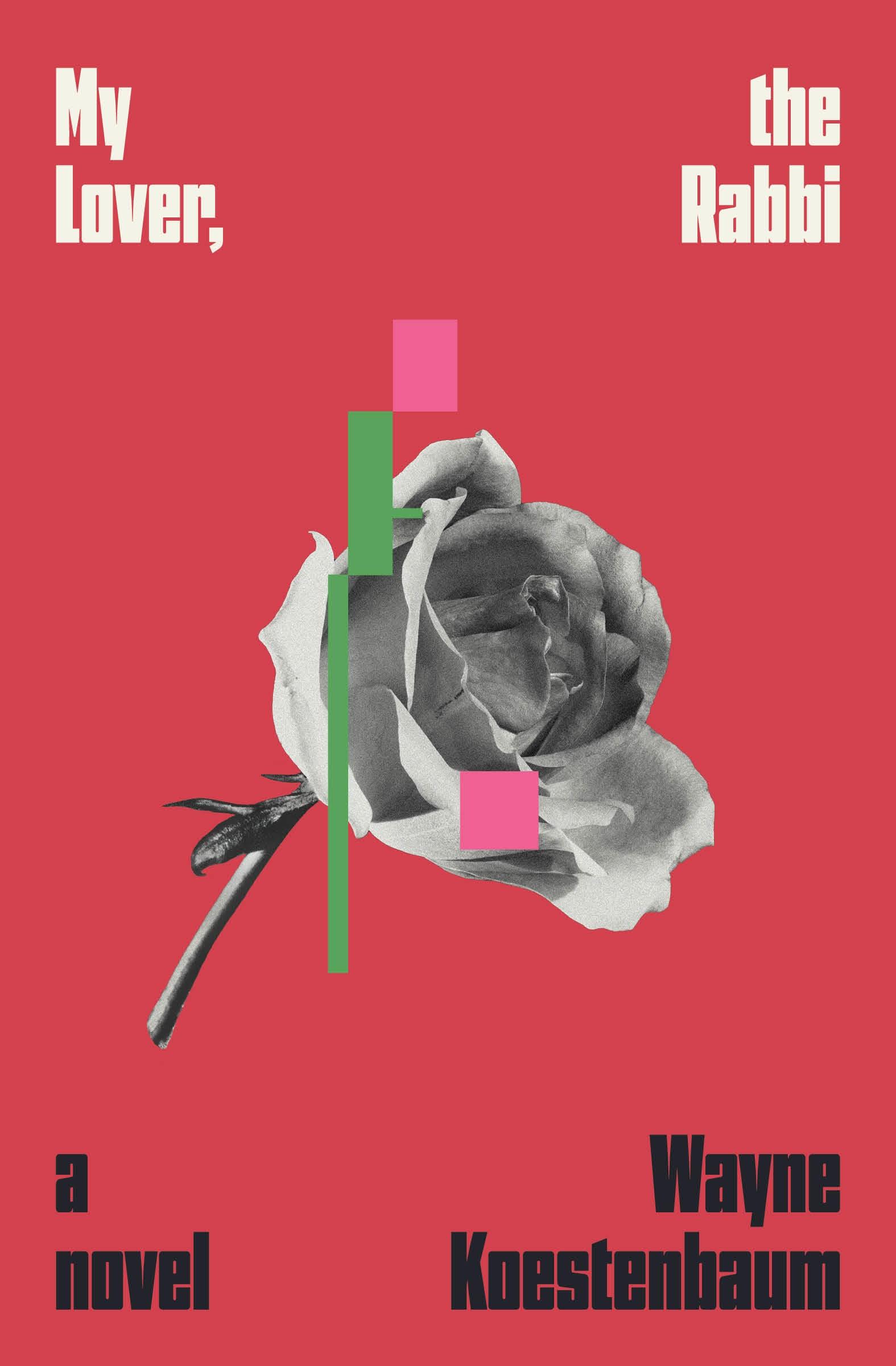
Cover for My Lover, The Rabbi (2026) Farrar, Straus and Giroux.
What came to me while I was reading the novel was some scraps of Robert Glück’s Margery Kempe—particularly, the story of her devotion to Jesus. This obsession, the feeling of being submissive to the god-like figure, the iconoclast, feels like an affinity to the relation the narrator has with the rabbi and, somehow, also toward his housemaid and protector, Monica Prague. Have you read Robert Glück’s book?
I have read all of, or much of, Robert Glück's published work, and I deeply admire it. I think of him as a compatriot in this zone of a recognizably gay male literature that is nonetheless anti-representational, or that plays with—or toys with—a reader's wish for security. Robert Glück is famously associated with a literary movement, as you know, called New Narrative, and I'm not part of that group exactly, but they're some of my favorite writers. Dennis Cooper, Dodie Bellamy, Kevin Killian. They're my allies. And so, yes, I definitely think of my book as in conversation with the work of Robert Glück, and also my book, like New Narrative works, is heavily autobiographical, but also entirely fictional.
You have previously published ten poetry books and two fiction books. As a writer, what do you feel you can do with fiction that somehow is not perceived with, or you can’t do with poetry? Which genre is sexier to you and why?
I'm always more at home as a poet, and becoming a poet was a decision I made very early in my writing life, in my early 20s. I decided to devote myself to poetry rather than to fiction, and that was because I understood that my strengths lay in language play and in semi-surreal, imagistic scenarios. I wasn't as interested in a conventional plot or consistent character and motive. I was also more interested in reading poetry than in fiction. So, I felt a cultural, intellectual, and spiritual alliance with the values of poetry. My Lover, the Rabbi is, in a secret sense, a poem. It is fiction, but it's written with the structure of a poem, in that it's based on intense repetition and on a fealty to the errant law of the voice. There's a line by the poet Frank O'Hara in his poem “Homosexuality,” where he says, “It is the law of my own voice I shall investigate.” That's a poet's credo and it's also the credo of this book. Once the characters began to enter the scene, the book’s nature shifted. It begins more in the realm of a poem: apostrophe, invocation, salute, and love song. But once the people start clogging it up, the tone changes and becomes more, not conventionally fictional, but more recognizably novelistic.
Your publicist from FSG, Tracy, shared with me the image of your handwritten first drafts in a pile of colorful notebooks. Do you always handwrite at first? Do you archive these notebooks?
I archive everything. My archive up to 2018, except for my diaries, is at the Yale University Beinecke Rare Book and Manuscript Library. So it is literally archived, and maybe in a couple of years, all the notebooks for My Lover, the Rabbi will also enter the library at Yale. I don't write everything longhand. These days, most of my essays I write on a keyboard. I dictate sometimes. In the last few years, I've often dictated my essays into my phone and then transcribed them and edited them. My diaries are always longhand, and I began this novel in my diary. I stopped writing my actual diary for a few weeks, and I just started keeping the novel in notebooks as if I were simply continuing to write in my private diary. Then I typed it all up and started editing it. In the past, I was very devoted to actual typewriters. And I still miss them.
In your interview with Ben Shields from The Paris Review (March 15, 2018) over Camp Marmelade, your poetry collection, you talked about figures like Gertrude Stein and Susan Sontag. You also said you’re a reader of Dennis Cooper and one of my favorites: Elfriede Jelinek. What’s your relationship with their writing?
Yes, I really love Elfriede Jelinek's books. They are difficult and weird. They are not cozy. They are volcanic. They are astute in their analysis of gender and cultural politics, and they are relentlessly visceral to an ugly extent. And I identify with that tropism toward the visceral. She's a real role model of mine.
Did you see The Piano Teacher?
Oh, yes, many times. That's a very important film to me. Not only because I'm a pianist, and I've had many piano teachers, but because I am an Isabelle Huppert completist.
Toward the end of the novel, the phallic-driven scenes and their extreme alchemy—“each time I rubbed my body along his coil-rich body, I was siphoning funds from my diminishing nest egg,” seem to warp into more inner-and-reflective-fueled periphery. The rabbi dies in the fire. The narration softens. It’s more intimate. The narrator still tries to comprehend what had happened to the rabbi, his death and his wish of the impossible—undying. It’s a beautiful and deeply touching ending. He finally seems to detonate his obsessive submission, as though the fire purged and melted his encrusted heart. How have you approached the end of the novel?
In general, I plotted the novel a day at a time. I would write little notes before each composition session. Each day, I would write fragmentary indications about what was going to happen next, what loose ends needed to be dealt with. As the writing progressed toward the climax, those notes got longer and longer, and I deliberated a lot over what would happen. I didn’t know how the book would end, until I finally wrote the last scenes. In fact, I remember considering the book finished right before the last section. The lines with which the book originally ended were Chapter 187, the penultimate chapter of the book. But then I felt a sense of restlessness, and the next day I wrote the truly final chapter, number 188. It's almost a musical feeling that I am familiar with from writing poetry, where you sense that there are still some beats missing in the phrase. When I wrote the end of chapter 187, the plot had ended, but I felt the need for another melodic trespass. Another gesture. Another leap across the stage. Even if it was a surreal leap.
That was a beautiful part of that dream that he had, or whatever it was. And it's also a great momentum, where it kind of peaks, and then it just collapses, cocoons itself. Now I'm also thinking about the use of the symbolic number 6, which appears in the novel.
The events in the rabbi's past formed the investigative core of the book. A lot of the plot is about delving into the rabbi’s repressed, mysterious prehistory. Those materials seemed governed by magical logic, magical reasoning. And to that extent, the numerological play is also a function of sorcery, or alchemy, or superstition. So I don't have a fixed symbolic program for what the recurrence of the number 6 means in my novel, but I'm aware of the number’s biblical significance. I felt that the rabbi's past, which is never very easily documented, has, for me, as it did for the narrator, a sensation of sky-writing, or ancient relics found in Pompeii.
What are your favorite gay/queer novels? And what books are on your nightstand?
Robert Walser's Jakob von Gunten, even though people don't consider him a queer writer. To me, he is, and that book is really queer. It's about an obedience school. Others would be Gertrude Stein's A Long Gay Book and A Novel of Thank You. Neither of those, of course, are strictly speaking novels, but she calls them novels, and so there they are. Also, I would add her novel, Lucy Church Amiably. Those are three very important queer books. But also Elfriede Jelinek’s The Piano Teacher because it covers all the bases of perversion. The novels of Dennis Cooper, aforementioned. Jane Bowles' Two Serious Ladies. A deep favorite of mine. All the novels of Willa Cather, especially The Song of the Lark. James Baldwin's Another Country and Giovanni's Room. Some of the essays of Hilton Als in his book White Girls are essentially fiction. Jamaica Kincaid's book, My Brother, is an autobiography, a memoir of her brother. It’s not fiction but it’s novelistic and it's a very queer book. (So is her Autobiography of My Mother.) She's one of my favorite writers. The book on my night table right now is Kincaid's Talk Stories. This is a collection of her New Yorker Talk of the Town pieces. Now I’m in the middle of reading Modern Woman, a book of poetry by Edith Södergren, translated by CD Eskilson, published by World Poetry.
What kind of columns have you written for Vogue?
That was a really long time ago. I wrote small pieces for a section called, People Are Talking About. I think the first thing I wrote was a tiny essay about the photo of the actor Jeanne Moreau on the cover of a Miles Davis CD, the soundtrack for a Louis Malle movie, Elevator to the Gallows. I interviewed the movie star Alec Baldwin, the opera diva Renee Fleming, and Vanessa Redgrave. Some of these pieces are collected in my first book of essays, Cleavage: Essays on Sex, Stars, and Aesthetics.
You’re invited to the VIP literati event and dinner. It may seem like a drag but you know you must go. You can take three of your friends. What would you wear and who would you take?
There's a little Comme des Garçons shop around the block from me, and I would go to Comme des Garçons, and clearly, someone else is providing me a clothes budget for this VIP event. As Vogue editor Anna Wintour said in a recent New York Times interview, “To be clear, Jessica, we have a very healthy budget at Vogue.” I would buy tight velvet pants, a floral shirt, and a hat. I definitely need hats. And I would buy a little purse—a white, shiny pocketbook. I have a necklace of Murano glass that I bought in Venice several years ago, and I would wear that, just like Anna Wintour does. She wears layers of necklaces. I would definitely bring my editor, Jackson Howard, and my UK editor from Granta, Daniel Bird, and my agent, PJ Mark. If I'm only allowed to bring dead people, I would certainly bring Emily Dickinson and James Baldwin, because I know they would get along. I know he could really work his charm on Emily Dickinson. I would bring Susan Sontag, though she might make a pass at Emily Dickinson, and literary history would be forever changed.