.jpg)
Grace Byron. Photo by Hunter Abrams.
“I wanted the dangerous love built on long-distance plane rides, trauma, and failed girlhood,” the unnamed narrator of Grace Byron’s Herculine confesses, walking quietly along the narrow river that runs through a patch of land in rural Indiana inhabited by 15 or 20 trans girls, inhabited, in turn, by their 15 or 20 corresponding demons. 700 miles from New York with a broken-down Honda Civic and spotty cell service, she weighs the risks of remaining long enough to trial the return to her first love, her ex-girlfriend Ash. The most notable risk is that of demon possession, which would tether her eternally to Ash’s trans separatist demon cult. “Choosing T4T was just choosing one kind of hurt over another. It’s no more valiant. It’s a survival tactic.”
Amid the onslaught of both the U.S. administration’s executive orders and Canadian provincial and federal bills directly attacking trans existence across the continent, anti-trans rhetoric has moved from the fringe into the core of right-wing political agendas and proliferates in mainstream culture. When it was released by Saga Press last October, Herculine arrived into a world infected with severe anti-trans hostility—a not uncomplicated moment for a novel populated by demonic trans girls and themes like in-fighting, identity politics, conversion therapy, and convoluted spiritualities. In the mainstream literary world, flattening marginal narratives is made compulsory and coerced—but, with Herculine, Byron breaks from what is easily digestible and, influenced by trans horror novelists that came before her, pushes her readers to tread further “into the muck.” The muck of trauma, jealousy, regret, dissociation, disappointment, and so on.
Byron has forged a space for herself as a journalist and critic, with a long roster of publications in spots like The New Yorker, Bookforum, The Baffler, and Vogue. Her work spans art and literary criticism, political reporting, memoir, short stories, and profiles. Byron’s debut novel Herculine is a departure in many ways—her first longform fiction project, her first engagement with horror writing. The throughline of her work, however, is an unfaltering and exacting critical voice that pierces through the haze of violent social and political schema, grounded in a real, mundane, and clear-eyed sense of solidarity. I spoke with Byron about all of that, and about constructing gritty characters, how criticism and fiction bleed into one another, and the use of horror to write in the shape of trauma.
I think literary fiction has always been about people fucking up. I don’t care about characters being likable or good people. The idea of reading as a manual for morality is pretty grim to me.
How does it feel to have Herculine out in the world and to be on the other side of your book tour?
It feels good! It reached a lot of wonderful readers and it was fun to interact with people in person. And also, to see Herculine have a life of its own is a strange thing, since I wrote it a few years ago and at a very different time in my life…it’s been interesting to see what has and hasn’t changed both in the culture and personally.
Well, the book is really about community—its promise and its pitfalls—so I wonder how it was to gather around Herculine in community and discuss its themes?
I think it really forced me to refine what I was wanting to say. A book can be a really flexible thing in a wonderful way, but when there are political stakes, it feels important to say what you mean very carefully. Like, it felt important to say that community is not all bad. The book has a pretty pessimistic take on community and T4T, but there are obviously great things about both of those political endeavors. It’s more “here's what not to do” rather than “this is always bad”—I think, in the book, that’s clear. But talking about it is tricky.
I want to get into the world you’re building in Herculine. It was such a fun read—so spooky and horny in a perfect way. But it's also such an incisive work on trauma. The horror genre was a beautiful choice for this kind of project—it’s especially fitting as an exploration of religious trauma where the ‘monsters’ are literally demons, straight out of Christian demonology. How did you come to build this sort of internal world for the book, and what was your research process like?
For most of my life, I was really anti-horror. I was raised in a religious household, so I had a lot of encounters with demonology and exorcism. I grew up in the church and youth group, and I was a big reader and took a lot of Christian studies classes, so I felt very versed in it. In the same way people use the mythology they grew up on in a flexible way, I used Christianity. So instead of Greek myths or whatever, I turned Beelzebub on its head. That was the context I started to play with, and it felt electric to change it and make it funny and weird and horny and strange. I think that element was always in my work—thinking about the vexed relationship between queer and trans people and religion or spirituality. I wanted to build that out, and then that interplay became the most interesting thing about the book. I was thinking about memes and internet culture and trans culture and also demons and the church and religious trauma. So those binaries sort of ricocheted throughout the book—cis and trans, New York and the Midwest, demons and God—they became the engine of the plot. And then, my boyfriend and I started watching a bunch of horror movies—that’s a big thing they enjoy, and I was like, okay, fine. We watched Candyman and The Blair Witch Project and Ari Aster movies that I’d never seen.
Well, the horror tropes are so potent in Herculine. Like this doubling you mentioned, where two things are presented as opposites, one seemingly good and one more sinister, so it casts a shadow over its other. It comes up with this faith or belief in T4T separatism, or in utopia in the kind of queer leftist sense, which is doubled by Christianity. The ‘back to the land’ commune project is doubled by a demon possession cult. The horror comes out of this suggestion that they aren’t as opposing as we want to think.
Complicating those binaries felt important. Queer and trans community is difficult—there can be a shadowy side. And, there are moments where the main character is getting something from Christianity or spiritual community. But, I think I've always been fascinated by cults. I grew up watching the X-Files and there are so many cult episodes. And I thought Midsommar was an interesting film, not because it's the best film ever, but in a way it really executes the sort of eeriness of wanting belonging, and joining a cult—this need for belonging being weaponized against you. I’m curious about the banality of cults…like, it makes so much sense that people want to feel belonging. I think that can be hard for a lot of queer and trans people, so it’s rife for being taken advantage of. But the need to feel loved makes sense. People want to feel like they have community, and if you can't find that in a more traditional way, you're going to go outside of that.
The way belonging is presented in the book becomes this never-ending series of returns to a sense of belonging or sense of family. The narrator goes back to the Midwest, back to her ex and T4T community. Then, at the end, there’s this return to the mother and the childhood home. But at every turn, the home is no longer a home. The familiar is made strange or dangerous—mostly with the demons that keep popping up—so the narrator has to keep moving. It felt tied to this idea of trauma, of moving with it; it stays in the body. It's not something you’re getting away from, but you're moving with it. There's this line where the narrator is recalling how, as a kid, every time she got home from a conversion therapy session, she would drop her backpack and go for a walk, because the house felt stagnant. The ‘therapist’ and the house were these sites of ongoing violence and walking was a way of letting things move, even if she eventually returned to that place. The book’s form sort of mirrors this process of leaving the house and walking around the block, even if the eventual return is inevitable—so, also the shape of processing trauma.
Oh, for sure. There's such a relationship between geography and trauma. Trying to outrun something and it still being there, returning to the wound again and again. It makes sense that the narrator has to return, physically, to the site of the original trauma—that happens in a few different points in the book. She has to confront the conversion therapist in a sort of spiritual and metaphysical way. She has to confront the house she grew up in and the state she grew up in, and then she has to confront this ex of hers, which also means breaking with the idea of T4T being a completely good thing in her life. Yeah, there’s a lot of moments where space is playing a pivotal role in processing. You can’t outrun the wound. And you can't return home the same way twice, you know. I found those two truisms to be interesting cliches to play with.
Yes, and once she gets to the commune there's this real ambivalence around leaving—there were so many opportunities for her to have left sooner but she’s hanging on to the idea of Ash and this notion of real love. Like, of course her car gets destroyed. As a reader, you're like, oh my god, get out.
Absolutely. That is the mark of trauma. Like, you can see a friend enacting and reenacting their trauma and be like, don't do that. Don't date this avoidant person again, cut this person out, whatever. But when you're in it, you are just not operating on the same logic. You do it again and again and again. Some readers have been like, why doesn't she leave sooner? And it’s like, what if your first love called you back? That is a pretty seductive siren song—that is the promise of utopia.
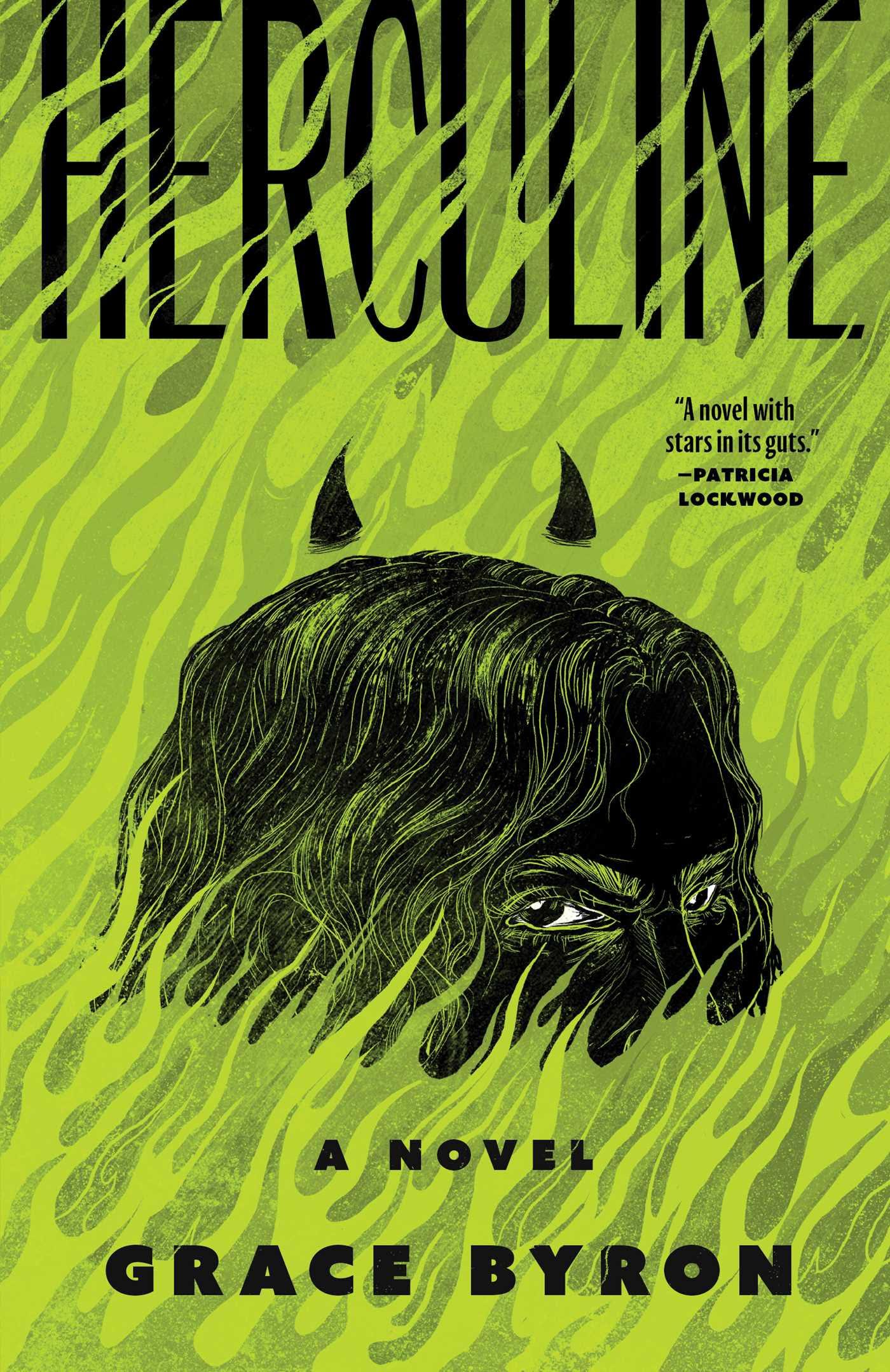
Cover for Herculine (2025). S&S/Saga Press.
The book also thinks about the inverse relationship of trauma and solidarity. I think especially in queer and trans spaces, we want trauma alone to build a shared foundation for solidarity, and a sense of real belonging or community. That can be a risky logic.
The risk is that you build unity or a kind of misplaced allegiance rather than solidarity. And things crop up in our spaces that can mirror the outside; almost nationalistic, carceral ways of thinking about community—casting people out, or having really intense rules for engagement. Solidarity means I don’t have to be like my neighbor, but I will fight for them or care for them. And, solidarity means a more expansive idea of who I consider as my neighbour. Community takes work and a shared ethic—shared identity is a starting point, but it's not an ending point. It can be beautiful, because you can share each other's burden, but it shouldn’t be a closed door. I think the narrator comes to that very slowly by the end of the book, though she never fully articulates it in that way.
By the end, there is real solidarity, and it's just a lot less glittery than she imagined.
It’s not always sexy. It's not always triumphant. Sometimes it’s eating at a fucked-up diner with your friends and complaining. But I think those things are actually really important, like, that is the glue that holds people together. It’s worth considering as an important praxis.
Definitely. So, Herculine is a bit of a cautionary tale, but there’s still this grounded ethic of community that’s rooted in that mundane sense of friendship. It’s anti-utopian but there’s still a hopefulness. That ethic seems to guide a lot of your writing—your criticism and political reporting. You invoke a sense of care and commitment to the world and your communities through a very honest, incisive lens.
I think that's true. That is the ethical framework that my work operates on, regardless of format. I also just really didn't want to write a well-behaved narrator or a how-to ethical guide. I care about characters that are grittier, I don't really have any interest in writing for the Goodreads crowd—there's enough romantasy novels if that's what people want to read, and more power to them. But, I think literary fiction has always been about people fucking up. I don’t care about characters being likable or good people. The idea of reading as a manual for morality is pretty grim to me.
You’ve written about this trap of good vs. bad representation discourse where, as a trans author, everything you write has to do some kind of explicit political work for your community. It makes sense to use fiction as a vehicle to move away from that.
I feel like the book riffs on that more than engaging with it. Like, it derides that kind of binaristic thinking with its jokes about the freelance crowd or the trans clickbait titles. I took a lot of courage from writers like Gretchen Felker-Martin or Alison Rumfitt, who cared more about putting grossness and ugliness into the world in a way that got at something deeper than, like, a trans memoir that’s like “here's how I overcame my challenges.” That kind of representation is fine. I’m sure that is really important for some people. But, Herculine isn’t for a reader who doesn't want to get into the muck a bit.
In an article in The Baffler on trans literature and the present tense, you write “We need books that acknowledge the pain of our current moment and books that imagine how to live in the ruins.” Herculine sort of straddles this line of the real and the constructed, fantastical. It is really rooted in the actual present.
Well, it's hard, too, because I feel like so much has changed about trans culture and discourse, even in the years since I wrote it. This isn’t a book you could write during the second Trump term. It's about a different era. Perhaps it could be set during Trump's first presidency, but I think these characters would have a very different set of concerns if they were operating in the contemporary moment—it almost feels harder to try and write about the current moment in a fictional way, even if there are resonances that ricochet out to now. I don’t know…I feel like I can never write good fiction about the contemporary moment. I need a little bit of distance usually, to engage with it.
I want to hear more about your writing life at large. How did you come to your current writing practice? What’s been nourishing you throughout that process?
So, I went to school for film and that just never really came together in a real way. At the end of 2020, my friend Erin Taylor became the arts editor at New York Observer and asked me if I wanted to write anything, so I started doing reviews for them. I did a review a month, so I felt like an unofficial book columnist there. It ranged from, like, Sally Rooney to Agatha Christie. Then I branched out to reviewing art shows, I wrote about Greer Lankton, and then I started learning how to pitch articles and pitching at other places. So I was writing every day. And to be a good writer, you have to be reading a lot—reviewing books forced me to be reading. I also put myself through a Classics crash course… and that's really how it started. I was ambitious, I started to do bigger pieces and more political journalism because it was in demand. It was all very random, a lot of falling into things or finding the right person at the right time.
I like to invite the reader in, and make them feel like they're getting a take—not in a ‘hot take’ way—but getting an opinion, getting something at a slant.
That does seem to be the way it works these days. How did you find your voice within your criticism work?
It was hard! I think it took a long time. I know some writers who are very young who came up very quickly, and I think that that's brutal. It was nice at the beginning to have the room to develop a voice and try things out. I think every writer will say the first few years of writing criticism can be embarrassing or difficult. A lot of it was about repetition, just doing it over and over again. And, it's important to have some sparkly bits. You have to have a few lines that feel true to your voice as a critic, and that takes time to figure out. I also think not enough critics are reading and admiring each others’ work. Patricia Lockwood is an amazing literary critic—reading her was really important. And Jenny Diski is one of my favorite critics of all time, she makes really interesting and surprising connections and just has a really natural voice. I also love Andrea Long Chu. I think she's such a great writer, very detail-oriented, but also has really beautiful, vicious prose. I just immersed myself in the world of criticism.
My work has a political tinge and a bit of a voiciness that is hard to get into some places—a lot of critical outlets have a house style. But there are still ways to say what you want to say in a fun way. I like to invite the reader in, and make them feel like they're getting a take—not in a ‘hot take’ way—but getting an opinion, getting something at a slant.
Well, the impact of your critical voice on your fiction is very clear. Has that been a two-way process? Like, did delving into this longform fiction work shift anything in your nonfiction practice?
I don't know. It's an interesting question. I think it is important to tell a story with criticism—to have a sort of narrative arc. You can’t force it, but I think a good review is a conduit to say something else, other than just what the book is about.
How was it shifting between the two modes, having these overlapping projects of longform fiction and shorter nonfiction pieces. Was that nourishing or just difficult or…?
I think I kind of thrive on creative chaos. I am a bit of a workhorse, but I also think I like doing different modes at once. Fiction feels so much more magical and strange. With nonfiction, it feels like there’s something I’m reporting on that I have to excavate, whereas fiction often feels like making something out of nothing. And the interplay is always interesting—seeing what does trickle into the fiction—because it's never a one-to-one. The interplay can be really elusive and subconscious. I really admire writers like Joan Didion or Annie Dillard or Ursula K. Le Guin, who could jump between those modes.
There’s something very politically potent about that kind of fictional work that can be really overlooked or neglected. But it seems like the temporal distinction is big—the sort of political work being done in shorter-form nonfiction has a really different texture to that of fictional work.
Less time to gestate, for sure, yeah. There’s definitely a pressure to be reporting on trans issues right now. I feel a pretty intense obligation and ethical commitment to doing it. Especially when I’m writing for places with a wider readership, it feels important to get in as much as I can, not giving into sentimental narratives about transness and getting as many voices in as possible. It is difficult, because being trans isn’t my whole life––it often feels like people want to make that my whole life, whether I want it to be or not. There are a lot of ethical quandaries that come up when writing nonfiction, both internally or externally, I think both are important to pay attention to.
You wrote a piece for Lux calling for a return to the feminist polemic, where you write:
“The polemic has taken a backseat to other genres of feminist literature because such texts are seen as inherently naive. It’s considered militaristic rhetoric of a bygone era. This is a loss. Polemics, even when ostensibly ‘wrong,’ offer a starting point to move discourse and energize debate. They give us a common language. The ability to take positions, to build an erotic charge on the left, to build and articulate feminist positions based on more than just dispassionate historicity.”
It’s interesting to think about polemics in the context of cults like Herculine––cults have that “erotic charge,” that, on the left, we’re really allergic to because we sometimes see a strong politic as a ‘hot take,’ something prescriptive…
Absolutely…which I think is fair. I think it's good to be skeptical of ‘hot takes.’ I guess I’m circumspectly defending the polemic. I have probably not written very many polemics…I think this piece is a polemic about polemics. I think I’m defending polemics and polemicists that I've enjoyed from being tossed aside—there are pretty few polemicists right now, which is sad to me. I think it’s a really interesting form. I would love to write a polemic.
Well, as you said, Herculine is a bit of a “what not to do” thing, but is not trying to tell anyone what to do. Will there be a sequel, or a new book project, that might take that on? I could imagine a kind of Monique Wittig-esque Les Guérillères type thing.
Oh yeah, maybe there should be…[laughs]. No, I don’t know. That's definitely not what I'm currently working on. I’m not very pro-sequel. I really like the work of Hayao Miyazaki because I'm sure the temptation for him to do a sequel is strong but he’s so against it. I like how each of his works is a self-contained world.
What are you working on right now?
I'm currently working on an essay about Carolyn Bessette Kennedy and the new Ryan Murphy show, on her mythology. I am working on a new longform project, but I don't want to say too much. But there is something cooking.
Very exciting.