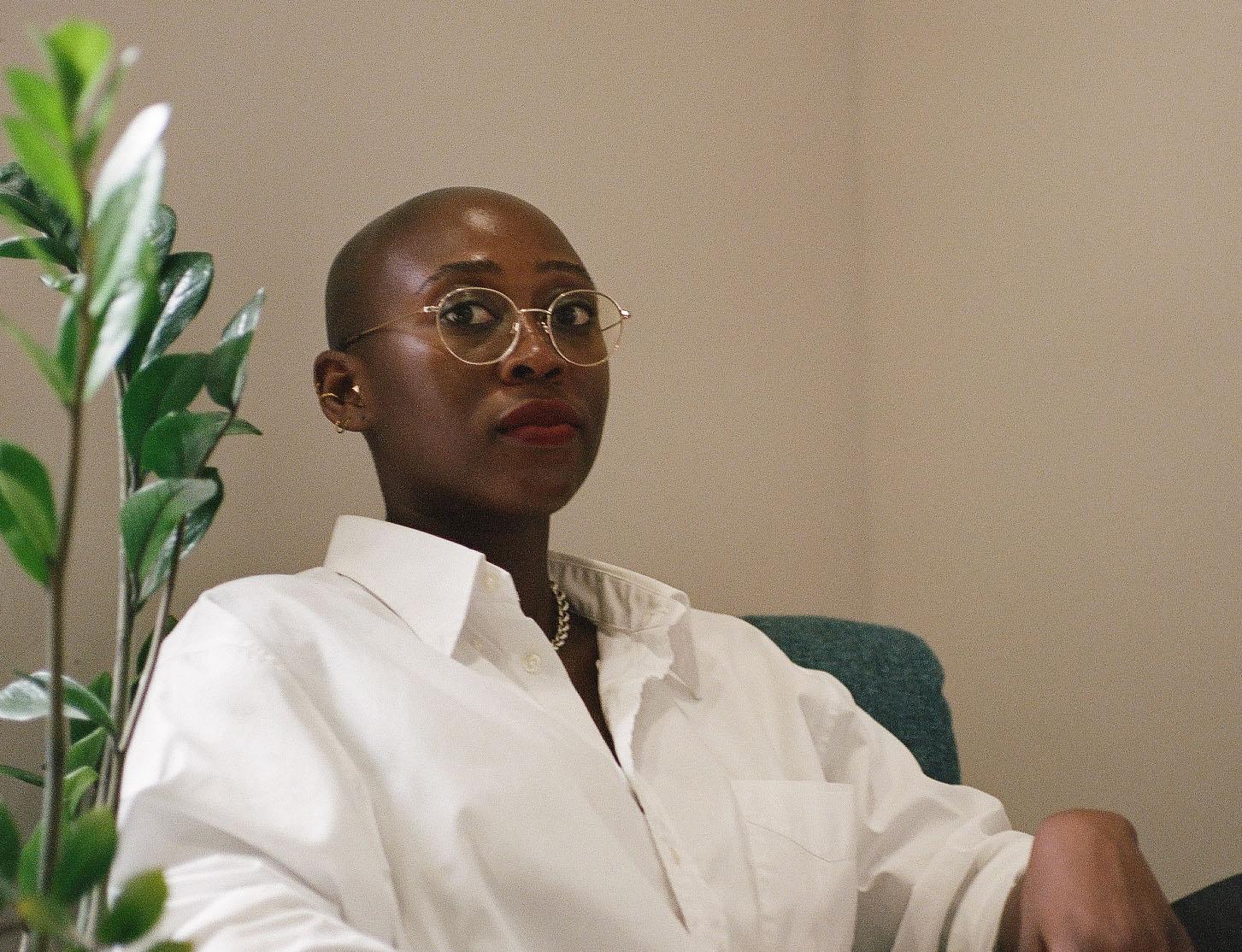
'Pemi Aguda. Photo by IfeOluwa Nihinlola
’Pemi Aguda does not have all the answers, but she wants to figure it out. The purpose of writing or ‘any kind of creative art is to imagine futures together,’ she says, a sentiment that aligns with cultural writer Umnia El-Neil’s essay, It's the end of the world, why bother?. In this, El-Neil writes that ‘storytelling can change the world’ and calls it a civic responsibility. In her rallying call, she describes the oft touted disregard for the Arts and Humanities as ‘bordering on suicidal in its lack of care.’ El-Neil does not offer an argument but a statement—art is not a frivolous but rather an ethical and social responsibility.
Aguda’s work operates from this same premise. In our conversation about her latest novel, One Leg on Earth, she returns to this same idea. ‘If we think of art as real, then the consequences of our art should also be considered real.’ Our discussion reveals the power of words to change perspectives. Through imaginative inquiry, Aguda presents an offering that interrogates themes of autonomy, taboo, gentrification, and the language of persuasion.
The novel follows Yosoye, a young twenty-something woman whose move to Lagos unfolds against the backdrop of mystery; pregnant women walking into bodies of water around the city and drowning themselves. One Leg on Earth explores liminality as a delicate balancing act of transitionary states and the complicity of toeing the line. What emerges both in our conversation and in her work is a motif of resistance. Aguda refuses to adopt an air of pristine tidiness and closure. It’s a disservice to the complexities of her character and for a city like Lagos. Our conversation reveals something important and known but oft ignored, the power of words.
The following conversation includes discussion of major plot points from the author's books.
All my questions are in the book. I'll put the question in the story even if I don't have the answer. I'm thinking about it, so you get to think about it, too.
Your work resists tidy resolutions. One Leg on Earth has a very open ending, which is great but it’s also frustrating. Is this something that you're very intentional about in the writing?
A few readers have said they are frustrated by the fact that the mystery isn't solved at the end of One Leg on Earth. I apologize to everybody, but I'm not that sorry. In earlier drafts, there was a tidy answer. The mystery was solved, or rather, somebody knew what was going on. Over the years of writing the book, I became less and less interested in a concrete answer. More striking was the realization that there could be a million reasons. In my years of writing it, I started to see: this could be a reason, and that could be a reason, and that could be a reason, too. The fact that there are enough things in reality that contribute to conditions for what’s happening in the novel made me sad. And you'll see that the book has many theories. It became more interesting to set out those theories, than to answer the question in a tidy way. Anything else might have made it too neat a parable.
When you were approaching One Leg on Earth, how did this process differ from how you approached Ghostroots?
Oh, it was a whole new beast. I'd never written anything longer than a short story before. In fact, I considered myself only a short story writer.
In the first semester of my MFA, a novel writing class was offered. The premise was to write a short novel in a semester. About 50,000 words. I wanted to go to the songwriting class instead, but the director of the program encouraged me to try. So, I decided to extend a short story because I had no ideas for a full length project.
I didn't know how to think about a novel, so, I approached it like I was writing a bunch of short stories. I’d write one chapter about Yosoye, the main character, and then I would pick a random person in Lagos to write a short story about. That was how I was able to string together the 50,000 words for that class. I put the draft aside because I was pretty sure it was trash. A couple of years later, I sent it to two trusted friends and asked: is there anything here? They said yes. After that, I wrote draft after draft, trying to teach myself how to write a novel.
I learned how to think more expansively about Story. Capital letter S. Story, because the biggest difference for me is having to hold the whole scope of a novel in my head. It's easy to do that for a short story, but a novel is so expansive. It was a steep learning curve.
There's a kind of familiarity and comfort in your writing already established here, it felt like you were able to keep elements of yourself in the novel while also creating a distinct project from Ghostroots. Did you have any influences beyond literature that helped shape this vision for One Leg on Earth?
That's a good question. I'm a big music person. There's a song called “Iemanja” by Angelique Kidjo that’s referenced in the novel. That was one of the songs I would loop on repeat because it's quite haunting. When it swelled, it put me into this almost-trance while trying to write about these women jumping into water. But for the shape of the book, it's hard to pinpoint exact references because influence feels like such a mélange. It's part of the mysticism of this writing life that I walk to the park down the street and come back with a story idea. I couldn't tell you the exact chemistry that created it.
You have three book covers. How do you navigate these states in between when you're writing? Does the visual lend itself to the themes that you cover in the novel?
The only visions I'm having are inside of the story. But once the book is a book, or once my publishers think it’s near completion, I get excited to begin envisioning covers. I don’t always have the final say, but I’ve figured that I can get ahead of things by suggesting artists. I create a deck showing existing covers that could be good references, and covers I don’t like. One of the artists I suggested for consideration was Portia Zvavahera. She's from Zimbabwe and I love her work, which seems to be, in some pieces, a visual depiction of what I'm writing.
I wanted to approach artists who I thought were working on the register of the in-between. I ended up with Bunmi [Agusto] whose work I'd been following for a while; and Calida Rawles. My artist friend, Nengi Omuku introduced me to Calida's work. Rawles makes art about black bodies in water, and I love the abstraction of Away with the Tides, our final choice. It was lucky that my publishers said yes to these; that's not typical.
There’s something you said about abstraction, because even Ghostroots had different covers as well. Do you always envision having an abstract version of the cover, something that's not too literal?
I think my tendency is to move away from the literal. For example, with Ghostroots, there was a cover option with ghostly skulls in a garden. It was a beautiful image by the same artist, Day Brierre, whose work ended up being the US cover, but that one felt overtly representative of the title. What we ended up with—the goat with the slit neck—is not an abstract image, but it doesn’t echo the themes so directly. There's more space to play with meaning.
Let's talk about Lagos because Lagos is a strong character in Ghostroots and also in this novel. In the book you bridge multiple versions of Lagos with the focus on The National Youth Service Corps (NYSC). As a failed cultural integration project, NYSC feels like a catalyst for the haunting of the novel. But why Lagos as the entry point for this story? Or just why Lagos in general?
I grew up in Lagos. Lagos is what I know. I lived on the mainland and would drive hours in traffic over Third Mainland Bridge to my workplace in Dolphin Estate in Ikoyi. There's water and there's Lagos. Growing up, I didn’t pay attention to the water. It was always there. That’s the fog of familiarity; you stop seeing things that are your everyday reality. It was important that the person seeing Lagos in the novel was an outsider so she could pick up on things that an insider wouldn’t. I listened to that Timehin [Adegbeye] TED talk and thought: why haven't I been paying attention to the waterfront evictions? This has been the reality of many people; it’s the history of Lekki. That so many people were displaced for Lekki to exist is something we don't talk about much. In the process of writing this book, I started to see Lagos more clearly. When you pay attention, there's a dissociation you have to partake in to live happily in Lagos.
There's a lot of meditation on gentrification and land ownership. Omi City becomes this monument to progress but it's built on loss of devalued life. And so in the novel, when the character of Gbenga asks who owns the land, it opens a much larger question which I’ll put to you. How were you thinking about power in relation to land and history and ownership?
All my questions are in the book. I'll put the question in the story even if I don't have the answer. I'm thinking about it, so you get to think about it, too.
Frank Lloyd Wright said, "A building should grace its environment rather than disgrace it." When we talk about that grace, it should also include history. How does a building grace the history of that environment, of its people? Of course, righteous anger about Eko Atlantic can be too easy, combined with the sadness of losing Bar Beach. But what Gbenga says to Yosoye is relevant: show me a place that doesn't have bad history. We've all accepted Banana Island; we've accepted Lekki, this peninsula. But if we think back to Maroko, back to what [Raji] Rasaki approved, we’ll see that we are enjoying life beside the ghosts of gruesome histories. Part of the work of fiction, or any kind of art, is to imagine futures together. For us to do that, we need to actually look, to not be scared to look at the past, even if it makes us complicit.
Another question is why the name Omi City?
Omi means water in Yoruba. It was right there.
You did a 2020 interview with the Republic, and you said “in these fictional worlds, I have some semblance of power.” I keep returning to this because the novel shows the persuasiveness of language so well through Yosoye’s copywriting talent. Words in this context feels like a form of spell work. Was this foundation of language in this way at the forefront of your mind when you were writing the novel, but also in your own practice personally as a writer?
That's a really good question. In 2019 or 18, I found myself sitting with some leaders and elders of the Otodo Gbame community. They were generous with their time and shared their history and the experience of being displaced so violently. Because I was coming from the University of Michigan, they thought I had some power. So, they said: tell them our story, tell them what they're doing is not good.
I remember leaving that space feeling quite defeated and powerless. I was thinking: I’m just a fiction writer; what kind of power do I have? I'm going to write a story about a lonely girl; where’s the power there? But like you just quoted back to me, there is power in language. There's power in fiction. Even now, we're having real conversations based on these fictional characters.
But with power comes great responsibility, as they say. And that's something Yosoye realizes in this story. Now that she’s found her own power of persuasion through copywriting, what is she using that power for? Who is it in service of? It's one thing to come into your agency, it’s another thing to investigate who you are helping or destroying with that power. Even with language.
Once upon a time, I told a class how excited I was to do more bonkers things on the page. I said, it’s fiction, I can put my characters through all the hardships! Who does it hurt? Afterwards, I wondered if that was true. Yes, it's fiction, but if we think of our art as real, then the consequences of our art should also be considered real. So it all comes back to responsibility, of language and stories.
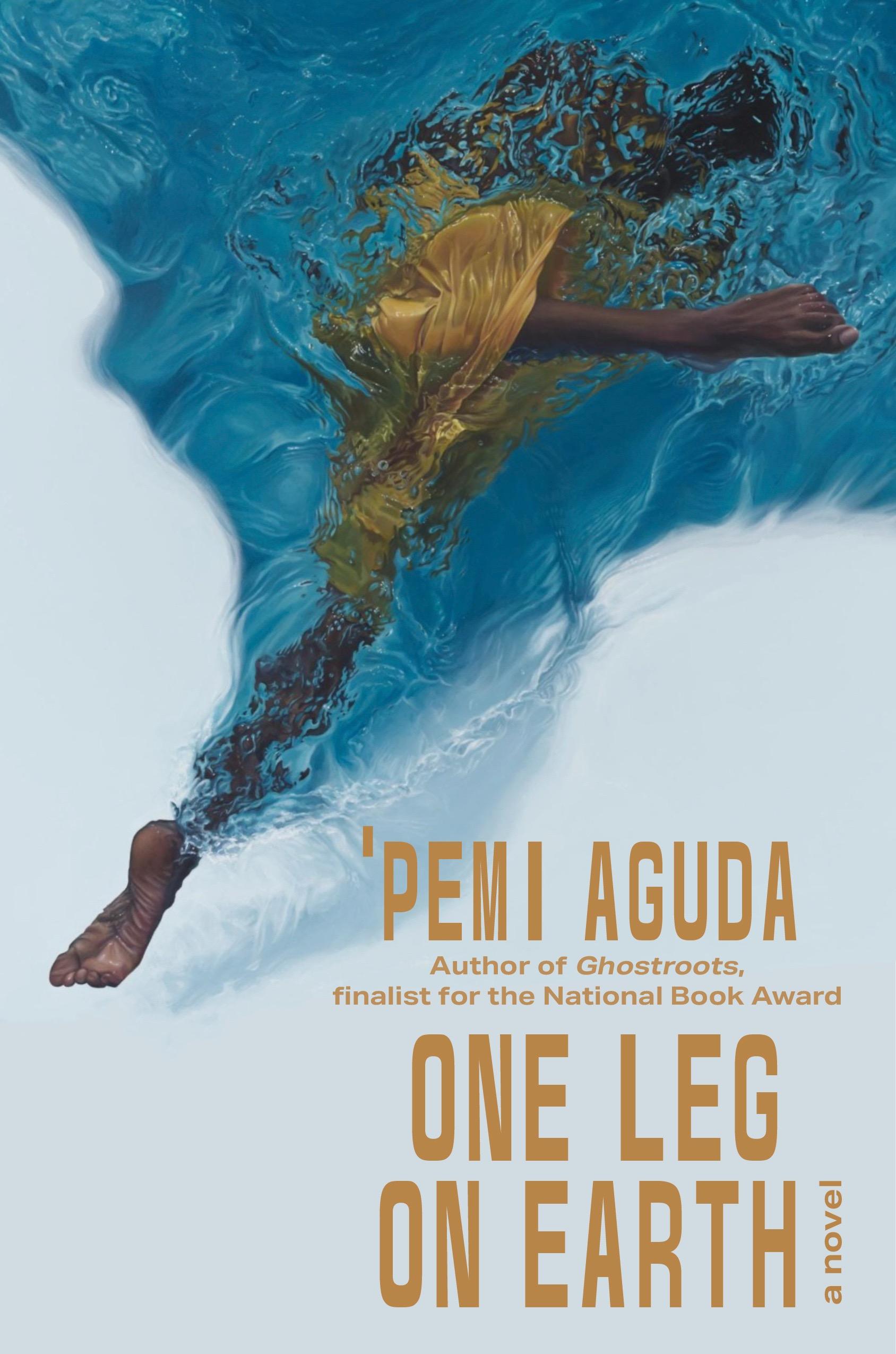
Book cover for One Leg on Earth (2026), WW Norton. Cover artwork by Calida Rawles
Earlier on, you mentioned mysticism. In Horror Noire Dr. Robin Coleman talks about horror as a revelatory and expressive medium for things that we're curious and we're scared about. And I guess my question is, do you think horror is a framework by which you navigate your work?
I watched Possession last night, the 1981 horror film. Have you seen it? It was two hours of wild shit. I really appreciate horror, but I never really considered my work horror. I don't enter a story thinking about genre. I follow the story where it wants to go, and sometimes, unsettling things happen. People give up body parts; people are scared; there are ghosts. When I'm inside the story, I follow its reality. I'm not writing with the aim to unsettle or scare or spook, but if that becomes a consequence, then I'm happy to call it whatever the people want to call it.
It's actually interesting that you don't consider your work horror.
If horror is looking at what we don't understand, or dwelling inside discomfort, then yes, that's what all of this is. It is horror. I try to leave the categorizations to the scholars, though. Elizabeth McCracken says that the purpose of fiction is disorientation, and that, I believe in.
There's a lot of taboo that lends itself a lot to the religious mode that Nigeria operates on. Yosoye's unraveling reads to me like less of a resistance and more of a bid to understand. Do you think that taboo becomes a kind of social architecture or a mode of character development in the novel?
It's a good question. I'm thinking about distance and protection, or distance and self-protection. If we don't look at something, if we don't talk about it, then we can pretend it doesn't exist. We can lull ourselves into believing that everything is okay.
In Craft in the Real World, Matthew Salesses describes setting as an awareness of the world. I teach this sometimes. A space can be seen as static, but everybody who enters is experiencing it differently based on our separate histories and moods and whatever we've come to the place with. Now, imagine a pregnant person’s experiences in this altered state. The awareness that you're bringing another life into the world might peel back layers of reality, where you're seeing things that everybody else is ignorant to. Your awareness might be sharpened, so that you see the world’s dangers more clearly. Pregnant Yosoye is a good device to poke at all the unsaid things that are happening around her; she can’t quite pretend in the same way because the stakes are different for her.
How else are you thinking about taboo in the novel? It feels like the more obvious one actually, but shame was definitely there. I find it very interesting because you feel it so deeply, even though it's an everyday thing. For example, if you look at her pregnancy and her decision to keep it, coupled with her relationship with her mom, there’s that element of being ashamed in private, but not making that known—it shouldn't be something that's seen. And so is taboo in the thing itself or in the fact that we can't, or we're not meant to speak about these things? I guess shame or silence is what makes taboo taboo. It's like this monster that the more you try and ignore it, the bigger it gets.
I'm now thinking about Yosoye and how her fight against loneliness prevents her from subscribing to taboo. She goes to Lagos even though her mom thinks it’s a bad idea. She decides to keep the baby, even though many think it’s a bad idea. But she's so afraid of being lonely that she'll go against all advice. In the world of the novel, pregnant women are dying and Lagosians don't want to believe it. But Yosoye goes towards them because her fear of loneliness is in the driver’s seat. Perhaps if Yosoye were not a pregnant lonely woman, she would have found herself accepting these modes of silencing and shame. At some point, she finds herself in a support group with women who refuse to use the word ‘suicide.’ But Yosoye is willing to go against what society thinks is acceptable so that she can feel the sense of belonging however she can.
Have you had a response by either family members or Nigerian audiences to your work and things you explore or things you don't explore?
The book isn't out until next month in Nigeria. So, let's revisit this question. It might be interesting. A friend of mine recently asked how my mom reacts to the stories I write. She’s a Christian, and in real life, if she were to encounter the stories in Ghostroots, she might have a big reaction, might say, “God forbid!” But for some reason, because it is couched as fiction, she is accepting. In fact, if she hears something strange, she'll call to say, “I know you’ll want to write about this.”
The label of fiction puts some distance, but this isn't always true. Some of the responses to Ghostroots from Nigerians were: oh yeah, this happened to my cousin; this happened to my sister. I think many Nigerians accept that there's strangeness in our world. With the novel, I am very curious because it's a different kind of strangeness. We don't really talk about suicides, do we?
Speaking on suicide, especially as it relates to pregnant women. Can you tell me about your decisions to approach or explore pregnancy in the novel? I saw it as exploring pregnancy through the lens of the uncanny, but it might not even necessarily be that. I mean, to be honest, pregnancy is also a very bizarre thing.
So I'll tell you where all of this came from. In 2016 or so, I was with my friends when the Lagos State government announced that they were going to start development on Eko Atlantic. I remember turning to my friends to say: Oh God, what if the water is angry? It was a speculative question.
A lot of my speculative fiction ideas come from me saying random shit, then following it through. So I asked: what if the water is angry? Then I started researching. I found out that one of the Orishas of water, Olokun, is also the Orisha for fertility. There was an early version of this book where it was pretty clear cut that this Orisha was taking back her gifts of fertility because the government was being bad to the water people, because of all the sand dredging and filling and land reclamation. It was a direct one-to-one. But the good thing about fiction, or about the way I enjoy writing fiction, is that even when I start from a very basic idea, the story starts to gather its own heft, and things stop looking so simple.
Over time, anger was no longer the emotion I associated with the water; the relationship between water and the characters became murkier. I was also doing a lot of reading: There are these stories coming out of Sudan where women who are choosing to jump into the Nile over being assaulted by men because of the conflicts. That’s not fiction. There was a news report a couple of weeks ago about this woman who was sued by the hospital because she wanted to try for a vaginal birth when they wanted to do a C-section. She insisted on trying, so they took her to court. The nurses brought a laptop into the room for virtual court. It shows how the pregnant body can be a symbol, as a vessel to bring forth the future to us, but the woman herself isn’t considered—what she thinks about, what she cares about, the conditions of her life, the conditions of her life in a city like Lagos. I read The Awakening by Kate Chopin when I was really young. It was the first time that I ever saw the ideas of suicide and freedom put side by side. I was curious about exploring in this book too.
Which you do. I have a question here about autonomy. Yosoye is quite young but her pregnancy elevates her to this higher realm of womanhood. It goes back to that question of the pregnant body as a vessel. So with autonomy, do you think that it's something that has to be negotiated and demanded in any capacity or do you think it's something that people simply have?
I don't know. But the cool thing is that through different stories, I can explore these questions. There's a story in Ghostroots, “Girlie,” about a young girl who is contracted out as a house girl by her mother; then she’s kidnapped by a well intentioned tomato seller who thinks she’s too young to be working. Through the course of that story, Girlie starts to think: maybe I don't need to belong to my mother; maybe I don't belong to my madam; maybe I don't need to belong to this tomato seller who thinks she's doing something good. I can make decisions for myself. Another story in that collection, “Breastmilk,” is about a woman who believes that her husband’s infidelity is the reason she can’t produce breastmilk. Spoiler, the story ends by her finally articulating how she feels about being wronged. She comes into power or some semblance of it by speaking up.
There's no one neat answer, but through avenues of fiction, I’m exploring how different women might approach this question themselves. Do they surrender to fate? Do they try to fight for agency or autonomy? Do they think it’s already theirs to wield? I don't think there's an answer. Do you think there's an answer?
Yes and no. I feel like I knew how to answer this but listening to you, I’m not so sure anymore. I’m thinking about the first story in Ghostroots. It's difficult because it's very easy to blame autonomy or blame the way we act on other people or things or beings. And I'm not saying that there's no element of that. An example I always think about is the Bible and God hardening Pharaoh's heart.
Yes. What is freewill if there's a story that has already been planned out?
Yes. And maybe I'm reading it wrong, but if I'm reading it plainly, he didn't really have a choice. And so when we then start about freewill and circumstance, it’s very easy to pass judgement on how to exercise agency despite the fact we know there are systems and structures in place that do affect the way we move through life. However, we have stories where people overcome the odds, which is inspiring, but raises another question about people who can’t. Or people who constantly have to negotiate those structures.
This is maybe one of the big questions of everything I write: How much can you do for yourself? Can you have agency under these cultural and political systems? These are not new questions. Yosoye comes to Lagos. She doesn't even want much; just friends and a life that feels a little bit full. But then she starts to realize that even for a small dream like that, a city like Lagos takes away other people’s dreams. What is individualism in a system like that? How much power do you have for yourself when everything is set up this way around you?
I recently read Why Live: How Suicide Becomes an Epidemic by Helen Epstein. “The hypothesis of this book is that suicide epidemics appear wherever a culture based on mutual aid, respect, and belonging suddenly gives way to a world of anonymous market transactions, individualism, and formal institutions, and, at the same time, a demonstrative love culture is weak. In such circumstances, people are forced to deal with the conundrum of the self and identity alone, without cultural guide rails or the ballast of strong affective ties.” She uses examples from post-Soviet Russia, from Micronesia, from the remote Canadian territory of Nunavut, to show that social ruptures, not just mental illness, can cause suicide epidemics; that “what suicidal people feel is the indifference, not of the universe, but of those closest to them.”
Ghostroots was thinking about this, too: how much of your choices are yours versus a play by all the forces that have come before you? But more than what they decide, the confrontation of the choice is most important to me. When you realize for the first time that you're within a social crucible, do you choose to stay inside? Do you try to get out? The moment of awareness is the most interesting to me.
This is feeling so philosophical.
I don't even know what we're doing at this point, but we’re doing it.
Let’s talk about loneliness. In the book, there's mention about intimacy and communion and this desire simply to have someone that she speaks about in a very raw way. My thinking is if all of these things have contributed to male loneliness and men are suffering in this way, how much more are women than suffering and feeling these things within this system?
I think that a lot of Yosoye's orientation towards the world is a result of her relationship with her mother. A lot of people talk about how their whole personalities are in reaction to their mothers. I make that joke sometimes, too. Oh, you think I'm calm? It's because I'm trying to counterbalance my mom's boisterousness. Yosoye has grown up with this woman who is very distant to her. I can imagine how she might think having a child could correct her own history. How she might think: When I have a child, I'm going to love that child. This child is going to feel my presence. And of course it makes sense that she also wants to be held by women because the one woman that she wants to hold her did not. Yosoye's not interested in romance. That's not the interest of the book. I like that reviews talk about her one-night stand as if the man was not really there; it might be Lagos, the city, who gets her pregnant. The man doesn't feature. What's interesting is Yosoye's need, her hunger. You were talking earlier about being alone versus loneliness. Yosoye has that question. Is her loneliness based on context? Or is it a genetic problem that she and her mother have? One where they will always be on the outside of things. That's part of what she goes to Lagos to figure out. If I change the world around me, maybe I'll feel different.
What do you hope stays with readers when they leave this novel, but also what stayed with you when you finished the novel beyond a sense of like, wow, I've done it?
I remember feeling so sad. I was sad for Yosoye. I was sad for her mom. I was sad for the three girls in the last chapter. But to go back to what I said earlier about the power of art… The last sentence is about a woman who looks out and imagines. Maybe that's what I'm gesturing towards. Despite a reality that suggests its futility, we can try to imagine a collective future that is good to everybody. Everybody. If one person is left to the wayside, then we’re all culpable. Although this novel does not have quite the cheerful ending, I'm hoping that invoking the power of imagination is useful.
This is a spoiler for the readers, but Yosoye goes back to her mom at the end of her story and she's changed and because she's changed, her mom is also changed. I think there's something sweet about the possibility of reunion, the possibility that this relationship will evolve even though hardships have happened.
Here's a quote by Toni Morrison that I've been thinking about: “Don't settle for happiness. It's just not good enough. Life has to be about something more [...] it has to be about acquisition of knowledge and the hope for wisdom. In every one of my books, no matter what else is going on—whether they drop dead, if they don't—that's what happens at the end. Somebody knows something about themselves or about the world that they did not know before." Yosoye knows something by the end of this book; about herself and the world. It's a hard lesson, but she's learned something.