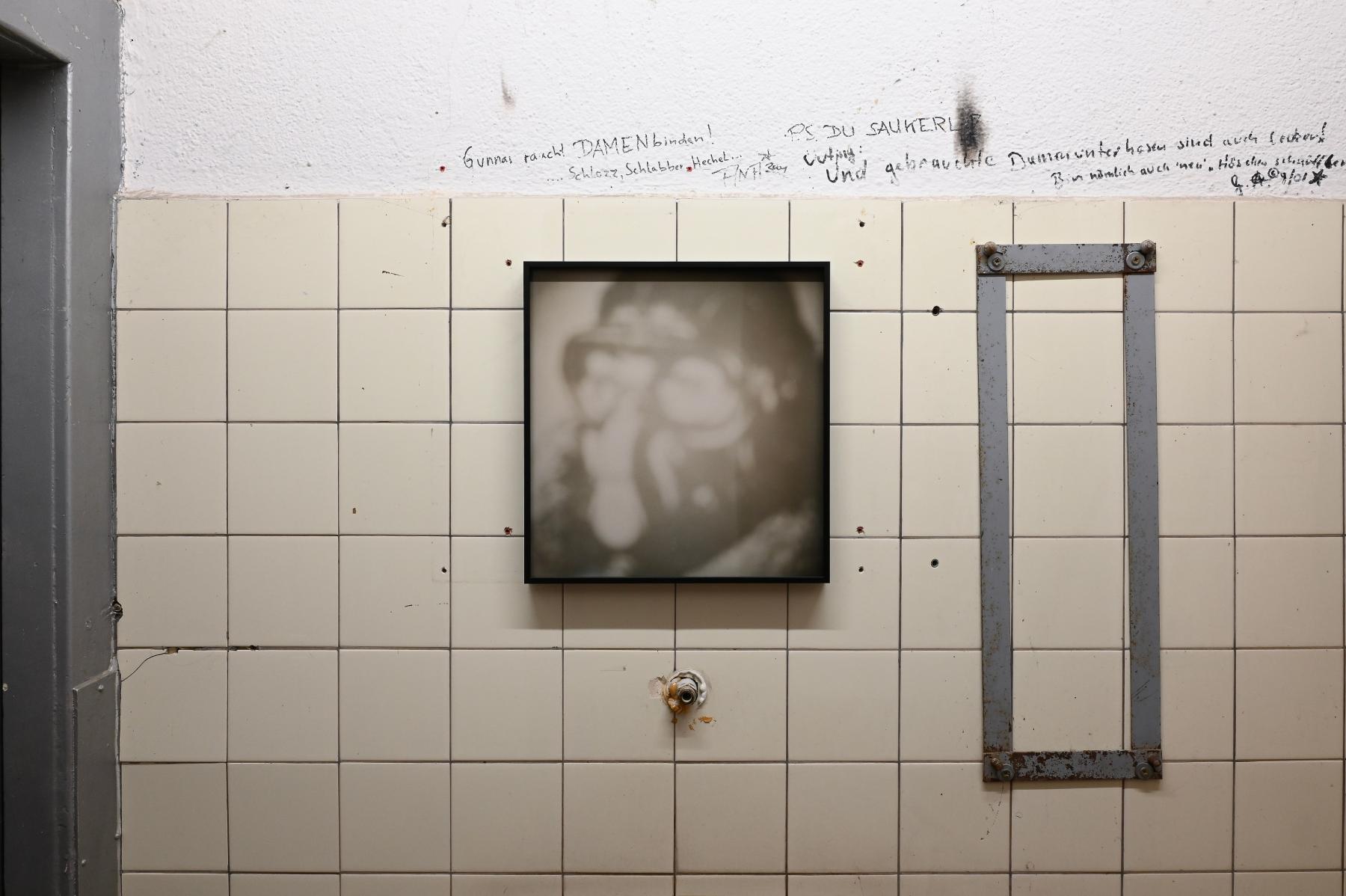
Sophie Kovel, The Kodak is at the Front (Gas Mask Goggles), 2026 archival pigment print from Polaroid 42 x 40 cm. Image courtesy of the artist and Kaiserwache, Freiburg. Photo by Stefan Lux.
Camera and event … Film was possible because there was history. Almost imperceptibly, like moving forward on a Moebius strip, the side was flipped. We look on and have to think: if film is possible, then history too is possible.
—Harun Farocki1
Sophie Kovel’s work is marked by a subtle, latent sense of oscillation—a constant shifting between the particular and the general, the longue durée and the event, and the instantaneous moment held within structures. It is through these tensions that Kovel’s forensic tendency takes place, mobilizing the art object as a means to make intelligible larger power structures which would normally resist imaging: the irony being here that oftentimes, the histories, architectures, and dynamics Kovel plumbs are frequently ones embedded in a regime of visuality, a regime of the image.
In some instances, her work engages the public and the monumental as the arena in which this regime is articulated. In her series Donations and Estates (2024–2025), Kovel takes as her object of enquiry the home and collections of General Goods heiress Marjorie Weather Post. This series consists of two poles. On one end, photographs of imperial Russian, British, and French jewels both in her private collections and donated to the Smithsonian Museum, and, on the other, a film titled Uncovering/Extracting (2025) which splices footage of the Post estate’s lion statue from the Somerset House with Muriel Rukeyser’s poem “The Book of the Dead: Praise of the Committee,” an elegiac meditation on the Gauley Tunnel Tragedy. The photographs shift between images of the gift shop’s replicas of the Hope Diamond and images of the collection, an array of coveted objects culled from European nobility. Occurring here is a kind of mapping of the ways in which the public collection becomes the site of fantasy and desire—not only in the illusionary participatory nature of the gift shop in which one can purchase a simulacrum of imperial might as condensed in the Hope Diamond, but in the ways in which this might can be folded in the fantasy of the ideal liberal democratic state, in all its exploitation across racial and class lines.
In other instances, Kovel hones in on images, in all their seemingly free-floating virtuality. In the exhibition Lieu de mémoire (À utiliser dans service intérieur) (2017–), a series of early 20th century French postcards are hung at the height of the fence at La Consulaire (the site of the spoliated Algerian canon, the Baba Merzug). Depicting Barbizon school painter’s gardens, cathedrals, castles, and other forms of monumental architecture, these cards are marked “use for internal service only.” This state internality—which in their inscription comprised France, Algeria, and Tunisia—triangulates the ways in which the boundaries of empire are reified through visuality (both in the built environment and its reproduction and circulation in images).
This dialectical negotiation between the fantasy of the image and the real of state power appears through a litany of other research-based works, such as her engagements with the wallpaper in the White House’s Diplomatic Reception Room and materials belonging to U.S government whistler-blower Reality Leigh Winner.
Running throughout Kovel’s practice is a leitmotif of the infrastructural—a term that I admittedly use loosely here, to denote her investigations into architecture, systems of circulation, private property, and surveillance alike. In some cases, her forays enter the realm of sculpture. Model of SCIF Wall A (Standard Wall)—Sound Group 3 (STC 45 or Better) (2024) poses as a kind of inversion of Michael Asher’s 1974 subtraction of the partition wall at Claire Copley Gallery. Here, Kovel re-made a SCIF wall, a form of soundproof architecture used for the discussion of classified information. Recently, at diez gallery, the artist exhibited a sparse selection of images of hedgerows from the Jack L. Warner Estate, a colossal land parcel in Los Angeles that has been handed down from titan of industry to titan of industry, to its current owner, Jeff Bezos. In the artist's terms: “There is an ‘imaginary economy’ of images—picket fences, hedges, property lines—but these photographs also document a real economy. Met with the ‘real’ of real estate, these very real property bounds speak to the imaginaries propagated by their proprietors’ media ventures. A present day spatial study, these images could just as well be an incomplete history of media ownership.” Ultimately, this is the action or process at play in Kovel’s work—the materialization of condensed points from which to approach the totality.
I met Kovel a few years ago during a period of research into artists engaging with private property and flux. It has been a pleasure to get to know her over the past few years as an engaged thinker whose approach has begun to influence my own. We met over a call in April—her in Paris, and I in Vancouver—to discuss recent explorations of Kodak’s technological experimentations in World War I, the act of withholding in a research-heavy practice, and the negotiation of site-specificity, among other things.
Kovel is an artist, writer, and researcher whose work examines the economic, social, aesthetic, and ideological operations of nationalism. Recent exhibitions include Kaiserwache, Freiburg; the Hessel Museum; Annandale-on-Hudson; diez, Amsterdam; NEON, Athens. Kovel is an alum of the Whitney Museum’s Independent Study Program. She has forthcoming solo exhibitions at Petrine and Haus am Waldsee.
My research often feels like looking through a foggy vitrine, through various layers of boundary. This extends across almost all of my projects. What’s being presented are boundaries.
In what ways does the notion of presentation play a role in your work? When I first encountered your work, I thought it clarified the systems that enable political and economic power to assert itself: surveillance, communications, private property. In a sense, it presents systems and structures that would normally remain resistant to imaging. But I also think there’s a focus on the ways institutions self-present through aesthetic means, whether through architecture, visual culture, or collections. I was wondering if you could speak about the notion of presentation and the role it plays in your work.
I am drawn to the self-narrativization implicit in a given site, collection, or institution. This might take the form of surface, decor, infrastructure (economic, architectural), or language… In terms of the literal presentation of the work, there’s a process of distillation that happens, in terms of withholding or granting information. I hope that process reproduces the conditions of the subject itself, which may also be withholding information from the public. I’m ultimately trying to raise a mirror.
In terms of the idea of subjects that are resistant to imaging, I often think of my images, and sometimes installations too, as cartographic or as having a mapping function. I’ve long been interested in Mark Lombardi’s diagrams.
Your work seems to map systems through tangible, empirical things rather than through abstraction. Why engage in that mode rather than something closer to Lombardi’s diagrammatic abstraction?
What I’m photographing is quite real. Beneath the images lies a network. These power networks, sometimes corporate networks, are latent within the images. You might not see the connections directly, or maybe I describe them in accompanying text, but the images themselves tend to be relatively oblique or appear unrelated.
It’s the fact that they exist in a given place that makes them related.
Exactly! Through that prismatic lens of the event or place comes the map or network.
Metes and Bounds feels like a strong example of this. There’s also the way power self-presents aesthetically, as in Donations and Estates, with Merriweather Post’s collections, but there are also moments where representation slips through the cracks.
Part of what interests me about Donations and Estates, too, is the fact that the Smithsonian Museum—and the Gems & Minerals Hall specifically—is a public trust. What does it mean to endow a series of objects to the citizenry where they are now on view?
Many of these images show the locations where the precious gems were first extracted. So behind the decadence, what’s imaged is a system of value exportation...
Post was a fascinating figure for her philanthropy, her admiration and importation of various imperial collections, and also her position as an heir to a breakfast foods corporation. Industrially manufactured food didn’t begin with TV dinners, it began far earlier, with cereal!
I was also wondering if you could speak about the formal decisions in your photographs. There’s an alienating artifice in their composition, a feeling of staging even though many of them obviously aren’t staged.
Your work seems suspended between several poles within photoconceptualism. There are aesthetic concerns akin to pictorialism, but also investigative concerns associated with conceptual documentary practices.
Many active photographers I admire—Taryn Simon, Stan Douglas, Buck Ellison—all have a relationship to staging or reconstruction.
What draws me to photography is its inherent relationship to advertising: not only corporate branding, but the advertising of landscape itself. I think I draw that out more explicitly in earlier works, like A Long Duration of Losses.
Landscape can become a self-aggrandizing, self-narrativizing site of nation. Sekula actually writes about the relationship between photography and nation very persuasively in “Photography and the Limits of National Identity.”
To answer your question more directly: no staging currently takes place in my photographs. They’re quite documentary in nature. But my installations and sculptures are more restaged and formally constrained by site.
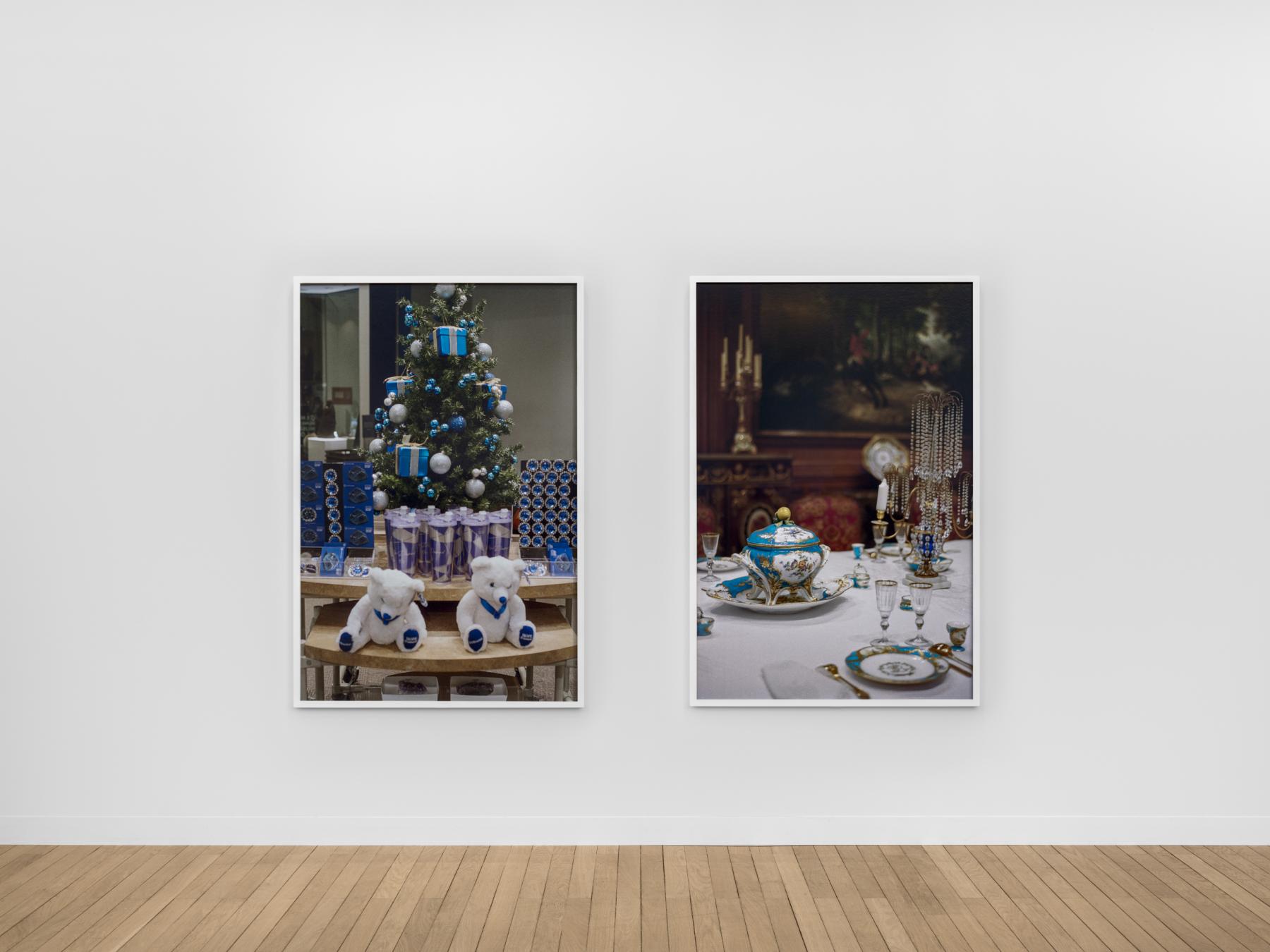
Sophie Kovel, Smithsonian Museum Gift Shop, Washington D.C. and Marjorie Merritweather Post, Dining room with Sèvres porcelain from the Louis XV service, Hillwood Estate, Washington D.C (from the series Donations and Estates), 2024/2025. Pigment prints on baryta paper, 150 x 100 cm. Image courtesy of the artist and Petrine, Paris and Düsseldorf.
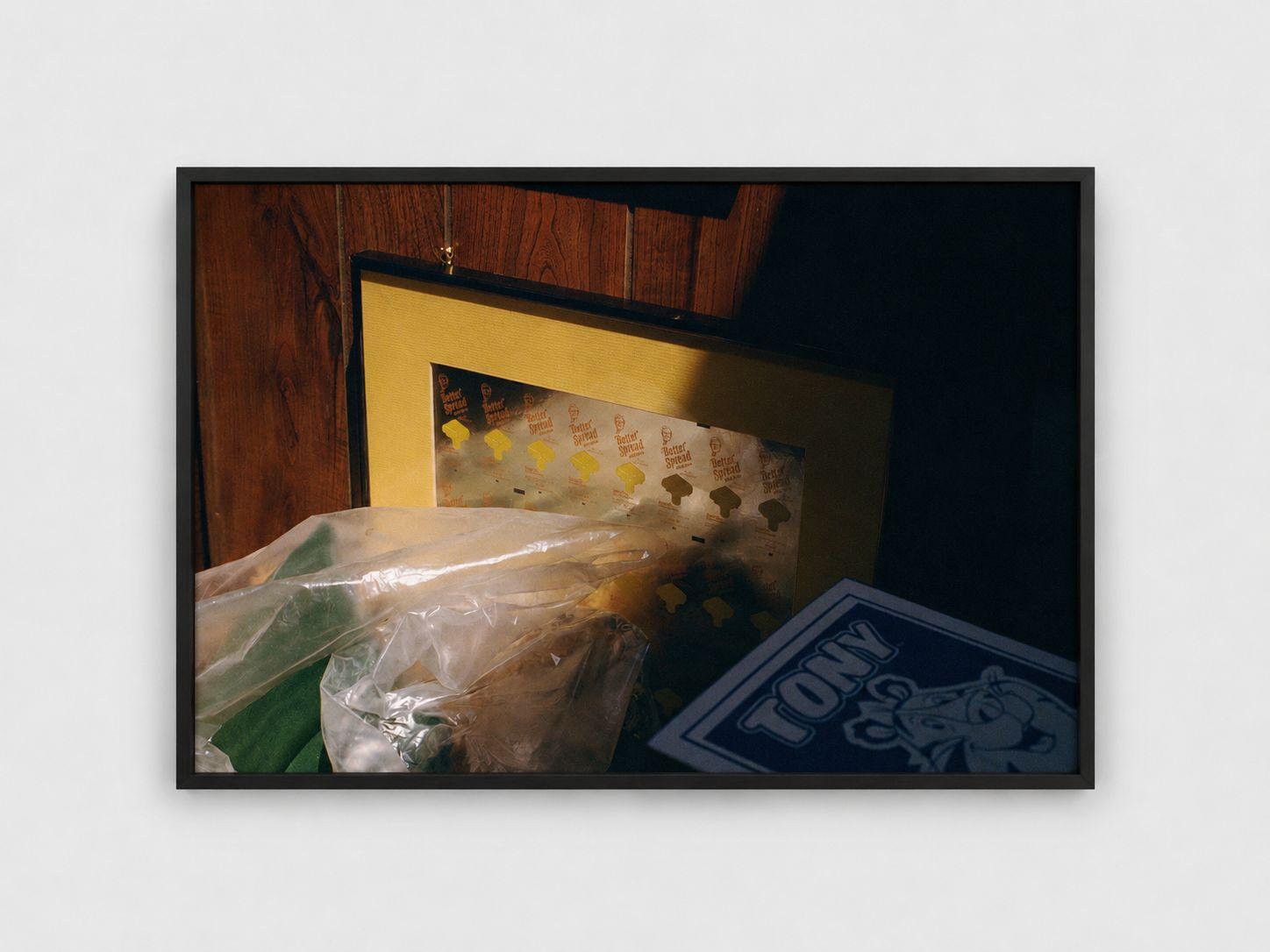
Sophie Kovel, Mascots (Sprout, Better Spread, Tony), 2026. Pigment print on baryta paper, 100 x 150 cm. Image courtesy of the artist and Petrine, Paris and Düsseldorf.
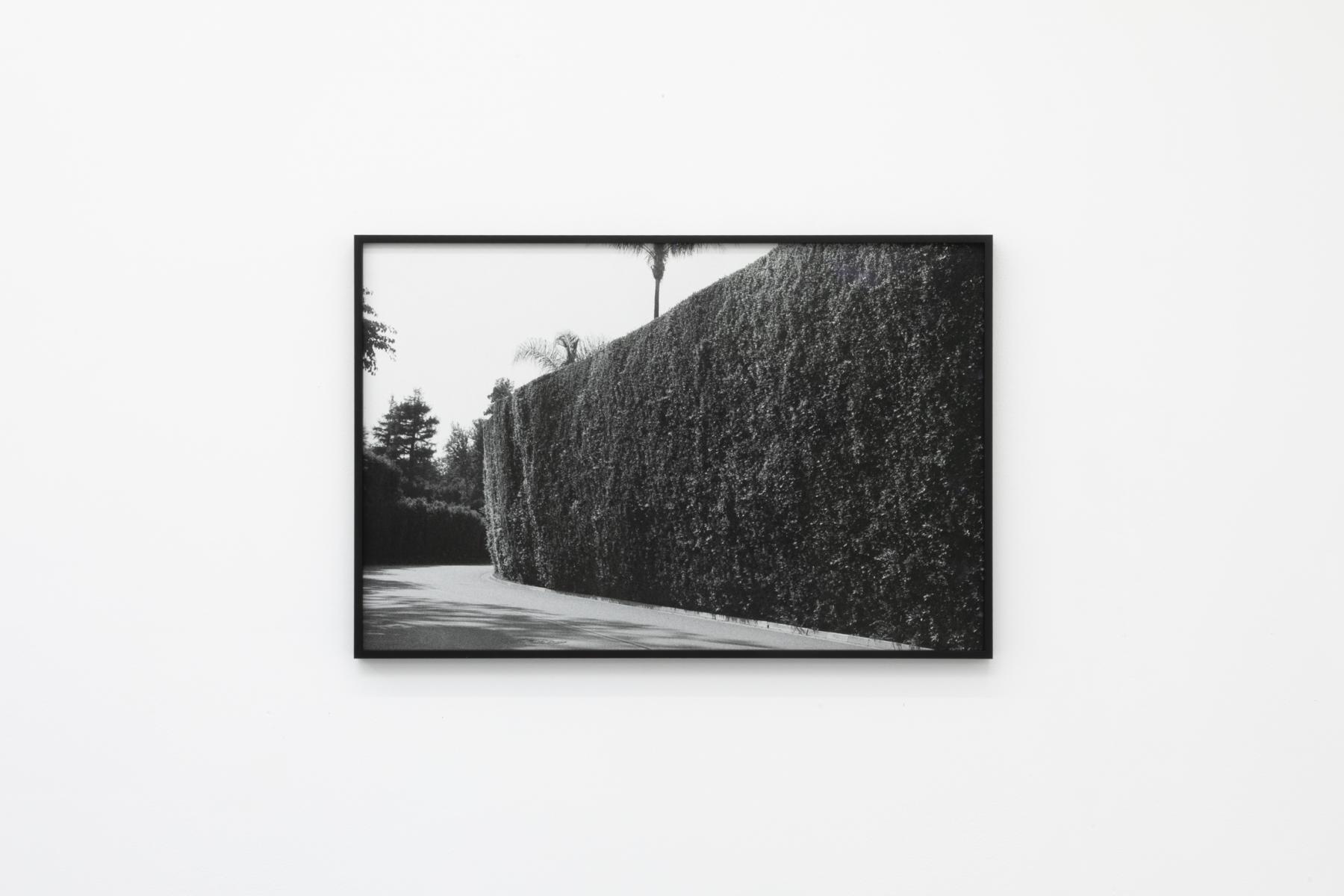
Sophie Kovel, Property Line, Jack L. Warner Estate, Beverly Hills, Los Angeles, 2025. Archival pigment print, 60 x 39.6 cm. Image courtesy of the artist and Petrine, Paris and Düsseldorf.
What fascinates me is that your photographs still feel estranged even though they’re not staged. Metes and Bounds, for example, consists simply of photographs of one estate, yet they still feel alienating.
I often seek a kind of deadpan affect, where images become alienating or strange. Maybe this goes back to my education in conceptual documentary practices… I don’t know if that’s entirely intentional, though maybe the selection process renders it so.
There’s also a quality of withholding in your work. For someone whose process is clearly research-oriented, there’s often very little textual production accompanying the work.
I think that’s partly a documentary condition of the subject matter I’m working with. Thinking about speculation through collecting institutions, property accumulation, or land accumulation means constantly encountering the question of access.
Metes and Bounds models this well because we’re confronted with these uncanny contemporary fortifications. With The Diplomatic Reception Room, diplomatic relations are also often fortified and inaccessible.
When I withhold information, I’m trying to reiterate or intensify the withholding enacted by the structure itself. I’m trying to exponentialize an existing boundary.
What’s at stake for you in articulating these ideas through the extra-linguistic space of the art object, especially given that many of the objects in your work are reproductions rather than found objects?
This reminds me of a Brecht quote about image-making as a form of historicization. I think the photographs do that work of historicization, while the texts often sit elsewhere, usually as a press release. There’s a suspension of the images and text, and the viewer occupies the uncanny valley between the two.
Regarding the objects themselves, it’s a dilemma, since I’m interested in real spaces and real objects, but they tend to be impossible to acquire or access. Often these spaces hold objects that are prohibitively valuable or are inaccessible because of security measures.
What remains is reproduction or documentation through surfaces and images. My research often feels like looking through a foggy vitrine, through various layers of boundary. This extends across almost all of my projects. What’s being presented are boundaries.
That makes sense, especially because the work seems equally concerned with literal and conceptual bounds.
With the Niagara Falls wallpaper, what does it mean for you to geographically and temporally move these works that originally functioned within a specific context?
Both the wallpaper and the SCIF works involve objects with iconic locations that nevertheless circulate freely.
The wallpaper, for example, was first discovered in a residential home in Maryland before becoming associated with the White House’s Diplomatic Reception Room under Jackie Kennedy. Today it appears in real media and fictional television depictions of the White House, at Gracie Mansion, and even as a purchasable luxury object.
Similarly, the SCIF structures circulate through markets and corporate infrastructures. I’m interested in upending the illusion that these objects are singular when in fact they move through systems of exchange.
So what happens when they appear in a gallery is that state power itself becomes reproduced or extended through their relocation.
Completely. The wallpaper allows the viewer to penetrate the aesthetic environment where political decisions are made, while the SCIF structures point toward highly secure environments where military or corporate decisions occur.
Those projects were actually conceived simultaneously. One infrastructural and the other concerned with façade.
I wanted to ask about your interest in photography more broadly, especially in relation to politics. Figures like Allan Sekula, Fred Lonidier, Louise Lawler, and Marianne Wex all establish a relationship between the lens and projects of liberation. How do you think about that relationship in your own work?
First of all, thank you for raising this tradition—because each of these artists have undoubtedly been an influence. (Many of whom I first encountered during undergraduate studies with Rosalyn Deutsche, Leslie Hewitt, and John Miller.) Photography has always contained both liberatory and violent dimensions. The camera can function as a prosthetic for witness but also to perpetuate various kinds of violences.
I’m influenced by Ariella Azoulay’s idea that the photograph “bears the seal of the event” and asks for active attention beyond simply identifying what is shown.2 Interestingly enough, I’m also currently revisiting some of Farocki’s film transcripts, which also tease out the relationship between camera and event… or camera, event, and history. I like thinking about this historically.
In Metes and Bounds, for example, the work isn’t about Jeff Bezos as an individual, though of course he is the current resident. It’s about a chain of ownership beginning with Jack L. Warner of the Warner Bros. that leads toward monopolization across the cultural field, especially in the music and film industries.
I’m curious how you trace that chain of ownership formally through the conventions of the estate.
It returns to the notion of the fortification. Beverly Hills already exists as a fortified residential environment.
There’s a history of property rights represented through fences, hedges—beginning with feudalism, even, with medieval defensive walls. These boundaries scale outward into age-old histories of patronage and land ownership.
In Metes and Bounds I was also looking at histories of westward expansion. “Metes and bounds” refer to systems of property surveying. One relies on geological markers, while the other uses lot-and-block systems associated with urban expansion (think Haacke’s Shapolsky et al).
That’s especially interesting in relation to settler colonial contexts like Vancouver, where land was treated as terra nullius and private property (and the conceptual and abstract understand of what constitutes the “land” within the settler state writ-large) emerged through, and in conjunction with doctrines like preemption, improvement, and highest-and-best-use.
The fiction of “no prior occupation” feels central.
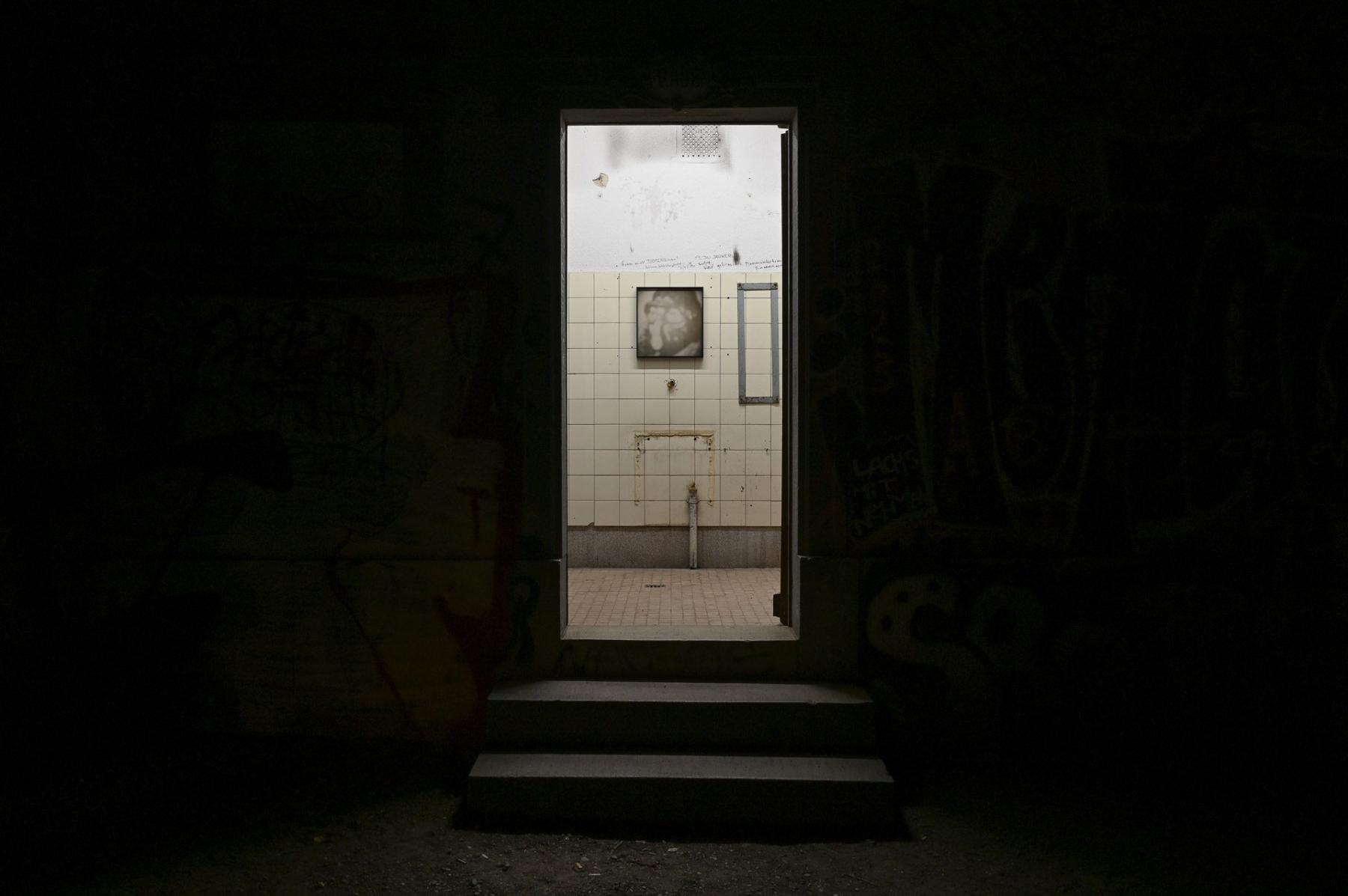
Sophie Kovel, The Kodak is at the Front (Gas Mask Goggles) (installation view), 2026 archival pigment print from Polaroid 42 x 40 cm. Image courtesy of the artist and Kaiserwache, Freiburg. Photo by Stefan Lux.
.jpg)
Sophie Kovel, The Kodak is at the Front (Aviation Goggles I), 2026. The Kodak is at the Front (Aviation Goggles II), 2026. Archival pigment prints from Polaroid. 40 x 42 cm. Installation view of Primary Structures at Kaiserwache, Freiburg-im-Brisgau, June 6–July 6, 2026.
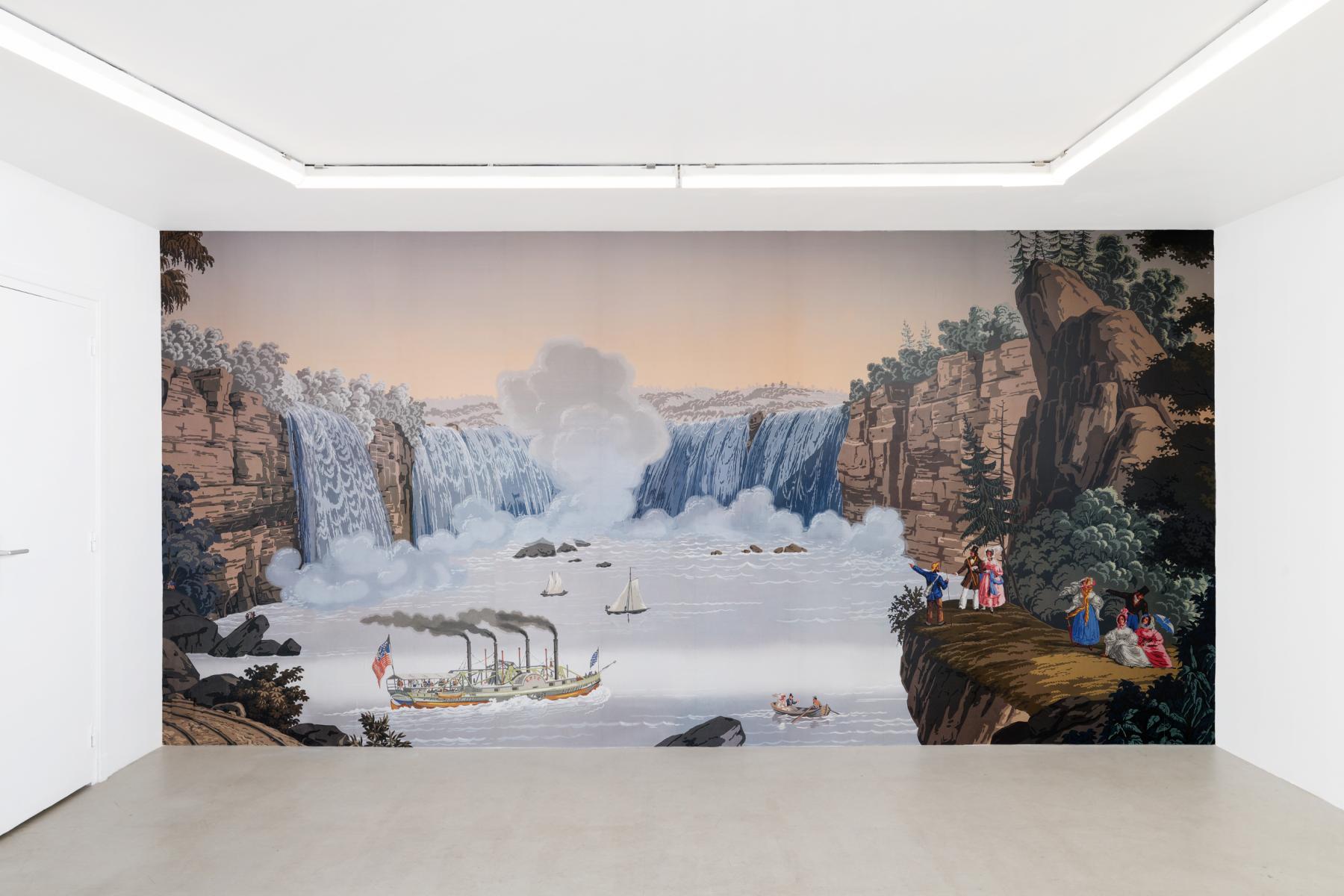
The Diplomatic Reception Room (Views of North America), 2024 Replica of wallpaper panels twenty-seven through thirty-two of the White House: Diplomatic Reception Room, Washington, D.C
What are you reading? Whose works are you looking at or excited by?
On my desk, I have a number books I’ve read recently or am currently reading: a new biography of Allan Sekula, Don Mee Choi’s DMZ Colony, Jalal Toufic’s Postscripts, and Julie Ault’s collected writings.
In terms of work I’m excited by, I recently saw Tony Coke’s new video, The World Won't Listen II (2026), which begins by citing the political theorist Joshua Clover. I’ve also been thinking a lot about Sekula’s TITANIC’s Wake and An My-Lê’s images of U.S. civil war reenactments and sound stages.
I’d also like to ask about the relationship between the apparatus and the image in your work. Sometimes the focus is on the photographed subject, while other times there’s attention to how images themselves are made. What are you working on now? What is the throughline between these projects and your past work?
This has become increasingly important in newer projects. When I think about apparatus in photography, I think about a history of doubt because images have always been manipulated, from exaggerations in the printing process for political propaganda to in-camera techniques to document landscapes.
In one new project, The Kodak is at the Front (2026), I’ve reproduced Kodak imagery from World War I. Kodak produced military apparatuses, including foldable cameras, aviation goggles, and coatings for gas masks.
I rephotographed these images using a Polaroid camera, creating a recursive relationship between historical and contemporary photographic apparatuses.
At roughly the same time Kodak was developing these technologies, they also introduced one of the first wage-dividend systems (employee shareholding) in the United States. So there’s this complex intersection of photographic technology, military infrastructure, and corporate collectivism.
That feels significant because it seems like one of the first times you’re explicitly photographing photographs.
Literally, yes, though I suppose one could argue the wallpaper and postcard works also involve representing existing imagery. But it’s true, this project foregrounds the recursion much more directly.
In Lieux de Mémoire, there’s also a typological logic at play through seriality. How do you go about selecting the histories you hone in on? What’s your research process like?
Every project tends to begin from a small seed. An article about Camp Topridge led me to Marjorie Merriweather Post, because she commissioned the site. Lieux de Mémoire emerged from an interest in colonial postcards and military monuments. This returns more generally to how images are tied to nation and national representation. In this case, I thought and have written about how this representation had, like the postcards themselves, a recto and verso: national vistas supported by the language and systems of empire. Interestingly, “postcard” in French can be used idiomatically to describe landscapes as idealized, scenic, or “picture perfect.”
Looking ahead, I’m continuing to think about branding, access, and other sites where images are produced for mass-consumption...
Regarding process, I’d say it’s a mixture of chance encounter and intentional looking. Some interests gestate over time and eventually lead, almost cartographically, toward various sites.
Reading and research play a significant part, but my process necessarily allows for the unexpected.