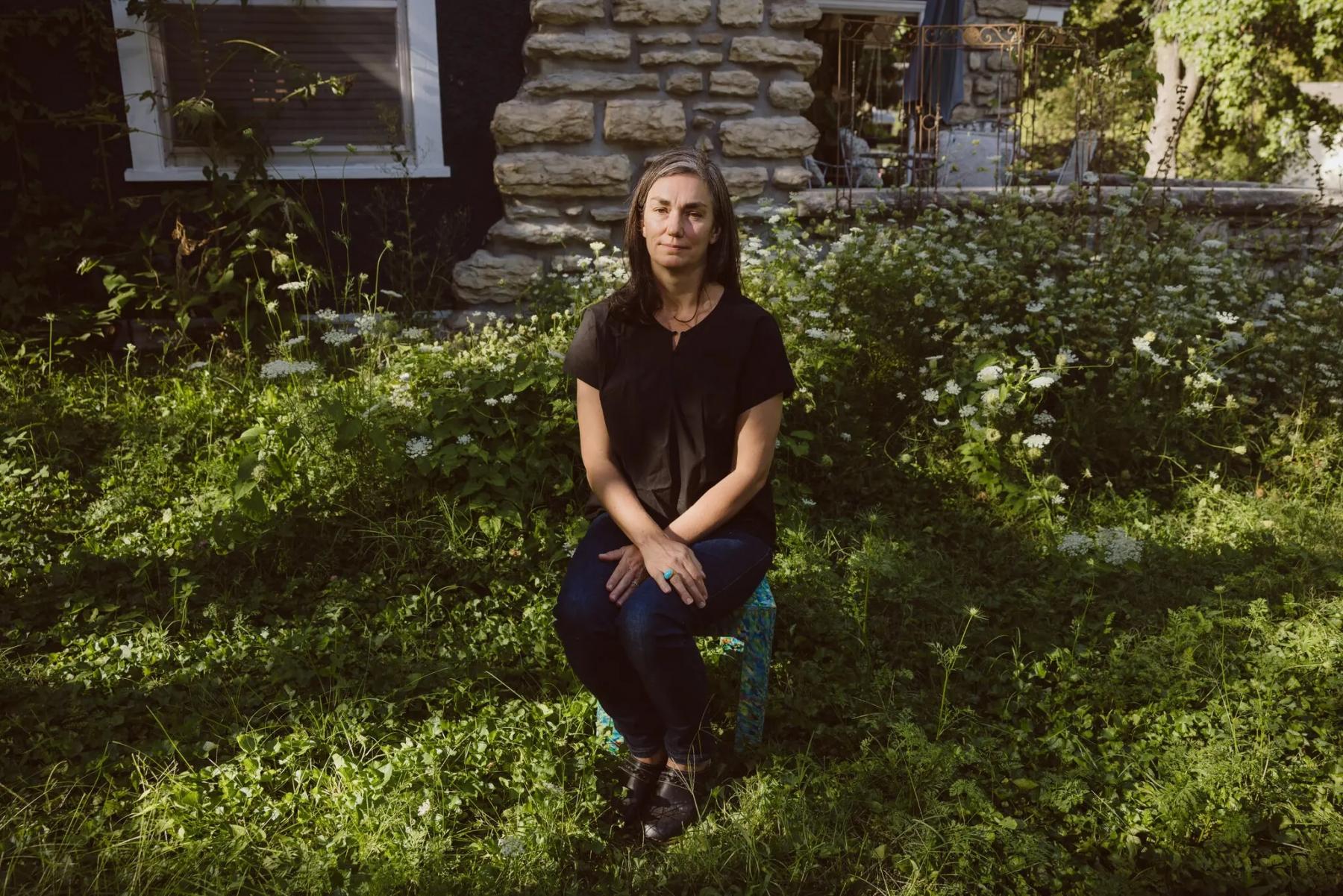
Amie Barrodale. Photo by Chase Castor. Sourced via.
Have any of you ever imagined logging into your Cloud to find your phone after your death? The strangeness and a sheer, frantic-like ineffability of it? Would a ghost remember a password? Would it qualify for a face recognition app? Perhaps not. I mean, how would or could we? How could we know that?
Inside the bardo realm of Amie Barrodale’s novel Trip (2025), Sandra—the protagonist’s soul or its clumsy scraps—attempts to access her former Cloud on her laptop. The habitual memory of what’s left of her reels in between the astral realm of death and rebirth. Within a baffling waiting room with a tapestry of bizarre shapeless entities and spaceless anti-matter, she experiences a perpetual drifting hallucination: all’s twisted and helter-skelter. As though an eidolon from another sphere—never starving, never sleeping, Sandra finds herself always lurking among wispy realities. Hence, quite likely, facial recognition software would not perceive the presence of a nocturnal “bardo-normie.” At least not yet.
Such is the karmic sap that sifts through Trip (2025), Barrodale’s first novel published by Farrar, Straus and Giroux, New York. A writer and editor, Barrodale is the author of You Are Having a Good Time: Stories (Farrar, Straus and Giroux, 2016), a critically acclaimed, unsettling short-story collection of compressed tales that expose the chaotic, hidden desires of its characters. You Are Having a Good Time was named a Best Book of 2016 by the Wall Street Journal, Vulture, Financial Times, and Guardian. In January 2026, Trip was longlisted for the PEN/Hemingway Award for Debut Novel. It was selected as one of the New York Times’s Notable Books of the Year and one of The New Yorker’s Essential Reads. Barrodale’s stories and essays have appeared in publications including The Paris Review, Harper’s Magazine, VICE, and McSweeney’s. In 2012, she was awarded The Paris Review’s George Plimpton Prize for Fiction for her story “William Wei,” the first of her ten stories in You Are Having a Good Time. From 2014 to 2017, she served as the fiction editor of VICE, shaping a program that brought together established and emerging writers in an unlikely setting.
To the ones who read the novel: There’s a before and after Trip. As a reader, you linger from one surreal perception to another. You’re looking through a person’s fingers and flesh, their former self, the soul-substance, and what’s left out of it, occasionally awakening to pinch yourself and possibly question your own existence. You are exercising to unfear it for whatever it is. Straddling the unhinged and the mundane, the incompleteness and unpredictability of life, Barrodale’s Trip will clench you by your mind’s throat.
During our early February tête-à-tête Zoom, Barrodale (raised Buddhist in Texas) and I spoke about the birth and behind-the-scenes of writing Trip. Publishing her second book nearly ten years after the initial success of her first, the author’s aura emanates from the pages with stark, comfortable interiority. “I like messier sentences now,” she said.
I mean, that's the truth about motherhood. [...] In some ways, you just can’t win as a parent.
Your first book, You Are Having a Good Time: Stories (2016), is a collection of 10 short stories. Trip (2025) is your first novel. There’s a shared, interlinked eeriness present in both books. But how different was writing Trip? How did you come up with its premise? I’m asking because I’ve never read anything describing a mother-son relationship and the bardo of such a surreal and unsettling, “impish” fiction. The novel really left me wide-awake in a great awe.
I was in Kathmandu with my son when he was one year old, and my Buddhist teacher invited us to breakfast. He is a film director, and suggested that we should work on a novel together, a love story set in the bardo. I thought it was a good idea, but he just never wanted to talk about it again after that. I would email him some thoughts, no answer. I would write something, like Bradley Cooper in his living room on a spaceship or whatever I was thinking the bardo would be at that time. Nothing. So I started to write the book myself, but over time I realized that I wasn't really interested in romantic love at all, probably because I had a small child. And slowly the novel became about a mother and son, probably because that was where my head was at the time.
From the beginning of the novel, there are several dramatic indications—as though bad omens are foreshadowing Sandra’s early death. It’s in a short detail when Trip plays with his phone and says, “It’s this game where you go inside people’s bodies. You can help them.” Afterwards, the whole journey to the local naga cave felt like a huge warning for Sandra. A picture of a snake is nailed to the wall in the hut. Then a rung from the ladder snaps. Sandra eats from the sacred vine—“I took food in the dark realm.” Before she tries to pass through the cave, she asks if she fits, and a shrine keeper says, “Only sinners cannot pass.” But she gets stuck there and fears this is her death. Except her actual death is quite comical—in its low-key bluntness, but the process of dying is written with a stellar plasticity! I loved the irritation of that hard-core, wry-wrought humor and softer sentient parts which felt “tectonic,” like grinding plates. And I wonder how you have intended to write that death build up? Was this something that you wanted to play with and construct through the narrative arc of the novel?
I felt that for Sandra’s death to be plausible, I had to prepare readers for it. Actually, I had this agent ten years ago who really annoyed me once. She criticized one of my stories, saying that the problem with it was that there was no foreshadowing. That seemed like the most stupid thing I'd ever heard. Like, are we in eighth-grade English? What are you talking about? But it stayed with me, and I slowly came around to her point. In a story, we do need to have an idea of what's coming.
Such an ordinary death of slipping on the hair brush felt wicked, and at the same time, it’s written with a great sense of hedonism, chaos and relief collaged altogether. More untethered was how you marveled at the whole process of Sandra’s dying.
The hairbrush thing was borrowed from life. I knew a woman who died slipping in the shower. I'm a bit out there in some ways, and I do have friends who claim that they can speak to someone after they've died. One of them said she spoke to this woman, and the woman said, “At first I was really confused, but then I figured out what had happened.” That always stayed with me, because it sounded so true. It sounded like what someone would say after dying that way. Also, I have an acquaintance who almost died that way. He slipped in a hotel room, and had a really bad injury. So it just seemed plausible to me.
That plausibility, precisely, was a great part of it. Because, as readers, we could identify with it. It was comical, but it was also very mundane in a way that this could happen to anyone.
Yes, I think it is a common way to die.
A quintessential element is the novel’s complicated mother-son relationship. The introspection we’re granted as readers. The bizarre and wry parts rebound in the more slowed and mundanely familial. Sandra’s made to understand that her son needed to be a different person, and that it was her job to change him. A maternal nexus clashes with what society expects from a mother, and how Sandra experiences it—that is a very unique portal into her character. She feels watched, evaluated, and judged on what kind of mother she is to Trip. It pressurizes and moves the story further. What was your construct behind this?
I mean, that's the truth about motherhood. These descriptions are taken from life, mostly. In some ways, you just can’t win as a parent. I remember once, my son began to despise the place we took him for play therapy. He just was done. At first, we tried to work through it. Maybe we come five minutes late, we enter through the back. Maybe the speech therapist comes to the car and escorts him in. Just quick fixes. At one point, the people who run the clinic asked for a meeting with us, and they’d made this whole slideshow with this bullshit ladder of developmental needs. And at the bottom of the ladder, the first rung, was something called “felt safety.” And they said to us—and they believed it too, which was the worst part—that our son didn’t have felt safety. And we asked, you know, what are you talking about, and they told us he was afraid to come into their clinic. Like… they couldn’t see that maybe this had something to do with their clinic. No, it went back to our original failure as parents. And that’s something you’re dealing with all the time.
I really hoped that Sandra would ultimately meet with Trip. I imagined that while he’s lost at sea, decrypting the stars in the night sky, he could draw some inner connection to his dead mother, whom he doesn’t know is dead. Despite that, Trip is portrayed as a highly sentient teenager, and a sense of eerie mirroring runs between the two of them. Trip’s knowledge of stars and objects in the universe is somehow metaphorical to how the novel operates in a realm of Sandra reeling in the bardo. Trip says: “The night sky itself is associated with Kali, goddess of death and destruction. But then they also say she is love itself,” and “I looked it up once, and read that it is a mistake, thinking that life is about being happy—that it is much more interesting than that.” and “He listened to the water. He thought if he listened to it long enough, it would reveal ancient wisdom.” I thought that Trip is more prone to perceive his dead mother. Was this “mirroring” essential to you?
Yes, initially I planned for her to get to him inside of Donald’s body, but then I felt that was misleading. I didn’t want to suggest that if you really really try hard, you can reach the life you left behind. Also, if she were to reach him, that wouldn’t be the greatest parenting, or the greatest representation of life. I think in life, you can’t fix things for your children. I did let her influence him. She does get a message to him, you know. Through Donald.
I guess like, this life, this being, this Amie and this Filip, are doomed. We’re going to die. But whatever awareness is experiencing us… whatever that is… is going nowhere.
The dialogues radiate with quirkiness and loom with a madcap, wry energy. Even the seemingly most normcore exchange plummets into a tragicomedy, a satire, a loony place to feel. And I had a great time laughing a lot! Whether I’m thinking of Sandra and her colleagues at the death conference, the caretaker and Trip’s teachers, then Trip and Anthony’s journey, and Sandra’s new consciousness with various bizarre deities in the bardo. The crow and Sandra’s incomprehensible talk when she’s inside Donald’s body. That wit and wryness—is this something you consciously employ to “enlighten” and de-sentiment the story? Or do you regard it as something inherited in your writing in general? What do you think of it?
Maybe a little bit. It’s who I am. I used to go see stand-up comedy in my twenties. I remember one time we had sort of attached ourselves to David Cross’s table. For some reason, I decided it would be a good idea to make him say out loud what he was thinking. I was like, “Hold on. Do I drink too much?” And he was like, “Amie. Yes.” I don’t know why I feel like telling that now.
There’s something very specific about the uncanny craft of your sentences, which are, at times, cut short to deliver the profound “high.” But what’s even more enthralling is how you leave “chapters in a hang.” Each seems to hang in an open suspense, perhaps semi-finished; some are at their bleakest. Like hanging off the crumbling cliff—edging the reader to nudge further and through. From 2014 to 2017, you were the VICE fiction editor. How do you feel this role has contributed to or formed your fiction?
When I was an editor, I was a lot more in touch with what would be interesting to read. I was opening a lot of things and starting them. I wanted my work to be immediate; I wanted it to be scene-driven, to move quickly. But now I'm getting all the vices of writers I used to be impatient with. I'm comfortable with interiority, and I like things that go long. I like messier sentences now. I don’t know why. It just appeals to me now.
That’s interesting because I find your sentences stylistically nifty. And that niftiness is quite perceptible, and it culminates at the finish lines of some chapters.
What do you mean by nifty?
What I mean by niftiness or nifty in connection to your writing is a craft the author develops, or possesses and it becomes their very own DNA. A hallmark. Like a stream that runs through their mind and hands, without them perhaps really registering it, at first.
Can you give me an example, maybe?
“Trip found the star called Algol. ‘The demon's head,’ he said. ‘Okay,’ Anthony said. ‘Good.’ He stood, unsure what to do. Trip took the wheel. Anthony said, ‘I'll bring back some hard alcohol.” I just opened a random page to point to such an example.
I don’t know. I remember once interviewing Renata Adler. I came in with a lot of specific questions about her work, and she deflected them all. So we ended up gossiping the whole time. She asked to cut the gossip, so I had nothing to send my editor but pages and pages of me saying, “Why’d you do this?” and her saying, “I’m not sure.” And he said I’d basically spent thousands of dollars to ask a fish over and over again what it’s like to be wet.
While reading Trip, I have been thinking about “longevity,” and how this term invades and operates in public spaces and media now. It’s quite alarming and panic-striking. However, with the novel, you ponder and vector toward the contrary of that experience. Like, into a forever escape room. To me, the novel is less about transformation and more about transcendence. A vaster, cyclic and spiritual form of the soul’s longevity. Rei Kawakubo, a Japanese fashion designer (Comme des Garçons), was once asked how she wanted to be remembered. She replied, “I want to be forgotten.” And I’m bringing this up because forgetting and letting go is one of the ingredients the protagonist and deities fear but undergo in the novel. Eventually, they’re consumed by it, they’re swallowed by time. You wrote a book about bardo, afterlife, and rebirth in a world that’s obsessed with physical longevity, and seems mostly performatively-transcendental. How do you think about and relate to that? Does that affect your writing?
At one point before my son was born, I went up to a drupchen in Maratika, this remote area of Nepal, and the Rinpoche leading the retreat said something about long life being unattainable, but deathlessness being in reach. This is based on a memory of something that I heard a long time ago. But I feel your question is touching on that. I guess like, this life, this being, this Amie and this Filip, are doomed. We’re going to die. But whatever awareness is experiencing us… whatever that is… is going nowhere.
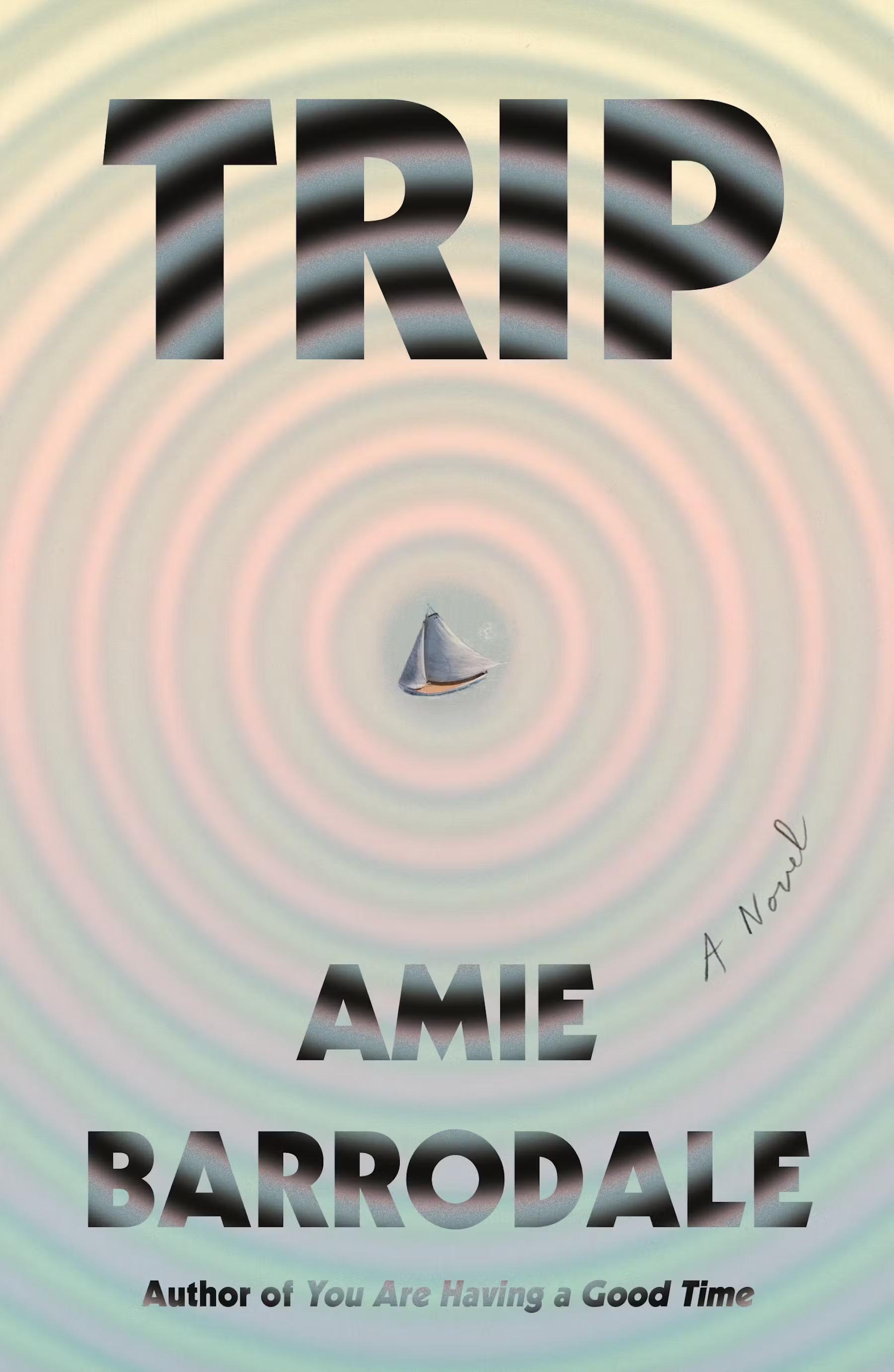
Book cover for Trip (2025). Farrar, Straus and Giroux.
What really got me was when Sandra’s consciousness in the bardo revisits her past and then tries to locate her iPhone. Such parts to me were truly crispy, like this one: “I went upstairs to the bedroom. I opened my laptop to do 'find my phone,' but the cloud wasn’t accepting my password.” How have you imagined what souls-in-waiting in bardo do?
It came slowly. I researched what the Tibetan Buddhist idea of it would be. And it changed. Initially, I had a view that it would be crazier, more like a story of Jacob's Ladder. As if everything were changing all the time. I thought it had to be like that, because I've read that. I think I mentioned this a few times in the book, that when you think of a place in that realm, you're there. I thought it would just have to be like changing channels all the time. But then, as I researched it more, I started to feel like it might be more normal. Like a normal part of life.
What’s really startling in the book is how you imagined and wrote the surreal descriptions in the consciousness of the dead Sandra in the bardo. Creatures with tentacles surrounded by flames, ghouls, spirits, deities, a dog’s digestive tract, a woman with the head of a horse, the dead waiter, owl-faced lady, a man with a dull black crow’s wing instead of his arm, or “a pyramid who feels stupefied—physically dirty and lethargic.” At one point in the bardo, Sandra is not even sure if she was a man or a woman; she has only a memory of her hands. The surreal intensifies toward the end when Sandra switches with another soul inside Donald’s body. The whole descriptive tract is totally madcap, I mean, it’s just insanely great. A kind of fourth dimension penetrates the narration. There’s this liquidity of some sort hazing the novel. It reminded me of some of Remedios Varo and Dali’s paintings, perhaps even Hilma af Klint. Were you working with some visual maps while writing a novel?
Those weirder characters were some of the first ones that I wrote. That was when I thought the bardo had to be crazy. And I kept some of them. That waiter, he came at the very end, and I really liked him. The crow is from one of Dzongsar Khyentse Rinpoche’s talks about the bardo. One of the examples he used was that you might suddenly have a crow's claw. You might be putting a sock onto your claws, finding it’s not working, but not feeling bothered about it.
In the novel, Larry, one of the academics refers to The Shining by Stephen King, and a movie by Stanley Kubrick. Some scenes in the novel brought the utmost neo-Hitchcockian perspective. I had flashes of films like Birth (2004), Ghost (1990), or even Transcendence (2014). My unconscious was perhaps registering them as references while I read, although these movies are totally Hollywoodized. Have you seen them? What have you recently watched?
I haven't seen Birth and Transcendence. I've seen Ghost. One thing I think Ghost does really well is, right after—Is it Patrick Swayze? Right after he dies, he sees these other ghosts wandering around. A woman who's dropped her son off at school, sort of just wandering through a cemetery stops and waves at him, and I think that's really good. I think they really got that right. I also saw Enter the Void (2009) from Gaspar Noé. It was helpful, because he started out with a character doing DMT. I was like, oh, this is so stupid, and then I cut my DMT scene.
You have studied and adapted a selection of traditional Buddhist writings. Apart from that, I’m curious what other literary writers and works have influenced your writing. And, what have you been reading recently?
I really have been liking Ben Lerner. I know people get annoyed when I say that, because everybody knows him and everybody likes him, but I came to him late, because when 10:04 came out, I was so jealous that I couldn't read it, and I was able to read it just a year ago. Then I started reading all his stuff. And I've been enjoying that. I finally read Don DeLillo this year, and I liked him.
Oh, which one from DeLillo?
I read White Noise and Mao II. Actually, I was a little disappointed, maybe because I spent my whole life hearing about them and starting to read them, but not finishing them. And when I finally finished them, I was like, “Oh. Okay. I mean, sure.”
We were exchanging DMs about Szalay’s Flesh. You read it, too, right?
Yes, I read that. I loved it. He's a unique writer. For a while, I lost interest when he married that woman. The scene when they’re at the estate sitting by the pool got me nervous. But I finished it and felt a little bit destroyed. I admired what he did, but it made me nauseated and afraid, also. I really liked Susan Minot’s Don't Be a Stranger. She’s a special writer. What I really liked about the book was that she's writing about an uneven relationship. A 53-year-old woman is in love with a younger man. And when it gets to the part where he's pulling away, I feel like most people just can't bear to write that. They exaggerate it, or they gloss over it. The experience of being abject is just too painful and too embarrassing to see clearly, but she does it.
I was wondering what you would do if you got a proposal to turn Trip into a script and film. Would you consider something like this if that were an option?
Yes, of course. I’m not Sally Rooney. I’m not in a position to turn an opportunity like that down. Also, I love movies and I love TV, so of course.
I really thought about Trip being turned into a series. Something like White Lotus could be fantastic.
Oh, yeah, I loved White Lotus. That would be great. I thought about Steve Coogan, actually. He was cast in the next White Lotus 4, and he came to my mind as a good person for embodying Donald. As I was finishing the book, for some reason, I kept seeing Steve Coogan as Donald; it's weird.