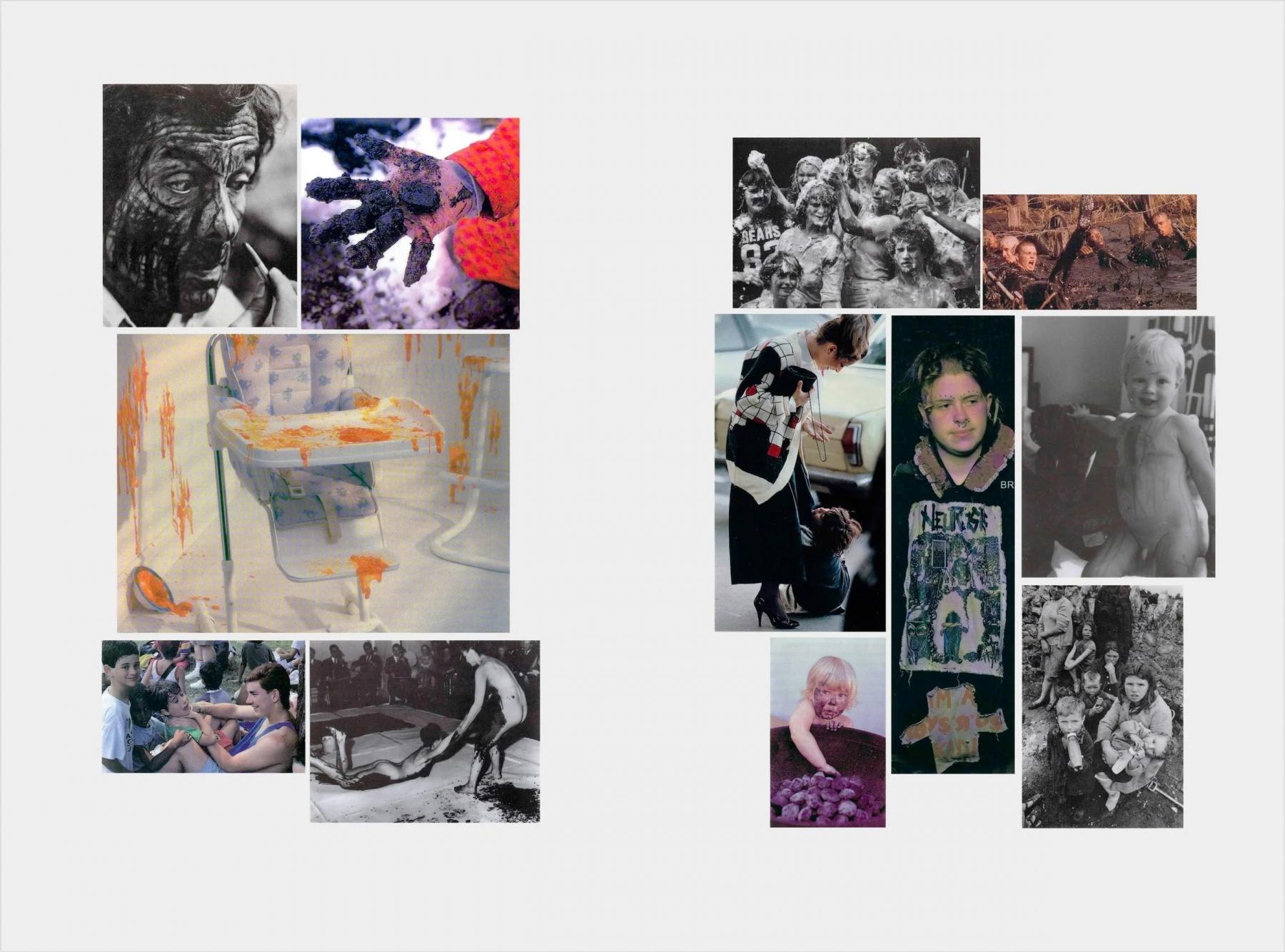
Excerpt from Luis Jacob's Album series.
Metaphor is a species of understanding, a form of seeing-as:
it has, we might say, flex. We see, simultaneously, similarities
and dissimilarities.
- Jan Zwicky
A psychic medium once told me that I would find navigating life difficult because I saw all things as having equal value. Reading a magazine has the same value as doing my taxes. Drinking a cup of coffee is equal to meeting a deadline and is equal to watching a YouTube video. I don’t think she was wrong, necessarily, but I still struggle to know what this assertion means. What access do I have to “all things,” and what is my influence over them? Does ease in life come from the ability to prioritize? To shift one’s perception of value in an object, action, or circumstance? Is the difficulty of horizontality worth it? Do I have a choice?
I think about these priorities as I navigate the volumes of Luis Jacob’s Album series. The work consists of images collected from magazines and books that Jacob has found “at arm’s reach.” When we spoke at a coffee shop in the summer of 2026, Jacob described the process of assembling these pieces, fingers fluttering over an unseen pile of clippings: the image material at hand when he began the project in the year 2000.
The work is multiple from the beginning. It lives as both a number of gallery-based installations and a series of artists’ books. When each iteration of Album begins, images are sorted, resorted, arranged, and laminated. In a gallery, the work is laid out panel by panel, and they often reach around the periphery of a space. When they are compiled into an artist’s book, each laminated panel becomes a single page. These constellations help navigate the froth of images not to propose an order but rather to build a methodology of seeing. They reveal a structure of collective thought through a subjective encounter. Flipping through their pages is propulsive and meandering. Thoughts accumulate and disperse through the alchemical process of Jacob’s accumulation and arrangement.
Album, first published as a book in 2002, has an incidental twin; Google Images (first launched as “Google Image Search”) has grown in tandem with Jacob’s Albums (I to XV), and when I first began to navigate the works, the influence of this technology loomed large in my reading. As I passed over the pages, the various rectangles tucked into one another, I was overcome with the inverse logic of Google Image Search. In the way that the search engine attempts to transfigure words into images, I wondered what words I might use to summon the images presented to me in the first volume:
rounded buildings
pointed/tapered buildings
high-rise buildings
population bar graph
vertical compositions (large scale)
vertical compositions (small scale)
vertical compositions (in a landscape)
couples (heterosexual)
men (?) holding sticks
This attempt, while earnest, betrays the more expansive ambitions of the project. A viewer’s ability to navigate Jacob’s networks relies as much on a capacity to recognize continuity of subject as it does on one’s ability to make abstract leaps and ping-pong between images from art history, consumer advertising, historical reenactment, and landscape photography. In many frames of Album, relation between images is recognized through the way that compositional elements sit within a frame: an obelisk, a smokestack, and a palm tree are drawn together by the way these vertical protrusions are contained by their own little rectangles. Each page features several different densities of images in these various modes of juxtaposition.
This relation draws on an aspect of reading that will be somewhat elusive to readers accustomed to reading the Latin alphabet, where rhyme is expressed almost exclusively by the sounds one imagines when reading. In scripts like Chinese, the idea of rhyme takes on a more overtly visual dimension where seemingly disparate meanings are lashed together by the resonance of their individual logograms. This approach to looking makes linguistic or cultural categories more permeable, and throughout Album Jacob uses this visual continuity to merge categories like person, rock, Modernist sculpture, and manatee. In these arrangements, Jacob questions common taxonomies by pulling images into this field of similarity and providing a glimpse of connective tissue.
I viewed the books from the Album series in the Paul D. Fleck Library at the Banff Centre for the Arts. Several volumes of the books were retrieved for me along with volumes of the series Going Astray: Artists Who Write. In the first volume, How to Write, Stephan Ripplinger says that “Concrete or visual poetry abolishes the difference between seeing and reading.” Flipping through the pages of Jacob’s Album, I wonder if he might see something of the same abolition in the slow and careful arrangement of these found images.
During our conversation, Jacob and I spoke about his commitment to Anarchy as a political project but also as a spatial and conceptual commitment to horizontality. In his work, the flattening of hierarchy often rekindles the observation of my medium from years ago: what springs from the refusal to prioritize? In casual usage, the word anarchy has become synonymous with chaos, disorder, lawlessness, and violence, but those understandings reveal a collective commitment to institutions like the nation-state or the church as de facto sources of stability, order, leadership, and flourishing. What happens to images when they are looked at as a horizontal category rather than one governed by multiple hierarchies of use, meaning, copyright, and authorship?
I asked Jacob about the pedagogical possibilities of the work, assuming that he would bring some observation to bear on his years of teaching at the University of Toronto. I thought he might respond as a teacher who had something to show an audience but in a characteristic reversal of expectation, he spoke about what Album had taught him. This observation helped to disrupt my assumptions about teacher and learner as stable roles. Like the images that lend each other meaning, the processes of teaching and learning can flip or coexist within the process of both making and viewing an artwork like Album. It can be read but also seems to be able to read a viewer, drawing on the associations that might be recognized or created through the process of moving across the images on single pages and stretching between pages and volumes.
Album is almost completely devoid of written language but remains intrinsically tied to the mechanics and logic of reading. Many academic settings follow a logic of transfiguration: images are transformed into words in articles or research papers and their meanings become inherently linguistic but this practice denies the fluidity and continuity that often make up the experience of looking at things. Even the best writers cannot help but engage this logic that treats words and pictures as essentially different forms that require division. An Album moves against that division and manages to express the interconnectedness of reading text and looking at images by performing an associative dance across the surface of image culture. This is a time when looking at the entirety of an Album might become essential to grasping what I am trying to describe. It manages to perform its own logic far better than I can describe it.
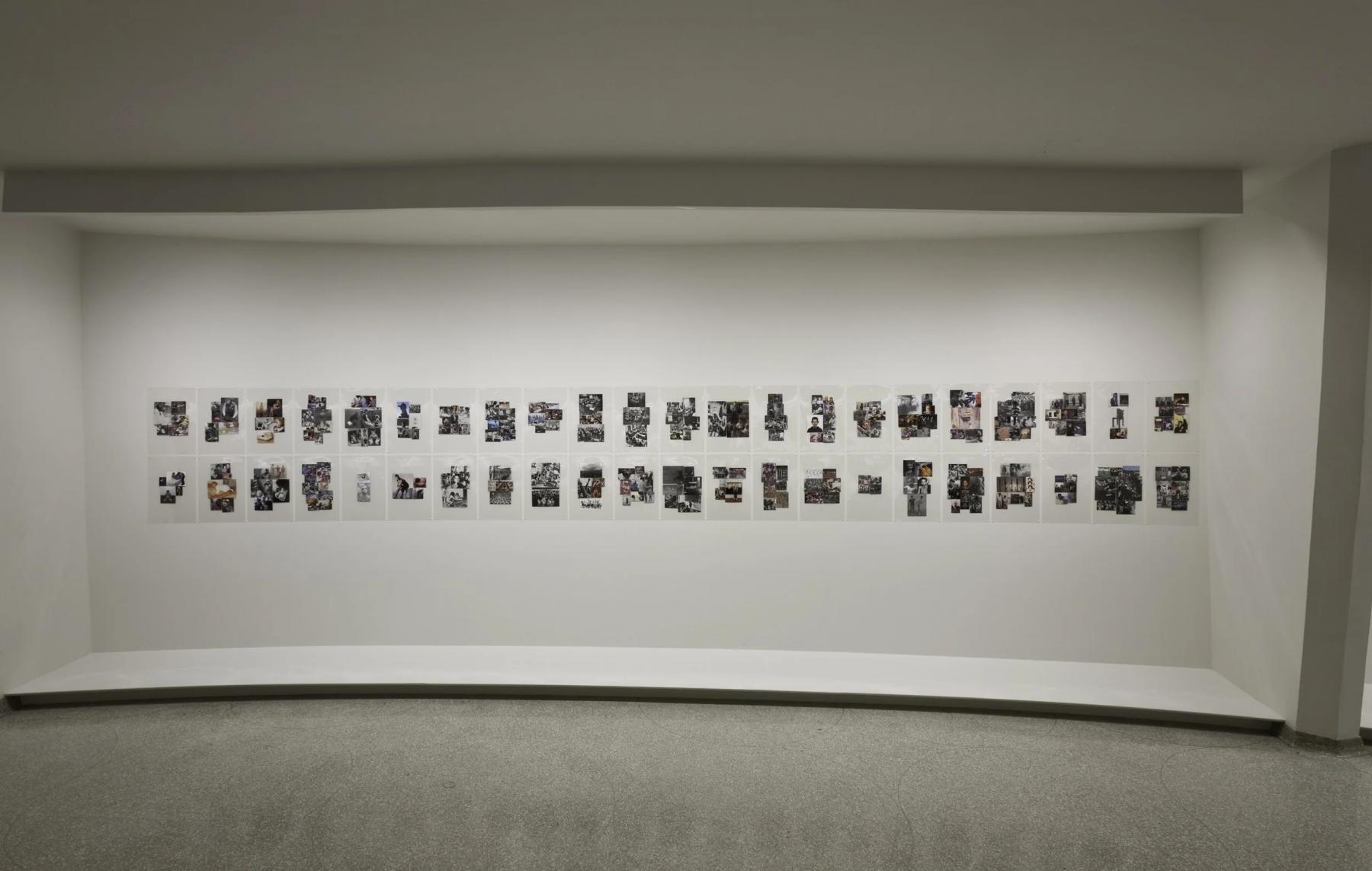
Installation view of Luis Jacob's Album series at Solomon R. Guggenheim Museum, New York City
The poet and philosopher Jan Zwicky has written extensively about the formation of meaning in poetry and music, often bouncing between them with deft metaphors about the negotiation of part and whole. In her book, The Experience of Meaning, she looks to the somewhat obscure history of Gestalt Psychology to make distinctions about aesthetic experience. In this schema, Zwicky stresses the importance of perceiving wholes over the analysis of parts. She uses the analogy of a melodic line in a musical composition to think about how this view of meaning functions. A listener does not perceive and study single notes first to understand the structure of a melody. They experience the composition and all of its densities as a whole.
Jacob told me about seeing people crowd around the panels in a gallery, trading observations and theories about these drops plucked from a larger sea of images and assembled carefully before them. They engage in both the granular speculation of single images and the strings of association that connect them. There is also a reading of this work that requires the task of negative reading: perceiving what is absent in order to imagine the bounds of an Album’s breadth.
I am a fairly recreational reader of philosophy, but I enjoy seeing the places where subjectivity leaks out from an earnest attempt to describe the world. While many philosophical works might insist that they are an objective account of reality, I like to see them as covert or unintended glimpses into the mind of another. In proposing structures for thought, many writers produce a portrait of their own paranoias. Whether intended or not, I think of this as an opportunity for intimacy; as if someone has said: “this is what I think about, and this is how I do it.” What could be more intimate than a glimpse of someone’s thought process? To some, this is a misreading of philosophical texts rife with the possibility of projection—and worse—it might miss the point of the work itself. But I’m not afraid to miss points when it is in service of my own nosy impulses. I think about that possibility to glimpse through Album in multiple dimensions. On one hand, Jacob glimpses the preoccupation of the image culture that surrounds him, and on the other, I get a glimpse of his. While navigating the loops of association in the Albums, it is possible to imagine you get a sense of a person, their thought habits, their aesthetic preoccupations, their worldview. These glimpses are always fragmentary and fraught with the same ambiguities that pervade love and belief. Each time I open a volume of Album, I am reminded of these ambiguities like a fly that has left home in search of ointment.