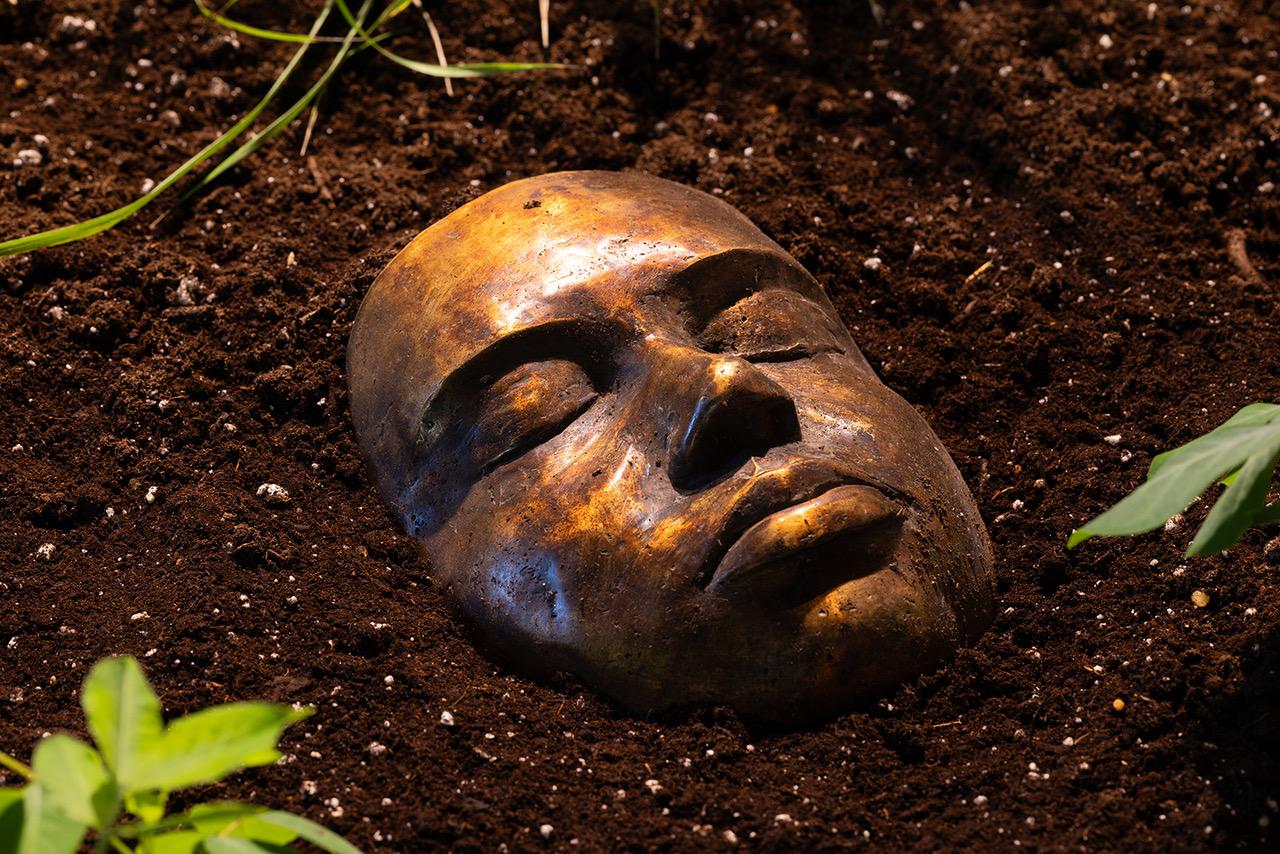
Mallory Lowe Mpoka, Deborah's Garden (detail), Photo by Michael Patten. Courtesy of the artist.
I have always known Mallory Lowe Mpoka to be an artist who refuses to be limited by one medium. Her work presents her ideas through a unique artistic perspective and visual language, seamlessly merging image-making processes, textile, and ecological material. The result is something entirely new and incredibly interesting.
Presented during the MOMENTA Biennale de l’image 2025 in Montréal, The Matriarch: Unraveled Threads marks the first solo exhibition of the Cameroonian-Belgian multidisciplinary artist. Working across diverse mediums, Mpoka’s practice explores the material and emotional landscape that continue to shape diasporic identities across and beyond the African continent. At the center of the exhibition stands a monumental textile installation composed of over 300 screen printed panels of recycled linen and cotton, dyed with the red soil from Cameroon. That piece—which shares its name with the exhibition—is a perfect representation of Mpoka’s artistic practice and her ability to push several artistic mediums forward simultaneously, while anchoring it in archives, heritage and family history. Although her practice previously focused on the technicality of photography, she has since expanded beyond the bidimensionality of the traditional photographic frame to tend to processes of repair and collective healing. Through weaving, ceramics, dyeing and sculptural augmentation, Mpoka engages the body, the soil and the self as living archives.
The Matriarch: Unraveled Threads feels particularly interesting in a global art market still structured by extractive, exploitative and colonial logics. Alongside the short film featured in the show, She Who Summons, the piece Deborah’s Garden articulates a practice of patience and temporal slowing, countering the velocity of contemporary life and inviting a renewed sense of attention and presence.
Her artistic research, which explores colonial environmentalism, seedkeeping and community gardens as sites of care and resistance, and dance as embodied knowledge, invites reflection on the role of artistic production in times of environmental and cultural crisis.
In the following conversation, we speak about how the artist envisions art as a process of reparation and knowledge preservation which intertwines the personal with the political, and the material with the spiritual. Together, we examine her evolution toward sculptural and textile-based practices, the conceptual framing of collective gardens as sites of speculation and regeneration, and the ways the movement and migration of plants, seeds, and bodies within colonial geographies serve as catalysts for artistic creation.
For me, identity can be a catalyst for creativity. Family histories often contain difficult or hidden aspects, but one doesn’t have to bear that weight alone. My work engages with these legacies, transforming archives and inherited histories into generative bodies of work.
I have always understood you to be a multidisciplinary artist who merges different art forms in the way you create. What has always fascinated me about your practice is the ways you have incorporated photography in your work. I'm thinking of works like Camera Obscura, or The Matriarch: Unraveled Threads, that was part of your recent solo show at Fonderie Darling, where you present images in ways that move beyond how people are used to experiencing photography. Could you talk about your relationship to image-making and how that has evolved in your practice?
Yeah, I think from a young age I have been interested and drawn to vernacular photography such as those found in family albums. I grew up in Montreal from a Cameroonian father and a Belgian mother. I grew up in this culturally eclectic Afropean-centric bubble. And so I grew up away from family on the continent and in Belgium, as the eldest daughter among circles of friends and part of the first wave of Cameroonian immigrants in Montreal. From a young age, I recognized how family albums and photographs carry the power to record, narrate, and ultimately shape one’s sense of identity. It wasn’t only the visual dimension of family albums that resonated with me as a child, but also their rich sensory layers. I still remember the jasmine scent of the album's pages, and imagining the conversations my family might have been having in certain photographs. These photo-objects carried profound immaterial sensibilities and encoded cultural knowledge, shaping the ways I came to understand myself. They were instrumental in helping construct my identity as a mixed Black child growing up in Quebec.
At the age of 15, I started experimenting with film photography, taking my friends' portraits and developing my own black and white pellicules in a community dark room in the basement of Saint-Enfant-Jésus Church in the Mile-End. When I was about 20 years old, after college, I started working in the commercial and editorial industry as a fashion photographer. Until around the time I was 24, I was working with brands like Nike, Lacoste and SSENSE here in Montreal, leading editorial and commercial shoots using my analog camera, a second hand Mamiya RZ67. I loved this work, particularly the opportunities to collaborate with other creatives within Montreal’s fashion and music scenes. It was the sweet years of Moonshine and Ti-Agrikol, it was great the time it lasted! Yet, as a young Black woman, I felt I wasn’t always taken seriously, frequently asked to assist rather than lead a project, and I was also impatient, seeking more depth and meaning in an industry driven by sales and the constant adaptation to new technologies. I was broke, living on my own since I was 19, so I couldn't easily afford new video/photo equipment. I have always had a sensibility for the process of image-making, and as my practice evolved, I came to understand that the act of creation itself mattered more to me than the finished product. I realized that I struggled with the confines of commercial demands, and that my approach to creativity was not always fully received in the editorial world. At the end of 2020, I began a BFA in Photography and Studio Arts at Concordia University, and from there, my practice gradually evolved.
Is this when you started to include other mediums such as textile, and ceramic?
Yes, because my practice had increasingly become research-based, I began undertaking residencies abroad, including my first one in 2021 at Bandjoun Station in Cameroon, on my paternal land. This residency was a pivotal moment, both personally and artistically, as it was also when I experienced my first queer love story. From there, I began experimenting with natural dyeing, textiles, screen printing, image transfer, and other processes. It was through these explorations that I realized I wanted to move beyond the limitations of the traditional photographic print on paper and expand the scope of my artistic practice.
Do you mind talking about your solo show? The Matriarch: Unraveled Threads, if I understand correctly, is your first solo show in North America. Could you talk about the purpose of the show, what you aimed to communicate with it and how it reflects the direction in which your work is evolving?
This exhibition came together at Fonderie Darling as part of the Momenta Biennale, La Biennale de l'Art Contemporain de Montréal. This year was curated by Marie-Ann Yemsi, a Germano-Cameroonian curator I met in 2022 at the Bamako Encounters, African Biennale of Photography in Mali. We began our conversation at that time, and about a year ago, she visited my studio while selecting the participating artists for the Biennale, and the conversation continued from there.
The works presented in this exhibition can be seen, in some ways, as a continuation of my recently published book, Architecture of the Self: What Lives Within Us. This is my first artist-research book, which explores themes of kinship, memory work, and subversion through archival work. The book weaves together poetry, reflections, journal entries, analog photography, self-portraits and more, creating a hybrid space where personal, collective, and intergenerational histories intersect. The work also engages with sonic and video dimensions. In the book, for instance, QR codes, pamphlets, unfolding pages, and cut-outs reflect my interest not only in the photographic image but also in the book as a tactile, multisensorial object. This intersectional exploration of form and materiality was the foundation of my research and served as the impetus for my solo exhibition. The show expanded upon this research in multiple ways. At its center was a textile installation titled The Matriarch, which began in 2021 during my residency at Bandjoun Station in Cameroon and has since evolved into the final piece that was on display. Other elements complimented the piece, including the short film She Who Summons; and Deborah’s Garden, a circular red-brick garden featuring native plants from Cameroon, Senegal, and Canada, which were accompanied by bronze sculptures, a soundscape, and an olfactory component.
My next question is about The Matriarch: Unraveled Thread. I first saw parts of it during Hugues Charbonneau’s open studio visits at the Belgo in Montreal, and I was immediately struck by the intentionality, format, and materials used, even though it wasn’t yet complete. You’ve described the piece as connecting your family archive to the broader history of Cameroon, particularly the war of independence and its enduring effects. Could you talk about how that context shaped the creation of the piece, and how you selected the images, mixing your own self-portraits with family archive photographs, for inclusion?
Thinking backward, The Matriarch was the foundational piece in my practice, tying together most of the works that followed. Many of my more recent works maintain a formal or conceptual dialogue with this piece, which has become central to my practice over time. Whether through the use of the red soil from Cameroon, or the circularity of its form and installation, I am continually coming back to it as inspiration. This sense of circularity is also reflected in the red clay brick installation Deborah’s Garden.
In 2021, I began gathering family archives, and over the course of the pandemic, I returned to Cameroon annually for three years to learn more about the people in the photographs with the help of my grand-mother Deborah. This process was informed by the country’s complex history, including the post-independence era marked by violence and Bamilékégenocide by the French colonial army. Cameroon holds a unique position as the only sub-Saharan francophone African country to experience a war of independence, and the Bamiléké people, who are people very close to their land and tradition, played a pivotal role in this struggle.
Was it a war against the French empire?
I would reverse it. A war by the French authorities against any local opposition to colonial power really, including the Union des Populations du Cameroun (UPC), the leading nationalist and anti-colonial party, founded in 1948. My father was around 10 years old when the armed conflict was nearing its end. My grandmother and grand-father lived through it all. And so there's a history of archives that has been erased in my family, archives that have been disappearing and there's this kind of taboo about these parts of history, like in many other families. The Matriarch is in a way an homage to my family and to their story. In 2023, when my grandmother passed away, she named me as her successor. In Bamiléké culture, when a matriarch dies, she designates either her eldest daughter or eldest granddaughter to carry on her role.
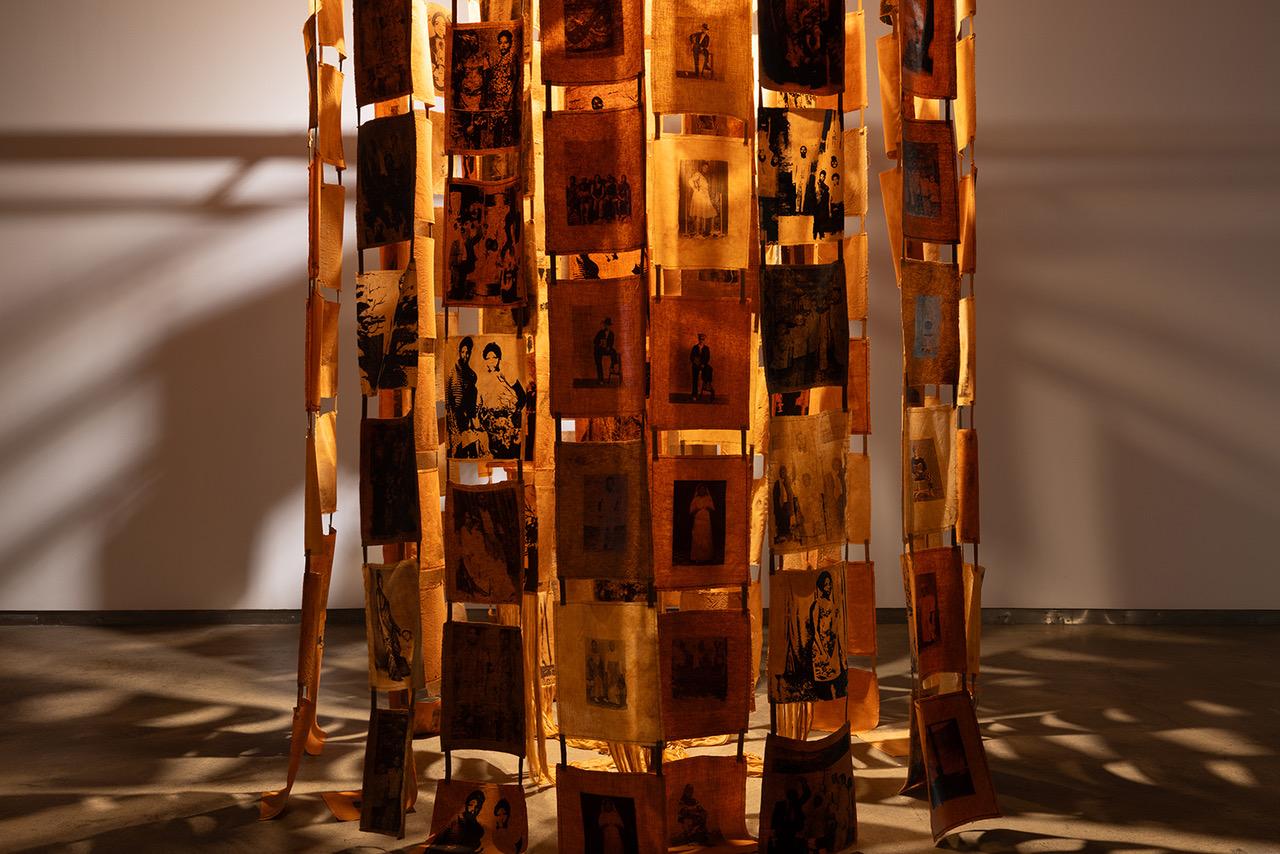
Mallory Lowe Mpoka, The Matriarch, 2021 - 2024. Analog photography, screen printing, photo transfer, embroidery on dyed cotton and linen with red earth pigment, acrylic, paper, steel. Photo by Michael Patten. Courtesy of the artist.
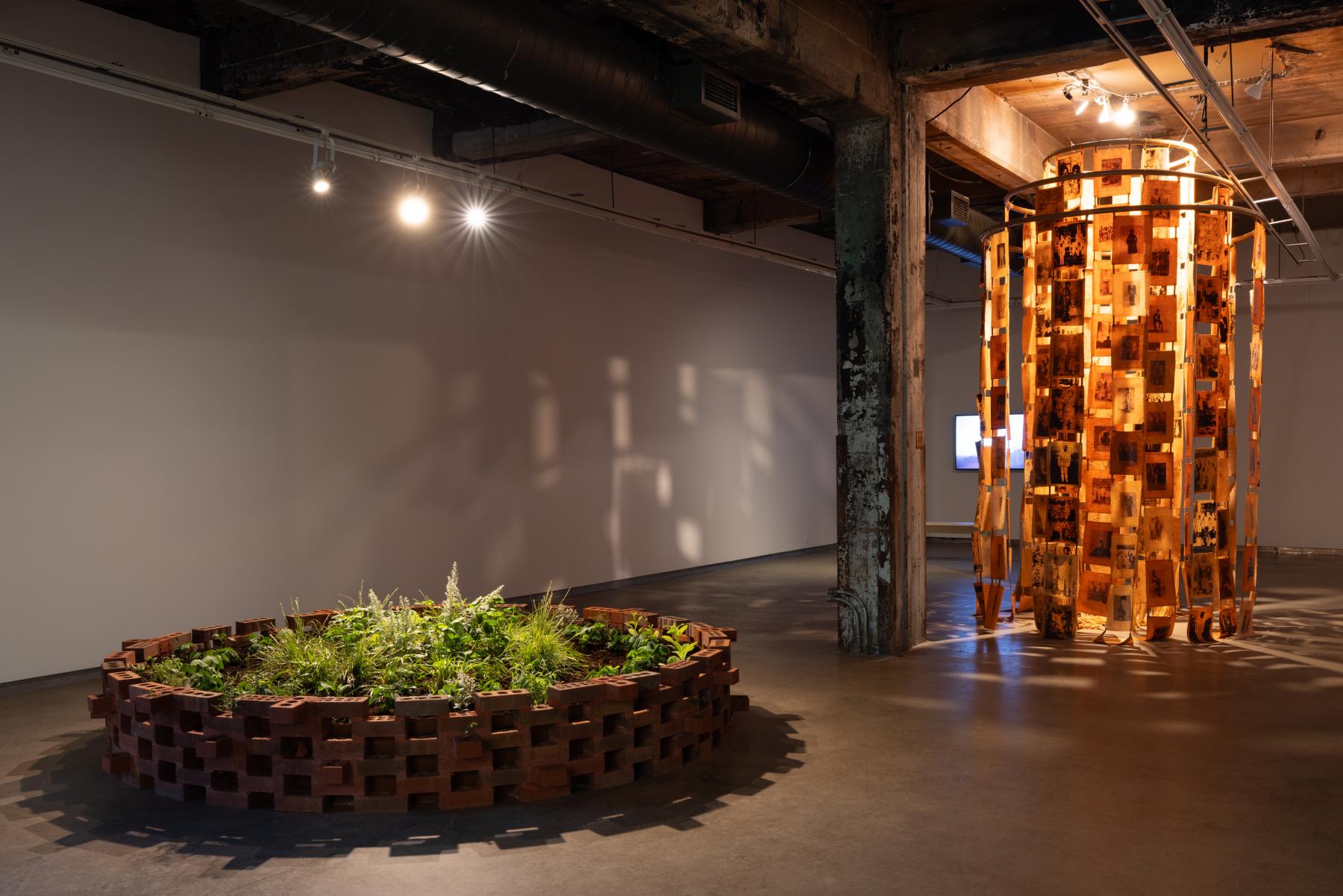
Mallory Lowe Mpoka, The Matriarch: Unravelled Threads, 2021 - 2024. Installation view at Fonderie Darling. Photo by Michael Patten. Courtesy of the artist.
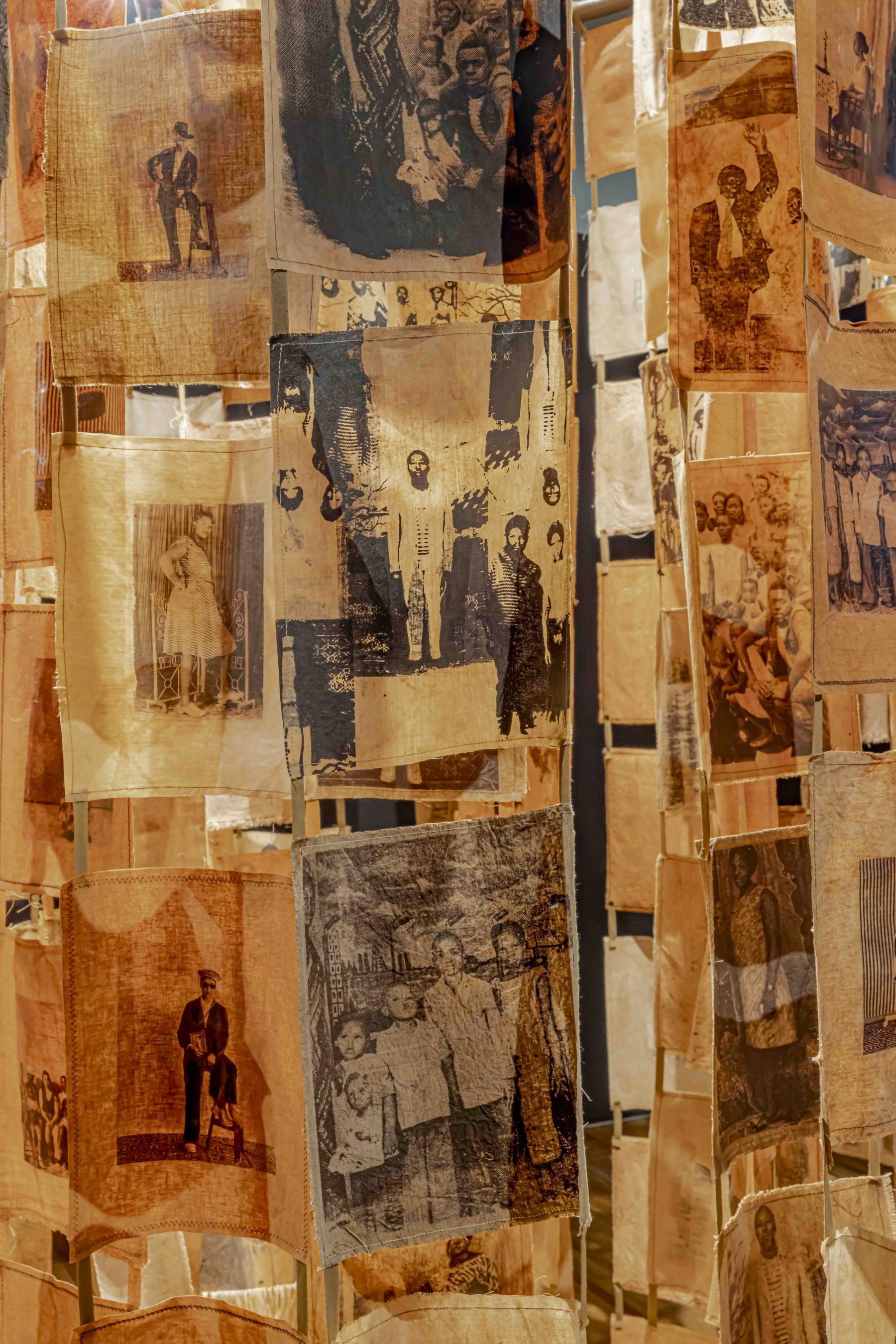
Mallory Lowe Mpoka, The Matriarch (detail), 2021 - 2024. Analog photography, screen printing, photo transfer, embroidery on dyed cotton and linen with red earth pigment, acrylic, paper, steel. Photo by Michael Patten. Courtesy of the artist.
My next question was about the fact that you're the matriarch—what it entails, what it means to you, and how that informs your artistic practice now.
I inherited both the emotional weight and the responsibility of becoming the family’s peacemaker, becoming a bridge between generations and people, and the keeper of memories. With that role I inherited the family’s physical archives: photographic objects, heirlooms, and other pieces of family history which I brought back to Canada, and ultimately inspired my next body of work.
When we speak of the matriarch, we evoke a sense of circularity, a continuous motion through which heritage, knowledge, embodied memory, and lived experience are transmitted. Living in the diaspora means inhabiting multiple realities at once: carrying the weight of where you come from while negotiating the space you now occupy.
In the textile work, The Matriarch, this idea of circularity and migration of knowledge becomes material. Images, both contemporary self-portraits and archival photographs, are inscribed into cotton and linen fabric recycled from my family textile workshop in Douala, their fibers dyed with the red soil of West Cameroon. This same soil also inspired my work Deborah’s Garden, which brings together native plants from Cameroon, Senegal, and Canada, species traditionally used for medicinal and spiritual healing. Through these living materials, the work establishes a dialogue between the legacies of the places I come from and the one I now inhabit.
Is this soil rich in iron oxide a hard thing to work with? In terms of malleability?
For me, soil isn’t a question of difficulty or ease, it’s about the kind of relationship you cultivate with the land, how you work with it, care for it, and listen to it. It’s a relationship rooted in reciprocity: if you water it, it nourishes you in return. Like many soils around the world, the earth of West Cameroon is exceptionally fertile, enriched by a balanced composition of silt, sand, organic matter, and clay. That deep red clay, in particular, recurs throughout my work, it’s both a material and a metaphor, holding memory, resilience, and connection to place.
I was wondering what brought you to this particular material? Why red specifically? You went into that a little bit, but I was wondering what was your first introduction to it?
Every time I visited Cameroon, I was struck by the color of the land. On my family’s property in Batoufam, everything is rusty-red, the houses built from mud bricks, the dust from the roads that settles on clothes, mats, and household objects. I remember photographing my grandmother there. In one image featured in the book, she stands in front of a window, and the red dust has left its mark on the curtain, tracing folds and patterns, integrating the environment into the fabric itself.
That observation led me to experiment with dyeing textiles using soil. What began as an intuitive process has become central to my practice, a way of engaging materially with the land. It has also shaped my interest in agriculture, which reflects a principle of care and reciprocity: when you tend the earth attentively, it responds in kind.
The next question I have is about the short film, She Who Summons. I was curious about what inspired you to start creating short films and if you think you will keep doing it in your practice?
Yes, when it makes sense. The short film emerged a few months ago at a point in my practice when I was exploring ways to incorporate movement.
Why did you feel like you wanted to involve movement?
I believe that movement and migration have always been central to the story of Afro-diasporic peoples and, more broadly, to humanity as a whole. The movement of plants, seeds, animals, goods, and humans is continuous and intrinsic to life. In an increasingly globalized world, movement cannot, and should not, be stopped.
This idea led me to explore dance as a medium to reflect on Black people—especially Black women—in motion, and on movement itself as an act of resistance and transcendence, resonant with maroonage as an act of self-determination, (systemic) disruption and liberation. Dance allows me to translate these concepts visually and conceptually. The film was shot in Mbour, about an hour from Dakar, with two dancers and choreographers, Amy Colle Seck and Ngosse Mbaye. They trained at École des Sables, a pioneering African dance school founded by Germaine Acogny in Toubab Dialaw, Senegal. Her technique, grounded in African rhythms but informed by modern dance principles, emphasizes the articulation of the spine and pelvis, dynamic improvisation, and the expressive potential of the body. So together with Amy and Ngosse we explored movement as both a personal and collective expression.
And it was important for me to be intentional with the accompanying music. The film introduces Papalaye Cissokho, a korafola, a master of the kora in the Mandé tradition, who opens the narrative by playing his flute, summoning the tales and ancestors into existence. In response, the two women enter and engage in a shared dance, and maybe a tale of queerness, who knows…
You've mentioned that your current research explores issues of colonial environmentalism and the garden as a space of collective care. You also mentioned care and resistance as important themes in your work. I was wondering how these ideas emerged and how your practice evolved towards that.
I began gardening through a QTBIPOC farmer collective in Montreal called Growing A.R.C, co-founded by Nadia Bunyan. Working in the fields, we cultivate cotton, flax, and indigo, among other plants that can be transformed into textiles and dyes. I learned not only how to grow these plants but also how to process them: how flax becomes linen, how linen can be shredded into thread, and then woven.
There is something humbling in this process of cultivation. It requires patience and active listening. As Malian indigo Master Aboubakar Fofana says, the relationship one develops with indigo dyeing baths is akin to that with a living entity: it must be fed, nurtured, and respected, so it can give in return. Farming became, for me, that space of reciprocity.
Continuing my research, Nadia suggested bringing seeds from home to grow in the community garden. I contributed cotton seeds from Cameroon, while others brought flax and sorrel. The movement of seeds resonates with me, particularly in light of the history of the transatlantic slave trade, when Black women carried rice, bissap, and other indigenous seeds in their hair to preserve their heritage and cultivate sustenance in new lands. African enslaved people and maroons often maintained their own gardens, using seeds they transported to sustain their communities and traditions despite oppressive conditions. Even today, the movement of seeds is tightly controlled by Western regulations, determining what can enter a country and be cultivated. For some of us, this means carefully concealing seeds, in luggage or clothing, to ensure they can take root and thrive here in Canada.
This research, combined with an awareness of the destructive legacies of colonial extraction, where plants, land, and Indigenous knowledge were erased, shaped Deborah’s Garden. Creating a space where medicinal and spiritual plants from different geographies coexist in dialogue.
.jpg)
Mallory Lowe Mpoka, Deborah's Garden (detail), Photo by Michael Patten. Courtesy of the artist.
.jpg)
Mallory Lowe Mpoka, Architecture of the Self: What Lives Within Us, 2024. Artist's book. Pièce Jointe. Available via.

Mallory Lowe Mpoka, She Who Summons, 2025. Still from experimental dance short film. Courtesy of the artist.
Your installation, Deborah’s Garden, feels like a strong reflection of the direction your work is taking. When I visited the show, I was captivated by the way you brought it to life. I’m curious to hear about your intentions behind the piece. Additionally, I remember you mentioning that the plants in the garden come from different parts of the world. Could you talk about how you made those choices and what informed the selection of each plant in shaping the garden as a whole?
For me, the garden emerged through reflections following residences and research travels across Europe & Africa. It was also shaped by discussions with Andrea MacDonald, an Ojibwe Anishinaabe community organizer. Their mother was a traditional Ojibwe herbalist, and when I visited their home a few weeks ago, they shared knowledge of specific plants meaningful to their practice. In these exchanges, we discovered connections between some Indigenous North American plants and African plants, and Andrea gifted me some of the species I incorporated into the garden.
Other plants came from seeds I brought from Senegal and Cameroon, given to me by aunts, friends, or farmers. I grew these for two months in the Université du Québec à Montréal greenhouse, applying knowledge gained through Growing A.R.C. The garden is a mix of medicinal, dye, and spiritually significant plants, baobab, white sage, sweetgrass, sorrel, bissap, tobacco, and white cedar—creating a dialogue between different places. In a way, it is also a self-portrait, reflecting the multiple geographies and cultures that live within me.
In Deborah’s Garden, there's also two bronze sculptures. Can you expand on them?
Yes, Heirloom I and II. These recycled red bronze sculptures were created four months ago during my research residency at Black Rock Senegal in Dakar, in collaboration with bronze master Makhonev Diop. We molded plaster directly onto my hands and face to form the pieces, which were then planted within the garden bed of the installation. These two works can be read as summoning ancestral presence, while also asserting my own rootedness within the land. That said, I often hesitate to define a definite meaning and rather invite viewers to bring their own interpretations as well.
Collaboration and community seems to be important in your work. How was the collaborative process for these three pieces, and how did they come about?
I see my practice as fluid, multifaceted, and research oriented. The concept often comes first, and the medium follows, chosen as the most effective way to embody and express the concept in question. Collaboration is central to my work; without it, much of what I do would not be possible. I draw inspiration from so many places and love to co-create with people from the places who inspire me. For example, for the film, I visited l’École des Sables and watched the dancers for several days before imagining what choreographing and co-creating together could mean. I’m always (and should be) interested in my collaborators' perspectives, and that’s what is exciting to me is that everyone comes with different strengths.
Similarly, Deborah’s Garden is a work of collective care. Everyone contributed, near or far. The structure of the red brick was co-designed with Tania Doumbe Fines, a Cameroonian architect based in Martinique. Together, we drew on vernacular African architecture, reusing traditional forms while exploring bioclimatic design principles. For The Matriarch, my aunt in Douala assisted with the dye baths, which became an opportunity for her to explore the creative potential of the red soil, a possibility she hadn’t considered before. In the process, she discovered a more effective dyeing technique that I continue to use today.
I understand your family has a textile workshop, how has that shaped your practice?
Yes, my family runs a textile workshop. My uncle has a boutique in Douala’s Central Market, that belonged to my grand-father, where he sells his creations and bags, and a sewing workshop at home with several seamstresses. I often spend time there working alongside them and my cousins, learning and collaborating on small hands-on projects, experimenting.
I think it’s very cool that it's a family thing that you included in your practice.
Oui. My family focuses on more utilitarian textiles because that’s what sells, while I have a more artistic perspective. The two approaches inspire each other. For example, The Matriarch incorporates reused cotton and linen from the workshop and Douala markets, which I then transform through dyeing.
As an artist who is interested in practices of decolonization and who works between Africa and Canada, I was wondering how you navigate the tensions between creating within Western institutions and maintaining the autonomy of your practice? How do you deal with that duality?
I live in a kind of in-between, between cultures, continents, and even across the spectrum of sexualities. Navigating this fluidity can make it challenging to have a fixed sense of self. Over time, however, I’ve come to see it as a strength. Home, for me, is not a fixed place; it exists within you and the connections you cultivate with others. That’s why people across the continent have made me feel at home, and why collaborating with the right people is so vital, it nourishes my work. What matters most is being able to do my work authentically.
And were you able to connect with your family regardless of not talking to your father?
Yeah, absolutely. And that's when I understood that I may not be at home everywhere but I can also blend anywhere. It's a curse and a blessing at the same time. And I think it's reflected in my practice in the sense that I use so many mediums, there's not one medium for me that I’m gonna focus on solely in my practice. It's very fluid. It's very multifaceted. And for me, there's no limit.
Now that your solo show at Fonderie Darling has opened to the public, how do you see your work evolve in the coming months? What do you want your audience to leave with?
I would say it’s about recognizing that it’s okay to embody contradictions and complexity. I used to feel ashamed of parts of my heritage, which can sometimes seem in opposition, coming from a relatively bourgeois Belgian family, with both direct and indirect ties to the colonization of Congo, and a Cameroonian family that suffered under colonial violence. Rather than carrying this as a burden, I approach it as a source of reflection and inspiration.
For me, identity can be a catalyst for creativity. Family histories often contain difficult or hidden aspects, but one doesn’t have to bear that weight alone. My work engages with these legacies, transforming archives and inherited histories into generative bodies of work.