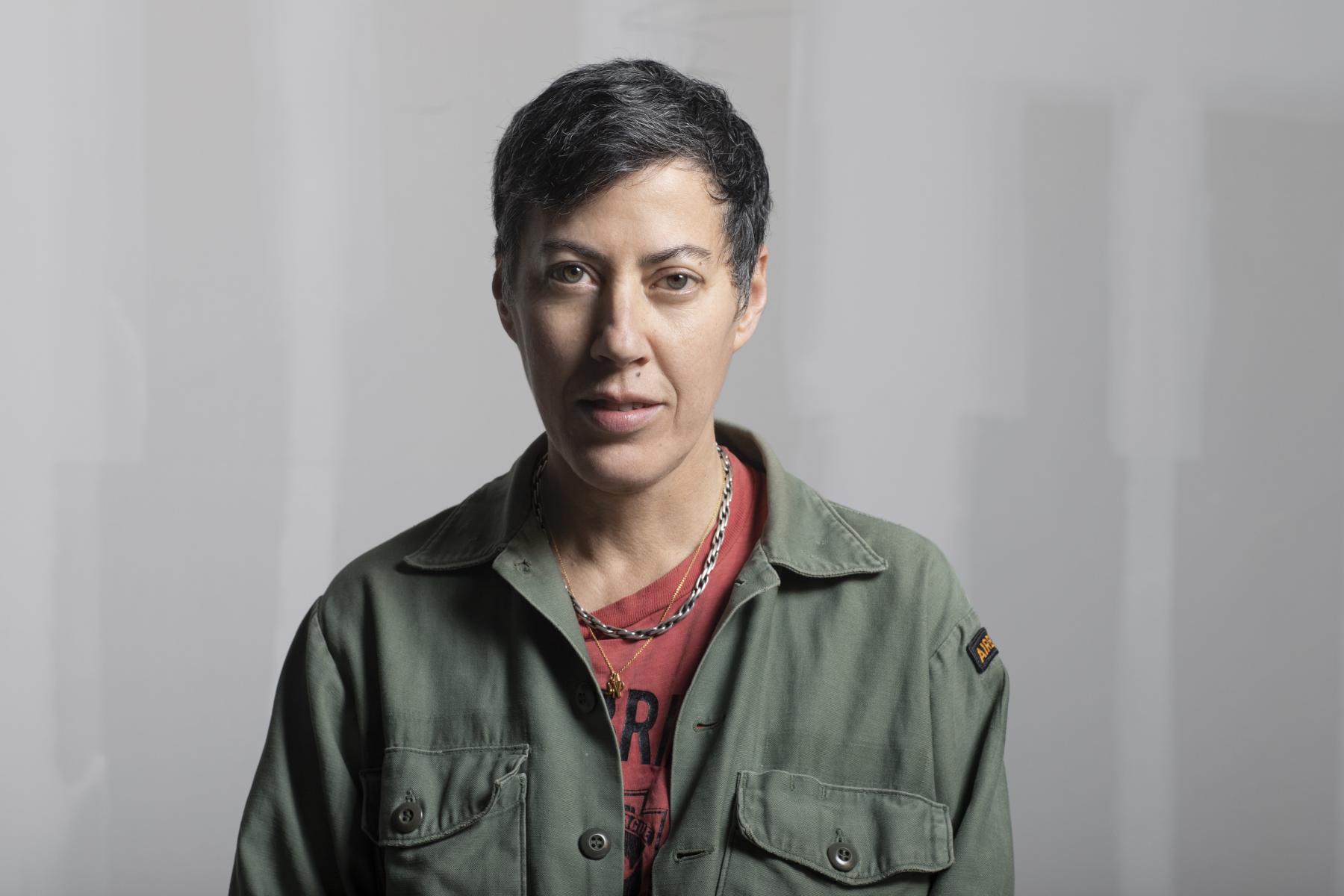
Nicole Eisenman. Photo by Brigitte Lacombe.
An auctioneer wearing the black gown of a judge sits stern-faced, between an international currency conversion table suspended in midair and a large abstract painting for sale. Above him, a foreboding night sky appears where one expects a ceiling. This is the scene of Nicole Eisenman’s The Auction (2025), where a painter is also present, clutching a similar looking canvas at his side. Positioned within the composition as if he had been called to testify, he’s rendered in flat Cubist color blocks, which make him gobsmacked—if not by the fact that he might be on trial than by the sight of an eager bidder before him whose hand is reaching way too high for anyone’s comfort, Sieg Heil style.
That sharp discomfiture you feel in your gut when facing total contradiction was at the heart of Eisenman’s STY, her most recent solo exhibition at New York’s 52 Walker. Comprised of paintings, works on paper, sculptures, and videos made between 2024 and 2025—after the start of Israel’s genocidal assault on Gaza and throughout the first year of Donald Trump’s presidential re-election—the exhibition depicted the artist and her milieu amid a battered social and civic landscape. These works were shown inside a floor-to-ceiling enclosure of Homasote board, a material commonly used by artists to allow for easily installation and deinstallation inside the studio, built inside the gallery walls, suggesting that Eisenman’s STY was not only a reference to an increasingly paradoxical outside world, but the effects of such a world on the walls of the mind. Here, no amount of focus, intent, or artistic autonomy can keep a person from brushing up against the threat of fascism, or from their own obliviousness to the violences that are every day surrounding them. We’re in this together.
Shortly after STY closed, Nicole and I had a conversation about the collision of styles and sightlines that inspired her exquisitely rendered canvases and sculptural works. We talked, also, about humor and its limitations; about narrative and abstraction; about the difficulty of making anything, including sense, during the present moment; and about the things that we are compelled to hold very close, even if we don’t yet understand them.
I like the idea of edging up next to a joke but not making or landing one. The paintings might be jokes without punchlines. They don't resolve themselves.
You just closed STY. How are you feeling?
I'm feeling satisfied! I think it was a good experience.
Going into it, I was worried about the show holding together and wasn’t totally able to wrap my head around how all the works were connecting to one another, but, in the space, it solved itself. It took a couple of weeks for me to really see the show and to understand it. The show was also up for so long—about three months—so I went in periodically and started to see connections that surprised me between the paintings and between the paintings and sculptures.
When did the work for this show begin?
The work for this show began with the painting that has a giant pig floating above an art opening, Archangel (The Visitors) (2024), which I made before Trump was re-elected. Making that painting at that moment was important, because it’s about what I thought might happen—and what, eventually, did happen. It’s also a painting of my world here in New York. There’s an art opening, a lot of my New York friends are there in it, and there’s some extremely ugly figures in it as well, which is also true to life. It’s often like, here we are, at the same opening as this guy. In the art world, we traverse this universe with that kind of feeling all the time, like: I don't know who all is in the room. When I was first offered to make STY I knew that I needed to get that painting back. I wanted it to be the anchor of the show.
Your work straddles humor and discomfort with very serious restraint. I’m thinking of the self-portrait that appears among the throng of art people in Archangel (The Visitors. “You” are pickpocketing a collector. That’s pretty funny. But then, one looks around, to see that, for fuck’s sake, Goebbels just into the room. Your paintings are comic, for sure, but there’s almost no joke to land. What’s your relationship to humor?
I like the idea of edging up next to a joke but not making or landing one. The paintings might be jokes without punchlines. They don't resolve themselves. Though, I’m not even sure what the joke would be, like “How many pigs does it take to screw in a lightbulb at an art opening?” I don’t know. I don't feel like I have jokes in me, or at least I don't feel like a very funny person. I work with absurdity, but you have to keep it on a tight leash on it or it slips into the surreal. I want my absurd worlds to make sense—in fact, I feel like the paintings are incredibly realistic in a way. They're very close to something inside me, my realism, perhaps, or, what's real for me.
My project has always really been about looking at the world and all the abhorrent politics going on in it, seeing how that experience lands emotionally, and then assigning a kind of symbolic language to those feelings. Once you find the symbolic language for the feeling that this shitstorm is producing in you, you've got your painting. To me, they are not meant to be funny, insofar as they are honest and realistic depictions of what I'm experiencing.
The title, STY, suggests a group or crowded space, which we see in paintings like Archangel (The Visitors) and The Auction. Two of the other paintings show artists alone in their “studios.” What role does isolation or solitude play in STY?
Most of my time is spent alone; I think that might be true for anyone who paints or writes. The figures you are referring to are both painters; both are a sort of self-portrait. One of them, in Fiddle V. Burns (2024), is in a hole in the ground, with treads of a tank on the ground above him. I was thinking, with this one, about the ditches soldiers sat in during World War I.
The other artist, in The Bunker (2024), is surrounded by insulation foam, cinder block, and noise reduction foam. There are layers and layers of things isolating that person from the world. To me, this painting was very much about what I feel like I have to do to paint. Or rather, it's a psychological portrait of what all of us as artists have to block out in order to function. The painting is very much about this impossible position that these psychotic governments put us in.
It’s about balancing what it means to witness things like the genocide in Palestine and then to take care of yourself. It has been artists, poets and activists who have adequately, with rage, responded to what’s going on in the world.
But, even still, since the start of the genocide, I have a feeling of embarrassment that I can just be in my studio, not thinking about it, and instead thinking about painting. I feel like the artists in the paintings, who look like total jackasses. One of them has his big thumb up in the air. And the other, the one in the hole, has this smug look and doesn't seem aware of their surroundings.
What role would you say art plays in a moment of despair such as this one?
Art is, of course, a safe harbor. But it’s also like one of those places that were popular in like 2015 where you could pay to go into a room and throw plates at a wall and break electronics. What was that called? A rage room? Art is a rage room.
It’s helpful for me to not only understand my fear and anger, but to do something with them, you know? I mean, what else are you going to do with life? You have to spend the time it takes to live through it, so you might as well make art. The Auction (2024), for instance, was an outgrowth of a moment that was truly one of the vilest moments I've ever experienced in the art world, which has obviously, by and large, treated me pretty well.
When I was 12 or 13 years old, I would often draw mean caricatures of my teachers in the margins of my textbooks. It was my own small revenge.
Rage is such a pointed feeling, but it can feel so abstract. To me, your paintings are so the opposite of that: they’re precise and orchestrated. They’re narrative. What role does narrative play in your work?
They're definitely narrative. I like that word to describe my work, because when I'm designing those big, multi-figurative canvases, I feel the same kind of writerly angst that my writer friends talk about when they're doing their work. In terms of process, I feel more aligned with novelists than I do with most painters. I understand how difficult writing is because I know how difficult it is to construct a story. It's sit-at-your-desk-and-pull-your-hair-out kind of work. But, if you get it right, it's also really satisfying. It can be really amazing to orchestrate a story in an image.
I feel very influenced by the idea of subtext and the subconscious—all the sub stuff. I try to remember my dreams every day and to analyze them. I find it very helpful personally but it can also help spur ideas for work. Since STY opened four months ago, I’ve been trying to think about what the story is now. Like, now the pig isn't floating above us like this big abstract thing that nobody's paying attention to. Now the pig is down in the room and walking amongst us. It’s here.
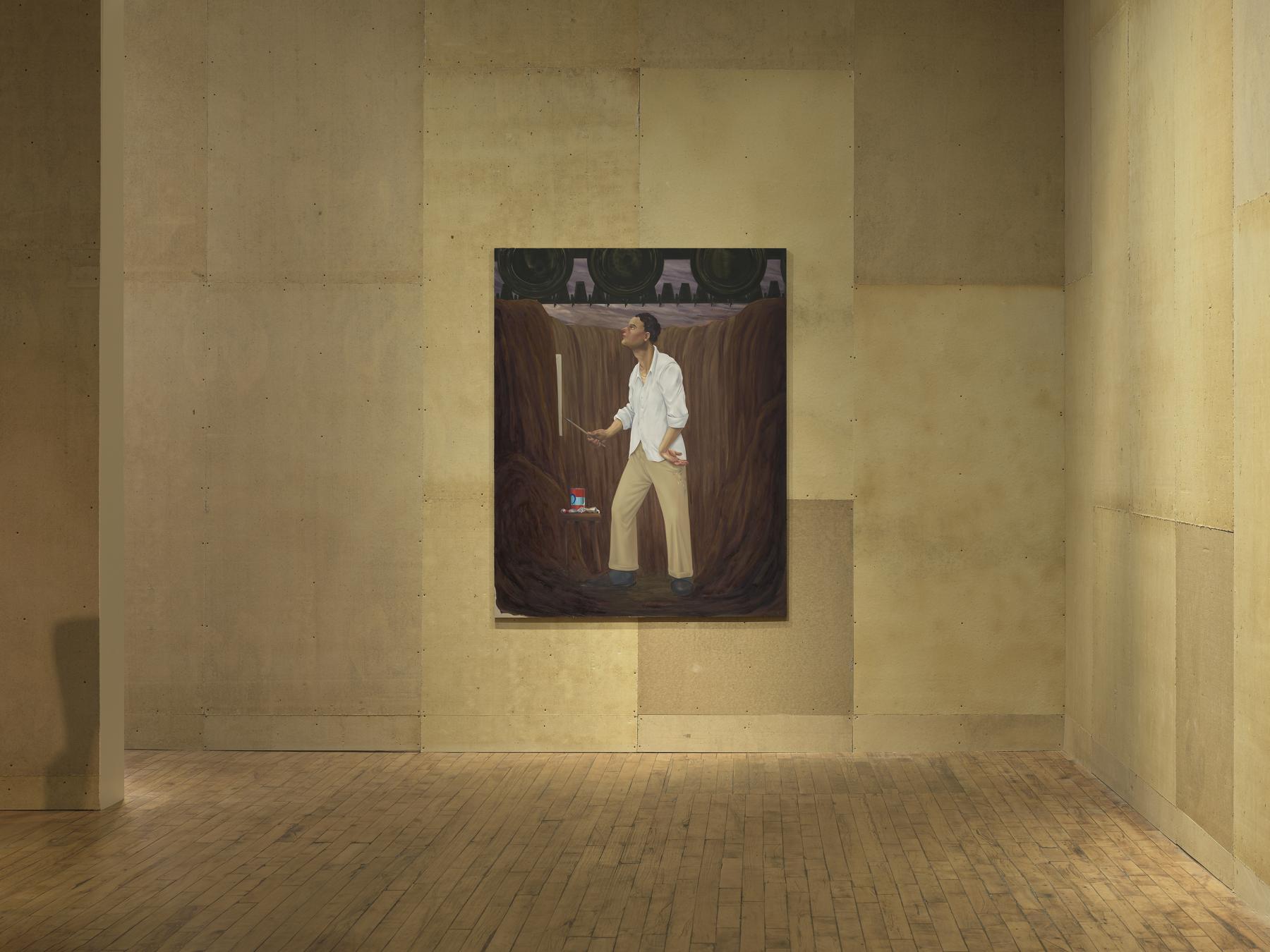
Nicole Eisenman, STY, 2025. Installation view, 52 Walker.
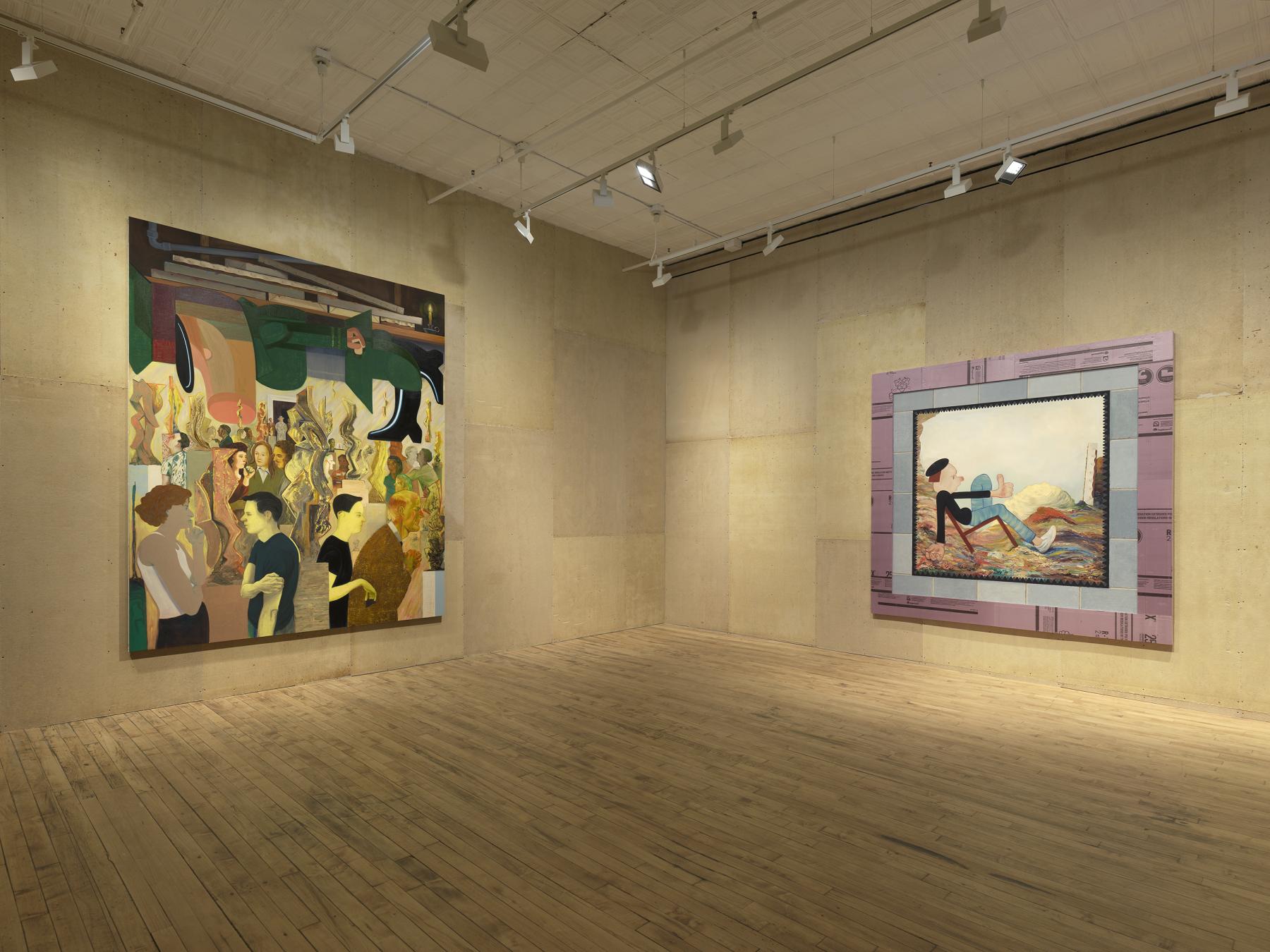
Nicole Eisenman, STY, 2025. Installation view, 52 Walker.
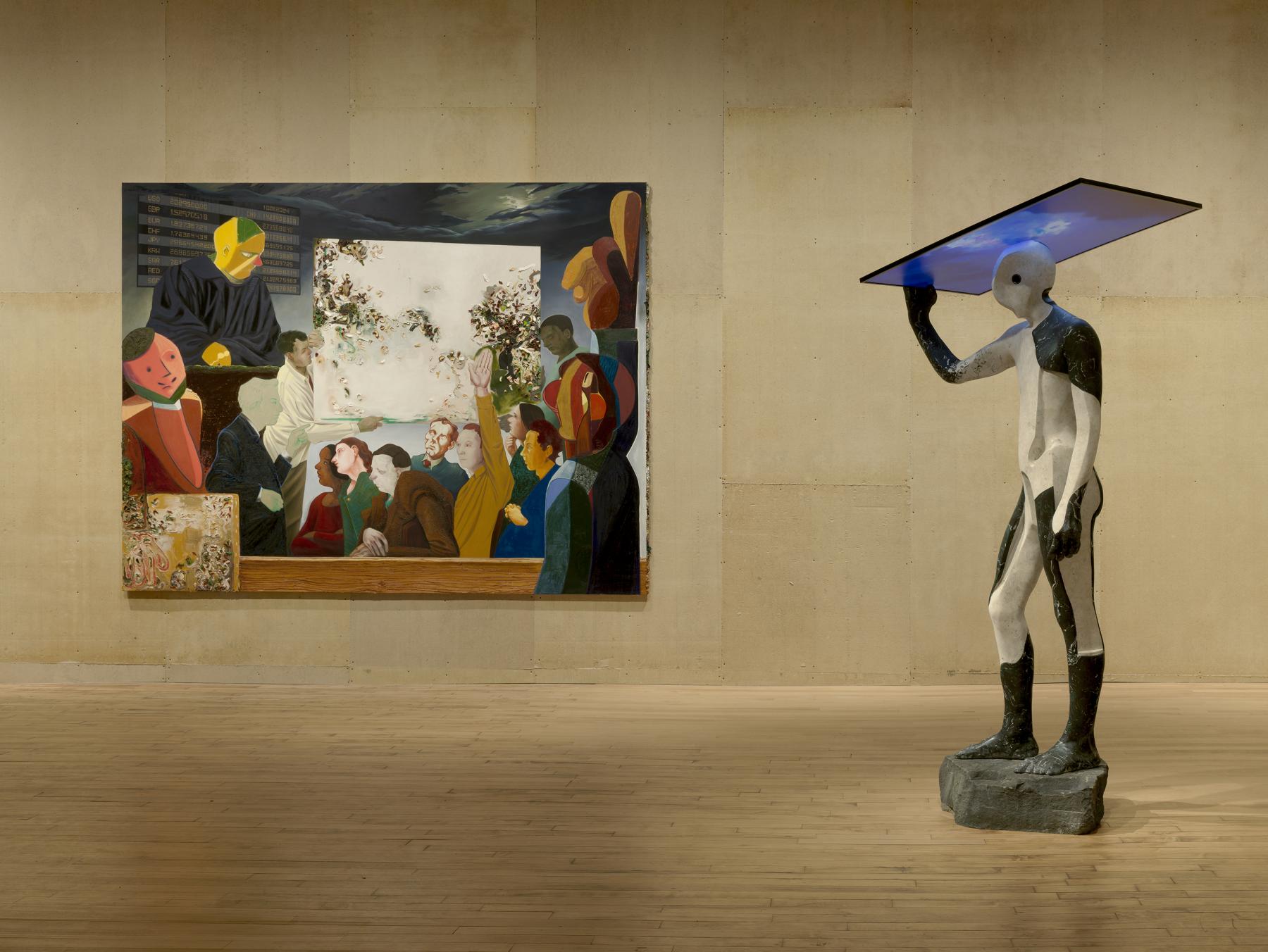
Nicole Eisenman, STY, 2025. Installation view, 52 Walker.
I love that STY came with a list of “Related Reading.” Balzac’s The Unfinished Masterpiece, a favorite of mine, appears on the list. And there’s another I want to ask you about. It has a great title: Alexander Woodcock and Monte Davis’s 1979 book, Catastrophe Theory…
Oh my god, that's a great book. It's a mathematics textbook, so I don’t know exactly how to read it. The copy I have, which I found at an antique shop, is old and beautiful. It has these great illustrations and graphs of when equations change from one form into another; it's about tipping points. That's not a book I read. That's just a book I have.
Maybe we ought to adjust what “reading” means. Carrying a book in my bag for months or a full year—can’t that be reading too?
Yes! Carrying a book in a bag is one of the great pleasures in life and should count as reading. I mean, this weird old book, I can't understand it but it's still inspiring and magical in its implications. What you imagine it to mean is important and drives imagination, but also, in a way I can loosely pick up the idea.
When I think about your sculptures, I think about found objects and plaster all smashed together, and I think about the visibility of touch. The sculptures in STY are made of scagliola—a composite plaster technique the Medici family once used to making swirling ersatz marble and terra dura constructions—and have such a smooth and pristine texture to them. But they’re also very complex. I want to call them “poetic” in the sense that they made me think, long after I saw them, about how the material came together to make them. How did you come to scaglolia?
I’ve been thinking about color and sculpture for a long time. It’s a baffling question. Color at first seemed extraneous to me. Coming to sculpture as a painter, I needed to take color out of the equation in order to keep things simple; there was enough to think about just making stuff that sits in the same world as us. In recent years I have been wondering how to use color without simply throwing paint on a 3D form, where color would seem extraneous and decorative.
As for the scagliola, it's dumb how I came to it: I first saw the material on Instagram and immediately liked the idea of using colored plaster, like fresco but thick. It’s hard to teach yourself. There are very few people outside of Italy who know how to do all the techniques, but I found this woman in the Midwest, Melissa Vongley, who was taught by people in Italy. I invited her to come to New York to teach me how to do it. So, we worked together to produce the sculptures in the show.
They're extremely complicated sculptures to make, so I'm glad they feel complex to look at. It’s tricky material and it easily requires like ten times the amount of touching than any other substance I’ve used before. It’s mind-boggling just how soft they are. If a bunny rabbit could be hard, it would feel like that. I was nervous about the slickness, about how angular and svelte they are, and about what it means to put figures out into the world that look like they could be based on some fucking supermodel or something. But, as you point out, they are also weird, cut up, sliced and diced. I was thinking a lot about the trans body while I made these works. One of the figures has indications of top surgery, for instance.
All three sculptural figures carry a flat-screen TV playing video works you produced in collaboration with Thomas and Anna Eisenman, your nephew and niece. Unlike the paintings, the videos depict some pretty abstract stuff, like hurtling through space. What was this collaboration like? Do you think of the videos in terms of abstraction?
Thomas is a filmmaker and Anna is an artist who has used a lot of video. The three of us conceived of the works together, but the two of them really made and directed the videos.
The videos seem abstract but if you were to watch them back-to-back, a story emerges. So, I wouldn't call them narrative but there is an arc that goes through them. The titles of the sculptures that carry each one of the three videos in the cycle are called Creation, Burning and La jetée. The entry point is the video that rests on the head of the black-and-white figure. In this one, an idea floats above you in its perfect state, before it comes down to earth and becomes embodied. The embodiment is terrifying—that's shown in the video that the figure with red and blue limbs is holding, which is the part of the sequence that's like a zombie apocalypse, with figures emerging from the mud. In the third video, there's a re-emergence from below and into a state of exaltation. That’s the subway surfing part. I look at footage of kids doing this and ask what it might be like to have that feeling, of being a teenager standing on top of a train, of feeling invincible. You’re basically like a god.
One figure carries the TV screen on its head; another one holds the TV to its side. They imply different ways to be attentive to things, including art. They favor distractibility and suggest, to me, how you might spend quality time with something you don’t totally understand.
Right, like how carrying a book in a bag is reading. It's heartening to imagine how these pieces could suggest a way of interacting with art rather than being simply burdened by screens. I wish we could take a painting out of the Met to walk around with for a day, or perhaps a month. A month would be good. They could provide you with a nice, strong leather portfolio so the painting doesn’t get damaged, and you could open the portfolio to take a peek at the painting while you’re riding the subway.
Okay, Nicole. If you were to pull an item out of the Met to have for a month, what would it be?
This is not a reasonable object to take out of the Met but there's this one samurai armor that is so wicked and fierce and gorgeous. It frightened me as a kid. I might take that and just wear it and walk around. Maybe I should choose something more realistic to carry around.
No, that’s perfect. You’d be like Lancelot in Jack Spicer’s The Holy Grail. He’s all worked up and has this great line: “If no one fights me, I’ll have to wear this armor / All my life.”