 copy.jpg)
Night Stroll. 2024-2025. Two-channel video installation (color, sound), 22 min. Installation view of Greater New York 2026 at MoMA PS1
My first encounter with Poyen Wang's Night Stroll was in Greater New York 2026 at MoMA PS1, where I was instantly seduced and disturbed by its uncanny protagonist: an expressionless cartoon boy with bloodstains on his hands, lying upside down on a staircase with awkwardly twisted torso. This animated puppet looks directly into my eyes, flirting with and threatening me at the same time, reminding me of Kirsten Lepore's Hi Stranger that went viral on YouTube several years ago.
In Night Stroll, an anonymous adolescent with sealed lips, eerie gestures, and an ever-changing voice inhabits a dimly lit domestic environment inspired by Wang's memories of his childhood home in Taiwan and construction sites found across New York City. The artificial space feels at once inhabited and abandoned, familiar yet estranging—always under construction and forever unfinished.
The two-channel video installation is presented across two large opposing screens mounted on metal scaffolding structures, with a smashed construction cone positioned in between. As the projections flicker on and off in a stroboscopic rhythm, I feel as though I have stepped into a murder scene, gripped by contradictory sensations of fear and anticipation, excitement and the urge to escape.
Throughout the video, the protagonist delivers a monologue on loneliness and the longing for romantic connection, interjected with lines drawn from U.S. immigration regulations. The voiceover is followed by an extended period of silence, during which a rotating red warning light fills the gallery. The whistling tone of "Ye Lai Xiang" ("Fragrance of the Night"), a classic Chinese love song about a flower that only blooms at night, eerily occupies the space. Once censored because of the politically fraught identities of the singers who performed it, the song carries a feeling of nostalgia and secrecy that connects to the work’s larger theme. Drawing from Wang's own queer experiences, Night Stroll reflects on forms of intimacy and vulnerability that can only be expressed under the cover of the night.
In the following conversation, Wang discusses the origins of Night Stroll's charismatic protagonist and monologue, his process of designing and 3D modelling the liminal spaces, his song choice, and the ways he incorporates theatricality, haunting, and the uncanny in his work to explore queer desire, diasporic dissonance, and alienation.
I am interested in contradictory feelings: seduction and repulsion, desire and rejection. I often make the character pose in ways that feel seductive, but at the same time, there is something monstrous about him.
Tell me about the protagonist. He feels ghost-like to me, appearing and vanishing across spaces—like a murder suspect with bloodstains, and at times a knife in his hand. Who is this character? Is he based on yourself or someone else?
People often assume this character is an avatar of myself, but he is not simply autobiographical. I see this anonymous, boy-like figure as a puppet that I can manipulate across different scenarios to create fragmented narratives. For me, he is a way to construct narratives that can be either true or fictional—they may draw from my own experiences or from stories I encounter in literature and film. He functions as a vessel through which I channel words and emotions.
I first developed this character for my 2020 solo exhibition, The Black Sun, at the Taipei Digital Art Center. In that exhibition, he appeared in a series of still images and two animations, though he never spoke. In one animation, he played the piano; in another, he sat alone in an empty classroom. I first gave him a voice in Endearing Insanity. While making that work, I realized there was something I hadn't fully explored in The Black Sun. I began thinking about spoken language and how the character might communicate through voice. His silence was a limitation, and by allowing him to speak, I was able to open up another layer of the narrative, creating a more complex relationship between memory and imagination.
I am curious to learn more about the protagonist's physical appearance. He always poses in awkward, almost impossible positions, his body bending in ways that feel unnatural or inhuman. I also noticed that his lips are always sealed, even when he speaks. Is the protagonist trying to scare us, seduce us, or perhaps both?
I think a lot about how different elements—the gesture, posture, and environment—come together to create an image. The posture is definitely something I have been working with since Endearing Insanity. I am interested in contradictory feelings: seduction and repulsion, desire and rejection. I often make the character pose in ways that feel seductive, but at the same time, there is something monstrous about him. You might not want to look at him because he has blood, dirt, and wounds on his body, but he also performs gestures that invite you to look closer. Some of his gestures are playful, for instance, when he lies on the staircase, he is almost flirting with the viewer. This push-and-pull dynamic is something I want to create to provoke certain feelings in the audience.
The design of the character is also influenced by Japanese anime aesthetics. I was reading texts analyzing Hello Kitty, particularly how the character does not have a mouth. The absence of a mouth creates a sense of vulnerability and silence, which makes people want to take care of her. I used a similar approach when designing this character. He appears cute and vulnerable, almost silent, but when he speaks, he has this monster-like voice and says things that can be disturbing. I am very interested in this contrast.
I notice that his voice also changes over time.
The voice is a form of identity, and I want this character’s identity to feel unstable. One version of the voice is deeper and more monster-like. Another version is more boy-like, reminiscent of a boy who has not yet gone through puberty—the process of becoming a man. That boyish voice can also carry a feminine quality. Through manipulating the voice, I explore different identities within the character: one that feels more masculine and another that feels more feminine, expressed through different pitches and sounds.
The monologues in Endearing Insanity and Night Stroll feel deeply personal and intimate, and at the same time clinical and detached. Could you tell me more about your writing process and any inspirations you draw from?
I worked with found texts from Craigslist when I was making Endearing Insanity. After moving to New York City, I used Craigslist to search for housing and became fascinated by this strange corner of the internet. During this process, I discovered the "Casual Encounters" section, where people post anonymously, looking to meet someone. Most of the posts were very direct—often about sex or hookups—but they were also ambiguous because you could never tell how sincere they were. At the time, Craigslist was built around anonymity. It wasn't about connecting with a real person in the way social media functions today. I first encountered these posts in early 2017, and I found those anonymous texts both strange and compelling.
When I began making Endearing Insanity, that memory came back to me, and I started researching more. I found an archive preserving many of the posts after the "casual encounters" section was shut down, and I read through them, collaging different texts together to create the work's monologue.
With Night Stroll, I moved toward a more personal direction. While Endearing Insanity was largely built from found texts, the monologue in this work is derived mostly from my own writing, which reflects on my adolescent experiences, combined with quotations from films and literature, as well as specific references from U.S. immigration documents. At the time, I was adjusting my immigration status and had to answer a long list of questions on these forms. Many of them struck me as strange, even absurd. As someone who simply wanted to remain in another country, I found it unsettling that the process required me to scrutinize my identity and my body in such a specific way.
My work has always been built on my lived experiences as a queer person and an immigrant. The construction cone in the installation is titled Your Body Is the Target of Their Sights. As an immigrant, your body becomes the object of governmental systems that seek to regulate, examine, and control it. On the other hand, as a queer person, the body can become an object of desire. I am interested in this dialectical relationship, where the body can be denied in one context and desired in another—the contradictory ways in which the body can be seen and experienced.
.jpg)
Still from Night Stroll. 2024-2025. Two-channel video with stereo sound, 22 minutes, loop
 copy.jpg)
Night Stroll. 2024-2025. Two-channel video installation, 22 min. Installation view of Greater New York 2026 at MoMA PS1
 copy.jpg)
Night Stroll. 2024-2025. Two-channel video installation, 22 min. Installation view of Greater New York 2026 at MoMA PS1
Your work draws from a range of artistic and cinematic references. Could you talk about the artists, films, and genres that influenced your work and how you incorporated them into your own visual language?
When I make a new work, I always think about what cinematic tropes I can explore and transform through video. For my previous work, Endearing Insanity (2022), I was thinking about combining horror films, body horror, and erotic films, including pornography. When I started making Night Stroll, I wrote down a list of keywords, and one of the major references I returned to was East Asian ghost films. Especially in Japanese ghost films, there is often a kind of character who appears in different corners of a house, trying to scare you through sudden appearances or flashes.
The artists Paul McCarthy and Vito Acconci use video and virtual space as a stage for performance, which inspires me to think about how to incorporate theatrical language into my own 3D animation practice. In Night Stroll and Endearing Insanity, the character appears on the stage I create and performs monologues. Tsai Ming-liang's films taught me that I can use a setting, a stage, a character's gestures, combined with my addition of spoken words to convey a narrative instead of relying on a progressive plot.
Another important reference was the musical. When I make these 3D animations, I don’t think of them as traditional linear animations driven by plot. I think of them more as theatrical performances. In the end, when the character is lip-syncing the Chinese love song, the construction cones light up and become part of this musical language. I am interested in working with this sense of campiness found in queer musicals.
From the protagonist’s monologues to building the virtual environment, your work combines fiction and personal experiences. Could you speak more about this approach?
I often think about the make-believe games I played when I was a child. When I was a child, I would use random objects, toys, or things I found around the house as characters and build small stages or worlds with them. Looking back, I feel that the experience of creating a small imaginary world is very similar to what I am doing now in the virtual space. My childhood experience of building imaginary worlds continues into my current practice of creating digital environments.
I often think about how, through my lived experience as a queer person, I have been channeling a lot of fiction through movies I have watched or literature I have read. These fictional experiences and associations sometimes become part of my own experience, and my own experiences also resonate with those fictional worlds.
I am also inspired by poetry and autofiction—writing that blends autobiography and fictional narratives. There is a form of writing called the “I-novel” (shishōsetsu) in early twentieth-century Japanese literature. For example, the work of Motojirō Kajii often includes a protagonist—a writer who is ill and approaching death—whose experience mirrors the writer’s own life, but the stories themselves remain fictional. When I read his work, I became interested in blending fiction and autobiography in my own work.
The digital environment in Night Stroll combines domestic interiors with construction sites. Many of the objects, such as the rice cooker and wok in the kitchen, feel very specific to homes in Asia. Could you talk about the places and memories that informed this virtual environment?
My work is influenced by the concept of chora in psychoanalysis, which describes a space that is difficult to name and always in a state of becoming. I was thinking about combining the construction site with the domestic environment to create a space where you cannot really tell whether it is indoors or outdoors, whether it is collapsing or rebuilding. It is always in a state of transformation.
The stage in Endearing Insanity was based on an apartment I lived in when I was in Brooklyn. The dining room had a single window, which made it feel almost like a cave, and I used it as the foundation for creating that virtual environment.
For Night Stroll, the environment is based on my childhood home in Taiwan. I created the furniture and objects myself to capture that specific Taiwanese domestic aesthetic. For example, the ashtray in Night Stroll comes directly from my memory. I remember it very clearly because I disliked it as a child. My father smoked, and I found cigarettes disgusting. I associated the ashtray with fear and discomfort, so I wanted to recreate it in the video exactly as I remembered it.
The construction site elements also come from my experience living in New York City. Whenever I walk on the street, I see construction sites everywhere, and they make me feel that the city is always in the process of collapsing while, at the same time, constructing and rebuilding itself.
Your digital environments feel highly realistic, but at the same time, they carry a distinct theatrical quality. Could you talk about your process of building these objects through 3D modelling, and how you balance realism with imagination?
The Brooklyn apartment in Endearing Insanity and the Taiwanese house in Night Stroll are both spaces that I carefully recreated from my own experience through 3D modelling. Even though viewers might not know the original places, I try to make the virtual stage as close as possible to what I remember because, for me, it is about being authentic to my lived experience.
At the same time, although the work might appear photorealistic, I want it to feel closer to an allegory. The objects are realistic, but they also function like theatre props. For example, when I worked with the fabricator to create the physical construction lights for the gallery, I asked them not to make them too realistic. I wanted them to retain a sense of artificiality, like stage props.
The objects in my animations have a similar quality. They are elements within a constructed stage rather than perfect replicas of the real world. This is why I do not use photogrammetry or scan objects to create virtual versions. For me, that would make them feel too realistic.
.jpg)
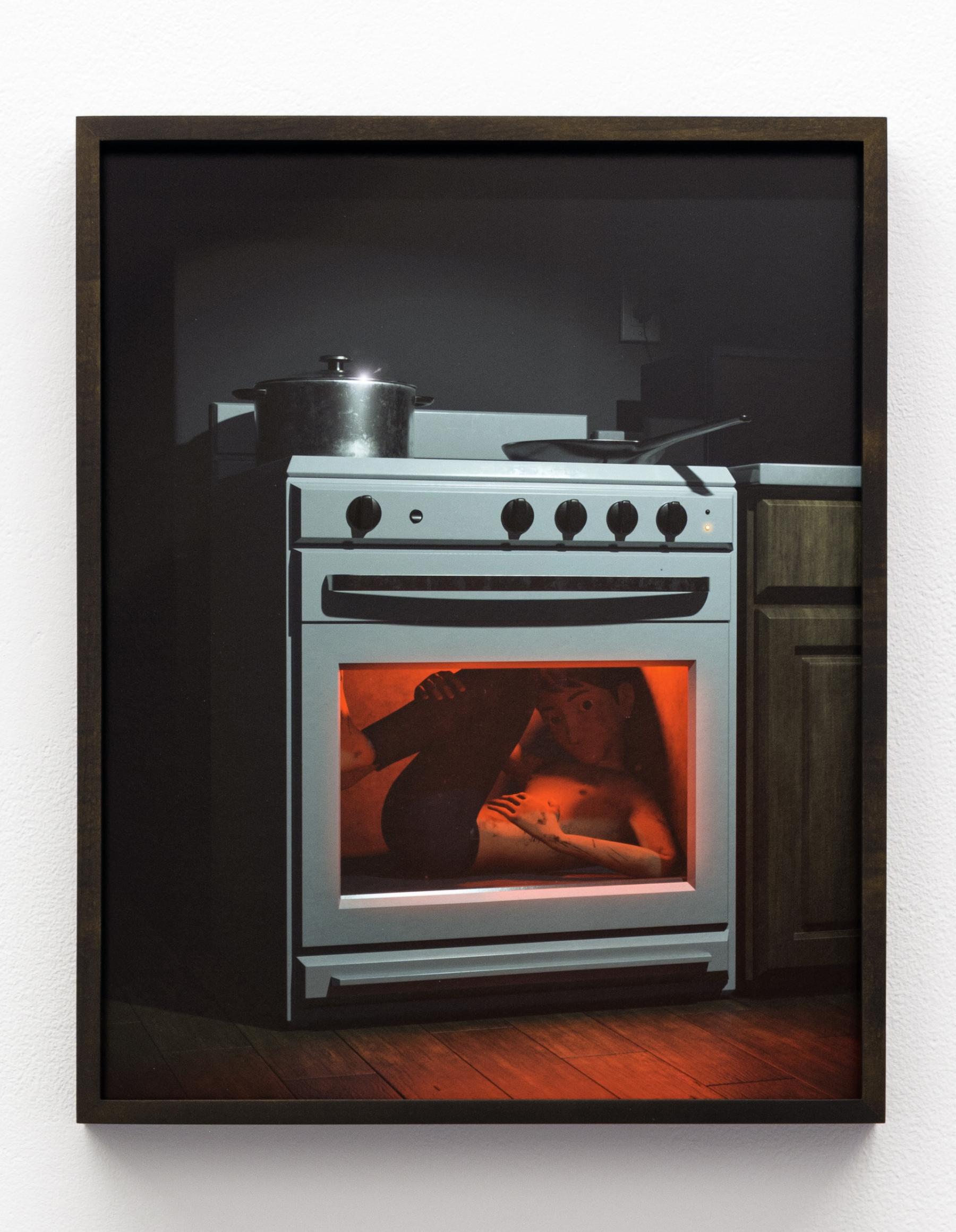
I got nothing to do (Oven), 2023, Archival pigment print mounted on sintra with maple frame, 12 x 15 inches
Night Stroll is composed of a series of short scenes punctuated by moments of darkness, and it begins and ends with extended periods of waiting as music plays and the red warning light fills the gallery. Could you talk about how these formal choices, including the use of darkness, two-channel installation, and moments of waiting and in-between, shape the viewer's experience of the work?
When I began working on Night Stroll, the strobe effect was the first thing I wanted to include. You see the camera continuously moving forward, exploring the space with these strobe lights. I was thinking about the queer cruising experience and how it can sometimes be dangerous but also very exciting. I started thinking: what if I created a queer cruising experience within the home?
The childhood home is usually a place where you have to follow many rules—rules from your parents, like you shouldn't touch certain things or sit on the table. In some ways, I think the childhood home can symbolize a kind of patriarchal structure or set of expectations. I wanted to subvert this idea of the patriarchal space by bringing this queer cruising experience into the setting of a childhood home. Later, as I mentioned, I decided to approach it through the language of the ghost film and the musical.
The darkness comes from my thinking about the work as a series of vignettes. It allows me to connect these fragments together while also creating a sense of suspension for the viewer, not knowing what the next scene will be. I think about this in relation to theatre as well. When I see an interesting theatre performance and all the lights go off, I feel excited because I am waiting to see what will appear when the lights come back on. There is a sense of anticipation in that moment.
In a physical theatre performance, there are spatial limitations. Usually, if a production can change two or three stage sets, it is already considered quite ambitious. However, because my work exists as video, I have much more freedom to create different stages and environments. In Night Stroll, you move through the kitchen, dining room, living room, bedroom, and bathroom. I use darkness as a way to transition smoothly from one stage to another.
The two-channel installation extends this idea of movement. In Night Stroll, the character sometimes appears on the left channel and sometimes on the right. This was intentional because I wanted to create a situation where viewers cannot see both screens at the same time. I want the viewer to locate where the voice is coming from by moving between the two screens.
You included the song "Ye Lai Xiang" in Night Stroll. The song is, on one hand, about a flower that blooms at night, but it is also filled with romantic longing and desire. With the film being titled Night Stroll, I feel there is something about "night" that resonates throughout the work and the song. Could you tell me more about why you chose this particular song?
I knew I wanted to incorporate musical elements in Night Stroll, and I would like to work with a Chinese song. The first song I thought about was "Ye Lai Xiang" because my mother loved this song. She used to sing it when I was a child and I have a strong memory of it.
I picked this song because I like how feminine it is. I like the lyrics about someone craving romance in a night garden because I feel they resonate with a certain kind of queer experience that usually happens in public spaces at night, especially in parks. Coming from my own upbringing in East Asia and within Chinese culture, it is still very difficult to navigate being a gay man, which makes me feel connected to this song.
The song Ye Lai Xiang also has a very complex history. Can you tell me more about how this history relates to Night Stroll?
The original version of the song was performed by Li Xianglan, who was born and raised in Manchukuo, the Japanese-controlled puppet state in Northeast China before and during the Second World War. After Japan's defeat, she was accused of being a collaborator of the Japanese because of her roles in films associated with imperial propaganda, and many of her films and songs, including Ye Lai Xiang, were subsequently censored.
The song later gained new popularity in the 1970s through the cover by Teresa Teng, a Taiwanese singer who was popular across China, Japan, and the rest of Asia, whose recordings were also censored under a different political context. A simple love song became censored because of the singer’s identity and the political context around it. I felt it was the perfect song for Night Stroll because its history resonates with queer romance, which is still considered a taboo in many parts of contemporary society.
What projects are you currently working on, and what are you planning next?
I am working on a new animation that will feature the same character again. One cinematic trope I want to explore this time is film noir—an early Hollywood genre known for its high-contrast lighting and its connections to detective and crime stories.
I also became interested in how camera lenses can blur and reveal information. In many Hollywood films, depth of field is adjusted to focus on one object while blurring another. Sometimes the opposite happens, where something in the background comes into focus while the foreground disappears. This is usually an aesthetic choice in cinema, but I want to use it differently. I would like to challenge the idea of visibility: what is being seen, what is being unseen, and how the gaze shifts between them.
Through making Endearing Insanity and Night Stroll, I discovered questions I had not previously thought of. In my new animation, I will investigate the relationship between the audience and the character—the character's gaze and the audience's gaze. I want to explore the act of looking through moving images and how looking itself can become part of the work.
Another project I am in the early stages of researching is related to puppetry. I am particularly interested in Japanese bunraku, where the figures have a very specific relationship to movement, control, and performance.