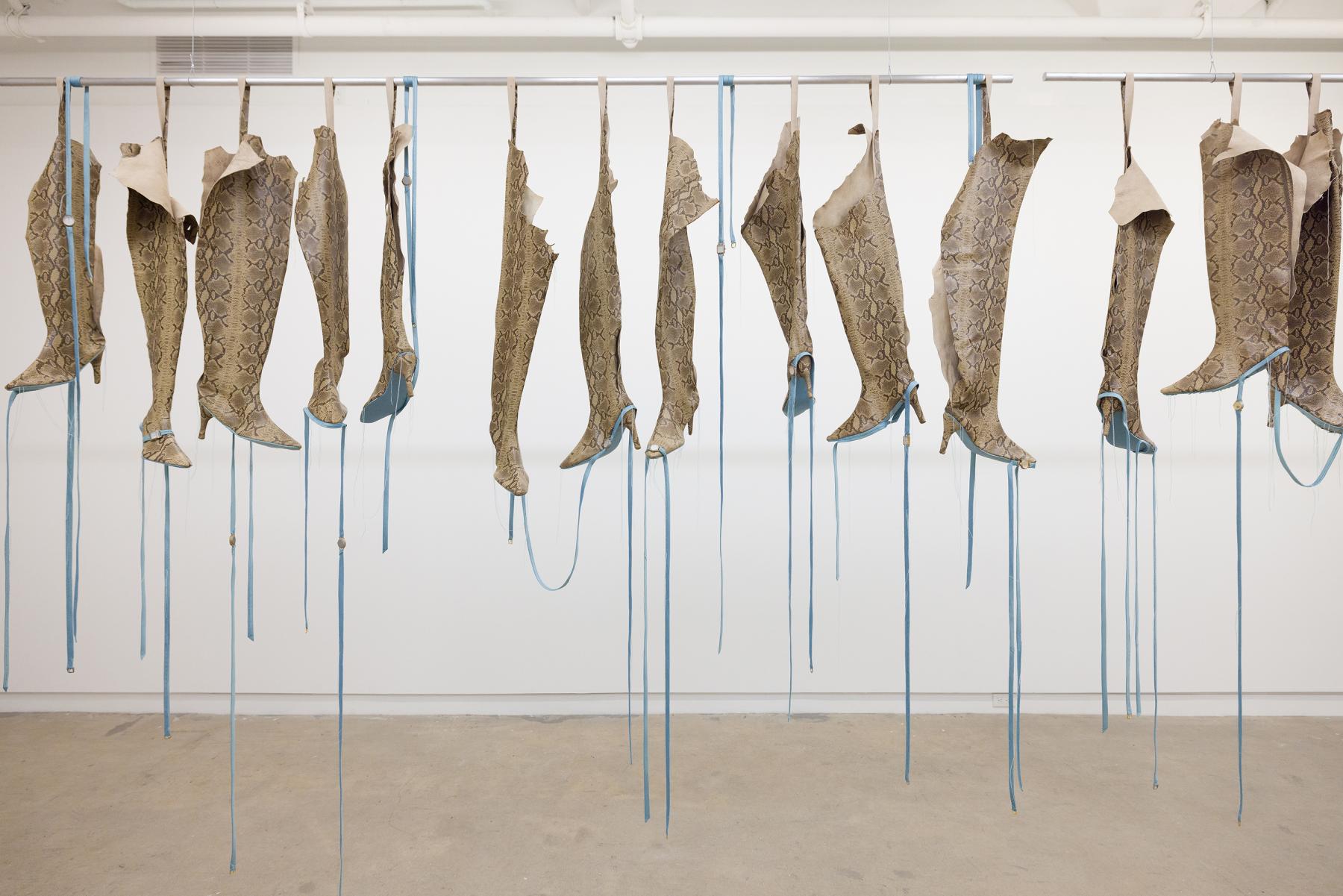
Kyle Alden Martens, Split Hairs, 2026. Exhibition view, Diagonale. Silk, leather, thread, sandblasted watch faces, watch buckles, horse hair, mat board, aluminum. Photo © Mike Patten
Three boots hang from the pole that greets me; something of an archway, a threshold to sidle and cross before the room comes into view. Two more poles partition the space of Split Hairs to suspend Kyle Alden Martens’ boot-sculptures—the lines of gaping bodies in an abattoir or the draped garments of a walk-in wardrobe, everything hangs in the air like open secrets.
----------
To my left, boots of deep purple leather drip with scissors and loose threads, punctuated by three jackets sewn shut. To my right, a line of snakeskin boots with turquoise soles and dangling watches. The matter of handicraft—thimbles, scissors, thread—is taken up as adornment, but produces instead a set of signs that point to the hands (the past hands that handled the work) as the sculptures themselves point to the feet (the invocation of future feet). Time spreads out as the hanging beings encircle me, winding and unwinding on their poles, drawing little loops in air, and I am urged to go around again, to make some sense of their arrangement.
The room proposes a closet, so I am moved to reach out—to take from the rack, to step into these skins as I do my own. When I choose clothes from my own wardrobe, I encase my animal body, wanting to inhabit something that intimates, however briefly, my imagined ‘I’. Queers have more language for this act: we perform, we flag, we enact ourselves, and we find each other through these visual codes—but it is anyone’s daily labour. As I approach Martens’ garments, I see that they are unfinished and splitting at the soles. The object of my reaching, this me concealed in cloth, but one lapsing iteration of many, splits open in turn.
----------
Kyle Alden Martens is a Montreal-based artist working across sculpture and performance. Informed by years of performance and videowork, their sculptural practice provokes imagined gestures through compositions of familiar objects. Common sense and comfort are both encoded and undone through the artist’s play with ambivalent signifiers and scale. The home, the familial—sites and systems that violate queer life—are denaturalized, disoriented from. Martens’ new solo exhibition, Split Hairs, which opened in January at Galerie Diagonale, blends sculptural practice and artisan shoemaking into a craft of disturbing the language of clothes or skin–exposing both the seduction and risk of coherence for the queer, or any imagined, body.
I. Skin
“[W]e should need no further warning as to the importance of clothes in human life and human personality; indeed, the very word ‘personality’...implies a ‘mask’, which is itself an article of clothing.”
(John Carl Flügel, The Psychology of Clothes)
Martens’ practice has long incorporated clothing, with handmade sandals, clogs, socks, jackets, and gloves doubling as containers for unexpected items like keys, marbles, combs, and rings. Placed on the ground of galleries, the shoeworks seduce the viewer to step into them—the embedded objects, then, interrupting this habitual act. Split Hairs presents a departure from the artist’s past work, exhibiting a constrained focus on the form of the boot, yet exposing its own (incomplete) process of making. The familiar is suspended, distinctly. Whereas clothes denote one’s ability to step into themself, to produce themself as a self, Split Hairs lays bare the careful labour of this process: one of excessive, gorgeous artifice.
Kyle Alden Martens, Split Hairs, 2026. Exhibition view, Diagonale. Leather, thread, sandblasted watch faces, watch buckles. Photo © Mike Patten.
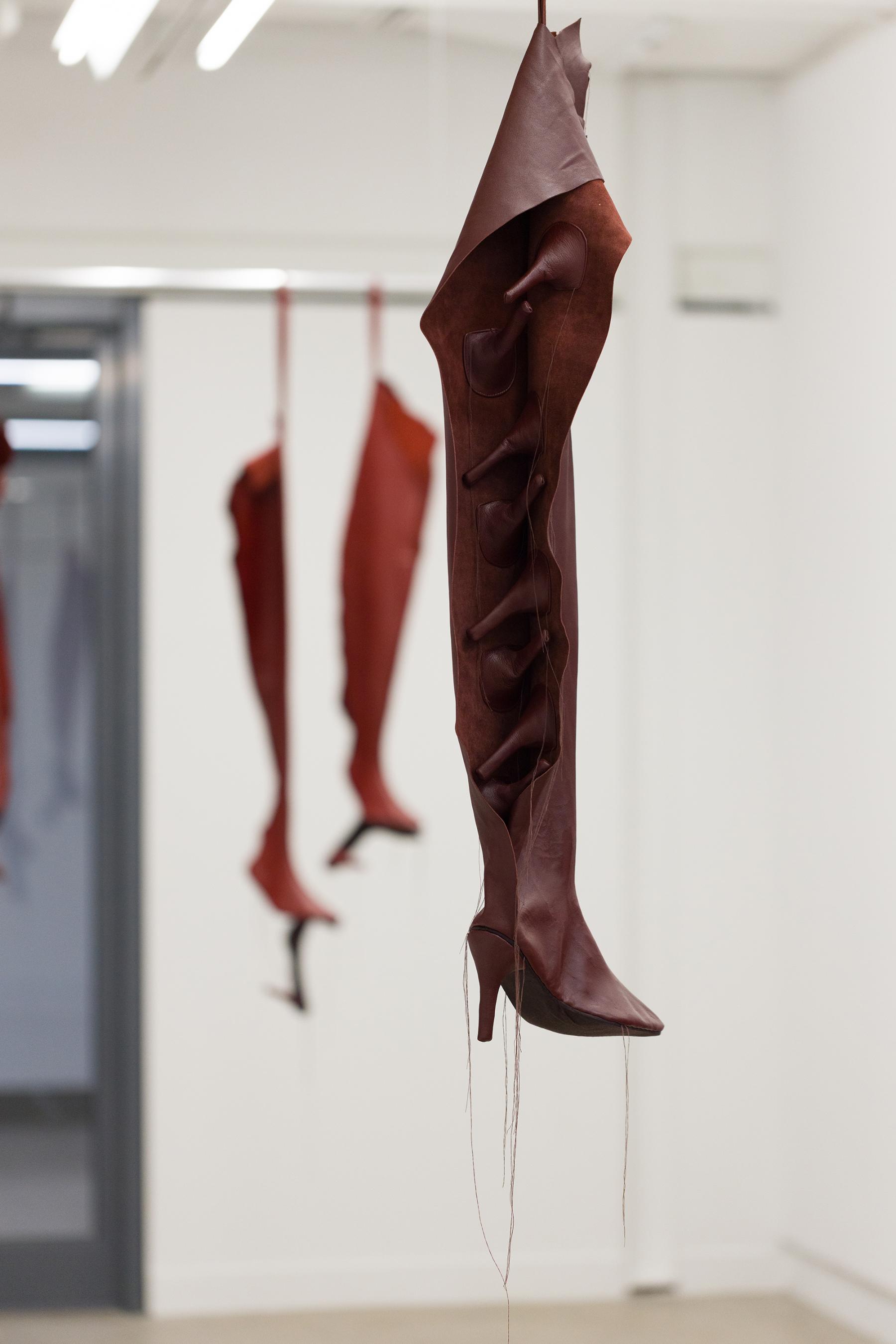
Kyle Alden Martens, Split Hairs, 2026. Exhibition view, Diagonale. Silk, leather, thread, horse hair, paper, mat board, aluminum. Photo © Mike Patten.
Suspended on their racks, the boots withhold this offer to step in. Their wide shafts gape open in uncut leather, retaining a fleshiness not yet obscured by clean stitching. One piece, a boot in burgundy leather, splits all the way down its shaft and hangs ajar, revealing a spinal column of stiletto heels protruding from its interior. This boot is a body, fortified by heel vertebrae of leather stuffed firm with horse hair. The spine signals strength and capacity to stretch, a series of bones in relation with muscles and ligaments. The spine, whose name comes from the botanical word also meaning ‘thorn,’ as in the spines of a cactus, signals threat. The spine may be a weapon, a protective apparatus. Shoes derive fully from a protective impulse—at some point, primates descended from the arboreal realm and our feet touched the sharp, hot earth. Shoes invoke a threshold, this risk-laden boundary of person and world, me and not-me. The foot, too, inhabits this crossing—the appendage is taboo; arousing and disgusting. The hands made the shoe to sequester the foot, guarded (or withheld) from the threat (or promise) of the wild ground.
Split Hairs toes the limit of tedium and tumult. The dragged time of meticulous making and the mess or murk of the unknown, the anarchic, the animal. Exacting care and disorder, hand and foot. To split hairs conjures a meticulous, obsessive labour or process and, yet, split hairs, as a qualified noun, imbues the work and its dangling threads with what was always already feral and broken open.
II. Stretch
“The aesthetic was ‘more more more,’ and every layer conveyed meaning as we created eclectic mystical collage on our bodies. With my drag, I was collaging myself together.”
(Fayette Hauser of The Cockettes in Fray)
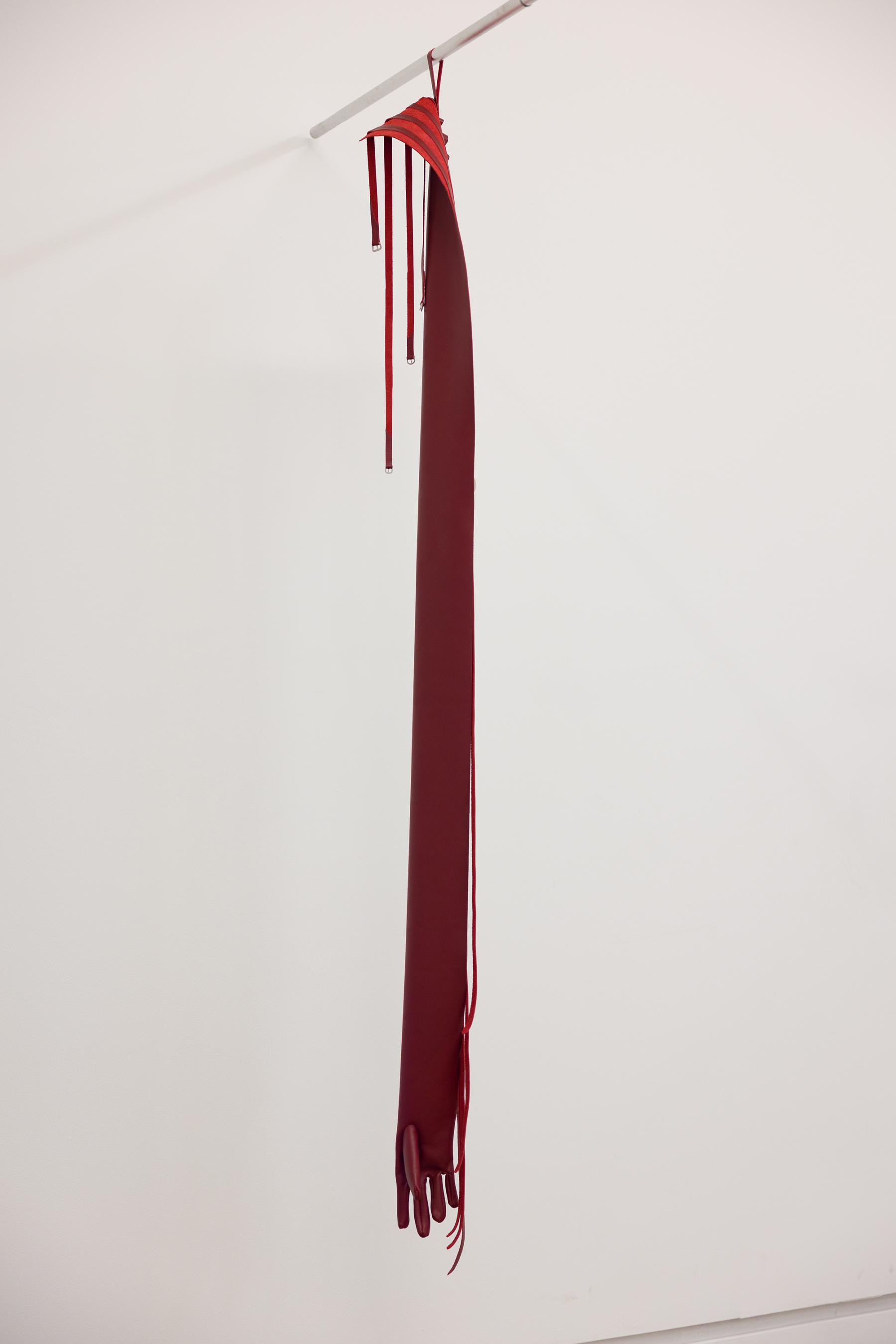
Invoking queerness via subverted gesture, the closet space of Split Hairs brings up Judith Butler’s “repetition with a difference.” The boots are shaped by stretching new leather over a single mould, culminating in a set of drafts. The mould is worn down with each reuse–every citation decays its origin and derives the next. The result is not a sequence; boots hover in a circle, evading implications of progress. Time is stretched and stitched and left agape along with the rest of the show’s vital matter. Dozens of watches drip from the exposed bootsoles; more are strung from inside the opened gauntlet of the show’s single glove. While their clocks’ hands are made illegible behind sandblasted crystal, the artist’s hands are everywhere, unobscured. The time of handmaking is doubled in the allusion to craft, which is always an engagement with the past: traditions of making are repeated with a difference. Craft is subverted as it cobbles together the queer body. And time becomes another material for such manipulation.
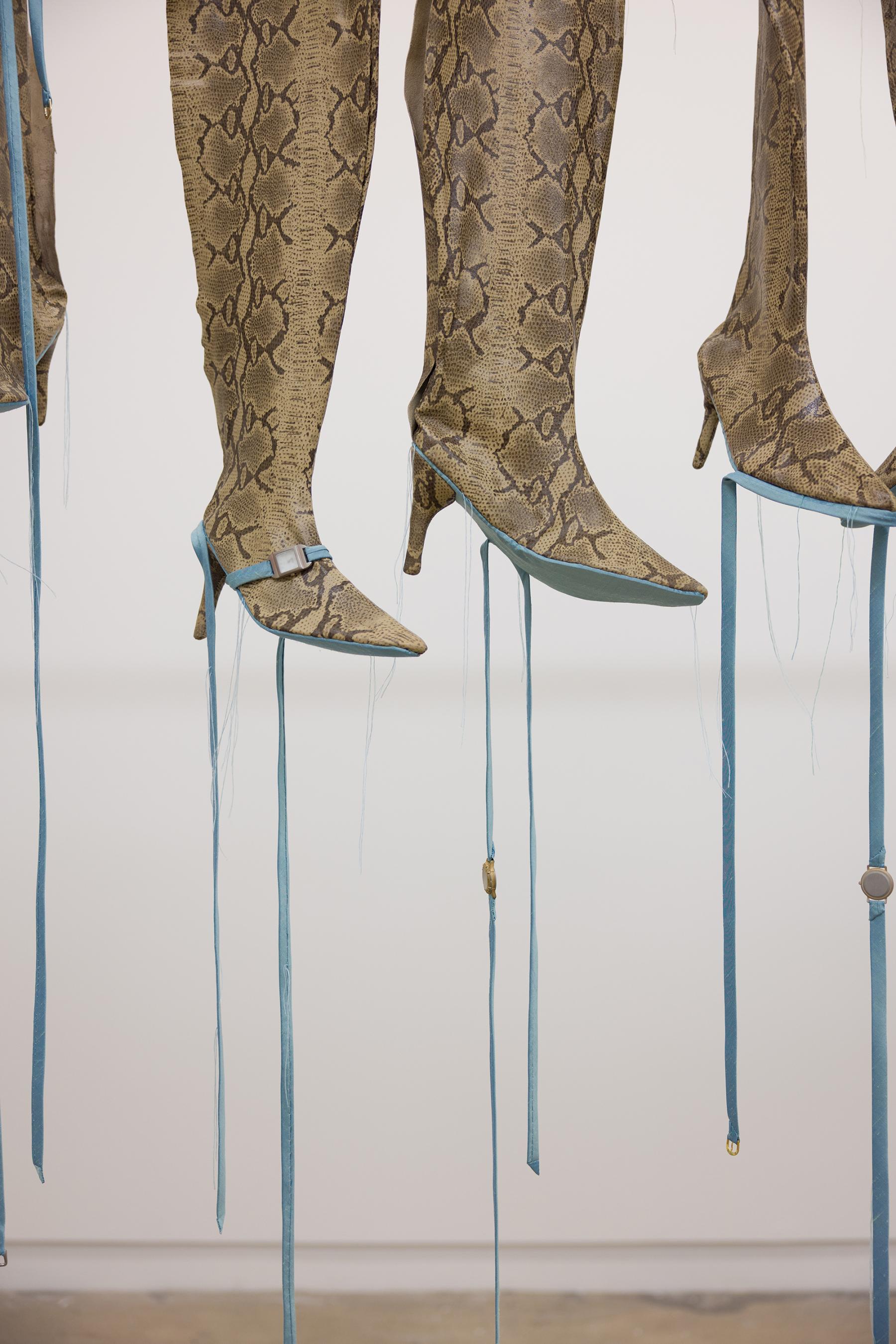
Kyle Alden Martens, Split Hairs, 2026. Exhibition view, Diagonale. Silk, leather, thread, sandblasted watch faces, watch buckles, horse hair, mat board, aluminum. Photo © Mike Patten.
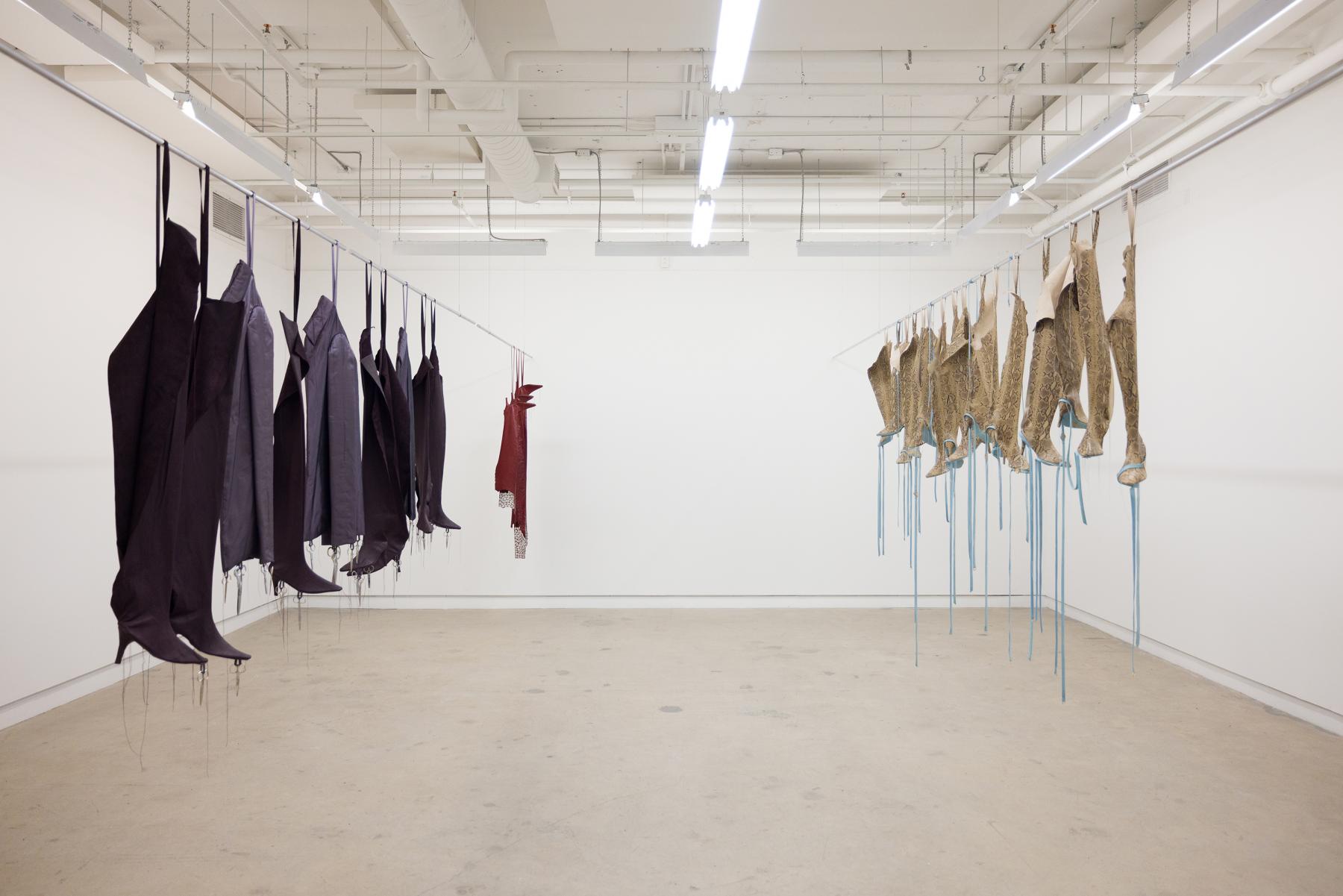
Kyle Alden Martens, Split Hairs, 2026. Exhibition view, Diagonale. Silk, thread, vintage scissors, hammered thimbles, sandblasted watch faces, watch buckles, horse hair, mat board, aluminum. Photo © Mike Patten.
In Time Binds: Queer Temporalities, Queer Histories, Elizabeth Freeman critiques Butler’s theory of performativity—in which the production of subjectivity is primarily citational—for its adherence to linear temporality. For Butler, every act is a reference. Queer selfmaking, then, is situated progressively, entailing the constant subversion of remnants of a heteronormative past. As Freeman writes, “the results of these temporal formulations can be that whatever looks newer or more-radical-than-thou has more purchase over prior signs.” And, “to reduce all embodied performances to the status of copies without originals” actually overlooks the provocation of the past—its residue; the atmosphere we live inside of in the present.
The repetitive act of producing a (gendered) self—this “collaging [a self] together” engaged in drag but extending beyond explicit performance—occurs in a referential loop. For better or worse, the past is always in the room. The past is the room. Drag lives in this temporal gap between referenced and reference, working as “a productive obstacle to progress, a usefully distorting pull backward, and a necessary pressure on the present tense.”1
----------
An inventory of garments made and remade, Split Hairs is the back of a shop, strung up with unfinished works, and an archive. It sprawls multiple pasts, residuary presents, and imagined futures—an index of indistinct time. The materials—cowhide leathers, silk taffeta, horsehair—bear their own lifespans, narratives outstretched and stained by time’s passage. Left undone, the absent referent is stitched to the present. The works reconfigure actual/imagined or prior/future bodies, in resonance with drag artist Fayette Hauser’s practice, where “shredded red velvet upholstery layered against an ochre gold tablecloth came not only to signify but to potentially reorder her own blood and flesh.”2
----------
From within the closet, we withhold the secret of ourselves. Nothing is as precious as this secret, even as it hangs open. There is tenderness in its concealing. A certain care, immixed with the certain horror of its exposition: what madness sits on the other side?
The secret’s matter is infected with the desire for meaning: we want to make sense. The idea of clothing adheres meaning to the body as it signals the calculus of gender. The idea of skin adheres meaning to the body as it proffers the enclosure of the human. Together, the ideas form a matrix for the (always violent) organization of bodies.
----------
Here, Martens constructs a closet, not to contain a secret so much as exhibit the negative space surrounding it. Held cautiously in rich cloth, a question hovers in the air: how do we step into ourselves? Gazing into our closets, we confront the possibility, and proposition, of its container––but Split Hairs begs deeper inquiry. Through Martens’ repetitive use of skin as the cloth that collages the self together—each attempt failing to conceal or cohere— common gestures of self-making are split open.