.jpg)
Anika Jade Levy. Photo by Bronwen Wickstrom.
There’s perhaps no better emblem of contemporary existence than a shattered phone screen. Abundance and dysfunction, it turns out, are not mutually exclusive. It follows that a broken phone recurs in Flat Earth, the debut novel by Anika Jade Levy, billed as “Speedboat for the Adderall Generation,” which is to say, zeitgeist-y and written with abrupt prose that skewers a certain downtown artistic scene—but with its own dissociative flair.
Flat Earth follows Avery, an aspiring writer, occasional sex worker, and grad student living in New York. At the outset of the novel, she accompanies her best friend Frances on a cross-country trip to help shoot an experimental documentary (which shares a title with Levy’s book) about the decline of middle America and the rise of right-wing conspiracies. In one of the novel’s more wayfinding passages, Avery observes: “It occurred to me that the players in the downtown art scene weren’t so different from the flat-earthers in flyover country—we each thought we had some unique insight into the way the world works, but in reality, we were all part of one big consensus machine, downstream from everything.”
In addition to being a writer, Levy is an editor and co-founder of Forever Magazine, a literary publication that champions provocative girl-coded short fiction. Cut from the same cloth, the novel includes a series of omniscient dispatches which report back on the state of our faith (“Many of us pretend to be Catholic, but only two join a convent”); wellness trends (“Right-wing nutrition fads fall into fashion that year: an uptick in bovine meat, unpasteurized dairy, seed-oil skepticism, vaccine hesitancy.”); and regressive gender dynamics (“The girls are upending all the progress our mothers made, demanding lower hem lengths and mandatory home economics course”).
Flat Earth primarily takes place post-pandemic, on the heels of a period of overwrought hyperpoliticization and a collective recoil toward reactionary, sometimes performative conservatism, as evidenced by Frances’ hard pivot to become a tradwife and Avery’s brief stint at a right-wing dating app called “Patriarchy.” The novel operates on lucid, if ungenerous, terms. Avery is a dogged scorekeeper, constantly tracking her value by way of metrics like youth and fertility. At various points throughout the book, Avery is told that she’s not as young as she thinks she is, a sobering refrain delivered by an ex-boyfriend, her grandmother, and a mentor. In another passage, Levy writes that “youth is something borrowed, a non-fungible currency, a cup of salt water scooped from the ocean, already evaporating.” The naked transactionality of it all can be bracing, but Levy is surgical in rendering how beauty, youth, and clout circulate within the economy of the art world.
Incidentally, my conversation with Levy took place just as the term looksmaxxing was completing its ascent into common parlance. We spoke about the aestheticization of belief, channeling cultural whiplash into prose, the prescient legacy of Stewart Brand's Whole Earth Catalog, and having your brain rewired by reading Shoplifting from American Apparel in middle school.
I’m interested in what conspiratorial thinking and hyperpoliticization does to people socially, especially in milieus where belief is aestheticized, and where having a transgressive take is treated like a sartorial choice.
Flat Earth takes place in a moment where conspiratorial thinking, religious faith, and hyperpoliticization are on the rise. What drew you to write specifically about this moment?
I’m suspicious of the idea that this moment is uniquely conspiratorial or hysterical. The writer Caroline Busta has spoken about the parallels between the present—the narcissistic psychedelic AI surveillance apparatus we’re all inside of—and the advent of the printing press. How Europe was suddenly flooded with competing authorities, and then everyone had sources, citations, and enemies. It made the culture sort of schizophrenic. I’m interested in what conspiratorial thinking and hyperpoliticization does to people socially, especially in milieus where belief is aestheticized, and where having a transgressive take is treated like a sartorial choice.
Would you say that beliefs have become the new basis for subculture, the way music or other cultural products once were?
Maybe. But it’s hard to say what subculture is in the absence of any legible monoculture. Maybe those terms have outlived their usefulness.
Avery has a Bolaño tattoo but admits she hasn’t read him, and at one point she pretends to read A Fan’s Notes. Rather than telling us much about her interior life, these moments seem to reveal how she wants others, especially men, to perceive her. How were you thinking about the performance of identity while writing?
The unflattering answer is that the book itself is probably a performance for men on some level. But with Avery, I was interested in writing a passive and porous narrator, someone who comes into view based on her anxieties and observations about other people. And I was thinking about how identity is flattened and optimized for a small screen, how taste functions as social capital and how we assess people based on the novels they reference, the magazines they subscribe to, the theory they pretend to have read.
Much of the book shows Avery procrastinating or avoiding writing. But on a date with a guy from the Patriarchy app, she receives a scathing assessment of her diminishing value in the sexual marketplace and suddenly feels inspired. How did you approach that moment, and why does such a brutal critique trigger creativity?
Why do I find the idea of young women as objects of sexual commerce so creatively compelling? I guess that theme came up in my own life while I was writing the book. Muriel Spark had this refrain about being a “magnet” for the experiences she needed to write whatever she was working on, and that seems to have been true for me so far. She’s also one of a million artists and writers who spoke about the idea of creativity as a channel. In this instance, that monologue came to me fully formed. It was one of the few moments where I was actually writing the way I want to be writing. It seemed natural to me that Avery would become productive and creative after an experience of acute embarrassment. And embarrassment is usually just an inopportune instance of visibility or exposure. She felt like that man saw something in her she’d been trying to conceal.
Avery’s fixation on fertility and youth reads as symptomatic of the moment. How much of this anxiety do you see circulating in your milieu, and why did you choose to make it such a central obsession for her?
My friends basically don’t think about their fertility, as far as I know. But I could see how all the manosphere chatter about throwing empty egg cartons might make a woman neurotic, and that was something I wanted to satirize. Certainly, people are waiting longer to have children. Some are mourning the disappearance of the single-income household. Mostly though, I was thinking about the idea of youth as a currency, and that there’s not really a right age to be a woman. By the time you’re old enough to be taken seriously, old enough to feel self-possessed and worldly, your beauty is allegedly plateauing.
That cruel paradox plays out between Sally and Avery. There’s a scene where Avery notices Sally has had a bad facelift, and it’s devastating not because of the facelift itself but because seeing the insecurities of someone you admire laid bare produces its own kind of vertigo.
Yes. Because Avery imagines that Sally’s status and professional reputation are enough to armour her against those anxieties, or, more charitably, that someone as sensitive and intelligent as Sally wouldn’t be so neurotic about aging.
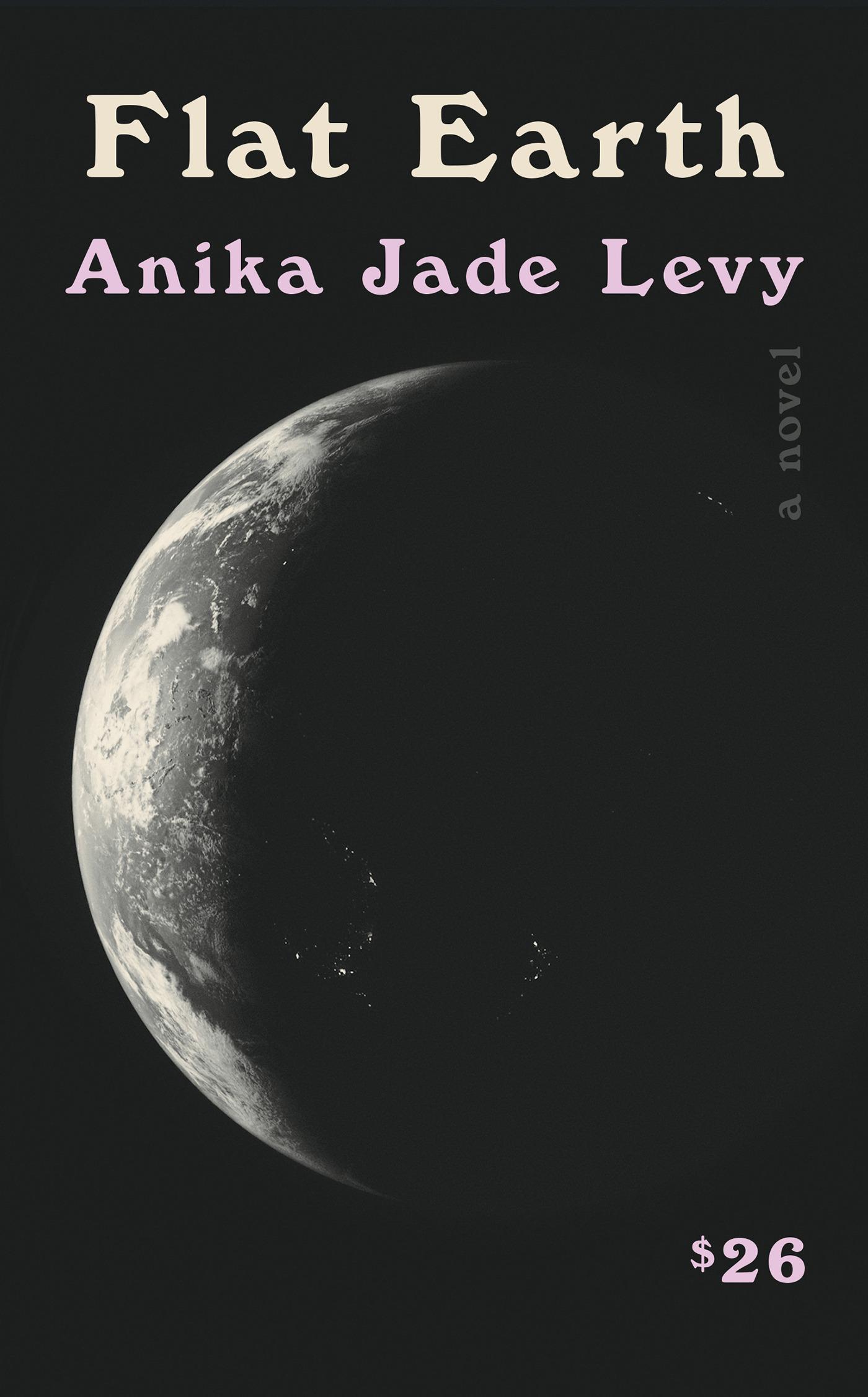
Book cover for Flat Earth (2025) Catapult Press.
Something you do especially well in Flat Earth is capture the uneasy coexistence of wealth and precarity in the art world. Avery is wealth-adjacent but can’t pay her rent or replace her busted phone screen. I’d love to hear your take on how these dynamics play out in art and literary scenes, and how that informed the relationships between the characters.
I think that in the same way Americans have incoherent political ideologies, we also have very warped relationships to our own class backgrounds. The coexistence of poverty and decadence in New York City is something I set out to capture, and of course, many of us will continue to live beyond our means—people with debts going to dinner and whatnot. But I think I was also trying to untangle my own upbringing, and how it accounts for my whimsical attitude towards money, my inability to understand it, my ambivalence towards my credit card debt, etc.
The flash-fiction cultural reports punctuate the text with a delirious, predictive tone, almost like a slightly unhinged trend forecast at the end of the world. Where did that voice come from?
That material came from somewhere else. I don’t know where it came from.
I’d be curious to hear about non-literary influences that were on your mind while you were writing as well.
I’ve watched Mad Men all the way through at least a dozen times, and I owe some of the book’s ambient regressive misogyny to that. I’ve been listening to Bright Eyes since I was a child, and I’m sure that’s had some effect on me, helped me to retain some sentimentality. The Christmas I was fourteen, my older brother gave me the book Shoplifting from American Apparel and The College Dropout on vinyl, and I think that combination probably rewired my brain.
That’s like a crash course in the spectrum of American Masculinity!
Yes. My brother is going to hate this.
The Whole Earth Catalog shows up in the text and is referenced on the cover design. In recent years, its brand of countercultural techno-optimism has come under fire for being, at best, politically apathetic and, at worst, recklessly libertarian. It’s hard not to draw parallels to Silicon Valley’s recent turn to the right. I’m curious how you think about the catalog’s legacy and how it’s meaningful within Flat Earth.
I’m happy you clocked that. I don’t think I realized what a perfect nested literary object The Whole Earth Catalog is for this book until I finished writing it—I just thought it was a cute Mise en abyme. It’s easy to romanticize a project like that, something that emerged when counterculture was more than just a set of hyper-niche consumer demographics, especially because it’s so aesthetically compelling. But if anything was radical or prophetic about the catalog, it’s that it was a lifestyle object, a way of signalling you were in the know, well before counterculture was focus-grouped and redistributed as a menu of consumer identities.
In terms of its legacy in Silicon Valley: The techno-fascists at the fringes I satirize in the book are reckless and probably genocidal, but in general, I don’t think the average Bay Area tech-bro libertine has changed that much. If you look strictly at social and cultural values, a lot of the behavior that codes as right-wing today—I’m thinking about distrust in institutions, vaccine hesitancy, survivalism—circulated at the turn of the century as lefty, back-to-the-land utopianism.
In addition to being a writer, you’re also an editor and co-founder of Forever Magazine, which champions, in your words, “style over plot.” What styles are you seeing emerge right now?
I haven’t been reading much contemporary fiction lately, other than the work of my students. I will say that some of the undergraduates I work with are playing around with mid-century experimental short stories in the tradition of Donald Barthelme, and that excites me. Otherwise, the only contemporary novel I’ve finished this year is Claire-Loise Bennett’s Big Kiss, Bye Bye, which feels fresh in some ways and mannered in others. The book is almost entirely about correspondence, which gives it a sort of Victorian tone, but I was happily surprised by how enrapturing this book is, being that it’s just a woman checking her email for 250 pages. As my friend Mariah Kreutter put it: I’m glad Bennett wrote this book so I don’t have to.
Around the same time I was reading Flat Earth, I came across an interview with Chris Kraus where she reflected on her early work and how she was able to be a bit reckless in a way that became difficult once she gained recognition within arts institutions. I’ve been wondering whether it’s possible or even desirable to preserve that edge as the stakes shift. I’m curious if this is something you’ve thought about, having just published your first novel and as your profile has expanded as the editor of Forever.
I think that what passes for recklessness in this book is actually just freedom. Chris Kraus writes with a lawlessness that I admire and rarely achieve. I was neurotic about reception from the moment I started writing Flat Earth, but I’ve never been particularly careful about curating a public profile or a serious reputation. The successes and the failures of this book are self-evident. I’m not so concerned with preserving my own edge, and especially not if that kind of rawness comes at the expense of developing taste. The best moments in this book were a surprise to me as I was writing them, and that creative intuition is the main thing I care about preserving.
At one point in the novel, Frances’s film, also titled Flat Earth, draws criticism. You write, “People were writing that the film made a spectacle out of white poverty… others denigrated the film for humanizing the conspiracy theorists allegedly tearing at the fabric of our democracy.” Was this meant as a provocation to critics or a reflection on the pressure for art to resolve itself into a moral position? Since the book came out in November, how has the press cycle been so far?
It wasn’t meant as a provocation to critics. I do think that we’re in a moment where art is expected to announce a moral position, which this book refrains from. But my press cycle has been thoughtful and generous for the most part.
Last question, what are you working on now?
It’s a secret.