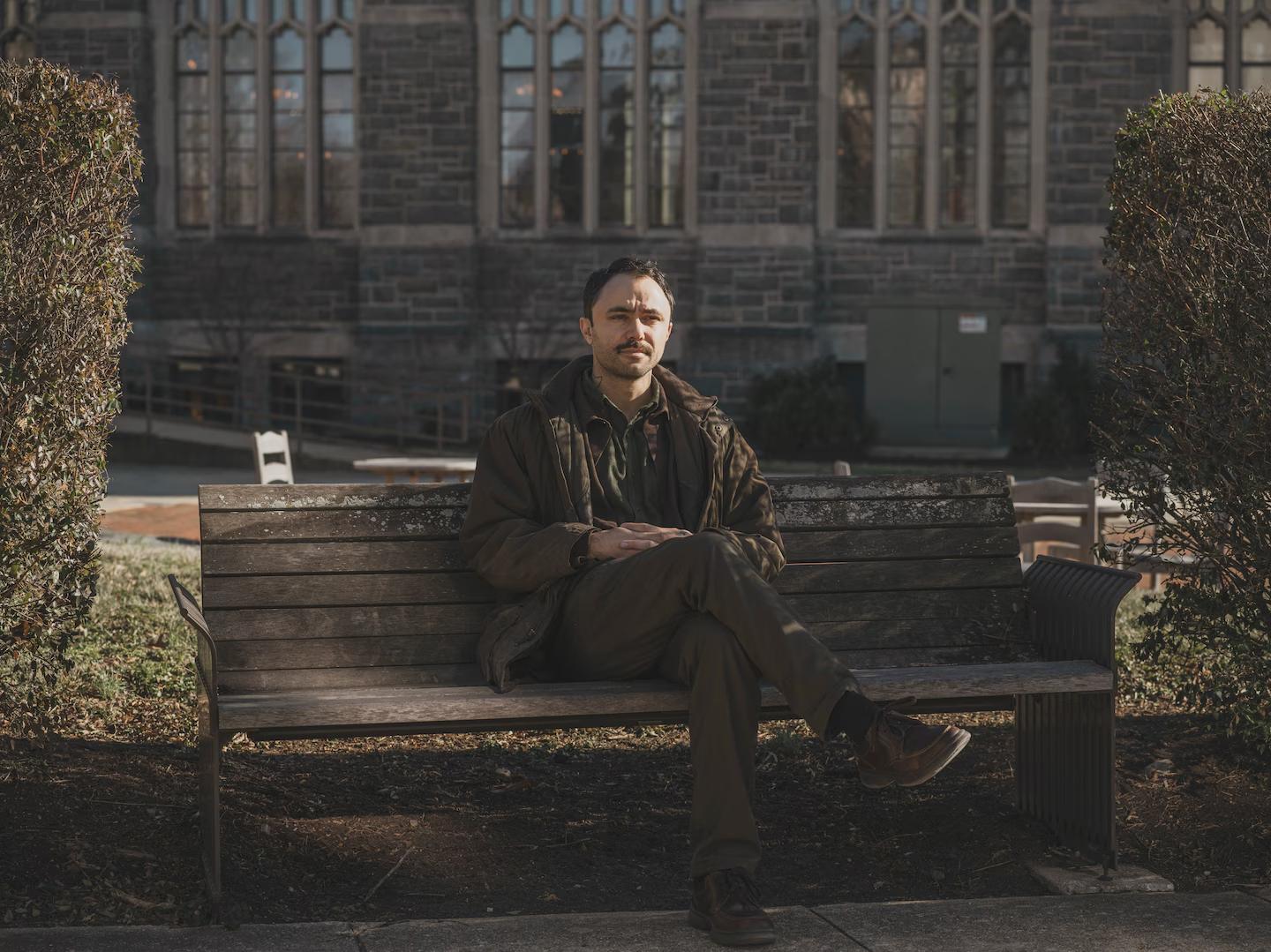
Jordan Castro. Photo by Greg Kahn. Sourced via.
An algorithm didn’t bring me to Muscle Man, Jordan Castro’s satirical, foreboding new novel about wayward English professors, but it could have. I’ve worked and taught in colleges since completing my master’s degree in the late aughts. I recently binged The Chair (2021) and Lucky Hank (2023), somewhat formulaic shows about academics and their departments coming comically undone. Muscle Man is funny at times. It’s also tense and much less predictable than the typical departmental drama. The central character, Harold, recalls feeling optimistic early in his career, thinking of himself as a priest in a temple of knowledge. “He had been excited to break free from the confines of society, and to enter into communion with the great thinkers of history,” Castro writes, “Academia promised a glimmering future, one in which worldly concerns were secondary to the pursuit of what he then viewed as higher ambitions.” When we meet him, though, Harold finds even the college architecture oppressive. He’s isolated. He doesn’t get along with the students or most of his peers. On the single day that the book takes place, his ears are ringing. In the hallway, he observes the bodies and faces around him as horribly misshapen, threatening to destroy him, and making sounds he doesn’t understand. “Limbs stretched over everything like unspooled yarn, mouths and walls making the same sad sound, a kind of scream-yawn, obliteration song…”
I interviewed the scruffy, well-read author on Zoom from his house outside Washington, DC. We discussed Muscle Man and his preceding book, The Novelist (2022), about an author’s attempts to break through social-media-enabled distraction. Castro shared some of his influences, thoughts on the state of higher education and the literary world (both, in his view, often self-destructive and tending towards predictability), and to what extent he writes what he knows—aspects of his life and beliefs, a kind of autofiction, or something else entirely. His preference is to read a book without knowing anything about it beforehand, to find something there that he hadn’t thought about before. We talked about what happens when characters express opinions in novels, how readers often misunderstand them as the author’s. “In the novel, the author has an almost ironic relationship with the narrator or protagonist who is embedded in a world of relationships and different voices,” he explained. “The speaker in the novel can only ever be at best angular to the novelist,” he continued. “For example, there are some rants in Muscle Man, but those rants are often spurred on by Harold’s perception of a personal slight. His thoughts are embedded in a situation. Thoughts and ideas can’t really be divorced from the subjectivity of who has them.” Even so, Castro and his novels sit on various fault lines.
When I was younger, I thought literature was fundamentally just self-expression, something that could make me feel better or even change my life. If I had sufficient knowledge about myself and the world, maybe I would be less miserable and find a sustaining purpose. I didn’t. I felt betrayed.
Jordan, your writing gave me the occasion to go back to Gaston Bachelard’s The Poetics of Space. After reading your work, Bachelard’s chapter on corners stopped me in my tracks. I’ll read some of it here: “Every corner in a house, every angle in a room, every inch of secluded space in which to hide or withdraw into ourselves, is a symbol of solitude for the imagination; that is to say, it is the germ of a room, or of a house… Also, in many respects, a corner that is ‘lived in’ tends to reject and restrain, even to hide, life. The corner becomes a negation of the universe.”
That’s good.
This was published in 1958 in French and translated into English six years later. Bachelard said that in a corner, one doesn’t talk to oneself. This isn’t true for your characters. In their corners, both the narrator in The Novelist and Harold in Muscle Man engaged in a lot of self-talk. Still, do you feel like it’s accurate to say that your characters are cornered in the way Bachelard described?
When I was younger, I would think: if it were up to me, what would my life look like? And I would struggle to imagine anything other than sitting in a small room, maybe even a corner, just reading and using my computer. I knew that was no kind of life, but it was the best I could think of on my own. When I went back to school as an adult, I couldn’t sit still. I would get up and leave. I felt almost propelled out of the room. One reason was that the buildings felt totally inhospitable. The open box of the classroom, fluorescent lights… But at the same time, all the beckoning corners. The rooms had corners, the books had corners, the laptops, phones… I wanted to go to my corner, not inhabit these shared open spaces...
When I read The Turn of the Screw by Henry James and The Haunting of Hill House by Shirley Jackson, I started wondering about the interaction between buildings and thoughts. I thought, What is the actual experience of being in a particular building? I’d never been curious about buildings’ relationships to people or history. When I lived in New Haven, friends would come visit, and we’d be walking around Yale, and they’d say, "Wow, it’s so amazing to see all these old buildings.” But they would always say it in front of a specific building that was built two years earlier.
The story I heard about Yale—I don't know if it’s true—is that as they were putting in the foundations of the original buildings, they buried materials they would use later, so that when they were finished, the buildings would already look weathered, like Oxford and Cambridge.
I hope that’s true. It’s basically true, even if it isn’t true. Contemporary culture and universities have an uneasy relationship with time and history. Academia has a queasy relationship with the past and its own existence. Are these institutions valuable because they’re elite and exclusive, or are they for everybody? These sorts of questions are actually present in the architecture, which, in many places, with new additions and so on, has gotten sort of jumbled and incoherent over time.
In Muscle Man, there are moments where Harold almost feels like Holden Caulfield from J.D. Salinger’s The Catcher in the Rye, who imagines, “I’m standing on the edge of some crazy cliff. What I have to do, I have to catch everybody if they start to go over.” Harold, to some extent, wants to save the students on campus, but, of course, he’s misguided. He steals a student’s backpack because he mistakenly thinks he noticed a knife in it. I’m curious about the spectre of violence in Muscle Man. I thought something truly terrible might happen in the book. Surely, my thinking was influenced by recent events. The conservative influencer Charlie Kirk was recently shot on campus at Utah Valley University, and there is an alarming amount of gun violence in schools across the United States. In your writing, there isn’t a catastrophic violent event, but the idea of violence hovers.
There’s all this discourse about “school shootings,” “mass” shootings, gun violence, violent speech, certain kinds of “political” violence, and so on. But this discourse always feels totally divorced from the reality of violence. We always imagine that only other people are violent. The victims we care about are the ones we can blame our enemies for. At universities, people use nakedly violent rhetoric all the time. I did a talk at a university a couple of weeks ago, and my conversation partner was talking about how we need to understand young men “so that we don’t end up with mass shooters, or Trump,” but when she mentioned Charlie Kirk, she immediately started sputtering to justify his getting shot. Violence is wrong, we seem to say, but the right kind of violence isn’t violence at all. It’s justice, or even love.
I don’t like the term, but I might basically be a pacifist. I love Nicholson Baker and Leo Tolstoy. There is no idea that triggers friends of mine across the political spectrum as much as a commitment to non-violence. Monks and martyrs are offensive even to me. If you say that you think killing is wrong, the response is always something like, “B-b-but what if…?” And then the person offers the worst possible thing that could happen to someone you love. You say that it might always be wrong to kill people, no matter what, and your friend will immediately jump to picturing something terrible happening to your mom or your wife. It’s like, why are you immediately imagining that? People will imagine super-hero scenarios, or come up with labyrinthine justification, they’ll go to graduate school for eight years, and then they’ll write whole books, all to justify their own violence. I’m conflicted about it, but it’s something I struggle with and think about a lot.
René Gerard, the literary theorist, said that conflict comes from sameness, not difference. I think a lot of the violent rhetoric at universities basically comes from the fact that everybody there wants the same things, and so they enter into rivalries with each other. There’s all this ideological and interpersonal justification for it, but it’s never terribly convincing to me.
In addition to feeling alienated at school, Harold is not doing well as a writer. Violence enters the picture here, as well. His apparently underwhelming first novel was about an artist who killed a peer at a writing residency. His colleague Dolly’s book is praised for being as violent as writing by men. Perhaps what I’m asking here is—in your estimation—what’s wrong with the literary world?
When I was younger, I thought literature was fundamentally just self-expression, something that could make me feel better or even change my life. If I had sufficient knowledge about myself and the world, maybe I would be less miserable and find a sustaining purpose. I didn’t. I felt betrayed. It was totally my misunderstanding of what literature was, or what role it should play in one’s life. But after this disillusionment, I started to think more about literature. Why was I reading and writing? There were some things about reading and writing that I was totally in love with. For example, the experience of reading a book and not knowing what I was going to encounter beforehand. There’s some surprise, an expansion of perception, or seeing a new way of describing something that illuminates an aspect of experience or consciousness that I wasn’t previously aware of. That, for me, was and remains a deeply spiritual and profound encounter.
The literary world has become very uncomfortable with this sort of encounter with a text. Instead, it has opted for crudely ideological box-checking. People want to know what they’re going to encounter before they encounter it, and when they encounter something that doesn’t immediately fit into a comfortable frame, they panic. You read reviews, and they’re like, “Here’s the way this novel interacts with the cultural landscape, and here’s what it means politically, or as it relates to some sociological trend.” They take what could potentially be an almost magical encounter and put it into a pre-charted discourse. Writers, publishers and universities are under a lot of pressure to make their pursuits comprehensible to people who don’t understand the discipline. When I first read Fyodor Dostoevsky’s Notes from Underground, the profound, multi-layered encounter I had was existential, philosophical, literary, and aesthetic. Maybe I can’t simplify that for a series of checkboxes to present to a board, marketing team, or even a “general public.”
It’s almost like you’re answering my question about the literary world by saying, “What might happen if Dostoevsky were teaching at a college and was on the tenure track?”
Yeah, well, that’s basically what Muscle Man is. If Crime and Punishment came out now, reviewers would say, “Look, this is a book about a right-wing lunatic, this explains Trump, this is about masculinity under threat,” and so on. Jon Baskin had an amazing essay in The Point in January 2020 called On the Hatred of Literature. There has been a bizarre, decades-long phenomenon: the people tasked with shepherding literature actually hate it. I took a class on Shakespeare when I went back to school, and we would have these classes where we would approach the text with proverbial red pens already in our hands, so we could, for instance, see where Shakespeare was antisemitic in The Merchant of Venice. We spent the whole class teaching Shakespeare about our current morality, instead of first being taught by him. I had one professor who loved literature, though, and it was the best thing ever. It was infectious. He would diagram Virginia Woolf or Henry James novels on the board, talk about the sentences, narrative structure, or representation of consciousness, etc. And the students were suddenly engaged.
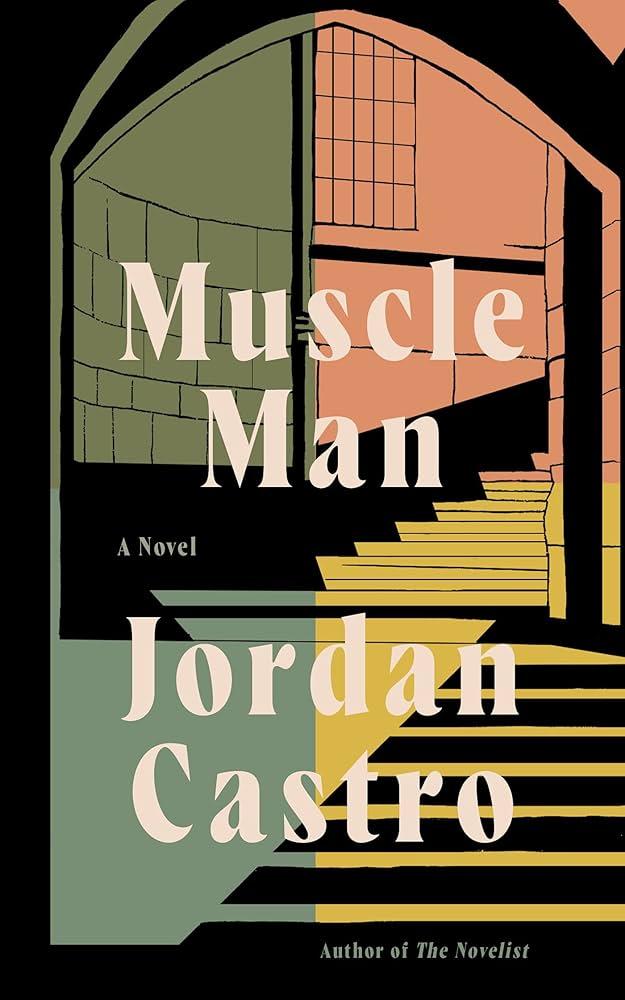
Jordan Castro: Muscle Man cover, Catapult, 2025.
I read your 2024 piece in Compact, The Unbearable Rightness of Professor Speak. You get further into what you identify as a kind of insecurity and groupthink in higher education.
I was pretty mad a few years ago. I’m a little less mad now. Maybe I got it out of my system. I have a lot more empathy now. With most people, everyone tells you to go to college, and then you go. You get into debt, then you move for grad school, and maybe move again for a PhD, or a job. You have to uproot every few years. Your debt mounts, and then there are no jobs or jobs that completely suck. It’s hard to have long-lasting friends, to put down roots in a place, etc. It structurally selects for agreeability. People don’t want to do anything that might decrease their chances at making a living, and they’ve already sacrificed their whole lives to this machine.
And then there are the numbers. Between advanced creative writing and English degrees (master’s and PhD), there are sometimes more than 9,000 graduates in the U.S. in one year. It’s an impossible pyramid scheme situation. There just aren’t that many jobs, and there aren’t that many people who are going to be good at it. Part of the reason I was so upset with professors is that, probably in another life, I would have been one. I’m probably not as acutely mad at the banks that take advantage of college kids because I don’t want to be a banker. Maybe I wanted to be a professor deep down.
Can we talk about weightlifting? There are passages where Harold talks about his passion for it. You wrote an article for Harper’s Magazine in 2024, Getting the Pump, that described your dedication to lifting. There’s some overlap in terms of what you say in the first person in the magazine article and some of the ideas in the book.
Some people have thought that this novel is autofiction, but it’s not. In retrospect, it’s probably a little bit my fault, because I did transpose some stuff from Harper’s into the novel. The key thing that I thought people would notice, and I don’t think people have noticed, is that what I say about Crime and Punishment in Harper’s is the exact opposite of what Harold says in the novel. Harold thinks that Crime and Punishment is about a great man, a Napoleonesque figure, crumpled by the weak society around him. He thinks Raskolnikov’s murders are sort of noble, and that society makes him absurd, which I meant to be ironic.
When I was reading the book, I thought there could be redemption for Harold in lifting. He’s in these academic and literary circles where he’s uncomfortable and bungling. Maybe he could get a job at the gym?
In my teens and early twenties, I lived in my head and in a screen. When I started exercising, it was a revelation. I was like, “Wow, I’m a body in a world.” I used to work at an art store, and only like four customers would come in per day, but every time one came in, I was terrified. I was literally terrified of talking to them. After I started exercising, that went away. A lot of what I thought were super complex problems were really just physical. I started reading Hagakure by Yamamoto Tsunetomo, on samurai philosophy, and Yukio Mishima, about warrior stuff. I had never considered physical strength to be a virtue. Mishima asks why thoughts always ascend up, to delusions of grandeur, or spiral down into the depths. He thinks that the surface is where meaning lives, because the surface guarantees our existence in space. There are limits to a physical body, and these limits are experienced as impositions on our tendency toward delusional thoughts, but there are also possibilities there, and there’s something grounding and humbling about that. But strength alone can’t be the answer. Strength alone can’t account for things like mercy and forgiveness. Why is it that so often the people who become so fixated on ideas like strength and vitality are the sensitive, weak, impotent guys who are basically mad at the world?
You mentioned you grew up online. I’m interested in how you started out as a writer. For instance, I found some poems you wrote early on, on Muumuuhouse. In a short one called American Psycho, the narrator’s head takes the shape of Christian Bale’s. It boards a plane and has a castration fantasy.
I’ve loved reading and writing from a very young age, and I started publishing when I was sixteen. I realized you could get published by an online literary journal just by emailing them some poems. At the time, there was a distinction between “internet literature” and “real literature,” and most people thought writing published online would never be taken seriously. I remember there were even debates about whether or not writers should promote their own work. The establishment literary world, at least the one that was discernible to me from my laptop in Ohio, was basically wrong on every question back then, too. I don’t remember a lot of what I wrote. I was describing strange, flitting bits of thought, which is something I still do. I loved trolling and was having a lot of fun. I was using tons of any kind of drug I could. I liked sad, realist fiction, but I’ve had a lot of different interests since then.
I was around when being published online was more casual. Was that formative for you?
I'm trying to remember the names of some of the websites. Maybe the first one that published my work was Mad Swirl. They always had these terrible names. The first poems I ever submitted got accepted, and that was super encouraging. I was also published in print, and was doing readings all over the country, all before I was out of high school. And I got, I don’t know, hundreds of rejections over time.
I think we could say that an aspect of the non-hierarchical ‘zine ethos came into early internet publishing, but then the internet got professionalized pretty quickly.
I was in DIY punk bands in Ohio, and so I did lots of self-published chapbooks and would sell them online.
Maybe that’s why some of the early internet journals had the kinds of names they did, because they were carryovers from punk band names. “Mad Swirl” sounds like a punk band. Times have really changed since then. When I first started reading The Novelist, the experience of diving into the frenetic energy of someone interacting with the internet—or overdosing on it—made me feel anxious. I would read about the narrator checking his phone and think I should check mine. When I got further in, the book became a demonstration of the kind of struggle someone might have to go through if they’re going to be creative. I wonder: what is your creative process like? Is it a version of the arduous distraction the narrator experiences in The Novelist, or is it easier? Do you wake up every morning at five and churn out a couple of pages?
There have been periods—brief periods—where I wake up super early and work diligently, and I cling to them. But it’s been years since that’s been the case. The Novelist was born out of the experience of waking up early, sitting down to write, and getting distracted. I know that’s a totally common experience, and maybe most people wouldn’t think it to be the most attractive conceit for a novel. But I would try to observe, almost like a meditative practice, what was actually happening when I got distracted. I would try to forget the “concepts” and cliches we all have related to social media, and really try to describe the essential strangeness of the experience concretely. I would catch myself at some point and reconstruct what I could remember of the last thirty seconds. And then it was like, OK, there’s a gap between what I want to do and what I actually do. There is a gap between who I think I am and who I actually am. You can find that in the Bible. Paul says, “I don’t do what I want to do, and I do what I don’t want to do.” That’s tension, irony, and plot.
How did you get the idea for a character in The Novelist named Jordan Castro, a character whom the narrator hates?
My wife Nicolette suggested it. That character was there, but had a different name. Nicolette is a brilliant writer. I asked ChatGPT, “Who’s a better writer, me or my wife, Nicolette Polek,” and it said “Nicolette,” then gave a bunch of reasons that I think were totally correct. The decision to name him after me opened up this whole metatextual layer I could play with. Someone on X asked me the other day if I was becoming the Jordan Castro from The Novelist.
You have this construction that you use, I think in both of your books, something along the lines of, “he thought-spoke it to himself.”
“Thought-talked,” yeah. A lot of people have reached out to me to tell me they do this. They imagine themselves on a podcast while driving, or pretend they’re being interviewed, as a way to organize their thoughts. I think it speaks to something deeper, some way that the internet has made it so that, for a lot of us, we’re always navigating some disembodied relationship with an imaginary Other—an audience or crowd. But we’re also starved for real human interaction, and in a way, we’re repressed. Foucault says that repression actually produces speech.