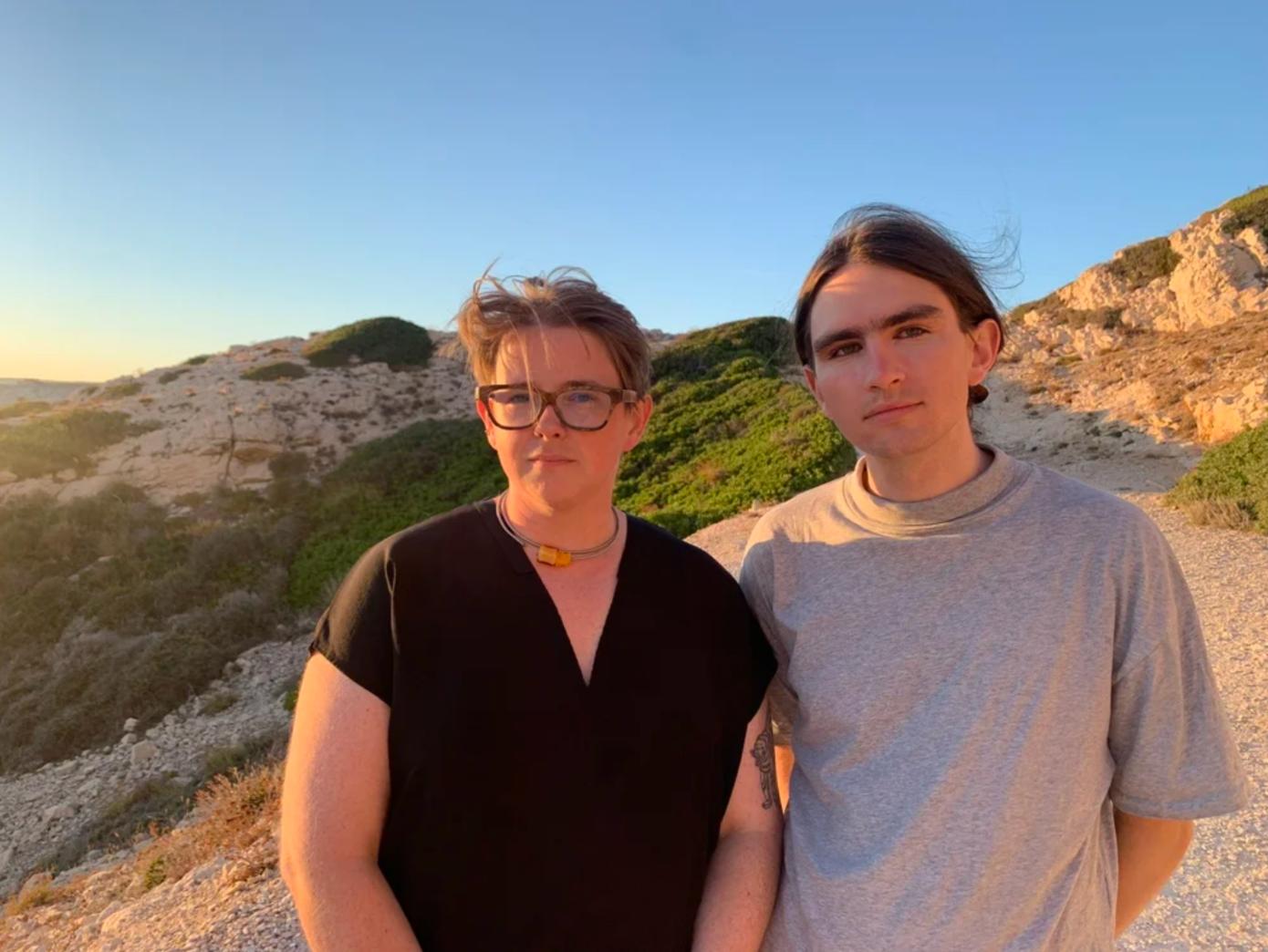
Rainer Diana Hamilton and Violet Spurlock.
I had already learned so much from Rainer Diana Hamilton’s poetry before reading This Reasonable Habit. Co-written with Violet Spurlock and published February 2026 by Spunk Editions, the long poem begins with a bicoastal phone call and unfolds at an imaginary summit where 26 characters—A through Z—convene, over the course of three days, to answer questions like: “Is ‘shyness’ a moral failing?”, “What makes good sex?”, “What constitutes a good reason to dislike someone?” Ever searching for guidance on living, relating, and loving, I finished the book with a rush of gratitude for the sheer abundance of thinking it opened up, meaning I wept. This investigative impulse is seen across Hamilton’s work, and, as they say in our conversation, the idea is to “find the form that can represent a thought you otherwise couldn’t represent.” Near the end of This Reasonable Habit, Violet says over the phone to Rainer: “Haven’t I loved you in loving to wonder alongside you about the nature of that love?” Friendship is a form, too—Hamilton’s work reminds us of this fact.
I first encountered their poetry in the fall of 2018 at Participant Inc. in New York, where they read from God Was Right. Listening to those poems, which were essayistic, I admired the way their deliberate, steady sentences carried such rigorous, digressive, and free thinking. Their poems neither rush to attain closure nor spin off into unbridled rumination, but hold us on the cusp of understanding until we arrive at a completely unexpected yet inevitable end. Recently, reading Maurice Blanchot’s The Space of Literature, I came across a passage about what he terms “the mortal point”: “the nearly central point at which we know that if the author remains there, he will die in the undertaking.” Hamilton’s poems exist in the glow of this central point—a blushing region, at once precarious and propitious, that feels like dwelling somewhere after hours, or like what is said after everything’s been said, after we say goodbye but stay on the line.
In Lilacs, published in late 2025 by Krupskaya, Hamilton develops “a form of long poem that promotes sense memory.” With a poem for each of the senses, and a sixth for love, Lilacs begins with a lost sense of smell and a speaker who sets out to recover it by cooking for scent. What unfolds is a path through memories and other lilac-inflected texts, towards a “forest dream,” and finally towards being able to smell everything, “and not just the past.” Hamilton is also the author of The Awful Truth (Golias Books 2017) and Okay, Okay (Truck Books 2012). They live in Sunset Park, Brooklyn. We spoke over the phone in early February about their recent collaborations, friendship, and the roles of contingency and constraint in their work.
I don’t want digression for digression’s sake, or to get lost in a totally unguided way, but to represent all the actual digressions that one thought requires. I’d like to take the reader with me.
I’d been wondering why your parentheticals and digressions were so moving to me from their outset. And nested tangents, even more so—as if I was being gently pulled farther into a field. Towards the end of the book, Rainer and Violet are trying to end their long-distance phone call. Violet says, after Rainer refers to a Henry James novel:
...And you would try to
introduce some new point of reference
just as we’re really needing to call it.
And continues:
I guess I did my own lingering,
but maybe now we get to enjoy
our privacy together, separately.
I want you to sleep and to dream
as much as I want you to keep talking.
I realized what I was feeling in the drifting of your Lilacs was this sense of deferring the end, deferring the separation, a move I experience as warm and generous. Do you think about this when writing a poem? About giving into digressions—how much to—or resisting it?
A lot of what I try to do in my poems, but especially in Lilacs, is take the things that I do by accident in other writing and let myself play them up. In God Was Right, that meant letting myself take on this too-academic tone of inquisition. In Lilacs, it meant indulging a real desire to never let a thought end, to try to keep the unit of one idea as long as possible and see how much it could contain.
Your question reminded me of a professor I really loved in college who told me that, when she was in college herself, she developed intense separation anxiety around books, such that she could only read really long books—that had multiple volumes, if possible—because she would become so distraught when one ended. I have a version of that around the sentence., as it’s really upsetting to me to read short choppy prose. In my own writing, I have to check that feeling. When I write a review for a magazine like Frieze or Bomb, the editors will insist each idea be as clear as possible, which for English-speaking readers often means containing it in some little syntactic fragment. I understand why that's the expectation, but it bears no relationship to what thinking is like for me.
I don’t want digression for digression’s sake, or to get lost in a totally unguided way, but to represent all the actual digressions that one thought requires. I’d like to take the reader with me.
I love this story about the college professor. I think I was feeling that while reading Lilacs. When a digression would move into another one, it gave me this sense there was going to be a long way back. That if we were being led this far out, we’d be guided back.
That’s my hope, that there’s a way of setting it up so that there’s some trust that the point of origin is still there.
I think I would have felt the floral form of Lilacs even if the title had not been Lilacs. The way the writing cascades, clusters, is multi-stemmed. At first, the poems were titled “Trance Essays.” How did calling them lilacs alter your writing or thinking about them?
The first poem in the book was “Trance Essay for Remembering Images,” which I wrote without planning to write more. Lilacs is also quite a collaborative book: I wrote it over the course of a year, when the poet Brandon Brown and I were in a writing group of two, where we would meet and each send a poem every couple of months. His son, Earlie, had just been born, and Brandon would call me at Earlie’s bedtime, when it was 10:15 pm in New York—he is in California—and we would talk for a couple of hours about writing. Before we started this habit, I hadn’t been able to write for a while, and I thought, well, I don’t really have any other ideas in mind, what if I try to write another trance essay for remembering a sense? So, I wrote “Smell” second, and Brandon encouraged me to write poems for all five senses.
I am repeating what I wrote at the end of Lilacs in my explanatory note. Later, my roommate at the time, the writer Shiv Kotecha, pointed out that when I said “trance essay” aloud, at readings, people thought I was saying “trans essay.” I don’t articulate “c” and “s” very well, I suppose. I found this misrecognition profoundly embarrassing, and I realized I needed a new title. It was Brandon who said, “what if you called them Lilacs?” I think that was the image we had gotten stuck on in our conversation that night. This change freed me from something in the project, not just the sonic accident of the figure of transition hovering above it, but also from my vague annoyance I was writing a second book where each poem had “essay” in the title. I didn’t want to be writing poem-essays; I wanted to be writing poetry.
The idea of the trance was a joke initially, but as it was repeated, it became too serious. I have no ability to enter a true meditative state. I wanted to emphasize that as much as I’m pretending to represent thoughts as they come, doing that involves a lot of piecing together memory from disparate parts, including academic notebooks. Somehow the flower form felt like it could contain more of what I was trying to do.
In “Image Lilac,” you’re trying to remember your block, and basing it off a lilac tree on your neighbor’s lawn?
Exactly, and lilacs come up in both “Image” and “Smell.” But there was something else to it—I like that the lilac is a common flower that grows in a lot of public spaces. It’s not hard to maintain. And it has a really noticeable smell, so people tend to know to identify it, people who don’t otherwise look at bushes and name them. Lilacs are both recognizable and temporary.
God Was Right was published as part of the Dossier series with Ugly Duckling Presse, which puts out books with an “investigative impulse.” How do you think about that framing: “investigative impulse”? Is it more exact than “experimental” or “formally adventurous”?
I like the framing of the Dossier series, and I was happy that that’s where God Was Right appeared.
As to these terms: “experimental” feels like a lot to claim—either it applies to everything, or I couldn’t say what narrow subset of things it applies to. I understand it best as a rejection of certain things I don’t want to do. You call a poem experimental often because you want to say, ‘I promise it’s not going to be a one-page poem that ends in an epiphany,’ right? And formally adventurous, I think, makes sense when talking about a period when poets seem, on average, to have agreed on a form one could then break from. But I don’t know what received, strict form we are supposed to be upending right now. Young writers often seem indifferent to form, as if expression defeated history. Investigative is easier, because, unlike experimental, adventurous, or avant-garde, it doesn’t require a point of departure. The poem is a way of apprehending or knowing something else. A poem might be good at a certain kind of thinking, at finding the form that can represent a thought you otherwise couldn’t represent, without positioning that form as innovation.
That relates to something you said in an interview at Triangle House a few years ago. You talked about your gradual fondness of writing that is contingent rather than intentional. You said, “In my imagination, a good writer would have a book in mind that didn’t take a wholly different course because of something she happened to have read, or because she made a new friend. At some point, I remember accepting that this good writer was not going to be me. And then, later, I found myself not wanting it anymore, even: I like that writing is a record of the kind of thoughts you get a chance to have only because some circumstances conspired.” You’ve said you were resistant to collaboration, which I was somewhat surprised to hear. Do you think your poetry has moved further towards an openness to chance?
I’m grateful you’re reminding me that I said this in the wake of The Awful Truth and God Was Right coming out. After that, I forgot again, and I entered many years where I couldn’t write. I had to accept that I was writing a book again only because my friend Brandon asked me to. I feel open to all the chances that friendship affords.
To decide you’re going to write requires a profound self-seriousness. To think, nobody has asked me to do this, I have no obligation to publish, but for whatever reason, I think that I need to write a book. I mean, God bless the people who are good at doing it, but it’s hard. And I think because it's asking a lot of yourself, people tend to outsource that to those with some literary authority, regardless of whether they actually trust or respect that authority. They look for an agent, an editor, a publication, a prize, to offer a sign that they are supposed to keep going. I don’t want to do that, and I also don’t want my friends or my students to. I don’t want them to think that the thing that should license their writing is a panel of judges convened for the purpose.
But when it is a friend, or even a stranger you’ve appointed to the role yourself, someone whose opinion you love or trust, someone you read or talk about art with, that’s a better compromise. That has always been the most generative space for me: there being a specific person, whose mind I’m interested in, who seems to want me to write something.
I was resistant to collaboration in the form of actual co-writing for a long time, because it felt like for both writers to feel happy with it, they would have to be quite harsh. To collaborate means that you have to be clear about what you don’t like in the other’s writing, it means to subject your style to someone else’s style, it means a lot of giving up control, and a lot of asserting control. I imagined it as very stressful. Or, on the other hand, I imagined it as a series of unhappy compromises.
But instead I found that, in the two collaborations we’re talking about here—Lilacs and This Reasonable Habit—my work could not exist at all without the other writer’s voice. I was uncertain Lilacs was a book I wanted to publish until the writer Bianca Rae Messinger wrote her poem in response to mine, in “Taste Lilac.” And then, the fact that the book was a home for this poem by Bianca made it possible for me to feel a lot of affection for the book. With Violet it was a many, many year process of writing This Reasonable Habit, but I similarly became fond of the representation of our talking in this ridiculous form.
I guess it’s easier to love someone else’s voice than your own.
It is, yeah.
I think if my published work feels like talking to a friend, it’s because my writing is at its worst when it doesn’t, when I’m trying to write to some abstract other whose desires I don’t know or care about.
This Reasonable Habit—first of all, this book helped me—I learned a lot. There are so many amazing questions—I’m so grateful that they were chosen as questions. For example, the section that asks, “Is ‘shyness’ a moral failing?” will literally help me this weekend. Others are: “Is conversation art?”, “Is writing accidental?”, “What can the libertine and nun teach each other?” How did you and Spurlock decide what questions to include?
This project with Violet started in a very different form. When we first became friends, she wanted to collaborate on something, and for all my hesitations about co-writing, I thought it could work if we each maintained separate authorship of our own sections. At the time, for reasons really unclear to me, I was trying to write metered sonnets, and I asked her if she wanted to join me in that. We decided we would make them what we called “conversational sonnets,” where we each made a list of ten questions we wanted to ask each other—or maybe it was five questions we wanted to ask each other and it came to ten, I don’t remember the exact number—to answer in the form of a sonnet in iambic heptameter. We did that until we grew tired of the constraint. Each poem was signed “Violet” or “Rainer,” and the lines between us were clear.
When Noah Ross and Eric Sneathen decided to start their new press, Spunk Editions, they asked us for that manuscript. Violet and I didn’t want to publish those poems as we’d written them, but we wanted to return to working together. We wound up taking the sonnets apart and reconstructing the answers and language, giving them to new, imagined characters. We created an imaginary conference where the attendees were talking to each other about the same questions we had previously been asking each other in the form of poems. That doesn’t quite explain how we decided what questions to include, other than that they were questions that we thought the other would write well in response to. And in the end, each line was really co-written, after all, as if the narrative’s polyvocality made it possible for the writing to be one, merged style.
I underlined this part from This Reasonable Habit:
…E was half
laughing bored by his lover’s actual words,
but drawn to the personality compelled
to produce them.
It reminded me of a question I haven’t really been able to articulate before: why it is that we aren’t necessarily moved by particular words a person will use but more so by what urges them on? I don’t know if you have thoughts on that.
I think I do, but can you say just a little bit more? Yeah, give me an example.
I hesitated to include this question because I’m not sure I really know what I mean. But that line really resonated. I was thinking how, usually with a book that I’m reading, it’s not exactly that the author is using, I don’t know, an amazing set of words, but that something in their impulse is more compelling than the words they’re using.
It goes a few different directions in my mind. The first is not related to writing at all.
If I’m really in love, I don’t need the things that a lover says, in happiness, to be particularly inventive. You wind up repeating, “I love you, baby,” “You’re so beautiful,” “I need you in my arms.” Not even a little bit experimental. What you’re experiencing in terms of specificity is something other than language, even if this repeated language helps you to encounter the specificity of this person you feel crazy about. But in a fight, that goes away, and suddenly the language has to be precise, such that the exact turn of phrase is analyzed for all the evidence that love has been withdrawn, or that somebody hasn’t been thoughtful. There’s something about loving attention that can let familiar language that isn’t particularly crafted or designed hold onto specificity, whereas feelings of defensiveness, or hurt, or vulnerability suddenly require this precise language.
I think there’s something akin to this in poetry. The poem that is so fixated on its special vocabulary or precise enjambment can feel defensive or guarded like a hurt lover.
That’s maybe not where you were going, and I might not mean that. I’ll try again. Written language represents whatever it says or argues or describes, but it also represents the impulse to write itself. Certain texts really make you encounter the impulse for them to have been written, and that can be a pleasure—to see the desire to write at play in the writing.
Robert Glück has said of your work: “Hamilton is the greatest company, a friend who invites you to refract your life through their refining lens” and Kay Gabriel in her introduction at the launch of Lilacs said: “Here I handled evidence that poetry could persuade with as much force and intention as it charmed the senses, could introduce ideas with more acuity, but then again revise itself with more humility than professional criticism […] Could do all these things in the tone of a friend taking you on a walk or writing letters to prompt your ideas.” Why do you think your writing has this conversant quality?
If you imagine that you’re talking to a friend, you get some of the best impulses. You get a desire to breathe, a desire to make yourself understood, the permission to get side-tracked. You can ask your friend a question and wind up telling each other 20 interrupting stories before returning to it, not because you want to confuse them, but because you can trust that they’re with you. You don’t have to make yourself more or less comprehensible. I think if my published work feels like talking to a friend, it’s because my writing is at its worst when it doesn’t, when I’m trying to write to some abstract other whose desires I don’t know or care about.
I want to return to Lilacs—there is a part in “Touch Lilac” that describes Frances Ponges’ “kings who do not touch doors” and therefore “do not know that happiness.” The speaker subsequently tests this theory, pushing their own body up against the wooden door, flattening their face, palms, chest and knees against the surface. Later you write in the poem: “I committed to keeping this poem from describing sex.” Had you developed rules for the poems prior to their creation or did rules emerge as you wrote?
There were light rules. The first lilac, “Smell Lilac,” has one-line stanzas, and the second, “Image Lilac,” has two-line stanzas, and the third has three-line stanzas and so on, until, “Love Lilac,” which cycles through the forms, so each stanza goes 1, 2, 3, 4, 5, 1, 2, 3, 4, 5. That’s barely a constraint, but it helps me give the thought a little shape.
There were other restrictions. With “Taste Lilac,” I love to eat and drink and think about those pleasures, but I didn’t think it would be very interesting to have a long poem that was mostly accounting pleasurable feasting, so I decided to make it about the other meaning of taste, discernment, especially in an 18th-century context, instead. And the same with touch: I thought that if it became too much about sex or physical sensuality, it would be a little bit like listing good meals.
“Touch Lilac” is probably the one that I had the least clear sense of beforehand. I sat down and wrote it in one sitting, with a more constrained sense of time. But I wanted it to be about this question of how touch relates to happiness.
Yes, I had wondered how “Touch Lilac” began. Because it starts with touching a bookshelf that doesn’t feel good to the fingers… And I love the part about putting Cetaphil on your hands and greasing up the wood. I tried to imagine how that poem came about. The speaker is at the bookshelf in the first place to find a quote about happiness for their friend’s birthday.
It had a very specific premise. It was the writer Elisa Gonzalez’s birthday, and I was trying to find a line that I could use to wish her happy birthday, but I instead wound up writing this poem.
Did you send her the poem?
I did, yeah.
Well, I think I’ll end with this: does friendship help you write?
I have benefited from extraordinarily generous writing friendships. God Was Right was really produced by Jameson Fitzpatrick seeing a form in one of the poems and suggesting a form for the rest of the book. God Was Right and The Awful Truth were both written almost entirely through the premise of Shiv Kotecha having just moved in and us writing together each night. And I started writing the poem to Bianca Rae Messinger in Lilacs when she was living in Buffalo, but she moved in later that year, and I finished the book with her in the next room, finishing her own. Then, Lilacs itself, as I described earlier, was written through talking with Brandon Brown.
This Reasonable Habit is the first truly co-written one, but it of course comes out of friendship with Violet. It’s great to use the writing of a book to maintain friendship across great distance. It went the other way: instead of friendship being a way to help me write, writing became an excuse to talk to my friend more often.