.jpg)
Hannah Black, HUSH MR GIANT, Arcadia Missa, London, 2025. Courtesy of the Artist and Arcadia Missa, London. Photo: Tom Carter.
Parasocial. Rage Bait. Vibe Coding. 67. Slop.
Each of these terms has been dubbed “word of the year” by a major dictionary. All originated online, went viral, and spread offline, entering the parlance in a way that would have been unimaginable, say, fifteen years ago. While the very selection of “67” might well be “rage bait,” this glossary captures a year of epistemic exhaustion in which intimacy has been streamlined, outrage optimized, production accelerated, and signs stripped of signification within ever more opaque digital infrastructures. “Slop” might, in fact, sum it all up. Fungible and frictionless, slop is the low-quality AI-generated content that has flooded feeds this year. Selected by both Merriam Webster and Macquarie Dictionary, the term captures the logic of oversaturated systems geared toward mindless consumption.
From this linguistic smattering, at year’s end, looking back on 2025, what comes to my mind is: “surreal.”
Perhaps the appeal of the “surreal” lies in the affective resonances of the term connoting an intensely subjective phenomena that is less so seen or heard or known or learned than felt. It is precisely within these vertiginous conditions of the present that surrealist tactics regain analytical force.
Surrealism dominated museum programming this year. The 100th anniversary of the movement officially inaugurated by André Breton’s Surrealist Manifesto (1924) spurred renewed institutional interest. Across blockbuster retrospectives and smaller thematic surveys, museums approached exhibition-making as a form of historical intervention, often through the critique and expansion of the Surrealist canon, long associated with an exclusive circle of white European men. From Ithell Colquhoun at Tate St. Ives to Alfredo Castañeda at The San Diego Museum of Art, numerous solo exhibitions have spotlighted long-marginalized figures who animated—and simultaneously complicated—Surrealism from the start. Exhibitions like Forbidden Territories: 100 Years of Surreal Landscapes meanwhile sought to decenter Paris as the singular origin, spotlighting circulatory networks of exchange instead of more linear trajectories of influence.
The bulk of these exhibitions shifted attention away from “Surrealism” as a discrete movement to instead track the divergent legacies of “surrealism” as a far-reaching intellectual project throughout the twentieth century. Surrealism: A Collective Dream at Tampere Art Museum, for example, incorporates more recent generations of artists like Sarah Lucas and Tony Oursler in dialogue with canonical fixtures like Yves Tanguy and Meret Oppenheim. Featuring work from 1964 to 2017, The Traumatic Surreal at Henry Moore Institute brings together German-speaking women artists who mobilized surrealist tactics to challenge the Nazi motto, “Kinder, Kirche, Küche” (“Children, Church, Kitchen”). The feminist angle of this post-war presentation featuring Birgit Jürgenssen, Renate Bertlmann, and Pipilotti Rist among others implicitly confronts the misogyny pervading much early Surrealism.
Sixties Surreal at the Whitney Museum, one of three surrealism-adjacent museum exhibitions in New York City this fall, actively engages with the semantic slipperiness of this term by advancing a bold curatorial proposition: surrealism—not “‘Surrealism’ proper”—was a central current of artistic production in the 1960s. Museum Director Scott Rothkopf emphasized, “It’s a show about the surreal ways of picturing a world that had itself become surreal.” This shift away from the uppercase term coined by Apollinaire in 1917 toward its elastic lowercase counterpart is crucial to the curatorial conceit of the show. In embracing the capaciousness of “surrealism” to present more than 100 artists, however, the exhibition risks inadvertently emptying the term of meaning. At the same time, though, Sixties Surreal circumvents the tendency amongst shows like Forbidden Territories to expand the canon without more radically interrogating its structures, conforming to the prevailing patriarchal model of genealogical lineage.
En masse, these exhibitions implicitly—or explicitly, in the case of But Live Here? No Thanks: Surrealism + Anti-Fascism in Lenbachhaus—evoke a parallel between the tumultuous, post-pandemic 1920s and the tumultuous, post-pandemic 2020s, both with the mounting incursion of fascism on a global scale. Though this might seem like low-hanging curatorial fruit, the most resonant exhibitions underscored that the early movement’s critique of “reason” amounted to a critique of authoritarianism. Surrealism, in ideal terms, emerges not as a style but a strategy, not as a closed historical chapter but a method for destabilizing rationality, revealing suppressed structures of power, and imagining otherwise.
Leaving Sixties Surreal, I found myself fixated on the slippage between “Surrealism” and the “surreal” as a ubiquitous descriptor today. Beyond museum walls, “surreal” has become a malleable catch-all for phenomena that feel impossible, contradictory, or beyond comprehension. Where historical Surrealism asked the operational question of how to subvert reason to reveal unconscious desire, the register shifts with the surreal—which confronts the existential question of whether there is any stable ground from which to determine what is real, whatever that might mean. This article emerged as a reflection on “the surreal ways of picturing a world that had itself become surreal” in 2025. In effectively emulating the premise of Sixties Surreal, I run that same risk of expanding the already capacious buzzword to the point of meaninglessness, yet the very elusivity of the ubiquitous term seems apt in characterizing an elusive quality of the year.
.jpg .jpg)
Installation view of Sixties Surreal (Whitney Museum of American Art, New York
September 24, 2025-January 19, 2026). Nancy Graves, Camel VI, Camel VII and Camel VIII, 1968-69. Sourced via.
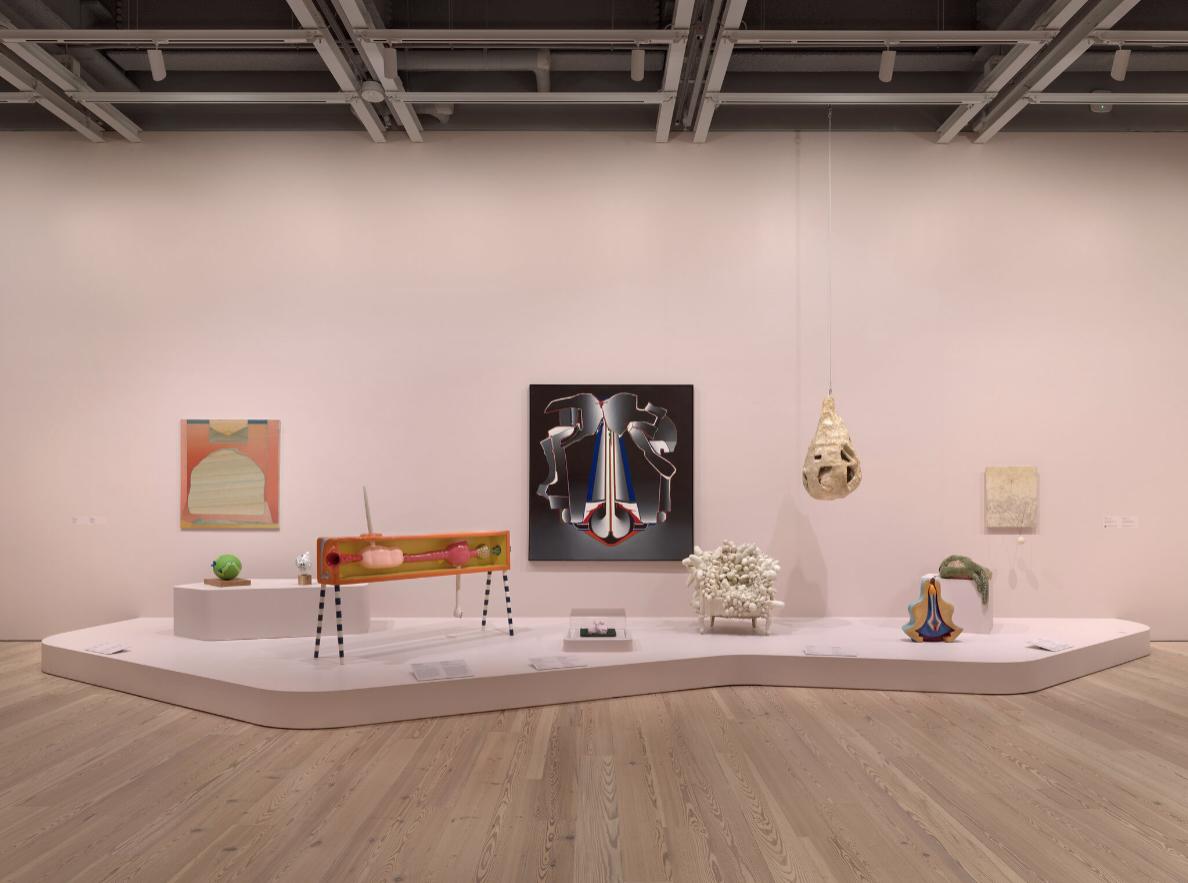
Installation view of Sixties Surreal (Whitney Museum of American Art, New York, September 24, 2025-January 19, 2026). Sourced via.
The heightened sense of the surreal today seems surely tied to the ontological instability of the present. The “surreal”—as an affective sensation rather than an aesthetic mode or historicized phenomenon—indexes a world in which virtual and physical realms have become indistinguishable. This year felt different as we witnessed the accelerated erosion of mechanisms that once stabilized meaning, with the demise of shared narratives, grounded images, and stable information architectures. The “surreal” captures this ambient disorientation of life shaped by the opaque logic of algorithmic feeds, the unpredictable outputs of AI models, and viral microcultures with lifespans measured in hours.
The centennial of Surrealism has coincided with seismic shifts in visual culture, with the proliferation of image generators like Midjourney, DALL·E, Stable Diffusion, and Sora, which fabricate images with unprecedented sophistication at an unprecedented scale. While image manipulation dates back to the very inception of photography, the advent of free and low-cost generative AI systems since 2023 has revolutionized the mass production of imagery with little time, effort, or expertise. The ubiquitous generation of images without authorship, intention, or even clear referents feeds into a broader sense of reality itself becoming procedurally unstable.
On the surface, generative AI might seem to fulfill the Surrealist dream of creation devoid of human consciousness. By such logic, automation delivers Breton’s founding fantasy of “pure psychic automatism” as a method of bypassing rational control to access unconscious desires. The image generator accordingly embodies “a kind of oblique search engine of the collective consciousness, liberated from any of the contextual social relations that would discipline what it produces.” Freudian associations with terms like AI “hallucination” describing a false or misleading output humanize these opaque systems, at a time when users turn to AI not only as a virtual assistant but also a therapist. The creators of “DALL-E” meanwhile deliberately aligned the system with the iconic mustached Spaniard, whose melted clocks have become a sort of metonym for Surrealism at large.
Take Italian Brainrot, for example. The Surrealist analogy is particularly tempting when it comes to this subgenre of memes, which flooded Tik Tok in February with chimeric creatures like Chimpanzini Bananini, a chimpanzee-banana hybrid, and Lirilì Larilà, an elephant-cactus mash-up. These AI-generated characters recall the “exquisite corpse,” the Surrealist parlor game in which the blindfolded assembly of disparate fragments yielded bizarre figurative composites. With creation outsourced to AI instead of human partygoers, the algorithmic process likewise produces hybrid anatomies from charmingly scrambled signifiers resultantly opened up to free association. The nonsensical pseudo-Italian monikers meanwhile echo the linguistics of Dada, the movement preceding Surrealism that insisted on absurdity amid cultural alienation. Does “Dada,” a famously arbitrary and nonsensical label, not in fact sound like Italian Brainrot?
These absurd memes are but one particularly prominent trend of “brainrot,” a broader aesthetic category of internet culture that insists upon recursive meaninglessness. The term—Oxford’s word of the year in 2024—reverses the logic of “brainwashing” with the suggestion of self-inflicted cognitive decline. As a coping mechanism of the Information Age, these insistently nonsensical memes evoke what Dean Kissick terms “vulgar images” as an antidote to “the rationalized views of a world that can no longer be explained.”
On one hand, the recursive absurdity of brainrot dovetails with the Surrealist rejection of rationality. But the analogy quickly falters. Where Surrealist montage broke narrative links to access subliminal truths, brainrot breaks links simply for the sake of breakage, flouting expectations for meaning within an attention economy defined by overstimulation and exhaustion. Moreover, AI does not disclose the unconscious, but rather predicts outcomes through data compression. The composite visuals therefore emerge as artifacts of computational probability rather than fragments of latent desire. AI merely simulates irrationality through supremely rational systems optimized for virality. This distinction is crucial insofar as Surrealists wielded automatism as a parody of automation to critique the irrational remnants of “modernisms that value industrialist objectivity,” according to Hal Foster. By contrast, Italian Brainrot is inextricable from technocratic infrastructures, extending the logic of such capitalist systems, as superficial absurdity folds seamlessly into platform incentives.
Furthermore, the content itself—billed as “slop”—is far from “meaningless.” Tralalero Tralala, a shark donning Nike sneakers, spreads Islamophobic rhetoric through scripts mocking Allah. Bombardilo Crocodilo (sometimes Bombardiro or Bombardino) is paired with audio describing the World War II-era aircraft with a crocodile head bombing children in Gaza. In actively advancing genocide as mimetic propaganda at viral scale, these memes elicit comparison with the sinister legacies of Futurism, perhaps more so than Surrealism or Dada. Futurist art and writing shaped the aesthetic identity of fascism through the glorification of technocratic progress. Mechanized creatures like Bombardilo Crocodilo exude masculinist aggression that echoes Futurism’s celebration of militaristic virility, while the frenetic looping format of the clips similarly privileges velocity over meaning. This comparison is sharpened by the consideration of Crocodilo alongside Futurism’s aeropittura as a glamorization of aerial bombardment. Simultaneously, as noted by Mel Ghidini, brainrot monikers like “Tung Tung Tung Sahur” recall Zang Tumb Tumb (1914), a concrete poem channeling the cacophonous rhythms of mechanical warfare, composed by none other than F. T. Marinetti, Mussolini’s then right-hand man. The staccato structure of the text resonates with the fragmented format of memes, which prompt thinking beyond any one isolated image.
A similar machinic bravado animates Trump’s AI-generated propaganda, which channels established authoritarian iconographies through the slick precision of generative models. This year, in posts and reposts on Instagram, X, and Truth Social, we witnessed “Trump” masquerading as a lightsaber-wielding Jedi, a muscular comic book anti-hero, and a king. In one particularly staggering clip, the president appears incarnated as a golden monument within an unrecognizable Gazan landscape transformed into an opulent resort. These hypermasculine self-mythologies, to note just a few, do not aim to deceive so much as to structure fantasy, inviting identification instead of ironic detachment. Trump’s embrace of synthetic spectacle coincides with his administration’s aggressive constriction of culture through authoritarian tactics since inauguration in January.
Like Trump’s caricatures, Italian Brainrot is unmistakably synthetic. Within this same visual ecosystem, however, a clip in which Senators Bernie Sanders and Alexandria Ocasio-Cortez appear to earnestly discuss Italian Brainrot signals a new standard of verisimilitude, where the artificial and the authentic exist in a continuum governed by algorithmic logic. This reckoning came for me in the form of six bunnies bouncing on a trampoline, a clip I took to be true without much thought.
Artists today face this onslaught of slop, contending with an oversaturated visual economy in which distinctions between critique and complicity prove ever more tenuous. Refik Anadol models one polarized approach to the so-called “AI revolution.” The Turkish artist’s wholesale, uncritical embrace of such systems secured his spot in Time’s top 100 list of 2025, which fittingly crowns AI developers together as “Person of the Year.” Also tapped to design the magazine’s “living cover,” Anadol leveraged AI to synthesize Time’s archives into a streamlined visual. While employing humanizing descriptions of AI “dreaming,” Anadol cultivates frictionless imagery conducive to mindless consumption, not unlike brainrot. I mean not to suggest that Anadol’s work is slop, however, but that his mesmerizing, screensaver-like arrays emulate the logic of slop as spectacles of technologization optimized for viral circulation.
What then might meaningful engagement look like in an age dominated by AI slop? How can art distinguish itself from brainrot within digital infrastructures that flatten attention into endlessly churned content? Can artists critique the extractive logics of these systems from within, deploying reflexive strategies without being absorbed by the very mechanisms they interrogate?
Performance has been proposed as a lifeline, with embodied experiences operating according to an alternative temporo-spatial logic. Critics like Janelle Zara have suggested that the embodied experience of performance might “cure us of brain rot,” a sentiment echoed by Matthew Gasda: “The 2020s are giving slop. With television in decline, talent is migrating from the screen to the stage.” In this moment of parasociality, performance is anchored in more familiar, physical notions of the “real.” Even the brief cultural fascination with the Louvre Heist this fall reflects a similar collective attraction to tangible, immediate realities. With performance, though, the question remains of how to engage the contours of the present, without reverting to pre-digital fantasies that deny the complexities of the Internet Age.
Surrealist techniques regain analytical force today in the capacity to embrace contradiction and suspend resolution while exposing the irrational substrates of ostensibly rational systems. Artist and theorist Hito Steyerl reflects that “a lot of the ingredients of 1930s surrealism are present once again in the cultural debate,” noting the rise of global fascism both then and now. This parallel evokes surrealism not merely as a stylistic category but as a tool to reckon with systemic instability. Sasha Gordon, for example, cultivates a surreal quality through the repetition of self-portraits, with multiple affective states coexisting within the same pictorial logic, which suggests the iterability of the self. Haze, the artist’s debut presentation at David Zwirner in New York, channeled the psychological tension of externalized self-consciousness in a manner that resonates with our screen-saturated present.
Where we can glean surrealist undercurrents in Louise Bonnet and Elizabeth King’s two-person show at the Swiss Institute or in Joyce Ho’s multimedia presentation at ShanghART in Shanghai, the living legacy of surrealism is particularly palpable in the work of Hannah Black. In HUSH MR GIANT at Arcadia Missa in London, Black leveraged the political potentials of surrealism toward an epistemological intervention. The artist transformed excerpts from the Universal Declaration of Human Rights (1948)—a speech act theoretically imbued with actualizing capacities—into nonsensical anagrams mapped onto circular canvases. These paintings imbued with a hypnotic quality recall the rotating discs in Marcel Duchamp’s Anémic Cinéma (1926). This method of disarticulation underscores the fundamental distortion of supposedly “universal” language within colonial systems.
In Black’s words, these paintings conjure Suzanne Cesaire’s understanding of surrealism as “‘the tightrope of our hopes’ stretching over the abyss of fascism.” While paying homage, Black, like artists such as Madeleine Hunt-Ehrlich, activates the unresolved political charge of surrealism to reckon with the contradictions of the present, while resisting the tempting slippage into nihilism. Jacolby Satterwhite likewise leverages his “surrealist toybox” as a politicized approach to envision alternative futurities, “using the materials and variables from yesterday to make work that is about today and tomorrow.” A Metta Prayer (2023), a multimedia installation featured in Machine Love at Mori Art Museum in Tokyo this summer, combines Buddhist ontologies and emerging technologies, while queering digital space as a site for collective speculation and ritualized embodiment.
Steyerl in fact suggests that surrealism surfaces through “a new emphasis on ritual, sorcery, transgression, and meme magic,” which goes hand in hand with the epistemological work done by artists like Black in challenging the enduring reign of liberal humanism. From the Bienal de São Paulo, Not All Travellers Walk Roads, to the Seoul Mediacity Biennale, Séance: Technology of the Spirit, Oliver Basciano contends that “the foregrounding of art that fuses the sublime and the immaterial, is an understandable, and vital, counter to the technological, ecological and political alienation that otherwise seems all-pervasive.”
Hannah Black, Everyone is entitled to a social and international order in which the rights and
freedoms set forth in this Declaration can be fully realized (Chinese Communist Revolution), 2025.
Courtesy of the Artist and Arcadia Missa, London. Photo: Tom Carter.
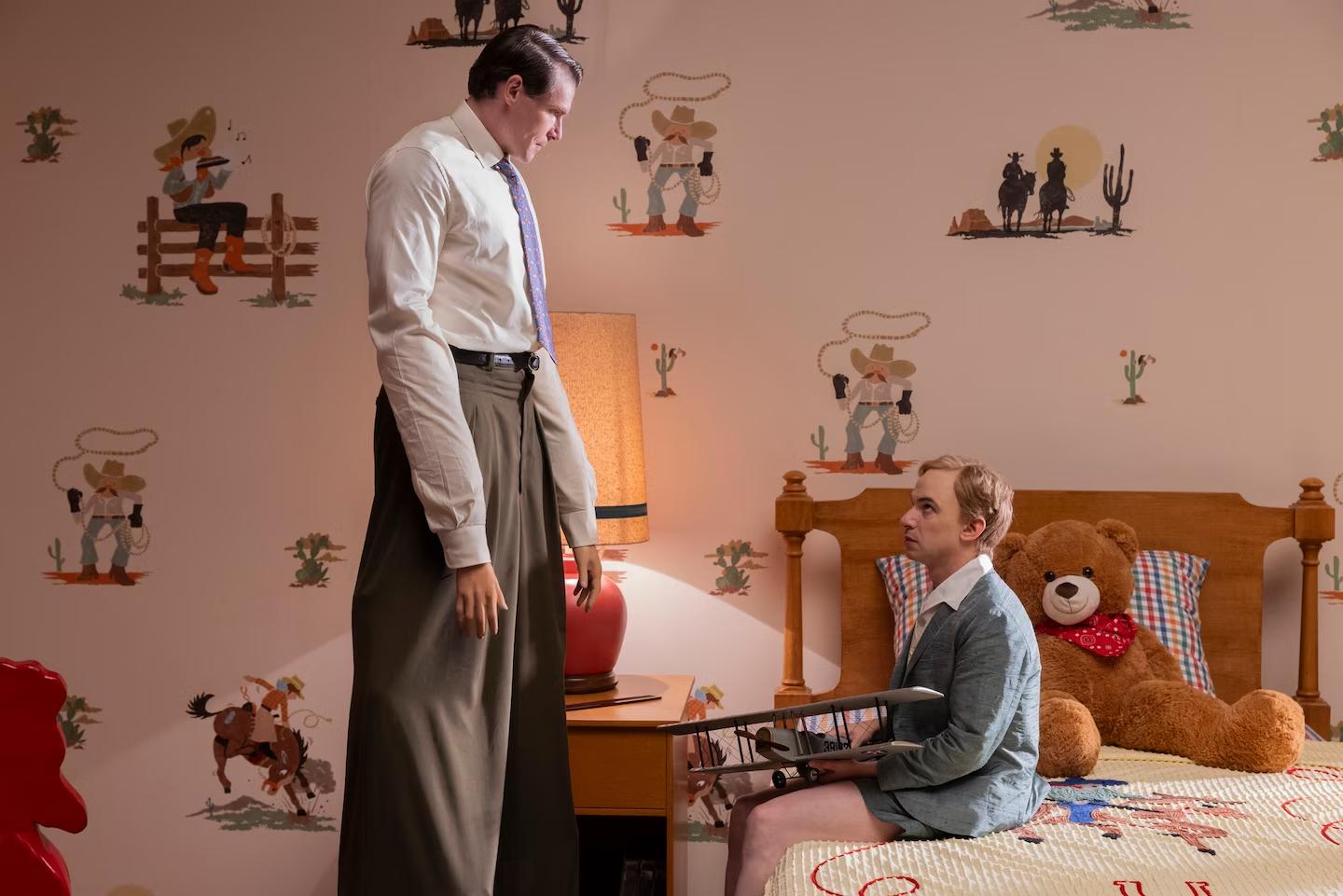
Still from Nathan Fielder's The Rehearsal, HBO.
Beyond the realm of contemporary art, filmmakers, producers, writers, and musicians reckon with the ubiquitous sense of the surreal today. In the second season of The Rehearsal, creator Nathan Fielder stages ever more baroque simulations to test his quixotic theory that improved cockpit communication might prevent aviation accidents. Each episode folds rehearsals within rehearsals, layering scripted reenactments of past encounters with simulations of potential futures. In this kaleidoscopic inversion of reality television’s promise of authenticity, social interactions are rendered recursive and modifiable. The season models a sort of procedural surrealism by revealing the mundane structures that mediate experience.
I’m reminded here of René Magritte’s La Condition Humaine (1933), which explores framing as not merely a compositional tool but an ontological problem. Through the painting-within-the-painting, which appears perfectly aligned with the view behind it, Magritte evokes the continuity of representational space and lived space. In turn, Magritte formulates the painting itself as a mediating apparatus, a sort of interface rather than a transparent window or flat surface. Both Magritte and Fielder underscore how frames enact the very realities they represent, inviting us to consider often unnoticed structures of mediation.
Doubling likewise emerges as a structural operation in season two of Severance. The dystopian workplace series literalizes the late-capitalist fantasy of a perfectly partitioned subject through the “severance” procedure, which cleaves the self into an office-bound “innie” and a leisure-oriented “outie.” Within the sterile corporate labyrinth of Lumon, psychological fragmentation is a management strategy, a means of rendering workers optimally compliant while commodifying their interior worlds as much as their time. This slightly off-kilter world governed by its distinct internal logic is shrouded in mystery for viewers, much as it is for the characters instrumentalized within Lumon’s all-consuming apparatus.
As with Severance, the surreality of Yorgos Lanthimos’s Bugonia stems from the closeness of the pictured world to our own, which renders the abrupt genre swerve in the closing minutes so effective. This shift—a structural shock, a sort of inversion of Plato’s cave—reframes everything prior, all that seemed so familiar, in turn destabilizing any boundary between plausible conspiracy and fantastical fiction. I’m hesitant to explicitly label Bugonia as surreal, given the tendency flagged by Breixo Viejo: “if any motion picture dealing with the unconscious, automatism, dreams, desire and revolution is Surrealist (or Neo-Surrealist), then the list becomes endless.” I find myself gravitating toward the term nonetheless, though, perhaps leaning into the slippage between the colloquial descriptor and the historically grounded term. Bugonia, like both The Rehearsal and Severance, speaks to an ambient sense of the surreal, while maintaining a certain surrealist resonance itself, specifically in a structural rather than stylistic sense, through critical engagement with the architectures of perception. Calling these works surreal or surreal-adjacent flags how each enacts rather than merely depicts estrangement, channeling the infrastructural conditions of mediated life.
To describe the cultural fabric of 2025 as “surreal” feels at once apt and insufficient. I’ve courted contradiction in switching between the art historical “surreal” and the colloquial “surreal,” which evokes an existential sense of disorientation, while teetering toward meaninglessness. This imprecision, though, simultaneously gestures toward the very limits of language in this moment of epistemological uncertainty exacerbated by the deluge of slop. Perhaps the appeal of the “surreal” lies in the affective resonances of the term connoting an intensely subjective phenomena that is less so seen or heard or known or learned than felt. It is precisely within these vertiginous conditions of the present that surrealist tactics regain analytical force.
In reflecting on spurts of surrealist energy beyond the 1920s—whether during the Spanish Civil War or the Négritude Movement in Martinique or today—we confront more fundamental questions of the role of art amid layered crises. Perhaps one of the most weighty lessons to be drawn from these expanded surrealist moments is the radical potential of art-making as a crucial form of political disruption. As Viejo so aptly contends, “the key question after all is not whether a Surrealist cinema”—or art more generally—“as such exists today, but if we are still capable of making and understanding movies as the Surrealists once did—as tools of a furious fight ‘to explode the social order and transform life itself.’”