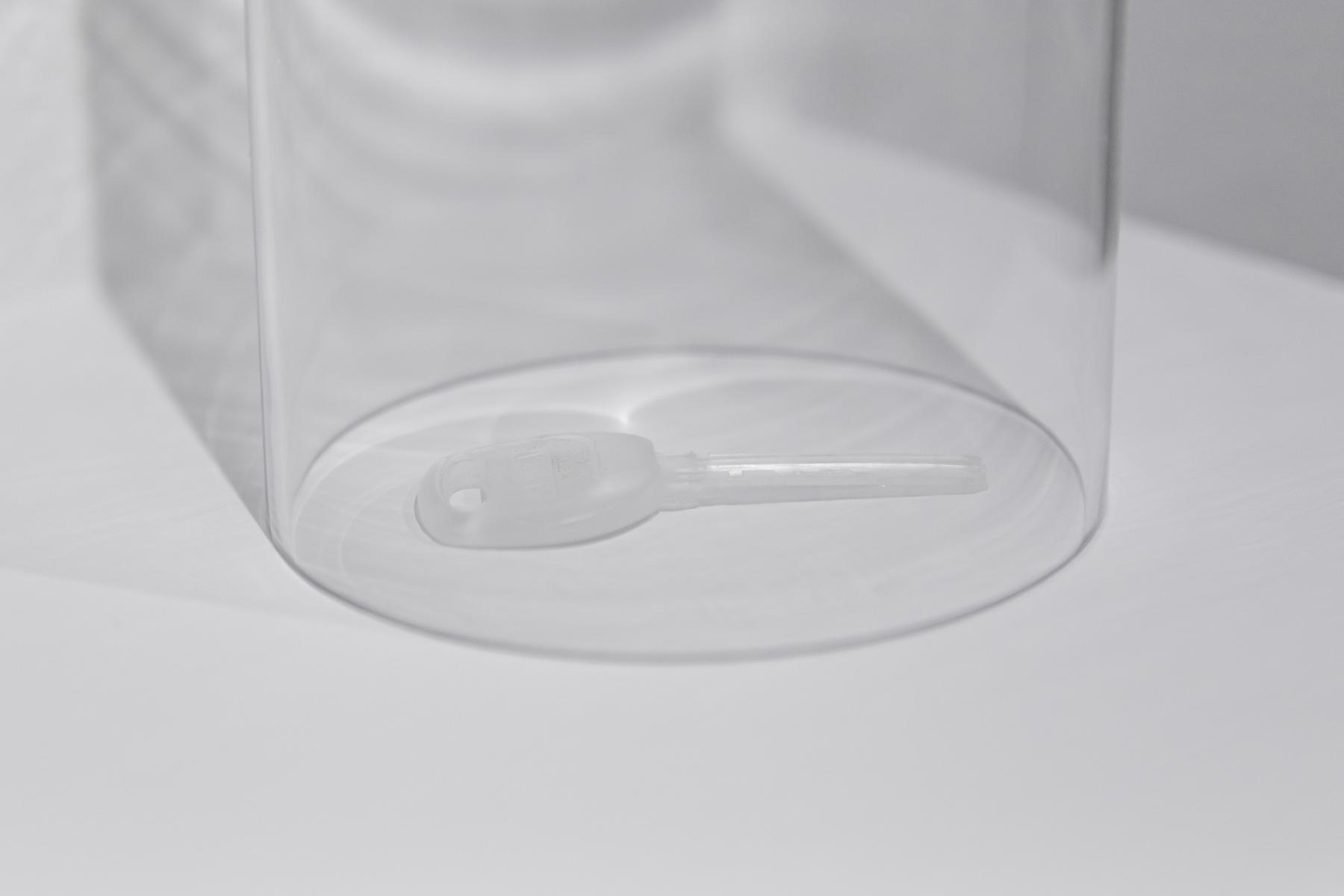
Narges Porsandekhial, Token, resin and bell jar, 2023. Photograph by Carey Shaw.
During February and March of 2026, two works were stolen from my exhibition in Saskatoon. I tried to retrace the thief's steps, imagining what compelled them to take these particular objects: journal pages I had kept since moving to Canada, and a resin replica of the key to my childhood home.
The theft made little sense.
The journals were written entirely in my mother tongue, Farsi. They possessed almost no monetary value, yet contained years of observations, griefs, anxieties, and ordinary routines. The key was fragile and entirely dysfunctional, carrying meaning almost exclusively for me. What door were they hoping to unlock?
Suddenly, a portion of my past lay beyond my reach. Years of memories disappeared; alongside a key I could no longer hold. The theft felt disproportionate to the objects themselves. I could not stop relating it to what was unfolding back home. It seemed as though everything and everyone were participating in the same process: the removal of traces.
_________
The internet blackout lasted almost ninety days. Faces of our loved ones slowly degraded in memory. Nightly grief sessions became routine. Then came war. We adapted to short phone calls that were interrupted, monitored, and almost always left unfinished.
In early 2026, nationwide demonstrations triggered by economic crisis and political repression were met with lethal force across Iran, resulting in one of the deadliest crackdowns in the country's recent history. The violence was followed by a nationwide internet shutdown that severed access to news, communication, and, simply put, access to hope.
The world soon forgot how many lives were taken on January 8th and 9th, beneath the cover of the internet blackout, through bullets, executions, and brutality. Attention moved elsewhere. I began to understand that visibility depended less on the scale of suffering than on the geopolitics of where the suffering occurs. Once the images no longer fit the rhythms of international media attention, the world's concern rapidly shifted elsewhere.
I had been squinting my eyes for more than 259,200 minutes, in search of a text, a project, or a creative outburst that speaks to the horror of January 2026. Perhaps expecting such work to exist under these circumstances is absurd to begin with. Still, I wanted to know whether anyone had found a language capable of carrying the weight of what happened. My search seemed to end before it began. Perhaps this is where disappearance begins. Not with silence, but with the realization that something has vanished, something I cannot necessarily point to, though I know it has been missing.
Eventually, I stopped searching for representations of catastrophe and began thinking instead about artists who question representation itself. The Iranian Canadian multidisciplinary artist Gita Hashemi has spent decades examining archives, bureaucracy, migration, and institutional violence by exposing the conditions that determine what can and cannot become visible. Her work offered me something I had not expected to find: permission to understand artistic paralysis differently. Perhaps the absence of art is not always evidence of failure. Perhaps it is evidence of proximity. I kept returning to Hashemi's proposition that the personal is poetic, the poetic is political, and the political is personal. January seemed to interrupt that sequence. The political became human. The human became too painful. Before anything could become poetic, it first had to survive. I was quietly looking for permission to acknowledge that not every catastrophe immediately becomes art.
_________
For years, my life was consumed by numbers.
1,500.
40,000.
18.
19.
I envy those for whom these remain mere digits. For me, they are bodies, flight numbers, hours, screams, bullets, executions. In these circumstances, numbers promise comprehension. They suggest suffering can be measured, catalogued, and communicated. Yet every new statistic seemed only to widen the distance between reality and its representation. The more numbers accumulated, the less graspable the tragedy became. Lives disappeared into abstraction.
In Regarding the Pain of Others, American writer and critic, Susan Sontag, argues that images can make suffering visible without ever allowing us to inhabit it ourselves. I kept wondering what happens when there are too many tragic images to circulate, even when the internet itself disappears, when even witnessing becomes unbearable. What remains after visibility becomes too painful?
I found myself looking for artists who had managed to bridge that distance. Yet gaps resist description. There are no references for them. No associations. No language. Instead, I encountered absence. Ordinary artist's block is one thing. This was something else entirely. I watched Iranian artists attempt to navigate January 8th and 9th, events that remained largely invisible to Western audiences despite their enormity. Media attention shifted. Solidarity proved conditional. Some tragedies remained visible; others disappeared almost as quickly as they occurred.
I was angry about that.
I still am.
Despite the anger, despite the relentless consumption of news, despite the urgency to respond, I found myself incapable of making work. The ideas existed. They multiplied. What disappeared was the ability to transform them into form.
For years, I believed artistic production was a position of privilege. That it requires freedom of thought and speech, access to resources, time, financial stability, and enough distance from immediate crisis to imagine something beyond survival. I had watched countless projects die before birth because those conditions failed to align. What I had not anticipated was that awareness itself could become debilitating.
I had always assumed censorship was the principal enemy of artistic production. But I discovered that witnessing can produce its own kind of paralysis and become my enemy. Leaving a totalitarian government gave me the illusion that distance would produce freedom. Instead, it produced another kind of incapacity. Not censorship, but paralysis.
What happens when the political becomes too personal?
When it becomes too painful to share?
When speech remains technically possible but expression does not?
When ideas disperse before they can settle into language?
_________
After the massacre, a handful of efforts emerged to recover the names of those who had been murdered. Most took the form of writing: text-based projects documenting victims, compiling lists of names, or public readings carried out online in the hope that families, friends, and strangers alike would hear them. What struck me the most was an interactive memorial website, Javid Namaan (Immortal Names). Soon after it was launched, the Islamic Regime blocked access to the site inside Iran. Even now, it remains one of the most heartbreaking web addresses I have ever typed.
Entering the site feels less like opening an archive than drifting through a constellation. Accompanied by a song that echoed through the country's collective mourning, visitors find themselves suspended within a solar system of countless stars. Each star represents a life taken by the Islamic Republic. You navigate toward the light. The larger, brighter stars carry the victims' voices. As you move closer, they begin to speak: a brief conversation, a final message, a few remaining seconds of a life. For a brief moment, they cease to be statistics. Then the star explodes, dissolving back into darkness. Visitors can search for victims by name or add a name to the registry. I have never been able to remain on the website for more than a few minutes.
I was almost certain I would not find artists inside Iran responding publicly to these events. Even if they were making work, they had little opportunity to reach audiences beyond the country's borders. During those first months, the only images I received from home—apart from evidence of the massacre itself—were walls covered in graffiti, blood-stained pavements, and hastily painted slogans.
The words appeared in black and red:
"Blood can never be washed.”
"There is no turning back. The blood of our loved ones has sealed that path.”
Much of the artistic response emerged instead through the diaspora, where social media became less a site for artistic experimentation than an emergency channel for communication. Iranian artists such as Saba Soleymani produced works that circulated online as acts of witnessing rather than objects of exhibition, illustrations condemning executions, commemorating the victims of January, and insisting that names not disappear. Infographics, drawings, animations, and digital collages occupied the uneasy terrain between testimony and artistic practice, refusing easy distinctions between aesthetics and political responsibility.
These were attempts to give numbers a body.
Art had become an independent news network.
Nothing mattered more than getting the story across.
The inability to create something beyond that was not an intellectual failure. Ideas existed. What disappeared was the confidence that any finished work could avoid reducing catastrophe into something consumable. Increasingly, I began to wonder whether postponing narration might itself be an ethical artistic response, not an evasion of responsibility, but a refusal to package grief before those still living inside it had reached its edges.
Diasporic artists are frequently expected to become translators, archivists, journalists, and witnesses all at once. We expect ourselves to transform grief into something legible before history moves on, to produce images before we have had time to process the ones already lodged in our bodies. I had been measuring artistic responsibility by speed. The faster the response, the more urgent it appeared. The longer the silence, the easier it became to mistake it for indifference. I no longer believe those measures are compatible with catastrophe. Some experiences demand immediacy. Others demand time.
A catastrophe rarely has a clear beginning or end; it continues to unfold long after its most visible moments have passed. An event may have a date, but living through it is rarely chronological. What happens before, during, and after does not always remain separate; the past can continue to enter the present, and the event itself can remain unfinished. Perhaps silence, then, is not always a failure to respond, but an ethical refusal to force an ongoing experience into a story before it is ready to be told. What if refusing to produce immediately is not a failure of artistic responsibility, but an acknowledgment that some experiences have not—and should not—become stories yet?
_________
During this period, I continued working on a flag titled There Is No Colour Above White(ness). The title comes from a saying in my culture: There is no colour above black. It is often spoken in moments of overwhelming despair, a reassurance that nothing worse can happen. I repeated the phrase to myself after each report of brutality. Every time I believed the worst had arrived, I was proven wrong. Across the flag, the sentence, initially printed in colour, gradually disappears into whiteness. A barcode interrupts the phrase, translating language into a system of classification and reduction. The words remain present, yet become increasingly illegible.
At the time, I thought I was making a work about visibility, selective activism, whiteness, and power. Now I think I was making a work about disappearance. Or perhaps about time. About what becomes visible only after enough distance has accumulated. I mistook the work for a response to current events. Looking back, I wonder whether it was quietly recording my inability to respond at all.
The more I searched for creative responses to these events, the more absence I encountered. At first, I understood this absence as failure, a collective inability to respond adequately to catastrophe. I am no longer convinced. Looking back, I realize I had been searching for an archive that did not yet exist.
Perhaps some stories arrive before language is capable of holding them.
We often expect artists to translate suffering into narrative, to transform catastrophe into something visible, meaningful, and communicable. We ask for testimony. Analysis. Hope. We ask artists to metabolize violence into forms that others can encounter safely, at a distance. We rarely ask whether survival leaves enough room to become any of those things.
But some experiences resist narration.
Not because they lack significance, but because they exceed the capacities of the forms available to them.
Perhaps proximity to trauma does not produce expression.
Perhaps it produces suspension.
Refusing premature coherence can itself be a way of remaining faithful to experience. Not every silence is imposed. Some are chosen because language, at least for the moment, would simplify what should remain unresolved.
Delay is not always avoidance.
Sometimes refusing to narrate is the only way to resist turning pain into content.
Sontag, borrowing from the American-British author Henry James, reminds us that no one remains "a mere spectator" indefinitely. I once believed that leaving Iran would transform me into an observer, that geographical distance would provide the perspective necessary to make work. Instead, I discovered that distance does not necessarily produce clarity. Sometimes it simply reveals another way of inhabiting the same wound.
_________
I still imagine the journals somewhere in Saskatoon.
Sitting on a shelf.
Buried in a box.
Opened by someone unable to read them.
The resin key may already be broken.
It no longer opens anything.
For 259,200 minutes, I searched for a work that could account for what had happened.
I searched for a language capable of making sense of disappearance.
What I found instead was evidence of its persistence.
Some losses leave evidence.
Others leave only a gap.