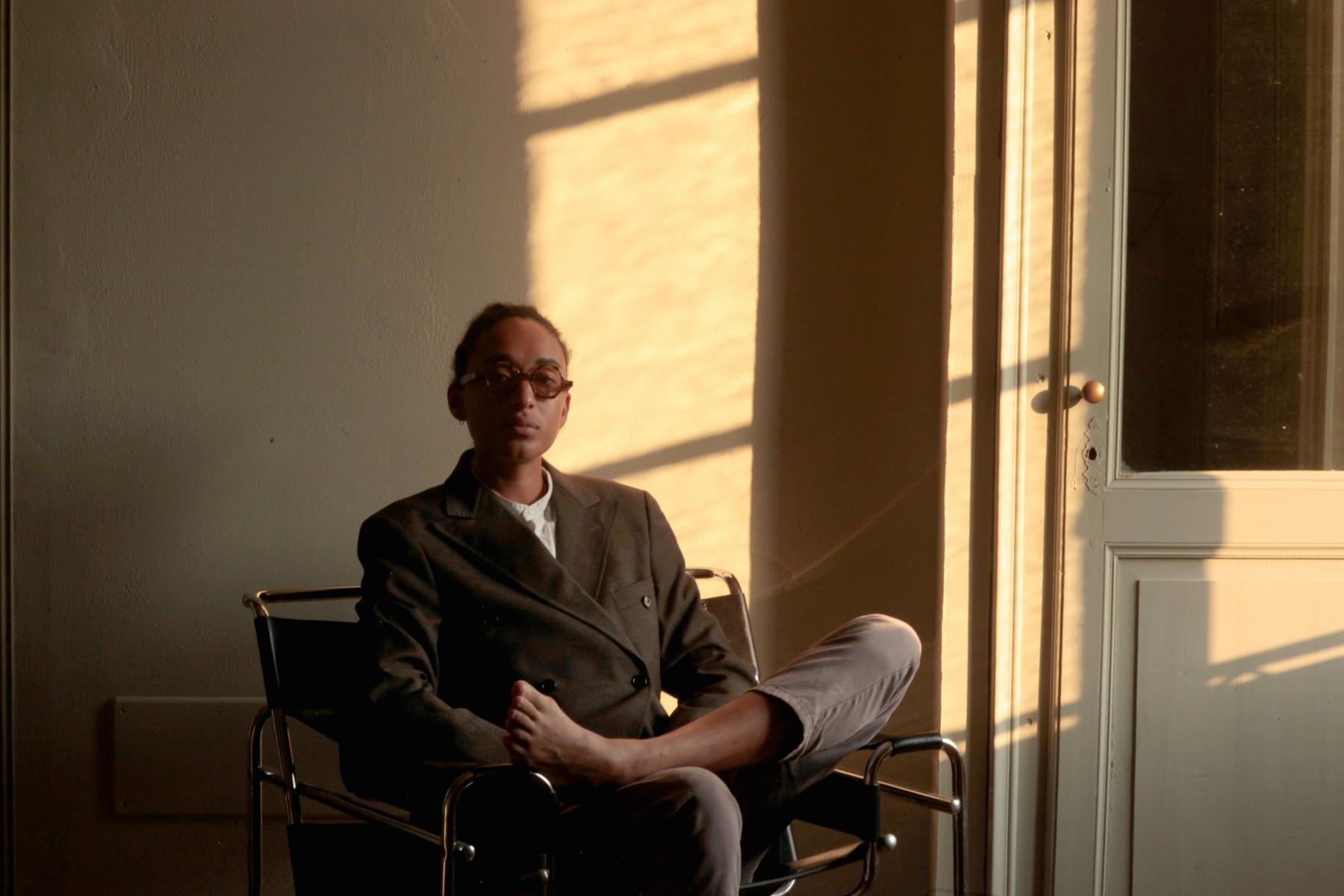
Photo of Imani Mason Jordan by Anwār Mason Jordan
I have been following Imani Mason Jordan’s work for some time. Among other things, they are a poet, a scholar, an artist, a curator, and an editor. A couple of days before it opened last May, we walked through their curated exhibition “Nomenclature for the Time Being” at Raven Row, a non-profit contemporary art space in East London.
The show took its title from Dionne Brand's 2022 book-length poem Nomenclature for the Time Being and gathered the work of 13 Black artists across generations and cultures that enacted what Mason Jordan proposes as a "Black feminist materiality." The hero image they used was pulled from Brand's 1993 NFB documentary Long Time Comin'. It’s a screenshot of a scene shot during the construction of Camp Sis', a feminist alternative community in Ontario, Canada. “These are practices that do not try to represent the world so much as actively reconfigure the conditions under which it can be known, felt and inhabited,” Mason Jordan wrote in their curatorial essay.
We met again over Zoom a few weeks before the show closed in September to talk through some of the exhibition’s themes and influences. Over several hours, our conversation roved through different topics. We started with poetry and the ways Black poetic practice functions as “a gathering tool and a habit of assembly.” We dive into a nostalgic review of the 2010s and a consideration of Black lesbian activist culture in the 1990s. We talk about the way the archive often holds optimistic examples of political imagination and, but that what goes unrecorded is the emotional toll of revolutionary disappointments, what Mason Jordan calls “the complex heartbreak of the failed revolution.” We consider how material conditions shape our capacity for sustained, long-term commitment to political action. “An individual independent commitment will always bring up competition, alienation, us or them,” they say and point to intergenerational cooperative economics and international solidarity. In the end, we turn to collaboration as both a personal practice and a political one, and finally to Black Study itself, which, as Mason Jordan puts it, “intruded into the institution,” yet ultimately resists absorption.
Black Poesis
Dionne Brand made a number of films with the National Film Board of Canada in the late 80s and 90s, including one called Listening for Something (1996), which captures an ongoing, far-ranging dialogue between Brand and the poet Adrienne Rich, who was a white, Jewish, lesbian, feminist poet and essayist. It’s so clear in the film that poets are guiding lights. I love how they talk about language and how it shapes the histories that we're given, how we see ourselves as people, and how we relate to one another.
Has poetry played a role for you? What do you think about poets and poetry?
I love poetry. I love being a poet. What's important to me are Black poetic practices of all kinds— spoken, written, abstract, experimental. All of these ways that stories are told, they're this primary material of Black life: through poesis, through this language, through this expression of feeling and communication. It's one form but it crosses over so many different fields and modes of expression.
All art is poetry. I think about poetry as a gathering tool and as a habit of assembly. Especially these long form poets, these griot storytellers, where you pull at any line, any thread, and that's a specific artist, a specific artwork, a line of programming. Poetry is the genesis of so much across conjunctures, cultures, diasporas, moments in time, moments in the body.
Poetry is always already political, whether we're talking about the politics of June Jordan, or Audre Lorde, or Pat Parker, or we're talking about poetry as sound, as music, as these sonic Caribbean practices, of telling the news, of Dub. Poetry shifts across migratory patterns, and it also subverts language in these avant-garde, experimental practices that influence jazz. To use Arthur Jaffa-ism, but also Elissa B. Morehead talks about how Black people have self-actualised within certain frames. I think poetry is certainly one of those frames.
And what I love about poetry is also that it becomes this primary material for all sorts of other things. So M. NourbeSe Philip writes Zong! and we have whole theses that are not poetry, that are based on this mode of being, this mode of understanding ourselves, which is really a kind of ritual, which is really a kind of togetherness, a kind of being, a kind of assembly.
My poetry book, Pivot, is about the Haitian Revolution. It's an experimental, abstract, 10,000-word book-length poem, which questions this idea that the Haitian Revolution was the only successful slave revolt in history, and then holds that alongside the reality of the conditions in Haiti today, the conditions of Black life today, and breaks down the language, after M. NourbeSe Philip, after Moten, after N.H. Pritchard, and thinks about all of the ways in which, at a base level, this primary material is the body and the voice, the sounds that we make, that we can make with that.
Nomenclature for the Time Being and Black Study
Dionne Brand’s poetry collection Nomenclature for the Time Being (2022) influenced the recent group exhibition you curated at Raven Row art exhibition centre in London, also titled “Nomenclature for the Time Being.”
When did you first encounter this poem, and more generally, how has Brand's work impacted you?
The first time I came across Dionne Brand was through epigraphs and quotations in the work of Katherine McKittrick. That's how I came across both Dionne Brand and M. NourbeSe Philip. The first book I read by Dionne Brand was Map to the Door of No Return: Notes to Belonging (2001). Around 2015 or so, there was a lot of engagement in Black geographies, and also at the same time there was engagement around an Afro-pessimist literature. So there were these two schools of thought.
I remember. All the articles were coming out. We were reading Frank Wilderson and Jared Sexton and Fred Moten and Saidiya Hartman. You had to be up to date.
Yes, there was Hartman, there was Moten and The Undercommons (2013). This was my introduction, 10 years ago, to Black Study. I had done my undergraduate, and so I was familiar with, like, Franz Fanon and Michel Foucault. And I had some independent research that got me to certain Black scholars, like Paul Gilroy, but not really to a deep understanding of Black Study. That happened outside of the academy, being a nerdy Black art lesbian who was interested in theory and study.
I would go and see Katherine McKittrick and Christina Sharpe. This was the Black Art/Black Study nexus, which was also performance, which was also a cycle of material possibility, which was also about Arthur Jafa. This was a big moment.
Yes, that whole era. Love is the Message, the Message is Death came out in 2017 at the Underground Museum in LA, and then there was a first Loophole of Retreat in New York in 2018. It was a lot of Black scholars and artists. That time was so ripe; it was so pungent. Everything was happening. We were engaged in all these debates and conversations.
It was also Trump's first term. It was Brexit in the UK, so there's all of this stuff going on. There's of course the Black Lives Matter movement, which started in 2014. As a group of activists, they were very, very, very good at mobilising. They mobilised a bunch of people to be think and talk freely about race and racism.
At the time we also realised, as organisers, as artists, as people who were interested in thinking and writing and being in study, that there was a liberal way to embed yourself into Black Lives Matter organising and politics, and then there was also a kind of deep intellectual, philosophical way, which was more about abolition.
There were people who were abolitionists before 2020, and suddenly there were Black Studies scholars who revealed themselves to not really have paid much attention to the study of abolition in the kind of Ruth Wilson Gilmore and Angela Davis and prison-industrial complex kind of way.
And so you had all of these strands of Black Studies, and you were placing yourself. It wasn’t a monolith.
For me, it's very exciting to think about all of these different factions and debates. Black Studies is this critique of modernity, but it's also all of these different ways of thinking about ourselves, and each other, and liberation, which was so generative in all of these different ways.
The importance of a writer like Dionne Brand, who is at once a poet, a scholar, and a Black lesbian, whose writing spans all of these different eras of Black liberation study, of organising, of activism. The earlier books, like Bread Out of Stone (1994), where she's talking about herself as a Black lesbian, as a dyke, and then her earlier films in that era. She matures in the public eye as a poet, but also as a thinker, and as a scholar, and she gets sort of brought into academic scholarship, but also is already embedded in all of that.
She writes from all of these centres of gravity: from an activist perspective, from a Black lesbian perspective of deep feeling, from a diasporic understanding of Blackness. The figure of this Black woman travelling and meeting all of these different people. [With Brand,] understanding Black American academic thought as also coming out of this deeply internationalist perspective and way of seeing Black life and Black liberation and anti-colonialism. It just expanded my mind over and over and over again to understand what it means to be and live in the world.
I saw an excerpt of Nomenclature for the Time Being in 2020 and I was like Oh, thank God: the diagnosis is in. I get so animated and excited by it because it's this diagnosis with no answers. It maps so well the condition of being, of living, of facing things.
What's so fascinating about reading people like Brand and James Baldwin and Stuart Hall––long durée scholars, intellectuals and artists responding to the time, is [how it can be] a way of learning history, of understanding the flow and trajectory of us as a community of people resisting in different times, in different conjunctions, in different conditions, and finding a way through.
And so I thought, like Dionne Brand who has always been around artists, musicians, writers, activists, organisers, and academics, how can I bring together all of those people in the context of a group exhibition and extend this idea of your best shot for the time being?
And so the exhibition was an open invitation for people to respond to the poem and also to Long Time Coming (directed by Brand, 1993) as two examples of a ‘for the time being,’ knowing they are precarious, fragile, fleeting, but also have so much longevity within them.
.jpg)
still from Long Time Comin', 1993, Dir. Dionne Brand
Long Time Comin’ and the Aftermath of Political Optimism
The hero image for this exhibition was an image still from Dionne Brand’s 1993 documentary Long Time Comin’, which features the artist Grace Channer and the musician Faith Nolan, two Black, lesbian activists in Toronto in the 90s. I was really moved when I watched it. It reminded me of how I grew up. Things were urgent then, a matter of life or death, but you weren't worried about it because that's just what life was. I grew up in a place where we just knew that you had to struggle and fight. Now, as an adult, those stakes don't always seem urgent in the same way. I feel like I can pretend that I don't have to struggle, and that's a little bit concerning.
What it was like for you watching the film? Did the testimonials in the film resonate with you, with how you were raised or how you live your life now?
Well, there are a couple of things. One is that, whilst it is a documentary, the storyline is staged from the point of view of Dionne Brand, who is the director. It tells a story by and for Black lesbians, lesbians of colour, lesbians in general, about what it was to be in a specific time and place.
[For me,] it's a complex film to watch because I feel all of this revolutionary fervour, this absolute love and adoration for lesbians in the archive, for being a lesbian. These are my friends. I know these people. This is the kind of culture that we have come from and [that we] are sustaining.
I feel like the 90s was a particular moment for being Black and proud and also for being optimistic. There was this kind of like Afro-centricism across the board––across gender and diaspora, this kind of Black optimism for us to be able to self-organise.
For Black lesbians specifically, the 90s was a period of burgeoning of an excess of political imagination, of self-making, and of community building. There was a lot of looking forward to the future. There was a real positivity. There was hope. There was a belief that if we live our lives in this way, we can create livable futures, livable presents. There was a group awareness of our revolutionary potential and of the kinds of ways in which we could be the authors of our own lives, by resisting very real, oppressive structures.
And this is something I see across geographies, in different diasporas, in the different kinds of filmmaking practices of various people like Jamika Ajalon [or] Ingrid Pollard. Specifically, Black lesbian communities were really having a moment in the 90s, and that was being recorded by lesbian filmmakers.
So in the 90s was there was optimism about where we had gotten to collectively as a society, but also where we could go. And so the optimism in Long Time Comin’ of being able to organise against very real threats towards something that could be a foundation for all of the things we know we can do together, that was inspiring for me, because I have felt those things in my own lifetime, beyond the 90s. I still feel some of those things now, but to see the level of collective organising and certainty of one's own goodness, possibility, creativity, our ideas, that's very powerful at the level of identity, but also the level of a political understanding of how change is made.
The film is cut in a particular way where you're left with the burgeoning potential of what could be rather than what has happened. Even though what has happened is togetherness, is love and joy and collectivity and the coming together of lesbian activist communities, there's also something around knowing that this is always at risk. It's not simple positivity or optimism; there are also the kernels of how hard it is, how much pain and trauma people are healing from.
There's also the reality of optimism then turning out to be both what we wanted and a kind of huge failure. And so then things get left in this archive wrapped up with all of these emotions. And the stuff that doesn't ever make it to the archive is the complex heartbreak of the failed revolution, the promise that materialised into something that was not as utopic as it wanted to be, or as we thought it could be.

Ebun Sodipo, 'Prosthesis for freedom - Mary Jones’s ‘piece of cow [leather_] pierced and opened like a woman’s womb', 2022
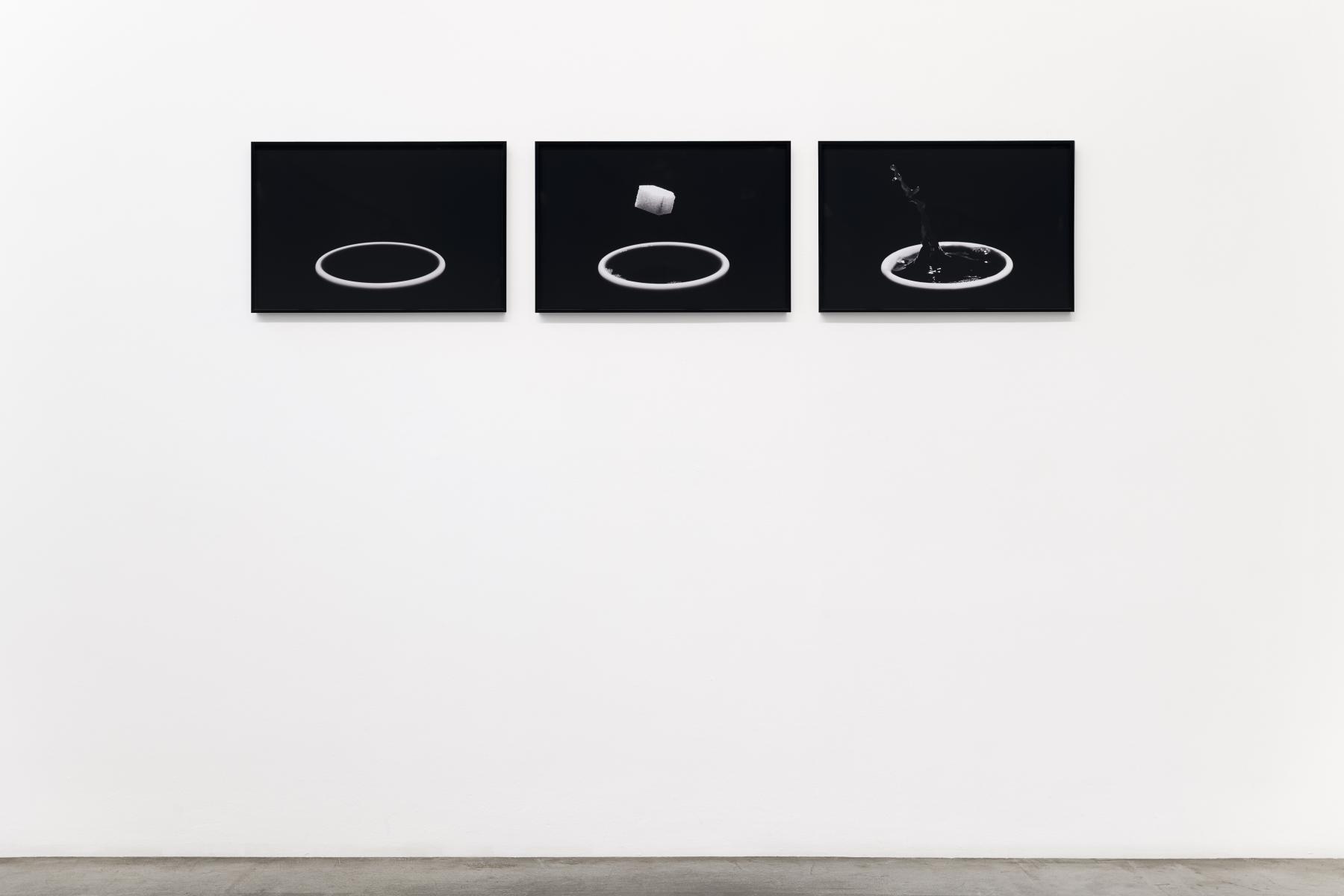
Atiena R. Kilfa, 'Espresso Adagio No.2', 2025, Courtesy the artist and Galerie Neu, Berlin

Ingrid Pollard, 'Bow Down and Very Low – 1, 2, 3', 2021. Courtesy the artist. Photograph by Franklyn Rodger
Conditions for Sustainable Commitment to Revolution
How do we create conditions for a sustainable commitment to the kind of change that these women were committed to? As you're talking, what I'm hearing is also a life arc. But what happens later? Those women were probably in their 20s and early 30s. That enthusiasm and energy and freedom to choose your responsibilities and commitments diminishes as you age. And I wonder if that is always the cycle: uber commitment to the cause and then slowly drawing away as responsibilities drill you down. And if that is the case, how do we escape that trap?
I do want to push back against this idea that young people are very revolutionary and very active and then as you get older you stop because I think it does us a disservice. I think it is something that we need to unpack as maybe also destructive because it gives us the idea that this kind of utopic vision for revolution, or even just for a sustainable living environment, is somehow youthful, as in naïve, but then real life comes.
To be honest, some of the most grounded, loving, revolutionary people that I know, the people who I feel most possibility around, are elders. Black lesbian women in their 70s who have such a clear, powerful commitment to everything that they have experienced in their lives, pointing towards there being a way to live otherwise.
[I refuse] this idea that people get less revolutionary as they get older. I even have conversations with some of these elders and I push back against their thinking that they're not as revolutionary as they used to be because I think it collapses revolutionary into one way of being and resisting. And I think perhaps our relationship to risk changes, what's possible [changes].
A commitment to a certain kind of life and ideas does require you to have some freedom. Not everybody has access to the same funds. I mention this in terms of time and what you want to commit to. Continuing this struggle can lead to destitution and poverty if you don't have inherited wealth, or access to a community that takes care of you.
I feel your pushback, but I wonder how we can include material circumstances in a consideration of people's ability to commit in a lifelong way to these ideas that require a different kind of sacrifice in the beginning, and over time require increasing amounts of sacrifice to your career, to your living circumstances, to your friendships, to everything.
My first thoughts are intergenerational cooperative economics. International solidarity.
Material conditions are always precarious for oppressed communities, whether or not somebody finds some independent stability. Because actually there are other ways to allow communities to sustain together. I want to push back on this idea of material conditions becoming something essential, important [over time], whereas they aren't so much when you're younger. In all ages, in all communities, in all conditions, our access to material safety and the conditions of liveability are vital. That is what is required.
And also I am talking about a kind of international solidarity where the material conditions in the kind of global north and the global south become this opportunity slash very real set of conditions and risks that we then have to consider if we're really serious about a collective commitment.
An individual independent commitment will always bring up competition: alienation; us or them; I can only do what I can do because I need to be able to feed myself. You [will] always get into this set of problems.
Collaboration as Practice
You were talking about intergenerational solidarity and the difference between going about these kinds of commitments individually versus collectively. Let’s extend this into your own work. You're currently half of the artist duo repertoire, and you've worked collaboratively in the past in different ways. How and why is that kind of practice important to you?
I really like working collaboratively. What's generated [is] more than the sum of its parts. There's something wonderful about that and what I learn about myself and how I develop as an artist, as a writer, as a curator, as a person, through relationship building through collaboration. But then even in the description of that collaborative working is an assertion of myself as an independent practitioner who is bound in some way—even if those boundaries are sometimes porous— I do see myself as a kind of entity that I care for that I try to develop and learn from [and] evolve within.
There's a certain kind of agency which comes from collaboration. Most of the things that I have done in my work life have been myself and somebody else, or a group of other people, wanting to do something and making it happen, rather than necessarily being invited as an individual or as a collaboration. I have work relationships with these people, but I also have life relationships with these people: I collaborate with my wife as repertoire; dear friends of mine are also my collaborators. I also like to work with people over time. And so [these relationships] shift and change as life shifts and changes. It [becomes an] interesting mapping of my relationships.
I feel like connected to this shift from individual work to collaboration. For me, Black Study is this way of surviving, being, and exchanging that allows me to go on and feel okay. I write, I teach, I show up, but I'm also growing, and I feel okay. I feel solace. I am no longer as invested in fixing the world as I used to be. My disappointments shifted my attention towards finding nourishing collaborations with people. I see that by reshaping our relationships to each other and the networks that we make, we can do something. These investments create all kinds of soft, slow reverberations.
Practical material conditions can certainly be shifted: by bringing people in and through collaboration, through asking for more money, through resourcing the work of more people, and through creating cycles of money within a community that is blocked from that cycle of money. Programming is also a way to pay lots of people. Bringing people into an exhibition is also a way to pay lots of Black women.
Outside of the conditions of capitalism and of materiality, outside of the university or the institution or the gallery, there are clandestine ways where collaboration is also a way of finding thought partners, of developing and growing, of protecting, of nourishing.
And that does come from a certain conception of Black Study outside of the institution, which is this gathering, which is this discursiveness, which is this stealing away from the kind of public discourse of study, of collectivity, of collaboration, which is always a kind of performance because there's always an audience.
As much as the material conditions that can be altered through collaboration in public are important to me, Black Study actually is something that I consider to be first and foremost outside of the institution. It was intruded into the institution, [or, reworking Bedour Alagraa] it was cannibalised by the institution, and is really a way of living and being together, of relationship building for Black liberation practice that is always already ongoing.