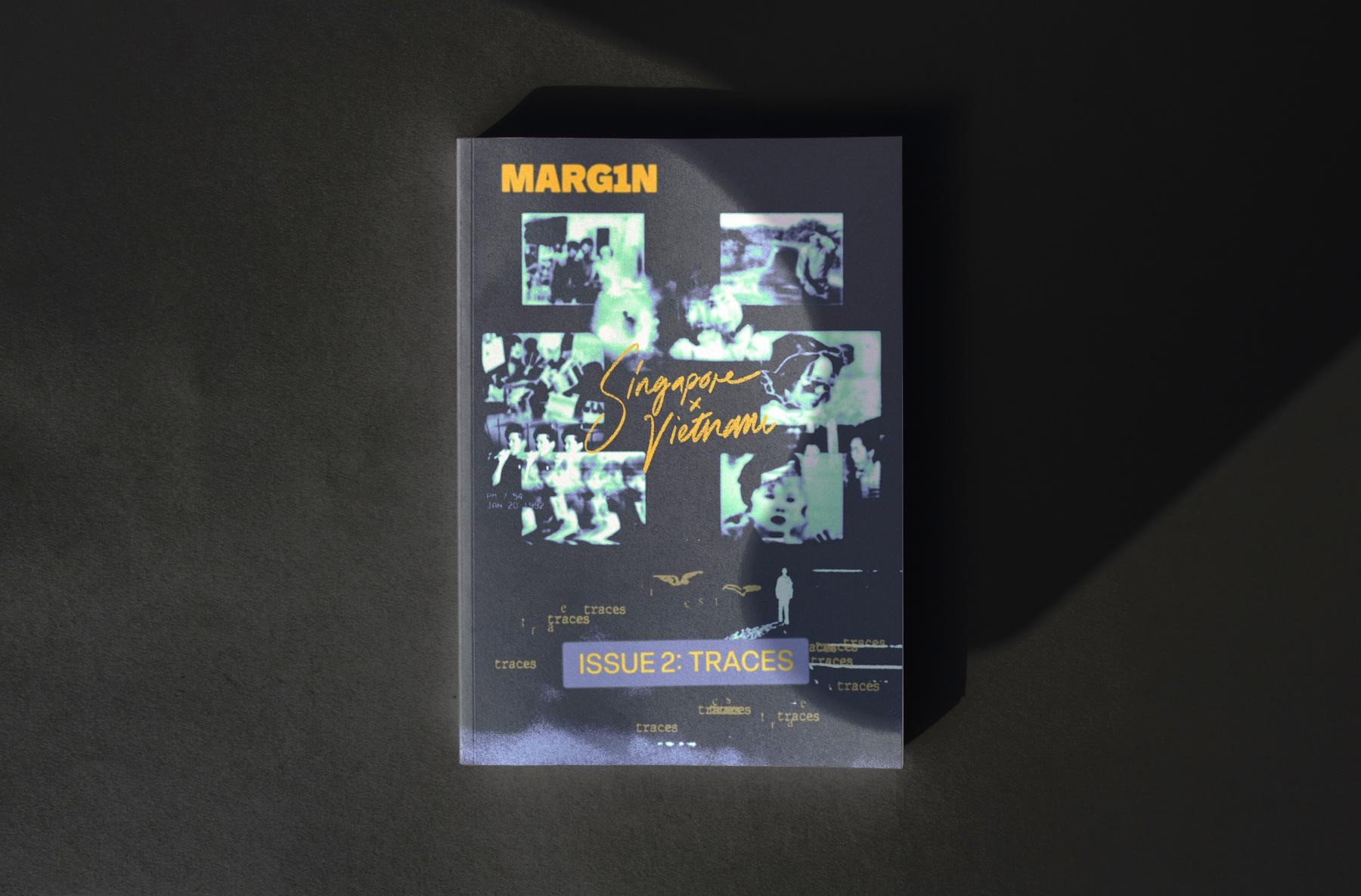
Cover of MARG1N, Issue Two : Traces. Photo courtesy of publisher.
Last year, Ho Chi Minh City was recognized by UNESCO as a “city of film.” This might strike those who live here as puzzling, the city where the evening’s offerings are four domestic horror movies and The Devil Wears Prada 2? A more diverse cinema culture does exist—in art spaces, bars, unlisted venues, sometimes even the cineplex, but not with a mainstream presence such an honorific implies. But the recognition is not about the art form but, as the UNESCO representative put it at the ceremony, about “placing creativity at the center of sustainable development.” That is, a cultural industry measured by its numbers, such as the stated goal of making up 7 percent of the city’s GRDP by 2030. The same calculus prevails across the region, though for some of Vietnam’s neighbors, it’s not only a matter of priorities—there isn’t any money to begin with.
So I was surprised to come across MARG1N magazine at a pop-up bookshop—an intricately designed, print publication celebrating cinema, run out of Phnom Penh. Its pages, playfully attuned to the relationship between image and language, as a film itself, are populated by writers, scholars, cinematographers, self-taught aficionados, “bonafide pirates,” of reviews, correspondences, scripts, impassioned deep-dives. MARG1N covers Southeast Asia, a category more often broad than useful, as the founders themselves are first to acknowledge; yet each issue, focused on a few countries through a theme, ends up complicating that framing rather than just reinforcing it. Issue 1, “pirate.lov3r.2024.mkv,” pairs Cambodia and the Philippines through torrenting and file-sharing culture—the bootleg networks that unite its citizens, including our magazine’s founders. Issue 2, “Traces,” turns to Vietnam and Singapore through “what has passed and what is becoming,” or, read in plainer terms, censorship. Issue 3, “Cosmos,” released this Fall, will look to the skies of Brunei, Thailand, and Timor-Leste—the celestial gods and bomb flares alike lighting up a terrain at war.
Under the difficult conditions that plague the region—the despotism, military rule, surveillance, or poverty—a film can become a vital tool: a premise for gathering, an alternate perspective, a rogue education. Yet when art can only be useful, that is also a loss. MARG1N feels rare in its containment of all these aspects, never disregarding the sober material conditions, while still taken with the magical pleasures of the medium. I met with the team—filmmaker and editor Savunthara Seng (Thara) and graphic designer Sonich Touch, both based in Cambodia, and writer and editor Alyssandra Maxine (Max), based in the Philippines—to talk about why anyone would make a print magazine in this day and age.
We don’t posture as an authoritative, objective resource on regional filmmaking, but in each issue, we try to present many ideas that build on what the hell “Southeast Asian films” mean, as fraught as the term is, the people involved in the different scenes and the myriad forms film writing can take
Minh Nguyen: How did this project start?
Thara: I met Max on Letterboxd actually.
MN: Incredible. How?
T: We were following each other, and I saw her film diary. I was trying to find Lav Diaz’s Evolution of a Filipino Family, and we ended up chatting in the comments about how I could pirate a copy online, this eleven-hour movie. It was also around the time of COVID, when people watched films together online. That’s sort of how it started. There’s since been a migration to Discord where people marathon films, and this proliferation of what was once the mundane act of pirating suddenly got exciting again, because file-sharing became sanctified.
MARG1N’s production is supported by Anti-Archive. As the graphic designer, Sonich has been responsible for the main image of the magazine from the start. It’s a creative collaboration between the three of us: Max handles the line edits on pieces, Sonich does the designs, I handle the publishing and overall wrangling and distribution.
Max: It’s cool to work on a project where curating the pieces is as intensive as independently distributing the printed issue. Selling magazines solely in Cambodia or the Philippines would be financially unviable with our current pricing and niche markets. So when we bring MARG1N to Southeast Asia and other parts of the world, it makes our decisions during the conceptualization and the editorial process more intentional.
MN: Can you tell me more about Anti-Archive?
T: It’s founded by filmmakers Davy Chou, Kavich Neang, and Steve Chen. I work as a production assistant and help with different tasks. It’s been around for more than a decade, and started out as a way to help realize their films. Then Danech San and Sreylin Meas, who were working in production or as set assistants later became filmmakers themselves. Anti-Archive thus became a kind of concentrated force to realize their projects, a necessity in a way. Later, MARG1N came along in 2023, as a seed of an idea, and was also supported by Davy and the team, as it shares the same ethos of trying something out and seeing where it leads.
What Anti-Archive represents is a small fraction of an even smaller, struggling industry. We’re working with limited resources, the majority of our funding comes from outside the region, 90% of the time from Europe. The larger project of the collective is to shift filmmaking away from foreign production that produces poverty porn you commonly see out of Southeast Asia, or in Cambodia’s case, from the usual Khmer Rouge films and documentaries that do not explore anything other than that historical trauma. MARG1N is a natural extension of that: to produce new memories, to enter transnational dialogues by exiting nationalist stories, particularly in Cambodia where filmmakers sometimes lean on fascistic undertones to “compete” against, say, Vietnam or Thailand.
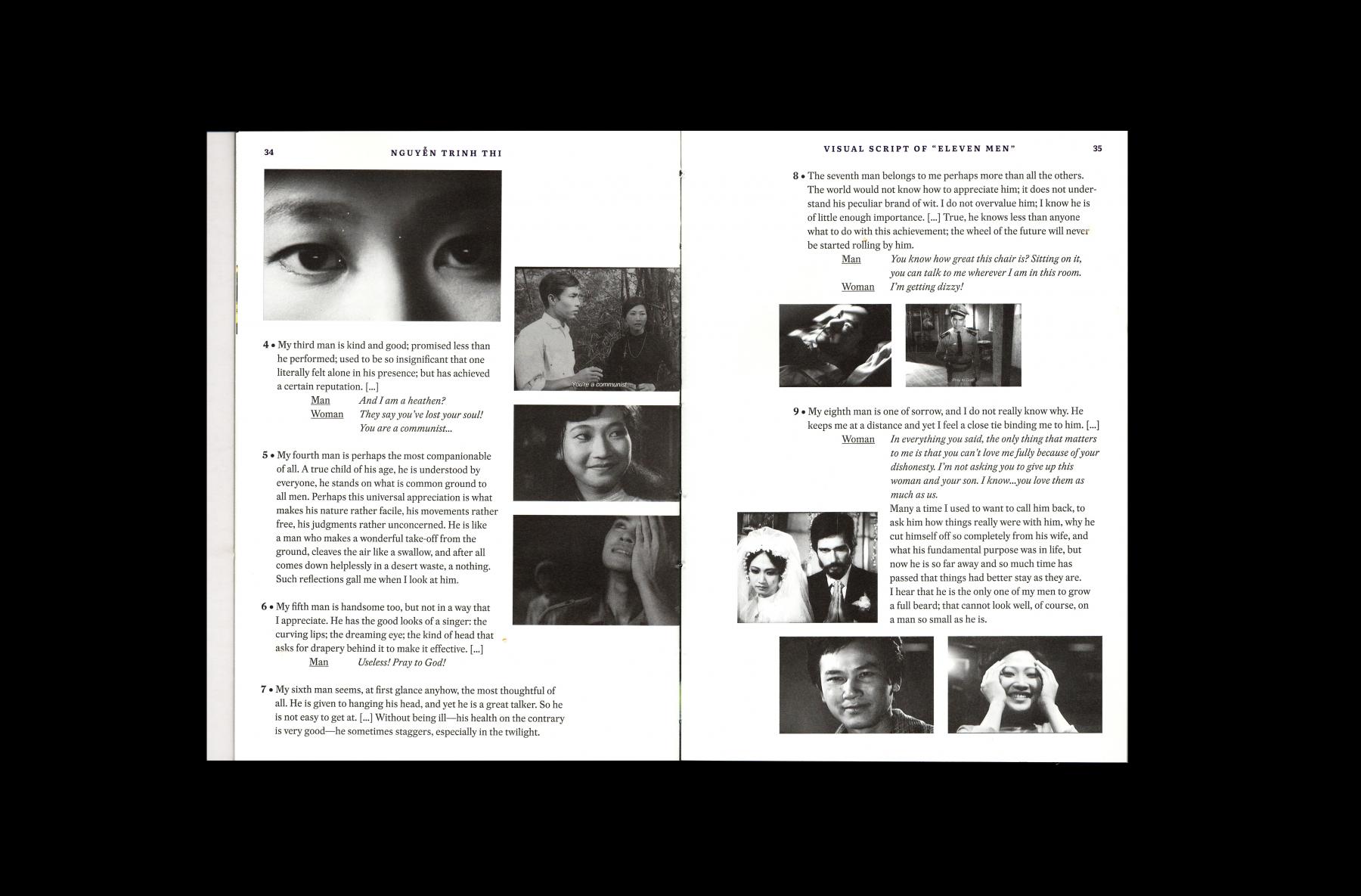
Spread of MARG1N Issue Two: Traces.
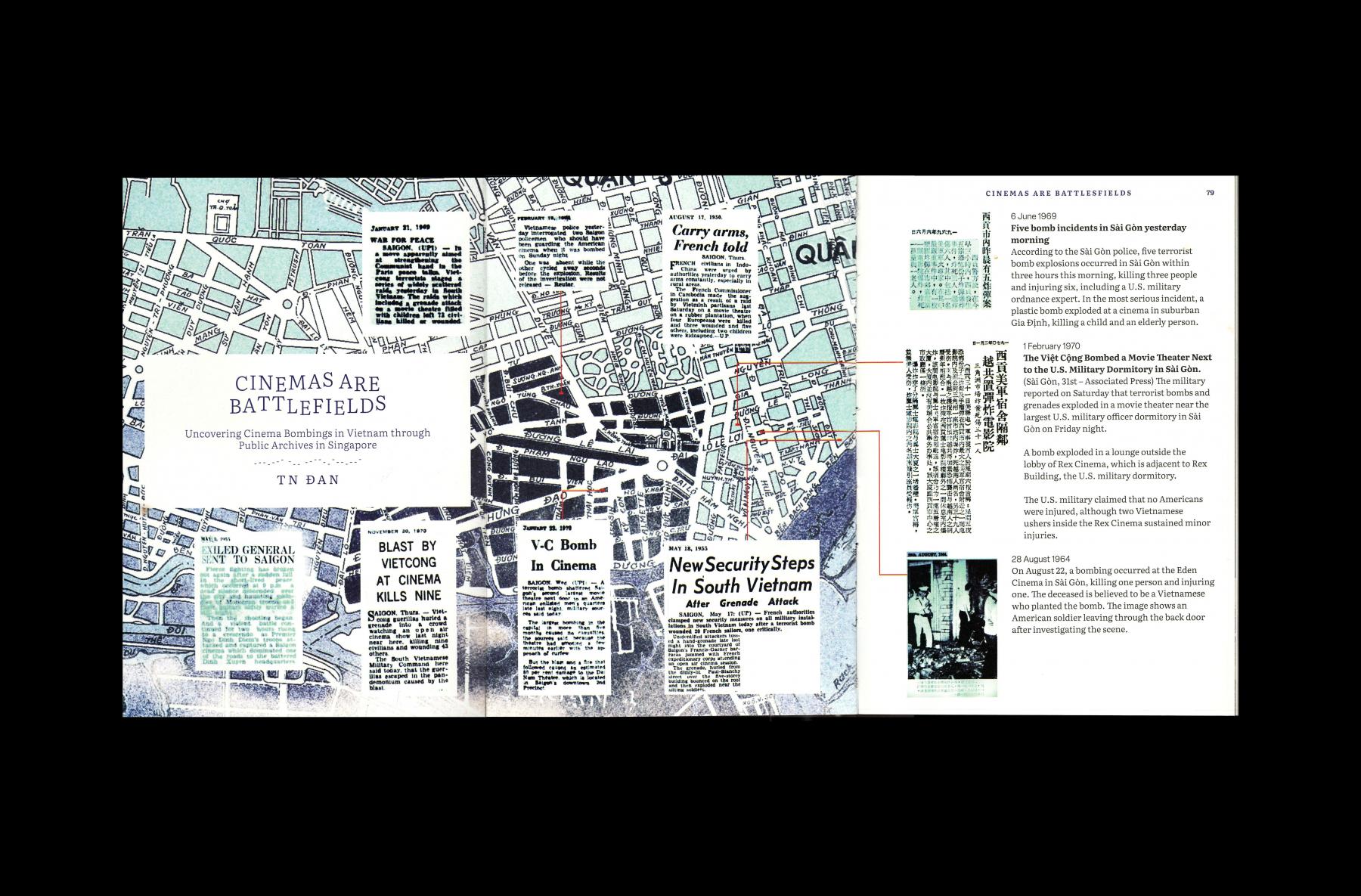
Spread of MARG1N Issue Two: Traces.
MN: What is the film culture like where you’re each based? How did you become cinephiles?
M: In the Philippines, we have an active film culture that’s robust compared to, say, Cambodia, given the Khmer Rouge and the fact that artists there had to flee the country if they weren’t killed. The reference I pulled when conceptualizing the magazine’s framing was Criticine, a now-defunct online Southeast Asian film magazine helmed by the late Alexis Tioseco. I admired the way his criticism was candid and hopeful for Philippine cinema while still being informative and thorough, exemplified in his letter republished posthumously by NANG Magazine. In the Philippines, fully engaging in all octaves of criticism—positive, negative, or somewhere in between—is seen as a provocative act, often met with pushback from filmmakers, studios, and some general audiences. There’s a culture of wanting to keep public discourse civil or fervent with adulation. Miraculously, Tioseco had his equivalent of “hot takes” while remaining an accessible writer and a likeable guy while making appearances on a local TV show as a film reviewer.
MARG1N approaches film writing similarly by pulling lenses from academia, cinephilia, pop culture, and country-specific contexts. We make a genuine effort to probe into each featured nations’ cultures and use the comparative framing of an issue as a call to adventure, encouraging readers to seek out whatever piques their curiosity. I see MARG1N as a time capsule of what captured the attention of writers or cinephiles, one way or another, about something in the film landscapes around or near to them. We don’t posture as an authoritative, objective resource on regional filmmaking, but in each issue, we try to present many ideas that build on what the hell “Southeast Asian films” mean, as fraught as the term is, the people involved in the different scenes and the myriad forms film writing can take.
For example, even a small country like Timor-Leste—where international funding is essential for artistic endeavors, limiting their output—has a film culture worth talking about. But given their “emergent”—a word I abhor—and sparse presence in filmmaking discourse, that dimension of their country is rarely invoked until someone else creates that prompt to bounce off of.
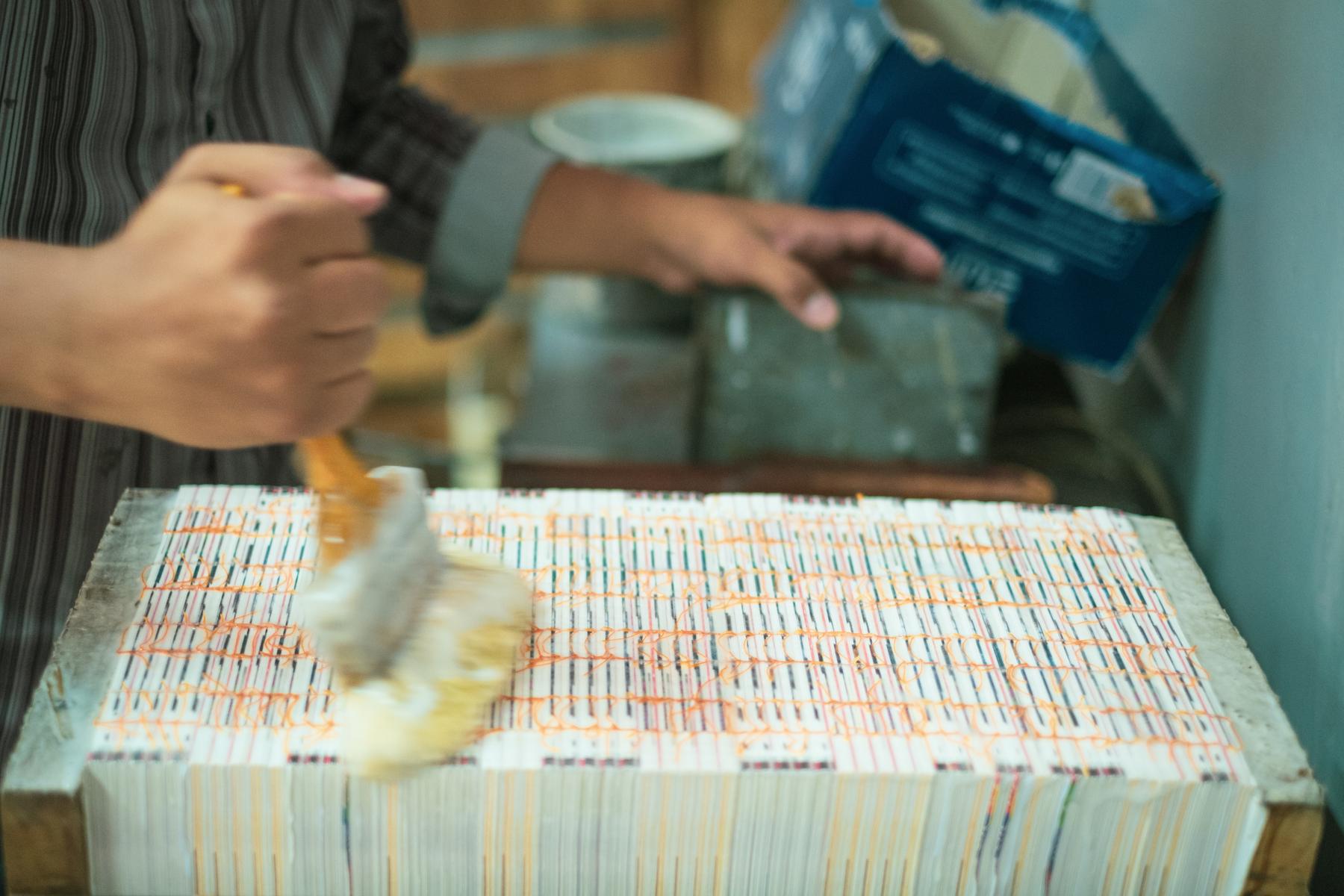
Applying glue to the MARG1N books at the printing shop.
We have this piece in Issue 3 about the last experimental film made in Timor-Leste eight years ago, Ema Nudar Umanu, written by its co-directors, Thomas Henning and Jonas Rusumalay Diaz. For a more personal framing, though not the argument the essay makes, Timor-Leste and the Philippines share colonial Catholic influences that seeped into previously animistic societies.
However, not only is the language or look of Ema Nudar Umanu different from, say, experimental efforts from Raya Martin or Khavn, so are the tactics Henning, Diaz, and their crew used while filming for two weeks in Bairo de Paz. One memorable anecdote is that they spent a large portion of their limited budget to send cameras from Cambodia to Australia and Indonesia before they finally reached the country. Another is that they eventually involved the whole neighborhood into the films as volunteers. I hope that people pick up the issue when it comes out and read about their experiences in further detail. Comparison is the provocation we hope to make.
On that note, we try to not compare our projects to the Global North. Colonial mentality is prevalent within film funding, because that’s where the largest stakes are. Unfortunately, securing local interest can mean chasing legitimacy or prestige abroad first, where success and sustainability are never guaranteed.
We also wanted to print this magazine because so much film discourse in Southeast Asia happens in closed gardens on social media. When someone posts something on Facebook, Instagram, or Letterboxd, they’re entrusting the long-term archiving of their content to for-profit companies. But if you’re a hardcore cinephile outside a major city, you’re on forums, which have migrated to even more inaccessible, unindexed services like Discord, which require accounts and moderator approval to access. Because MARG1N is in print, the ideas within are preserved outside of the internet.
Sonich: In Phnom Penh, the cinephile scene is pretty young, and the readership for film writing is small, much smaller compared to our neighbors. For me, the project pushes the conversations around regional cinema forward, and through the visual design, which I see as an act similar to translating—it’s a way to pay homage to the films that came before us. There’s no better way to do that than to be seen, exposed, through a kind of rupture that lets a momentum of our regional cinema form. In the first issue, I combined visuals of Khmer and Filipino classic films of the 60s and the harmony of these images tells me, and hopefully the readers, how similar we are.
MN: The books are so beautiful, and is one of the things I like about MARG1N. The other is that it feels like a real convergence—of writers, scholars, viewers, and those who actually make movies. There’s often a separation between the makers and the consumers, we don’t have the same conversation. Academics can describe a film while being totally ignorant of what making one actually entails, and filmmakers can dismiss history and criticism of the medium as irrelevant to their craft. How do you put an issue together?
T: It’s kind of intuitive, choosing the pairing of countries and the topic between them. We chose to start with Cambodia and the Philippines for the first issues, because we were most familiar with the scenes. The issues also come from people we met along the way, and a kind of synergy. I met Dương Mạnh Hùng, a Vietnamese writer and translator, when he was here in Phnom Penh for a film program which featured one of Trương Minh Quý’s short films. We had long conversations about the art and film scenes there, alongside the issues of censorship. It felt natural for him to be our guest editor. While we were producing Issue 2, it also happened that Viet and Nam and Small Hours of the Night were banned in their respective countries. We try to cast a wide range of people: first-time writers, critics, Letterboxd reviewers, actors, film scholars, friends, musicians, poets, and now even astronomers with limited knowledge of films!
S: For the design, we wanted it to feel tangible and textured, congruent with the tactility of print. As for the themes, it’s a very collaborative process. For Cosmos, for instance, Max comes up with the premise and basic concept. We all talk about what the paired countries could offer, and I start imagining a “look” and proposing it, so it gives them an idea when they talk with the writers during editing. After that, I translate what’s been said into something visual, and it builds from there, capturing that essence and cohering it into a single issue at the end.
M: The theme of cosmos specifically came up for the Timor-Leste, Brunei, and Thailand pairing. We found the religious parallels between those places fascinating. Thailand is a Buddhist country. Timor-Leste is Catholic, because of its Portuguese influences and history. Brunei is a Muslim country. So it was cool to have that mélange while also considering that they’re very different cultures under the same sky. The political situations in our highlighted territories always shift as well, like how the films from Vietnam and Singapore were banned when we were working on Traces. And now while we’re working on Cosmos, the war between Thailand and Cambodia escalated and Timor-Leste ascended to ASEAN membership. All these histories become recorded in parallel with cinema. Or we’re just harbingers of the fortunes and the malapropos.
MN: Let’s talk about production and distribution, which, given the regional context, is a large aspect of the project. Where can people find these magazines?
T: We try to put them all over Asia. The way we distribute is kind of like piracy. We have friends hiding copies in their suitcases and bringing them into different countries, like contraband. It’s extremely costly to ship anything outside Cambodia. When I sent copies to Vietnam for the Under the Mango Tree Reading Station [pop-up bookstore at A.Farm art space, organized by Linh Le], I gave an artist a box of around 20 books to take on a bus. I wrote text on the covers to make them look like different books. I smuggled close to 60 copies into Singapore once by labeling each box as gifts for colleagues or friends. It’s always like that, people bringing them to Vietnam, Singapore, Thailand, Indonesia, wrapping them to look like gifts or personal belongings.
Strict anti-money laundering rules from PayPal and other processors make it hard to accept international payments, so our distribution is very DIY. I rely on friends and the film scene of people always traveling to festivals abroad, to carry a few copies with them outside Southeast Asia, particularly Anti-Archive producer Daniel Mattes who’s tallied up the carriage up to hundreds of copies.
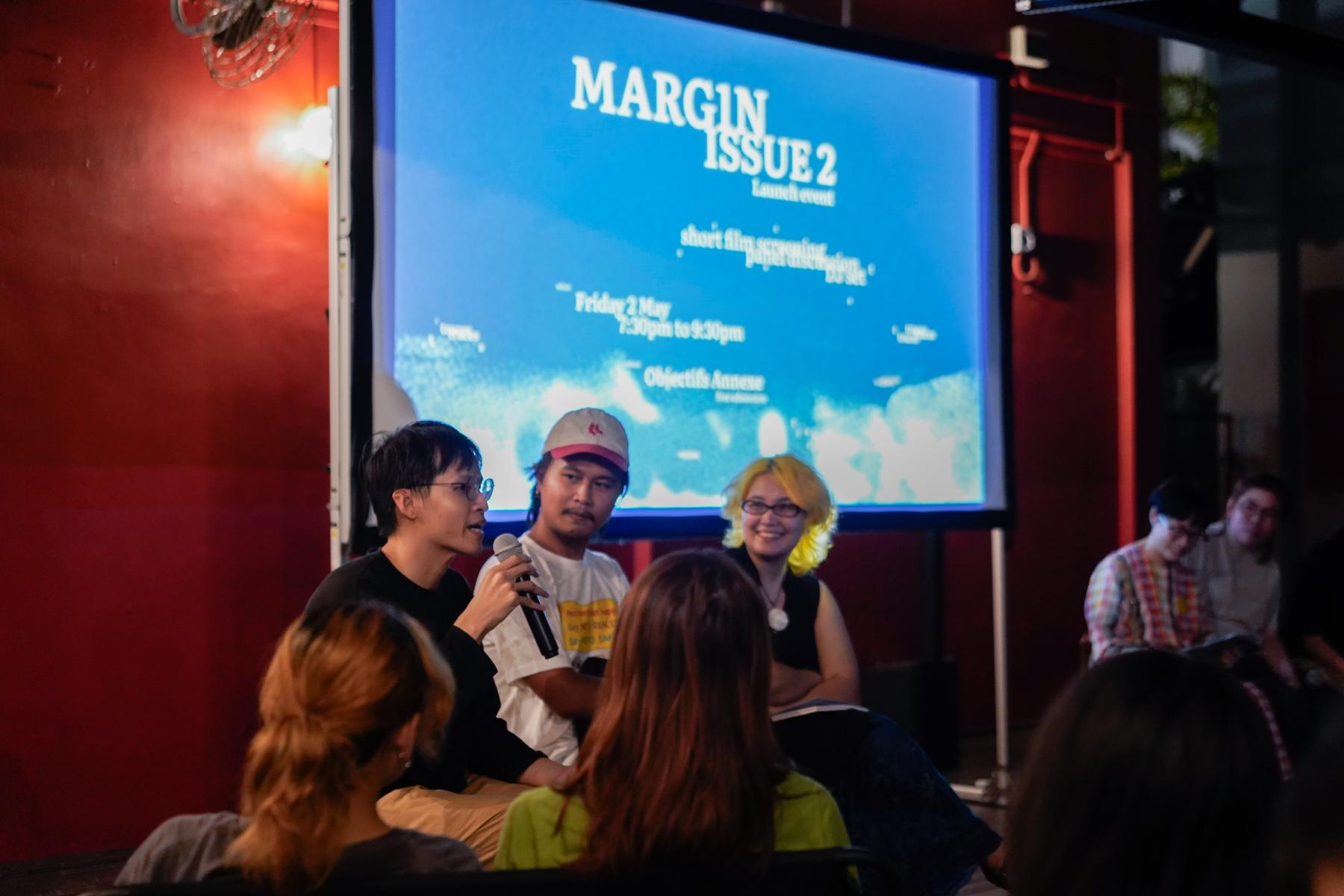
MARG1N Issue 1 launch at Objectifs, Centre for Photography and Film, Singapore, 2025.
 in Hanoi.jpg)
MARG1N showcase at Như Trăng Trong Đêm in Hanoi, Vietnam, 2025.
MN: Have there been any memorable or surprising receptions to MARG1N?
T: What’s surprised me is the growing readership outside Southeast Asia. I didn’t expect the interest we’ve found in diasporic circles in the US. Some publications have asked about collaborating on cross-publication, or on programs, or to republish articles or program films from the magazine. For me, it’s validation that MARG1N should exist.
There’s also an intricate link between MARG1N as a critical space for film writing and Anti-Archive as a film collective. It’s not necessarily a reception but more about how our presence extends beyond line production or image-making, into building a kind of regional and national capacity for filmmakers, cinephiles, and writers alike.
In 2025, we held a talk alongside the Asian Film Archive and Calotta Films on archives and memory-making processes in cinema, during the Như Trăng Trong Đêm (Like the Moon in the Night Sky) film festival in Hanoi, organized by Trương Quế Chi. There we met younger cinephile crowds who came out to see old films. It blew me away that we could attract young crowds like that.
MN: It’s nice to feel the coherence of a niche community here. Flipping through the magazines, I recognize so many names, a good reminder that even when people are separated geographically, they do find each other and stay in conversation. Does this feel like success to you?
M: Measuring impact is difficult, as we refrain from intrusive analytics. The resonance is more diffuse. Some contributors have continued writing on their own while others viewed the experience as a one-and-done thing. We learn something from every issue, including understanding who our readers are over time.
T: That’s true. We pretend we’re programmers that way, because the filmmakers who contributed, like Tan Pin Pin or Nguyễn Trinh Thi, are filmmakers we look up to and used to bond over their films back during the Discord days. The magazine conveys our cinephilia, as editors, too.