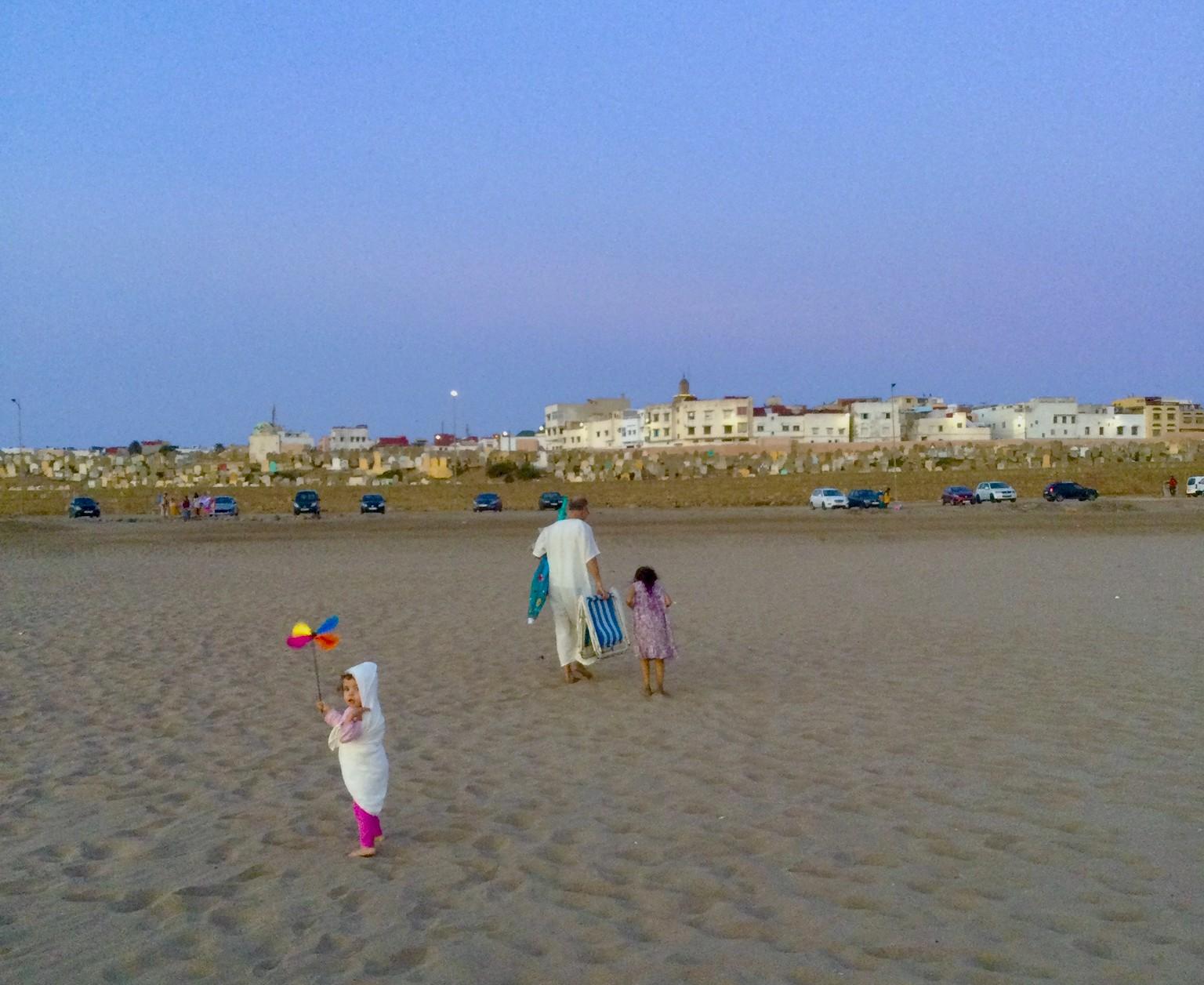
A child in the beach of Salé (author's hometown). Photo taken by Abdellah Taïa
The following story is translated from French by Emma Ramadan
__________
You’ll grow up and you’ll forget, they all said, all of them.
They were wrong, obviously. I know that now. I’m 50 years old. Forgetting doesn’t exist. Forgiveness doesn’t exist. And reconciling with the past seems to be the most difficult thing to do.
We stop running sometimes. We dare to look back. A bygone time still alive in us, in me, reveals itself. An old film starts to play again. Back then. Before. Life. Years. Losses. Regrets. Graves. Some flowers. Some bursts of laughter. And already the tears are falling. There’s nothing else to do. Let the dead images of childhood and adolescence return, resurge, relive. A resurrection. A miracle. Really?
I can’t resist.
I embrace this nostalgia. For a Morocco that might no longer exist. I am not ashamed.
By the Bou Regreg river. Faced with smug Rabat. Everything happened in Salé. My city. My huge family. Poverty day and night. My world forever. Brief happiness and eternal hardship. Our endless arguments and my mother’s daily resistance through sorcery. She is a heroine, my mother. I see that now. But it’s too late. She’s gone, my mother. She lives in one of the graves in the Hay Rahma cemetery.
I keep watching, this me from before that stands up and walks. Is that me? Yes. No. He extends his hand. I take it with no hesitation. I follow him. I become his project, his purpose. We will wander together. The Land of Allah is so vast.
I recognize the scent of the day. It’s Friday. It’s almost 1:00. I smell couscous everywhere. Suddenly I’m very hungry. A hunger that comes from the heart.
Salé is empty. Calm. Abandoned to the phantoms and spirits.
Salé is free. The fear of power and police has disappeared, just for a few hours.
As if the Revolution might begin again.
.jpg)
Abdellah Taia at the age of 6 with his father (Mohamed Taia) and his aunt (Massaouda Taia)
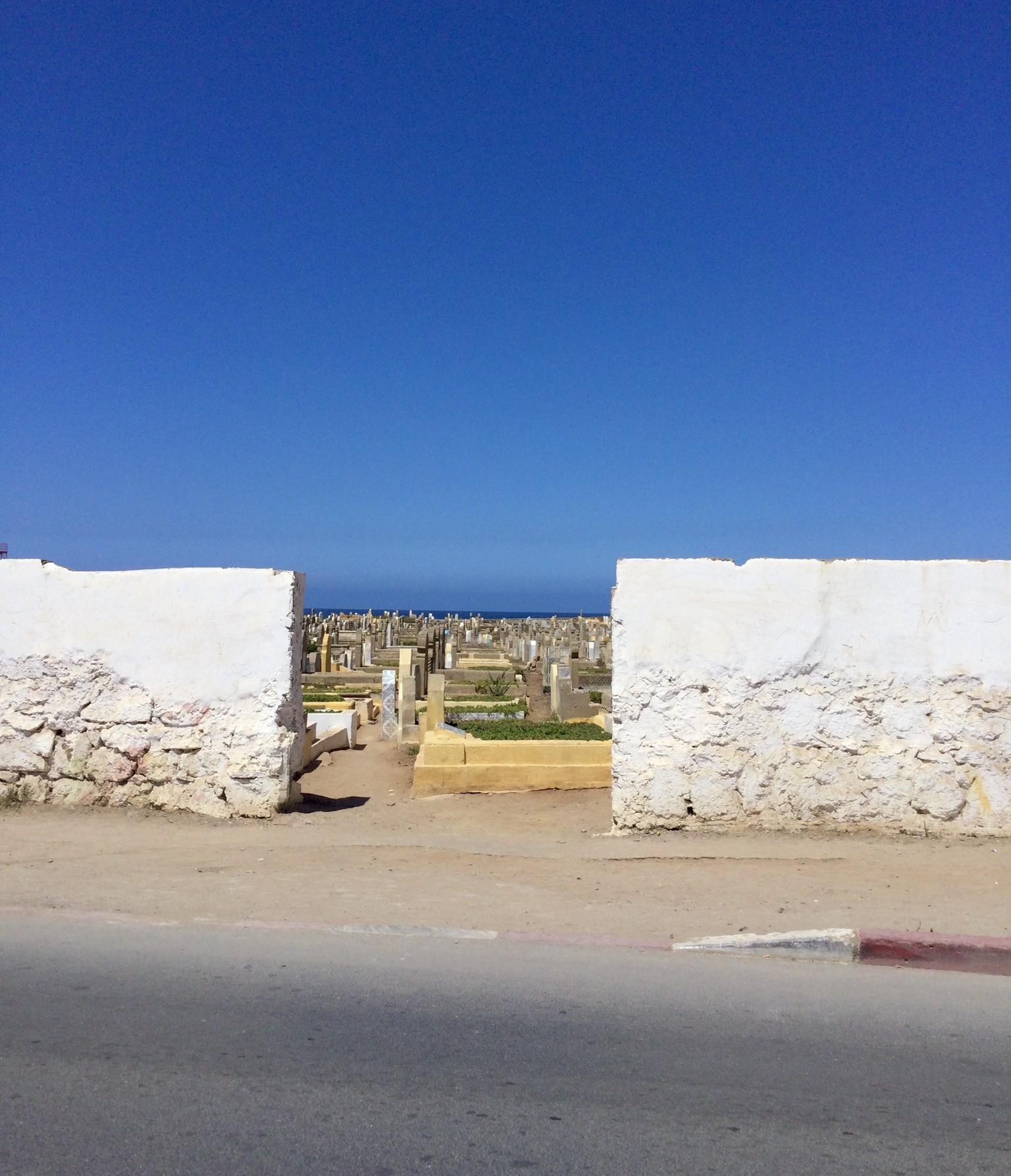
The cemetery of Salé (My Moroccan hometown).
No one has forgotten the thousands of students killed in the ‘60s, ‘70s, and ‘80s for having dared to defy King Hassan II, to protest for democracy, for real modernity, and not the one imposed by the colonialist West, to shout in the streets, for months on end, to demand a fair distribution of wealth.
No one has forgotten the sublime political leader Mehdi Ben Barka, assassinated in Paris in 1963. Ben Barka did so much for the masses, for minorities. Ben Barka is a ghost we still love, intensely, whom we never stop feeding. That is the role of the living, of the survivors: carry the dead, speak to the dead, walk alongside the dead.
It is 1:20. The muezzin announces the Dhuhr call to prayer. His voice is so beautiful. Unreal.
The pious are already at the mosque.
I’m with a group now. We’re four teenagers. I scrutinize them. I can’t remember their names. No big deal. I invent new names for each of them. Soufiane. Hicham. Kamal. And me? I’m still Abdellah.
We are at the very top of a small hill, on the final frontiers between Salé and Rabat. We see the Bou Regreg river clearly. And the other shore, the white capital, where we have never been. Why go where the Rabatis live? We have Salé. We love Salé and the mad saints of Salé. This is where our battles and our loves unfurl.
I am in love with one of the three boys in my group. Kamal. The most fragile. The most tender. He is as effeminate as me. Even more than me. I love him like a brother and like a lover. I love his silence and his way of walking. I love his gestures and his courage. And his shout. I am Kamal the Queen of Salé!
What happened to Kamal? Where is he now? Where does he go? With whom?
I don’t know. I don’t know anything.
I remember Kamal the Queen of Salé and I smile.
Kamal joined the Revolution long before me.
I think all I did was imitate him when later on I dared to tell the world, tell Morocco, my truth: I am gay.
It was Kamal who brought us there, to that hill. Soon, the family that I know will come and bring the couscous for the poor. In an hour, maybe less. As soon as the imam has finished the Friday sermon.
Where are we?
In the Bettana cemetery, Abdellah. Did you pray for the dead when we passed through the main gate? No? Well, do it, right now.
Kamal is the same age as me, 13, but he knows better than me.
I do as he says. I come up with a sincere prayer for the dead. For those who live in these graves, simple, moving, welcoming, in solidarity with those rejected by Morocco.
Graves that do not evoke fear.
Dead who do not judge the living.
A cemetery where the diktats of society pause to leave room for poetry, tenderness, brotherly sex.
I’ve forgotten nothing. Absolutely nothing. Everything comes back.
It was there, in that space outside the law, in life and death, with the beggars waiting for the Friday couscous, that I understood the true meaning of freedom.
Freedom cannot only concern Abdellah. Freedom exists only with others, amidst the struggle with others. Endlessly negotiated and renegotiated with them. Alongside our peaceful graves and our benevolent ghosts.
The Dhuhr prayer has finished.
We approach the main gate of the cemetery.
With the six beggars present that day, we form a circle.
We wait. In silence.
We stare at each other, we smile at each other. There are no more wars, no more conflicts. The couscous that they give to the poor on Friday is on the way. We smell the fragrance of this dish that draws near our circle. Our mouths are all watering. We want to live and we want to eat.
I am not ashamed to be there. Poor among the poor. Connected to the same energy and to the same desire. Under the same Sky. On the same Land. In a new family.
A mother and her 20 year-old son arrive.
The son carries the large plate of couscous. It’s covered with a green cloth.
They stop beside us.
The mother has tears in her eyes. She says nothing.
The son places the dish in the middle of our circle, on the ground. Then, he lifts the green cloth.
It’s a chicken couscous tfaya. A couscous for important days and important guests. Maybe the mother has made a mistake. Is it really for us, the poor, that she has prepared this lavish dish?
Eat, eat, my children. I hope you enjoy the food made by my hands… And please, pray for my son Jallal. He is all I have in this world. Next week he takes the university exams. We need your prayers and your baraka, your blessing.
We do not throw ourselves at the couscous. We all watch the mother and son. Moved, we all understand the important mission that the son must complete. He must absolutely pass his university exams to save his mother and secure her a dignified end of life.
Jallal and his mother are like two branches cut from the same tree. They cling to one another. They live for one another.
We start to eat the couscous. We devour it. It’s very good. It’s divine.
Some of us start to pray for Jallal’s success.
The mother smiles. Her eyes are filled with tears, joy, and gratitude. And me, what about me, won’t you pray for me? My name is Keltoum.
My friend Kamal the Queen of Salé turns to her and says: May God give you light, Lalla Keltoum. Light, success, and eternal love.
I wish for you all, my children, the same light. Light and justice. Eat, eat. All of it. All.
I still live in this Friday, in this cemetery and in this circle.
I am still eating this couscous, so delicious, made by Keltoum. I hear her wonderful words. Light and justice.
I look up at Jallal. I start to love him.
He understands. He smiles at me.
His mother is delighted.