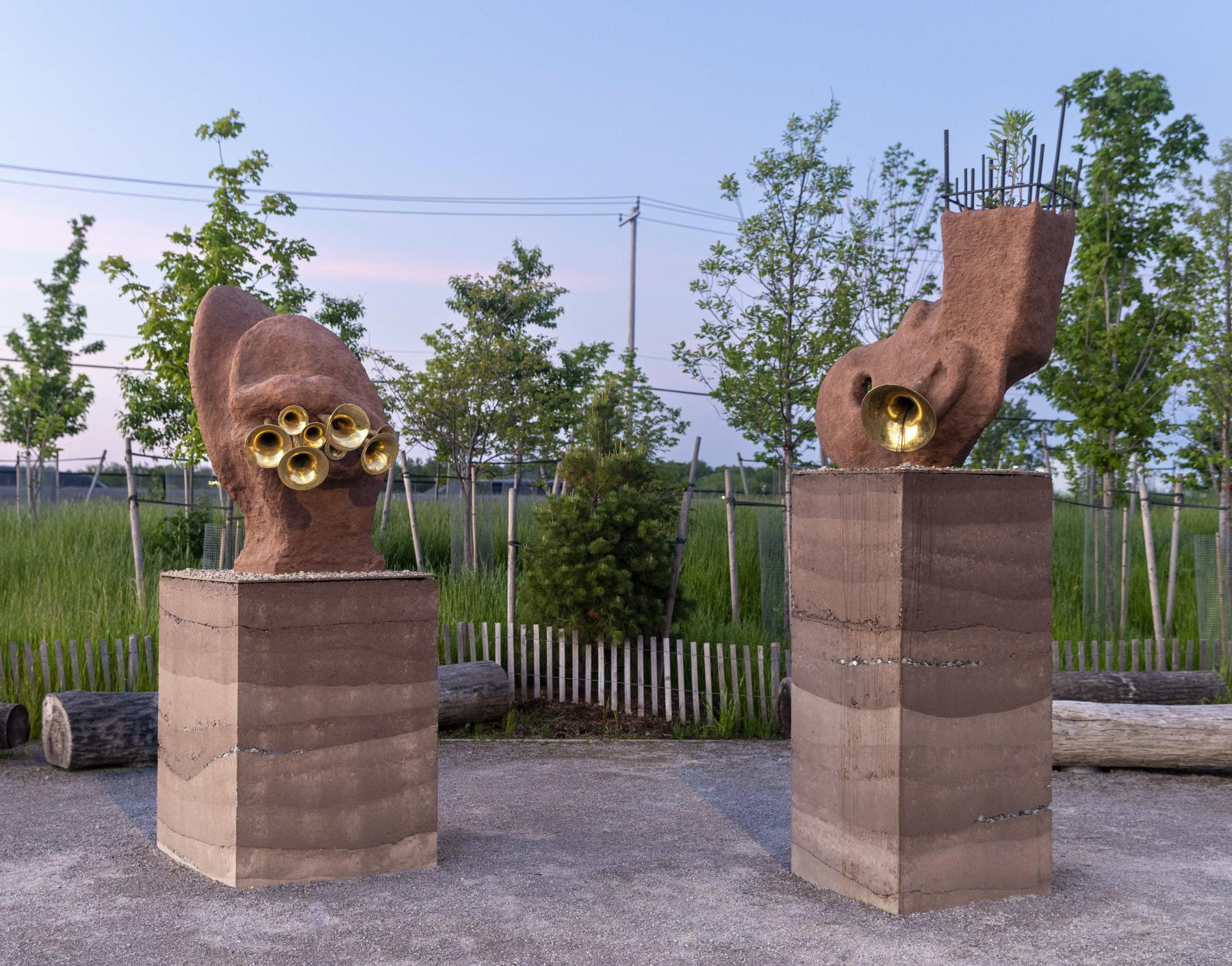
Kara Hamilton, Delicate Matter (for the birds), 2026. Photo Vid Ingelevics and Ryan Walker. Courtesy the artist and Lassonde Art Trail.
On a warm and sunny, but very windy, late-May afternoon, Kara Hamilton and I walked the winding paths of the recently minted Lassonde Art Trail (LAT), housed in Biidaasige Park in the Toronto Port Lands, where Hamilton had just installed a new public artwork titled Delicate Matter (for the birds). The work considers the concept of “re-wilding” by using organic materials such as straw, soil, pebbles, and plant life, as well as a rammed earth technique. Sculpted by hand, Delicate Matter consists of two busts with cob and trumpets recycled by the Toronto District School Board (previously used in her 2019 exhibition “Nothing is wild” at Cooper Cole), which emerge from plinths of rammed earth inlaid with crevices for collected sea glass from the Leslie Spit. The work was completed with the help of York University students while Hamilton was York’s Odette Sculptor-in-Residence. Having been installed shortly before our visit, Hamilton diligently checks some spots for holding strong and a small plastic container she had placed beneath the mouth of a trumpet. The container has some rocks and a dark liquid, which she theorizes as either soil or rust, or a combination of both.
Born and raised in Toronto, Hamilton reveals that her father, an architect, was an advocate for change to the waterfront area. Living now in Toronto’s East End, Hamilton regularly walks her dog at Cherry Beach and notes the significant changes made to the Port Lands since this project has been underway. Personally, she was inspired by a story about 150-year old buried seeds found by construction workers while digging up the land in 2021. Some were extinct plant species. The seeds were taken to the University of Toronto for research and allowed to grow in the soil they had been buried within; in 2023, the plants were returned and replanted in the Port Lands marsh area, serving as a new mouth for the Don River. As we walk the winding trails of the park, replete with many animal species making a comfortable home amongst the native flora and bulrushes, Hamilton says it was exciting to think about what was happening below the surface of what had become a largely industrial wasteland; her concept for Delicate Matter became an emphatic way of encouraging an audience response to this lush new environment. The rammed earth plinths mimic layers of stratification of industrial waste, and Hamilton imagined the “busts” as talking heads discussing what is happening beneath the surface of the earth.
The LAT is a public art project created in conjunction with Waterfront Toronto, which works across federal, provincial, and municipal levels of government to choose “revitalization” projects for Toronto’s waterfront area. Planning began in 2020 via Waterfront Toronto’s Villiers Island (now Ookwemin Minising) and Keating West Public Art Plan, with underground infrastructure built into the park system to support large sculptural works, and, in 2022, Pierre Lassonde—co-founder of the first publicly traded gold royalty and streaming company, the Franco-Nevada Corporation—committed a large sum to establish the Lassonde Art Trail Foundation in 2023. This is not Hamilton’s first public artwork, having installed Curtain Wall, a large wall of Tyndall limestone with two large “eye” cutouts, in two places thus far. But Delicate Matter was conceived of as “a sculptural conversation between living ‘artifacts,’” including a small pollinator garden atop one of the busts, intending for the work to change and become weathered by the outdoor elements it is subject to over time.
Over a nice, long lunch at the heralded White Lily Diner (Kara’s choice) near her studio in the East End, Hamilton tells me the story of her artistic career. Despite her formal training in fine art and architecture, her first work was in video while studying abroad in Paris during her BA in architecture at UBC. She was interested in the hammams in Paris, but “I was behind in terms of my drafting skills, so I explored the architecture through video.” When she returned home, her professors were confused by her final project, which was a video exploration of Parisian architecture rather than a series of drawings, like her peers had done. For her application to Yale, she made a video work inspired by Michael Snow. “I was interested in [William] Wegman and Maya Deren, but couldn’t figure out how to make it work for myself as a career.” Following her MFA in sculpture at Yale, Hamilton’s post-grad work transitioned into making jewellery (which she began doing in childhood) once she moved to New York, where her mother was originally from. A friend of hers was showing at Salon 94—founded by art dealer Jeanne Greenberg Rohatyn, who is now known for integrating the worlds of fine art and design (in part thanks to Hamilton)—and wore some of Hamilton’s jewellery to her opening. Rohatyn became enamoured and excited by the idea of showing and selling it, and Hamilton saw a way to begin making a living from her art. Rohatyn’s high society friends bought pieces, and Barney’s even picked up her work: “They would take me into the backroom and say, ‘What are you doing for next season?’ I would be like, ‘What does that mean?’ They’d ask, ‘Could you use more rubies?’ And I would say, ‘No.’” Hamilton became absorbed into the world of 47th Street, the Diamond District famous for its diamond and jewellery trading, where jewellers would also buy and sell scrap by weight from large buckets in backrooms. Hamilton recalls seeing people lined up in the area to sell their jewellery following the 2008 market crash.
Hamilton explains that while it was admittedly interesting to be part of this burgeoning art and design fusion, she did not want to be a designer. She had inadvertently found herself in between subcultures: one of backroom gold trading, the other an elite class of New York collectors buying her work. To make sense of these intersecting worlds for herself, Hamilton began researching the potential political implications of jewellery and stumbled onto the story of the eight missing Fabergé Easter eggs. All fifty-four of them were created between 1885 and 1917 for the Tsar Alexander III and his son Nicholas II to give as gifts to their wives and mothers. As incredibly ornate commemorative objects of the Romanov empire, several were lost to the Bolshevik Revolution, and others disappeared more mysteriously, still unfound. Representing the stark wealth contrast between the imperial Romanov family and the starving citizens of the Russian empire, the eggs were confiscated as state property following the Revolution in 1917, later sold by Stalin for foreign currency.
With Rohatyn giving her old silver and tableware to support this new direction, Hamilton created the work for her solo exhibition at Salon 94 in 2011, “Gift. Provenance: Unknown,” an installation of sculptural objects combining found metal, cement, found shells, insects, deer antlers, and feathers. Taking the missing Fabergé eggs as subject, Hamilton’s poetic meditation on this historical narrative reveals her interest in investigating the strange tenets of bourgeois rituals and symbolism, namely desires for ostentatiousness as they intersect with other, older traditions of gift-giving. Her sculptures use existing, elaborate descriptions of the missing artifacts to construct new miniature worlds. Formed into the rough shapes of half-eggs with vignettes inside like the original eggs, they coalesce into something that is both referential and deconstructive of the aesthetics and economics of ceremonial gifts. The show posed a challenge for using the material she’d become intimately acquainted with through the act of jewellery-making, figuring out how to “enact value,” in her words, while juxtaposing other natural materials that she found inspiring. Having been recently diagnosed with breast cancer, Hamilton admits her work at the time was an exercise in confronting her mortality, thinking about materials that live forever, and those that don’t. “I became interested in symbols of life and what is cast off, like the way metal and bone mirror each other. They are what’s left.”
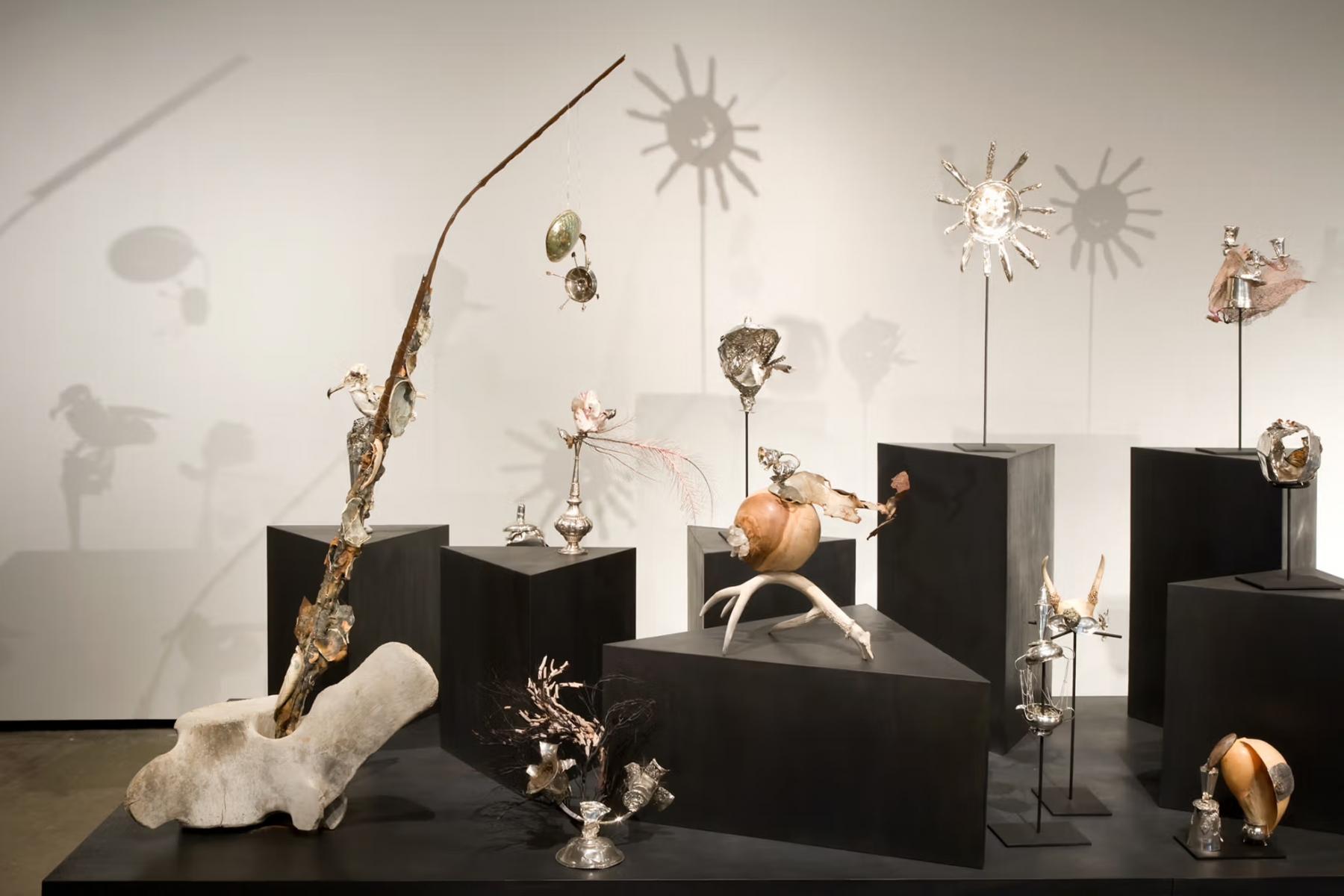
Kara Hamilton, installation view Gift. Provenance: Unknown, 2011-12. Courtesy the artist; Cooper Cole, Toronto; and Salon 94, New York.
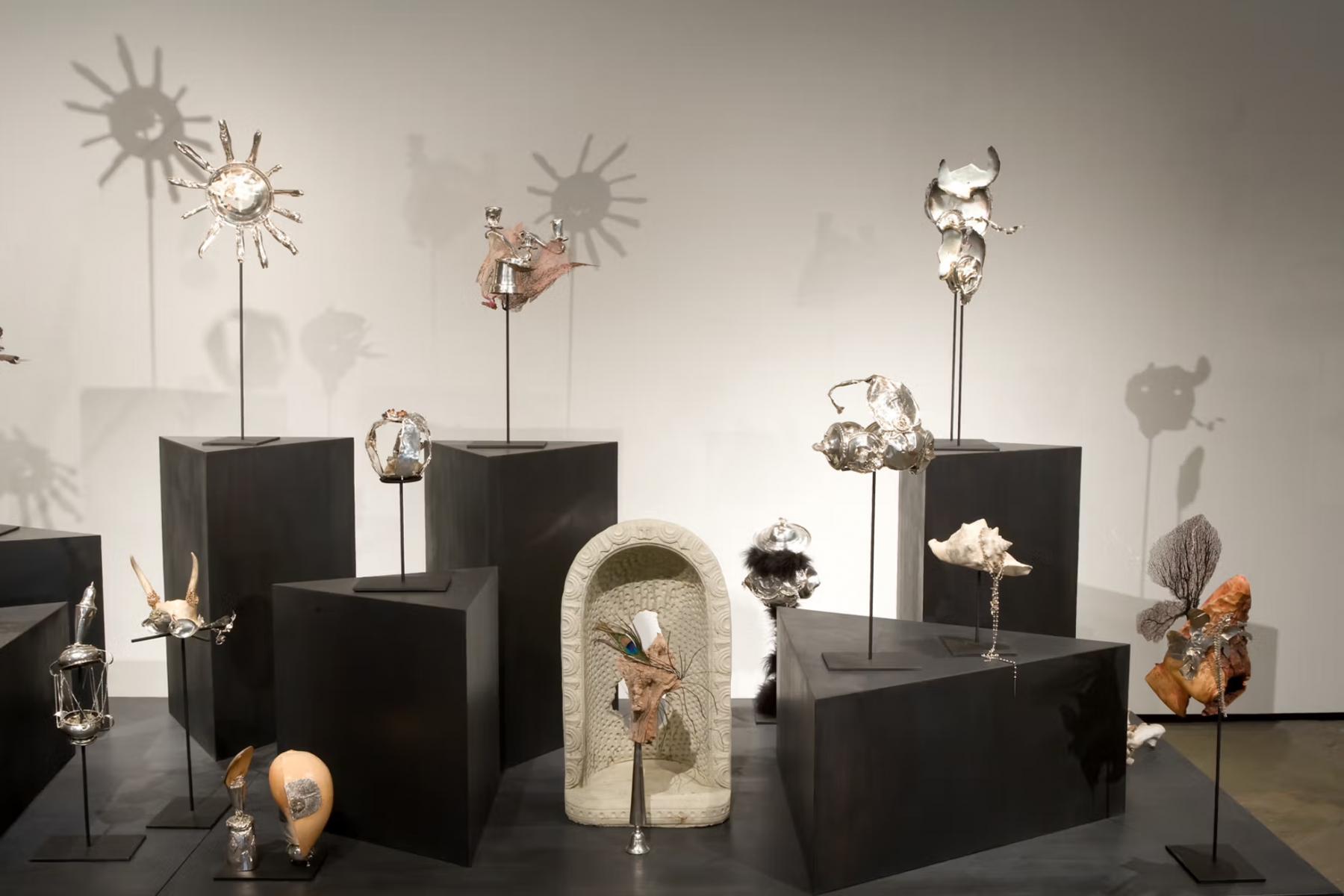
Kara Hamilton, installation view Gift. Provenance: Unknown, 2011-12. Courtesy the artist; Cooper Cole, Toronto; and Salon 94, New York.
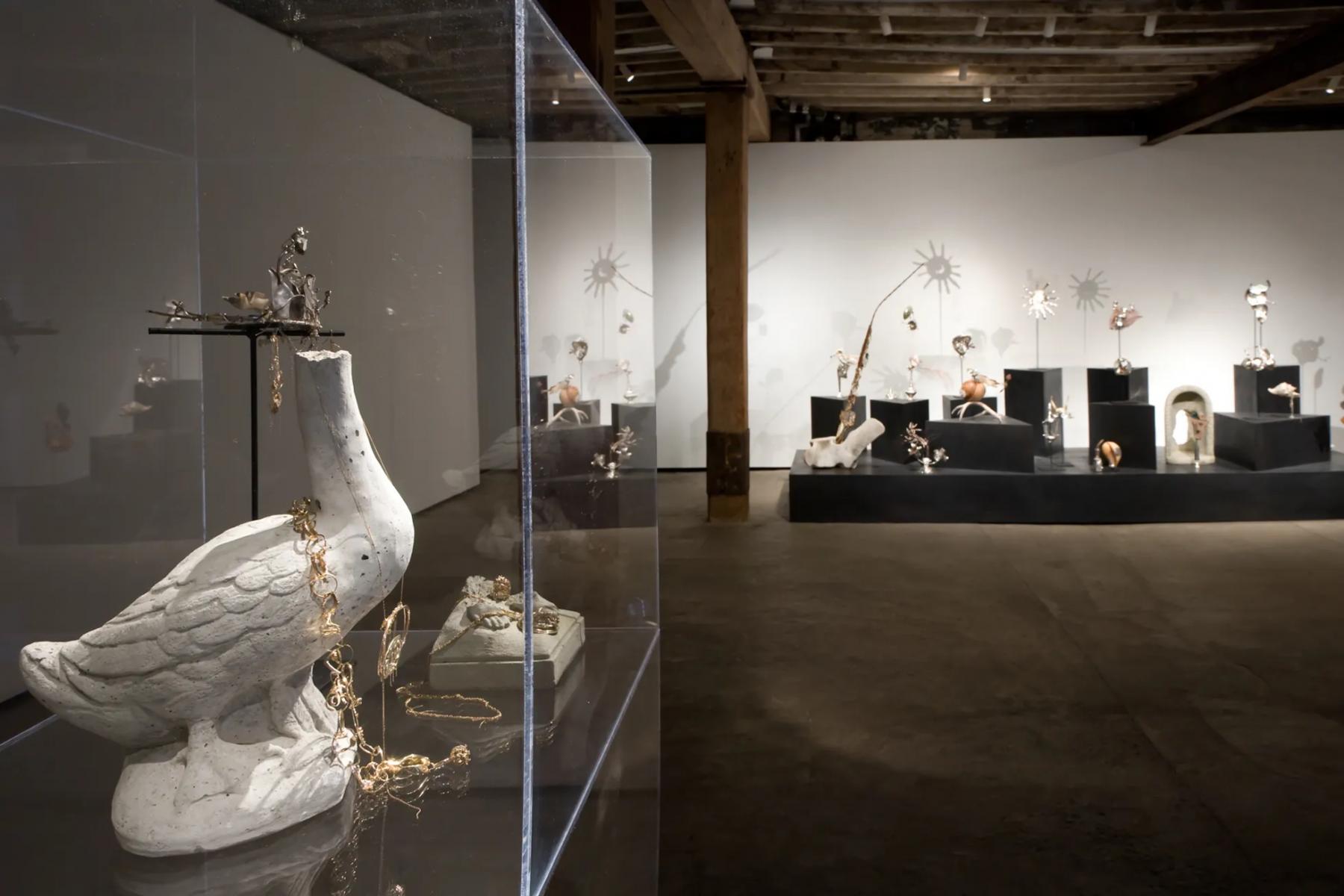
Kara Hamilton, installation view Gift. Provenance: Unknown, 2011-12. Courtesy the artist; Cooper Cole, Toronto; and Salon 94, New York.
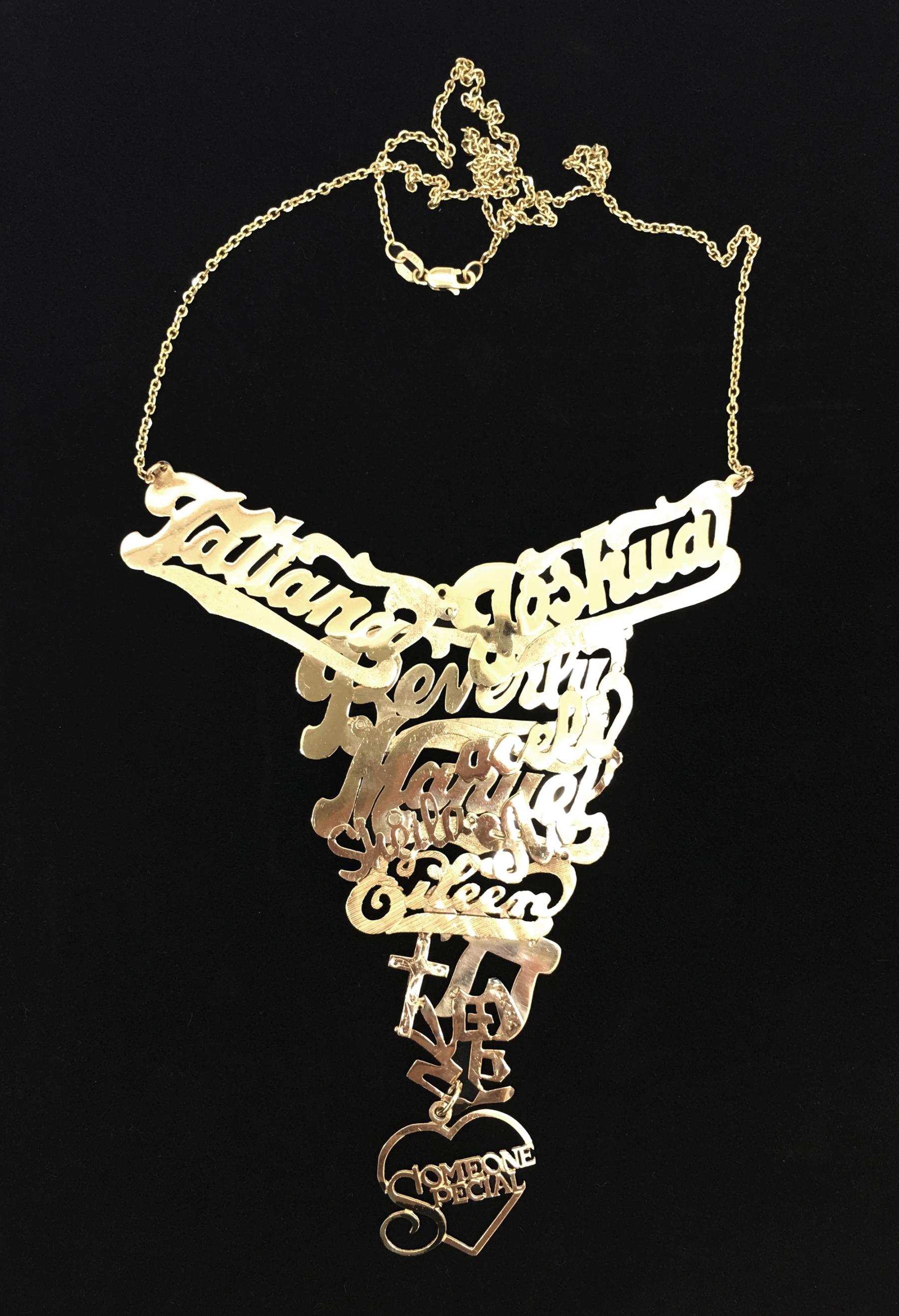
Kara Hamilton, Someone Special, 2012. Courtesy the artist and Cooper Cole, Toronto.
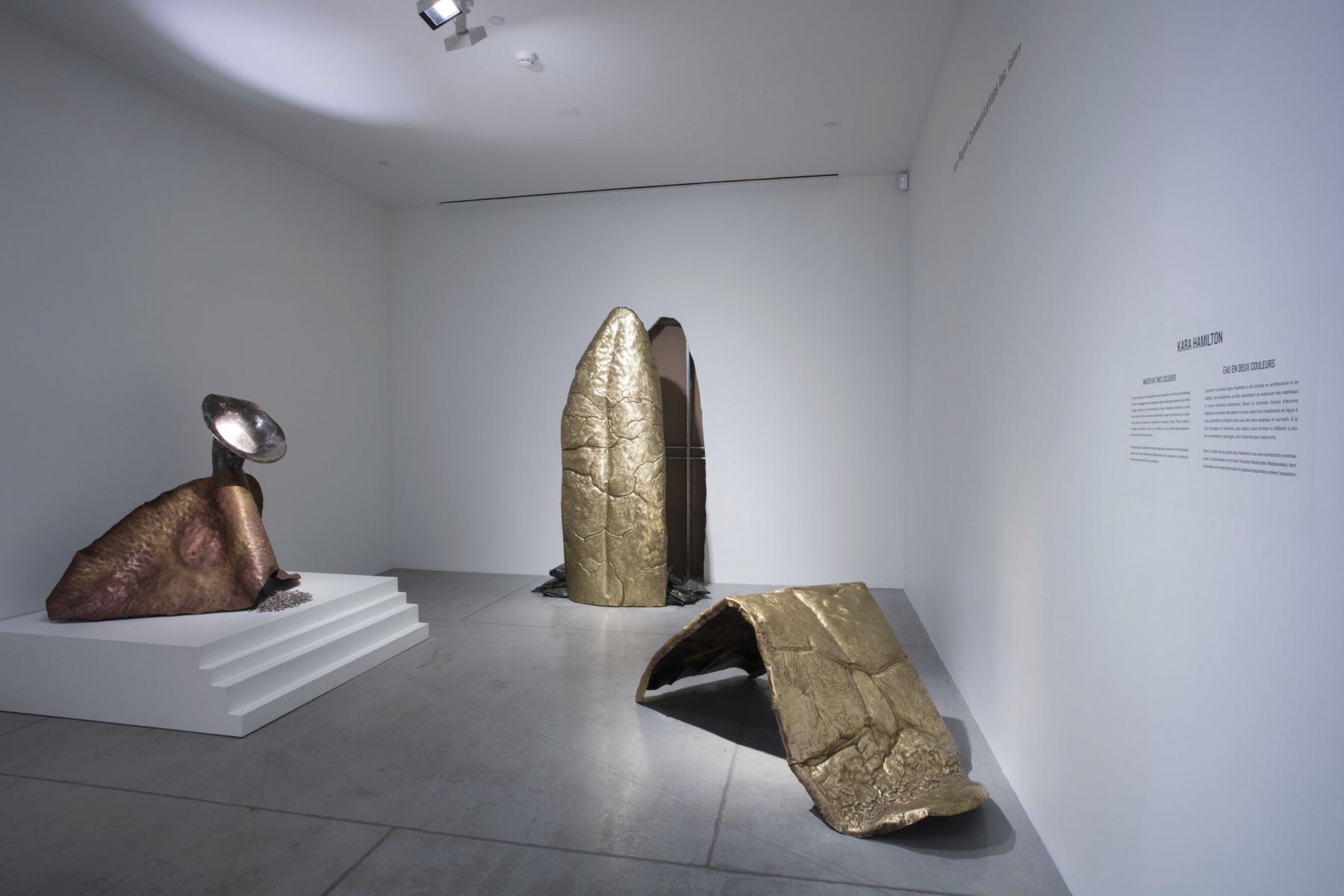
Kara Hamilton, installation view Water in two colours, 2018-19. Courtesy the artist; Cooper Cole, Toronto; and the Art Gallery of Ontario, Toronto.
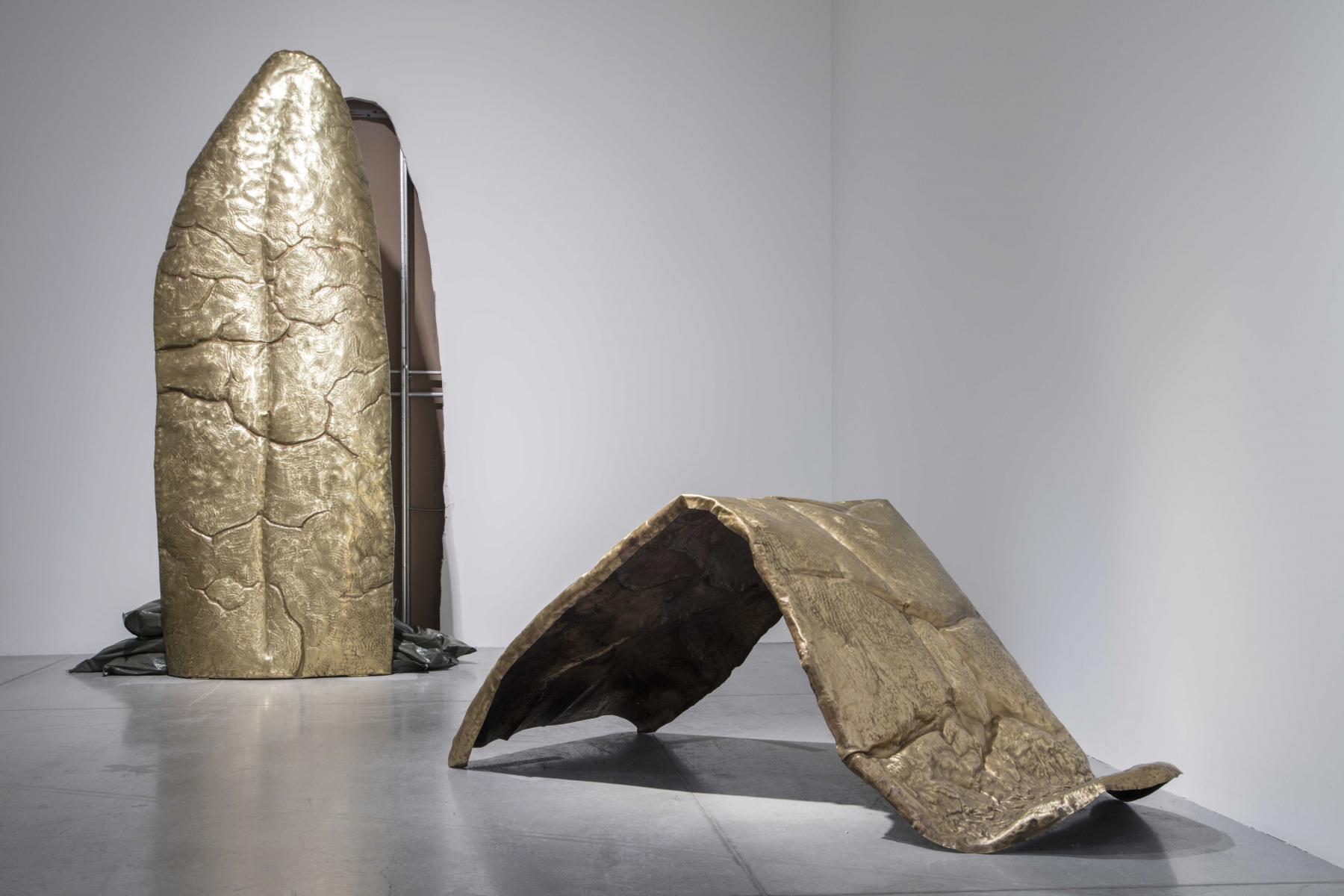
Kara Hamilton, installation view Water in two colours, 2018-19. Courtesy the artist; Cooper Cole, Toronto; and the Art Gallery of Ontario, Toronto.
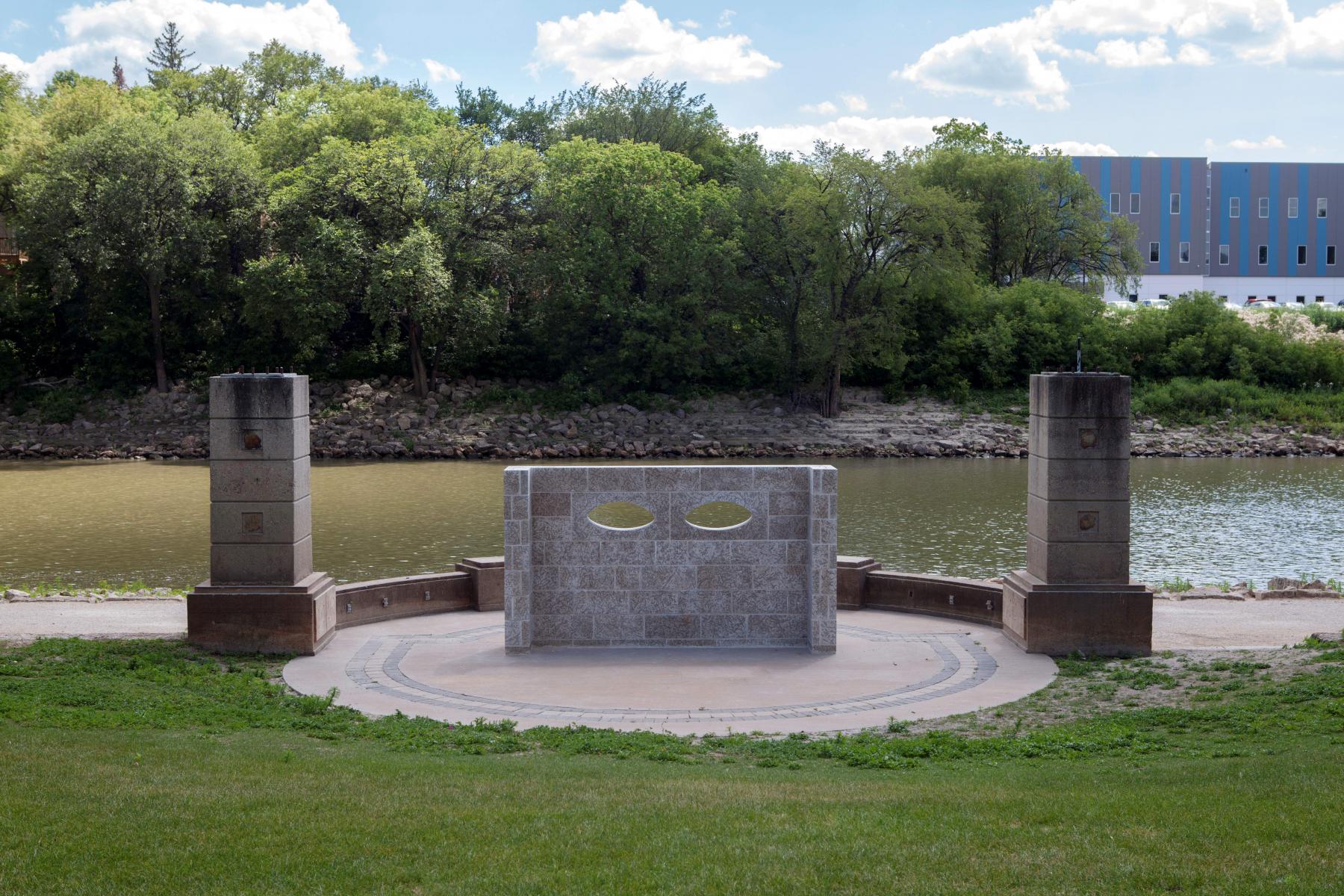
Kara Hamilton, Curtain Wall, 2017, Winnipeg. Courtesy the artist and Cooper Cole, Toronto.
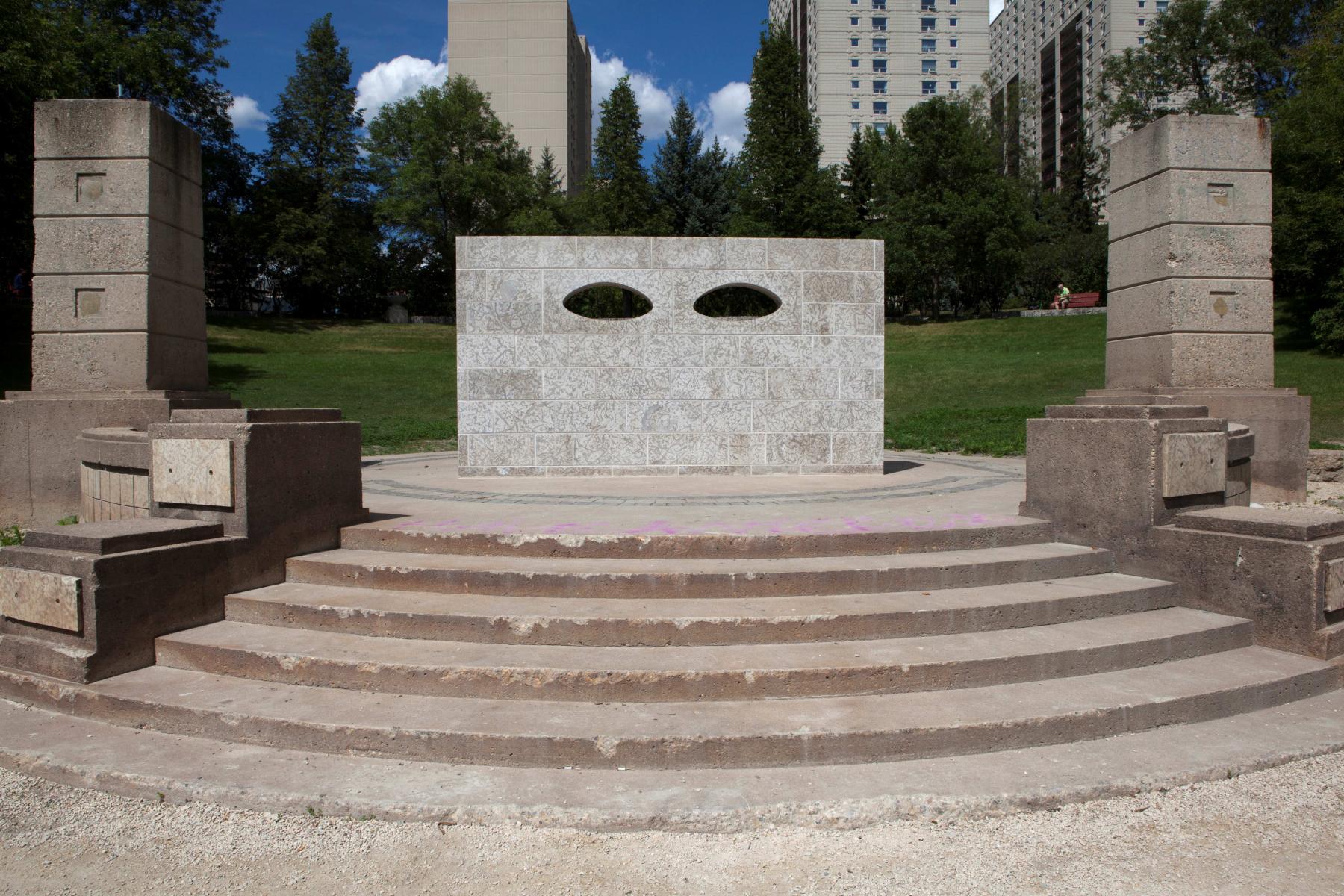
Kara Hamilton, Curtain Wall, 2017, Winnipeg. Courtesy the artist and Cooper Cole, Toronto.
In her 2018 AGO exhibition, “Water in two colours,” which also happened to be my own first encounter with her work, Hamilton pushed her architecture-art-design hybrid further by creating larger sculptures that engaged the complicated histories of materials. The most eye-catching work was a large standing gold tongue, titled Mother Tongue (whale), about three to four feet away from the wall and propped up with a pile of molten metal on the floor behind it with a near-exact cutout from the wall, as though the sculpture had burst forth. As an installation of materially transformed found objects, they continue a lineage in Hamilton’s work of considering shared experiences—such as being in a body—using “precious” materials such as pearls and precious metals. Creating a sort of monument out of a giant tongue in gold, a crucial part of the body for communicating but often taken for granted, Hamilton magnifies a vulnerable need for being seen and heard. Seeing this show, I was a year out of my Master’s and still finding my footing in the Toronto art scene, following a return to Canada after some years away. The scale and simplicity of the work struck me as a sensibility that came together from through the artist’s experiences of being somewhere else. There is a well-known adage—owing to ideas about “provincialness”—that in order for Canadian artists to have a better chance at success, they have to move elsewhere; it would seem that there is also a certain pull for them to eventually return.
Sitting down to talk about his decade-long friendship with Hamilton, artist Scott Treleaven and I also ended up reflecting on this sentiment of leaving and returning as a Canadian artist. Treleaven recalls a culture of stern competition in his younger days in Toronto, and that leaving would put you on a blacklist. In recent years, however, it has since softened into a much more nurturing and supportive scene. This atmosphere of mutual uplifting, according to him, is owed in part to artists like Kara—an artist who came back—whom he crossed paths with serendipitously as the two began showing with Toronto gallery Cooper Cole around the same time. Before moving back to Toronto with his partner, painter Paul P., Laura Hoptman (Executive Director of the Drawing Center, formerly curator in MoMA’s painting department) asked if he knew Hamilton, and that, if not, the two should meet. Ultimately, the two met at a potluck in Hamilton’s studio where they discovered their interests to be very aligned. Treleaven recalls the poignant effect that her work had on him, particularly comparing “how masterfully she handled shifts in scale without any fluctuation in the impact it had”—from the gold jewellery pieces she had exhibited at Cooper Cole in 2016 to the large-scale sculptural works in her AGO exhibition, which we gushed over together. Treleaven’s own practice takes interest in the ways in which artists and others pull at the mind’s threads to prime us for an unexpected experience of potential transformation or uncertainty, a process, he notes, that is susceptible to the cheap tricks of politicians or cult leaders, for example; but in Hamilton’s work, he was immediately struck by its sincerity.
Treleaven highlights the relationship between artist and artisan that comes through as well, as it relates to a process of concern about creation. He suggests that this is part and parcel with both deep thought and deep doubt, much like the Buddhist saying that small doubt leads to small enlightenment, and great doubt to great enlightenment. “Kara doesn’t want to waste anyone’s time, or feed them an idea that hasn’t been thoroughly conceived of.” In dealing with points of great conceptual gravity, what also attracted the two as friends was being “very acquainted with ideas of mortality,” sharing beliefs about being a massive consciousness trapped in a flimsy vessel. Hamilton’s use of more literal demonstrations of mortality, such as bones, fur, and insects, is coupled with subtler considerations of brevity and ephemerality, what endures and what does not.
In projects, such as “Gift. Provenance: Unknown,” “Cats Talk to Dogs in their Own Way” (with Christine Roland, 2013, Taut and Tame, Berlin), and “Live Wire, Tender Stakes” (2024, Cooper Cole), Hamilton shows a concern for museological display. Generally the museum is designed to suspend things just out of reach, pronouncing them as not part of the viewer’s immediate experience—which, of course, depends on one’s socioeconomic positioning. By contrast, Hamilton takes great pains to let the audience in, equally using an intimate scale and an extra-life-size one. Avoiding the term spirituality and the terminating clichés it invokes in most people’s minds, Treleaven proposes that Hamilton, and her work by extension, are concerned with the “imaginal-social” in a way that emphasizes a shared poetic spirit and political uplifting. “For an artist tackling these huge ideas, she’s the real deal. If someone is presenting mortality to me, I want to know that they’ve lived more than simply popping out the other side of a cloistered academic experience like a grad program…. If I’m entrusting the commerce of my soul to someone, I want it to be for real, and Kara fulfills that,” he declares.
Curator Kari Cwynar tells me the story of how she and Hamilton met in Amsterdam and 2013, when Cwynar was participating in the De Appel curatorial program. Visiting Kunsterverein Amsterdam, Cwynar encountered co-founder Maxine Kopsa (another Canadian), who described creating the space as a tongue-in-cheek response to franchising the popular German model, established in the late-18th to early-19th centuries. Traditionally, the Kunstverein (“art association”) is similar to how we know the original model of artist-run centres: non-commercial, publicly-funded, and operated via a membership of artists, broadly defined, to champion contemporary art through exhibitions, programming, events, publications, etc. In Germany, this model is rather professionalized, with all Kunstverein members in the country belonging to a national art workers association as a governing body. However, anyone interested in opening a Kunstverein in another country is able to become part of this network that also nurtures collaboration, while allowing each space to work within its own context and with its own people. Kunstverein Amsterdam opened with the intention of fostering cross-disciplinary programming that would be more unconventional compared to the German model. Revealing that she would like to start something similar in Canada, Cwynar was recommended to meet Hamilton, who had also wanted to do the same. As luck would have it, Hamilton was involved in the Kunstverein Amsterdam exhibition opening the following week, and the two met at the opening.
When back in Canada in 2014, Cwynar and Hamilton met again and Kunstverein Toronto was born within a few months with the blessing of Kunstverein Amsterdam, the main difference being that the former chose not to have their own dedicated physical space. Kunstverein Toronto operates with a similar mission to Amsterdam, seeking out the overlooked moments of art history with an approach that is not centred on visual artists, but also musicians, poets, designers, chefs, and textile artists in order to blur the fine-art and artisan/design divide. The goal was to create an international network of new pathways for Canadian artists to show in Amsterdam or Milan, and for artists showing in those spaces to present to an audience in Toronto. The pair’s first show in June 2014 was a new iteration of the Hypnotic Show by Raimundas Malašauskas and Marcos Lutyens, first presented in 2008 and again at dOCUMENTA(13) in 2012. As Cwynar explains: “They collaborate with artists and writers to develop ‘scripts’ of an ‘exhibition’ that Marcos, the hypnotist, would use to conjure a scenario so that the exhibition would only occur in the audience’s minds.” The project took off thanks to a more nimble funding model at the Canada Council for the Arts at the time, where one could apply for multiple, smaller grants up to $20,000 to use simultaneously for programming. Within their first year, Kunstverein Toronto presented projects with Carolee Schneemann, Glenn Lewis, Alex Waterman, and Maryse Larivière, among others.
Cwynar describes her collaborative relationship with Hamilton as one of ease, where the two have a similar taste for the kind of projects they work on, but their strengths are quite complementary in order to make those projects come together. “One of the reasons why I think we work so well is that she’s an artist and I’m a curator. I tend to do more of the writing and grant writing, the more administrative work, and she’s the real people person. She really connects with the artists that we work with, and they feel comfortable with her as a fellow artist with an open collaborative mindset.” Creating a space for experimentation first and foremost, Kunstverein Toronto’s self-consciously un-institutional mission centres artistic freedom in a real way, and the duo allows for their curatorial capacities to ebb and flow as necessary. When Kunstverein worked with Carolee Schneemann, Hamilton had a long-standing relationship with the legendary performance artist and filmmaker while living near each other in New Paltz, New York. As Schneemann was aging, Hamilton would check on her and often drive her where she needed to go. She had fewer exhibitions for a long time prior to her retrospective at MoMA PS1 in 2017. Schneemann invited Cwynar and Hamilton to look through her archive, and the resulting exhibition was based on her correspondence with artists and writers, “espousing her manifestos and ideas about art-making, rants about the art world and the pushback she received from male artists and institutions.” Schneemann also allowed Kunstverein Toronto to re-publish her long out-of-print chapbook, Cézanne, She Was a Great Painter (1973).
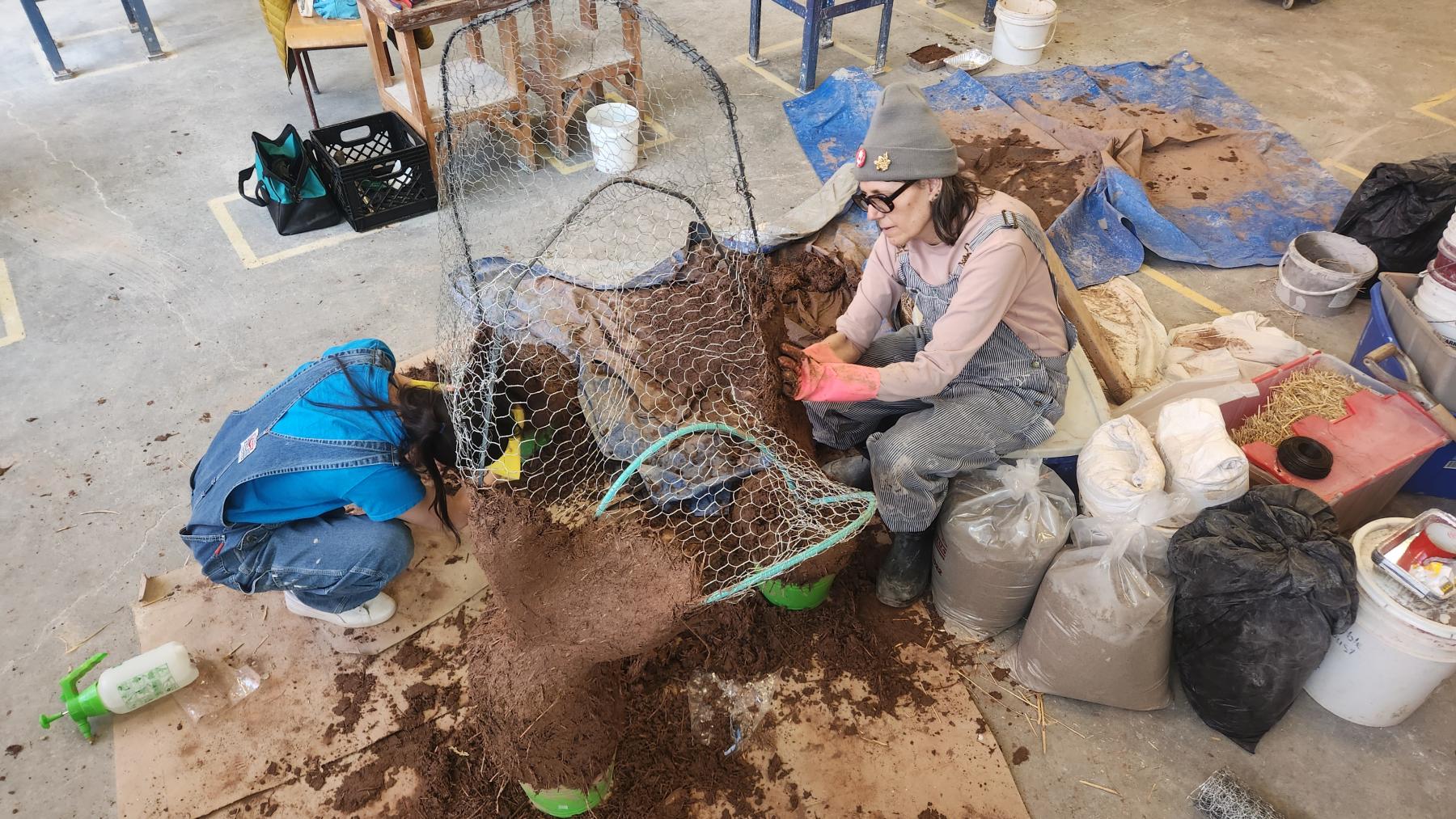
Kara Hamilton, Delicate Matter in progress as L.L. Odette Sculptor in Residence at York University, 2025. Photo by Adam Krop.
In talking to others about Kara Hamilton, what becomes very clear is a sense of a holistic artistic practice in which relationships are of the utmost importance. I met Hamilton in 2024 through mutual friend and studio-mate, Shannon Garden-Smith, spending a day at the Leslie Spit. Hamilton’s tenderness and genuine interest in others was immediately apparent. Garden-Smith says that the kind of proximal working with someone, as in side-by-side studio spaces, provides more revealing insights into an artist than what we see in their artistic output. “Kara is one of these artists who actively supports other artists’ practices that she admires. In a contemporary art paradigm where so much is about the individual and their ‘brand,’ many of us do get into art for exactly the opposite reasons, to resist these things, which I see Kara doing in a very strong but also gentle way.” The two have often discussed their personal feelings about the mutual reinforcements of art and life; the ultimate question to pose to an artist is what part of the artistic process do they stay in it for? If it is the presentation of the “finished product,” this can be a very fleeting dopamine hit. But if artists are in it for something else, a life where you have the opportunity to connect with other like-minded people, there is something more sustainable in that.
Hamilton’s other collaborative curatorial project, “Co-Conspiracy Means (to) Breathe Together” (CMBT) with curators and fellow breast cancer survivors Patricia Ritacca and Yan Wu, began with the desire to improve the art chosen for exhibition in hospitals. In discussing what it meant to “conspire,” they discovered that the Latin root of the word means “to breathe together.” The trio’s mission begins with recognizing the very complex realities of being a patient in a hospital and how a considered experience with art can help in easing medical anxiety. CMBT’s first project was installed at Royal Victoria Regional Health Centre in Barrie, Between Lead & Light, an immersive sound work of recorded bird songs by Scott Rogers. By filling the waiting area with birdsong, Rogers enacts a carefully researched mediation that is said to activate the vagus nerve and parasympathetic nervous system, relaxing muscles and encouraging a state of calmness. Birds sing when they have identified that their surroundings are safe, a welcome feeling to bring into a hospital waiting room.
A certain amount of serendipity, or let’s call it fate (despite, perhaps, invoking the terminating cliché), emerges from the stories of Hamilton’s life and work. Chance meetings repeatedly flourish into meaningful projects and relationships, considering the mutual interconnection of both for her. I tell Treleaven of how Hamilton’s jewellery has always reminded me of Schiaparelli; he says he met Marco Zanini during a residency in Milan, who had been tasked with reviving the fashion house in 2014. Zanini stated his inspiration was Derek McCormack’s 2015 book, The Well-Dressed Wound. McCormack, a good friend of Hamilton, recently began making his own jewellery which is published in his new book, The Shithole Opry Collector’s Guide, recently launched in Toronto with a conversation between McCormack and Hamilton. Hamilton shows great sensitivity in paying very close attention to the world around her, picking up influences from the extra-human as much as the human.
Embedded in her is a close consideration of the way that space makes its impact with the beings that move through it. She belongs to a generational cohort that was taught to be suspicious of the art object. In her artisanship is a desire to reach a breadth in her audience, to speak as widely as possible to as many people as possible. Often, she asks herself, “What happens to someone when they look at a piece of art, and how it is presented? What is the contribution to the social?” Discussing the long historical trajectory of what it is that art does over lunch, Hamilton tells me: “I was listening to Sister Wendy [Beckett] talk recently, and she made me cry. I feel like that sensibility about what art is for [to meaningfully communicate with people] is becoming lost. She’d say, ‘We are not born human, we become human’—that art helps us become who we are.”