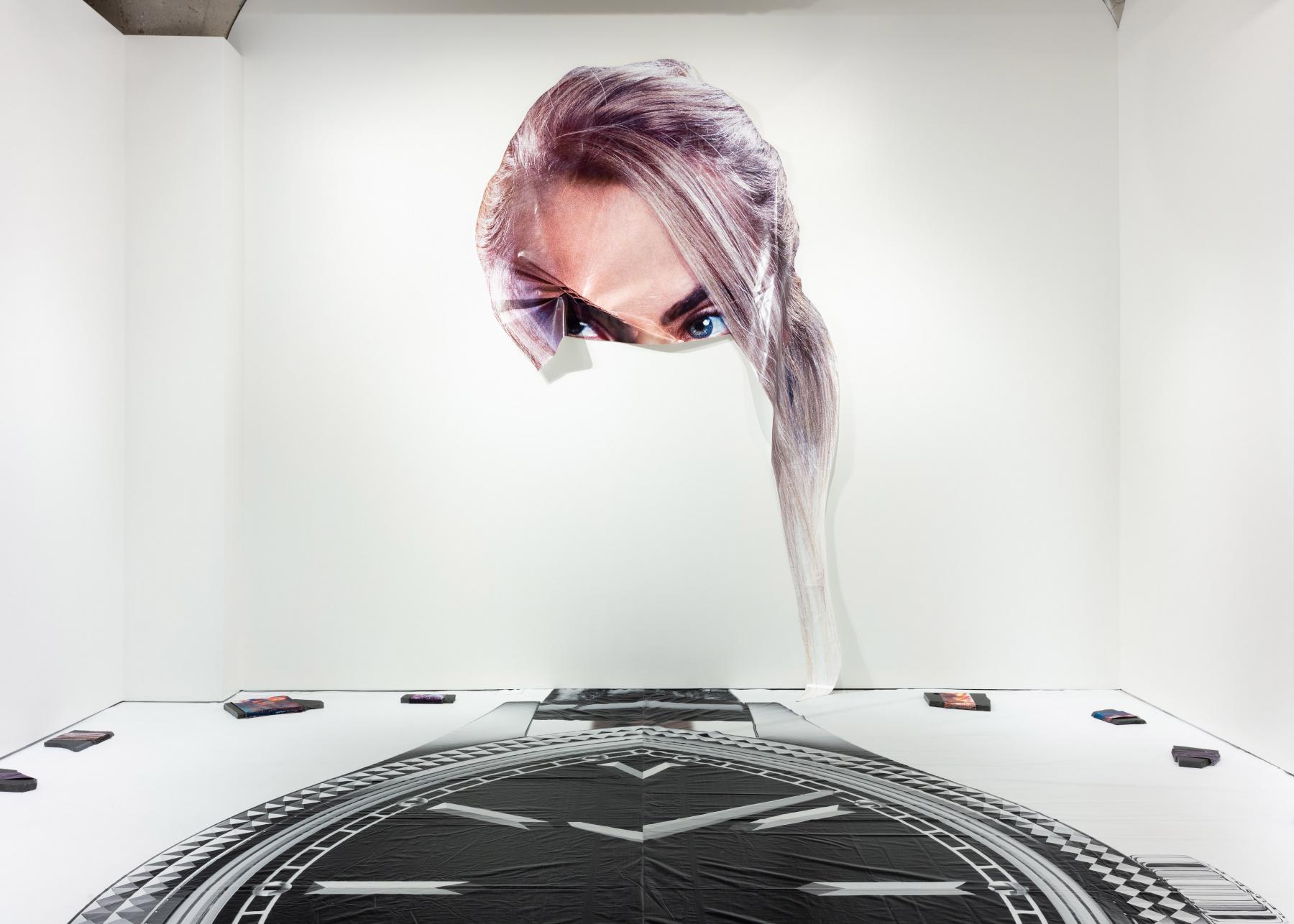
Time Scale, 2022, part of a site-specific intervention for the North End Gallery including salvaged PVC billboards, salvaged granite, and thread. Photo by: Laura Findley. Sourced via.
When Kelly Jazvac started working on Upgrade in 2007, she wasn’t new to making savvy sculptures about consumerism. But this piece, commissioned by the Toronto Sculpture Garden, marked the start of a new phase of her burgeoning career. Using adhesive vinyl stickers, Jazvac covered a 1998 Pontiac Sunfire inside and out to disguise it as a 2007 Porsche 911. Critics loved the work’s mischievous simplicity. It was an ArtForum critic’s pick. In the exhibition essay, cultural critic Jeanne Randolph described the viewer’s (and her own) “paradoxical delight” at discovering this “object of consumer lust” to be “Cinderella at midnight.” The sleight of hand was surprisingly effective, a harbinger of Jazvac’s consistent ability to gently pull the rug out from underneath us and leave us wobbling in the morass between desire and reality. Apparently, the piece even got a few parking tickets.
This was also the moment that sparked Jazvac’s fascination with plastic as a material, an evolving exploration that underpins her practice to this day. Working on Upgrade, Jazvac was struck by the obvious, yet underdiscussed hazards of polyvinylchloride, one of the most commonly used yet environmentally damaging synthetic plastics in the world. “It was really eye-opening, in terms of fumes and waste,” she tells me. “That led me down this research rabbit hole, like what is this material? What is its toxicity?”
Jazvac is a conceptual artist based in Montreal and a professor at the University of Concordia in the Department of Studio Arts. Working primarily in sculpture and collage with found materials, she investigates the material, conceptual and aesthetic possibilities of waste and plastic. Her work often takes up the detritus of advertising, reframing these ubiquitous toxic surfaces to unsettle normalized patterns of consumption and extraction. In the years since Upgrade, she’s built an impressive profile, showing widely in Canada and internationally. But her approach has remained remarkably consistent, revealing someone driven by lifelong curiosity, a committed researcher and teacher who also knows how to let things emerge. Working collaboratively at the intersection of contemporary art and scientific research, Jazvac’s interdisciplinary practice is a model of exceeding the sum of its parts, at once treading and dissolving the fine lines between siloed worlds. An eco-feminist and experimenter, she’s constantly reminding us that instrumentalization is not inevitable, playfully proffering ways of seeing and being otherwise. In her response to the wily machinations of our toxic, seductive, plastic world, she’s built a practice as nimble, knotty and captivating as the materials it explores.
With each piece, Jazvac ruptures the glossy facade of a plastified world while inviting us into surprising new engagements.
The first time Jazvac and I meet to chat, it’s at her Concordia office, where her warm, professorial presence immediately puts me at ease. As we settle in, she indulges my questions about the many objects in the room. The large rolls of plastic in the corner were given to her by a student (“They’re always bringing me things,” she laughs), and the huge press next to my chair is used for compacting matter as part of her Sculpture and Sustainable Practices class. Various curiosities spanning, or maybe erasing, the distinction between trash and treasure dot her desks and windowsill.
Often, when I ask her something, Jazvac takes a moment to absorb it, murmuring “mmm” with a slow smile before she decides how to respond. Sometimes, she’ll say something quite serious about the scale of plastic pollution or some new dire health impact of microplastics we’ve discovered. In the wake of this disturbing information, we’ll be silent for a moment and then, she’ll break into a surprising, infectious laugh. It’s never glib, just cathartic—a generous response to inevitable overwhelm. It’s easy to join in.
For Jazvac, I learn, our contemporary relationship to waste and consumption has always been a site of fascination (and horror). “I remember being young and thinking, how are there so many Canadian tires all across Canada, and they have all these tires! All those tires are going to end up on the road? There’s this feeling of an incomprehensible scale and being totally complicit that I’m always trying to find ways to navigate or process.”
Jazvac grew up in an outdoorsy family where environmental issues and politics were dinner table conversation. Both her parents were educators, and instilled what she describes as a “strong sense of justice.” They were also DIY makers, involving their kids in various creative projects at home. The first time Jazvac realized how expansive art could be, she was in her teens, and saw an exhibition of work by N.E. Thing Co. at the Hamilton Art Gallery. “It was about environmental issues, and it just kind of blew my mind, that art could do that,” she says. To this day, it’s an example for her of “when something really clicks—poetically, socially, politically.”
By the time she started her undergraduate at the University of Guelph, Jazvac already knew she wanted to make art, but she was drawn to study broadly, taking courses in Chemistry and English before settling on a BA in Studio Arts. After graduation, she worked at David Mirvish Books on Arts, a beloved Toronto bookstore in Mirvish Village. Staffed by artists and stocked with the latest issues of art magazines and gallery catalogues, it was “an amazing resource,” she says, and the perfect space for some of her early intellectual and artistic incubation. She completed her masters of fine arts at the University of Victoria in 2006, and travelled to the UK and Berlin for residencies before landing her first teaching gig at Western University in 2009.
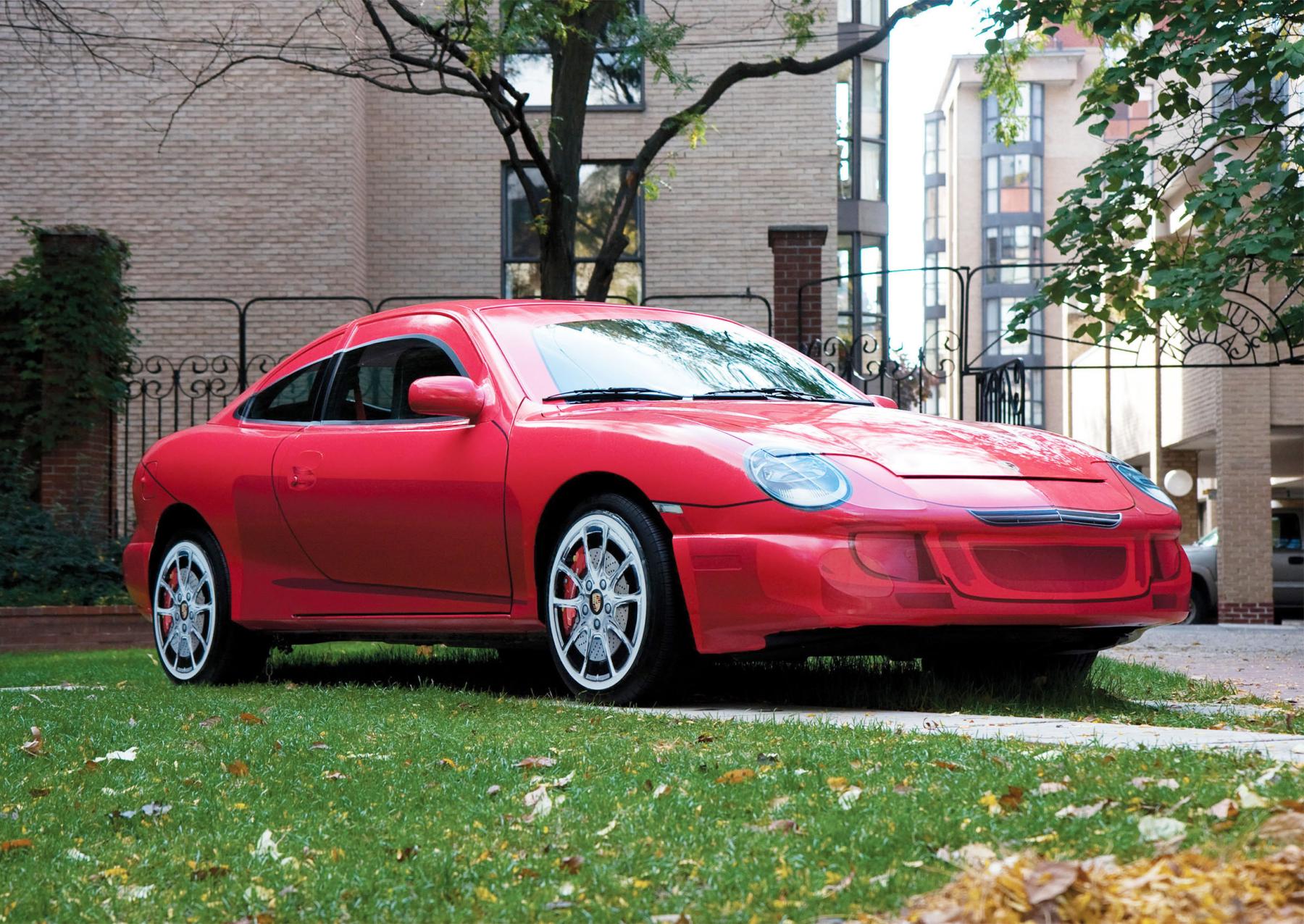
Upgrade, 2007, 1998 Pontiac Sunfire, printed adhesive PVC, plastic, Plexiglas, sealant, 450 cm x 170 cm x 120 cm, Commissioned by the Toronto Sculpture Garden. Photo credit: Rebecca Wood
It was at Western University that Jazvac connected with many of the artists and scientists who would become key collaborators, and shape her transdisciplinary practice. In the wake of making Upgrade, she started seeking out academics studying the chemical impacts of waste—to understand the risks associated with her own work, and to tease out what these toxic entanglements might mean. “It was amazing just to ask questions,” she says. “I started introducing all these different practices into my work just from talking to different material scientists and chemists.”
One such connection, with Patricia Corcoran, a geologist and fellow professor at Western, sparked a collaborative research project that made international headlines. At the encouragement of oceanographer Charles Moore, and building on the work of local activists Noni and Ron Sanford and Megan Lamson, Jazvac and Corcoran travelled to Hawai’i together in 2013. There, they collected samples of a plastic-geologic hybrid, dubbed “plastiglomerate”—a mix of sediment and natural debris fused with molten plastic. In their co-authored scientific paper about the phenomenon, they grimly note the “great potential” of this new anthropogenic ‘stone’ “to form a marker horizon of human pollution.”
For Jazvac, the project was a chance to experiment with cross-pollination across disciplines and an introduction to its rewards and challenges. Writing about the experience, she wrestles with the relationship between power and science, calling for a notion of knowledge that includes “discussion of subjective biases, history and power; a consideration of ethics; and a value and appreciation of speculation, listening, story-telling, feeling, and lived observation”—in short, “folding arts and humanities back in.” She’s careful to emphasize that Noni and Ron Sanford already knew much of what made it into her and Corcoran’s scientific paper. It’s a lesson she’s taken forward to always “make space and give authority to local, lived knowledges.”
Taking plastiglomerate samples into galleries was also a reminder for Jazvac of how these ecological questions can never be untangled from cultures of consumption—even when the work itself mounts an implicit capitalist critique. Despite being “smelly” objects of uncanny horror in person, “they get much more charismatic and seductive” in photos, she tells me. “People wanted to make jewellery out of them!” She ended up making protocols to control the contexts in which they were shown, the first of many times she’s had to place restrictions on her work.
Researching plastiglomerate inspired Jazvac and Corcoran to explore plastic impacts in their own local water systems. In 2014, they started to develop the Synthetic Collective with other like-minded researchers, bringing together a group of women artists, cultural workers, and scientists to weave art and science together through research collaboration. Focused primarily on plastic pollution in the Great Lakes region, the collective has written scientific papers, produced a field guide for exhibiting art sustainably, and curated group exhibitions probing the loaded history of plastic in the arts. Whether drawing attention to art’s long romance with fossil fuels or tying microplastic research to the broader obfuscation of plastic pollution in our lives, each of the group’s projects has been a move toward grappling with the complexity of this wicked problem. The initiative is both a testament to the power of cross-disciplinary work and a gentle rebuke of limiting silos. “I think bridging that gap is not only interesting, but urgent,” Jazvac says. “There’s such a separation between the understanding of chemical realities and everyday life.”
Plastic has clearly been an endless muse for Jazvac. “So much is contained within plastic as an idea—molecularly, politically, chemically,” she tells me. “The depth and extent of its toxicity” is poorly understood, even as it accumulates in our bodies and ecosystems, and “there’s so much injustice and harm” and “instrumentalization along racialized, class, and geographical lines from mining to disposal.” But it also acts as the seductive surface that obscures these violent realities. In this way, it’s the perfect medium and message of late capitalism, an ideal substance to probe inescapable dynamics of exploitation and complicity.
Wrapping up discarded, toxic images in soft mycelium and plaster that absorbs carbon dioxide, [Jazvac is] quietly insistent that more cyclical, connected forms of life abound, and that we have the tools to realize them. At the same time, her work doesn’t dismiss the toxic present, but weaves it into this more capacious, collective future.
Despite her political lens, Jazvac never gets mired in didactics. When I ask art writer Jon Davies, her friend and one-time curator, what makes her work so effective, he points to this instinct for nuance. “I really appreciate that it doesn’t have a message you could boil down to one sentence,” he says. She’s “always thinking about the pleasures and seductive aspects of plastic” without losing a critical vantage. Meanwhile, in sustaining this material exploration over many years, her interventions have only gotten sharper. Her “commitment to what this kind of material can mean for us, how that changes over time and its potential” makes for a “refreshingly deep consideration of these issues,” as he puts it.
The result is work that evolves alongside its unwieldy subject without losing focus. “It always feels like it's innovating, and keeps a kind of strangeness,” Davies notes. With each piece, Jazvac ruptures the glossy facade of a plastified world while inviting us into surprising new engagements.
Jazvac and I decide to meet for a follow-up chat at her studio in a stately old building across the canal from St. Henri, a glamorous outlier among its industrial neighbours. She greets me warmly at the door, sporting a pair of carpenter pants and cropped jacket with accent stitching. She and her studiomate Tegan Moore have the 4th floor all to themselves, a tacked-on, well-kept secret up a steep set of wrought-iron stairs at the back of the building. Corporate start-ups have mostly taken over the building, she tells me, but they plan to keep the studio as long as they can. As we enter, tall windows fill the high-ceilinged space with pale spring light. Jazvac’s space is tidy but brimming with weird possibility—sculptures disassembled or under construction, little experiments populating her desk and shelves. Part of her 2025 work, Le désir et le matriarcat, is positioned off to the side. Sorbed and Modeling the Fate, two pieces she will later show at the 2026 iteration of Montreal's Plural Art Fair, are out for final preparations.
Looking at Jazvac’s work in person for the first time, I’m newly beguiled. Sorbed and Modeling the Fate reanimate large cardboard make-up stands that Jazvac found discarded in the trash. Thin blown glass tentacles reach forward from the cardboard backdrop of Modeling the Fate like flagella, maybe, or odd elongated nipples, a vivid swirl of micro-plastic embedded in each tip. Sorbed features clusters of solid aluminium lipstick tubes held together like the blunted claws of a little beast, molded from the tabs of beer cans Jazvac collected over the pandemic. Both are covered in a salt wash, leaving only the pouted lips of the models visible amidst the cloudy grit.
Both pieces reveal Jazvac’s gifts for playful, feminist recalibration. I ask her how she disrupts imagery intended to objectify and sell women’s bodies, without lapsing into fresh commodification. “I really like the challenge of shifting the passive to active,” she says. “There's something useful about trying to reframe something so we see what it is, but also trying to shift the power at the same time.” Jazvac uses collaging, shaping, and cutting ads as physical attempts to enact these power shifts. Then, she tries to bring the encounter to a head so “we can feel a break and then suddenly see something new,” she tells me. Often, this takes the form of women’s eyes looking back to create a sense of “agency, witnessing” or emphasizing the mouth as a contested site of pleasure, sustenance and power. In one particularly pithy reset, she took images of women’s arms thrown back in a supine pose and turned them 90 degrees to create the illusion of swimming forward.
.jpg)
Detail of AN MAMAN 2025, recuperated ash wood, clay, sand, shredded financial documents, lime plaster, polyvinylchloride, MuskinÔ, sunflower stalk, nori paste, soap. 51” x 14” x 4”: Jean-Michael Seminaro
 copy1.jpg)
Modern Additives, recuperated lightbox, plastic and thread. 2025. Photo credit: Jean-Michael Seminaro
 copy.jpg)
Installation view of le désir et le matriarcat, Photo Credit: Jean-Michael Seminaro
 copy.jpg)
Detail of AN MAMAN 2025, recuperated ash wood, clay, sand, shredded financial documents, lime plaster, polyvinylchloride, MuskinÔ, soap. 54” x 14” x 4”: Jean-Michael Seminaro
Part of this reframing work has demanded a confrontation with the particular bodies and commodified desires on display. “It’s so obvious, it’s almost cliche,” she notes, but almost all the ads she’s collected over the last 20 years have been white women’s bodies, often in idealized natural settings. In one memorable example, she displayed parts of Kaia Gerber’s body (Cindy Crawford’s daughter), and was struck by how quickly the audience identified her by a tattoo and started debating her plastic surgery with almost “forensic” precision. In those moments, “it starts to feel like this is not a being, it’s an object to claim,” she tells me.
In a visual culture warped by white supremacy and misogyny and trained in scrutinizing women’s bodies, interrupting our consumptive gaze is no easy task. But Jazvac proceeds with a humble but dogged curiosity. “It’s like turning the dial on the mixer until it’s just right,” she jokes. Somehow, the friction she creates is always inviting, a juicy site of self-reflection and cultural confrontation rather than alienation. “Catching oneself in judgement and scrutiny—I find that to be a super active moment,” she explains. Often, she uses space and embodiment to upset the assumed terms of the interaction. “I've done things like play with different heights, put things on the floor so you're walking on it, make things at a human scale so there's some kind of one-to-one encounter feeling,” she shares. “I do hope there’s some kind of shift in how one feels in their body.”
When I ask Jazvac how she decides an image or discarded object is worthy of artistic treatment, she says it takes time. Often, she’ll sit with it in the studio for a while and wait to see what happens. “It has to either have the potential to be transformed into a poetic object, or be emptied of itself.” It strikes me as beautiful to assume such potential in objects whose legible value, already co-opted, has also long been spent.
When we turn to the partial installation of Le désir et le matriarcat, Jazvac’s complementary vision of feminist possibility is on display. Inside each of the work’s wooden pedestals, which spell AN MAMAN (year mother), from above, she has placed delightful, inscrutable packages dense with material and texture. Chunks of white plaster hold together vinyl sewn in elaborate patterns and pieces of mushroom leather like thick covers of a book. Plastic ads, woven into thick ropes, bound the packages, keeping their strange potential coiled. The objects refuse our attempts to categorize—like talismans for some mysterious ritual perhaps or undiscovered deep sea crustaceans. The plinths, transformed from platforms to containers, are brought into new relation with these sheltered creatures, and become art objects themselves.
Here, Jazvac meditates on alternatives to modes of domination. Gesturing to mothering and care, reciprocity and reparation, the sculpture nurtures new ways of looking and suggests more collective ways of being. Jazvac worked on the piece the year her mother was diagnosed with cancer, and was inspired by the myriad ways the women in her life surrounded her. “I feel like it’s also an homage to that support behind the scenes that’s very undervalued and underrepresented.” She was also thinking about Ursula K. Leguin’s iconic essay, The Carrier Bag Theory of Fiction, and surfacing ideas of holding and gathering as core to our collective well-being. The abstract packages are reminiscent of purses, handbags, bundles, or even sandwiches, she tells me, adding, “How many women have something in their bag for someone else? There’s this planning of care in advance.”
The sculpture is, of course, also an exciting material experiment. Recuperated vinyl billboards sit alongside natural plaster with cob filling and mushroom leather, all part of her ongoing research into sustainable sculpture and building. As always, Jazvac’s use of material adds new dimensions to the work. Wrapping up discarded, toxic images in soft mycelium and plaster that absorbs carbon dioxide, she’s quietly insistent that more cyclical, connected forms of life abound, and that we have the tools to realize them. At the same time, her work doesn’t dismiss the toxic present, but weaves it into this more capacious, collective future.
Eventually, our conversation shifts to teaching, and Jazvac is effusive. “I am such a passionate teacher,” she says. Growing up in a family versed in Paulo Freire, she’s always believed in the radical potential of education. Education “can be this really beautiful, emancipatory, empathetic space of putting love and knowledge that is missing into the world,” she sums up, before laughing at herself. “It sounds like I joined a cult!”
 copy.jpg)
Modeling the Fate, 2017-2021 recuperated cardboard, plastic, borosilicate, glass, salt, chalk, gum arabic, fish glue, and plastic microfibers provided by Dr. Natalie Tufenkji and Laura Hernadez Rodriguez at the Biocolloid and Surfaces Lab at McGill University. 19 x 20 x 67 inches (48 cm x 50 cm x 170 cm). Photo credit: Jean-Michael Seminaro
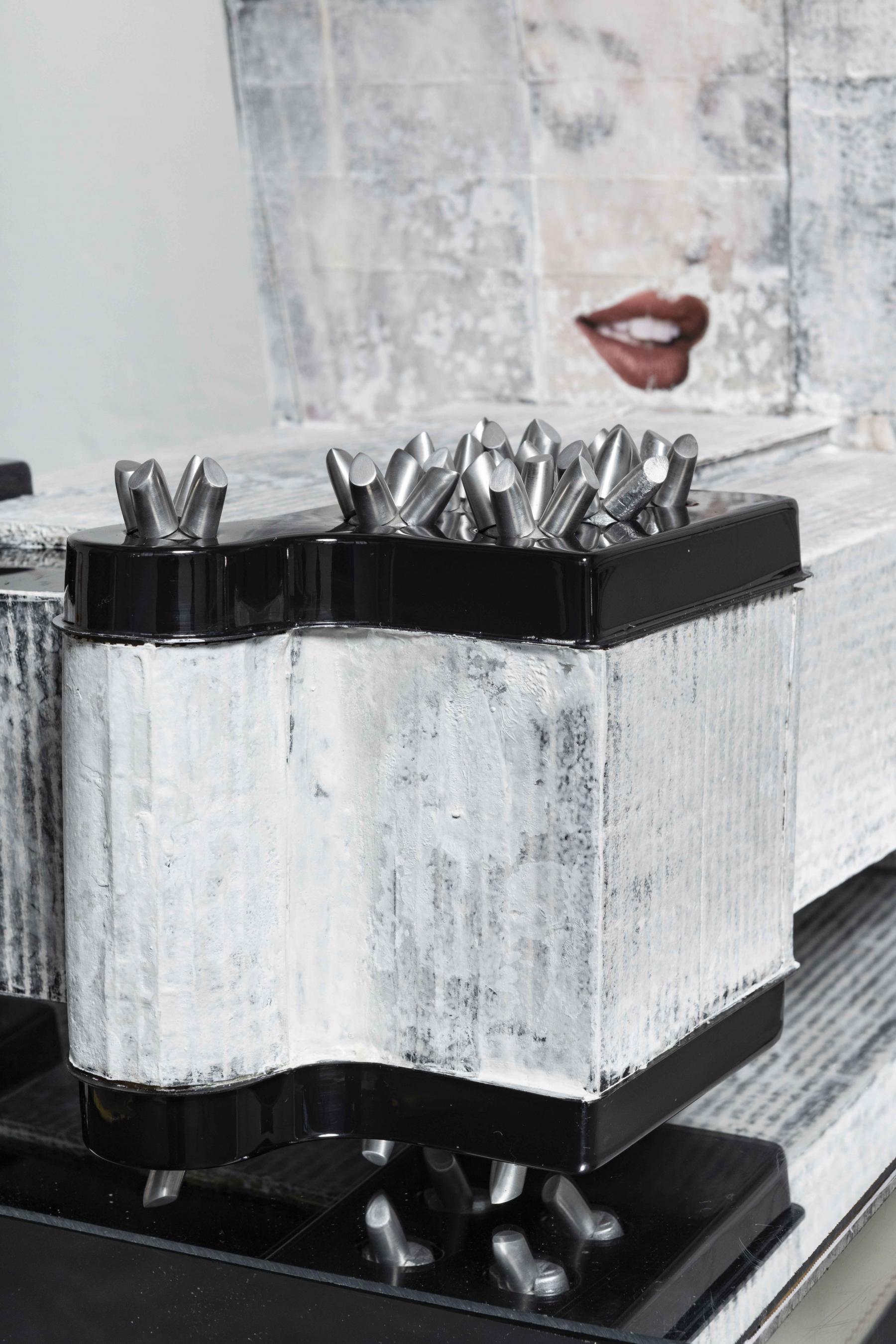
Sorbed, detail, Photo credit: Paul Litherland
 copy1.jpg)
Sorbed, 2021, recuperated cardboard, aluminum, plastic, salt, calcium carbonate, gum arabic, fish glue, wax, Plexi, Velcro, chair, 66 cm x 96 cm x 54 cm, Photo credit: Jean-Michael Seminaro
I’m reminded of the first time I saw Jazvac speak at Centre Clark in early 2026. She was facilitating a discussion with her former student, Dexter Barker-Glenn, an artist whose playful use of found garbage echoes her own. During the introduction, she joked about her “teacher instinct to stand.” Her questions to Barker-Glenn were slowly articulated, marked by genuine curiosity, assuming equal footing. At one point, she passed around a Zero water filter from her studio that had started to degrade in the sun, the plastic flaking like a bad sunburn, and asked the audience to think about how even materials designed to protect us often lapse into toxicity. Everyone examined the filter before silently passing it to the next person, smiling at each other like bashful strangers at our favourite class. After the talk, I headed to the front, but got stuck behind a swarm of current and former students jockeying to say hello. The line-up vibrated with that mix of awed shyness and flushed excitement so classic of our early relationships with formative mentors.
Jazvac’s teaching seems to be an extension of her practice, another outlet for her instincts toward connection and experimentation. In her introductory Sculptural and Decolonial Practices class, she starts with an assignment called “Free,” where students are asked to make something that both costs nothing and is free of cliche. Another project for her Sculpture and Sustainable Practices course involves making an artwork as a gift for another student in the class. It “takes a fair bit of listening and attunement,” she says, but “man do they ever step up.” There were lots of “happy tears” after the last one, she says. People just made “these really beautiful, poignant artworks specifically for someone else.”
For her, the classroom is a forum to think about non-domination based ways of structuring life. She assigns texts by decolonial and feminist writers like Leanne Betasamosake Simpson and Vandana Shiva to help her students think about “reciprocity, relationality, anti-colonialism and ecofeminism.” The main priority, for Jazvac, is fostering community. “And it works,” she says. “It just feels like an antidote to all the alienation and isolation that oppressive structures thrive on.” Jazvac’s appreciation for how much her students offer back is woven throughout our conversation. It’s “such a privilege,” she tells me, to “think through things with students, about what the world is and needs to be, and what’s important to them.”
If Jazvac is beloved for making rich collective spaces for learning, she’s also a dedicated mentor to individual artists. When I ask Moore, also her former student, about Jazvac, she’s emphatic about her professor and friend’s influence. “She really helped me to figure out what questions I was asking,” says Moore. Outside of this personal guidance, Moore sees Jazvac’s thoughtful, diligent approach as an example for emerging artists. “There’s a kind of deep dive she does in her work, in her research and her inquiries. She asks questions with such humility, and I really found that to be a unique approach and a model of how to work.”
The last time Jazvac and I grab coffee, she’s just returned from Italy, where she attended the Venice Biennale and a feminist research residency titled “Refusals and Practices of Freedom,” organized by Fulvia Carnevale, Béa C.T., Gabby Moser, and Helena Reckitt. She regales me with her experience of the Austrian pavilion by artist Florentina Holzinger—a provocative critique of turbo tourism, featuring fierce nude women performers (driving jetskis and snorkeling in tanks of filtered water from audience porta potties, among other things). “I thought I was going to hate it,” she tells me, “but I was profoundly moved.” The residency, meanwhile, was an inspiring injection of fresh ideas and rich feminist history. One presentation by cultural worker teresa cisneros, “Domming from the bottom: Bringing an institution to heel/heal - survivance, borders and pleasure,” felt particularly relevant for navigating institutional failures in contemporary art and academia. A critical reminder, she tells me, that “the people doing the behind-the-scenes cleaning and fixing actually hold the power to rebuild when things go awry.”
As usual, Jazvac’s grounded, genuine curiosity is contagious. As we chat, I make several mental notes of films to watch and texts to read, while feeling my thinking shift and coalesce in new ways. The major takeaway from the residency, she says, was this need to create more collective space and connection. “We have to find new social fabrics to do things together,” she tells me. It’s hard to think of anyone doing it better.