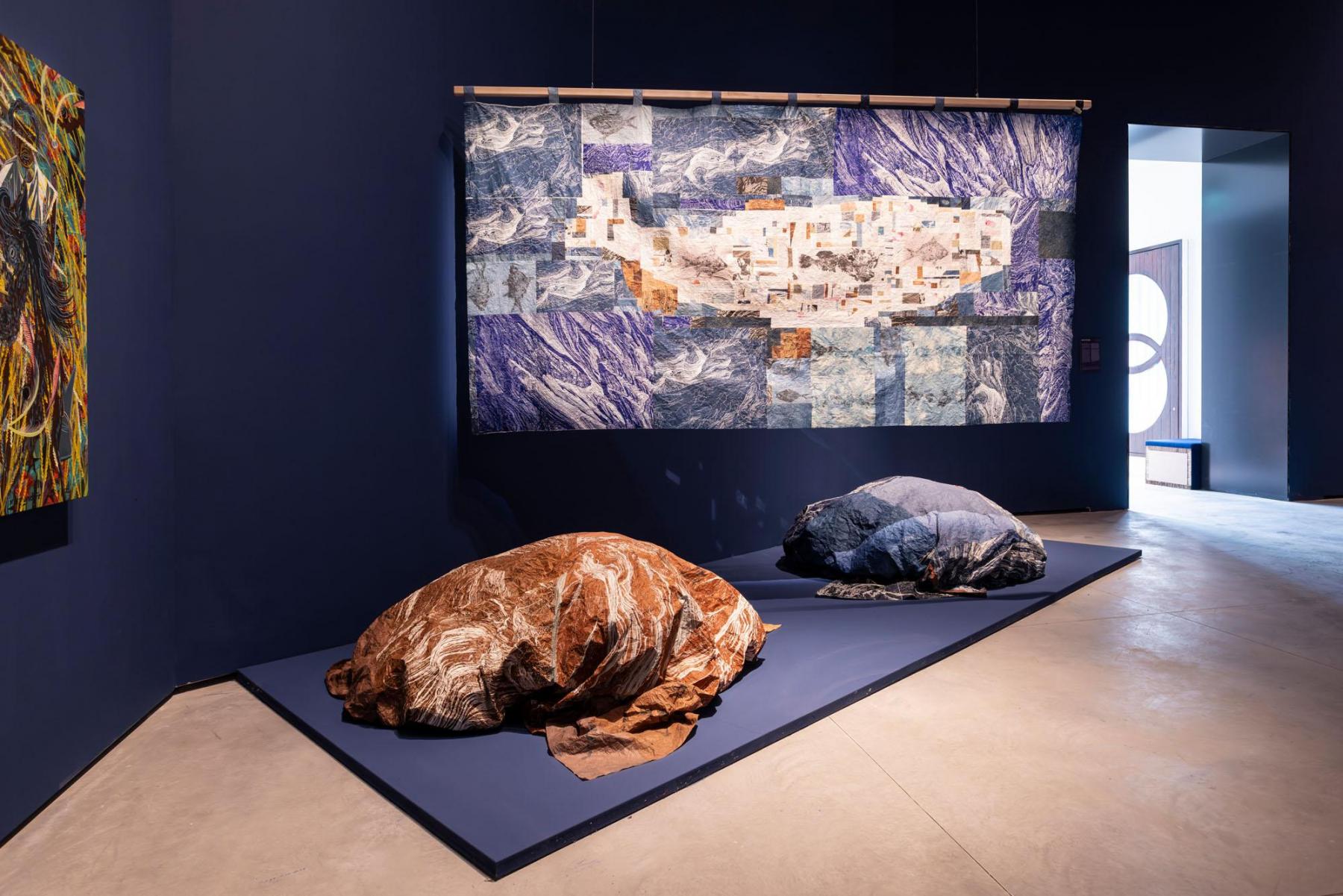
Alexa Kumiko Hatanaka. Namazu, 2023. Movable and Immovable, 2026. In Minor Keys, 61st Biennale di Venezia. Photo: Marco Pavan.
It’s early May and I’m on a small ferry to the 61st Venice Biennale to see the work of Alexa Kumiko Hatanaka. The cabin of the boat sits low in the water, and I’m seated in the aisle, next to a man by the window who is nodding off. I frequently peer over his drooped head to try to get a good look at the glassy greenish-blue water outside. Ever since I met Hatanaka, I’ve been looking for fish.
I first met Hatanaka a month earlier, back in Toronto. After weeks of emailing back and forth trying to find a time when we would both be in the city, we eventually settled on a date in early April. Her west-end studio ended up being on the same block as my apartment, and I dropped in with fruit, and coffee and croissants from the coffee roaster and bakery nearby. Hatanaka meets me at the door, dressed in sneakers, patterned pants and an oversized t-shirt, her brown hair pulled under a kelly green cap that reads “Parkdale Yacht Club.” We walk up a few flights of stairs to her bright west-facing studio. She crouches over to shuffle away large sheets of washi paper that are sprawled over the hardwood, stacking them into a loose pile on the ground under a window. “I usually work on the floor,” she says, “But we can sit over here.” We pull up two wooden stools beside a table pushed up against the wall.
“I’m glad this is happening,” I tell her.
“Sorry,” she replies, “it’s really the busiest time, because next Saturday, I’m going to Venice to install the Biennale, which as you might imagine, is the biggest thing I’ve ever done. And I was away. I had a show in Tokyo and in Taiching, which is in Taiwan. So it was just a very crazy time.”
Only four months into 2026, Alexa Kumiko Hatanaka had already shown work in a solo exhibition in Tokyo, and group exhibitions in Toronto, Manila, Berlin, Atlanta, New York City, Calgary, Vancouver, San Francisco, and Taipei. Hatanaka, whose practice spans textile, sculpture, printmaking and papermaking, often draws from traditional craft practices to explore migration, shared ecology and cultural exchange. The Japanese-Canadian queer artist lives with a bipolar condition which often materializes in her practice. Hatanaka first enrolled at OCAD University for Painting, but after taking an elective in screenprinting, switched her major to Printmaking and graduated in 2012. Hatanaka was recently longlisted for the Sobey Art Award, and her work has been exhibited in galleries across Asia, Europe and the Americas, including Kotaro Nukaga Gallery in Tokyo, Harper’s Gallery in New York City, the Art Gallery of Ontario, the Toronto Biennial of Art and the Ino-chō Paper Museum in Kochi. In recent years, motifs of landscape, fish, and bodies of water have surfaced repeatedly in her work, becoming vessels for thinking through personal and collective experiences of struggle, resilience, and connection.
As we settle into our seats in her one-room studio, I ask Hatanaka about the work she’ll show at the Biennale. She tells me that the work is of a significant scale, and is a development of the ideas she's been exploring for the last few years, connecting differences in mental health as a useful adaptation to extreme weather. “I have bipolar, so I was researching a couple years ago why it exists.” she says. “One theory that I thought was really interesting was that it might have evolved over the Pleistocene era when the weather was really erratic and extreme and shifting, as something adaptive. It might have been useful to be manic when the weather was good because you could be very creative, quick to make connections, and barely need to sleep. And then when the weather's bad, it's the opposite, right? Quote unquote depressed, like a total conservation of energy.” She stops to take a sip of coffee. “I was very compelled by that because we're obviously in a time of extreme weather shifts. I thought it was a nice way to think about how we can shift our lens on what we consider illnesses or neurodivergence as potential sources of wisdom.” She pauses for a moment, then adds, “Mind you, I think the theory is kind of reductive, because there's such a spectrum of how people experience any condition. Like, sure, I learn a lot from the experience of having these different phases of emotions, but it's mostly just really uncomfortable and inconvenient and deeply painful at times. So there's something there that doesn't feel useful at all. But I think the theory is interesting for those reasons–for thinking about potential found in mental differences.”
“Can we talk about how bipolar affects your way of making?” I ask.
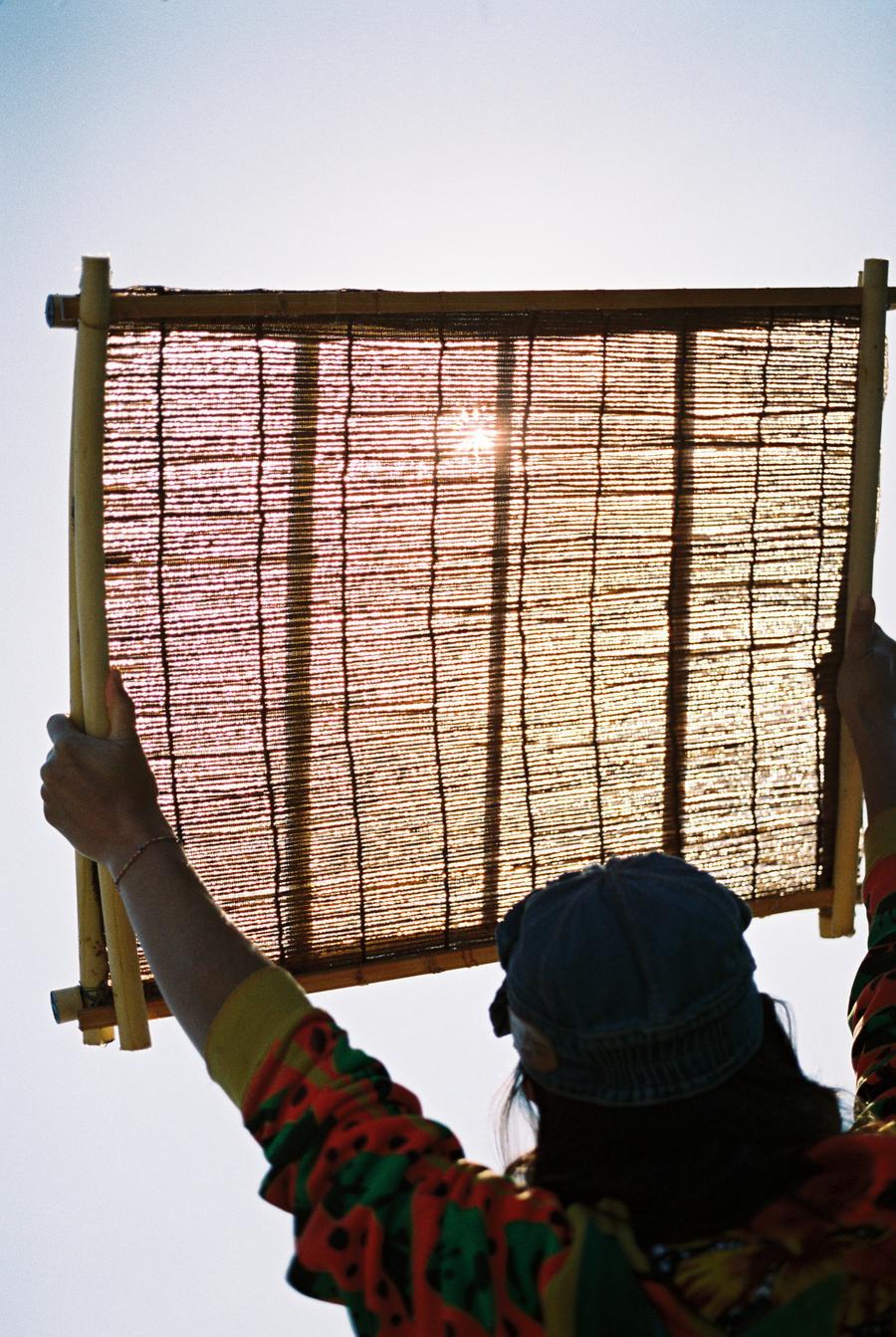
Hatanaka holding washi-making frame at Niyodo River, Kōchi, Japan. Photo: Johnny Nghiem
“I think language is really important, and I hate the fact that it's called bipolar because I think it's immediately misleading.” Hatanaka explains. “In reality, every day is different. Even within a day, it's different. And then there are distinctive quote, unquote episodes where you're existing in mania for a period of time, but it still ebbs and flows. And it brings about symptoms that aren't necessarily just depression. There's feelings of anxiety, paranoia, a lot of it is, like, in the body.” She gives an example. “Like, if I'm feeling good, I'm really efficient and I have ideas that come quickly and I get into the flow, which is an amazing feeling. So I can really create things in bursts. And then, there's certain things that I do that lend more to if I'm not feeling as good. I can labour, but I can't ideate. It's really hard if I'm feeling depressed to come up with new ideas.”
We turn our attention to the papers on the ground that Hatanaka was shuffling away when I arrived. They are washi paper naturally dyed in various tones of brown and beige and cream, on which Hatanaka has hand drawn images of ginkgo leaves in black ink. The impressions are imperfect, some with a watercolour effect, others with dark outlines. The drawings were made when Hatanaka was in a less creative and more labour-focused period in New York two years ago. Ginkgos are one of the beings that survived the ice age, and she connected to them through the theory that links bipolar to a changing climate.
“These are old, but I'm going through the process of making my archive. Turns out I've made a lot of art,” she says. “I was just working with my studio manager to document them.” Turning to a box made of corrugated plastic, she offers, “I do have other things in here. They're just not open. I can show you.”
We fiddle with the packaging for a few moments, and then, together, find an opening. Inside, under a few layers of white tissue, is Egg Grader’s Prayer, a wearable orange boiler suit, stamped repeatedly with a linocut portrait of Hatanaka’s grandmother, a factory worker who was employed as an egg grader. “She always prayed that my brother and I would make money,” she tells me, “I wish she was alive now to know I'm totally okay–it worked out.”
The boiler suit is an example of kamiko–clothing made of handmade sheets of wrinkled washi. The garments are produced by adding konnyaku–a natural starch–to the paper, and crumpling the sheets by hand, which add to their flexibility and strength. The process, made by craftspeople in various parts of Japan during the Edo period, is today an endangered craft, with few still holding the knowledge required to produce garments in this manner.
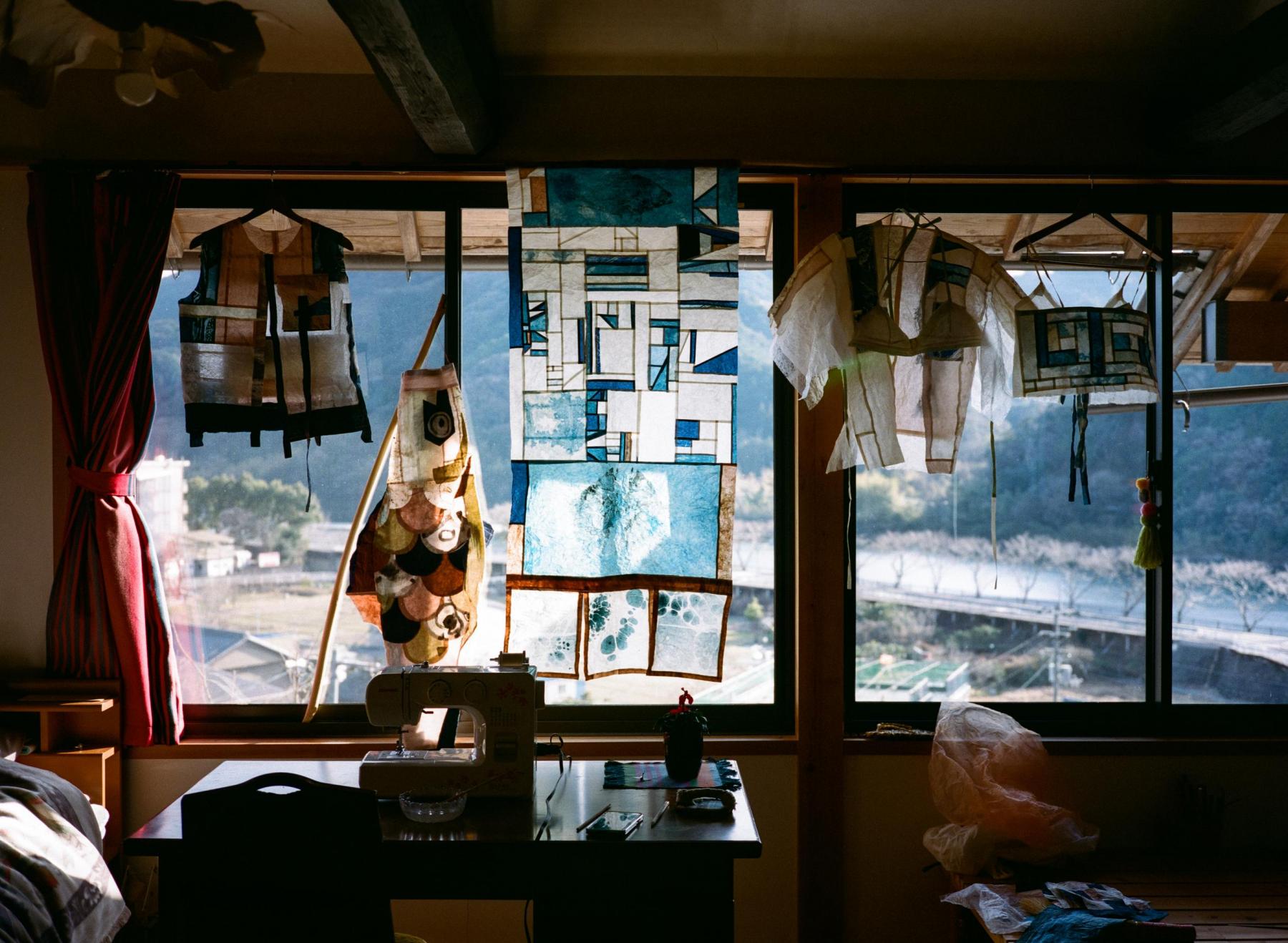
Most of the washi Hatanaka uses in her work comes from the small town of Ino in Kochi, Japan. In 2022, when Hatanaka spent ten weeks in the prefecture, participating in land-based papermaking residencies, she invited fellow Toronto-based artist Holly Chang to come along. The two spent time living in the Japanese countryside, harvesting kozo–paper mulberry–for one of the last paper mills in Kochi Prefecture that uses regionally specific materials. “Most of the days we'd go up the mountain and cut branches. We had these electric cutters, and we’d clip all the branches and tie them up and then load them on the truck. And then some days we were steaming and peeling the branches,” Holly tells me, “We'd sit and peel the bark off. The green part of the tree branch is what you use for the washi paper. Because the fibres are so long, it makes the paper extremely strong.”
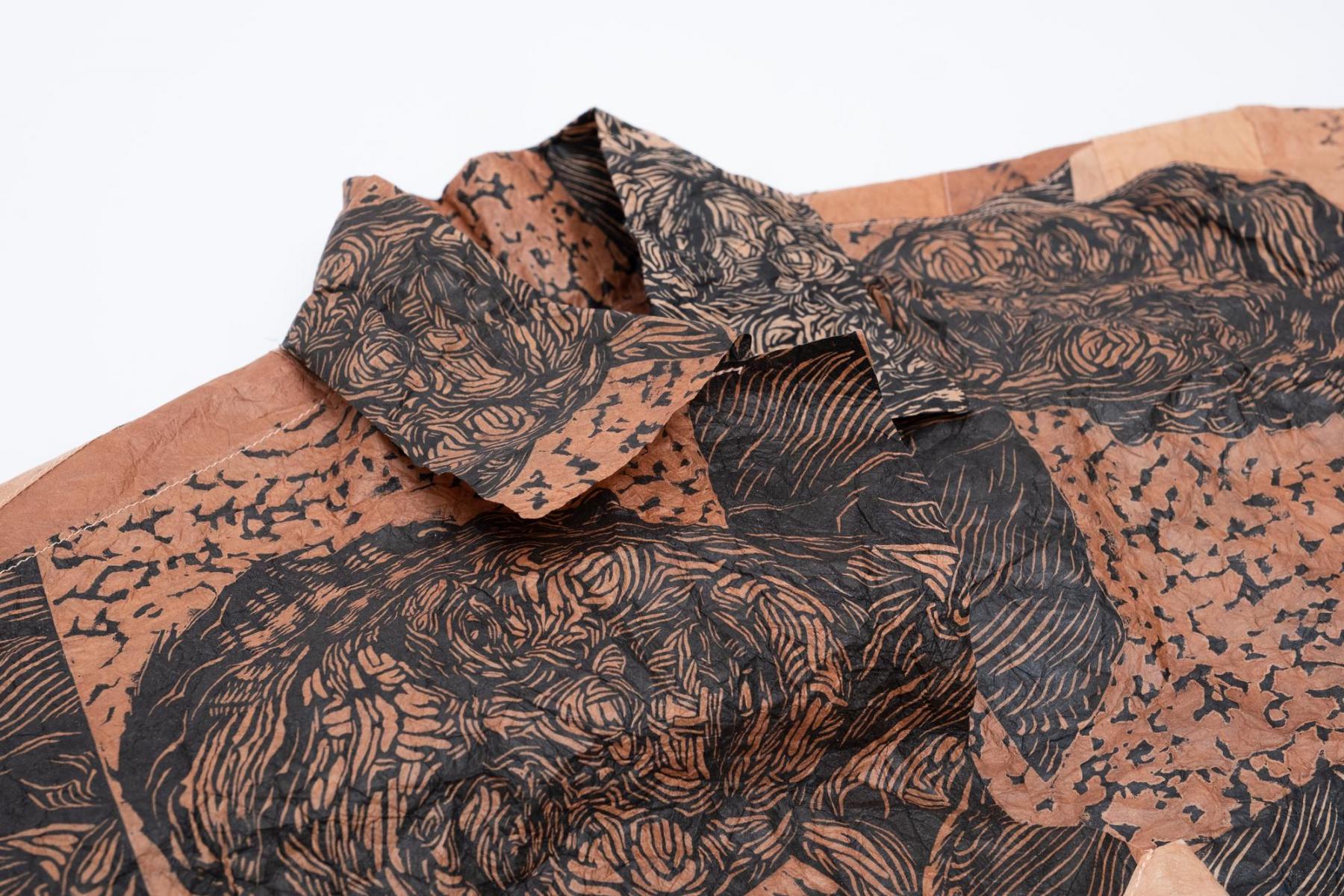
Alexa Kumiko Hatanaka. Egg Grader’s Prayer, 2021. Sewn washi, natural dyes, linocut, artist’s handmade paper, konnyaku, 70” x 67”
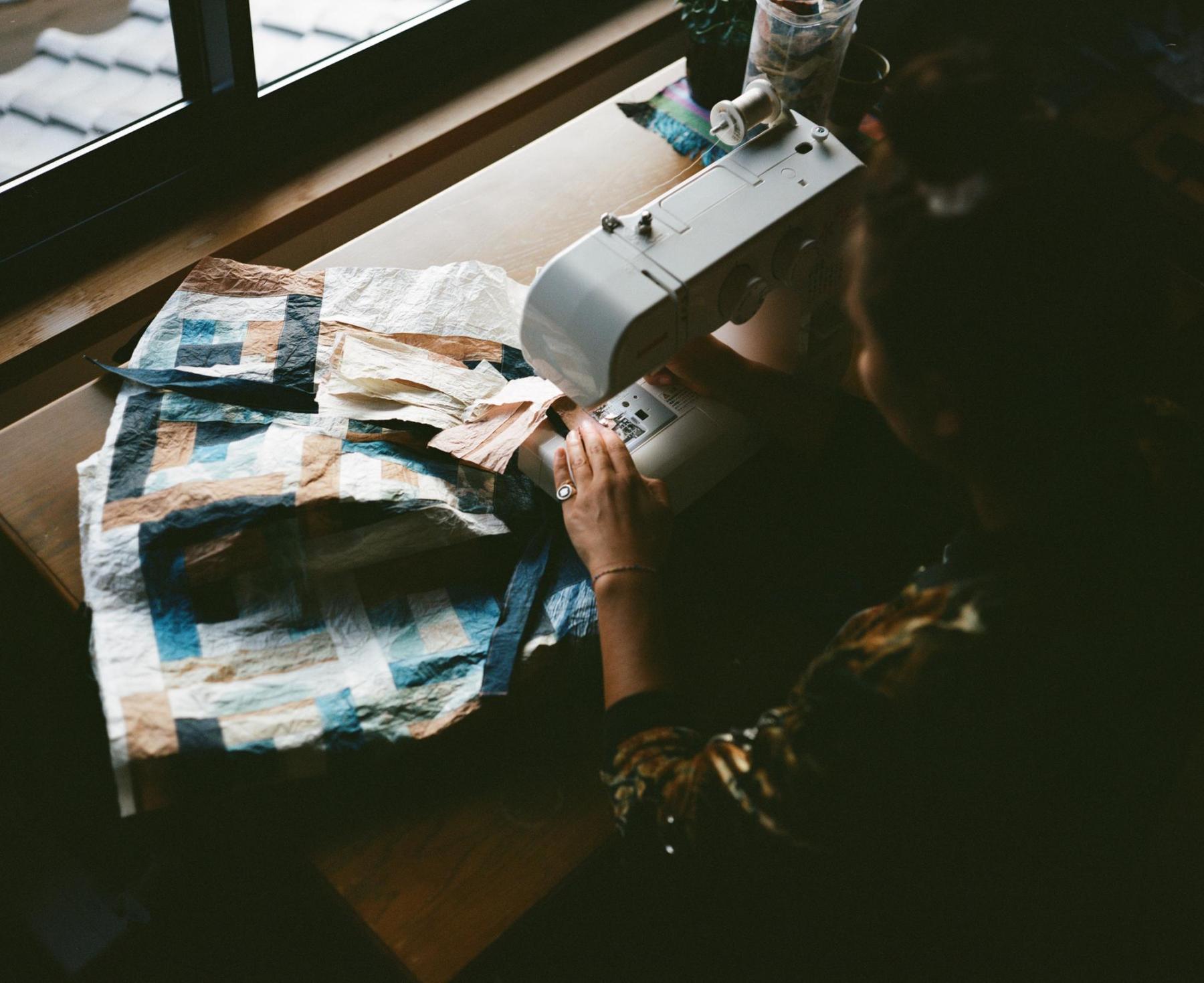
Hatanaka sewing washi wearable during her residency at Kashiki Seishi. Photo: Johnny Nghiem
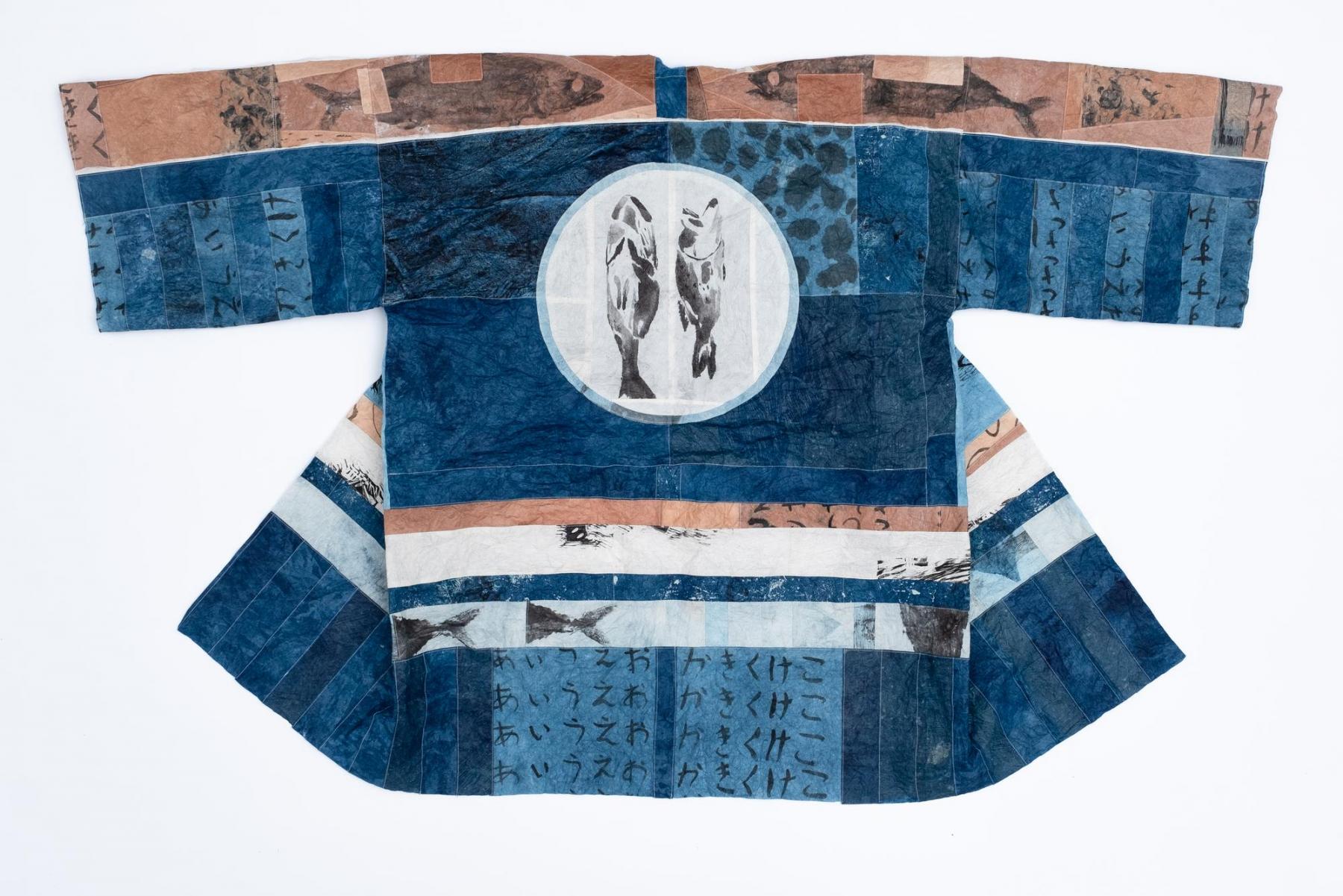
Alexa Kumiko Hatanaka. Firefighter’s Jacket, 2022. Kashiki Seishi washi, indigo dye, kakishibu, linocut, gyotaku printmaking, sumi ink, konnyaku.
“This is another one,” Hatanaka says, pulling out a short indigo-dyed garment with orange sleeves. “These are quite old, so I'm not making things like this now. But this is based on an old firefighter's jacket. It wouldn't be adorned with these, obviously,” she says, waving a hand over the watercolour-like ink blots, images of fish and handwritten text. “But, I found out that firefighters' jackets at one point were made of washi. It really speaks to the versatility and durability of the material. So that's why I was interested in making it at the time.” She pauses, “Because of the context of making art in Canada and to a degree in The States, I think there's a perception that also has to do with your identity, particularly your heritage. It’s naturally embedded in what I'm doing also because I'm using materials and processes that are Japanese. But I didn't do that on purpose, I came to it because of printmaking, and then it evolved. And I was like, okay, it's actually cool that this gives me this connection point. But I'm very, very wary of people thinking that my work is just about exploring Japanese identity or Japanese stories. Because I'm really not Japanese. It's very different to grow up here. It's just a completely different experience. I'm more interested in the materials in regards to how they relate to the natural environment.”
After spending some more time going through Hatanaka’s archive of work and chatting about her upcoming projects, we finish our coffees and say our goodbyes. During the five minute walk back to my apartment, I wonder if I should go to Venice.
[...] Hatanaka folds inner and outer landscapes together, aligning emotional fluctuation and environmental volatility within the same shifting field.
When I step off the ferry near the Giardini della Biennale, the weather is sunny and cool. It’s the first public day of the exhibition, and I follow a small crowd of artists, curators, visitors, and Italian television crews towards the parkland where the Biennale is held. Our shoes crunch rhythmically across the light, pebbled pathway leading up to the entrance. The sound is comforting and feels like an invitation to slow down. After scanning my ticket, I turn toward the exhibition grounds. Hatanaka’s Susceptibility to Gravity is the first work I encounter.
Seven large ripstop banners hang from flagpoles flanking the entrance to the In Minor Keys exhibition at the Giardini Central Pavilion, rippling gently in the breeze. The first resembles a fish with a pink face, a swirled black and blue body, and bright red and maroon fins. Hatanaka reduces the fish to simple, playful forms without losing its symbolic weight, imbuing the work with a sense of childlike wonder.
Hatanaka spends a lot of time thinking about fish. Her great-grandfather fished for a livelihood, and her grandfather fished, too. Hatanaka herself is an avid fisher. She spent around ten years in the high Arctic in Kinngait, Nunavut, working on community murals and art projects centered around youth with the collectives Embassy of Imagination and Kinngarni Katujjiqatigiit. Ice fishing was a pastime, and it was there that Hatanaka began to think of the fish as a figure of sustenance and relation, linking water and land across cultures.
The remaining banners outside the Giarddini echo and transform elements of the first: some repeat the swirling blue textile pattern of the fish’s body, trimmed with hanging fringe, while others present black ink impressions of the surface of fish against flat expanses of colour. Since 2019, Hatanaka has practiced the technique of gyotaku–a traditional Japanese printmaking method that involves applying a non-toxic sumi ink directly onto a fish to make a contact print–, creating surface transfers of fish she finds in her travels. The process, originating in the nineteenth century before the advent of photography, was used by fishermen to create a record of their catches at life-scale. These renderings shapeshift between craft and scientific method: originally created as documentation, turned into an art object, then again returning to a form of record. Fish are among the earth’s oldest creatures, and are some of the first to adapt to altered environmental patterns. Scientists today use historical gyotaku prints to study shifts in fish populations, using their surface imprints as evidence of adaptations within a climate in flux.
Passing Hatanaka’s seven flags, I enter the Central Pavilion. I find more of Hatanaka’s work in the back room of the exhibition. Namazu is a sprawling patchwork composed of paper fragments collected by the artist over three years–linocut and gyotaku prints, sumi-ink paintings, naturally dyed washi, and handmade papers stitched together into a textile suspended from a length of timber overhead. The patchwork evokes the presence of an enormous fish. The name of the work references the Japanese legend Namazu, a giant catfish said to live in the mud beneath the islands of Japan, whose thrashing tail triggers earthquakes above ground. Hatanaka told me that this so-called folklore is based on observations by eel fishermen that catfish would become agitated before an earthquake. Later, this finding was validated through studies by seismologists. Hatanaka mines the chasm between dominant forms of scientific knowledge and people who are deeply embedded within their environment. “It was already known,” she tells me.
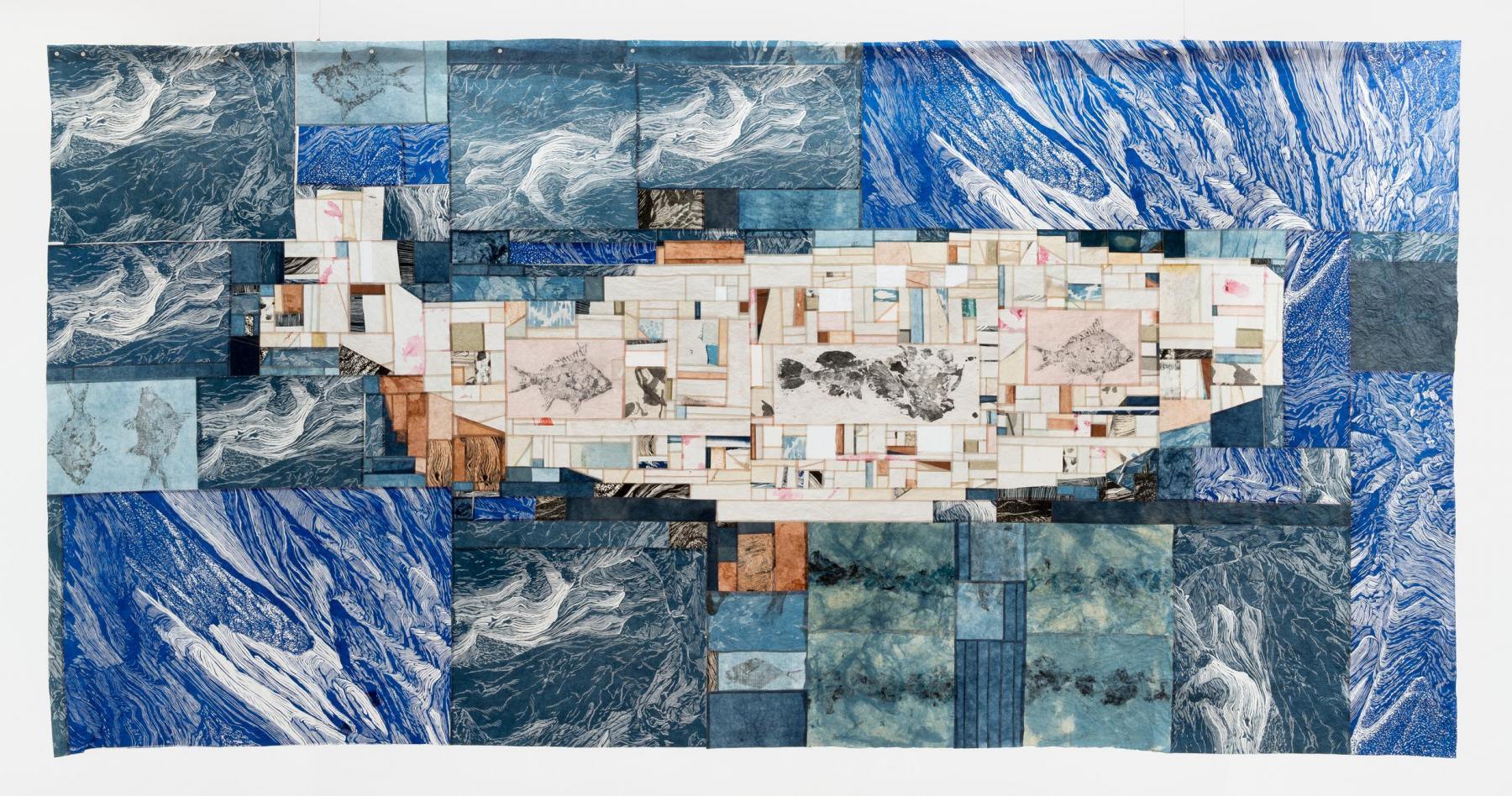
Alexa Kumiko Hatanaka. Namazu, 2023. Sewn washi (scraps collected over three years), linocut, gyotaku printmaking, natural dye, ink, konnyaku, 70” x 128”.
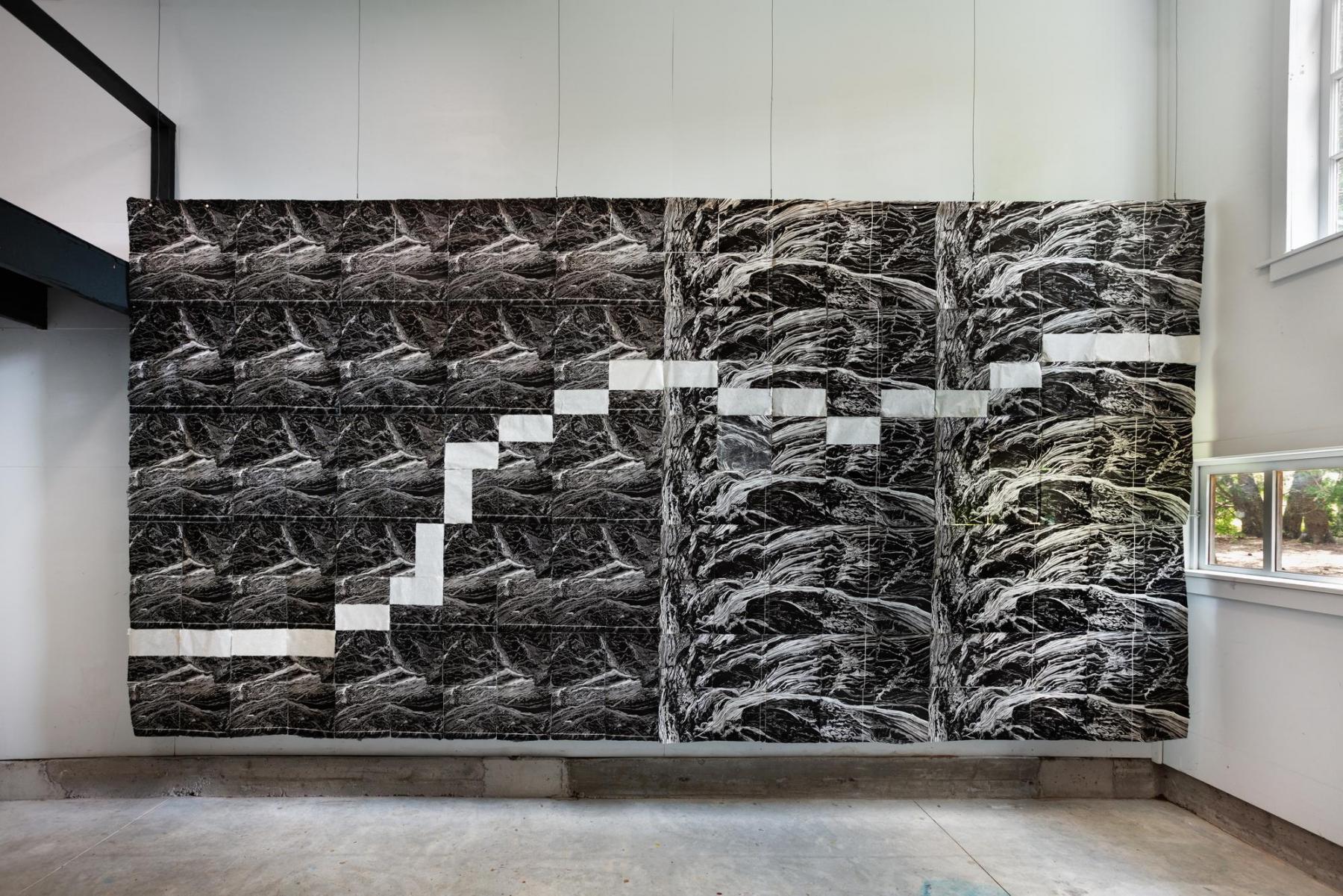
Alexa Kumiko Hatanaka. Faultlines and Loneliness, 2024. Hand-carved and hand-printed linocuts on kozo washi produced by Tatsuyuki Kitaoka, 148” x 112.5".
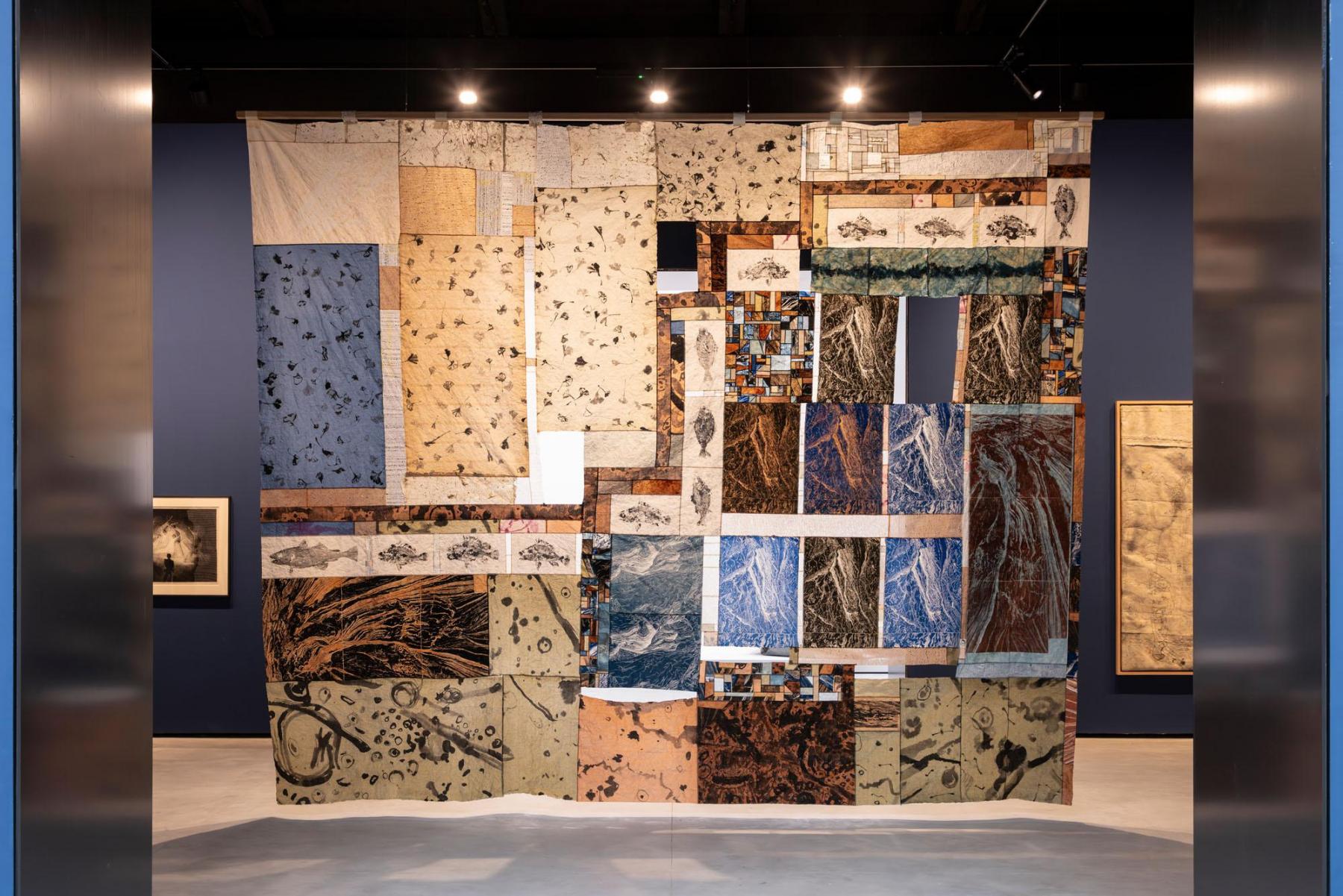
Alexa Kumiko Hatanaka. Instability, 2024. Patchwork of printed, sumi ink painted and naturally dyed washi from Kashiki Seishi, gyotaku, artist’s handmade paper, 145x168”. In Minor Keys, 61st Biennale di Venezia. Photo: Marco Pavan.
On the ground beneath Namazu sit Movable and Immovable, an installation created for the exhibition. The sculptural heaps made of washi paper appear dense and stone-like, though they are likely far lighter and more portable than they seem. Hatanaka employs the metaphor of heaviness, drawing from her experiences with bipolar—thinking through how something can appear either fixed or mobile depending on one’s internal state. One of the piles of washi is dyed mostly a deep indigo blue, while the other echoes the burnt orange of the boiler suit adorned with portraits of Hatanaka’s grandmother. In one corner of this form, I recognize the outlines of Hatanaka’s ink-drawn Gingko leaves.
Opposite these works hangs Faultlines and Loneliness, a paper textile work suspended from a timber beam. Its backdrop consists of black and white linocuts on washi depicting snow and ice formations in the high Arctic. Back in Toronto, Hatanaka explained to me that this linocut is based on patterns that can be used to navigate the land for those with traditional Inuit knowledge. When printed in blue ink, this same print resurfaces throughout Hatanaka’s work, shifting toward something more fluid, more water-like than snow-like. And yet, both states are part of the same cycle–different phases of a shared material world. In this work, the motif of snow and ice is interspersed with a jagged white line that rises irregularly from the bottom left to the top right of its length. The line charts the steep rise of the use of the word “loneliness” over time. In this gesture, Hatanaka folds inner and outer landscapes together, aligning emotional fluctuation and environmental volatility within the same shifting field.
Further into the exhibition I find Instability. The impressive patchwork echoes the themes and materials of the works that I’ve encountered in the exhibition so far, at a larger scale. Suspended in the center of the room, the washi paper’s translucency is fully expressed, imbued with the magical and spiritual characteristics of stained glass. I watch as an Italian tour group pauses briefly, huddling around the piece, their eyes darting between their docent and the installation. As they are hurried on to the next work, they are replaced by a German tour group, and the large patchwork catches a gust of wind. I watch as it ripples rhythmically, almost like a wave.
I’m impressed by the strength of the seemingly fragile material. In places, the fibers of the paper seem to be only lightly held together, yet somehow have the strength to withstand the bluster of several tour groups. Up close, I see the exactingly straight lines of its machine stitching, which contrast against the imperfect raw edges of the washi paper itself. I think about what Hatanaka told me about firefighter’s jackets being made out of the material, and I am in awe.
After moving through the exhibition, I step outside again. The sky has shifted noticeably since I entered; clouds have gathered overhead, and Hatanaka’s fish flags whip harder in the strengthening wind. As I leave the Biennale grounds and enter the city, a heavy rain suddenly crashes down. Crowds begin to scatter in every direction, people holding jackets above their heads as they rush back toward exhibition halls, nearby cafés, or whatever shelter they can find beneath awnings. Water quickly begins to pool in the narrow pathways, soaking my sneakers and the bottom of my jeans. I think about how I learned that the grounds of the Giardini used to be a marshland, and that they were drained by Napoleon to become a public park. I trudge on, losing my way a few times in the seemingly labyrinth-like maze of Venetian streets. How quickly the weather has changed. I find my way back to the ferry and quickly hop into the small cabin of the boat, huddling in close with the other souls who have braved the rain, and head back to higher land.
Hatanaka asks how we might learn to live more attentively within unstable conditions rather than imagining and imposing stability as something permanent. In her work, fragility and resiliency are not opposites. Washi paper can become firefighter’s clothing. Bodies and minds adapt within systems that are often hostile towards them.
A few days after I return to Toronto, I set out to visit the construction grounds that are being redeveloped to become the Lassonde Art Trail. Along the way, I pass Ontario Place, the iconic waterfront park that was recently razed overnight; more than 800 trees were cut down to make way for a new privatized spa granted a 95-year lease on public land. What was once a green oasis–home to abundant wildlife, including 195 species of birds–has been reduced to a flat, grey expanse. Continuing eastward, I arrive at Biidaasige Park, just east of downtown Toronto, where the Don River flows into Lake Ontario.
Historically, the river’s mouth was a vast marshland. The area became highly industrialised in the nineteenth century, and in response, the lower Don River was straightened and redirected. The surrounding wetlands were filled in to create the massive industrial district known as the Port Lands–interventions which made the area prone to flooding. For the past several years, the area has been undergoing a large-scale restoration project, aimed at reimagining Toronto’s waterfront. A new river channel has been carved through the landscape to reduce flood risk, its winding path designed to mimic the natural flow of the stream. Around it, a network of trails and green spaces forms a river valley, intended to protect the area from future flooding should water levels rise. This new landscape is the site of the Lassonde Art Trail, an open-air space for contemporary art scheduled to open in the summer of 2026.
Hatanaka was one of fifteen artists commissioned for the inaugural exhibition. Back in her studio, Hatanaka showed me mock ups of the work. Three patchwork washi paper fish–each slightly different–hang from the wall under which we sip our coffees. “They’re inspired by koinobori,” she tells me–traditional Japanese carp flags that are shaped like wind socks, traditionally flown to celebrate Children’s Day. “That one’s kind of carp-like, and the other two are pumpkinseed fish and pickerel.” Toronto and Region Conservation Authority biologists have been monitoring the new mouth of the Don River and surrounding wetlands, finding new species of fish that have come back to the harbour that hadn't been seen in 80 years. Pickerel and pumpkinseed fish are among them.
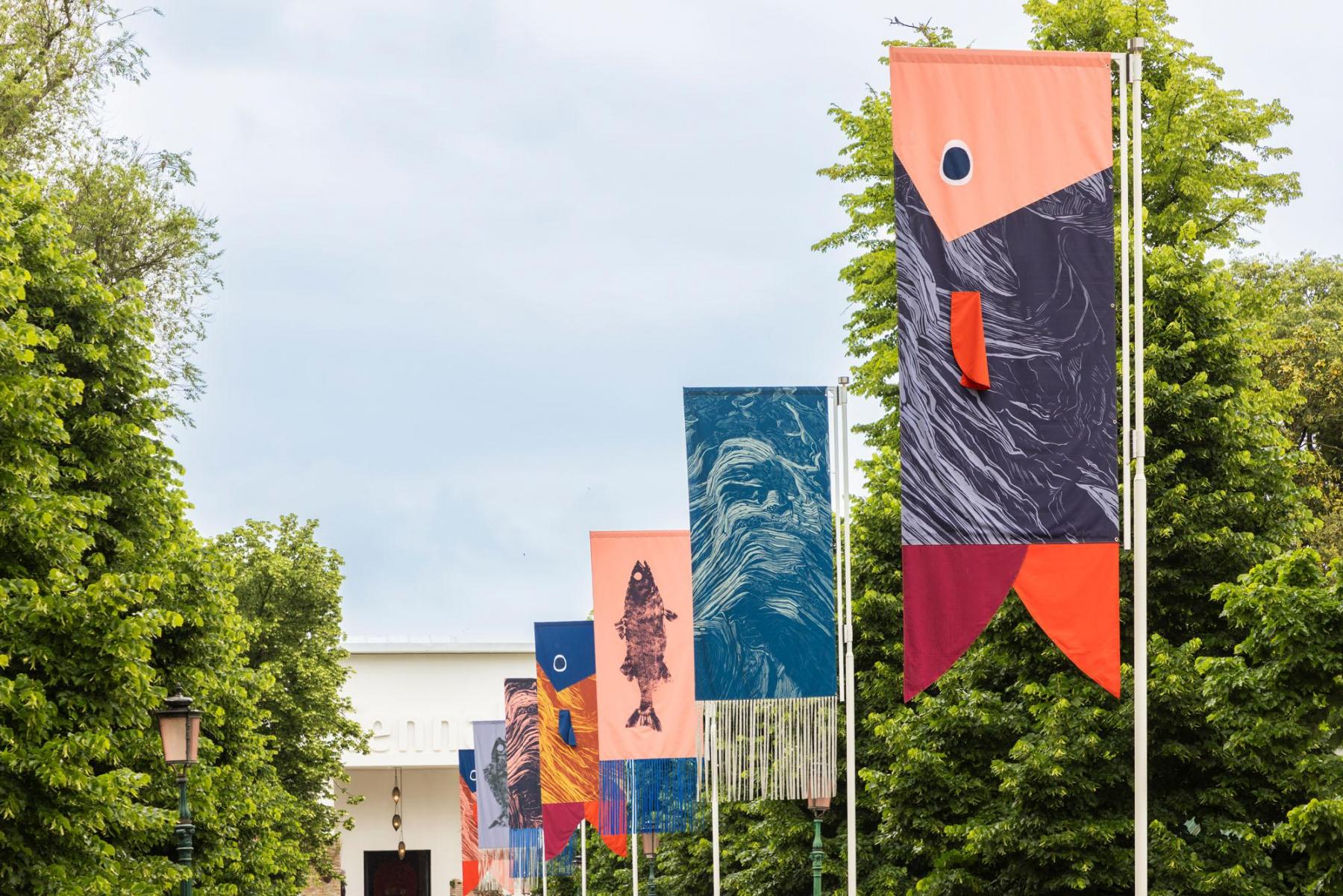
Alexa Kumiko Hatanaka. Susceptibility to Gravity, 2026. In Minor Keys, 61st Biennale di Venezia. Photo: Marco Pavan.
“A lot of Torontonians don’t know that there's even fish there,” Hatanaka tells me, “In the urban environment, I feel like everyone refers to nature as a place that you go visit. But it's actually, you know, it’s this thing among us–this is what we live within.” Since they’ll be outside, like her flags at the Biennale, the works at the Lassonde Art Trail will be made from repurposed ripstop nylon, and created in collaboration with sail-making experts. “It's challenging because, obviously, the whole point of my practice has a lot to do with the material, the history embedded in it and, of course, the environmental soundness of it,” Hatanaka tells me, “So it felt a little bit weird to translate that into a fabric that didn’t meet that criteria. But I thought it was an interesting challenge. I have a background in public art. I painted murals for many years in the beginning of my career. I like being in the public dialogue, so I was intrigued to do the project.”
In a phone call, Artistic Director and Chief Curator of the Lassonde Art Trail, November Paynter, tells me that most of the projects on the Art Trail will be in gathering spaces along the path, but Hatanaka's will be installed on the beach. “I knew we had this site,” she tells me, a cobble beach, right down by the water. “I think it's a really perfect location for the artwork… thinking about the fish returning, you know, being right there, at the footprint of that beach.”
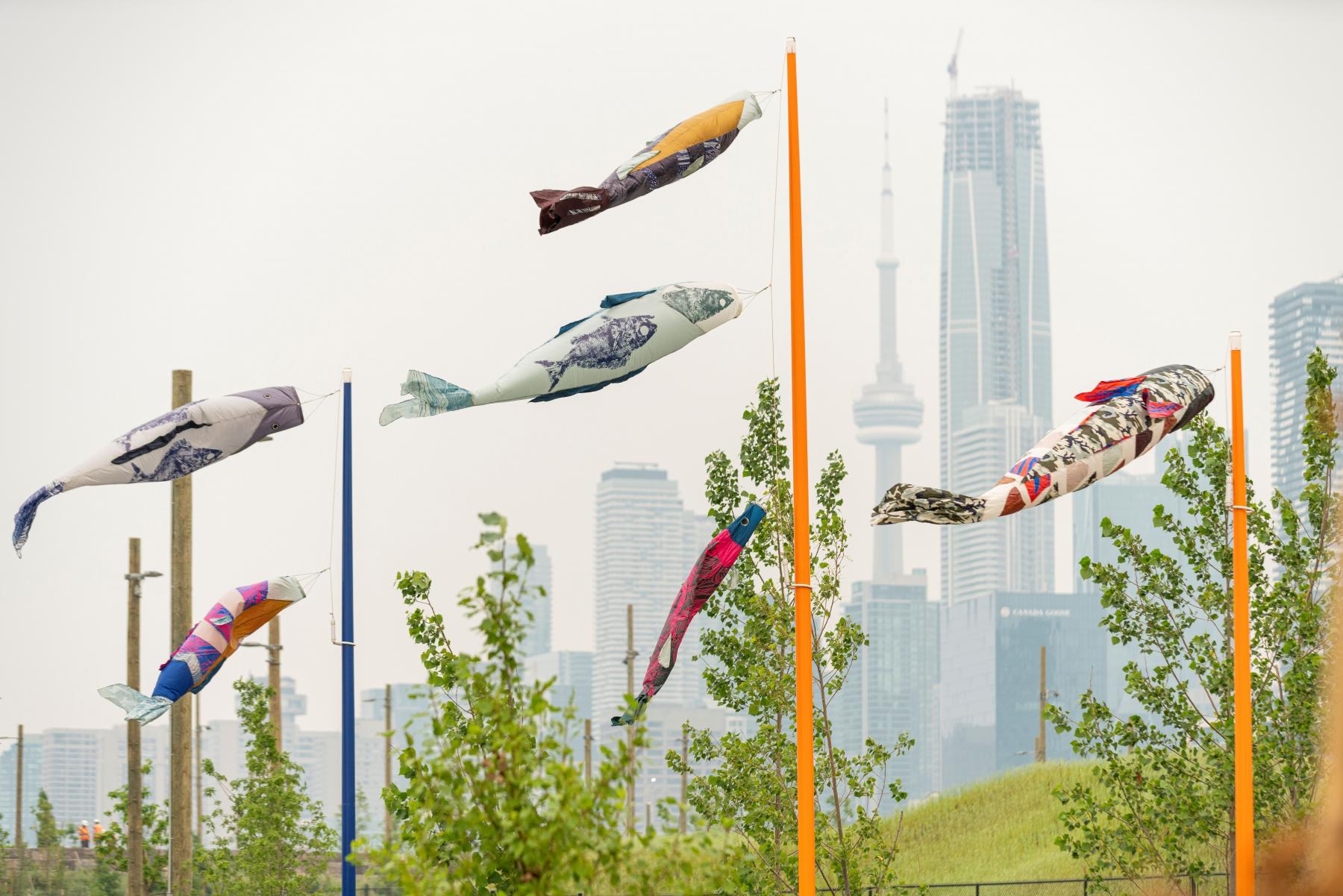
Alexa Kumiko Hatanaka, against the wind, with the wind, 2026. Photo: Vid Ingelevics and Ryan Walker. Courtesy the artist and Lassonde Art Trail.
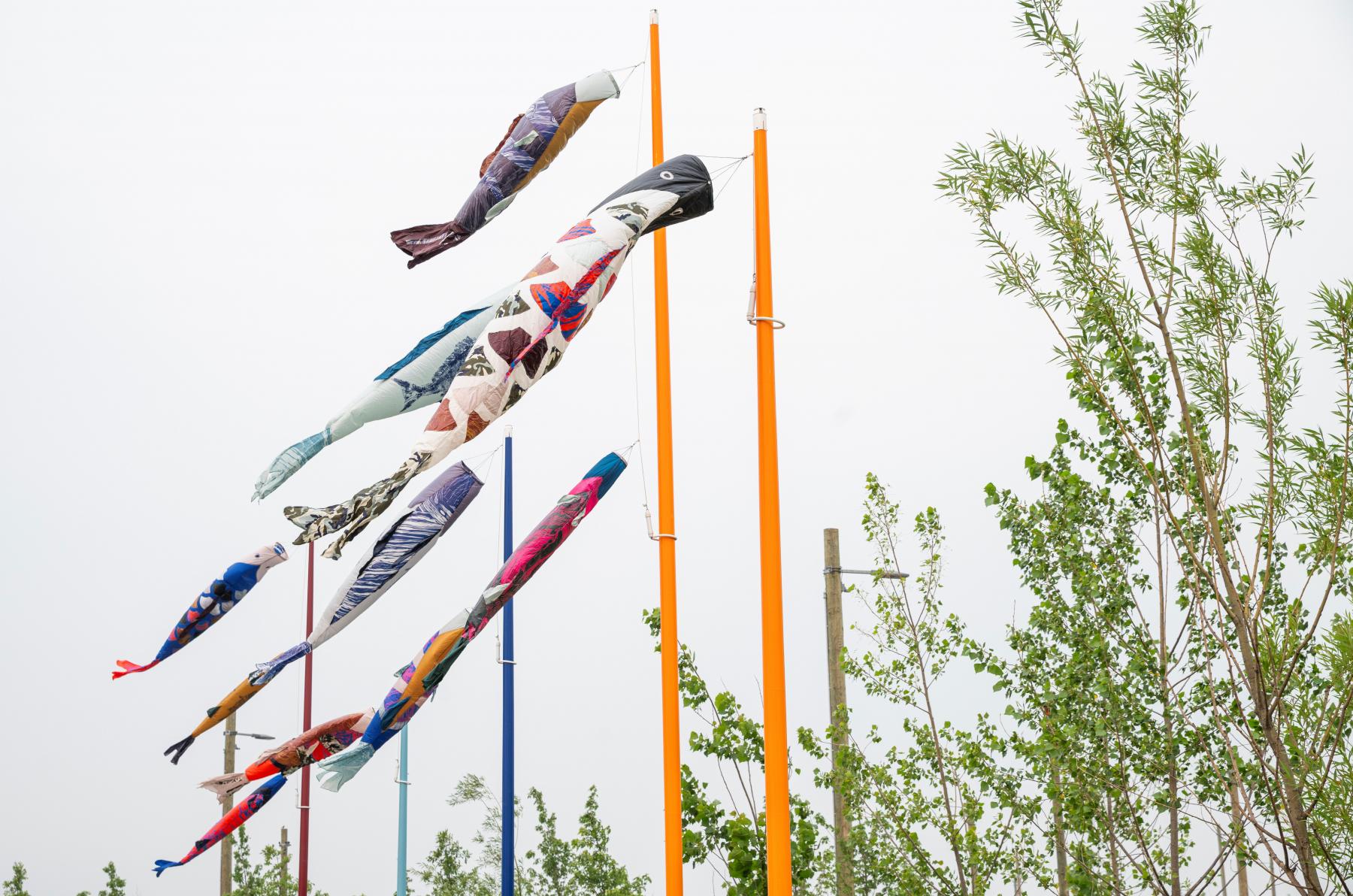
Alexa Kumiko Hatanaka, against the wind, with the wind, 2026. Photo: Vid Ingelevics and Ryan Walker. Courtesy the artist and Lassonde Art Trail.
It is foggy and unseasonably cold for late May when I arrive at the site set to house the Lassonde Art Trail, and there is a constant dribble of rain. I walk along a paved pathway that eventually leads to a pebbled area that descends into the river–a levee for future floods. I continue on, looking up to the sky, imagining Hatanaka’s fish flags. How might they be transformed by the landscape and the weather? Would they sway gently in the breeze? Would they whip wildly on windy days? I stand at the ledge of the river for a while, peering into the dark murky water. I don’t see any fish.
As I continue on, I find a young man with a fishing pole standing near the shore. The fisherman casts his lure. The bright orange shape arcs briefly through the grey air before disappearing under the surface of the river. For a moment, nothing happens. Then he reels it back in and tries again. Around us, the sounds of the newly constructed wetlands overlaps uneasiliy with the sounds of active development: sparrows and warblers and gulls and red-wing blackbirds are interrupted by the grinding of machinery and the sharp beeping of reversing trucks. The landscape itself is suspended between states: part restoration project, part construction zone, part public park, part flood prevention, part public art project.
Much of my exploration of Hatanaka and her work has unfolded through landscapes shaped by water: Venice, a city perpetually negotiating rising tides. The Giardinni, once a marshland before it was drained and remade into a site of culture and spectacle. The mouth of the Don River, a marshland redirected, and now engineered in response to earlier interventions. In Toronto, wetlands are being restored while public waterfront land becomes privatized. Fish species return to harbours after decades away, even as cranes and condominiums continue to reshape the shoreline. Hatanaka’s proposed fish flags for the Lassonde Art Trail feel significant within this context. They respond visibly to the ecological conditions around them. Like the koinobori that inspired them, wind determines their movement and weather activates them.
Hatanaka asks how we might learn to live more attentively within unstable conditions rather than imagining and imposing stability as something permanent. In her work, fragility and resiliency are not opposites. Washi paper can become firefighter’s clothing. Bodies and minds adapt within systems that are often hostile towards them. Adaption remains ongoing. The fisherman casts his line another time. Still no fish. Yet beneath the dark water, unseen currents continue to move through the newly carved channel. Somewhere below, beyond visibility, fish adapt to altered cities, shorelines and climatic shifts.