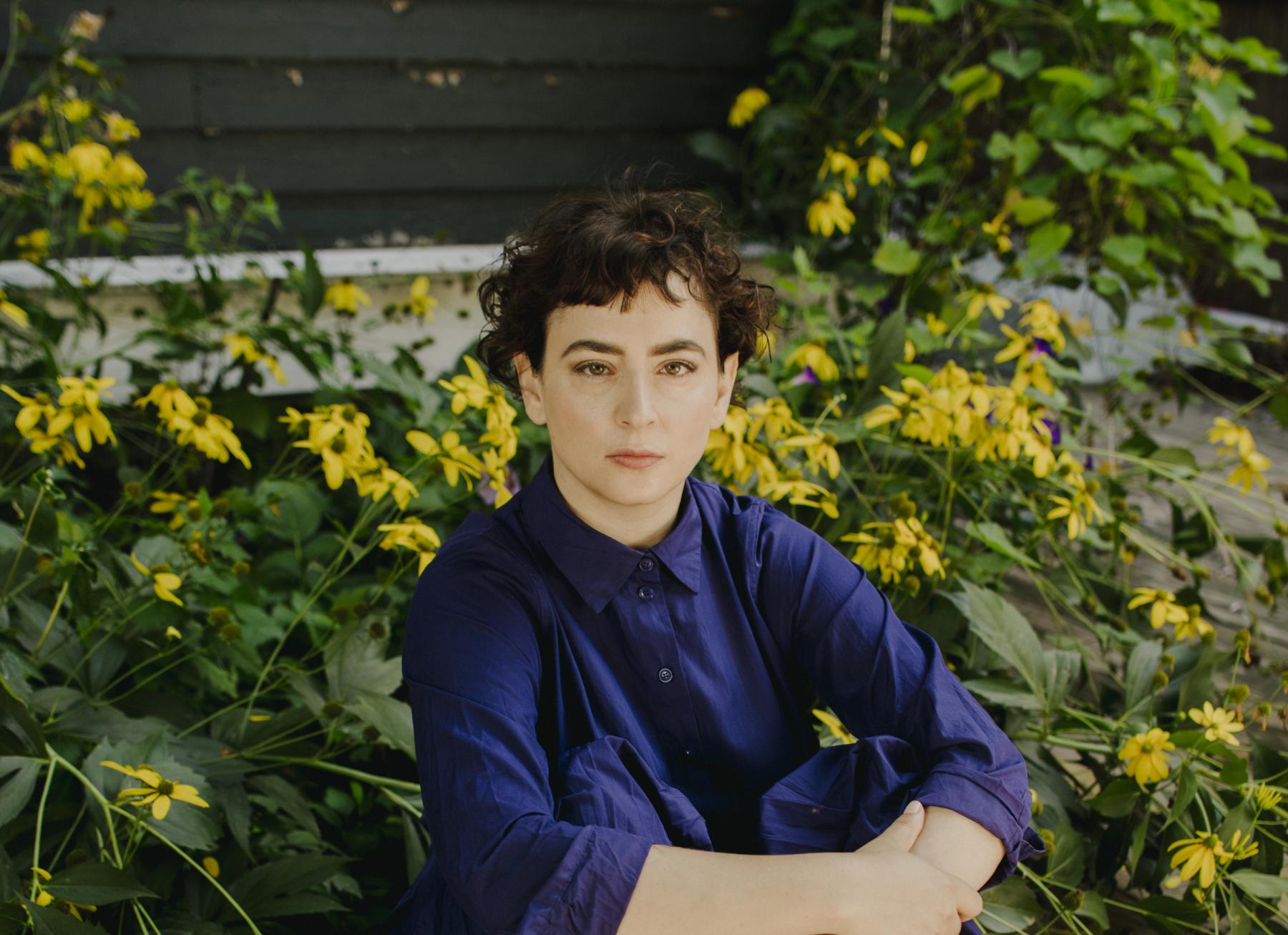
Portrait of Kate Zambreno by Heather Sten
Foam is American writer Kate Zambreno’s latest novel, published by Semiotext(e) in September 2026. The book begins in a hospital room where an encounter with another postpartum mother gives way to the narrator’s reminiscence of two hired “mother's helpers,” both named Eva, before folding into a novella-within-the-novel about the artist Eva Hesse. Evas abound.
Like Zambreno’s recent novels Drifts and The Light Room, published by Riverhead in 2020 and 2023 respectively—and all their books, to an extent—Foam exposes its own construction. Each narrator expresses formal desires; in Drifts: “my fantasy of a memoir about nothing”; in The Light Room: “a notebook of seasons and exhaustions, a form I’ve termed ‘translucencies’”; in Foam: “a soft book, made out of ridiculous materials,” “an unfinished book.” Most keenly, Foam aspires to the absurdist qualities of Hesse’s sculptures—precarious, composed of disintegrating material, with an element of antic.
“All the Evas are an instability—they catalyze something in the narrator, sometimes attraction, sometimes revulsion, sometimes it’s more mysterious,” says Zambreno in our conversation, held over email early this past August. Foam is unsettling and disorienting. Hostilities unfurl across the novel. The narrator is a published, adjunct writing professor dealing with a brutal graduate student, unsympathetic institutions, abusive landlords, and students-turned-nannies alienated by the shiftiness of the relationship—is Kate, the mother, their mentor, friend, or employer? As Kate encounters the Evas, the mounting aggressions, and disruptions—one by one—the book balloons into absurdity. Or bubbles. Or foams.
I sensed the instability viscerally. By including multiple autobiographical details, Foam gestures at the category of nonfiction, but more incisively, at the way Zambreno’s work is largely read—as autofiction, memoir, or as they say in our conversation, “close to the body, to biography.” This rapid and recurring movement, from the absurd to the realistic, has a crackling, disintegrating effect. Foam capsizes, in a more extreme way than autofiction, the distinction between author and narrator, by tilting dramatically into the fiction of self.
Zambreno, who has been called a relentless literary stylist and conceptualist, is the author of many acclaimed books, including the above-mentioned Drifts, as well as To Write as if Already Dead, a study of the French writer and photographer Hervé Guibert. In our conversation, we spoke about the collective practice that is reading and writing, the instability of the first person, the flattening moral obligations of the memoirist, and about what they term “precarities”—a form that is a duration, that abandons notions of separability.
My work for me is a form of survival, and it’s often finding the small or absurd or even something voluptuous or pleasurable in alienation.
I sat with Foam for a long time after I read it. I wondered how I should think about it, how I could talk about it. Then I listened to an audio documentary on Eva Hesse, produced by the Getty Research Institute, in which the host, Helen Molesworth, asks art historian Darby English what kind of story he thought Hesse was trying to tell with her 1966 sculptural piece, Hang Up. He says, “It is a color story, it is a shape story, it is a format story, it is a medium story, it is a wall story, thereby it is an institution story, it is a phenomenological story…” I started to imagine your book as this object in space I had interacted with, and it seems similarly appropriate to say Foam is “a precise system of art gestures,” as English further describes Hang Up. There are multiple vantages from which to view Foam. How did the book begin to take shape for you?
It pleases me so much to read you speak of the project in such a way—the strange, maybe, even unsettling, affect it had, like a lingering feeling, and wanting to sit and think through it. That it resisted being easily described or categorized—something like both sound and silence. This is all I desire now in reading and writing. It opens and continues—it’s indeterminate, never finished. It represents a duration. It’s a collective practice, not about “I” but about “We.” And, really, that’s also the transfer of this text from other texts—the feeling of looking at soft sculpture, wondering how a series of texts could respond to bewildering forms, and reading atmospheric and tense novel-like things like Clarice Lispector’s The Passion According to G.H., Magda Szabó’s The Door, and Marie NDiaye’s Self-Portrait in Green.
I had this tickling sensation in my brain when I read your first question, and then I realized—I forgot—I had written about Hang Up before, probably the origins of my Eva Hesse investigations, at the end of the novella, “Disappearance,” that begins To Write as if Already Dead, my study of Hervé Guibert that’s also a study of literary friendship. (I use study as a collective set of practices, after Fred Moten and Stefano Harney.) I write how Sol LeWitt began to explore the not-straight line after his close friend, Eva Hesse, died, and how he helped fabricate Hang Up, which I describe as a “sculptural send-up of a painting.” Often, I wonder, with my own work, probably beginning with wondering if what I’m doing is really sculpture, at the end of Book of Mutter, whether I’m doing a novelistic send-up of other art forms, or vice versa. How Hesse felt this was the first piece that reached the “absurdity or extreme feeling” that she desired in her work.
It’s interesting to think of a book taking shape. Maybe it’s also like a body taking shape, with others. There’s a fiction of separability or singularity there. It’s all connected. I definitely thought of extensions beyond the straight line (is that narrative? Or like Hesse, its playful refusal?), of a series of soft forms/foams. But I think perhaps it took shape with thinking through Hang Up, at the end of the duration that was the Guibert study, when I am heavily pregnant with my youngest and thinking about strange ephemeral private practices, desiring for absurdity and extreme feeling, amidst cruelties and precarities, that these foams began. And, in terms of circling timelines, Foam opens in two layered postpartum periods of softness and trauma, that follow the end of the Guibert study, and in that brief interval period of weeks before The Light Room begins, and also follows Drifts. It’s quite repetitive. I go back to the same time periods—bodies are layered over each other. And the same spaces–which are the spaces of rooms, of the life of the apartment, that is also a life of the body and bodies.
Molesworth also says the large metal loop “interrupts the space of the viewer,” and I really like her use of “interrupt”—it made me wonder, while reading Foam, what is the protrusion here, what is the shape or material that sticks out and figuratively holds me at a distance from the frame? And framing, in publishing, is also a marketing word—to frame a book as memoir. In Foam, the writer aspires to the fugitive qualities of Hesse’s sculptures—they wish to write “a soft book, made out of ridiculous materials,” “a book on fragility and absurdity.” In The Light Room, there’s a moment when the narrator, who has been commissioned to write about a James Rosenquist painting, is walking around lower Manhattan, wanting “to think about space, how a painting can take up space, but also how my own writing occurs within space and time…” How were you thinking about space when writing Foam?
I’m always thinking of space. Of time and space. With Foam there’s the Bergsonian durée that I’m thinking through—also a return to investigating the artist B. Ingrid Olson’s work, another commissioned series of pieces that, like the pieces published in Screen Tests, are supposed to approximate space, a series of windows as texts, texts as windows. The last pages of Foam are like windows, which also is thinking through a specific Eva Hesse window-like series.
It was weird to be evicted from the apartment we were in for over a decade, after a yearlong rent strike, after our toddler was lead poisoned, because it is such a space that I have exhausted (to use the Perec constraint) across a series, a series of works of interiors (Appendix Project, Drifts, To Write as if Already Dead, The Light Room). I have documented various transformations and multiplicities in that same space. In many ways the hauntingness of Foam, is remembering, say, the vestibule feeling, of this shared space, of a house with thin walls, and then living in another shabby rundown Victorian house, in the same neighborhood, and then being evicted from that, expelled from that space—the uncanniness of these home-like spaces that we were always estranged from. I think that’s part of the ridiculousness of Foam (and Performance Art (Semiotext(e), 2027), which follows, albeit in a different, more absurd, maybe antic, mood, and takes place in a series of exteriors, in a way, in the process of eviction). It’s so fragile and absurd, the postpartum feeling, amid precarity, while never having parental or postpartum leave and expected to continually work, as an adjunct, after each birth, this alongside the tenant feeling, of being temporary, ephemeral. The toxicity is throughout both the works but I often don’t name it. It is something like trauma, in terms of what trauma does to memory and the nervous system. I go to softness and absurdity instead.
I like the use of “interrupt” too—that wide funny loopingness. Playing outside the frame. I don’t know where I read it, but Eva Hesse was making a joke out of always being on the phone, with her then husband, that toxic relationship, the housewife role she occupied uncomfortably, being “hung up,” like psychoanalytically, on her childhood trauma, which was, obviously, historically intense. I think the protrusion is my repetition of Evas throughout. That is resisting the frame of memoir, of nonfiction. But it’s using simple language, simple materials. It’s making a joke. It all started actually when I basically had cardiac problems, still do, following the birth of my second child, not having leave, in this period of extreme endurance, working myself to death, following periods of what I can characterize as abuse—abusive landlord, an abusive student, abusive and uncaring institutions that allowed this. My cardiologist was actually named Eva. And it reminded me how Eva Hesse’s stepmother, who she refers to in her notebooks, is also named, somehow, Eva. And I was like—ha, ha, this is funny. All the Evas. My work for me is a form of survival, and it’s often finding the small or absurd or even something voluptuous or pleasurable in alienation. Even, here, in trauma.
By the way, you’re the only interviewer who’s ever brought up the long drifty piece on James Rosenquist that’s in The Light Room, or that The Light Room is so much about looking and thinking about art. That piece is kind of my attempt at a psychogeography—originating from another commission, which often becomes a space of play and experimentation for me. Sometimes a commission is the only constraint that forces me to finish something. Like all the layers of these uneven spaces, walking around lower Manhattan, a meditation also on grayness. Sometimes it completely fucks with my head, how often my work is overdetermined as memoir, like no matter what I do—I could have lengthy speculative digressions on Rilke writing Malte Laurids Brigge, I can write a novella-length essay on Kafka’s notebooks that also is a detective piece about the theft of the Mona Lisa, as in Animal Stories, I can include long art essays within a book I almost jokingly call a novel—I am read close to the body, to biography. People will literally erase these sections, which I often think of as gender play, sometimes even ventriloquism, in their reading. Still I’m asked, like, on a loop, “What is it like balancing motherhood?,” when I’m writing about Garry Winogrand’s zoo photographs or a study of Hervé Guibert. But you know, this has kept me loose and opened me up to experiment even more. It’s made my work wilder and weirder, I think. Because it’s like—ha ha ha. OK, fuck you! It’s made me explore plurality and multiplicity even more. In Performance Art everyone’s named after the characters in the sitcom Friends—there are prolonged jokes about Friends. When writing feels like a prank—I think I get this from Eva Hesse. I have always felt a real intimacy with a reader—not in a parasocial way, like an online cult—but in that they’re in the space that I first inhabited; I’ve moved out already. A space where I’m performing something delicate and mischievous, and it’s erotic to me, like a reader will track that mischief, they’re in on the joke. It’s like what Lana [Del Rey] says—it’s you, it’s you, it’s all for you. Loneliness can be quite a luxurious space. It’s also such a fiction.
This makes me think of something you said in an interview with Danielle Dutton for The Believer: “What am I writing if I don’t have the stability of a home, the security of tenured work, the resources in which to be a writer full-time? I guess I’m writing fictions.” In what way are loneliness and precarity fictions?
I think the very fiction that there is an “I,” not a “We,” that there is ever really a self. I think the belief in the stable, bourgeois subject—with a childhood, an Oedipal formation, that can be analyzed, with a past that can be entered also like this home that still exists—this is the very ideology behind creative nonfiction. There’s that line in the writer Anne Boyer’s “Not Writing”—I am rereading Garments against Women again, like a bible lately, of communism and desire, of how writing can be anti-capitalist—and there’s that line that goes, “I am not writing a memoir because memoirs are for property owners.” I think that line informs so much of my recent work, to be published in the next year or so, which is also, collectively, a treatise against landlords and uncaring, extractive institutions like the creative writing program.
You’ve drawn out that I like to name these forms something other than publishing categories—and in the lectures that I gave at Columbia’s graduate writing program in Spring 2025, that I called Against Nonfiction, lectures that are coming out in the spring from Haymarket, I coin the term “precarities” as forms that must be somehow more about duration within capitalist realisms (at once slow and performed impossibly within gaps of time). In the first lecture I am deeply engaged with Sofia Samatar’s Opacities, which are themselves going back and citing our letters together that relate to the present-tense thinking in Drifts and To Write as if Already Dead. This is from Opacities:
“TIME, I wrote. If I had more I’d be a different writer. You wrote to me of slowness and accumulation. It was true, you wrote, that time was required, but only in order for art to be ritual, process, to be about the impossibility of time.”
If I had more time I’d be a different writer…the opening lecture thinks through the concept of the sabbatical, the idea of rest to do the real work that tenured professors are allowed, to be the actual full-time writer, how the lecture I am giving is replacing such a memoirist on sabbatical, on a prestigious fellowship, and how my cycle of adjunct work over a decade was always replacing such sabbaticals. I ask in the lecture, if not sabbatical, or rest, or an office, how can the thinking together, in the classroom, even within the enclosure of the campus, especially that campus, be a form of study? This also reminds me of the poet Bhanu Kapil, writing on her blog, of that interview with César Aira where he speaks of the task of the novelist as having an intense amount of ongoing time in order to inhabit the space of the novel. OK then, Bhanu asks, there and in her work: Then if I don’t have this (because of constant teaching, in the undercommons at universities, because of constant carework) I guess I’m not a novelist then—then what am I? Without the luxury of space and time? It is like an anti-novel, a not writing, of the exhausted writer, the caretaker, the precariat, that is the writing I’m interested in. With no time or space—without the private property of the tenured writer, the traditional memoirist or novelist.
The luxury of the traditional novel or memoir—all that time, all that space—is deadly to me. I think this is why I’m drawn to the document, the report, the notebook, all these forms that take place in the present-tense, in impasse. Precarities are also the writing that is not writing—the servile letter begging for one’s lease to be renewed, begging to be able to adjunct another term, begging to be read or published.
I felt while reading Foam that I was outside the categories of fiction and nonfiction, and closer to performance art. In a conversation on the David Zwirner podcast, you talk about publishing as one of the more conservative art forms—its marketing priorities and editorial committees. But I wonder if there is something about the medium, too. Speaking with David Naimon on Between the Covers, following the publication of Tone, co-written with Sofia Samatar, you describe the multiplicity of voices that is already present in reading—the reader's voice, the narrator's, the author's, and potentially the translator's. Would you say Foam is thinking through these ideas, by circling the absurdity of repetition and the instability of self?
Yes, absolutely. The instability of the self, something I’ve always circled around, and repetition as form become the central investigation in Foam. A lot of my work I track internally as being finished or written in summers. It’s the only time I am not teaching, so it tends—outside of moves, or like this summer, when I didn’t have any childcare—to be when I get writing “done,” outside of the practice of notebooks, which is ongoing. I believe that Sofia and I wrote Tone the summer I finished The Light Room, whose last movement is inspired by Bernadette and Rosemary Mayer. And I’m pretty sure that’s the summer I began Foam, finally wrote the opening movement, “A Cold White Wing,” first published in Granta, that came out of this strange, spacey feeling in the maternity ward, during the height of the pandemic, where I shared a room with another mother, but we had to wear masks and were separated by a curtain, and weren’t allowed to speak to each other. That doubling of voices layered over each other was both lonely and social. I found the experiences of being in these semi-public spaces during and post the pandemic other-worldly, very sci-fi feeling, and it did something to time—it destabilized it more, time became almost outside of capitalist time, it was intimate, domestic time, but it also never stopped being capitalist time. I guess this is another way to say what instigated the project. It might have been the next summer I began Foam. I think in that interview Sofia and I were already riffing on the project we’ve attempted since we finished Tone: atmosphere—the collectivity and multiplicity—what Fred Moten calls sound—all these voices together. I think our concept of tone was a blurring of voices, a totality of voices—the reader, the narrator, the author, the translator—and we began to want to continue to investigate it. Foam is my attempt to write atmosphere.
I’m most drawn to works that are about what [the French writer and literary theorist] Maurice Blanchot called the neutral—a refusal of the first person. I don’t think the medium—I love the idea of medium, like a psychic transmission, maybe even fraudulent—is essentially normalizing. Roland Barthes thought of the fragment as that which resists the doxa, the regulatory and normalizing forces. American mainstream publishing is extremely liberal, neoliberal, bound up in market forces. It’s gotten even worse, more cowardly and conservative, with the financial exigencies and manufactured scarcity of this new world order. The problem with writing is usually you do need a publisher, right? But I mean the art world is also completely cowardly now, completely determined by the market. Like we see this with the art world and publishing’s cowardice in terms of politics, of refusing to take the only acceptable moral position about Palestine. My readers have never been the bourgeois, corporate hardback readers. If I could publish in pamphlets I would. I’m really lucky Semiotext(e) was willing to publish these two books.
I have turned more to performance, actually. I’ve been doing these performances when I’ve been invited to Europe, to be an author, where I’m sleeping instead. People always think it’s a joke, the publishing people, and maybe it is, in a way.
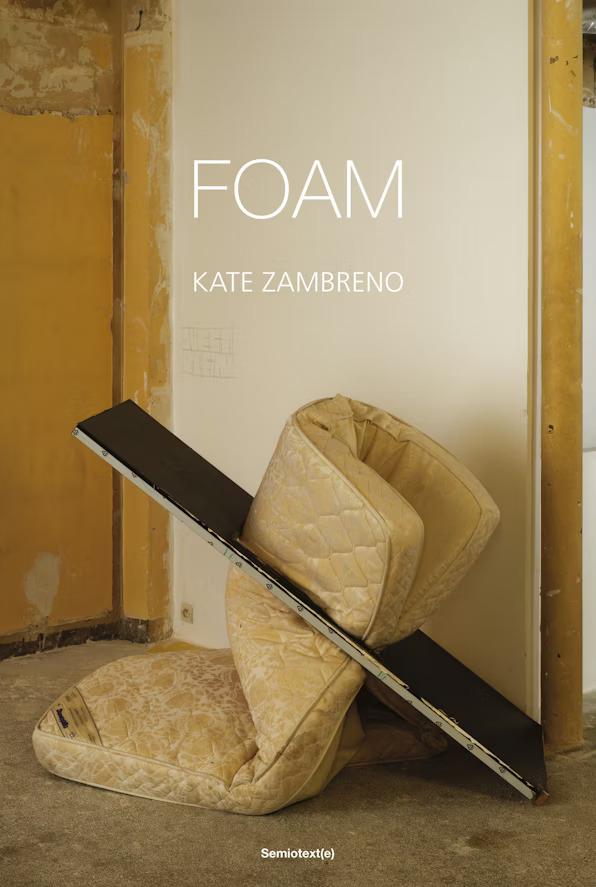
Bookcover of Foam (2026) by Kate Zambreno, Published by Semiotext(e)
The fragment as resistance to the doxa makes me think of Drifts, when the narrator realizes they aren’t suffering from writer’s block but from refusal. The refusal to refine or perform certainty. I love to think about, what does the writer surrender to instead?
Yeah, I like that line. This is also in the context of photography or collecting trash on the street to make an assemblage. The interest in the bricolage, not characters and plot, not what the publishing people are asking for. I don’t think of the refusal as a refusal to refine—I do like my work to have, as the Russian poet Daniil Kharms has said, a “slight error.” I want it to feel live. I don’t like it to be too polished. I think that I am choosing inertia and stillness as opposed to productivity—as a philosophical position, even. It drives me crazy when I’ve seen Drifts utilized as writing prompts or as part of productivity culture—the book has the opposite feeling for me. A totally lazy book—a book about lying down—about walking around and doing nothing. I think ultimately in that work I’m refusing corporate publishing, and their attempt to make me into an object, how alienating I found it. It took me until after The Light Room to realize how miserable it made me, what I was supposed to want. I just read this Verso book by the Marxist thinker Kristin Ross—The Commune Form—where she talks about the commune as a space of everyday life and questions the concept of “resisting” versus “defending.” The commune defends everyday life. I think in Drifts and elsewhere I’m trying to defend the communal feeling, the idea of process, of thinking, walking, and feeling. I think there was such a desire to be a great artist during that time, which was at odds with my desire instead to be just someone, among many many others, who think and read and write, but also organize, and take care of others, and this is a continuum. It’s such a relief, honestly, to give that all up.
I’ve read that you consider Drifts and The Light Room to be a series. Foam feels part of that world, too. The form of these books, variously called drifts, translucencies, foam, nervous systems, comes through at the level of the “unit,” too. Or maybe, necessarily? In Foam, for instance, each section is titled, giving it an enclosed, apart, feeling; in Drifts, fragments are untitled, each beginning on a new page; The Light Room handles its titled sections differently again. I’d love to know how you think about the “unit” in these books, and about your process when it comes to formatting?
I think Foam is in that world—maybe it’s in a different room. Like a succession in the series, but still a continuation. I mean I wrote them all, apparently, at some point. I don’t remember, really, writing any of them. There’s this whole period of work where I’m really inspired by the notebook form and obsessed with photography—the relationship of writing to photography. Drifts is interested in Chantal Akerman and Peter Hujar, the extreme long take. The snapshots around a neighborhood. I do like names of forms. I wanted to call The Light Room, “Translucencies.” It’s really about exhaustion and endurance. So was Appendix Project.
I like your units. Units feel more modular than how I work, sometimes, which can feel more amorphous, but also maybe there are grids or units. I like that more than “story” or “essay.” Sometimes I think of it like movements. Pace is important to me—speed and slowness. Drifts and To Write as if Already Dead are two separate movements—they are diptychs. And these units are also durations—charting periods of time. I mean, time is an obsession and a problem in my work. It’s much less about memory and more about time. It’s interesting, the second movements especially of Drifts and To Write as if Already Dead have been read as diaries—like transcriptions. I’m not trying to emphasize artfulness—I think that sounds boring—but the work has a diary feeling but is not actually my diary. I think when I learned of Annie Ernaux’s process, I felt pretty close to that, in these works that are trying somehow to chart domestic time. I didn’t actually look at my diaries for either of those, or with Foam, because that would have been long and unwieldy. I do transcribe my diaries, and my notebooks for projects that aren’t exactly diaries, but then I usually don’t look at them. It’s torturous, but it’s part of my process. The second part of Drifts is like an extreme present tense, a time of pregnancy and waiting and slow looking, almost like the time of a sleeping dog. The entire work is obsessed with the local, the neighborhood, which Foam returns to.
What I think of as a series usually charts a period of one or two years. They are durational projects. The Light Room was also written in basically impossible conditions—insomniac, immediately postpartum, breastfeeding, while teaching constantly—because we needed the money for rent (most of my works have that pressure-cooker feeling). So, each of the titled sections, over two years, are like periods of intense writing, happening despite it all, through commissions or deadlines. Foam is much more layered—it’s like two durations on top of each other, and the blurring of recent events. It returns to these other projects and destabilizes them, I think? It’s no longer photography, portrait or landscape, but a series of textures and intensities. Drifts, The Light Room, and To Write as if Already Dead were all commissions, partly, and had the deadlines often of a body (the first and third end with me basically going into labor). No one ever asked for or wanted me to write Foam! Ha. It’s slower and more porous as a result.
I’m into the fragment, but I often don’t think of all the work as fragmented. Sometimes I think when people say “fragmented” in publishing they mean—without a plot. Vibes. Which yeah—my work is pretty plotless. It doesn’t follow linear time, which is capitalist time. It has a different intensity or even passivity moving through it.
I like what you suggest about the “enclosed, apart” feeling of Foam. I think that’s it. But these enclosures are also open, permeable, and connected. It’s related to and inspired by [cultural theorist] Peter Sloterdijk’s concept of foams, in his Spheres trilogy, that Semiotext(e) publishes in translation, that also catalyzed my foams. There’s the placenta, the apartment building, air-conditioned spaces, ecological spaces—all foams. Sofia Samatar calls my series, probably beginning with Foam, my “apartment” series—like to be together and apart, in an apartment.
I didn’t answer your question about formatting, which is an important one. The format—the visual space of form. I don’t indent at all. I always have a specific way I want pages to look—titles to look—centered, or off to the left kind of subtle, etc. I’ve annoyed every publisher I’ve ever worked with, with my obsessive formatting.
I agree—Foam destabilizes Drifts and The Light Room. There is a moment in The Light Room when the mother, exasperated, screams and escapes the car of screaming children, leaving the father to find parking. Later, she explains to her daughter that mothers have tantrums too sometimes. Then, in Foam, a climactic moment when the narrator snaps at their “mother’s helper,” and thinks, “I often feel now, it is never, ever okay for me to lose my temper. Not in front of my students (but I could never). Not in front of my children, although of course I still do. But then when?” This felt like a distorted mirror image. In Foam, unlike The Light Room, I viewed this moment as a nod to the limitations of genre, as well. That it was also asking, where can this voice emerge if I am always read as a memoirist?
I love that you ask me about that because these are both such moments of cringe in both books, right? Something I’ve come to terms with is how my work evokes that cringe feeling, that too much feeling, and I think this gets at your question. The moment in The Light Room—which was quoted in every review—is just a play on a much more exquisite, graceful moment in Yūko Tsushima’s Territory of Light, which the narrator or speaker in The Light Room is reading throughout, especially in that first movement, the despairing, fourth trimester, winter notebook. It’s funny, just as an aside, the gender of the main parent and then the oldest child changes throughout these books—I like the fluidity of that.
But the melt down! My friend Claire, a former grad student, who closely read Foam (and is a great reader) called the work “mean,” and then clarified that it was written with an “inside voice.” Ultimately, I think that literature, or whatever I’m doing, somehow beneath literature, should be written with that inside voice. There’s a lot of ethically complicated and messy entanglement throughout Foam. It allows me more what I look for in the Guibert study, “bitchy prose.” And yes, how can that voice emerge, if the American concept of memoir is supposed to be above all moral, like being the professor, good mother, or, even worse, therapist or life coach at all times? I think nonfiction by Édouard Levé and Heike Geissler, both of whom I give lectures on in Against Nonfiction, and Annie Ernaux, allows for that messiness.
I finally met Heike in person, at BuchBasel in Switzerland, the day after I gave my sleep performance, where I slept, with the hotel bedding, in the square, all the festivalgoers mingled around me drinking (no one noticed me apparently), the morning I had to give my auditorium talk on The Light Room. I love her so much. She wrote a book, that hasn’t been translated, which is basically a woman writer lying in her office the entire book. I said to Heike, one of the things I’ve become more and more aware of, is that I allow myself to be irritating in my work, and I am aware that I’m irritating. She thought about it and she was like, very German, “That’s true,” lol.
What does transcribing your notebooks bring to your process?
I think I’m drawn to excessive rigor, in some ways, surprising because I’m also pretty lazy. It’s a form of remembering—where I was, what I tracked, at that time. I will often undertake, like this year, reading all of Capital, in a class with Fred Moten, or reading all of Critique of Pure Reason, in a class with Denise Ferreira da Silva, and really it can be so boring and painful and I kind of get off on it. My vision has become increasingly poor, as has my handwriting, so maybe someday I won’t be able to transcribe them.
I love how the artist Moyra Davey photographs her diaries, in bed, in Burn the Diaries, and calls herself a flâneur of the interior. I often work in multiple notebooks, on the bed, with a book. Today it is Hannah Arendt’s On Violence, a book I’m taking a lot of energy severely disliking, but the play of the hot pink lettering against the black background, my multiple notebooks I take with me, maybe only a little bit of time to inhabit them at all. I think and play and experiment in the notebook. Maybe it’s intimate? Erotic? They’re quite domestic, my notebook space, as it occupies my bed, and I’ll sleep on them at night. The many ink stains on my bedding.
In the interview with Danielle Dutton, which is from 2024, you described entering what you hoped was a transformative period for your work. You mention a few projects that you are working on, including Foam. Can you talk more about that period, or what has changed since?
In Foam I fixate on some fact I was given as a hand-out at my kids’ school—on the cellular change after 7 years. Like I’m probably a completely different person than when I wrote those books, but also the same person, and probably many people. After each birth I kind of felt I was a complete new person. Foam also follows a period of realizing I am more drawn to being “they” rather than “she”—the multiplicity of my gender feelings—there are a lot of she/theys in Foam. All the Evas are an instability—they catalyze something in the narrator, sometimes attraction, sometimes revulsion, sometimes it’s more mysterious. For a while I thought of this period of work as tracking hostilities, also what [writer and music critic] Mark Fisher calls capitalist realisms—coldness and cruelty, desires for softness. I think this recent period gets more at class feelings, living in New York, in basically servile roles, over a decade, but not having a past or background that’s coherent. Both Foam and Performance Art contain pieces in which I fictionalize a series of facts, basically that my two other serious boyfriends I’ve had, from where I grew up in the Midwest, both committed suicide during the pandemic. I’m continuing to think a lot about what the anthropologist Elizabeth Povinelli conceptualizes as abandonment and endurance. What is “care” in this capitalist death cult. A desire, always, for collectivity.
I guess I’m always desiring transformation. Or becoming. It never ends. My real life is quite cyclical, despite the instabilities so many of us experience—the brutalities and absences of care—but in the work, there can be wildness and porousness. I feel I’m entering another adolescence. I’m studying duration and endurance, in a Ph.D. program, at middle age, which is extremely, even bewilderingly, transformative, like an act of decreation… I’m thinking more, in every way, through the “they.” I’m interested even more in what Spinoza would call the sad passions. Lately, I’m interested in what is writing and study outside of creative writing. What is the purpose of study? And also—what I have no answer for—and I think is a line I say in one of my books, I don’t know where—what is the use of all this first person, anymore?
The poet Bhanu Kapil, whose voice is in many of your works, was asked in an interview with Stephanie Sy-Quia, “Is writing hard?” and I wanted to bring in part of her response here, and ask you the same, because you’ve been called prolific—I think you don’t agree—and Foam plays up this “accusation”; the narrator believes writing students resent them for publishing many books. Kapil says: “the thing that’s difficult is to move between different parts of life.”
I love reading Bhanu, always. The way she thinks through writing—and not writing—feels kindred to how I think of it, and this is also, I think, because we’ve occupied caretaking roles, often precarious and unstable, but finding some funding in these institutions. We also wrote blogs together. There is of course the seeming incongruence of being anti-productive writers who can generate a lot of pages, because the work is often documentation or notes. I don’t think of writing as hard—I think of publishing, lately, as almost impossible. The expectation to generate “content,” as Sofia just wrote me—content on a podcast, content on an interview—not here, when it feels so creative and generative, such a gift, really. They don’t care about wasting our time or exhausting ourselves.
I think there’s a neoliberal position within the creative writing programs that adjuncts are supposed to give their time endlessly, mentor endlessly without being mentored, make the customer happy, and there’s not a sense of sabbatical—of having our own work cared for, of anyone caring if we do find time and space to write. We are supposed to find a way for them to write and publish books. So yes I am playing up a bitterness in the relation between one of the Evas and the narrator. All of this feeling of competition is a scarcity mentality, it is capitalist realism—but I feel outside of that, I have beautiful relationships with former students, of real reciprocity, all of us trying to write in the margins despite it all.
I do get a lot of digs, from a lot of writers. My good friend, the writer Nate Lippens, whose Bastards, part three in his genius Wisconsin trilogy, Semiotext(e) also published in September, and I talk about this a lot. “Oh my god, how are you so prolific?” But I think we just have more of a working-class ethos about our writing. It’s something we do; we desire to do. It’s a series. And I think for me and Nate, if I can speak for him—yeah, it’s way more difficult to move, to find mobility, between these parts of life. Most of the time I am not a writer. And mainstream publishing, here, doesn’t see us as having value or visibility. So we write for each other. We write for our former selves. We write to try to find some form of community or being together.