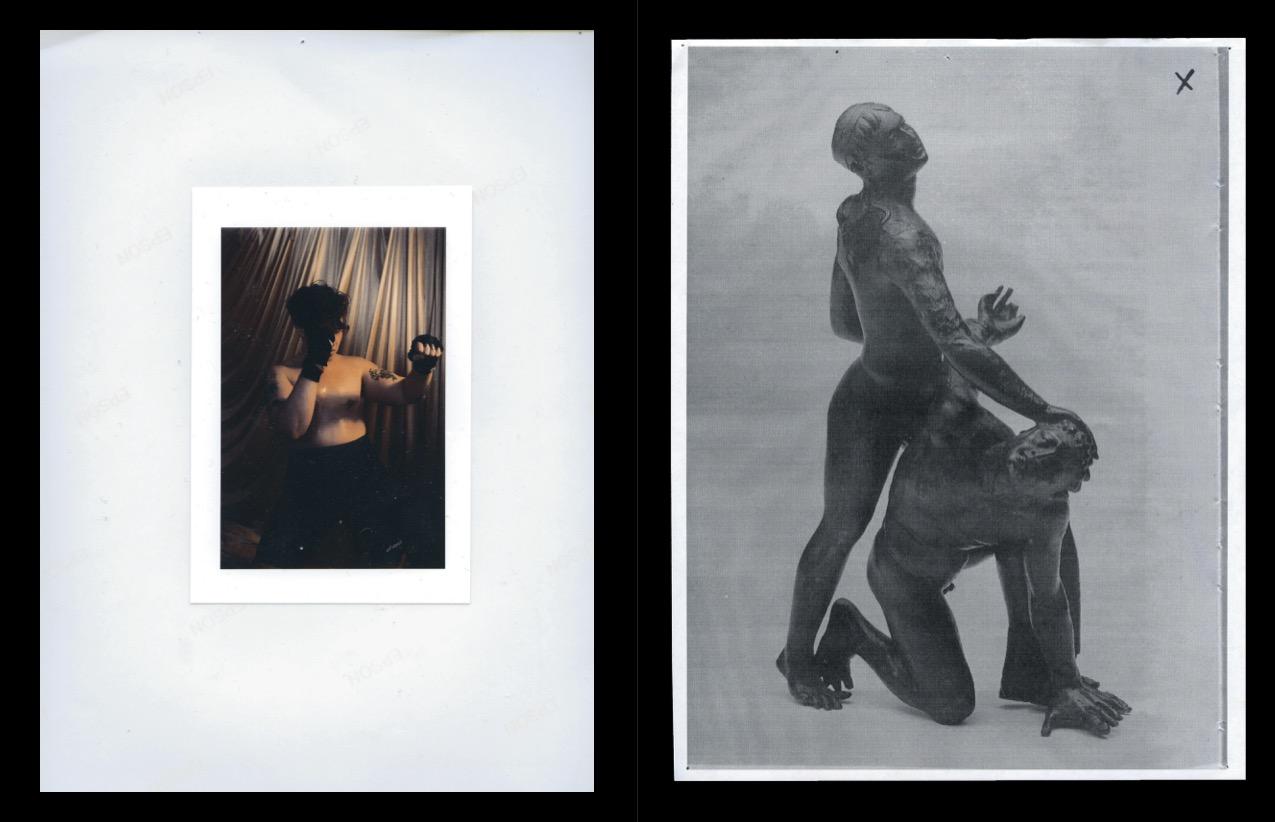
page spread from monograph, "Devotions", (2026) Elle Pérez, published by Aperture.
Devotions, Elle Pérez’s debut monograph (Aperture, 2026), isn’t just a compilation of hits. In it, you will find emblematic images from their extant body of work—the glowing vial of testosterone, held up to assess how much of a dose is left; the entertainment wrestler patiently pressing a foot down on an opponent’s throat; the string of cum attenuated between fingers in a lingering record of contact; the gaze from within the privacy of an embrace between dancers—but these icons have company. Flanking the sparely-printed images in the book’s central section, photocopied book pages and handwritten lists mingle with the photographs, elaborating Pérez’s approach to photography as a practical, physical means of asking questions.
Pérez grew up in the Bronx, where they made their first photographs at punk shows. Their portraiture, film work, and landscape photography have gone on to trace the stolen pleasures of self-determination at many scales, including transgender bodily autonomy and Puerto Rican autonomy in the contexts of colonization and gentrification. In their wall-spanning collage installations, first introduced at their solo show at MoMA PS 1 and iterated across spaces including Mass MoCA and the American Academy of Arts and Letters, they integrate the material of their research and reflection into the exhibition space.
Pérez’s arrangements have a pronounced non-hierarchical sensibility: tthey put xeroxes, printouts, annotations, and note-taking on the same plane as the exhibition prints themselves. These layers of material generate affiliations, rubbing up on the boundaries of their components, until they become porous. Devotions takes this installation strategy and zooms in, enacting the multidirectional relationship of source, annotation, and image across its page spreads. Seen in its shared context, a photograph is less a final product or stable image than a resting place within a process of thought. This mobile relationality is one direction of Pérez’s search, documented in a note within the book, for “an image that asks more than it answers.”
This summer, my dog Bear and I took the many-legged journey of the non-driver to a house of friends in the Fire Island Pines. Among them were Pérez, their partner kL Mays, and their dog Spike. We swam, ate mung bean noodles, took photos, and talked about Devotions.
What I prefer about these types of offerings of information or studio material is that they're not an essay. It's not my artist statement. It's just the stuff I was looking at. I’m offering up where I got to, or why I went a certain direction, or offering some answers in the form of other things to look at rather than an authoritative position
Your images make me feel how active skin is: a surface some inner part of us can rise to in “a bruise or a blush,” as David Wojnarowicz writes in one of Devotions’ textual fragments. In particular, you bring a sensual attention to surfaces in a state of change: sweat and riverwater beading on skin, falling from a hem to a hand reaching up a leg. How do you approach photographing moments of physical change?
I find it helpful to be able to reflect on these moments of change longer than life usually allows. That’s why I started preserving the studio walls.
Bringing the studio into the gallery space, or the space of the book, puts the material of your thought and process into direct contact with your photographs. What becomes possible when you make the thought that has gone into the production of an image visible?
Photography is a medium where it's hard for people to see the work that goes into the images. Painters have drawings or sketches or underpaintings. Sculptors have models, and people wonder what photographers have, or at other moments, assert that they don't have anything of that sort. This is that stuff. It's a genre of thinking that leads to these images. Every photographer has this, and that's the point of showing it or including it in the book.
I observed that incorporating the studio material also draws people in for longer than the individual photographs do. That happened in the exhibition at the American Academy of Arts and Letters (The World Is Always Again Beginning, History With The Present, 2025) by the nature of the layout. I asked the curator to have no gallery text in the front room, and that created a no-words relationship to the image until you had already gone through one gallery. It hadn't been positioned, so you could position it. After that, there's a return to the photographs, a more enriched view or a more contextualized view. It’s a kind of churn that interests me in the gallery space. The initial experience is of the decontextualization of the image and underseeing it that way—seeing it with your lack of understanding and having that be one read. Then, receiving this download of information, if you want it, within that space, and being able to return to the images.
Those photographs from the Bronx underground are frequently positioned as a photojournalistic social documentary of counterculture in a marginalized area. They have these projected readings that are ethnographic, anthropological, sociological, cultural, identitarian, whatever. But what if you could encounter them without that?
What I prefer about these types of offerings of information or studio material is that they're not an essay. It's not my artist statement. It's just the stuff I was looking at. I’m offering up where I got to, or why I went a certain direction, or offering some answers in the form of other things to look at rather than an authoritative position, and you might have a different thought. It’s a network of information instead of a single narrative, which might have to do with the type of thinking that artists of our generation do: the ways that our thoughts are organized more in clusters than in single narratives. As I think about what I get from other people's version of this, I always come away understanding the artist better and appreciating their decisions more.
Peter Hujar (another of Devotions’ textual referents) said, of his portraiture, “I want people to feel the picture and smell it.” You’ve said, of your collage installations, “They’re still warm when they’re on the wall.” Both of you describe sensing the presence of a living body, whether it’s of a person or a composition. How do you want your work to generate heat? What does that heat power?
[Splash] That was kL jumping in the pool.
That's such an amazing question. I try to generate heat in the gaze often, or when there's no gaze, where there's some kind of tension. Color is often where the heat comes from. When I get something singing, that makes me feel so happy. Different seasons call for different kinds of heat, and as I've been making photographs longer and longer, I am enjoying the seasons of style. I had been in this real black and white, sketchy, raw style for maybe two years before I came into the style that I was taking on more over the past two years. That style was a very descriptive color, using the Mamiya 7: a horizontal, quieter, more pulled-back image with a deep depth of field I could manipulate into being confusing. Those styles are reflective of where I am in my life, and the more honest I can be about that, the more the heat generates, and the more I can pay attention in those moments to high craft, high form, high high color, high tension—ratchet it up in the moment as much as you can—and think about it. Those are moments I feel I'm really getting something, or moments where I get something before it's too late. It's powering a time machine, bitch! That's what it's doing: getting there before it's too late.
One of your notes reads: “These photographs trace erotic actions that can never be completed.” Talk to me about following the erotic.
What do you want to know, charles?
Reading that note, I thought about the way eroticism doesn't stay still in its moment. If it was really erotic, I want it again. I want to permutate it into something else or to return to it in some way. Are we thinking about the erotic as a pursuit that never stops happening?
I’m thinking about it like, “That's not gonna happen.” There's no happening: it’s a kind of fantasy that can find a home in a photograph, where it can be almost protected from reality.
There is an insatiability, but that moment in particular was about wishing and fulfillment, and then there's a real middle where I feel that it was about questioning photography. What I’ve found exciting about the new camera that I've been working with is that it creates a digital photograph that really looks like seeing. It has a little bit of affect and a little bit of reality. It accentuates the seeing of the moment. Because we're so image literate now, all of that plays on all of these other things in your mind. So this referential style becomes a way to index images that you've seen before, and so you see this hyper-semiotic image, and all of its references: it’s a certain type of poetic, analytic realism that is aware of its construction. Some people take pleasure in decoding that, and some people just want to feel it. But it's happening in both places.
[An interlude to photograph kL, who is sitting cross-legged, reading a book called Chaos]
Wait, just flash me the biggest smile. You’re so cute. Oh my god! All right, now it's serious. Chaos. Amazing. Do you want to go back to reading?
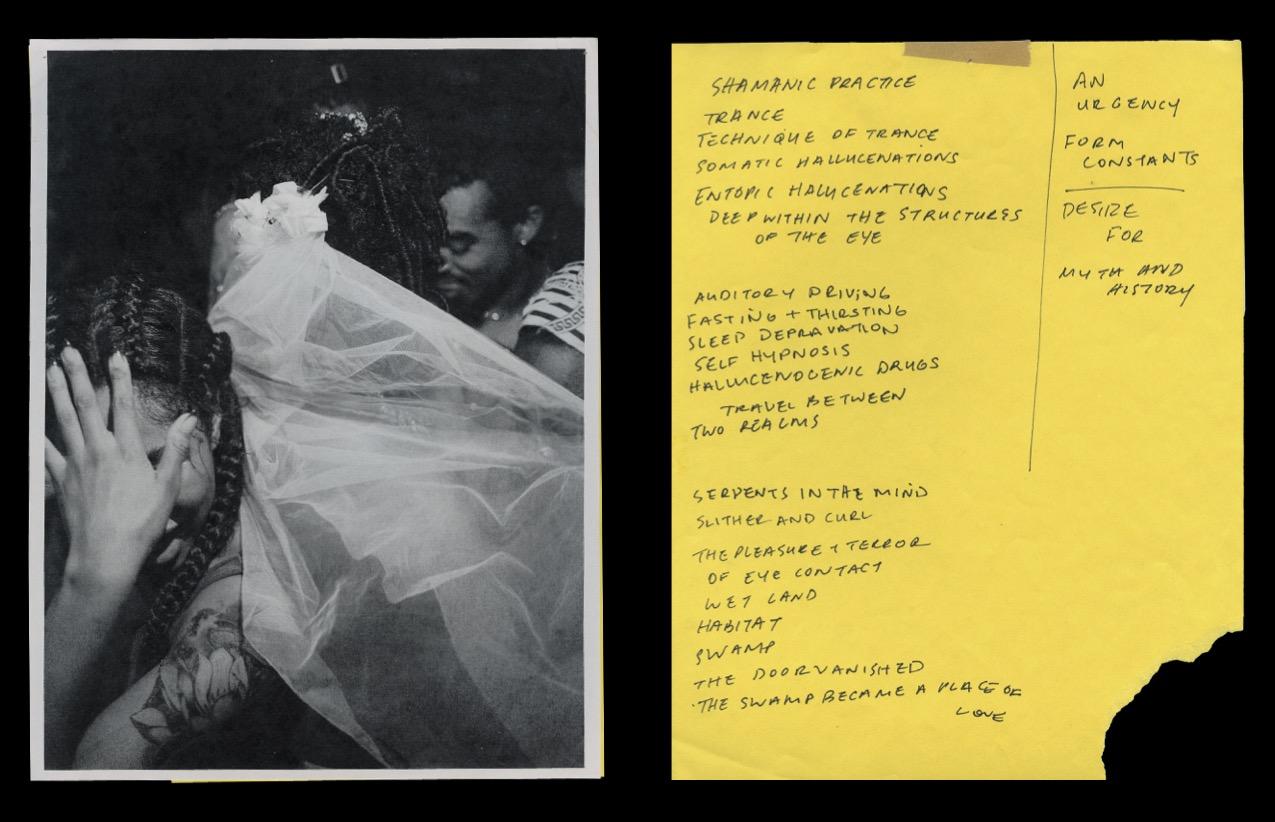
page spread from monograph, "Devotions", (2026) Elle Pérez, published by Aperture.
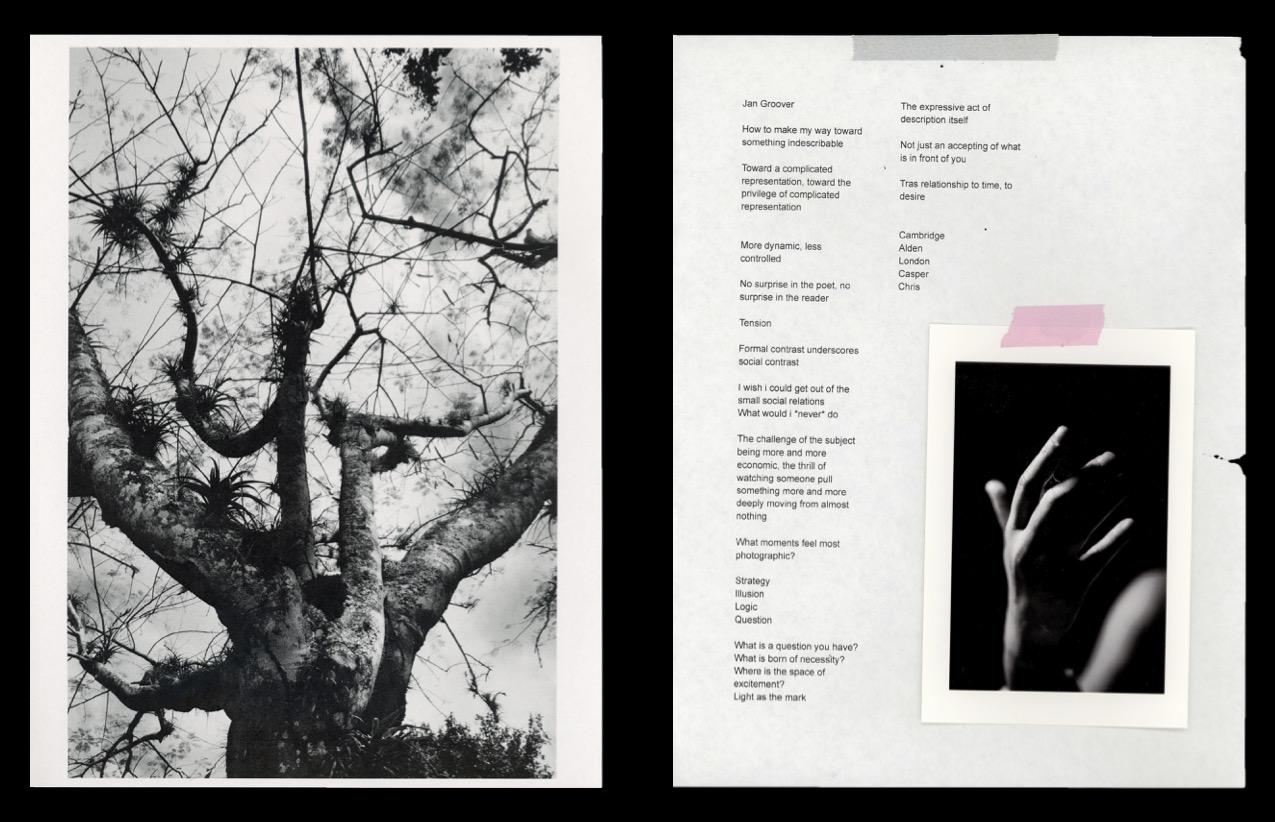
page spread from monograph, "Devotions", (2026) Elle Pérez, published by Aperture.
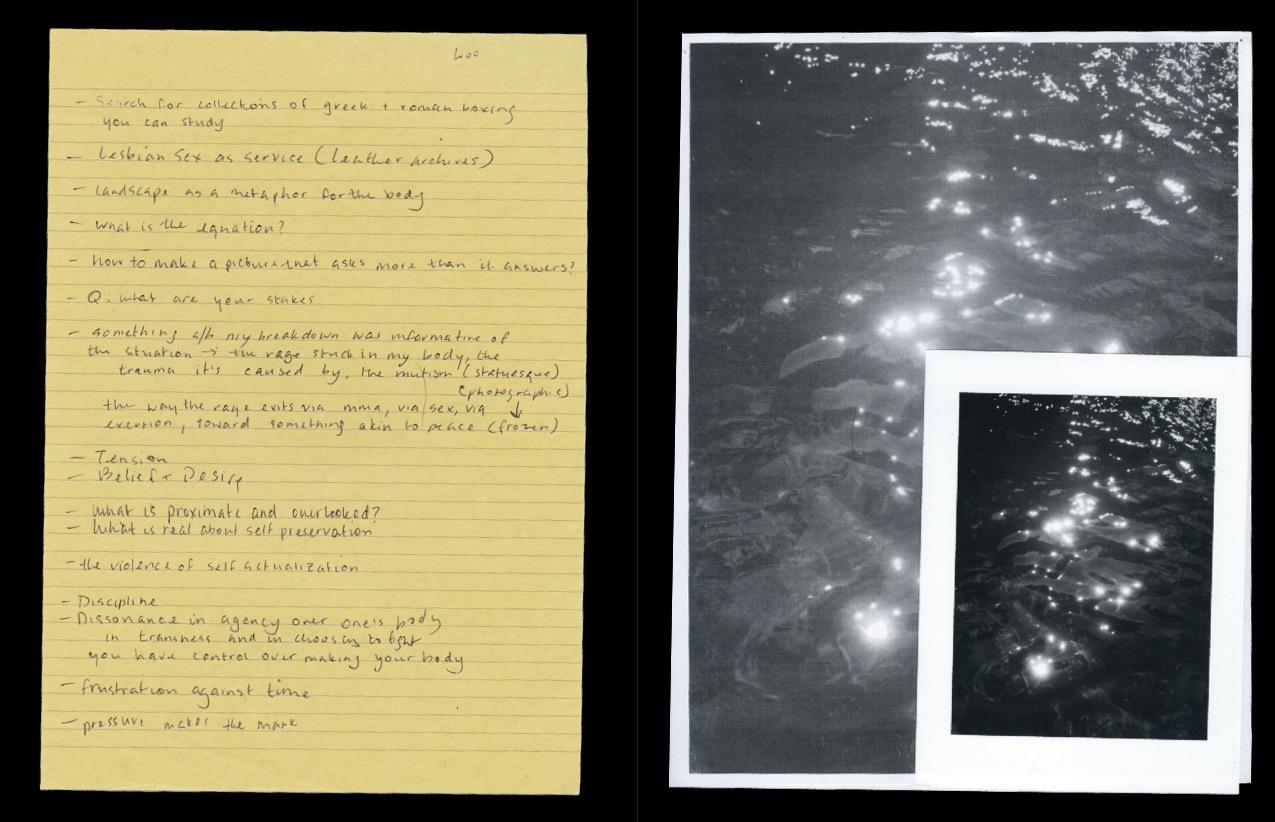
page spread from monograph, "Devotions", (2026) Elle Pérez, published by Aperture.
Devotions is an explicitly intertextual project. Among its many xeroxed book pages, there are a number from anthropological writings about Taino cemis, physical manifestations of spiritual life. In one of these, we read about the scale of sculptural representations of cemis—often small, to allow for transport, exchange, and safekeeping. How have you been thinking about scale?
I've been really into blowing things up. I took all these 8.5 x 11” pages that have been floating around my studio, from these binders that are my sketchbooks. I had only haphazardly documented them, so when it was time to digitize them, we had to do a lot of front-to-back documentation, and then we had to edit the book. I was going through them and deciding what goes here, what goes there.
I'm good friends with the artist Sara Cwynar, and I didn't want to bite her style too much. Sara has always been thinking about the materiality of the studio, and her images flow together in these sequences, whether they're on the wall or in a film, and now floating in space. And she has all these incredible innovations in how she does it. I was feeling maybe my moves were a little too close. Like, okay, I gotta figure out what my move is. So it took me probably five or six years to really reckon with the idea of blowing the notes and xeroxes up.
I often feel that I’ve got to figure out what I’m not doing in my pictures. People were spending an hour, or even two hours in some cases, in front of one of the collage pieces. How do I pace that experience of viewership out? I started photographing and then printing the studio material at the same scale as the photographs, and they're side by side. The other pictures get to be different sizes within this single plane, and then you can pace someone through it in a way that's not unlike a sketchbook.
The collages work with the vocabulary of a wheatpasted wall and its layers of messaging. The book is another, more portable, technology of transmission: Taking the photographs off the wall, you can hand them to someone, put them in a lap and lean over them together. What are you passing to a reader when you give them this book?
You can have them. You can have any experience you want with them. I really wanted to give the reader the work, and that's what's up with the section in the middle. I really fought for it to just be austere.
What was the counterproposal?
Pictures doing sexy things: One's on the wall over here. This one's on the ceiling. That one's on the floor. This one's twirling around the middle. I didn’t want wall-to-wall graphic design. Let things have edges. Like, I worked on those edges! If that picture's in that section, it is because I feel I formally stitched it together. Aperture wasn’t able to give me that many pages in the middle. We had a limit, so I thought ok, let me look up at my limit and work with that.
How does your work hold the traces of interventions in its presentation?
You can see it in which images are reproduced again and again and which ones aren't. Because it had been in a previous body of work, I tossed around this idea about whether or not I should, or was allowed to, reuse the testosterone photograph (“t,” 2019) in another sequence, even though it wasn't from that body of work and I wasn't going to make another picture like it. I felt like I could use that same picture because I was thinking about it, and it became a kind of jumping off point for another body of work and another kind of string of images and that ended up being the middle section of Devotions.
You can see some of the social work that goes into the management of images. I think everybody is doing that at this point, to navigate the pathway an image takes and also to warn about its instability.
The paradigm we're all living in is a kind of instability of an image or video and who has to take responsibility for it when it does something volatile. The volatility is about context and how other people experience it, what they see in it, what they take from it, what they take it to be, how they take it as evidence or not evidence or what they want from it. What it makes them angry about, what it makes them happy about, what they think it can do for them, what they never want it to do again. What they are pissed that it did in the first place.
Does managing this volatility connect to the decision to include the background thinking in presentations of the work?
Maybe not in a direct sense, but in the construction of a frame that would be interested in creating this type of encounter with context.
Oh, hey you!
Uh-oh, Bear! Bear! Uh-oh.
[An interlude where I run after the dogs, and Elle narrates into the recorder]
Whoa! Bear just chased a deer. A deer just came up by the pool at Fire Island and Bear and Spike took off. So charles had to go get Bear.
.jpg)
"Fire Island, 2026", (2026), Elle Pérez
.jpg)
"Fire Island, 2026", (2026), Elle Pérez
Whew, we’re back. You’ve photographed many boxers, at least one basketball game, and a retired racing dog. Some of the writings in Devotions document your reflections on taking hormones, and you’ve documented the durings and afters of a variety of trans surgeries. When I make this list, I think: every living person is acting upon their body. What do athletes’ and trans people’s approaches to the body show us about self-determination?
They're interested in pushing a kind of limit and seeing how far they can go. They're interested in transformation and they're also accepting of cycles of change. There's so much space within that type of recognition between people when those communities are together. You can be at a different place every day, over seasons and over time. There's a space held for you that is about your potential, your grace, and your gifts and possibilities, and maybe also forgiving you for your faults.
I find both communities very forgiving about their faults, to a point. Don't get them on a Reddit thread, but in peer-to-peer reality, you see a real acceptance of the human part of you. There are moments of a ritualistic coming together, in these places that I tend to make photographs.
What has photographing dance floors and sparring matches shown you about making portraits?
I’ve learned so much about portraiture in the gym. I also engage with fighting as a member of the gym, and I appreciate having had such a long relationship with the subject. Making pictures of it over a long time, my understanding of fighting changes, and the whole thing gets richer.
In sparring, there's so much eye contact. You’re looking at your opponent’s face, who is also your teammate (and potentially also your friend, lover, or a stranger), and they're looking at you. At that moment, you can't hide. When people are beginners, one of the things they're often negotiating is the fear of being seen or of looking in the mirror. Some gyms have mirrors and others don't. Some people filming themselves have replaced the mirror. But there's still a need to look at yourself to improve technically. That’s a component of the negotiation between your body and what it does.
When you're engaged in this moment of practice with another person, you're looking at them, reading their movements, and you have to see them and not see them at the same time. Overthinking doesn't help. I can look at certain people's bodies in my mind with great detail and intimacy. Not because I’ve photographed them—but because I’ve been looking at them for years.
The chance encounter at the club is a longer relationship with a different type of looking than the designed confrontation at the gym. It becomes a kind of looking where trust is gained from seeing you again and again and again. As I've been doing it over and over and over, I've made friends, something that I remember doing for the first time at the punk shows in the Bronx I used to photograph.
I’ve been working on a piece about [Brooklyn-based dance party] Papi Juice since 2022, and every time I film at Elsewhere, I learn something new about it. It feels gargantuan. Reaching your arms around a subject that wide and trying to contain it intimately is so ambitious, but I'm doing it until I understand that it's done. And that's just listening to the material.