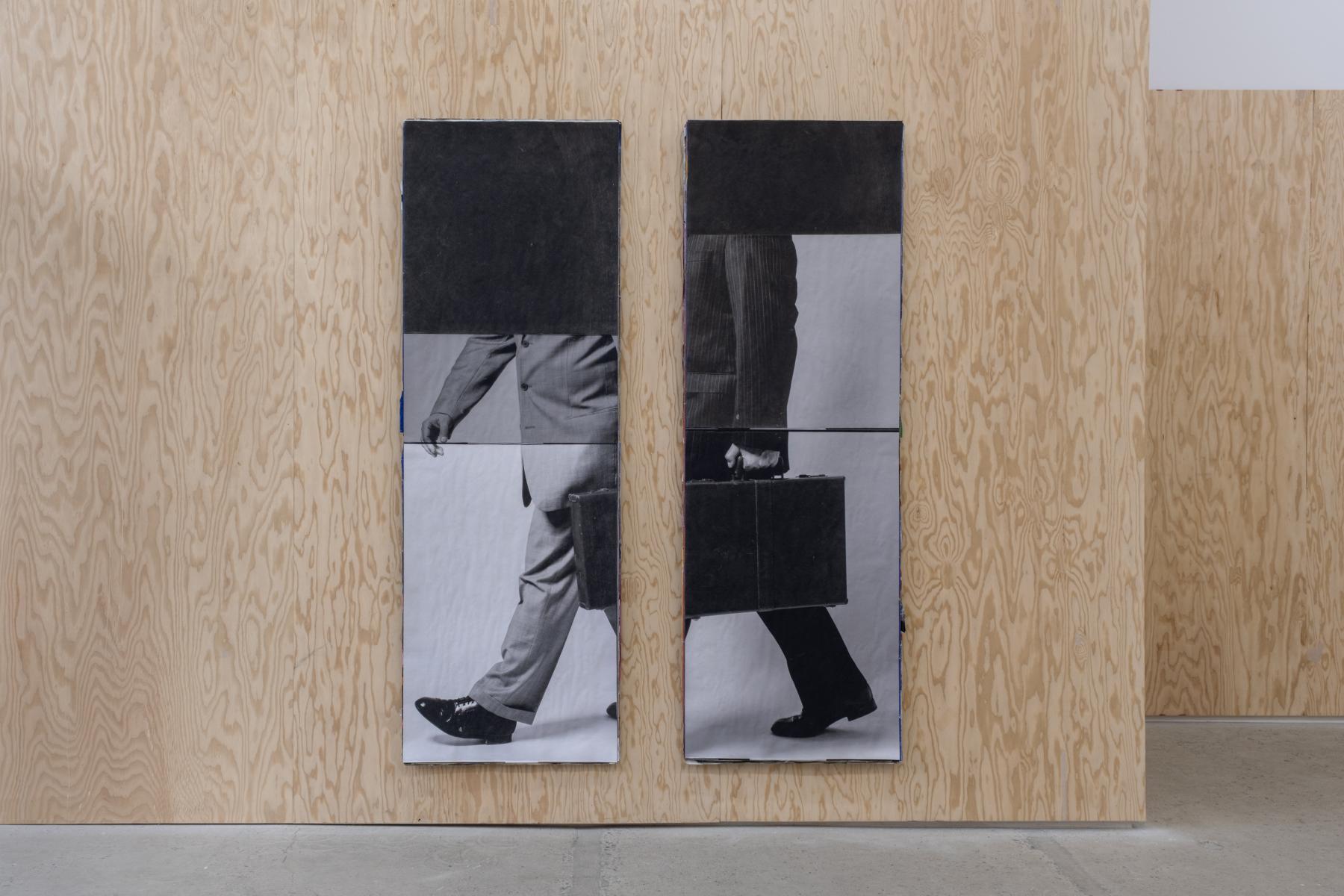
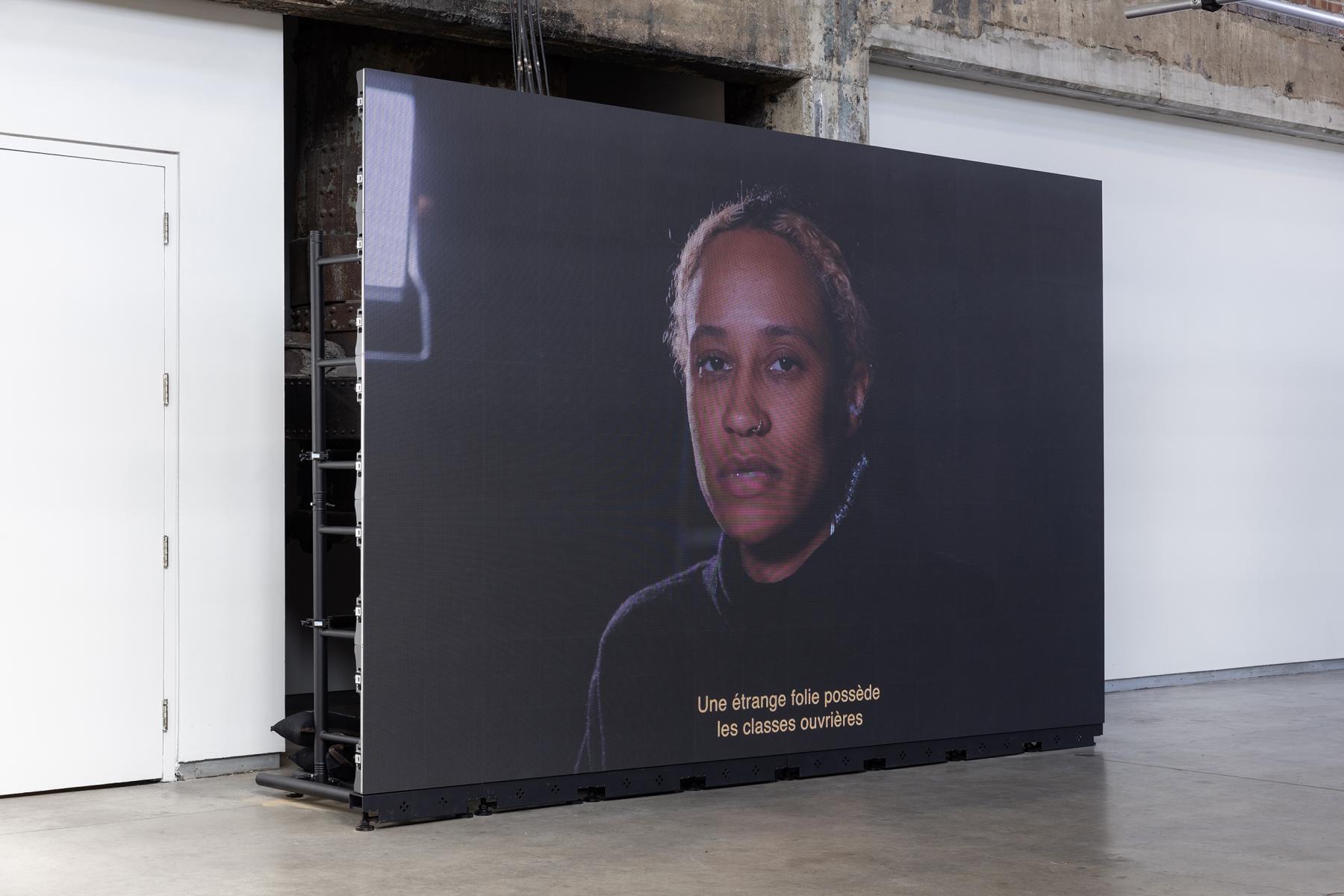
Simon S. Belleau, Figure Walking Towards Work, 2026. Archival pigment print on neutral Tyvek and recycled advertising posters. 24 x 72 in each (diptych).
From Mediaeval, Galerie Eli Kerr. Image courtesy of the artist and Galerie Eli Kerr.
Part-way through my conversation with Simon S. Belleau, he picked up a tape-measure from the workbench in his Montréal studio to measure out 48-inches against a blank section of wall. This is the height at which his work Times—a definitive acrylic comma painted on a canvas the exact size of an A4 sheet of paper—must be hung for viewers to grasp the tacit pause in speech. Minutia is necessarily calculated, since it's not exclusively in macro-gestures that the preoccupations of Belleau's practice reside, but rather, the micro interactions and compact maneuvers. An inhale, the infinitesimal lull, before a new section of sentence begins. There's a pixelated logic at play: pixels, which could also be letters in the alphabet, fibres, dust, or any material deployed in composition, amass into a legible whole. However, deciphering the bigger picture of an image, exhibition, or narrative requires viewers to step back and lose track of the pixels. And so it goes, an interplay between foreground and background; the component parts and the final, circulated object. As a discursive armature, this purposeful simultaneity places Belleau's work in a climate that encourages looking.
Working between sculptural, lens-based wall works and film, Belleau’s composite practice pulls frequently from both means of diffusion. Elements of on-stage, off-stage, post-production, and set building are formally embedded in his static wall works. Still-life compositions, vanishing points, and a photographic impression of singular moments interact with filmic omniscience in his extended video pieces. Miniscule LCD screens nest in ubiquitous fruit boxes. Theatre risers painted the requisite absorbing-black face a projection of a man reading a script of dubious origin. A red light above the entrance to a small gallery space blinks on, indicating that a recording is in progress. Any object tells the story of film since film is the story of time. More than ever, Belleau's current practice presents an occasion to notice time elapsing. With the imminent release of a monograph; plans for a poetic silent film; and a curiosity to explore making observational films, duration has become an increasingly central, albeit subtle, sensibility of his practice. As he notes, "time doesn't need to be explained—we know why it's important."
After he put the tape-measure back on the table, our conversation ruffled the marginalia and paratextual activity of his practice. This includes references to Structuralism, Pier Paolo Pasolini, Samuel Beckett, Joan Didion, Hollis Frampton, The White House press conferences, Modernist painting, Jungian synchronicity, Jean-Luc Godard, and endless Post-It notes. Belleau has exhibited in solo and group presentations widely across North America and Europe, completed an MFA at The School of the Art Institute of Chicago, and is preparing a presentation for Frieze London this year. I'm left thinking that, no matter where he goes, Belleau keeps a question tucked under his arm like a commuter with the morning newspaper: What takes place materially between actor and spectator?
The backstage of cinema, politics, and art production is paratext. It’s what surrounds all discourse. To be ambiently aware of a scaffold for lighting means that you're in an acceptable context for performance.
I'd like to begin with your most recent exhibition, Mediaeval, at Eli Kerr in Montréal. Particularly, I’m curious about the link between the title and one of the main works in the exhibition, Substrat (Street level). This work initially appears to be a de-commissioned newsstand, but in fact, was never commissioned in the first place, as it were. It's a prop; an object used to create or enhance a desired effect, to make theatrical action more realistic.
This is a good place to start. I’ll jump right away to the 'decommissioned' aspect of your question to make the argument that it was in fact commissioned for a purpose and decommissioned from a purpose. It’s true that this newsstand was never contracted or engaged as a genuinely integrated architecture. But, it was built to be used as part of the film industry in order to mimic something real. Even the word 'decommission' is quite interesting, because I actually decommissioned it from the rental industry. That's the economy it circulated in. From when it was first built, which was for a Xavier Dolan film in 2016, it was moved from one production to another. From one studio or film set to another. This is exactly what happens when any object, including props, enters into the merchant market. Over the course of these various productions the newsstand was meant to mimic New York, London, Montréal. And so this single object traveled across different eras and lieux [places] depending on the film. Je m'égare un peu mais [I’m digressing a little but] I think this is important to note.
So it’s a question of perspective: which economy is the real one and which is the fake?
Yes, but there’s no separation between the two. The entertainment industry is an incredibly large economy, so it can’t be considered ‘fake’. So then we, as viewers and consumers, are forced to acknowledge the public / private binary. We clearly only have access to a limited number of domains or economies. I'm always interested in introducing objects or forms that are explicitly created for private, limited consumption. I’m sure during our conversation we’ll dip back into the separation between the public and private spheres, because it's one of my fixations. Something I should mention right away is that I grew up in the film industry. I think it’s important for me to draw on this, both as a curiosity and an anecdote. I worked as a set painter from when I was 17 years old until I was almost 35. It's a story of before and after: from the age of zero to 16 I was totally taken by the magical aspect of film. Then, once I had access to behind the scenes—the metaphorical backstage—I was like, “Oh.” That’s not to say the magic went away, but by that point I understood the mechanisms of production. Many intricate, precise, and extremely niche mechanisms which coalesce into a single 'production.' But now, in a way, I'd like to revert back. I'm totally preoccupied with finding a way to reintroduce magic into my relationship to film. This is probably why I began to work in and around cinema within my practice. I want to treat cinema, film, movies – however you'd like to call it – as a subject worthy of consideration.
Now I'm even more curious about the title of the exhibition, Mediaeval.
There’s no magic in it. It's crazy. But please, go ahead.
Well, it references the past. It’s an epoch, a quality of life, and a qualification. I have a precise image in mind when I hear the word.
There are two main reasons that I was interested in using Mediaeval as a title. The first one is, as you said, it refers to something from the past. Today, when you hear the word medieval, you're immediately brought elsewhere. It's so clearly not our epoch, nor that of our parents or grandparents. It's unimaginably distant. At the same time, the word functions as a smooth encapsulation. I gravitate towards words that act as a border, with a clear inside and outside. It’s a conceptual and physical limitation. When you hear the word, the future and present are immediately excluded. The second reason is that it's simply a beautiful word. And, it incorporates the word media. Even though outside of the United Kingdom it’s rarely written with the second A now. Which is important, because the title is, in itself, out of time. Desynchronized. Media isn't technology, it’s medium, right? So by repurposing the old way of spelling medieval it was a clin d'œil [wink] at the etymological root of the word and a way of pointing towards the core of the show. Media in all its etymological permutations is the crux of that show. But I specifically drew upon certain media, or mediums, that have become obsolete in the same blink of an eye. Titles are super important for me—they're an opportunity to be hyper specific in language, but are also about the specificity of language.
Right, so that title references its own process of production. The information embedded in the title sets up conditions for the exhibition. Now I'd like to ask about your exhibition Thousand Telephones that took place at Letters to Nora in Chicago last year. In the exhibition narrative, there’s a sentence that introduces the décalage [gap] between voice and image. I take this to mean the discrepancy between speed of sound and light, the sound of one's own voice in the mind's ear, and how we hear ourselves in recordings, for example. The décalage that occurs once we're obliged to articulate. Using the exhibition title as a point of departure, I’m wondering if one of the issues at play is the thousand ways to answer a question, or the thousand ways to take one’s interiority and make it external and visible?
If there's a thousand ways to answer, there's also a thousand ways to ask. This is super nice. The title was adapted, as was the exhibition, from my presentation Répliques at Fonderie Darling in Montréal. The film exhibited in Chicago was a continuation of the film A Thousand Telephones (scenes 1-5), but we changed the title. I’m going to answer your question on the curve, but it’s worth noting that the exhibition as a whole emerged out of a desire to translate. Both linguistically and in terms of setting. If we’d kept the title Répliques, English-speakers would immediately make an association with 'replica,' which in French is just one of the word's two meanings. Thousand Telephones integrated a multiplicity that Répliques alludes to. Donner la réplique ou les répliques à quelqu’un, la réplique de quelque chose [to reply, to read lines of script for someone, the replica of something], which is not just one copy, but can be the infinite copying of something. That exhibition is so anchored to the act of listening—the way actors are fed lines of dialogue through earpieces. In that film, I whispered lines to the professional and non-professional actors on screen. Which of course made me think of the childhood game telephone. That game is prefaced upon or composed of leaks, additions, and intentional mishearing or miscommunication. It’s a synthesis of the two meanings of répliques. I'm inspired by structuralist-filmmakers like Hollis Frampton who worked with desynchronization, like in his film nostalgia. To be out of sync is an echo of the world we live in.
So it’s less about responding to the thousand telephones and more about the calling, or dialling, if you will—it’s about the original speech act. In the exhibition text there’s an extended quote from Derrida about the “situation of the world” that employs an intimate mode of address: he writes towards a you. When we address another, there’s a noise-cancelling phenomena, described in the exhibition text, that takes place in moments of intense concentration. The noise of the world is superseded by the noise of addressing, speaking, saying. So I'd like to ask: are the different works in Thousand Telephones one sound addressing a single experience, so to speak, or multiple experiences that produce a complex, amalgamated echo?
My instinct is that it’s many echoes emanating from one source. But there’s a lot to say about how sound functioned in that exhibition. It was a small show with only four pieces in it, but it contained almost the whole scope of my practice. What you said about modes of address ties into how, when I whispered lines of script into friends’ ears for the film, it felt like a loop opening. Like a treasonous or subversive act. I think because of how I was the only one who knew what the next word was going to be, there was a real intimacy and secrecy involved. And that noise-cancelling phenomena, too, because the actor had to listen so attentively to the sequence of script. To whisper is private and exclusive, right? Waiting to hear the next line is not something that I typically associate with visual arts. It was important for me to make the viewer identify as the audience, in that sense. And then there’s another layer of treason relating to the efficiency and trustworthiness of language, which is almost too much to get into right now.
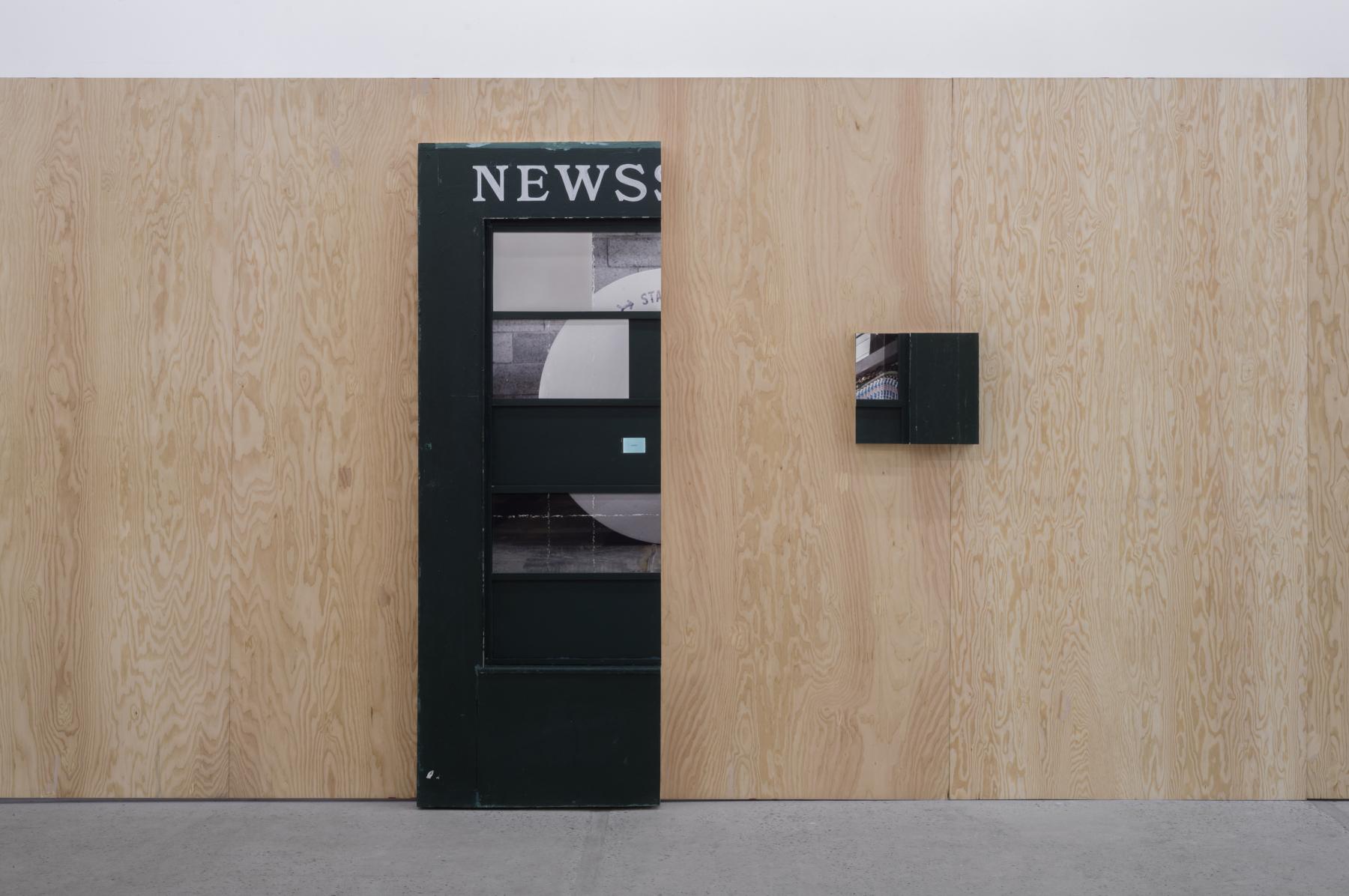
Simon S. Belleau. Installation view of Mediaeval, Galerie Eli Kerr. Image courtesy of the artist and Galerie Eli Kerr.
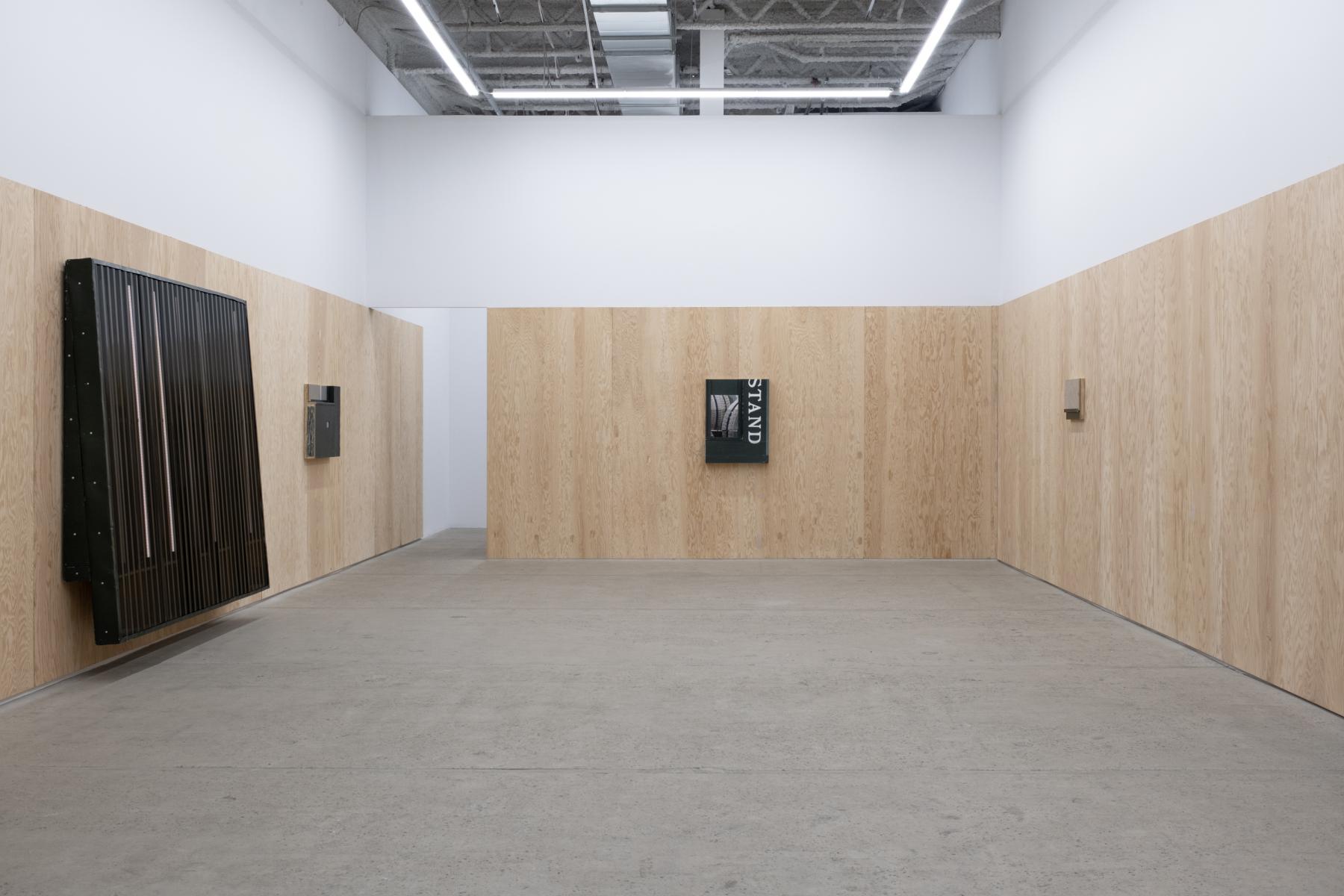
Simon S. Belleau, Mediaeval, 2026, Installation view at Galerie Eli Kerr. Image courtesy of the artist and Galerie Eli Kerr.
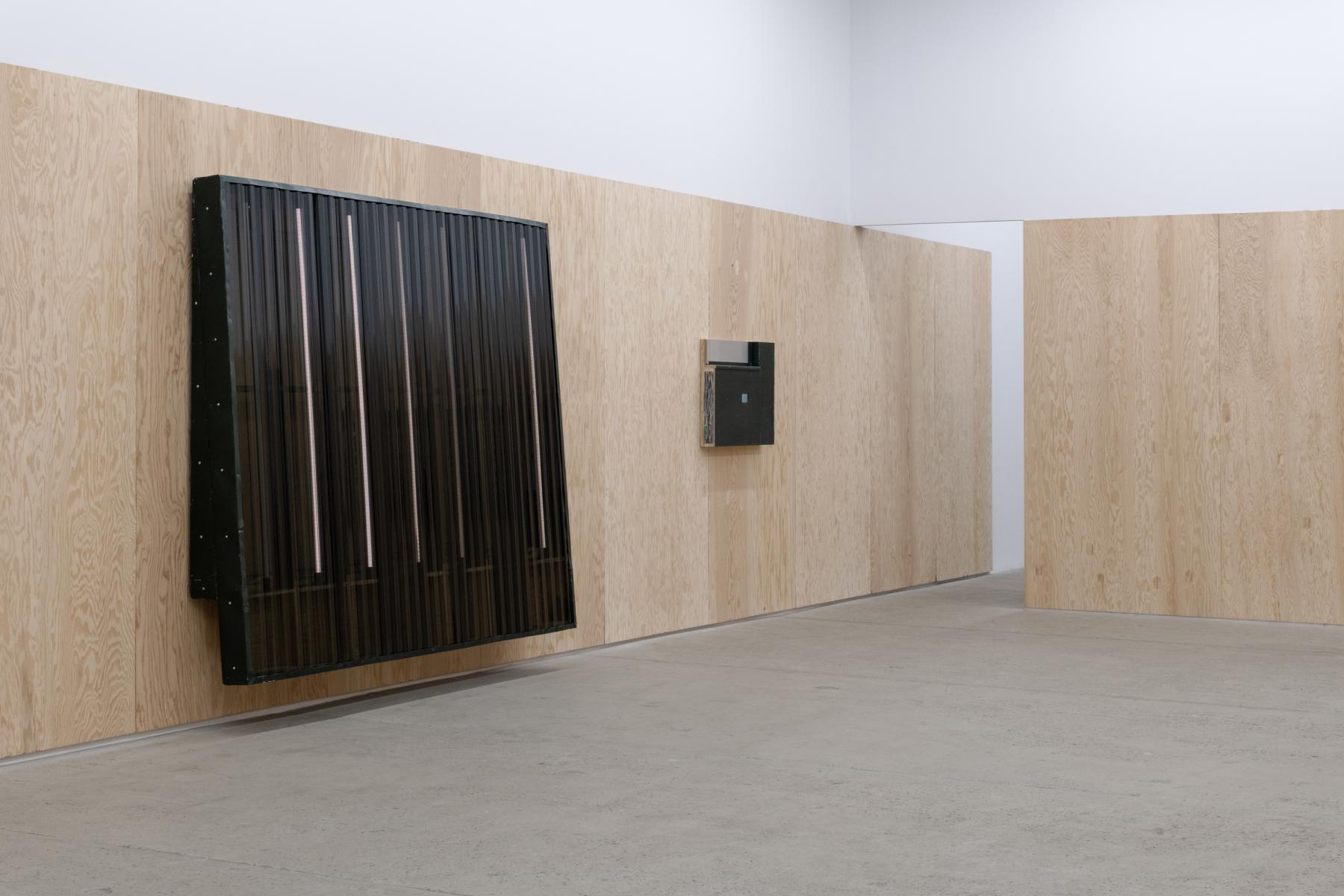
Simon S. Belleau. Installation view of Mediaeval, Galerie Eli Kerr. Image courtesy of the artist and Galerie Eli Kerr.
That brings to mind the work Flies dial I, which is an image of a fly catcher printed on the topmost layer of used advertising posters. As an image, it contains the action of opening a spiral, but it’s also an object that’s meant to catch matter. Its purpose is tied to accumulation—accumulation of the poster to make the physical image and the documented accumulation of flies, which indicates that it’s serving its purpose. The flies are almost like stand-ins for words, and as an image, perhaps it gestures to the moments when we get stuck in language. As we wait to be given our next line of dialogue.
That work is really a marker of time; it’s a time trap, if you will. You get that right away from the title which references a sundial. I made a series but that's the only one to be exhibited so far. Each work represented a month—those are all the flies that I caught in one month. I was living in the countryside and I entered into a totally different schedule that allowed me to lose track of time. The image that was exhibited in Chicago was February, but I made one for March, April and so on. So in a very basic sense that image represents another way of marking time.
In that same exhibition, does the work Self-portrait as a table similarly function as a marker of time?
Yes, absolutely. It’s the literal accumulation of mess that making work requires. Like a byproduct of art. Over the past few years I’ve been thinking a lot about exhaustion, labour, and fatigue. From the point of view of an artist, but also more generally. It’s a topic that I’m still working through. I upcycle the used poster paper that the work is printed on from a company that pastes advertisements around the city. Of course I was hoping for viewers to make a connection between publicity, accumulation, and production. But again, it’s a behind-the-scenes production that's typically effaced or glamorized.
Dramaturgy, the process-oriented practice of closing the gap between the context of the original text and that of the staging, seems to be important in your practice. Especially sociological dramaturgy in the tradition of sociologist and social psychologist Erving Goffman, who divided interactions between "actors," "audience," and various "front" and "back" stages. This came to mind particularly as I was looking at the documentation of The Reader (2022).
In 2019, I started reading in and around Goffman. But he's not an easy read! [laughs] Then, in 2022 when I made the film The Reader for my exhibition Outline of a Screenplay at Parc Offsite, my main focus was to begin working with people. Prior to that, I had mostly filmed objects; but where there's objects, there’s obviously people. Sociological organization of people and the roles we adopt is endlessly interesting. So with The Reader I consciously made space in order to populate my films and make the role of an actor more explicit. Of course, 'actor' has many connotations. Political, theatrical, rehearsed, improvised, in relation to nation-states etc. Because making art is part fear, part courage, for that film I made a reassuring decision, which was to ask my father to be my first filmed subject. He was my prothèse vocale [vocal prosthesis]. With that decision came a posture of assuming one’s own voice, since he read from a script that originates in the context of my life. It was a major adjustment and a new arrangement of how actors function in my work. But you can see this everywhere in my work. Répliques was really about these roles, as well.
Perhaps there’s something about assuming one’s own voice that necessitates a formal, structured backdrop. At Parc Offsite it was the form of a script that allowed you to enact your voice. In Répliques there was a suspended, grid lighting scaffolding that acted as a formal context-as-backdrop for the pieces that were more declarative. Do you think it’s easier to speak or utter with the support of formal structure? It makes me think of the first page of a long-form poem by Shanxiang Wang, from his book Mad Science in Imperial City, who writes:
"Clockwise it starts to turn. My turn. So I begin. But I'm at a loss to utter… After rapid dry run it pauses its rotation. As if taking another deep breath. I ease / into the second quadrant of the circular hall. It turns into a music stage. I turn to the / 2nd page. Literature review and introduction. From the statistical ensemble of string / instruments, his violin sings his magic words."
A formal, even physical, introduction for speech. I think of this in terms of reassuring forms, and forms that provide 'sense'. There are certain moments that precede utterance that allow language to form into an expressible mass. This is another root of my practice. Structuring principles that initially appear rigid. These structures—and that could even be a father who represents a familiarity or family structure—create a moment for paralanguage to present itself, or assemble itself as explanation. The backstage of cinema, politics, and art production is paratext. It’s what surrounds all discourse. To be ambiently aware of a scaffold for lighting means that you're in an acceptable context for performance.
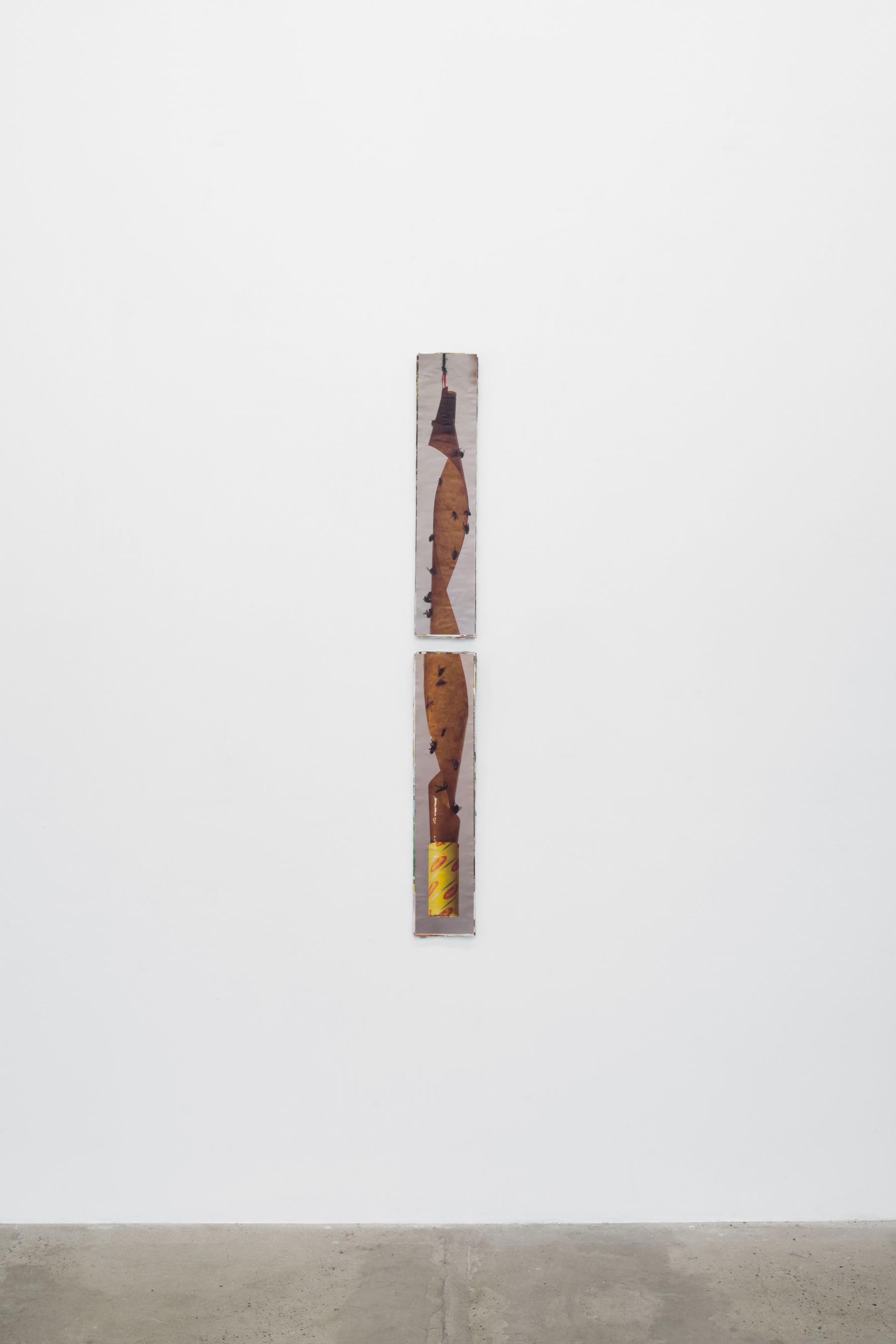
Simon S. Belleau, Flies Dial I, 2025. Archival pigment print and upcylced advertising posters, 48.5 x 5 inches. Photo by Atlas Documentation.
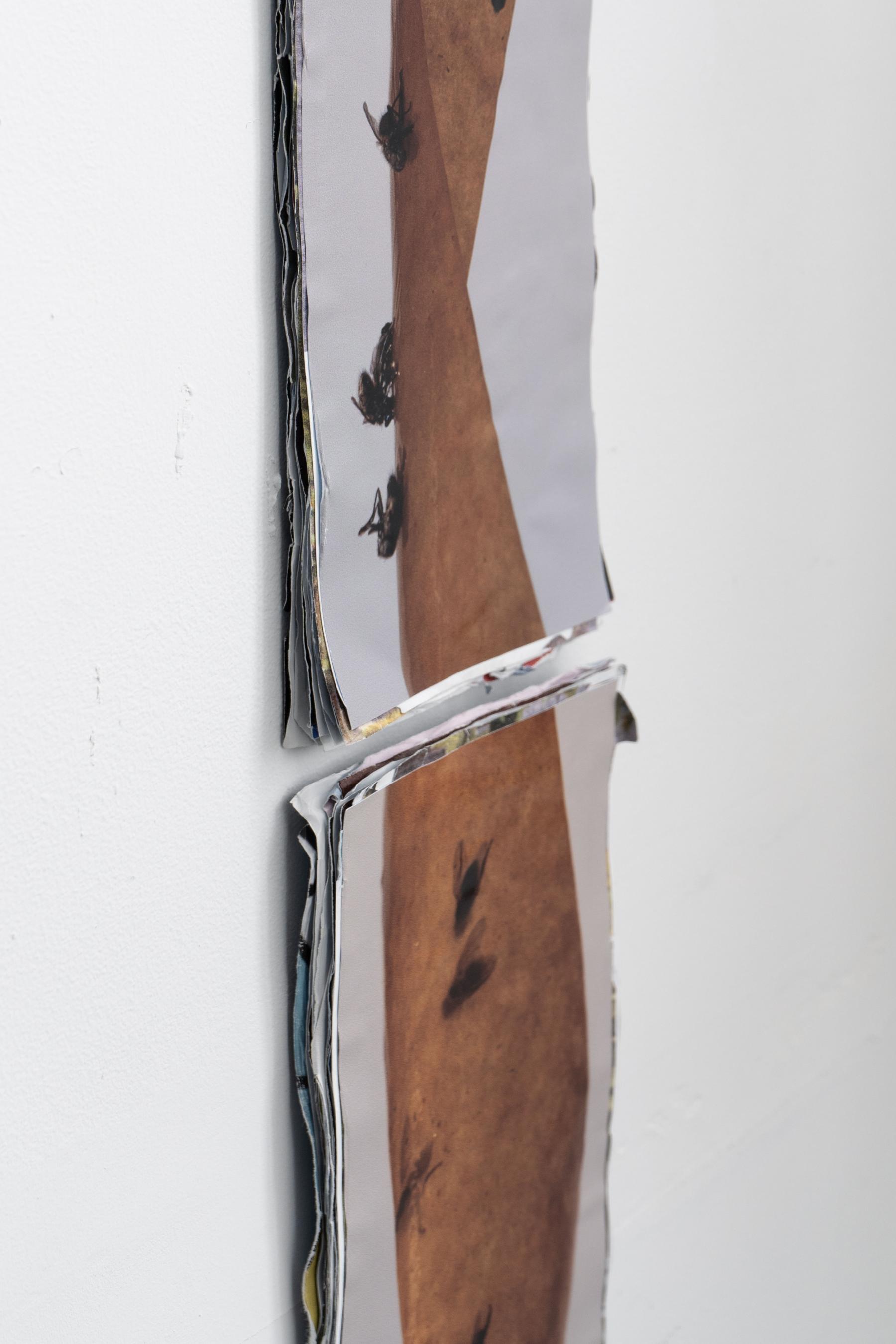
Simon S. Belleau, Flies Dial I, 2025. Archival pigment print and upcylced advertising posters, 48.5 x 5 inches. Photo by Julian Van Der Moere - Letters to Nora
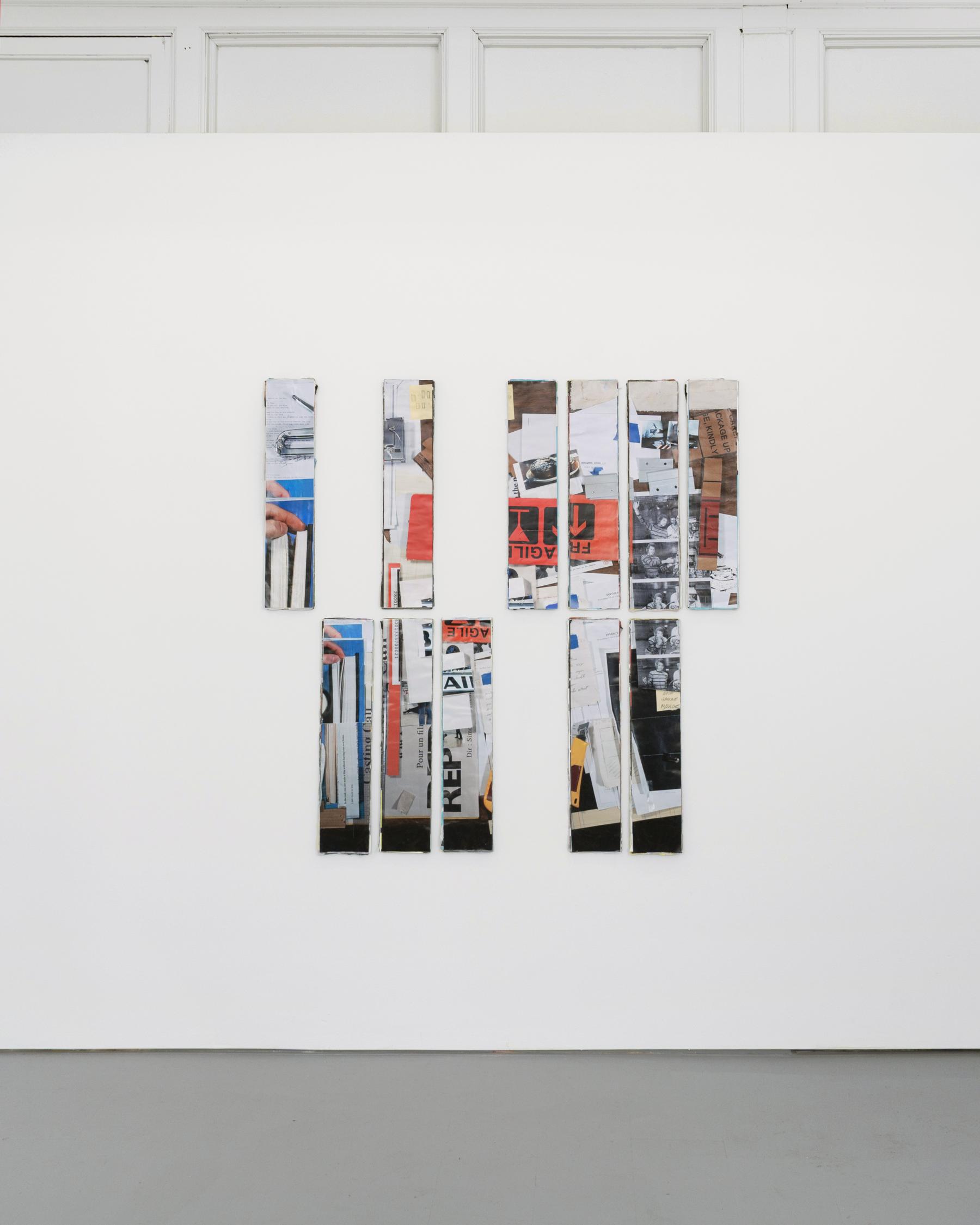
Simon S. Belleau, Self-portrait as a table, 2025. Eleven printed photographs on twenty layers of upcycled posters, 49 ½ x 48 ½ inches, from the exhibit Thousand Telephones at Letters to Nora
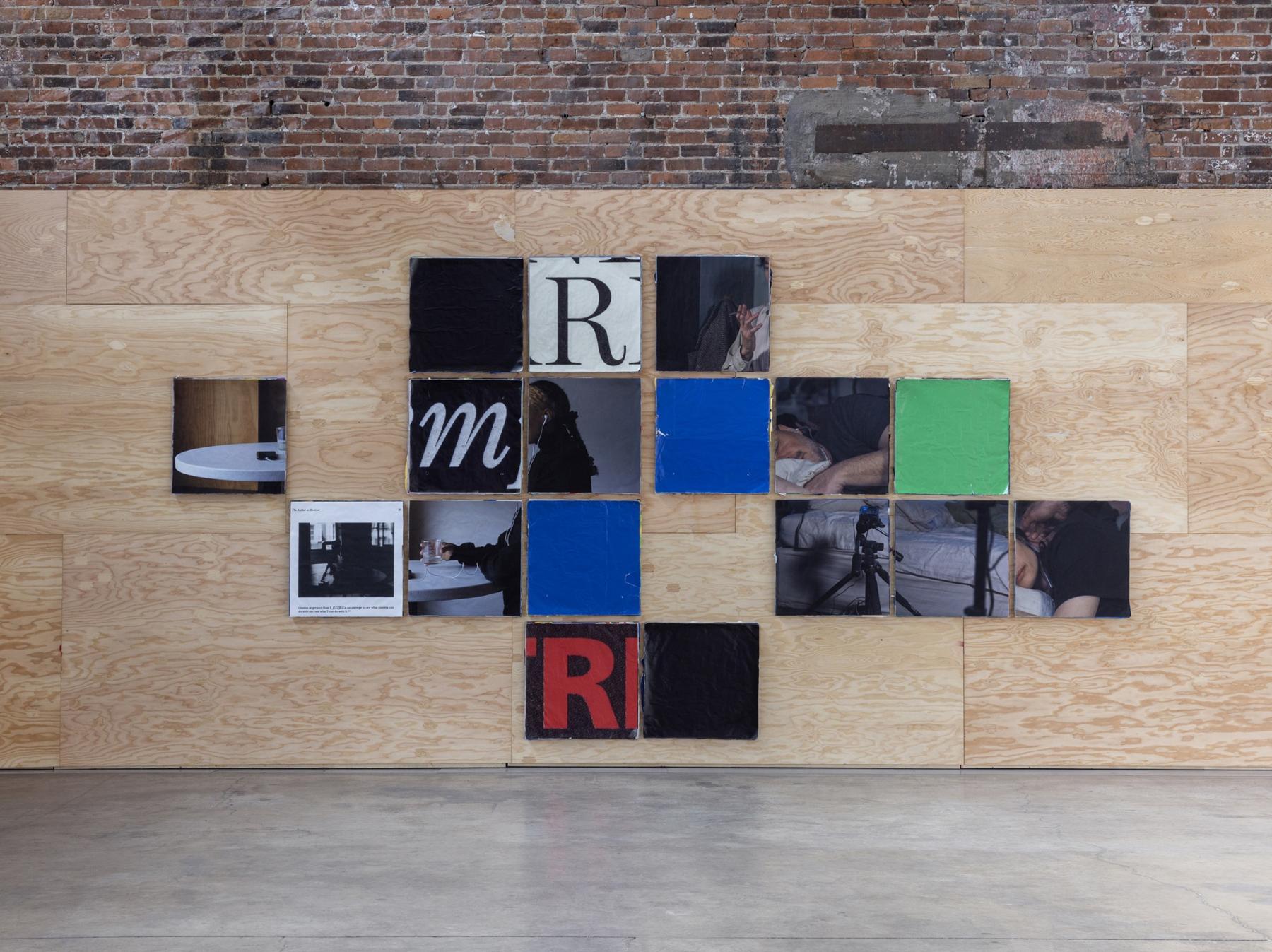
Simon S. Belleau, Interfaces : bleu-vert, 2024. Archival pigment print and upcycled advertising posters 108 x 192 in. Installation view from Répliques at Founderie Darling. Photo courtesy of Simon S. Belleau.
Répliques at Founderie Darling. Photo courtesy of Simon S. Belleau
Right, like how city grids fade into the background despite the fact that, as a structure, the grid supports our daily movements in cities whose design is based on this principle.
Yes, exactly. In that exhibition Répliques (1-4), the grid was hazy and a bit ambiguous. It acted as a substitute for language. So I didn’t have to explicitly state “I’m talking about structures,” because the grid did that for me. That was the role of the post-production schedule, as well. It’s interesting to talk about these structures as backdrops because they’re literally always present. There’s no interaction or art that doesn’t have this formal, structural backbone. But these are the structures that also create exhaustion and fatigue.
Outline of a Screenplay was full of these structures that have explicit, commonly understood modes of orientation, no?
Yes, especially the riser which I repurposed from a theatre company. As an object, a riser is typically more muted and refers to theatrical spectacle. That show had an undertone of diffusion: of speech, of intention, of orientation. In the film, my father was reading a script that I’d written for a film about a Pasolini script that was never filmed. Pasolini never wrote the script or filmed it, but I annotated the script for a film and then made a ‘fake’ film with my father. The process was like stairs that lead to nowhere. Pasoloni is another king of décalage: he was so weird with sound, constant paroxysm, and vocal dubbing. I draw on his tradition of desynchronization a lot. It's so fascinating to make work like this. It must be frustrating as a viewer, but I find that frustration very important. This comes back to Goffman; sometimes, as a viewer, you're the filmmaker, then you're the visitor, then a spectator, or the one who whispers lines of dialogue. On occasion these dynamics pause. That's what the subtle painting of a comma does. Commas have no sound. They contribute to flow, act as a slight pause. Like the briefest moment to consider what kind of sentence or dynamic you're in.
It’s about dictating. In Thousand Telephones there was a piece called Speech Assistance Machine (Charlie Chaplin’s speech in The Great Dictator - 1940). The verb to dictate comes up a lot in reference to your work. To dictate: say something aloud for another person to write or record the words. And of course it also means to give orders.
It’s a great term, isn’t it? I have an unrealized project called A Thousand Dictators which was going to be a continuation of my teleprompter work. It hinges upon the simple association between 'dictator' and 'dictating'. For French-speakers there’s another layer: de faire la dictée [to do dictée], which was when your teacher in primary school would say words aloud and you’d have to correctly spell them out. The prompter work, and even when I whisper lines of dialogue to actors, is a form of dictatorial language. This ties into what I said earlier about making chains of production, or chronological sequences, visible. What’s interesting with teleprompters is that it’s very difficult with that technology to locate the source of a voice. There’s a preexisting script that’s then fed to whoever is speaking. Another example of prothèse vocale [vocal prosthetic]. It’s a fascinating apparatus.
I want to ask you about teleprompters in a more specific way. I did some research and found that the original version was a scroll of paper, and that early integration of this technology cut production time for certain shows by 50%. I have thoughts around how, as objects, they suggest a shift in the tonality of politics, but what are the implications for your art, or art more globally? And what would you like to bring into the foreground with works such as 100,000,000 Bushels More which was presented at Liste Art Fair Basel and OFFSCREEN Paris?
Embedded in this question is a topic that’s been one of my main focuses this past year; that of cutting costs, cutting production time but then conversely facilitating diffusion to a wider audience. I’ll start by speaking for myself: it’s like a bénédiction de Dieu [a blessing from God] for me in my practice. The fact that what I’m intrinsically interested in—fictionalization of the image through cinema and television—attached itself so cleanly to politics via a single object. It's incredible. It’s a moment of a clear symbiosis between politics and art. The history of teleprompters represents the moment when the domain of politics realized it could deploy an apparatus, or technique, from film and television to facilitate speeches. And what we see is how the mode of address immediately became more intimate. It was a way of speaking directly to your population—as a figurehead, you could look directly into the eyes of your citizens. Prior to that, during Eisenhower’s time and before, cameras were extracurricular; they weren’t part of the spectacle, but are rather simple observers. Then there was a shift, at the end of the 1960s, when cameras were integrated as part of the spectacle.
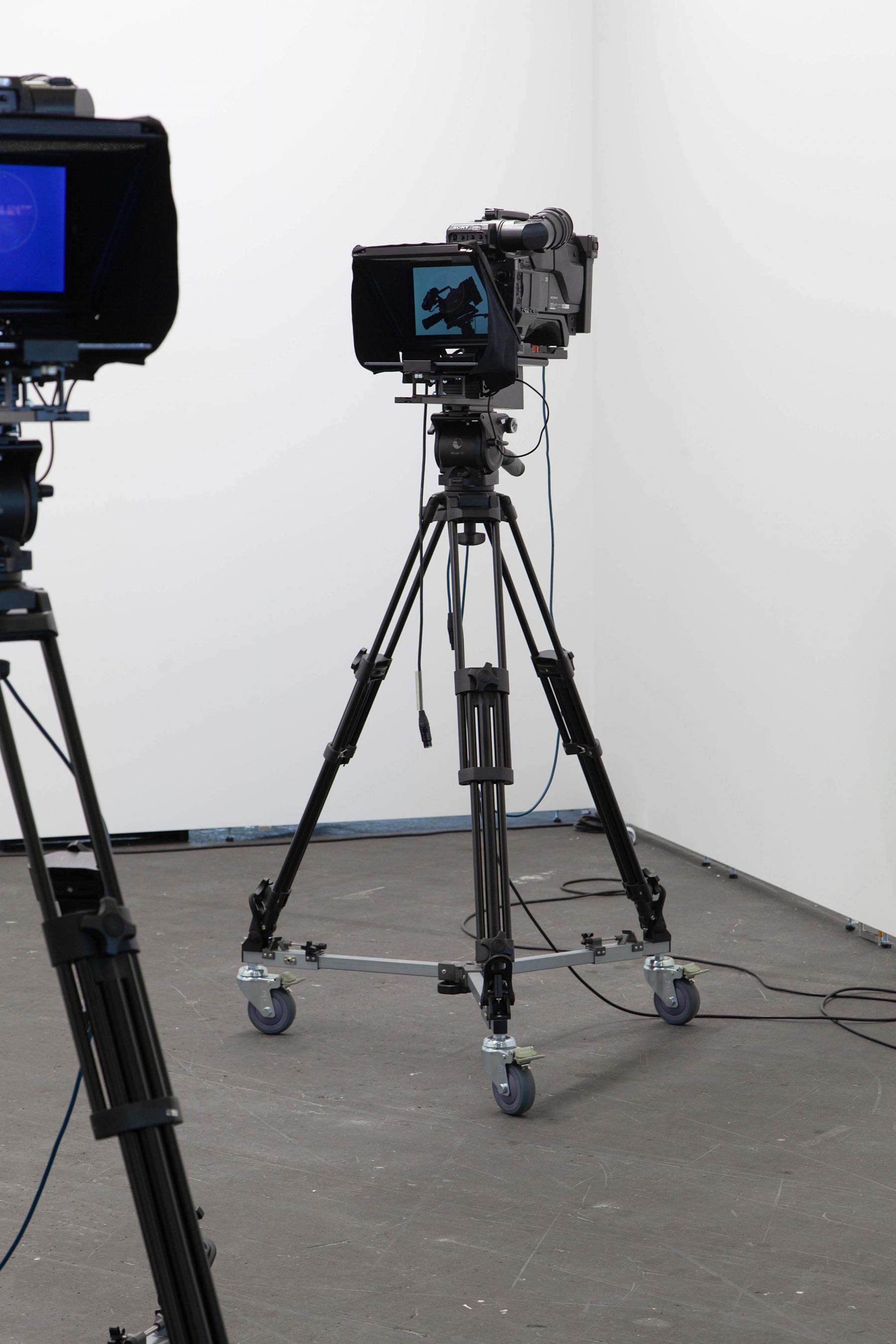
Variable dimensions. Image courtesy of the artist.
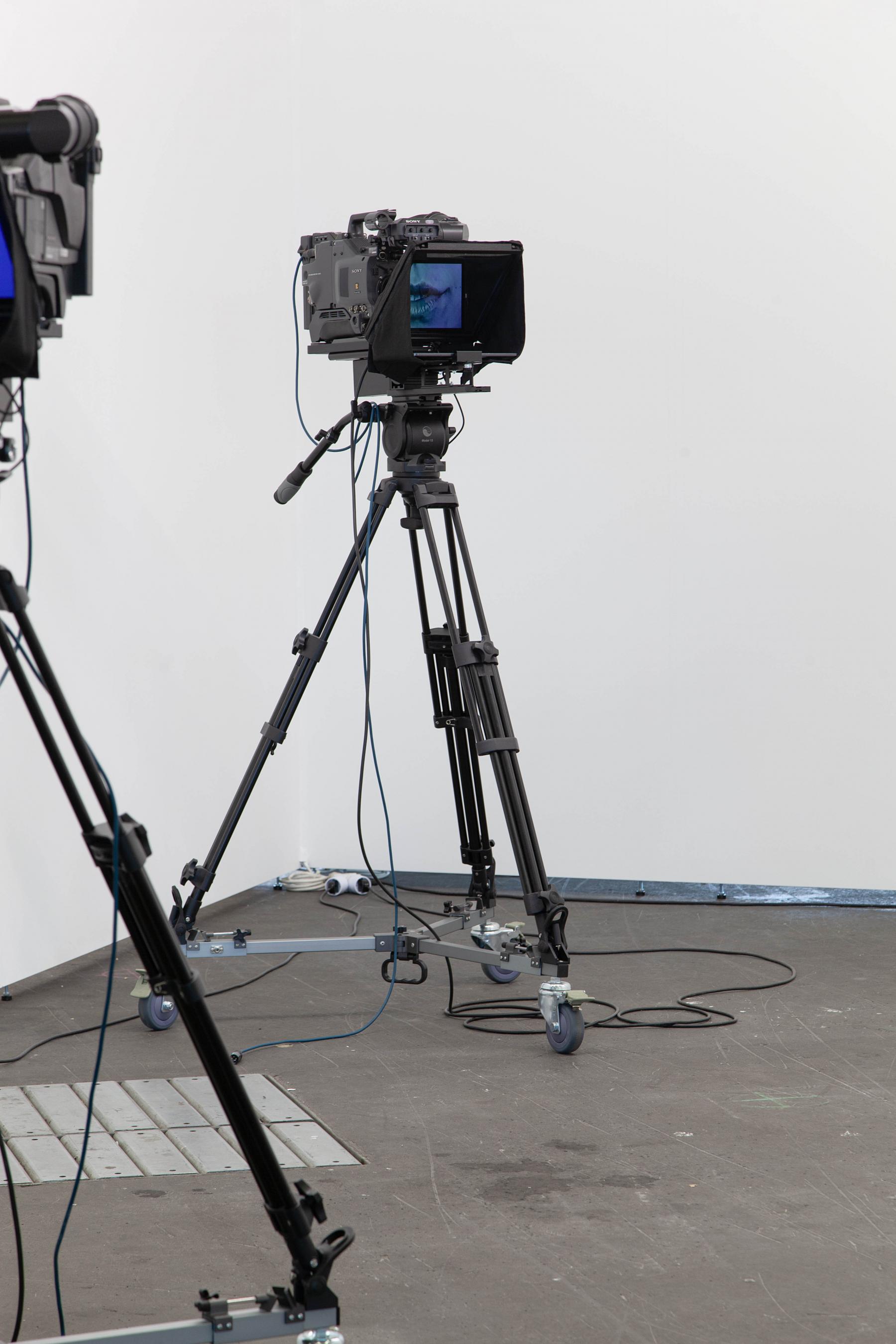
Simon S. Belleau, 100,000,000 Bushels More, 2023. Teleprompter, camera, tablet and tripod. Single channel video, color, no sound. 00:11:59
Variable dimensions. Image courtesy of the artist.
The beginning of documentation, the process of rendering factual, too.
Right. And to answer your question, I don't know what the implications for art are. Or the media more widely. But I know that in my practice and in my life, there was a very clear progression of steps that I purposefully took that then allowed me to naturally use teleprompters as tools. Or to observe the apparatus. They became a proxy—once again, a prosthesis. The first time I used a teleprompter was in a film, Les Spectateurs, that was presented at the Musée d’art contemporain in Montreal. The teleprompter rotated and the camera that filmed stayed fixed. So as a viewer, when you entered the room, you only had access to fragments of the speech. You always missed part of the text. And there arises a relationship to power and lack of power. Because as a tool, the teleprompter was designed to vault someone into a position of power through control of speech. But when it doesn’t perform its designed role, power is adjusted.
In the documentation I’ve seen of 100,000,000 Bushels More, the teleprompters appear to be facing each other like they’re occupying an awkward, cagey human posture. As if they didn’t know how to hold themselves in space and therefore the viewer also has to consider how to orient in the room.
I wanted those works to be anthropomorphized. I tried to adapt the technically correct but ultimately blocked, or unsatisfactory position of the viewer that I achieved in Montréal for the teleprompter presentations I did in Liste, and later in Paris. For those, I knew that two teleprompters would have been too confrontational, so three ended up being the minimum to achieve the flow I wanted. As a viewer, you were forced to circulate around them, but there was never a position from which you had full access to the three-channel video. So then the question is, where do you place yourself, what information do you want, and what information gets categorized as unnecessary or superfluous? As objects, I find teleprompters stand in for humans so effectively because of this relationship to power that’s cemented in access to and within language. So the implication for my art is that I’ve naturally arrived at an object that can interpolate and synthesize my fascination with language and apparatuses.
Can you talk a little bit about your video work Almond-Orange Cake? Object-wise, it feels like it exists off to the side, or in a different realm, than the teleprompter for example.
It’s so simple and it’s so outside my practice, or satellite to it. I’m an avid baker and this film is literally a 27-minute video of a cake resting on the countertop. I made this film at the same time and in the same place, outside the city, as the fly trap images. Again, this video acts as a marker of time’s passing—over the course of the film you see the light change subtly, but the cake stays the same. That’s the mechanism of time. So simple, beautiful, uncanny. It’s in the territory of my practice where I don’t feel the need to explain or justify its existence. I love to explain things, work through concepts, have conversations, but it’s not always necessary. I could get into how it contains a sculptural gesture, that cake is like plaster or concrete, but I wanted to let this work just be. And I would say that’s my biggest desire for the future: to step out of the methodology that I’ve established for myself and move towards observational film. It’s essentially a long-form poem. Like the experience of reading Beckett or Balzac. I want that literary progression in film. Mixed with still-life paintings in the tradition of Cézanne, tu vois [you know]?
Well, my next question was about your forth-coming monograph. I’m curious about your choice to focus on the book format and to explicitly focus on language and duration independent of film. Because I would say those are the two things that books and film have in common: time and language. Maybe images, too.
If my whole career and practice could be embedded into a book, I would only make books. I think they’re the perfect objects. And I’ll say that my first dream job was to be a writer. The mental and emotional texture of writing still compels me. Film is an obsession, but writing is something else. It doesn’t require mounting, installation, lighting etc. The monograph that I’m working on is about the last five years of my practice. So it spans the period from 2019 to the end of 2024. That first year, 2019, was when I decided to bring language into my practice. We’ve organized it chronologically which has been such a bizarre experience—from my position, as the person inside it, my practice feels chaotic. Now that I see it sequenced as a series of pages, it feels cohesive; a great but uncommon perspective to have on one’s own practice. This project has helped me structure my whole practice. A book, like a film, is a structure through which to achieve a perspective of understanding. So putting the book together—which has been quite long because I embarked with no deadline—has allowed me to remember, but also given me permission to forget. Like all the little notes and scraps of paper we’re constantly writing urgent phrases or ideas on. Poof! Once you’re out of the moment the urgency is gone and you forget. It’s freeing to move on. So this book has been very satisfying to work on—and really fun, I must say!
To end on: what is film, to you?
Films are images you can fall asleep to.
So it will require imagination, then.
Yes, and I don’t think we talk about imagination in relation to contemporary art practices enough! It’s such a mystery and so essential. I would say it’s as mysterious and unknown as love.