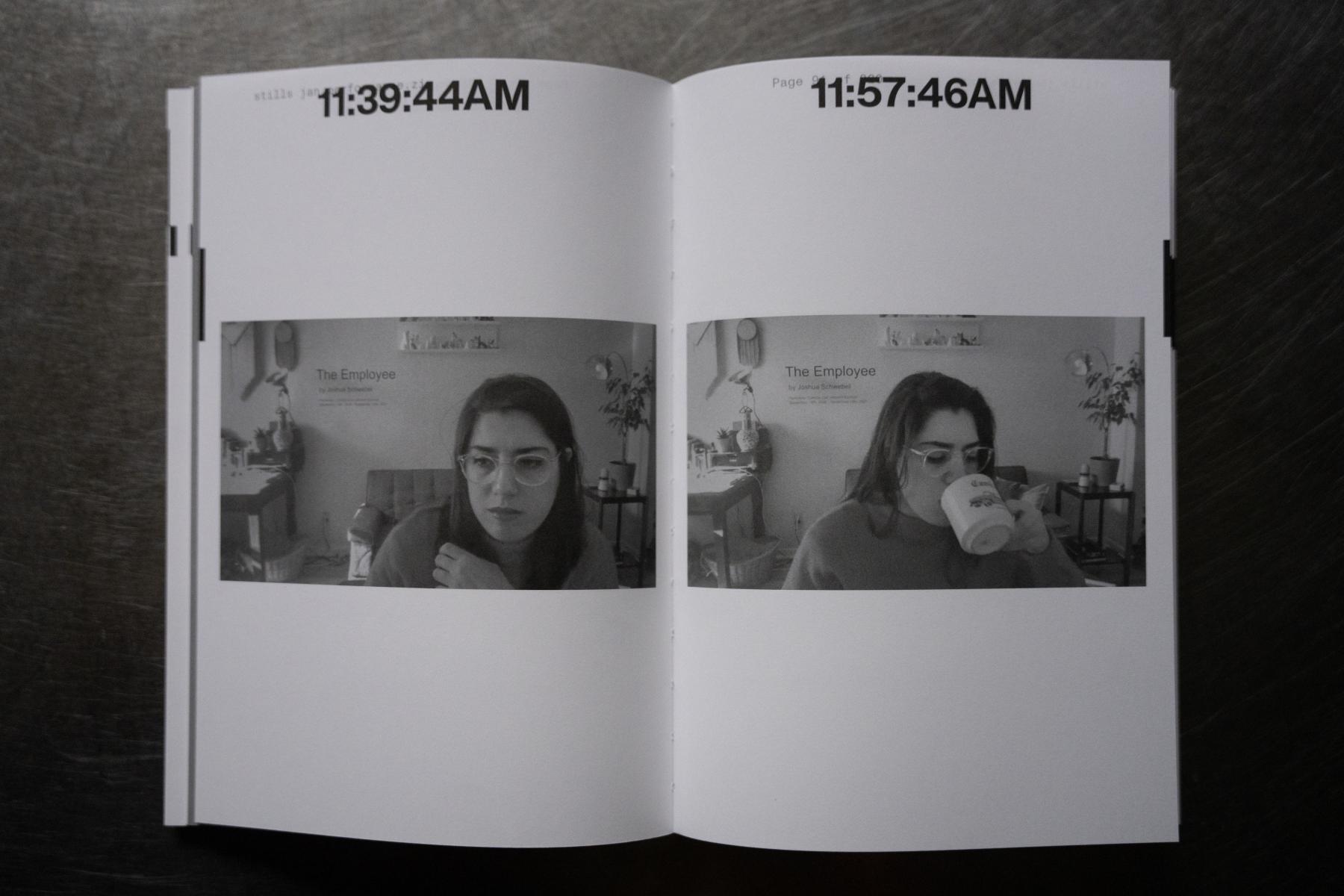
Joshua Schwebel, The Employee, 2025. Artists' book. Co-edited by Joshua Schwebel and Lauren Wetmore. Published by Art Metropole, Forest City Gallery. Designed by House9 design
Near the beginning of The Employee, a wide-ranging text about labour and exploitation in Canadian art, Joshua Schwebel shares a line from the grant he wrote to fund the project’s eponymous artwork:
“My artwork will produce the infrastructure necessary to reinforce the currently inadequate infrastructure at the gallery, while the gallery produces the infrastructure necessary to understand my gesture as an artwork.”
It’s the kind of crisp but packed line that brings us to the edge of Schwebel’s restless mind and labyrinthine practice. The syntax may be clear, but the provocation is akin to an iceberg.
He’s referring here to a year-long (art)work in which he hired artist Camille-Zoé Valcourt-Synnott to perform in a double sense—as a grant writer and an artist carrying out a performance of cultural labour. Aimed at supplementing the precarious funding of London, Ontario-based Forest City Gallery, the piece simultaneously explored the constitutive lack of sufficient labour, fair compensation and resources endemic to artist-run culture. Revealing both the disciplining force of neoliberal funding structures, and the ways cultural workers are made complicit in their own exploitation, The Employee was at once a material, aesthetic, and political intervention, striking (with love) at a beleaguered but beloved institution of Canadian art. But that was just the beginning. Next, Schwebel, alongside co-editor Lauren Wetmore, gathered an enviable roster of artists, workers and theorists to unpack the piece and its surrounds (a process captured in all its fascinating and mundane detail in the project’s comprehensive email archive). The resulting publication, an art object in itself, is the most frank, juicy, and rigorous analysis of contemporary cultural and artistic labour I’ve ever encountered—-an exhilarating gut punch I have yet to put back on the shelf.
The Employee is just one example of Schwebel’s significant body of work, but it gives a sense of how he operates. A conceptual artist living between Berlin and Montreal, Schwebel uses institutional contexts, power structures, and products as material and medium to examine art’s relationship with power. Often collapsing the artificial boundary between art and life, he skewers the myth of art’s autonomy while simultaneously leveraging it to make incisive material and political interventions. This might take the form of using his artist’s fee to reimburse unpaid interns at a prestigious institute like Künstlerhaus Bethanien, as he does in Subsidy, or exposing the symbiosis between arts communities and gentrification, as he does in The Tenant and Evictions. When institutions respond (often badly), Schwebel captures this existential reckoning within the work itself, in thrilling maneuvres that reveal art’s instrumentalization while slyly liberating it from its institutional confines.
It might be tempting to take easy satisfaction in such moments of exposure or comeuppance. But Schwebel refuses to let himself, or anyone else, off the hook. Investigating the seedy underbellies and open secrets of an increasingly co-opted art world, Schewebel’s work also insists on contending with the tacit acceptance of these compromises as the cost of entry. If this radical transparency is what gives Schwebel’s work its queasy power, it’s also what makes it so generous. Playing instigator, comrade and conscience, he demands his peers and viewers join him in the fray. Not only does this sharpen art’s defanged stakes, it equips us with the tools to consider the violent machinations of late-stage capitalism in the rest of our lives—another Schwebel tactic that somehow leverages art’s exceptionalism while insisting on its place within the material structures that surround us.
I recently told someone who’s written beautifully about Schwebel’s work that I was working on an interview with him. “He’s no-nonsense,” I said, appreciatively, clearly a bit awed. “I love Josh,” the person responded simply. “There’s a lot of nonsense in Canadian art. But none with Josh.” Nonsense can be great of course, but it can also feel like a harbinger of further capitulation or complacency. Many of us, I think, are craving cultural interventions that are more honest, demanding, equal to the moment. In Schwebel’s practice, we find a species of radical hope that cuts to the quick.
I’m drawn to these messier expressions—all the places where these white cube structures erupt into dysfunction that they themselves have created, which bring their contradictions and failures into view.
Your work explores how art institutions are in bed with power, and how art is used to obscure and enable processes of exploitation and extraction. What drew you to making work about this thorny relationship?
For me to be active in the cultural sector, these questions need to be asked, otherwise why are we part of this? A lot of what I do is the result of the needs that I have, which I experience as a sort of “allergy” to unfounded authority, for lack of better terminology. For myself, the need for autonomy is of the utmost importance. It has taken me time and effort to support myself in a world so overwhelmingly organized around preserving and protecting authority. My life as an artist has helped me navigate this incompatibility with given social orders, but the basic friction I experience has not changed, it is just less immediately manifest, and less overtly visible. I’ve found that a lot of the abuses of power that I wanted to avoid in coming to art are actually quite prevalent in its institutional formations, and that as much as we focus on a rhetoric of transformation or critical reflection, the actual working culture within art can be extremely hierarchized, and involves social exclusions and cliques that are not that different than the ones that have previously shut me out. In turn, I’m very unwilling to compromise my hard-won autonomy that got me this far already, and more than that, unwilling to replicate these or to see these replicated more broadly against others as a condition of my own inclusion. If I need these conditions to change, why should I rope myself unquestioningly into art worlds that ultimately are also in the service of upholding the same hierarchies of wealth and abuses of power? As I continue pursuing my practice, this reflection cannot only turn outwards but also needs to be a concern for how I relate to others through our shared work, since I often delegate or contract jobs to others, transacting or perpetuating possible hierarchical relations in which I’m potentially assuming power. To be clear, I’m not opposed to all forms of hierarchy—since there are no relations that do not have a dynamic of relative forms of power—but I do think that the way that these are expressed in our arts milieu can be deeply problematic, because they operate on opaque, unreflected, or insincere terms. My work exposes these social politics as a part of what we, as a cultural sector, have built and are responsible for. My work attempts, at least in part, to critically consider how our sector (myself included) internalizes, replicates, and wields power. If we want to espouse transformative politics, it needs to be achieved through more than a show, but a radical, engaged, and ongoing reflection on how we structure our relationships to each other and to abusive forms of capitalism on which we are dependent. I see asking these questions with my work as important to me personally, but more than that, I also think that asking these questions is conceptually and poetically freighted, opening onto existential questions about the hairline differences between art and its value, and how these can be confused or manipulated.
You’ve used the label of institutional critique to describe your work. Can you say a bit more about your approach? Has it shifted in this moment of hyper-neoliberalized institutions and “institutionalized Institutional Critique”?
I use institutional structures as material forms to challenge how active these are in what we call “art.” I manipulate these structures to draw out the ways that they are not separate, but part of capitalism, and how art is also not something separate—ethically, politically, materially—from how we live our lives.
I really struggle to attach terminology to what I do. I don’t think that Institutional Critique is necessarily the right fit. It’s arguably the closest descriptor, but it's also so gutted at this point. It’s hard to take Institutional Critique seriously when its most fervent practitioners are totally embedded in careerism and uphold the same hierarchies of value that dominate the global art system. These self-beneficial performances of critique don't, or perhaps can’t, go far enough. This is one reason that this mode of working has lost credibility for me.
Marina Vishmidt has proposed the term Infrastructural Critique as a proposal to address Institutional Critique’s shortcomings. I not only find that to be a more trenchant model to engage, since it addresses the criticism beyond the immediate structure towards power, both in its concentration and proliferation, but I also think that it is a more appropriate way of modeling the structures my work is engaging these days. Infrastructures contain and mobilize institutional frameworks, and it makes sense to work with an eye towards examining how and to what end a critique of these are possible.
You’ve had several projects at large private institutions which exposed and skewered exploitative labour practices and hollow commitment to values, but more recent works have focused on artist-run centres. The Employee, for example, explores the ARC as this complex site of artistic autonomy and labour struggle that’s increasingly warped by neoliberal funding models, structural precarity and self-exploitation. Why the shift to ARCs? How does institutional structure and size inflect your critical approach?
The ways that cultural institutions have positioned themselves in response to Zionism’s annihilatory campaign in Gaza has deeply affected how I understand my relation to these institutions. The genocide we are witnessing is an expression of colonial power, and exposes its modes of dispossession, destruction, denial, and propaganda in the most horrific and absolute of terms. Many of the legacy cultural institutions in the international art world as well as in Canada have remained silent or continued to operate as though it’s business as usual (despite claims that also suggest some commitment to decolonial concerns)—revealing that for them, apparently, colonial genocide is still business as usual. This has nailed home in no uncertain terms that my values do not align with these dissolute structures of liberal power. They are no longer spaces to which I look to validate my work.
Instead, in the last few years, I’ve anchored my work more intentionally to artist-run spaces. I feel much more comfortable in artist-run contexts for so many reasons. These structures are organized around upholding artistic autonomy. This premise in itself allows for a greater degree of flexibility, reflexivity, and criticality. There is an idea floating around that artist-run centres are less-than institutions, that they are for emerging artists, or that they are jumping-off platforms for the institutional recognition that marks success. I strongly disagree with this. I have received far better working conditions in artist-run centres than I have in institutions, and I regret how much the arts community at large uncritically equates budget size with prestige. As artists, we undergo a lot of grooming to be very individualistic, competitive, and to make ourselves as convenient as possible to those with decision-making power and the institutions that will accelerate our climb to what is arguably a very undifferentiated model of success. For my part, success is equivalent to autonomy of practice, to finding ways to make radical, challenging, or rigorous work, much more than showing in larger or more prestigious spaces.
Politically, I also feel more comfortable working in artist-run spaces since I know where they are positioned. I know how they're funded, I know the scope and scale of their entanglements. When I work with an artist-run centre, as when I work with an institution, I am not just putting something into the exhibition space, I am reflecting on the centre itself, both as site and as structure. Often my work uses the organization as a material form in itself, occupying or appropriating functional spaces beyond the gallery, using, for example, funding applications, residency programs, etc, as material to be manipulated and appropriated into the envelope of my work.
All these structures are flawed. There’s no easy solution, but the artist-run centre is a platform from which to struggle, because it contains a fundamental commitment to artistic autonomy, difficulty, and a parallel relationship to “success.” Part of trying to divest from the many disappointing, horrifying, or harmful ways that I am made complicit is to choose how my work is circulated. That’s also led me to engage more and more with artist-run spaces.
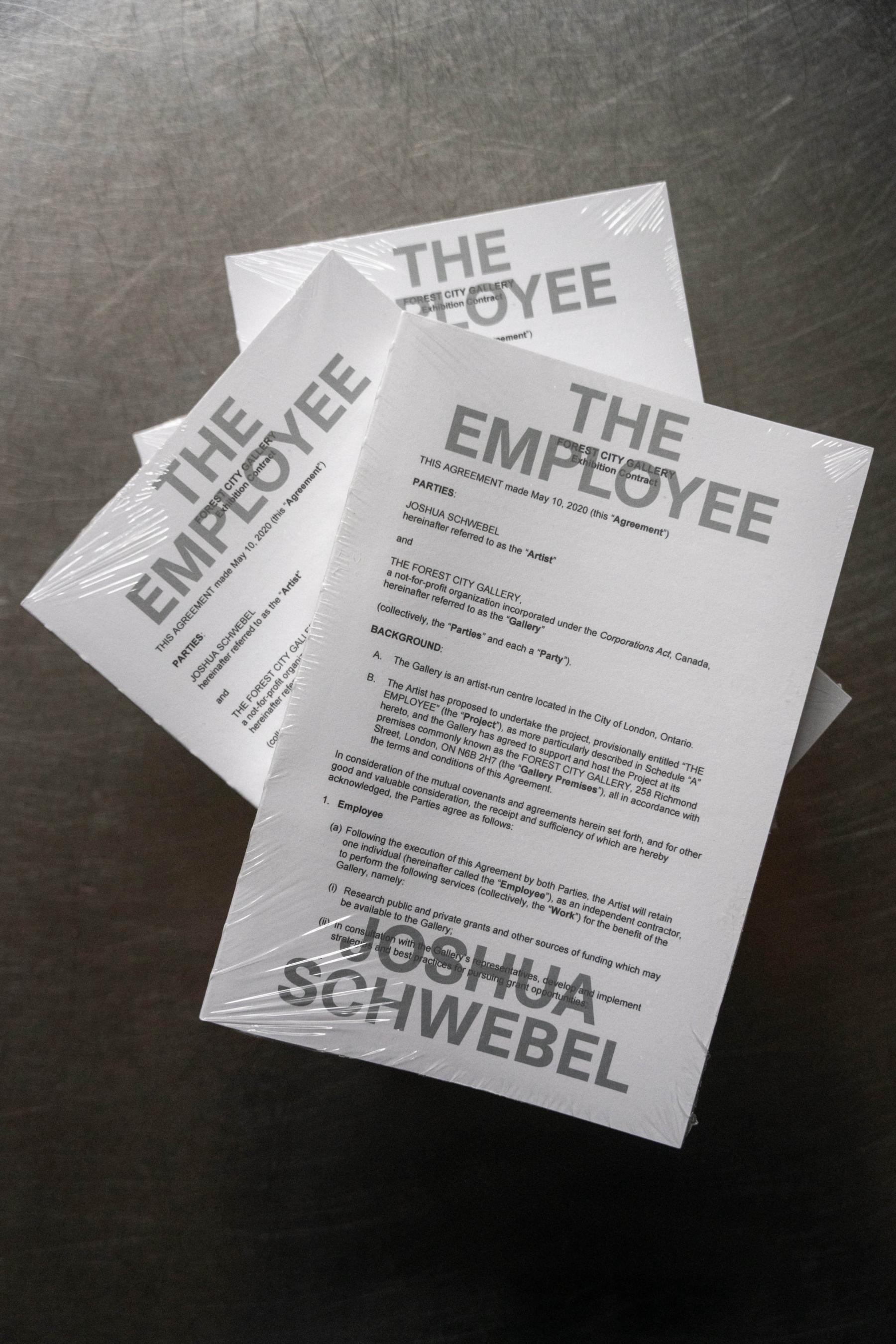
Joshua Schwebel, The Employee, 2025. Artists' book. Co-edited by Joshua Schwebel and Lauren Wetmore. Published by Art Metropole, Forest City Gallery. Designed by House9 design
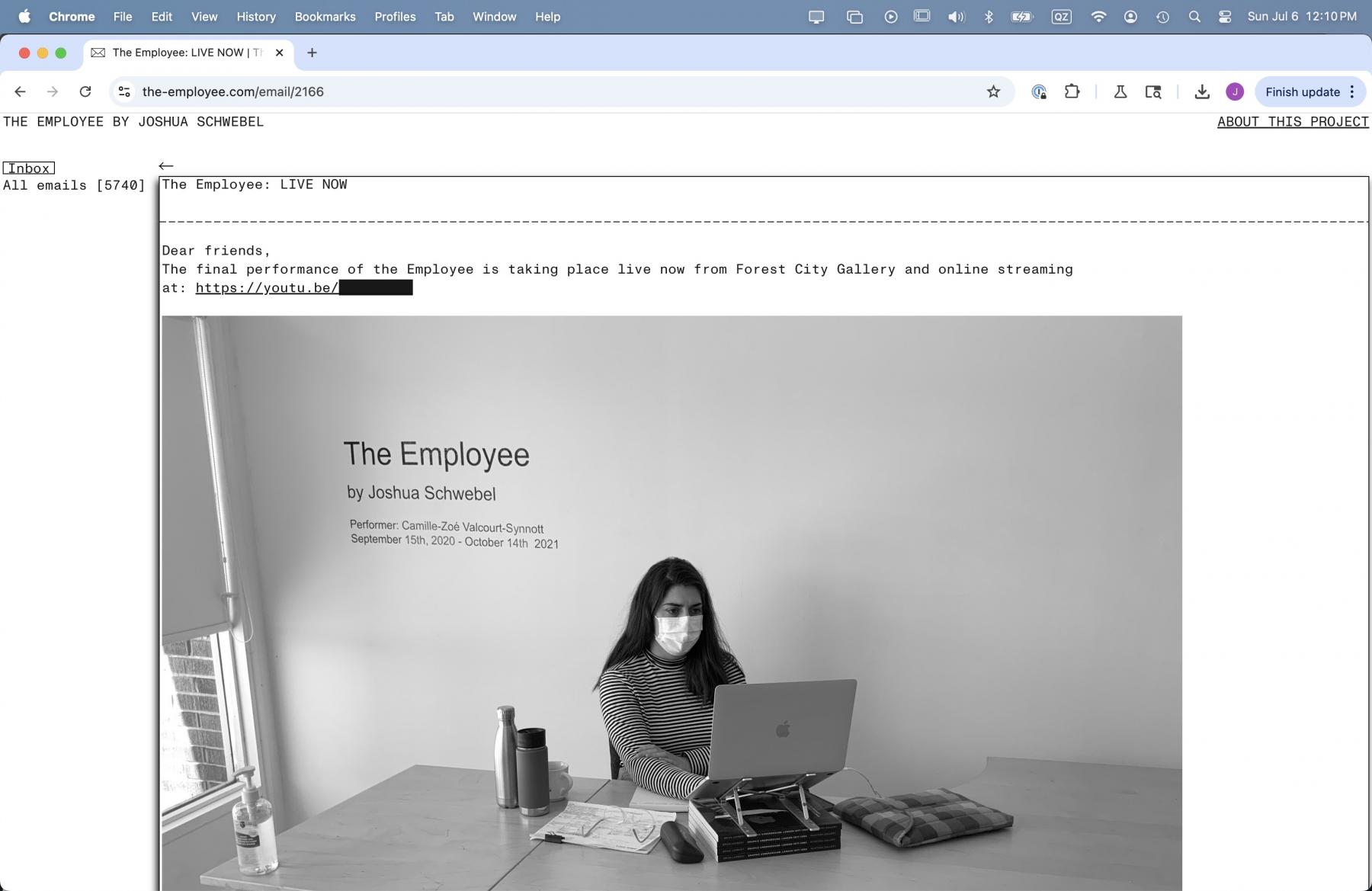
Joshua Schwebel, The Employee, 2025. Email archive. Please visit www.the-employee.com to view the complete email archive.
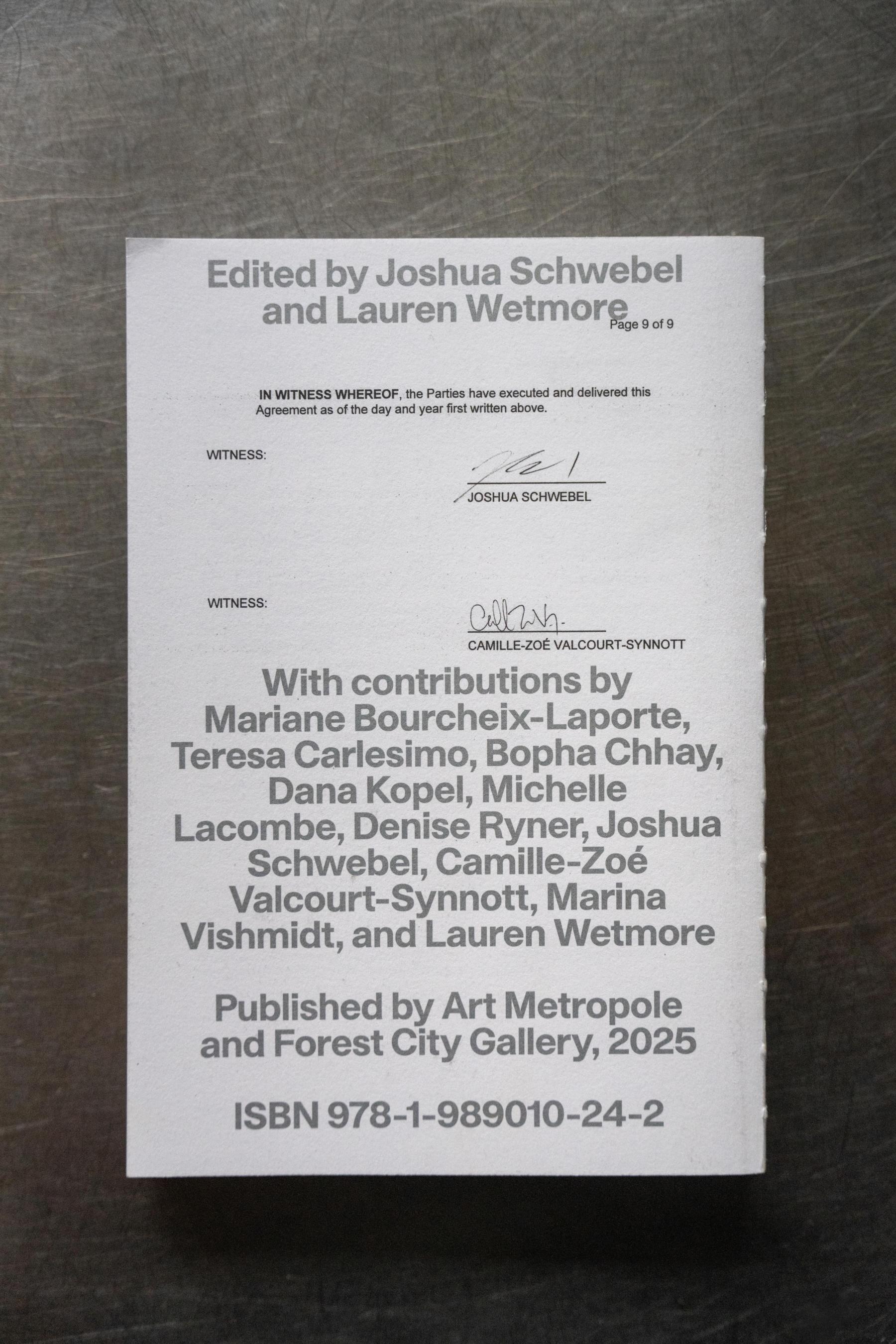
Joshua Schwebel, The Employee, 2025. Artists' book. Co-edited by Joshua Schwebel and Lauren Wetmore. Published by Art Metropole, Forest City Gallery. Designed by House9 design
In your earlier work, there’s this mischievous sense of subterfuge and conceptual play as you sort of trick institutions into saying the quiet part aloud. In more recent works, it seems like this “whistleblower” approach emerges through radical transparency and forcing institutions to crumple under their own contradictions in perhaps more direct ways. Does this reflect a shift in your own way of working, or maybe a response to increasing neoliberal capture?
I think that this shift has a lot to do with my own power relative to the curators or cultural contexts in which I work. As I’ve become more established as an artist, I don’t have the feeling that I’m underestimated as often as I once did. In a way, I am less exposed to expressions of art’s hierarchies than I once was, which, however demeaning, also infuriated me and gave me clear directives for irreverence. I am in a different place in my working relations now, and I don’t feel as comfortable perpetrating actions that rely on a certain underdog or retaliatory dynamic vis-à-vis my host. Because those are not the working conditions that are offered to me anymore, it would feel disingenuous and inappropriate to exploit. I think it also comes with working in artist-run spaces more than larger institutions, and in this shift, choosing to work in relations that are, at least on paper, more horizontal. It is of the utmost importance to me to be as honest and sensitive to the specificities of power dynamics at play in the sites and contexts in which I work, especially in order to avoid replicating power dynamics that I criticize.
As I shift the target of my work to larger conglomerates of power beyond the immediate frame of the work—towards funding bodies, or philanthropists, or global mining profiteers—it also is harder to use humour as a technique, since there is less of a chance to initiate a dialogue with these inhuman, non-accountable behemoths. In addressing these forms of power, I do still propose funny interactions, but they are more often thwarted, since they are not obliged to “get” the joke or play along in the same way that art professors or curators must to preserve their image.
Your work is always deeply researched and very site-specific. Where do new project ideas emerge for you? What compels you to dig into something?
One project leads to the next. The Employee led me much more into thinking about infrastructure and policy, which has shaped the projects I have coming up. I'm doing a project in about a year about CARFAC and RAAV together demanding collective minimum fees from the National Gallery of Canada. The Gallery’s model for compensating artists had been based on contracts with individual artists following copyright’s protection of artwork as intellectual property. CARFAC-RAAV, on the other hand, approached cultural work through a labour framework, and proposed a collective fee schedule to the NGC. The disalignment between these systems of valuation (or fees) brought this case before the Supreme Court, who ruled in favour of CARFAC-RAAV. I find this history not only to be quite an epic struggle, but it also opens up a lot of the questions I return to in my work about the value of art, its limits, its definitions, and the fickleness of its supposed autonomy from the systems, structures, and infrastructures that profess to support it, but often overdetermine it. I remain curious about moments where the categorical definition between art and its other collapses, where art’s value is flipped open, or in situations in which the instrumentalization of art starkly overturns the common understanding of art as autonomous. So I guess finding new places to dig into with my work is not a challenge.
I want to come back to this idea of the artificial boundary between art and life. Marina Vishmidt has a great line about how your work makes use of “the suspensive power of art to surreptitiously advance transformative effects in reality that can perhaps not be achieved as directly by other, more prosaic means.” Your work seems to have a remarkable ability to drag art out of its exceptionalism, but also use its exceptionalism to effect material or political shifts, or at least attempt to. The Employee was a fascinating example of playing with this boundary. Maybe you can say a little bit more about how your work tries to dissolve, shift or leverage this artificial frame.
I find the whole way that value works to be a case of the Emperor's New Clothes, a collective suspension of disbelief which is most clearly perceivable in the case of art. We walk into a room and believe that the objects in it are somehow outside of our world. That they have this extra layer of significance—value—by being called art. And art itself, really is just a sense of intent. So, and this is not a new idea, but what happens when that room itself is called art? or is that room necessary to perceive art? These are basic ideas of contemporary art that emerged out of Fluxus or John Cage or Duchamp, but they continue to fascinate me, because they open up onto ways of shifting identities or seeing how much of what we take seriously in the real world are matters of belief rather than matters of fact. This is why I did a lot of earlier work with counterfeit receipts, or other documents of circulation or exchange. The proximity of these genres with art documentation lends itself to a double awareness of the constructedness of the real world, and the actual realness of what we imagine to be “the art world.” So with The Employee, I think I just ran this double world in parallel around one extra turn, taking a real enactment of the art economy—grant writing—and, by way of a transaction, turning it into a performance.
I think Marina understood this about my work, but also about the wider world and its economy. She is a collaborator who I miss so much.
With a work like The Tenant, which looks at the process of gentrification around Centre Clark in Montreal, you pointed to the ways in which both artists benefited from this corporate landlord enabling their studio practice and artistic production, and then also ended up getting pushed out of the neighborhood through the ensuing gentrification of the area. Artists are shown to occupy this double role of being oppressed by power structures while also acting as accessories to or beneficiaries of power. How do you navigate notions of implication or accountability in your work?
I'm just always very interested in the situatedness of art. As I said in the previous question, art is understood as somehow outside of, or parallel to “the real world” because of its representational role. Representation suggests a difference from presence or presentation, that distances and even segregates art from accountable reflections on its footprint. My work often digs into those connections and interdependencies, bringing out the ways that artists and our institutional formations both impact and are impacted by economic transformations such as gentrification, labour exploitation, and resource extraction. There is an in-betweenness or an ambivalence that emerges when we look at art in these ways that I find fascinating.
Another good example of this type of work was Solvent, a piece I did a few years earlier at the Or Gallery in Vancouver. That work looked at the building that the Or rented, and how economic necessity created a situation that was unhealthy and toxic. The landlord offered the gallery extremely low rent on a month-to-month basis, but wouldn’t repair anything, wouldn’t actually even allow repairs to be made by the gallery (to avoid increased taxes, permits, and fees). Nonetheless, he, and the gallery board believed he was doing the gallery a favour. He did not treat the staff with respect, yet expected to be met with gratitude. The most obvious expression of this was that the gallery ceiling leaked profusely. The gallery became the material for the work, and the context exerted the pressure, literally dripping water from the ceiling above into the gallery, which, when not collapsed, was stained with concentric rust and mold circles.
By installing track lighting on the gallery floor to illuminate the damaged ceiling, I was accused of making the landlord look bad. I was not doing more than pointing out the compromises we feel that we need to make to survive as artists. I was criticized for my work, because in many ways it was a real win to have such a large and affordable exhibition space, a rare opportunity in Vancouver. The condition of the space was accepted as a byproduct of this as a necessary compromise. In accepting this compromise, however, we as an arts community are also internalizing and perpetuating abusive and hierarchical power dynamics that are not transformative, that are unhealthy, and that uphold cultural codes that impose shitty working conditions predicated on manipulative demands for gratitude. I don’t think anything I did was singling the landlord out to look bad. In fact, I was making the whole art community look bad, since these conditions had been accepted for so long, and I exacerbated the precarity of the whole situation, which made nobody particularly comfortable.
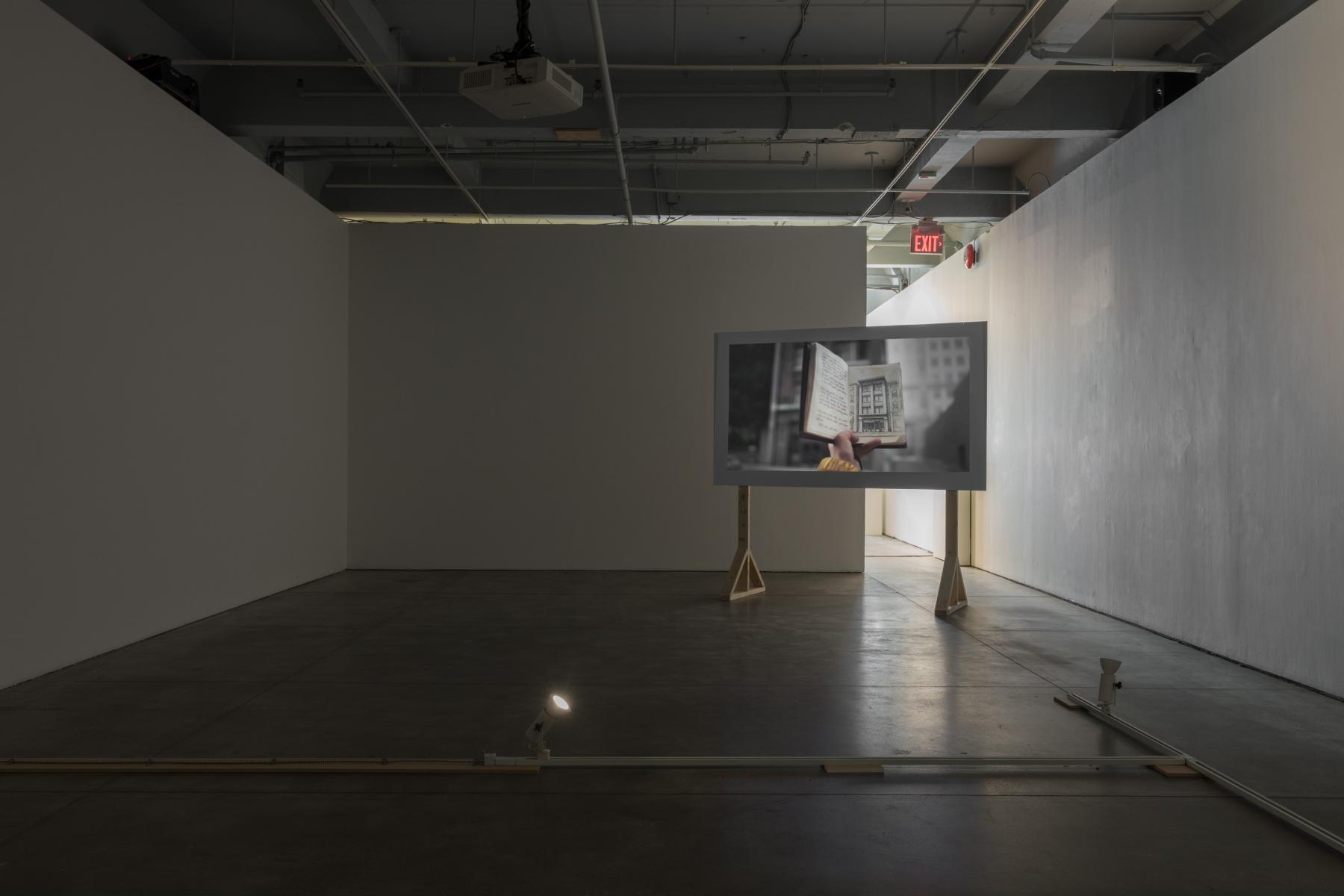
Joshua Schwebel, Solvent, 2019. Installation at Or Gallery.
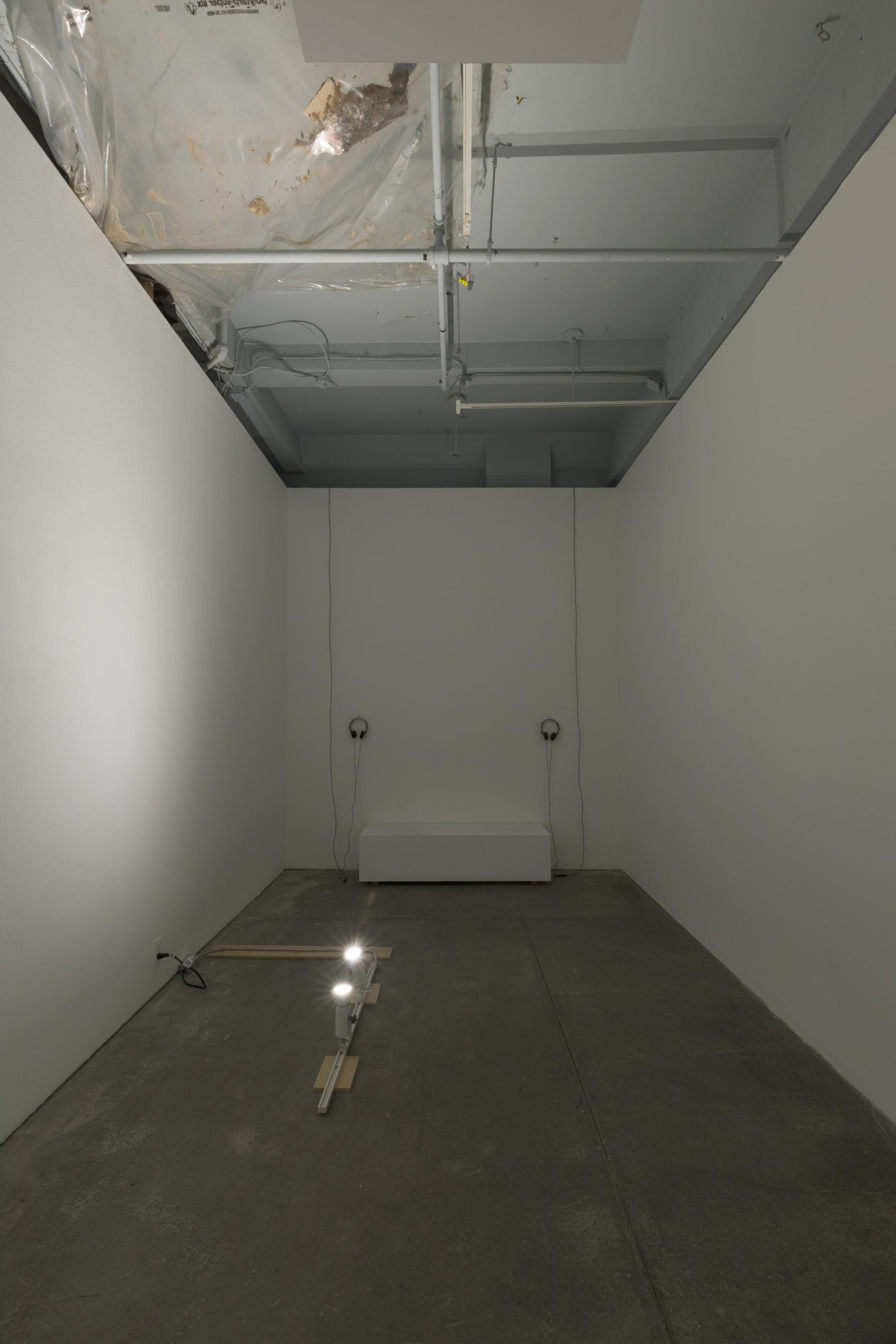
Joshua Schwebel, Solvent, 2019. Installation at Or Gallery.
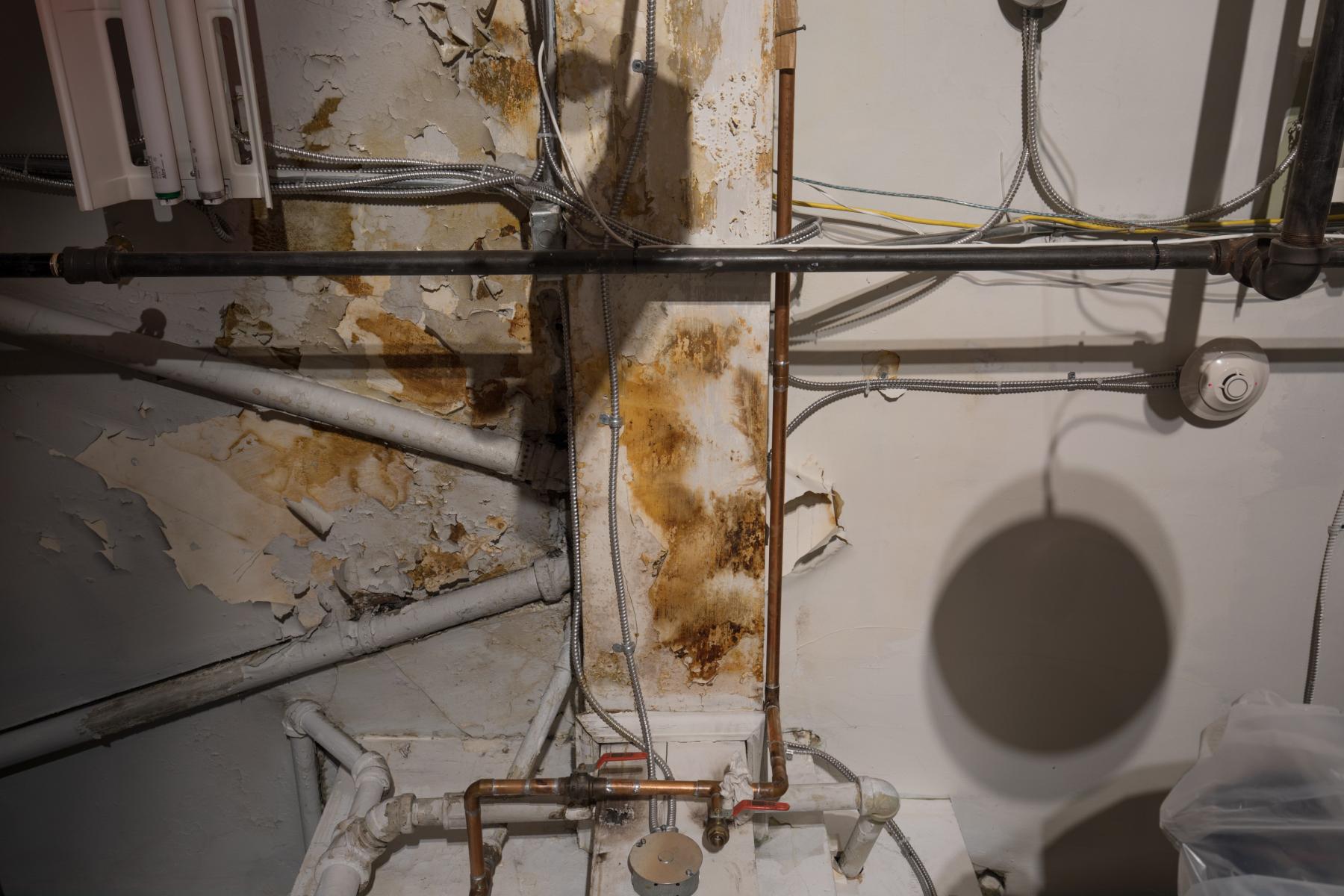
Joshua Schwebel, Solvent, 2019. Installation at Or Gallery.
The response seems to prove your point about precarity in the arts, and how deeply it shapes our expectations of relationships and conditions for art making.
There are so many pervasive abusive dynamics that exist in the art field, and we are conditioned to protect and enable that abuse, because it's a survival mechanism. Solvent is a good example of my approach because it's about showing the compromises and complicities that we can’t really avoid. We keep art in a white cube that's intentionally cut off from the external world, which has everything to do with the fantasy, but also says a lot about how society domesticates, or even incarcerates culture. I have done several projects that take art for a walk, or infiltrate or use artistic protocols in non-artistic spaces in public, or even in the non-exhibition spaces of art institutions. The results of that way of working shows again how uncomfortable people are with oddness, and returns again to the framing protocols that my work tests. Many people need these framing protocols in order to know that something is art. There are several habitual signs on the threshold of art spaces that tell people that they are stepping out of the everyday world, but also defang whatever is happening in the space (because it is “outside” of the world). Even when I work outside of the exhibition spaces of art institutions, in, for example the administrative or operational spaces of an art gallery, and with arts administrators or cultural workers, often the work cannot be recognized by those very people, because it deliberately evades, occupies, or toys with those threshold markers. I find this all very interesting, because it not only speaks to habit, or to art’s performance, but it also speaks to how “value” in art is entirely arbitrary, and only accrues to the work if it is known (already) to be art (i.e. if the threshold is clearly marked).
Given your use of existing materials and conditions within institutions, how do you think about medium?
Power structures, value systems, and institutions are the materials I work with, and so the medium—i.e. the institutional vocabulary or how I occupy the space—just depends on what the context reveals to be important. The majority of my working time is spent determining which elements will show what I’m trying to address. At Or Gallery, the leaking ceiling said it all. I spent a lot of time trying to figure out how to show the ceiling is leaking. It took me a year before I finally figured out that I could drop the lighting grid down to the floor and point it upward, and that would be enough. I also used footage from the TV shows and films that had been recorded there to create a montage featuring the background as the subject. The institution is the machine that produces the work and then the material is already made. I don't really have so much control over what I receive, or what the context tells me. It's just about finding the proof or product of that conceptual machine. So I suppose I would answer that question more abstractly by saying that my medium is what is given to me by the site, the invitation, or the subject itself. I work with these given materials and to edit, montage, redirect, or resituate these already-circulating elements as readymades that behave a bit oddly and in that oddness can be perceived as intentionally resonant as art.
How does audience play into the display of this conceptual evidence?
I think of the public as a reader of the work, but also I don’t think of this as a single role. I often work with multiple perspectives or readings of my work. So an arts administrator may encounter the work in one way that offers a certain way of deciphering it, while a spectator coming from the local artists’ community may read it in a different way. In The Employee, for example, a lot of the work involved Camille-Zoé Valcourt-Synnott (the employee) applying for funding on behalf of Forest City Gallery. As the employee, Valcourt-Synnott’s work was both a delegated performance and a sincere process of trying to procure funding for the artist-run centre. This doubleness was indicated by a didactic description in her email signature, indicating that her work was part of an artwork. Now, most of Valcourt-Synnott’s emails were inquiries about funding opportunities, application protocols, etc. (the complete archive of emails sent and received over the course of this project can be accessed at www.the-employee.com), and most often her email signature was likely overlooked. At one point we received an email from a funding officer asking about how the email signature affected the content of the email. And in this interaction you can see how reading the employee’s email as art both supplements and entirely resignifies the content of the email, flipping it from functional to performative. Nonetheless, every funding administrator who read Valcourt-Synnott’s emails was an audience, reader, or spectator of “the work,” whether or not they “read” it as art.
Your work often ends up exposing the inner workings of offices or administrative practices, making mundane documentation into art objects or inscribing them in performances or installation. Would you say there’s a particular aesthetics to your practice?
Well, to speak about The Employee again, the work sets up a system which is genealogically very close to conceptual art and relies on aesthetics of administration intentionally. But what’s really interesting to me is how these conceptual systems are very similar to other exploitative structures that try to systematize everything and eliminate breakdowns, mess, the body. In that work, the project is set out with a protocol—a proposal for a delegated performance of hiring a grant writer to both make the funding application process a visible artistic gesture, and an operation of shifting funding from “art” to its administrative precursors. The context out of which that project emerged is a very real understaffing of Forest City Gallery, where the work took place. In the case of FCG, a single staff member is tasked with keeping the ARC running, while being paid for 30-hours a week to do so, when it is inevitably a more-than full-time job. The budget allotted to staffing the centre requires staff to donate time (and money) to the centre that is not reflected in the contracts or budgets that document the centre’s operations. So by using my “creation” grant to fund resourcing the staffing in order to resource the ARC, the work exposes how conceptual documents—including contracts—suppress real distress.
And the project replicates that gap between protocol and reality. Although it uses this very dry administrative aesthetic, it also includes the content of collapse and burnout in the email archive as well as in the other documentational forms that the work took. I’m drawn to these messier expressions—all the places where these white cube structures erupt into dysfunction that they themselves have created, which bring their contradictions and failures into view.
You’re also an excellent, analytical writer. How does this fit into your practice?
I accept that I write, but I find it very scary. It’s very exposed and I really like to hide as much of myself as I can. Writing feels uncontrollably, irrevocably exposing. No matter how many times I edit, I'm never gonna be happy with what I write. But my work often does often take the form of writing, I can’t deny it. And to be even more honest, the majority of my time is spent writing applications for funding or projects.
You often play an editorial role as well, engaging others to create a space of discourse around your work, while also redistributing power or authorship. I’m thinking of the breadth of pieces and conversations in The Employee, and the critical essays by the interns from Subsidy. Why is this important for you?
I really enjoy gathering people around my work and unpacking it through their readings. I think it comes back to the plurality of perspectives that my work proposes by creating different levels of access and visibility. I've always thought of my work as being very condensed. Writing allows for different facets of the work to be unraveled. It’s also a complement to the resource redistribution I like to do since I can open up the budget to many contributors. I’m very uncomfortable being credited for my work, and it’s much nicer to share it and get a sense of what other people think. When you’re talking about experiences of cultural workers, it’s also important to have multiple positions and multiple voices testifying to these experiences.
Despite this moment of institutional crisis, are there particular spaces or work that you’re excited about right now?
These are things that are still emerging through the transformations that are happening right now. We're not done yet. We’re never going to be done, but the heads have yet to roll. The institutions that we have right now have failed us, and I need to see them transformed and dismantled. The work I’m most excited about is the dismantling of power, the forces pulling things apart, or the forces that are melting themselves down, and the configurations that are still emerging that will hopefully shift our ways of working in more horizontal, accountable, consequent, and reflective directions.