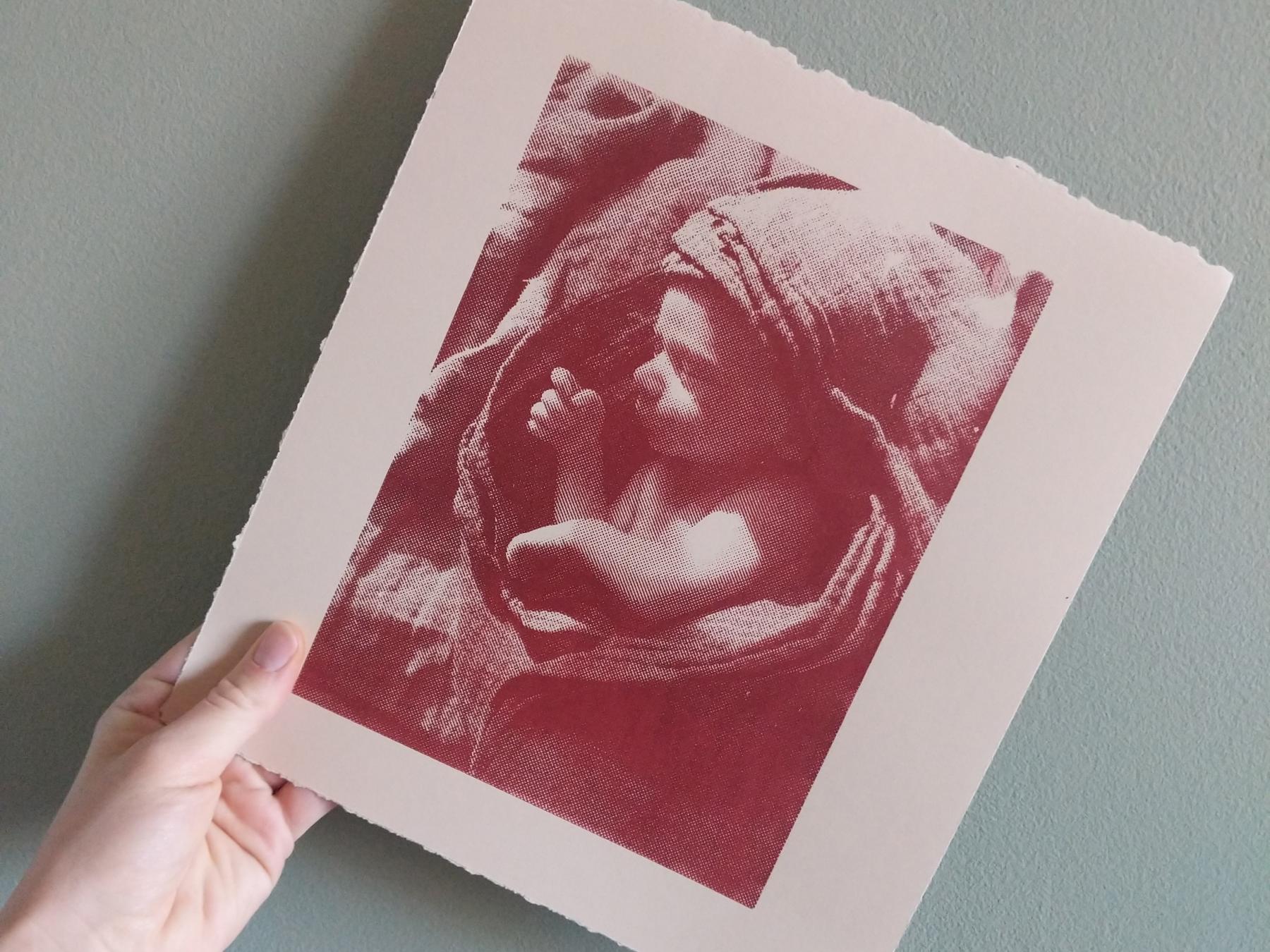
Screenprint by the author.
matrescence - noun. the process of becoming a mother
1.
As a teenager, I taught myself to write with my non-dominant left hand. My penmanship became legible if not elegant. I liked the different poems that emerged. Nevertheless, once my identity calcified post-pubescence, I gave up the practice for 17 years—until I started writing with my left hand while breastfeeding my first child.
Once again, I can feel hesitant new neural pathways forming. Once again, I am surprised by what I write, and by what it says about who I am becoming.
2.
A few weeks after my son was born, I read Lucy Jones's book Matrescence, in which she cites a recent study showing that the brain changes undergone by biological mothers are comparable in scope and consequence to the brain changes commonly associated with puberty:
“The group compared the brains of twenty-five first-time mothers with twenty-five female adolescents; the brain changes were extraordinarily similar. Each group had reductions in cerebral grey matter volume at the same monthly rate. Both showed changes in cortical thickness and surface area, and depth, length and width of sulcal grooves (the lower part of the Viennetta-like ripples of the brain).”
Though this study was small, it confirms Jones’s—and my—subjective experience: Like teenagers, new mothers are engaged in a dramatic, intensive identity-forming process.
3.
Why have so few writers acknowledged this existential shift? Why don't we have a whole genre of literature devoted to it—the coming-of-age novel, but for matrescence? Even before reading Jones, I'd had a similar question: If the war novel exists, why not the birth novel?
My provisional answer, nine months into my own matrescence, is that there is a deep incongruity that a mother-writer, at least, discovers in attempting to describe pregnancy, birth, and early motherhood. There is a real problem of language. Of literary language.
Love is an impulse, but it is also a practice. What practice will free my natural voice, allow me to translate love onto the page? Because that—nothing more and nothing less—is what I actually want when I talk about wanting to achieve “good prose style.”
4.
On the one hand, I have access to thousands of videos about breastmilk volume, intrusive thoughts postpartum, how to achieve a “belly only” pregnancy, the quest to pee alone. On the other hand, I have read hundreds of novels like Cormac McCarthy’s All the Pretty Horses, novels with sentences like: “A year later he married his dead wife’s older sister and a year after this the boy’s mother was born and that was all the borning there was.” I have been dissatisfied by the graphic details of motherhood that proliferate on social media and the brusque, clever mentions that proliferate in Great Books alike.
And while there has been a recent spate of novels about their protagonists’ matrescence—including Kate Briggs’s The Long Form, Rachel Yoder’s Nightbitch, and Olga Ravn’s My Work—these books are still being heralded as anomalies by the critical press and by the mothers who pass them around.
While I am about to do my best to suss out why describing the full dramatic tableaux of motherhood has felt almost impossible for me, I can only hypothesize that other mothers and writers are afraid of both the clinical glare of graphic detail and the prim handwaving of the modernist, masculine style we still call “beautiful prose.”
Why do we find ourselves so inarticulate? Is it simply that English (both the language and the literature) has been shaped primarily by patriarchally constructed movements like “becoming a man,” like war?
What does this problem of language mean for me, a woman writer, a woman coming of age as a mother, a woman who was once the girl who looked for herself not in The Bell Jar but in The Catcher in the Rye?
5.
But surely Cormac McCarthy and Jerome David Salinger and all the other ultra-stylish, ultra-masculine writers of war and puberty and the meaning of life also come up against the inadequacy of language. Isn’t their triumph in this very battle (note my metaphor) why their prose is so wonderful?
Don’t we all think that Ernest Hemingway’s famous paragraph about the dusty leaves is wonderful?
“In the late summer of that year we lived in a house in a village that looked across the river and the plain to the mountains. In the bed of the river there were pebbles and boulders, dry and white in the sun, and the water was clear and swiftly moving and blue in the channels. Troops went by the house and down the road and the dust they raised powdered the leaves of the trees. The trunks of the trees too were dusty and the leaves fell early that year and we saw the troops marching along the road and the dust rising and leaves, stirred by the breeze, falling and the soldiers marching and afterward the road bare and white except for the leaves.”
This is the style I was taught to revere and imitate; until very recently the style held up as the epitome of “good” English language prose (remember that website where you could input your own paragraph and a rudimentary AI would Hemingway-ize it by removing all adjectives, adverbs and subjunctive clauses?). But Hussein Zamani, among others, argues that Hemingway’s style is primarily a traumatized style. One could make the same argument about James Baldwin the preacher’s son, about Salinger—who is much funnier than Hemingway but for whom suicide feels like an ever-present subtext.
What would it mean to try to apply a traumatized, masculine style to matrescence? Is that what I have been trying to do?
6.
Hemingway maybe not so much, but Baldwin, Salinger, Steinbeck, Wallace—these are writers I can’t resist reading aloud to whomever is in the room. Never mind the rest of the novel; I would have named my son Zooey out of sheer exhilaration with Franny and Zooey’s dedication:
“As nearly as possible in the spirit of Matthew Salinger, age one, urging a luncheon companion to accept a cool lima bean, I urge my editor, mentor and (heaven help him) closest friend, William Shawn, genius domus of The New Yorker, lover of the long shot, protector of the unprolific, defender of the hopelessly flamboyant, most unreasonably modest of born great artist-editors, to accept this pretty skimpy-looking book.”
Cool lima bean! Dear Jesus, let me write a sentence this charming before I die.
7.
In my Salinger moods, I try to find words on a small scale. I try to formulate precise descriptions.
Zooey nursing at three months: An Olympic swimmer receiving the Lord Jesus Christ as his personal saviour. Zooey nursing at five months: A 1960s cartoon monkey grasping a coconut.
Social media has convinced me that information alone (“I bled 0.8 oz a day for five weeks postpartum”) is not enough. It has convinced me that baldly stated sentiment (“I love my baby”) is not enough. The reality I am experiencing—the meaning of the reality I am experiencing—is not captured by these kinds of statements.
Style is needed. Prose style is needed. Literary writing is needed.
Why? Because the gestalt created in the process (of writing it, of reading it) allows literary writing to take on a kind of quantum significance. Many incompatible, even contradictory, meanings can coexist.
(This quantum signifier seems crucial when trying to describe motherhood, which changes genres by the minute, moving from psychological thriller to romance, folktale to Irish troubles novel with bewildering fluidity.)
Literary writing creates ambivalence. The writer’s attempt at beauty, her acquiescence to the artifice of art, creates ambivalence.
Just by including a statement like “I love my baby” or “I have lost myself” in a piece of literary prose, the writer makes herself vulnerable to the possibility of the opposite interpretation. The lady doth protest too much? This is what makes a literary treatment both necessary and dangerous.
8.
In one attempt to give my own matrescence the literary treatment, I wrote a description of my early pregnancy and first ultrasound, which included these paragraphs:
“At eleven weeks, the woman and her husband have their first ultrasound. She expects the technician to have to interpret—this blob here, that fuzzy area there. Instead, the baby, in profile, springs right into focus, bouncing gently like a balloon and waving its fists. It is enchanting and surreal. Her husband cries.
It occurs to her that so much of what we think of as soul possession is in our projections; we are looking—searching, desperately—for the soul in a horse or a dog; not so much in a pig or a cow. She is clearly searching for the soul in her baby. Even that word; she doesn’t bother trying to call it a fetus. She cannot now imagine having an abortion.
Nevertheless, she pays three hundred dollars and sends six vials of blood off to Ontario for a full genetic screen.”
My husband was deeply upset when he read them. He took issue with my “chilly” style, and we had a fight. Why couldn’t I drop the ‘the woman’ bullshit and just say ‘I’? he demanded. How can you castigate me for writing about my own pregnancy the wrong way? I demanded. And yet I couldn’t unsee his crestfallen face as he read my interpretation of an experience we’d shared. I realized I had destroyed his own, more romantic and innocent, memory of that ultrasound.
I felt ashamed.
Because the style is cold. Because even while it describes a real intellectual experience I had, it omits a profound emotional truth: One reason I couldn’t say ‘I’ was because I dissociated during that ultrasound. A year and a half before, I had discovered I was miscarrying at eleven weeks. I was terrified it was going to happen again. And so, while my husband was free to weep with joy when he saw Zooey, all I could think about was how wrong it had looked last time. Even then, there was grief that I couldn’t share his experience. And a freshly nuanced grief over the last pregnancy. And a feeling of guilt that I was supposed to feel differently than I did. And an awe I could barely acknowledge at the perfection and energy and existence of my lime-sized child. And a feeling of grim responsibility at the possibility that I might have to make an ethical decision that suddenly seemed impossible. And an anger that I had to carry that responsibility while my husband could simply enjoy the moment.
I still don’t know how to capture all of this in beautiful language.
9.
I keep telling myself that if I can achieve good prose style while also capturing the full truth of the experiences of matrescence, the experiences will be redeemed. Redeemed from what?
What style would justify mentioning these things, enable me to bring them into educated, polite society, prevent them from inflicting violence on other people, make them not shameful in their femininity, their intensity, their resistance to consistency, their lack of intelligibility?
I seem to have trouble taking myself seriously. In my journal, I write: “I have to keep reminding myself that I can say anything!” But can I say anything?
10.
What style would make me intelligible to other people? To myself?
In The Long Form, Briggs’s protagonist also encounters this dilemma of intelligibility, but in the context of narrative time. A young woman named Helen imagines barging into a lecture hall with her six-week old baby Rose and accosting the speaker, scholar Thomas C. Foster. In this exhaustion-induced daydream, she tries to explain how Rose’s biorhythms “break” both literary and social conceptions of time and threaten Helen’s own social personhood:
“for Helen: the very well-being of her mind and her body were at stake—and she couldn’t. Not without—she was preparing to leave now; she was already pushing her shoulder into the double doors. Not without risk. Not without what could feel like colossal, life-or-death risk to her own—she reached back for the word Foster used, because it was the right one—intelligibility.”
When I started trying to write about my son and my experiences postpartum, I made a note: “Re: finding the right style: important because it is style that enables something to be taken seriously”
11.
I seem to have trouble taking myself seriously. In my journal, I write: “I have to keep reminding myself that I can say anything!” But can I say anything?
When I took a style workshop with the American novelist Garth Greenwell, he challenged his students to find the idiom that would allow them to say all they needed to say. When writing about motherhood, it feels like an all-new idiom is required. How else to write maternal joy + placental gore? (Adoration + rage? Immanence + transcendence?)
How might mothers use literary techniques to add layers to existing language? To reinvent, to retrofit it for their own purposes?
12.
Perhaps by becoming a ventriloquist.
In a recent interview on Between the Covers, Danish writer Olga Ravn and host David Naimon discuss Ravn’s use of the doubled voice in her new novel, The Wax Child, which is narrated by a doll.
Recalling Ravn’s observations on the prevalent use of doppelgängers in women’s writing of the Gothic and Victorian periods, Naimon reminds her of her own theory that “one has to play several roles. The multiple roles cause the idea of an authentic self to disintegrate and become porous.”
Ravn responds by expanding the notion of the doppelgänger to apply to all first-person writing—but especially first-person writing by a person (for instance, a mother) whose identity has been subsumed, appropriated, or interpellated by other forces: “When you sit down and you write an ‘I’, you’ve already created a sort of doppelgänger...And I think that if you have already had the experience of losing your ‘I’, of losing your freedom of movement, freedom to define yourself, this is quite an easy concept to understand. As soon as you speak of the self, it becomes double...When we write, who is speaking?”
13.
One of my great joys as a reader has been the discovery of the naïve narrator, the gushing narrator, the piqued narrator, the gossipy narrator—the shameless narrator. Who is, in my experience, almost always a woman and often a mother (though sometimes a wax doll).
The shameless narrator is not trying to deliver “good” prose (though the writer of the shameless narrator may be). The shameless narrator is making fun of herself, and therefore gets to express several truths simultaneously—the truth she naïvely professes, the truth of her own gullibility or innocence or emotion-driven state, the truth revealed by her reader’s discomfort, the truth that is the author’s courage in embodying a shameless narrator’s voice, the truth of all she doesn’t or can’t say.
The shameless narrator takes the quantum literary effect and ratchets it up several notches—though this doesn’t always result in “beautiful” language.
Ashley Bristow’s motherhood memoir My Own Blood is an example of what I would call ugly, unstylish prose. The voice is shameless: defensive, indignant, even bitchy. “This study will help me retroactively organize lots of vague thinkitty-thinks I’ve had about the finite nature of mental bandwidth.” And yet, I trust the narrator Ashley Bristowe absolutely. I trust her, and I am with her, and I have taken on her stakes to the extent that my imagination and human empathy permit. And I feel this way in large part because the narrator Ashley Bristowe does not give a flying fuck about furnishing me, her reader, with suave sentences. (The author Ashley Bristowe has bigger fish to fry.)
14.
These days, I enjoy writing shameless narrators more than anything. The novel I finished last summer, most of my poems over the past five years, all my favourite short stories spill from the mouths of characters who aren’t out to impress anybody.
But I haven’t been able to deploy a shameless narrator in writing about matrescence. Even though I suspect that a quantum voice is required (you know, to shoehorn the Prussian folktale into the police procedural), I am still compelled to search for a unified voice. A cool lima bean of a voice. A voice that will allow me to be taken seriously.
Scratch that. A voice that will allow me to take myself seriously. A voice I recognize as my own.
15.
In the updated introduction to her 1982 book In A Different Voice, which vividly exposes how difficult it is for women to speak the truth of their own experiences of pregnancy and abortion within cultural frameworks designed by and for men, Carol Gilligan refers to the work of voice teacher Kristin Linklater: “Linklater speaks of ‘freeing the natural voice’...and what she means is that you can hear the difference between a voice that is an open channel—connected physically with breath and sound, psychologically with feelings and thoughts, and culturally with a rich resource of language—and a voice that is impeded or blocked.”
Gilligan and Linklater are concerned with the embodied speaking voice, but I think this difference is discernible in writing as well. As a writer, I think I know (I hope I know) the difference between the natural voice and the impeded or disingenuous voice in my own work.
16.
Gilligan also invokes the traumatized male voice as an example of cultural framework designed by and for men, quoting Shakespearean critic Anne Barton’s introduction to Love’s Labour’s Lost: “Gently, but firmly, the men are sent away to learn something that the women have known all along: how to accommodate speech to facts and to emotional realities, as opposed to using it as a means of evasion, idle amusement, or unthinking cruelty.”
It’s too harsh to accuse all the canonical masculine novelists of evasion, idle amusement, and unthinking cruelty. Still, Barton’s words remind me of the accusation I’ve already made—of an unwillingness “to accommodate speech to facts,” to admit to the full scope of what they’ve seen and—perhaps more importantly—felt.
Which brings up a nagging question: Is distance—even dissociation—required to write beautifully?
Even now, I feel like I need the protection—the distance—of an aesthetic filter. Both the coolly observant narrator and the shameless narrator have their limits, but both promise the protections and revelations and freedom of artistry.
17.
In her essay “Last Words,” we learn that mother, writer, and venerated prose stylist Joan Didion first read Hemingway’s dusty leaves at “twelve or thirteen, and imagined that if [she] studied them closely enough and practiced hard enough [she] might one day arrange 126 such words [her]self.”
Like Hemingways’, the hallmark of Didion’s style is an immaculate sense of remove. I would argue that she maintains this remove by mocking everything she writes about. In “Getting Serenity,” an essay from the same collection in which she writes about her love of Hemingway and his four perfect commas, she describes attending a meeting of Gamblers Anonymous, a group of which she is not a member.
“‘This Gardena,’ a young man breathed softly. ‘She destroyed me.’ The young man, who said he had done OK in mechanical drawing at Van Nuys High School, was twenty-two years old and wore his hair in a sharp 1951 ducktail, which perhaps suggests the extent to which he, like everyone else in the room, heard a different drummer.”
While apologists for her style might say she is allowing these details—this person, in fact—to speak for themselves, I would never trust Joan Didion to write about my own matrescence. And I wouldn’t believe a word of what she wrote for publication about her own.
But in the recently released Notes to John, in which Didion revisits the question of Twelve Step programs, Didion is not writing for publication. She is writing for herself and her husband about their daughter Quintana, who was an alcoholic. Interestingly, the prose in Notes to John is nothing special. It has none of the brilliance, none of the flair of a Joan Didion sentence. But I trust it. (Whether it should have been published is another question.)
18.
But now I am the hypocrite mocking Joan Didion. Even now, I feel like I need the protection—the distance—of an aesthetic filter. Both the coolly observant narrator and the shameless narrator have their limits, but both promise the protections and revelations and freedom of artistry.
In that same Between the Covers interview, Naimon notes that the narrator of Ravn’s My Work “names herself Anna after the narrator of Doris Lessing’s The Golden Notebook in order to distance herself from herself”—that is, in order to say what needs to be said.
In The Wave in the Mind, Ursula K. Le Guin called it “the maker’s loving difference from the thing made.”
But do I want to create that distance, that sense that Sally Mann and Susan Sontag talk about in terms of photographs, that the art has eclipsed the memory? I worry about losing this private experience of Zooey’s babyhood, my own baby-motherhood. What if the stylishness of my prose style becomes the very thing that destroys the experience—one of the most precious of my life?
The fear isn't that it won’t be intelligible; the fear is that it will be intelligible. Can I afford to risk the mystery reduced, destroyed; the dissection of the flower that the Romantics decried?
The stakes have never seemed higher: on one hand, an indescribably beautiful baby; on the other, my own personhood. But look at me falling back on ‘indescribable,’ writing an essay about the prose style that might be up to the challenge instead of simply describing, as best I can, what is happening to me.
Is it this hesitation, this awe of one’s own experience, this horror of getting it wrong that has rendered motherhood almost invisible, denied its admission into the canon? What if, for hundreds of years, writers had been so overawed by love, or by London (probably the most written-about city in the world) that they refused to put pen to paper? The experience, the place, would, in a sense, not exist.
19.
I have firsthand experience of what a person might sacrifice in order to become intelligible. My own childhood has been largely eclipsed in my own memory by the novel I wrote about it. I mourn that loss.
It was Joan Didion who said that thing about the novel starting out as the whole world, then, by page 10 of the first draft, becoming something much smaller and meaner than the whole world. Perhaps because Zooey is here with me in it, motherhood is the one world I am not willing to risk making smaller and meaner.
20.
Speaking of smaller and meaner. It seems fashionable lately to write books about motherhood that focus on the horror, disillusionment and uncanniness of it. Though these are literary books, their prose does not offer me a model via which to communicate my experience. Their enraged voices are legitimate; the indignities they report are real. But they cannot say everything.
What can’t they say? Well, for instance, an enraged voice can’t use the idiom I share with my son. He and my husband and I have developed our own private language, as new lovers do. If you walked into our house unannounced, you might hear Zooey crying, you might hear me crying, but you would be just as likely to hear:
“Ascend!”
“Triumph!”
“Going for a float!”
I write in my journal: “Only love has enough room for all of this. (Also humour.) Writing out of fear or anger will kill everything.”
21.
Love is an impulse, but it is also a practice. What practice will free my natural voice, allow me to translate love onto the page? Because that—nothing more and nothing less—is what I actually want when I talk about wanting to achieve “good prose style.”
Is editing a way to nurture the natural voice? A practice through which to speak through love, if the loving impulse is too overwhelming, leaving only a loss for words?
22.
Surely this is what Hemingway was attempting to accomplish, with that description of the dusty leaves. We can call it suppression, dissociation, toxic masculinity—but perhaps his heart too, overflowed. Perhaps his heart too, could not bear to speak directly of what it needed to speak. Could not even look directly at what it knew was there. Had to approach at a distance, down a dusty road, with the crutch of four perfect commas.
23.
It isn’t becoming a mother that has taught me that love is the source of the natural voice. If I look back on my own work with any honesty, sorting it into the true and the false, I am forced to acknowledge that I knew this already. But as I keep repeating, in this essay, in conversation: The stakes are high.
Because Zooey exists. Because I am losing myself, like the rageful, cat murdering protagonist of Nightbitch, much as I might not want to identify with her. Because I have never felt so fragile, so much like a chick in an egg that has been cracked open by some blundering or cruel one else.
The stakes have never been so high.
To keep them in sight at all times, to allow my heart to overflow constantly, is not possible. The exigencies of daily life prohibit it. How can I maintain a loving distance when I am in the thick of it? How can I keep track of feeding times, do my pelvic floor exercises, fold all the laundry, with an overflowing heart, a heart like a newborn baby itself?
Much less write sentences. Much less spew out sentence after sentence in the natural voice? Because at this, the eleventh hour, the twenty-third section of this essay, let me say explicitly that what comes out at first is not cutting it. How can I accuse myself of writing about my own experience the wrong way? And yet that is how I feel when I read over what I’ve written.
24.
I am in the thick of it. Like a moustached man in a battle zone, sure. To both of us, literature offers the promise of an oblique approach. An approach mediated by time—by multiple too-short writing sessions spaced too far apart, by notes taken in multiple moods cycled through multiple times a day, notes taken on the grocery list, notes taken by the left hand and by the right. And sometimes, it is true, the left hand doesn’t know what the right hand is doing. Sometimes the mother doesn’t know what the writer is doing.
Pre-matrescence, I believed that my writing self was my real self. In giving birth, however, it was undeniable that my body became my real self.
The fear is of one real self betraying the other.
The self I hope I am becoming is the self that can write without betraying or destroying—that can allow the flower to blossom without cutting open the bud—the self that can mother myself and my son and my writing, triplets, as in a recent dream.
25.
Speaking of dreams. In Jungian psychology, there is an image of the mother giving birth to herself—a process which, Jones’s work suggests, is happening on the level of neural structure as the mother becomes a different person. Discussing a study of maternal brains led by Elseline Hoekzema and Erika Barba-Müller, Jones notes:
“The brains of the control group—who haven’t born children—are solely grey. But the brains of the mothers are dotted with pools of yellow-orange to indicate the regions that are structurally different. The coloured parts show areas of shrunken grey matter, in multiple brain regions, including the frontal and temporal cortices as well as the midline . . .
Shrunken grey matter? Decrease in cortical thickness? It sounds as though the brain might be deteriorating, or losing some of its abilities. Instead, the lead author Hoekzema, explained to me, volume loss can show a ‘fine-tuning of connections.’
In adolescents, Jones continues, neural pruning is considered “a critical process for cognitive, emotional and social development when a human turns from child to adult.”
It occurs to me that this process of neural pruning is much like the process of writing—that is, the process of editing. Unnecessary and inelegant connections are pruned so that the vital material may become more efficient.
George Saunders describes how, through the not-so-mysterious iterative process of editing, the authorial voice present in a piece of “good” prose becomes a “more noble, kind, transcendent” person than the writer who shows up for any given work session (three hours, Monday and Thursday afternoons, at a coffee shop on 99th Street while Zooey is with my husband’s parents, four blocks away). How does this happen? Through the gradual concentration of moments of brilliance or insight via the gradual excision of moments of shame, disingenuity, and confusion.
Is the natural voice I am looking for the product of editing, just as the new mother is the product of neural pruning? Is editing a way to nurture the natural voice? A practice through which to speak through love, if the loving impulse is too overwhelming, leaving only a loss for words?
Is this how I co-opt the English language, redeem myself, make myself intelligible, become the writer-mother-of-triplets—by doing what I’ve done since I was a teenager, sitting down to write and rewrite, again and again and again?