
Still from Archipelago of Earthen Bones - To Bunya (2024), Malena Szlam. Courtesy of TIDF.
While I saw many remarkable titles in competition at this year’s Taiwan International Documentary Festival (TIDF)—one of Asia’s premier documentary festivals, occurring every other year in Taipei—I feel compelled to discuss two non-competition programs: Encounters: The Living Landscape of Contemporary Canadian Documentaries and Taiwan Spectrum: War Memories, Shifting Identities. Together, they reveal something I find admirable about TIDF: its ability to connect people and places in ways that challenge stable notions of identity and community.
The Encounters program introduced audiences in Taiwan to ten recent films by Canadian filmmakers centered around relationships to land. It was guest-curated by Marlene Edoyan and Hubert Sabino-Brunette, artistic co-directors at Rencontres Internationales du Documentaire de Montréal (RIDM). RIDM had previously invited a program of Taiwanese documentaries to their 2025 festival, and in the manner of an exchange program, TIDF returned the gesture. At TIDF, I chatted with Edoyan and filmmaker Pablo Álvarez Mesa, whose film The Soldier’s Lagoon (2024) played in the Encounters program, about our impressions of the festival.
“There’s a strong sense of regionalism [at TIDF],” said Edoyan. “It’s not just about Taiwan, but about how to engage the wider region… for me, that is really inspiring.” I agreed. TIDF’s “sense of regionalism” stems from its support for networks of solidarity that span East and Southeast Asia, linking movements from below—and those recording them—in places like China, Hong Kong, Taiwan, Thailand, Indonesia, the Philippines, Myanmar, and further afield. “I think the festival is an encounter, rather than a showcase. It’s a place of discussion,” said Álvarez Mesa. Indeed, TIDF’s programming performs what film scholar Cheung Tit-leung calls “extending the local”—a process through which local artistic, social, and political discourses are put into conversation with films and filmmakers from around the world. In doing so, TIDF builds a community that exceeds frameworks of recognition predicated upon the nation-state system.
The Encounters program made a fine contribution towards this end. As their curatorial statement made clear, neither Edoyan nor Sabino-Brunette wanted to represent “land” as something specifically Canadian. Some of their selected films destabilize Canada’s settler nationalism from within by attending to Indigenous presence, such as Nicolas Renaud and Brian Virostek’s Holiday Native Land (2023) and Lindsay McIntyre’s Tuktuit: Caribou (2025). Others take place entirely outside of Canada while still attending to Indigenous histories in their respective regions, like The Soldier’s Lagoon, filmed in Colombia’s highland páramo ecosystems, and Malena Szlam’s Archipelago of Earthen Bones - To Bunya (2024), filmed across Eastern Australia’s volcanic terrain.
Indigenous perspectives also permeated the Taiwan Spectrum program. It featured 12 films from the 1930s to the present, concerning Taiwanese soldiers who fought for the Japanese Empire during WWII, and some of whom later fought for the Kuomintang (KMT) in the Chinese Civil War. Many of these films documented Indigenous Taiwanese soldiers, such as Archive: Li Guang-hui (1975-79), by renowned Taiwanese photographer Chang Chao-tang. Chang filmed the return of Suniuo (aka Li Guang-hui), an Amis soldier lost for decades in the Indonesian jungle after WWII, to his village in Taiwan, and the propagandistic media frenzy surrounding him. His story, amongst others in the program, demonstrated how Taiwan’s Indigenous peoples have been disciplined and instrumentalized by successive political regimes, and offers a way of rethinking Taiwanese history from a decolonial standpoint.
From opposite sides of the world, these programs charted expansive geographies across the Pacific. They portrayed lands and waters as contested and heterogeneous spaces, and engaged in subversive acts of remembering that bear on struggles for justice in the present.
Natives, Elsewheres
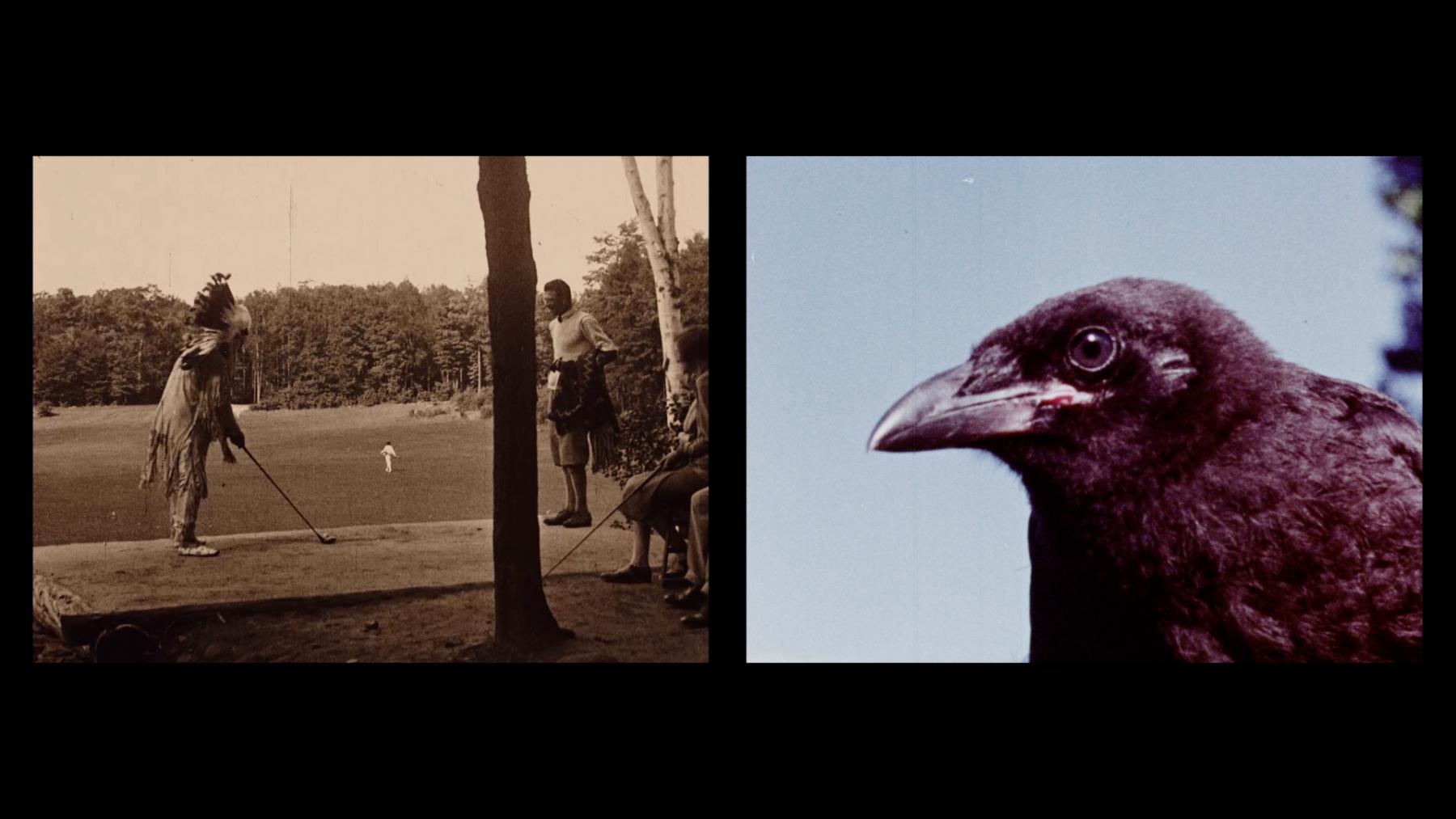
In Holiday Native Land—a montage of footage sourced from Canadian tourism promotional films—a steam locomotive crawls through a mountain pass in an extremely slowed-down shot. The motion smoothing applied to the footage warps the dark cloud of exhaust billowing from the locomotive into an uncanny, menacing miasma. This stalled-out image disrupts what film critic Shigehiko Hasumi calls the “archaeological rapture” of cinema—the pleasure we derive from gazing upon and traveling through picturesque landscapes (usually by train), which hearkens back to the vistas captured in the earliest silent phantom rides. Such pleasures were constructed, as Renaud and Virostek show, through Indigenous dispossession and the taming of frontier lands for touristic consumption.
Many of the films clipped within Holiday Native Land were funded by the Canadian Pacific Railway, as disclosed by the supercut of credits and logos early in the film. Using a split-screen format, the film teases out insidious contrasts: White Canadians are depicted as highly mobile, traveling by train, car, or speedboat across an expanding network of nature destinations; meanwhile, Indigenous figures enter the frame on horseback or canoe, essentialized as features of the landscape. Certain charismatic wildlife like deer, rabbits, and birds are hand-fed by families frolicking in forests, while elsewhere, cod populations are trawled and depleted. The simultaneous valorization and despoilation of the environment are intertwined, both symptomatic of a settler-colonial possessiveness over its resources. The directors eschew their own narration, letting the footage expose its own hypocrisies.
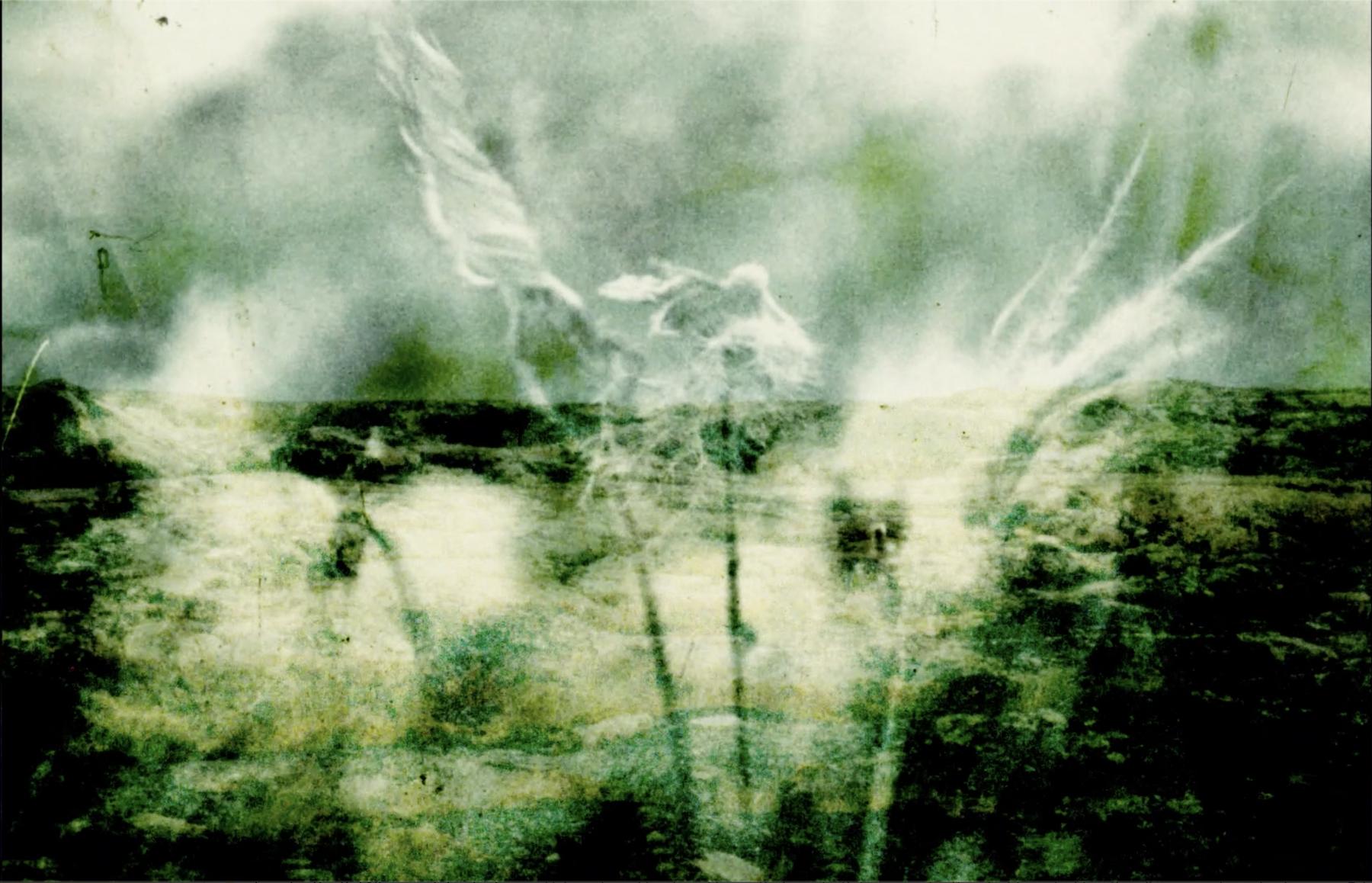
If Holiday Native Land dissects how film imposes on land in service of colonialism, Tuktuit: Caribou explores, through experimentation with 16mm film stock, how land intervenes in the materiality of film. McIntyre processed her film using developers hand-made with lichens, and made gelatin emulsions from the hide of caribou that forage upon these lichens across Canada’s polar latitudes. The visual imperfections and abstractions resulting from this process register a relationship between method and form that resists the industrial lineage of film production. Filming these lichens, her home territory of Nunavut, and herself preparing caribou hides for use, McIntyre reorients filmmaking as Indigenous knowledge and practice.1
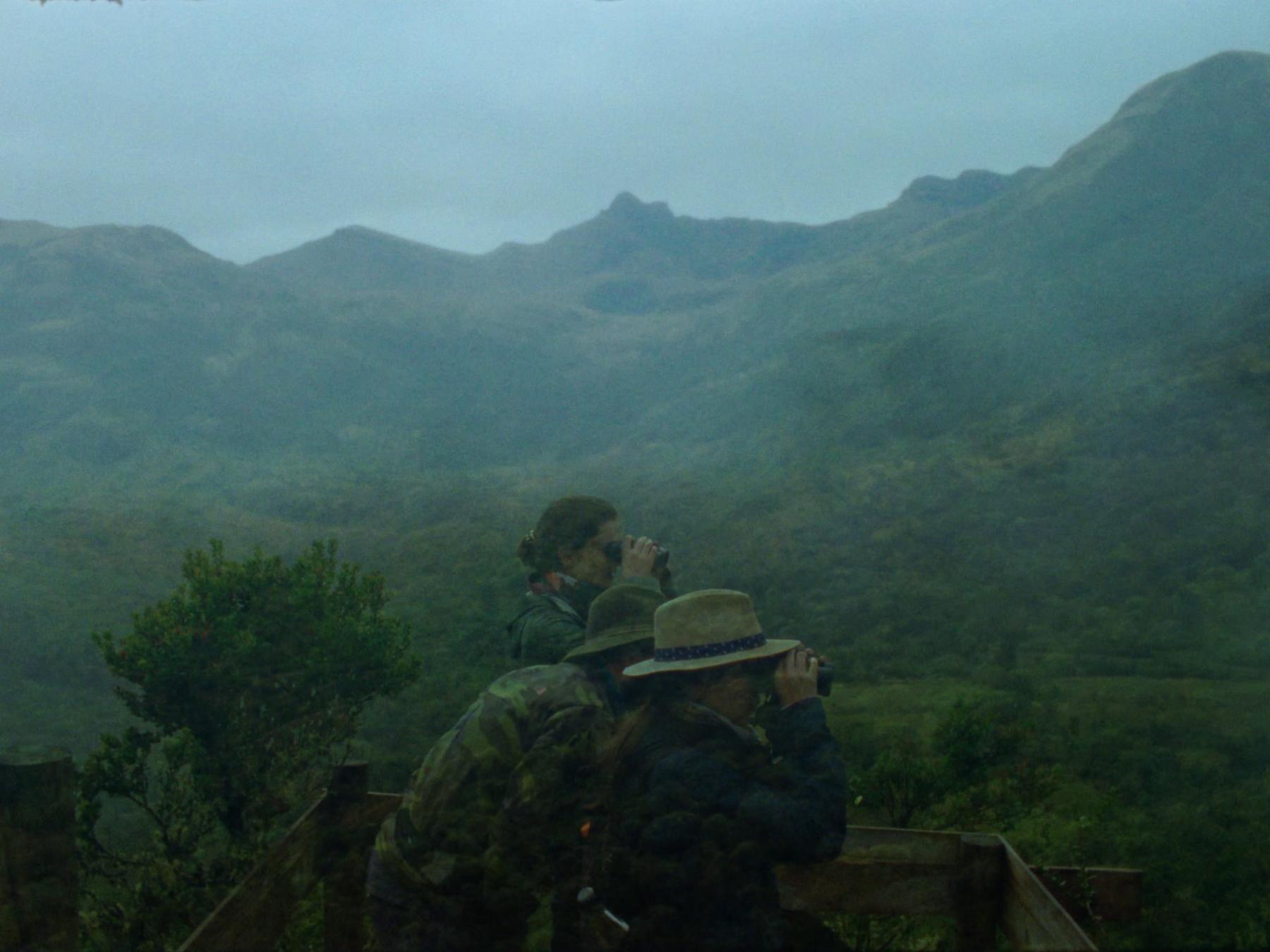
Canada and Taiwan are both settler-colonial nations—the key difference between them being Taiwan’s unresolved political status as a sovereign country. Taiwanese politics is dominated by contending settler nationalisms, espoused by its main political parties, the Kuomintang (KMT) and the Democratic Progressive Party (DPP). Taiwan’s Indigenous peoples struggle to articulate their agency in this limiting discursive space, where debates over autonomy in the face of the Communist Party of China (CPC)’s irredentism reflect, at worst, the narrow interests of a Han majority, or at best, a multiculturalism which sidesteps the question of Indigenous sovereignty.2 The Soldier’s Lagoon speaks to this dilemma. Álvarez Mesa’s film is the second of a trilogy which follows the route of Simón Bolívar's 1819 campaign against the Spanish across the Andes, using fog-drenched, Straubian shots of the ecologically sensitive páramo to survey the bloody histories soaked into the soil. He interrogates the romanticized portrayal of Bolívar as the Liberator of South America, tuning into the perspective of Indigenous peoples that suffered under the Spanish yet were sidelined by his vision of independence. Across South America, as in Taiwan, projects of nation-building dismembered Indigenous societies.
Though Álvarez Mesa shies away from depicting human figures, instead lingering on water (cycling through its various states) and plant life, he paints the páramo as a striated space layered with countless memories. The páramo has been crossed not only by Bolívar's wars of liberation but by conflicts between the Colombian army, paramilitaries, guerilla units, and criminal gangs, as various interviewed scientists, conservationists, farmers, and Muisca land defenders point out. Their voices emanate from off-screen, blending into each other. This violence controls where they can go and what work they can do, engendering constant negotiations and shifting local alliances. María, a Muisca activist, notes that this experience is nothing new for Indigenous peoples, who navigated the expropriation of their commonly-held lands and the writing and rewriting of agreements with colonizers under the Spanish Empire and throughout the establishment of new republics.
The Soldier’s Lagoon was preceded by Archipelago of Earthen Bones - To Bunya, which also had transnational resonance with Taiwan. Like The Soldier’s Lagoon, it is part of a larger project, in which Szlam films landscapes shaped by the volcanic Ring of Fire (upon which Taiwan also sits). “We’re usually taught to view the Americas, Australasia, Polynesia, and the Pacific Islands as separate, but in my view they are deeply connected, unified by the Pacific Ocean,” says Szlam in a recent interview. Its dazzling superimpositions of geological features carry an implicit political charge that composes Australia as Aboriginal land. Images overlap like clashing tectonic plates, capturing the energy of a region in transformation at its peripheries. For Szlam, geologic time contains its own poetics of relation that moves us away from colonially-imposed borders and temporalities. It was an inspired choice to bring this film to Taiwan: a place which, in healing from the KMT’s White Terror and its state-imposed historical narratives, is engaged in a process of remembering a much more complex transpacific history which decenters China and turns towards the archipelagos that surround it.
Still from Tuktuit: Caribou (2025), Lindsay McIntyre. Courtesy of TIDF.
Still from Holiday Native Land (2023), Nicolas Renaud and Brian Virostek. Courtesy of TIDF.
Still from The Soldier's Lagoon (2024), Pablo Álvarez Mesa. Courtesy of TIDF.
-3.jpg)
Still from Mujō (The Heartless), (2019) by Hikaru Fujii.
Forgetting, Remembering
Nangoku, the “southern country”—this was a term used to characterize Taiwan under the Japanese Empire, which colonized it from 1895 to 1945. After Japan’s defeat in WWII, Taiwan came under control of the KMT-led Republic of China (ROC). Overnight, Taiwanese people transformed from members of a defeated country into those of a victorious one. The KMT faced a serious problem. Here was an island of people who identified with Japan after decades of colonization. How could they be “redeemed” and admitted into a Chinese identity in order to be integrated into the ROC, and thereby mobilized to fight their ongoing war against the CPC? Furthermore, Taiwanese soldiers were complicit in Japan’s wartime atrocities against Chinese populations across Asia. According to Taiwanese historian Shi-chi Mike Lan, the KMT’s solution was to institute a state-imposed amnesia whereby many Taiwanese soldiers were granted amnesty and forced into silence. Their unacknowledged memories were wiped from the historical record—officially forgotten.3
Lan was a historical consultant for Lau Kek-huat’s From Island to Island (2024), a five-hour documentary about Taiwanese soldiers in Southeast Asia during WWII which formed the basis for the Taiwan Spectrum program.4 From Island to Island premiered at TIDF in 2024, achieving domestic success and notoriety. It won Best Documentary at the Golden Horse Awards that year, igniting renewed debates across Taiwan about its role in WWII. Since the end of KMT-imposed martial law in 1987, historians have been recovering the memories of Taiwanese soldiers through oral history projects, and many films in the Taiwan Spectrum program exist downstream of these efforts. Though Taiwan’s DPP-led government is formally engaged in what it calls a “transitional justice” process of coming to terms with the martial law era, remembering these unsavory memories erased by the KMT has been politically inconvenient. Who wants to remember a history in which one’s ancestors may not have merely been victims of colonialism, but also its perpetrators?5 By further contextualizing Lau’s already dizzyingly expansive film, the Taiwan Spectrum program refused to back away from discomfort, making a rigorous contribution to public history.
An illuminating collection of shorts in the Taiwan Spectrum program deconstructed examples of state propaganda. It opened with short propaganda reels made in 1930s and 1940s Taiwan, showing Taiwanese soldiers mobilizing to fight the Greater East Asia War. The footage was of poor quality, containing over- and underexposed images and accidental double exposures. These contextless, degraded images had a ghostly aura to them, as if visually representing the memories suppressed by the KMT.
These were followed by Mujō (The Heartless) (2019) by Japanese artist Hikaru Fujii. On one side of the screen, a propaganda reel showed a "civilian training dojo" in Tainan where Taiwanese people were "converted," through physical and emotional discipline, into imperial Japanese subjects. On the other side, Southeast Asian migrant workers in Japan repeated the same gestures in the propaganda reel in the present. These reenactments are startling—we are made aware that indoctrination is not an abstract process, but an ideology that tangibly works upon and through the body. The propaganda reel displays the “converted” civilians as groups moving in orderly patterns, and its opening shot shows the dojo’s symmetrical layout. Through framing and montage, it establishes a unified visual rhythm—the rhythm of fascism. As film scholar Mamie Misawa points out, this focus on rhythmic bodies is reminiscent of Leni Riefenstahl’s films, which were in vogue in Japan during WWII.6 Fujii's restaging, by contrast, frames certain individuals in close-up, highlighting tensions between the state and the individualism it sought to erase.
By employing Southeast Asians rather than Taiwanese people in the reenactments, Fujii provocatively reflects on the exploitative labor arrangements that continue to bind Japan, Taiwan, and Southeast Asia, linking present-day conditions to the afterlives of imperialism. Japan’s postwar decolonization was disrupted by the rise of Cold War anticommunism throughout Asia, of which the KMT government was one manifestation. The KMT laid the foundation for Taiwan’s economic growth as one of the Four Asian Tigers, and today that growth is sustained by a racist migrant labor regime that imports workers from Southeast Asian countries.7 Similarly, in Japan’s resurgent ultranationalism, which dehumanizes foreign workers like those in Fujii’s film, we find echoes of its colonial past in Taiwan.
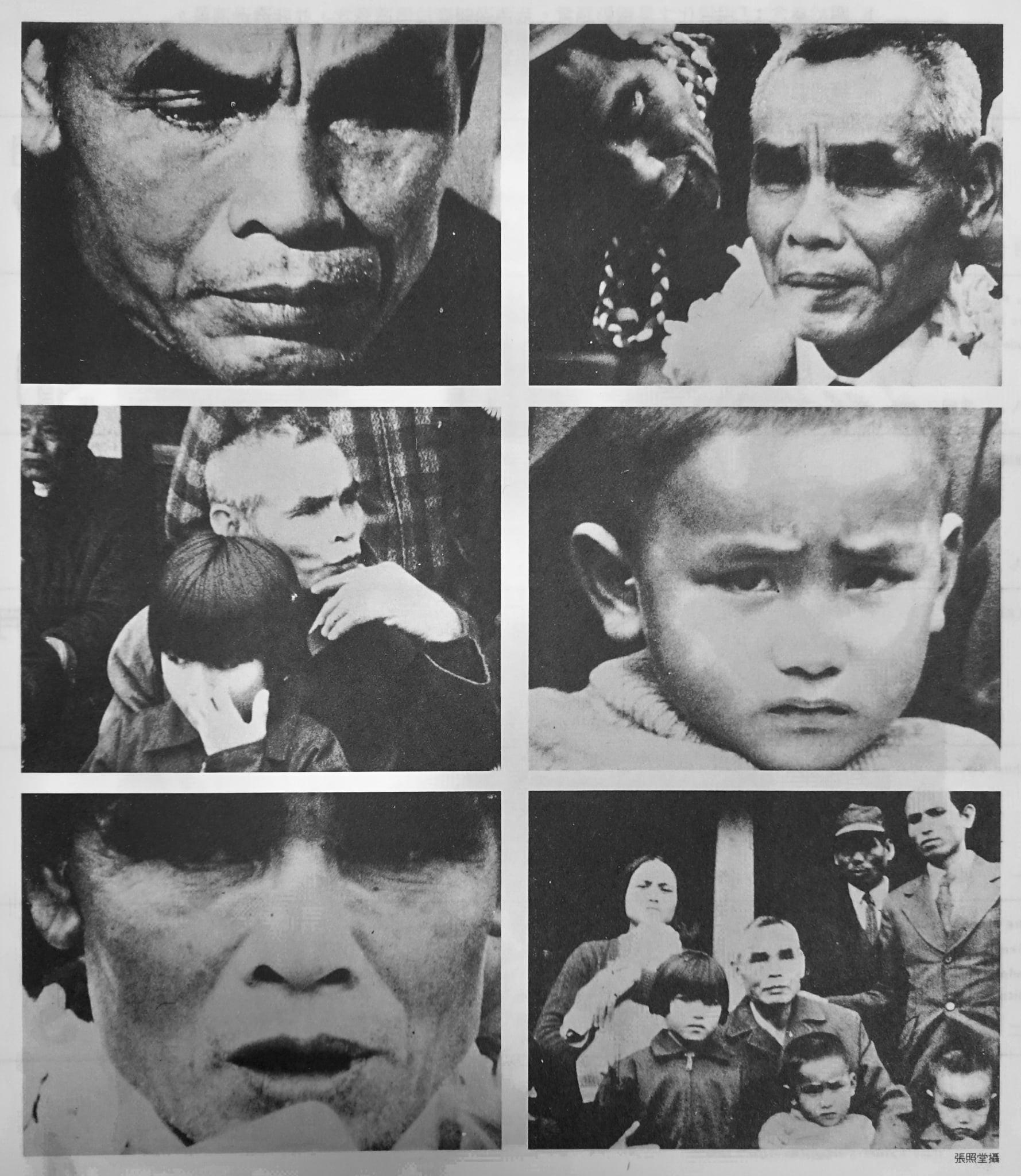
The screening concluded with Archive: Li Guang-hui, the most memorable thing I saw at TIDF. It’s not actually a film, but a posthumously presented collection of footage shot by Chang that was perhaps intended for later assembly into a film. If this is not a finished film, or even a rough cut, what effect does that have on the viewer’s understanding of it? I’ll return to this question later. It begins with Suniuo’s son and former wife being interviewed by news reporters. They travel to the city, where the government treats them to shopping and meals to get ready for Suniuo’s return. There's a paternalism shown by the reporters and government officials who surround them, and it is only heightened when Suniuo arrives at the airport. He is taken to his village where he partakes in a traditional Amis dance.
The media spectacle around Suniuo’s return was a carefully orchestrated absurdity. The KMT framed his return as a return to the ROC—a nation which Suniuo, having grown up under Japanese colonialism, and having been lost in Indonesia in the years since, had no identification with. His Chinese name, Li Guang-hui, was given to him upon his return. After the screening, Lan led a spirited discussion with the audience, unpacking the ways the KMT manipulated Suniuo’s image (notably, Suniuo hardly speaks). By celebrating him as a patriot returning to the motherland, the KMT could retain legitimacy in the face of an unexpected event that threatened to erode their historical narrative.
In this light, the presentation of Chang’s footage as a fragmentary archive and not a film is powerful. Sometimes repetitive, and with long stretches missing recorded sound, the footage exists in an unedited state that resists Suniuo’s further interpellation by state-controlled media. While constrained in his time, flashes of freedom appear to break through, such as when he smokes a cigarette. And there is a precious moment during the dance in his village where he seems, albeit briefly, to be genuinely smiling.
Still from Archive: Li Guang-hui (1975-79), Chang Chao-tang. Courtesy of TIDF.
Watching Archive: Li Guang-hui, I thought of how Micronesians serve in the US military in disproportionately high numbers. The experiences of Indigenous Taiwanese soldiers parallel those of other Pacific Islanders, who fight on behalf of states that neglect them—an intentional abandonment which keeps their communities dependent on dominant geopolitical powers. This neglect was also on my mind while watching the Nihon Documentarist Union (NDU)’s Asia Is One (1972). The NDU, an anonymous left-wing film collective from Japan, made this film by smuggling themselves without visas from Japan to Okinawa to Taiwan, collecting stories from people on the margins which trace a myriad of oceanic journeys along the Kuroshio current.
As in The Soldier’s Lagoon, offscreen voices merge, creating a space where the stories of Japan, Okinawa, and Taiwan cannot be separated. People speak of drifting from job to job, island to island, farming and fishing wherever they can find work, adapting to new lives, and resolving questions of unclear citizenship. They speak of fending for themselves amidst disappearing wartime industries and the opening of islands to tourism. Japan’s defeat forced formerly colonized people to determine where they belonged and how they identified in an archipelagic region being rapidly reconfigured by administrative upheavals (e.g. the ROC’s expulsion from the United Nations and the signing of the Okinawa Reversion Agreement, both of which occurred in 1971). The film ends in Taiwan in a Tayal village where people have three names: an Indigenous “mountain” name, a Japanese name, and a Chinese name. Some of them became Takasago Volunteers, an Indigenous guerilla fighting force in the Imperial Japanese Army.8 The villagers seem to have been forgotten by everyone, including Japan, which they harbor a conflicted, remnant loyalty towards. All the tragedies of the 20th century seem to bear down on this remote village, which plays the Japanese naval anthem at midday.
What would it mean for “transitional justice” to honestly confront martial law traumas, Japanese colonialism, and Han settler-colonialism? In other words, what would it take to decolonize Taiwanese history and identity? As ‘Oponoho Rukai anthropologist Leeve Palray puts it:
[Taiwan] prides itself on being a postcolonial, post-authoritarian democracy in the face of the looming threat of Chinese invasion. The deeper Taiwanese society invests in this postcolonial narrative, the less it acknowledges the ongoing processes of settler colonization and dispossession. Ironically, this postcolonial narrative in Taiwan further buttresses settler-colonial amnesia, where the past colonial situation is easily separated from our present… it is challenging for non-Indigenous Taiwanese to reckon with their dual position—victims of Japanese imperialism and KMT authoritarian atrocities, yet also inheritors of an enduring settler colonial structure and Han supremacy.
Perhaps this task begins by committing to acts of remembering which reject the perpetuation of the KMT’s state-imposed forgetting by other means. To remember is to acknowledge debts owed to survivors of the past, and to recover shared histories and potential solidarities between settler and Indigenous populations in Taiwan, as well as places abroad which also bear the scars of Japanese colonialism.9 Remembering, in these terms, is an act which pursues not historical closure, but the reopening of the past. I think the Taiwan Spectrum program counts as one such act.
Scores of young people packed the theaters for all these films. Maybe because they know their freedoms are precarious, Taiwan’s youth seem remarkably invested in learning about their past. To quote Lan, who quotes Vietnamese scholar Nguyen-Vo Thu-Huong, “In present-day Taiwan, remembering the Second World War—what and how to remember—remains a ‘political and ethical act involving choice.’ There is no simple choice, but fortunately, there is a choice.”10