.jpg)
Photo of Maggie Helwig by Sandro Pehar
Maggie Helwig is the priest at St. Stephen’s-in-the-Fields, a downtown Toronto Anglican church just north of Kensington Market, which became contested ground with neighbours and the city when unhoused people found sanctuary in the churchyard.
Last year, Helwig, a peace activist as well as an acclaimed novelist and poet, published Encampment. At once a work of ethnography, argument and memoir, this book is a moving and urgent account of the daily lives and circumstances of its residents, as well as of the church’s struggle to protect the encampment from the city of Toronto’s bulldozers. Shortly after the book’s publication, the encampment at St. Stephen’s-in-the-Fields was forcibly cleared and blockaded by the city.
This summer, Helwig’s publisher, Coach House Books, released Instructions For the End of the World, an anthology of Helwig’s homilies through recent years. (They are also reissuing her novel Girls Fall Down this fall). Guided by a lectionary, or book of readings assembled by the church, her weekly messages from the pulpit effortlessly draw her close readings of scripture to current events. The homilies begin in 2020, with Helwig preaching virtually on solidarity and resoluteness through Ezekiel and Exodus, and continue on to move through the headlines of the last five years, international and local: from Black Lives Matter to encampment clearings, from isolation to inauguration. Each looming and current crisis has an analogue in scripture.
Lambs and boneyards, droughts and miracles: as the images of scripture bleed through the newspapers we read alongside Helwig’s congregation, time stretches further in both directions. The sanctuary in which these pieces were told houses biblical rage alongside the everlasting love of God. Helwig yokes this ancient tenor with the rage and love enduring in the present, offering up a text that is deftly available to her downtown congregation in all its diversity, as well as to those who’ve never walked through a church door.
Those latter readers are offered through this text a glimpse into how faith can be an opportunity for both routine intimacy and everyday courage. I spoke with Helwig in the storeroom of her church, beside boxes of oranges, about how the mundane meets the metaphysical, and what the church brings to activism.
...on some kind of horizon that we can’t even comprehend, some horizon that’s outside of time as we can even think of it, even the fundamental principle of evil is going to be brought into love
Rarely do I read writing which is so specifically located within a setting. Your setting is formed by the community with whom you’re speaking, but also the room in which you’re speaking. When the text moves us out of that room into the pandemic, it made even more apparent the value of that space of the church to the community. I wonder if you could tell me a bit more about St. Stephens-in-the-Fields, the church, as well as your history there.
Yeah, we’re an inner-city Anglican church. Quite small, both in terms of the size of the congregation and in terms of the physical building. It’s a church that has a long history of engagement with the community, and that engagement has changed as the community has changed around it. Obviously, it’s a community that has gone through many alterations and is still in constant flux, and that’s really deeply embedded in the character of the church.
It’s a very old building. It was built in 1858, and then a few years later burnt to the ground, and was rebuilt. It’s a very stubborn church! But the area in which the services happen, and where I preach, the most visually striking part of it is from roughly 1890. So we’re in that old style, classic, Arts & Crafts, red brick, low arches, stained glass, that sort of setting.
But also, our front door opens directly onto College Street. It’s one step straight onto College St. There’s very little division. And because of the kind of church it is, the street flows in and out. We use very traditional rituals in the service, but we also have a lot of openness - that whatever is happening is going to be happening.
Our deacon has a toddler, and they bring the toddler to church every Sunday. They have to. So sometimes a lot of the service is built around, “What’s the kid getting up to now?” I have a daughter who has her own sorts of needs, and presents her own ways of participating in the church. We have people who come in off the street who have different needs, so it’s a very interesting mix of very structured ritual and also a lot of chaos.
I’m thinking right now about that single step - I live nearby and pass the church quite often - and the difference it makes, not only for physical accessibility, but also the lack of the grand staircase you see so often separating the building from the street. I’ve often seen people halfway in-and-out lingering on the doorstep.
Yeah, I don’t know of any church aside from ours that has such a fantastic street-to-front-door. There’s no laneway, there’s no stairway, there’s no fence, there’s no garden. It’s just: “Open the door, you’re at the church.”
And how long have you been there?
Thirteen years.
I found the homilies to be this epistolary opportunity to read into your connection with this small community, the congregation which you described in the introduction as “staggeringly diverse.” And so I was wondering, in your intimacy with this small group, varied from week to week, how your relationships with your congregation inform your weekly writing and speaking.
That is one of the really interesting things about the sermon as a genre. It is initially for a very specific audience. I know my audience fairly well. They’re my community. I’m trying, on one hand, to unpack these weird old texts in a way that’s going to be useful and relevant in general, and I am, on the other hand, aware that I’m speaking to very specific people and at specific times.
And there are times when I know I’m going to be going in and speaking to a lot of people who are feeling very upset and traumatized. The homily I read right after Trump’s inauguration, for instance. Earlier, there were homilies I read when Doug Ford was elected and reelected and reelected. When there’s been death. When there’s been an encampment clearing. All of those things are going to inform what I’m saying, how I’m saying it.
I remember early on thinking how do you preach to a congregation that’s very diverse - ethnically diverse, socially diverse, diverse in terms of educational background - in terms of how people understand text and relate to text - the only way to do that is to lean into the poetry. That’s the only thing you can do that’s going to have some kind of universal contact. So a lot of the time that’s what I do.
And you’ve written poetry and novels. Your literary interest was instilled in childhood, and comes through so strongly in all of your writing. Encampment is such an unusually well-crafted call to arms. I’m interested in this close tracking of the moment, in what other writers, secular writers, might take from the close tracking of their day-to-day environments, because it’s such a distinguishing feature of both Instructions for the End of the World and Encampment.
Other writers?... I’ve wondered what other secular and non-religious readers would take from the book. I think about that a lot.
Quite aside from any questions about belief or faith - there are some really unique advantages to being part of a faith community. Because there’s not really anything else comparable. A community that is held together by bonds and structures greater than ourselves, but also a community that is held together by relationships with each other. In the art world, politically, we’re always trying to create communities like that, with not a tremendous amount of lasting success. So that being able to write from a community embeddedness, and being able to write into the moment-to-moment of a community, is something that’s much easier to do if you’re part of a faith community.
I know that you’ve done organizing work prior to being a priest. Did you find yourself in an oratorical capacity then?
I spoke at rallies at things, but it’s not the same thing. When you’re speaking at a rally, you’re supposed to go, “This is terrible! We all agree this is terrible, right? Yeah! Okay! Yeah!” It’s a very limited genre. Speaking at rallies is a genre where you cannot really achieve anything literary.
That’s very true. That’s something I find so unique about these two books of yours - blending a real call to action with this nuanced exploration of story and image. Also, the homily is brief; sermons can last up to hours, and I do think what you accomplish in just a few pages is a real lesson in form. There’s beautiful repetition and rhythm throughout the texts as they accrue. What are your thoughts on the length of the homily?
It’s the discipline I’ve been given, so it’s a discipline I’ve learned to work with. There’s an evolution I see preachers go through, because I train students here. The first homily that somebody gives - they need to pack into fifteen minutes every thought they’ve ever had about this text, and everything they’ve ever learned - it all has to go in in fifteen minutes. It produces a real specific first student homily that I know very well. And gradually people relax, and realize that, if you go into this as your vocation, you’ll be preaching on these same texts over and over again, so you don’t have to say everything at once. I often find that where I really hit my stride with any particular text is when I’ve preached on it three or four times. That’s when I find I’ve worked through my ideas, and I’ve got a structure that’s working. What you do when it comes to the sixth, seventh, or eighth time is another matter. There is a point with some texts, where I decide I know what I’m going to say. It won’t change from cycle to cycle, so ever three years or so, you are going to hear the same homily.
Some things bear repeating.
With Matthew’s parables, which are so problematic, when I’ve spent years with these texts trying to get something out of them that’s going to be useful for people, something that I believe that is actually supported in a scholarly sense… I’ve worked for years to try to create this. I’m not going to say, I did it once, I’m not going to do it again.
Christmas and Easter, though, you’ve always got to try to say something new.
Your congregation is bigger on those days?
Yes. But the core people are still there, and they deserve to hear something new.
The “we” of the homily includes you, and as a reader I was thinking - this writing is woven into each week for you in the very busy context that’s given for what’s happening in the community and that readers would also glimpse in Encampment. I wondered how you found the time to engage so closely with these stories each week. Do you find that practice sustains you deeply also? Have you ever wished to stop?
You always have days. There’s always days. I do like the practice. For years, when I wasn’t doing any other kind of writing, writing homilies was the only kind of writing I was doing. It was very important to me, because writing is how I work things through. It was kind of terrible because people would come up to me at events and say, “Oh I remember you! You used to be a writer.”
But in the pulpit, you have impact! There’s a curious thing with the creation of a book-length project, as you know, where there’s a gap between its creation and reception, that doesn’t apply to the work of a preacher. Reading aloud is such a vital part of the sharing experience, because otherwise it’s a private experience. You have weekly experience of that impact, which is the core of writing.
How is it for you, as Instructions for the End of the World reaches a wider audience? It’s been out now for a couple of months.
It has. It’s going to be a much quieter book than Encampment. People are still wanting me to talk about Encampment, read from Encampment, speak about Encampment.
The two books are so deeply in conversation with each other.
I understand that the homilies can be very off putting. For people with religious trauma, for instance. For people who have had bad experiences with the church, which might not rise to the level of trauma, but are still bad experiences. They’re probably not going to want to look at it at all. And when I read user reviews of Encampment, the most common negative comment is “I wish there weren’t those homilies in there.” So obviously there’s going to be a bunch of people who just don’t want to read this book, and that’s fine. I knew it would be a quieter book, I knew it would reach a much smaller audience. My hope is that it will reach some people who aren’t necessarily Christians, but who are willing to read it as literary and intellectual work. I think it is reaching some people, but probably not very many.
The life of Encampment must be so strange, as the encampment in question is currently occupied by concrete blocks.
It is! It’s very strange, and it’s reaching the point of being really disturbing and frustrating. I didn’t write that book to make me famous. I wrote the book to try to change the public conversation about encampments. I wrote it with the hope of maybe on some policy level making some changes or affecting some things. And it’s not helping. Doug Ford is still running his “A safer Ontario means parks without encampments” ads everywhere, and people are still talking about how seeing homeless people is a threat to their children, and all my people are still unhoused.
But you gave people language for the crisis, as well as bringing in information that confirms who is to blame. The general public is genuinely curious about how they can support and help. This terrible machinery persists, which you also describe in the homilies. But I can imagine how frustrating it must be to be recognized on an individual level as the encampment has been dismantled, and Doug Ford carries on.
And a lot of the conversation around the book seems to be about how great I am. And I’m not. Nothing in that book is about anything I did by myself.
Is there anyone you’d particularly like to recognize?
Lots of people. Andrew Neelands did magnificent work. Noah Lamanna. They’ve been two of the people that did the most intensive work. Cara Cruise… they’re all in the acknowledgements.
Leroy Niles, who died, was an older member of the congregation. By the time the encampment was there, he was really not well enough to go out anymore. He just came to church services on Zoom. But he was such an elder of the congregation. And the fact that Leroy would just consistently say to everyone, “Of course these are our neighbours, and of course we have to help them.” I think that brought around other people who might have been resistant, because Leroy was just so respected by everyone. He was so calm and so respected; there was no question about what should be done.
Both of your texts are such lateral explorations of what a community is. The neoliberal mind is so focused on what an individual gets up to, which is perhaps why the reaction was focussed on you. Readers of Encampment may perhaps wish to make some big or sweeping change, but there are lessons within each of these works about how it’s not some giant task, but that it’s many hands, a collective effort.
I read in Port Perry, and someone brought up Doug Ford’s hideous ad. And I said, “Yeah, you know what. Everyone in this room, write letters to the editor about that ad. It’s something you can do. It could have an effect.”
And on the other hand, your source of inspiration - the Bible! - is grand.
Well, it’s also small. As I’ve pointed out many times, Jesus lived a very small life. He was born in a town with a population of about fifty people. He spent most of his time in that area, wandering around these tiny little towns, and dealing with ordinary poor people and their daily problems. And that was 90 percent of his life. Then he went to Jerusalem and this whole state conspiracy killed him, but a great part of his life was a small life among small people.
Jesus is hyper-local.
I want to engage more specifically with some of your homilies. Quoting you speaking on Exodus: “We’re still the people who searched for water in the heat of the noon sun and found mystery and responsibility, have found that we are fully loved more than we can ever imagine, and that we are called to the task of loving ourselves.” Can you speak to the relationship between mystery and responsibility?
I suppose they are two of the greatest underlying dynamics of religion, of faith. One of the reasons that I became interested in the Christian tradition, and decided that it was the tradition I would commit myself to for the rest of my life, is that so much about it is very strange. It seemed like a tradition I could inhabit for a long time without getting bored, because there was so much strangeness and paradox. In the Hebrew scriptures, you have this God that appears in a burning bush and names himself by a name that cannot be spoken by human beings, but means something like “I am”. This literally cannot be spoken. Part of the definitional thing about this God is that you cannot speak his name. And yet this God cares about what happens to the slaves in Egypt. This God, who is such an enormous mystery that he cannot even be spoken, cares about what happens to a bunch of slaves in Egypt.
In later Christian doctrine, you get this concept of the Trinity, where God is one, and God is three and, God is three persons in one being and, again, it’s something you can’t really articulate. All this mystery and paradox and strangeness, and one of the tragedies of what’s happened to Christianity is that everybody wants to put this mystery and strangeness into a box and say, “Yes, this is God.” St. Augustine has a line somewhere: “If you can understand it, it isn’t God.”
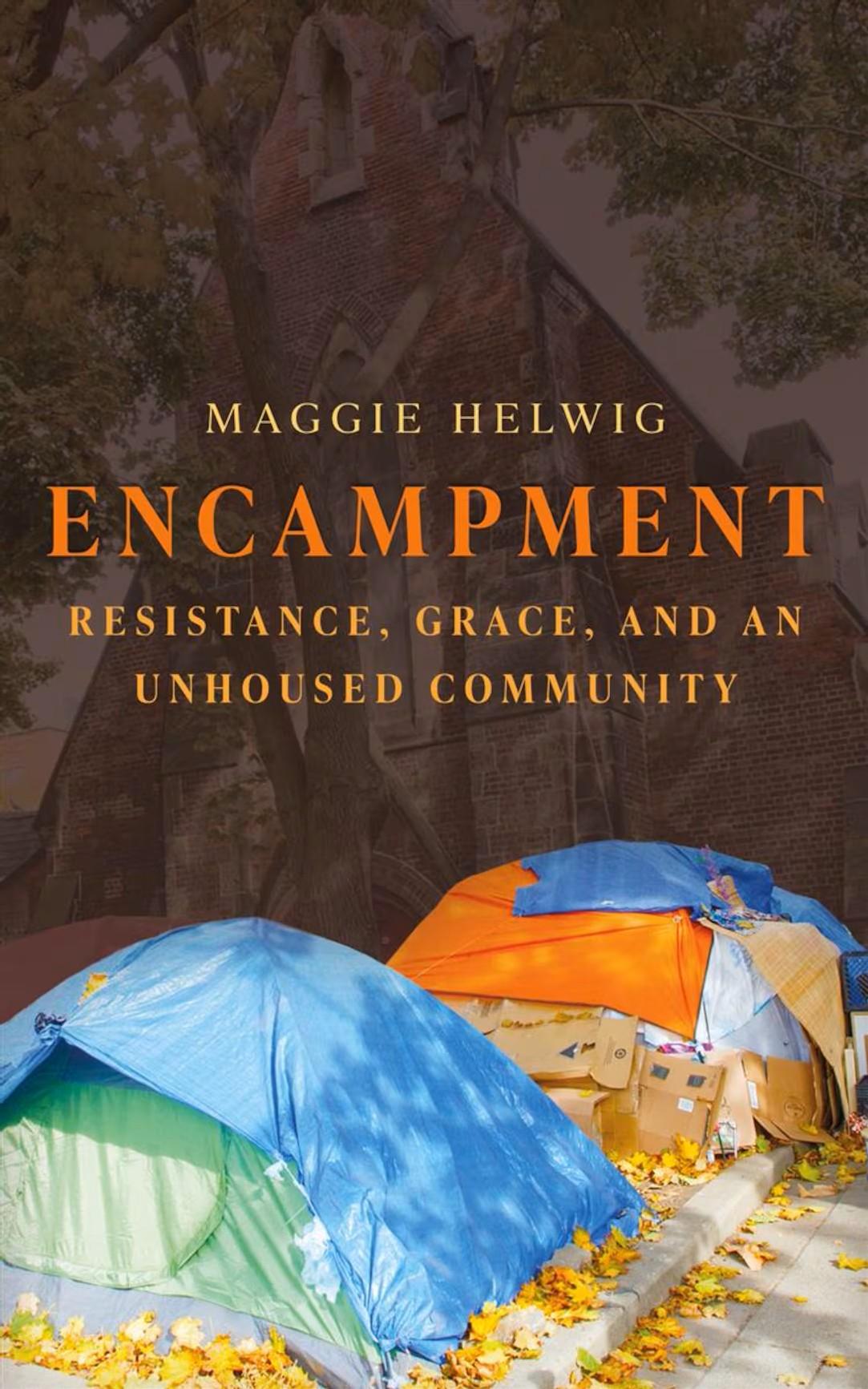
Encampment (2025), Maggie Helwig
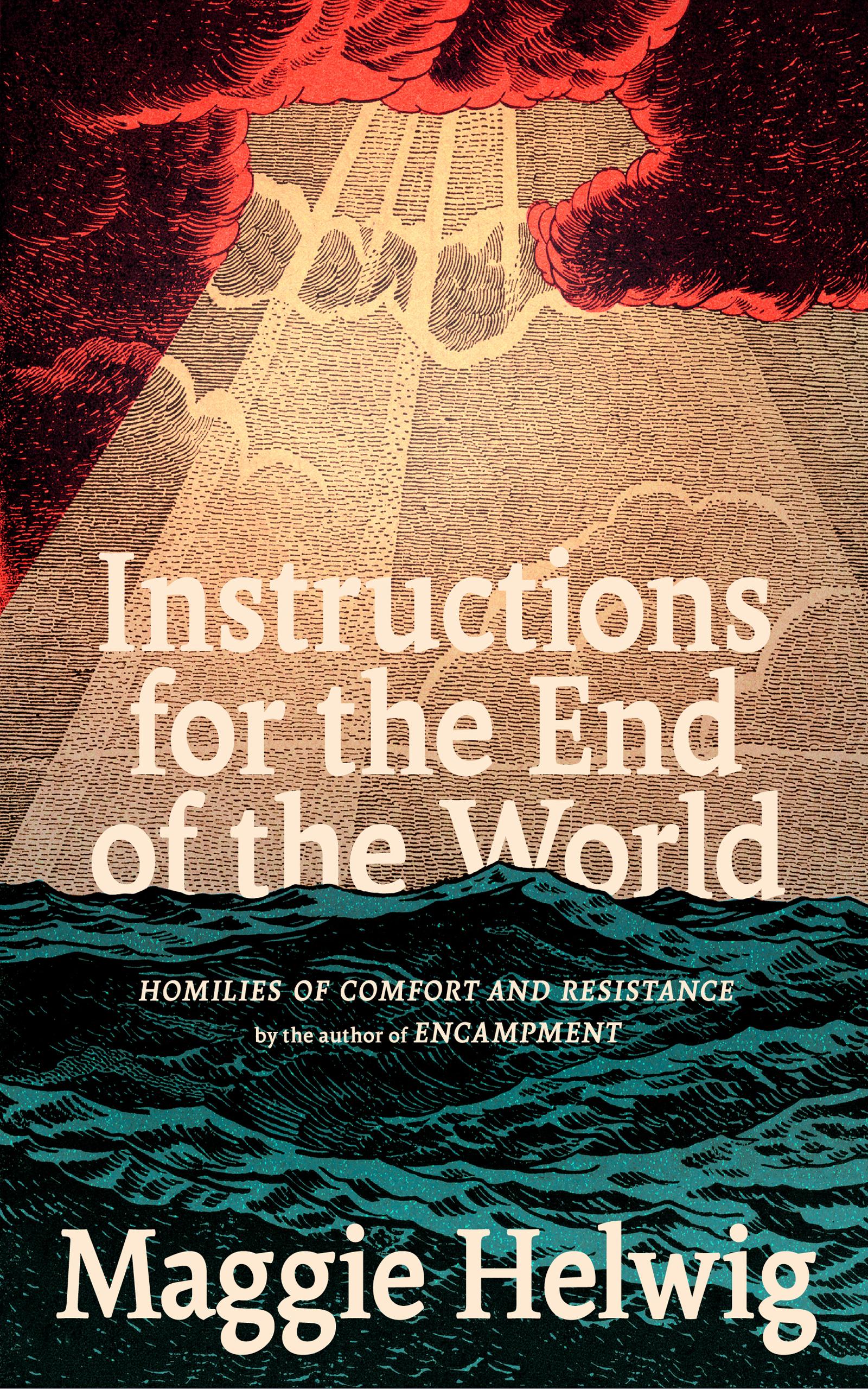
Instructions for the End of the World (2026) by Maggie Helwig
Girls Fall Down (2008), released 2026, Maggie Helwig
Which carries us back to poetry and negative capability. It also makes me think of the consistency with which you take us through the unknowableness of horror. The book is called Instructions for the End of the World. We’re encountering the genocide, plagues and sufferings of the Bible in our lives every week, and you’re naming that and bringing it into conversation with our current times. You’re articulating that which people find hard to articulate, and also that which cannot be articulated, which cannot be known. That can also be extremely comforting. The comfort of saying the unsayable, and also not saying what cannot be said, are both present.
Responsibility, that’s where I’m really more specifically talking to a church audience. When God brings the slaves out of Egypt, the idea is that God is making them into a specific people, a particular people, a people different from other people. What constitutes that difference is a really singular focus on the vulnerable and the outcast, and a focus on justice. That’s the theme that really echoes and echoes and echoes through scripture. You are chosen to be the people who need to live this out. It’s kind of strange the way Christianity became this giant, hegemonic, world-wide thing where everybody’s supposed to be a Christian, because it doesn’t really look like that’s what Jesus had in mind. His imagery for his community is really that of a small oppositional community existing within a larger community and shaping it by being in resistance. The salt and yeast imagery is all about being these little trace elements that transform things.
And if we’re going to call ourselves Christian, and if we’re going to come to church, and if we’re going to say that we believe in these things, that’s what we’re supposed to do. That’s who we’re supposed to be. I think the responsibility comes with a lot of good things, but it is a responsibility. And so that’s the part of it that is addressed specifically to my congregation, my audience.
Now there’s also a way in which we all have a responsibility, as human beings. If people outside of that want to take on that responsibility without taking on the identity of Christian, that’s wonderful.
You’re not going to stop them!
The point is doing the work.
On the topic of apocalypse, I really appreciate not only your close reading of scripture, but of the current times. And in the book you shepherd the reader through the pandemic, which is something else I think people find very hard to access or articulate. You write, at the beginning in March 2020, “It’s very, very strange to speak to you, we are in a strange moment”. And I’m sure you’d agree that we’re in another strange moment. We’re in another wilderness now. Is that just the condition we find ourselves in, much like the people in the Bible?
I mean, yes, and I think one of the reasons why the Bible is still important is that a lot of those texts - not all - a lot of those texts were written during really bad times. Or they were written to address or frame or understand bad times, sometimes bad times that happened in the past. Most of the Hebrew scriptures are circling around the experience of the Babylonian exile. Almost all of them were written after the Babylonian exile, but some of the prophetic writings are more directly in it. But the later texts are still trying to come to terms with that experience, which was cataclysmic. That huge experience shaped so much, even texts that didn’t seem to have a lot to do with it. That was a horrific experience. Jerusalem was devastated. Large numbers of people were taken away into exile. The people who were left in Jerusalem were mostly very poor people trying to survive in the wreckage. Everybody else was taken away.
And then the Gospels are all dealing with - as well as the extremely confusing experience of the crucifixion and resurrection of Jesus - they’re also dealing with the Roman destruction of Jerusalem. And the diaspora this time, which would never be undone, unlike the Babylonian exile, the diaspora that happened when the Romans destroyed Jerusalem would never end. And all of the Gospels are written shortly after that experience. And again the Jewish people and the early Christian community - to the extent that they were separate, because they weren't really separate - with that reality of exile that their whole world was taken away. That along with that it was a very poor subsistence society, and there was disease and economic instability, it was written for people who’d experienced a lot of upheaval and suffering and were continuing to, and I think that is what makes them potentially relevant texts now.
And we’re in such a moment of apocalyptic hand-wringing now. Has that always been true? I remember it all my life.
I think that this is a genuinely apocalyptic time. Hand-wringing about the apocalypse does seem to be a permanent human condition. But comparing the state of the world to when I was twenty, or when I was thirty, to the state of the world now, I would say we’re in an apocalyptic time.
I’m frequently looking for that perspective, because when we look at the length of history, which you beautifully conjure, it’s bewildering. There were so many disasters in Biblical times that relate to the present.
Where there is some hope, is that something always survived. Will we this time? The scale of disaster is terrible.
These are lessons that we also hear from Indigenous thinkers, who have survived the apocalypse of colonization.
Annalee Newitz has a book called Scatter, Adapt and Remember. It’s about all the major cataclysms that have happened on Earth. Most of them are prehuman actually! Talking about how in all of them some kind of life survived. She says those are the three strategies life forms use to survive: scatter, adapt, and remember. And you can see that, too, in the response to the Babylonian exile - that is what people did. So maybe those are the strategies we need to work on.
And also, love. Love, of course, appears in almost every homily. God’s unconditional love, and you contend that God loves Satan, God loves Donald Trump.
Gregory of Nyssa says that God loves Satan, and many theologians disagree, but I agree with Gregory about everything. It requires an extraordinarily long view to say that somehow, on some kind of horizon that we can’t even comprehend, some horizon that’s outside of time as we can even think of it, even the fundamental principle of evil is going to be brought into love.
That certainly doesn’t mean we’re going to see it happen. This is something that’s happening on some sort of incredible conceptual scale. To try to believe that, to try to believe that could be possible, and to try to live as if that could be possible… it doesn’t mean being nice everybody!
Appreciate that.
That’s where that kind of thinking can get problematic. I remember once somebody brought a friend to church, and his friend was a very excitable person. At one point she thought she saw Doug Ford driving by, and she said “Doug Ford is driving by, I’m going to go chase him down and talk to him!” She just ran out of the church! She never found him. I’m not sure what she would have said if she had found him.
It makes me think, we know such great activism comes out of the church. Is that because of this horizon of love, do you think?
I think that, and it gives you a structure which can support you when you’re not doing well. The movement has historically really sucked at supporting people when they’re not doing well. And the church can support people when they can’t be active. When people are ill, when people are depressed. The movement might have been good at that for a little while, [but] it drops away. The whole point of a faith community is you don’t have to do anything. The community has to do things. But individuals within the community - if they just need to be carried, they just need to be carried. That’s why people can be activists for the long haul when they come out of a faith background; they have support that says, if you have times in your life when you can’t do this, we will carry you.