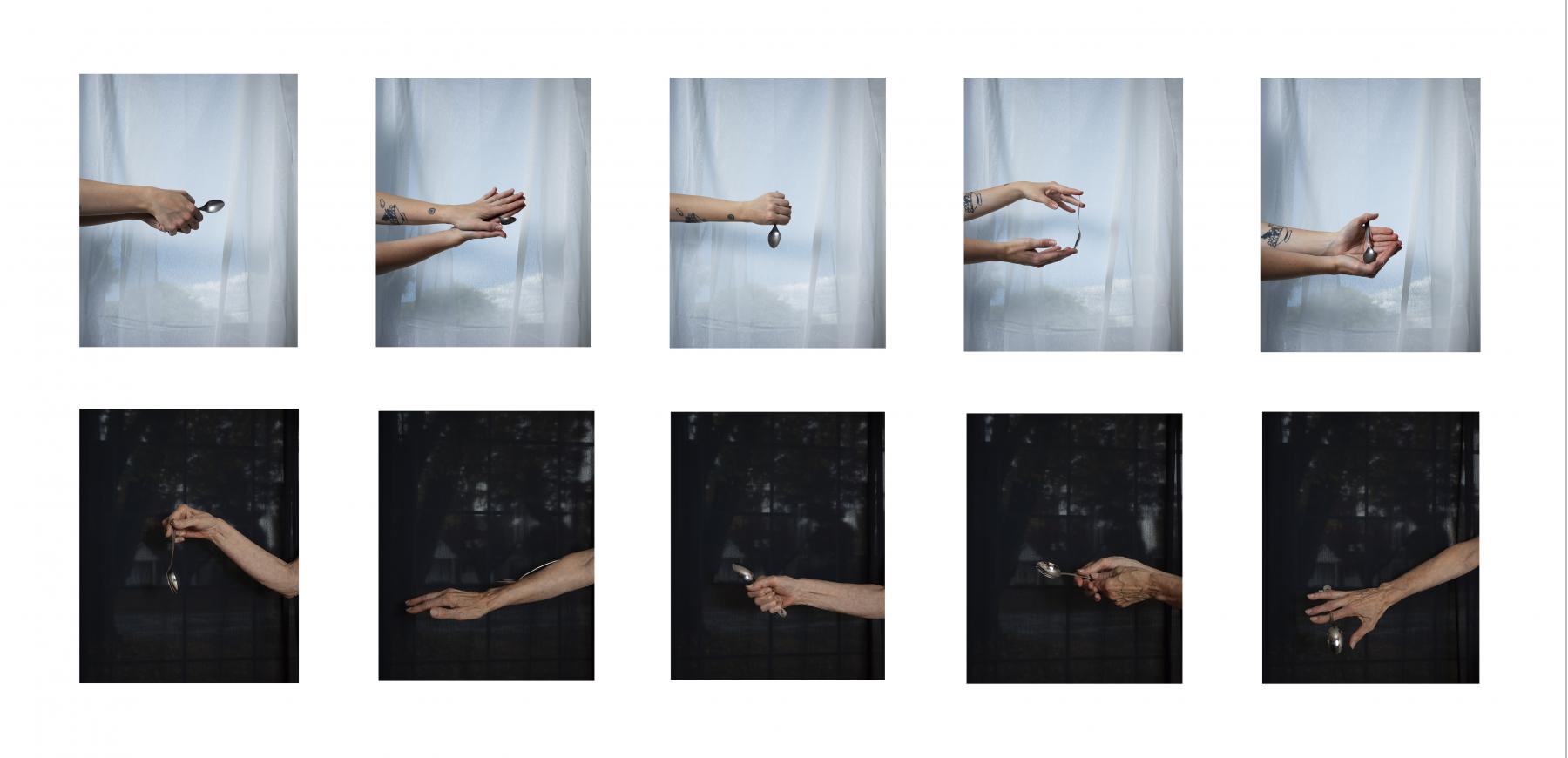
Top row to bottom row: Enlacer, soutenir, porter, offrir | Grasp, Hold, Carry, Offer (Daughter), series of 5, 2026 ; Enlacer, soutenir, porter, offrir | Grasp, Hold, Carry, Offer (Mother), series of 5, (2026)
Quebec-born artist Claudia Goulet-Blais’ photography practice is largely autobiographical, using photography to reflect on familial relationships and personal experience. Her installations centre image-making, but involve sculpture and found photographs, allowing her to consider the materiality and objecthood of the photo itself. Compellingly, Goulet-Blais’ primary subject is her mother, and her practice since 2019 has documented not only her mother over time, but their process of collaboration, and their relationship. Their ever-changing roles as mother and daughter evoke that familiar yet elusive parent-child connection, inviting viewers to engage through their own experiences.
I met the artist—who works between Montreal and Vancouver—at her show with Michelle Caron-Pawlowski, Pull Them in Close, at the Alliance Française Vancouver as part of the Capture Photography Festival earlier this year. Sometimes art presents itself in the right moments, and Claudia’s work landed in front of me on a day I happened to be ruminating on my own identity as a mother and the related anxieties of parenting—an angst that’s whispered about loudly but is often muted from the chat. Her art offers modest meditations on care, highlighting the point of view of the child and their role in caregiving for the parent, seeming to acknowledge that as much as the child is forever marked by their parent, the parent is reciprocally transformed by the child.
What is striking is the degree to which Goulet-Blais leaves her work open to the viewer. While she begins with autobiography, the process allows larger ideas of family to be worked out in the viewing. She actively cedes control of meaning as she releases her work. This is just one of the places where our interests dovetail. In our conversation we contemplate how photography has provided Goulet-Blais an ideal medium to document process through gesture and performance, and we consider intersections of identity and memory throughout her work and in our individual practices.
I'm trying to portray care, not only from that obvious place of love for a person but also acknowledging that caring for someone inherently comes with anxieties, responsibilities, and even a sense of guilt sometimes
In your body of work, you are looking mostly at your relations. While you have some projects that center your relationship with your father, or the relationship between yourself, your mother, your father—the family unit—it seems like your relationship with your mom is the central preoccupation of the work you make. I'm curious in what ways photography becomes an ideal medium to document your relationship with your mother over time?
Photography is not necessarily a way to document or represent my relationships. The main reason I’m using photography is to capture our collaboration or shared experience while it’s happening. In a way, the project is a record of our process, and it gives me something that I can look back to, at these moments that were created. I'm interested in how meaning in relationships changes over time.
For example, I collaborated with my father previously, and now my father is not around anymore, so when I look back at our projects, there's a new layer of meaning to what we made. That's the primary reason why I use photography.
Your answer makes me think about questions of time, because, of course, photography is a time-based practice and, in your work, the time of photography intersects with the time of family relationships. Family offers really interesting forms of relationship, never static, always changing. Sometimes relations are really good and really strong. Other times they're weaker. On the other hand, as you document yourself and your mother, the photographs are lodged in a linear autobiographical time: over time they point to how bodies change, how people age, how beauty doesn't stay still. I wonder if you can talk about the experience of following subjects like your mother and your father over long periods, and how time is significant in your work?
I think that I'd start with how all the ideas for these projects with my family began mostly with the idea of bridging a distance—whether that be physical or emotional or both. For my current project with my mother, it started when I moved from Quebec to BC, and it was to create a tangible way of staying connected. And with my father, it was during the pandemic, when he was ill and when social distancing was a huge factor. In both cases, photography is there to foster the relationship and to bridge that distance.
A big part of these projects is about learning about my parents, not just as parent figures but also about their lives, so there's a lot of conversation and dialogue that the photographs unfold. The projects are about looking back at time, and I think that examination is how I’m able to build the individuality of my subject. This is what’s important for me in collaborating with someone. While the photographer is obviously sharing their own perspective on their subjects, for me, it’s about acknowledging that this person is more complex than what you're presenting to your viewers in the image.
How do you show that complexity in your photography?
It's difficult to describe visually. I think it happens in the way that I approach a project. I try to center conversation and dialogue and process and hold these as equally important, if not more important, than the images that are created. For me, it's not just a photo project. It's really a performance, because in the images we're performing, we're constructing these images, we're performing these gestures, these interactions. We're showing how we're figuring out our relationship through that performance.
It's interesting that you talk about performance, because I think that when so many of us get our photographs taken, we don't want to be seen the way we see ourselves, so we perform to show a “very nice version” of ourselves. I always think of that line in Barthes’ Camera Lucida, “I pose, I know I'm posing, I want you to know that I'm posing.”
Yeah. It’s so difficult to detach these ideas from the medium of photography. I have been working on this current project with my mom for three years, and the first images we took were a lot more composed, we were thinking of appearance more. But the beauty of the image—I still think there is beauty in the images—is that we’re trying to be more playful with it and let go of the idea of representation. One way that helps is to frame the project as not a representation of my mother or of our relationship. It's like we're stand-ins for larger ideas of motherhood and daughterhood and we're playing with our roles in this dynamic and exploring these ideas by performing for the camera. Otherwise, I do think there's that pressure of how we're appearing and what we're revealing to our viewers, and it can get quite personal. I think for us it's important to allow ourselves that distance.
Right, it must be an interesting balance to be so vulnerable, but to also try to maintain your own safety and boundaries.
Yes, absolutely. And that goes for the images, but also in learning about how I want to talk about the project, how I want to present it to viewers.
When we were corresponding about our interview, you asked me what role I believe photography plays in memory. You had written, “do they preserve our memories of people, or do they reshape the way we remember them?” I see some of your works as prime examples for this discussion. I'm curious to ask you how you see your practice amidst this field of ideas around photography and memory.
I was asking you this in relation to photography as a document, and I think what I find interesting with photography is not so much how it acts as a document or a record, but more the emotional resonance that a photograph can spark. You had a really interesting reflection that you shared about Roland Barthes and the famous photograph he discusses of his mother, Winter Garden. This idea of memory seems to relate.
I had my students read the entirety of Camera Lucida for their History and Theory of Photography class. And in this book—which he's writing just after his mother has died—he describes this photograph of his mother, which has become iconic as a picture that no one has ever seen, one that he only describes. I'll quote him: “There I was, alone in the apartment where she had died, looking at these pictures of my mother, one by one under the lamp, gradually moving back in time with her, looking for the truth of the face I had loved, and I found it.” In the book, he is seeking out a photograph where he can exclaim in recognition, “there she is!” When he finds what he’s looking for, it's not a picture of her as she was, perhaps in her prime; instead, he finds her in a photograph from when she was five, standing next to her seven-year-old brother. Somehow in the image of the child, he sees his mother’s “unique being.” He writes, “I studied the little girl and at last rediscovered my mother.”
My students were really resistant to Barthes attachment to this particular photograph, and also his insistence that the only authentic image of his mom was an image of her as a child. They said he was holding her in time and doing so in a way that is limiting to who his mother may have actually been or how she may have seen herself. They were suggesting that it's Barthes’ refusal to allow his mom any kind of dimensional life outside of his own idea of her. And in doing so, he canonizes her innocence and kind of valorizes her as childlike and perfect.
I'm curious what you think about that, because in this case Winter Garden is not a document. It's not an image of his mother necessarily as she was, as she had lived her life, because at five, she had barely time to live. It's also not a memory because he hasn’t remembered it…he wasn’t alive when she was five years old. So how is it that Winter Garden is the only real photograph of his mother?
The last point you made about memory is interesting for me. Barthes doesn't have a memory of that image, but I think his memories do inform how he reads it anyway. I sometimes work with found photographs of strangers, and I see this when people are experiencing the work—they make connections to it just because of their own histories and memories. I found this also to be the case when people read the images that I take with my mom. Some see it more from the lens of care and softness and intimacy, and some feel the anxiety and the stress that are also linked to these ideas of family. So I do think that people bring in their own memories to their interpretations.
It is true that in his description of his mother, without seeing the image, we're missing a whole aspect of this person's identity. Whatever we can know about her is shaped by his description, and his feelings, and his emotional response to that image. But I do think that photography never really represents reality. Like I said, we're always kind of bringing in our own memories and histories into our reading of it. I don't think there is a true representation of reality.
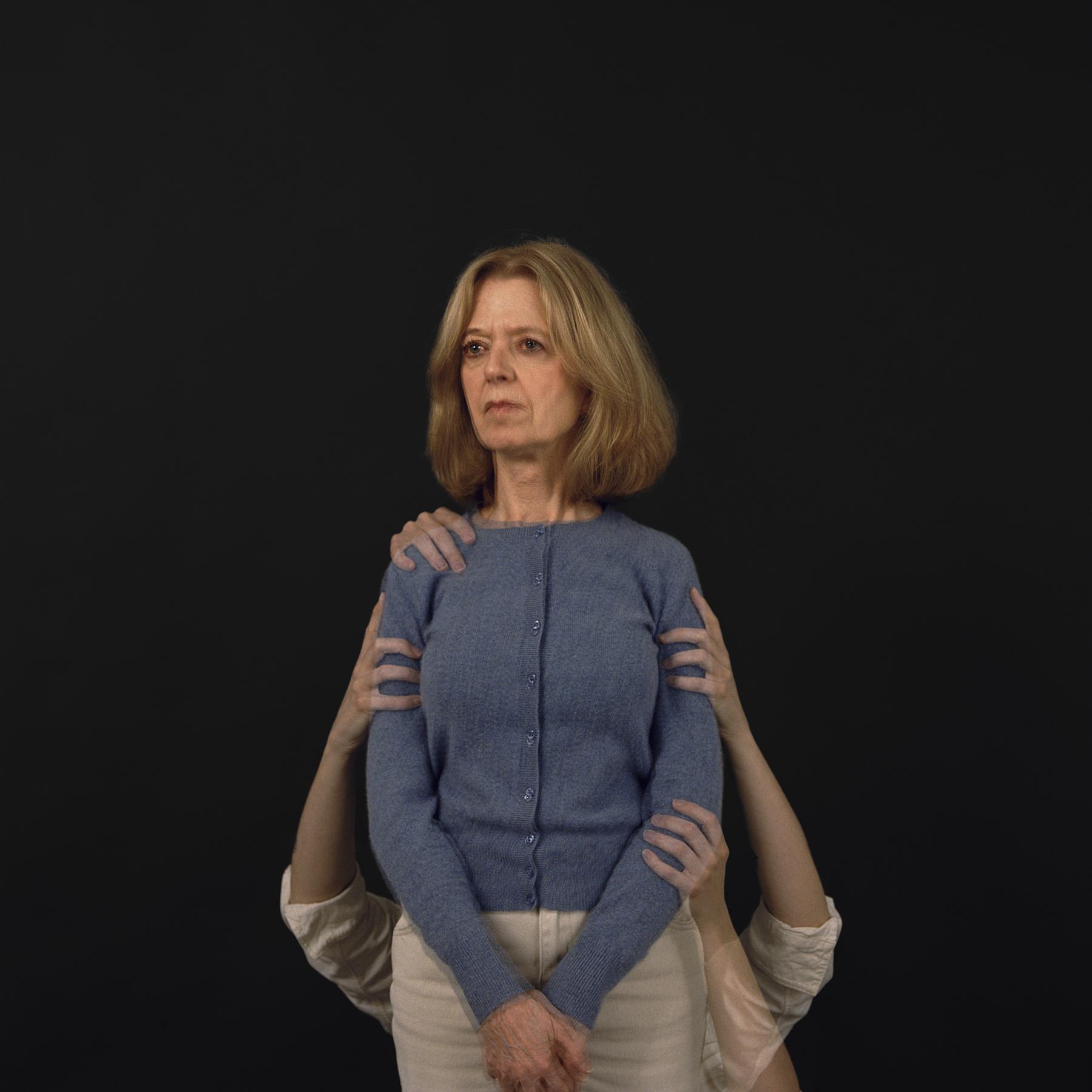
In Action, (2024)
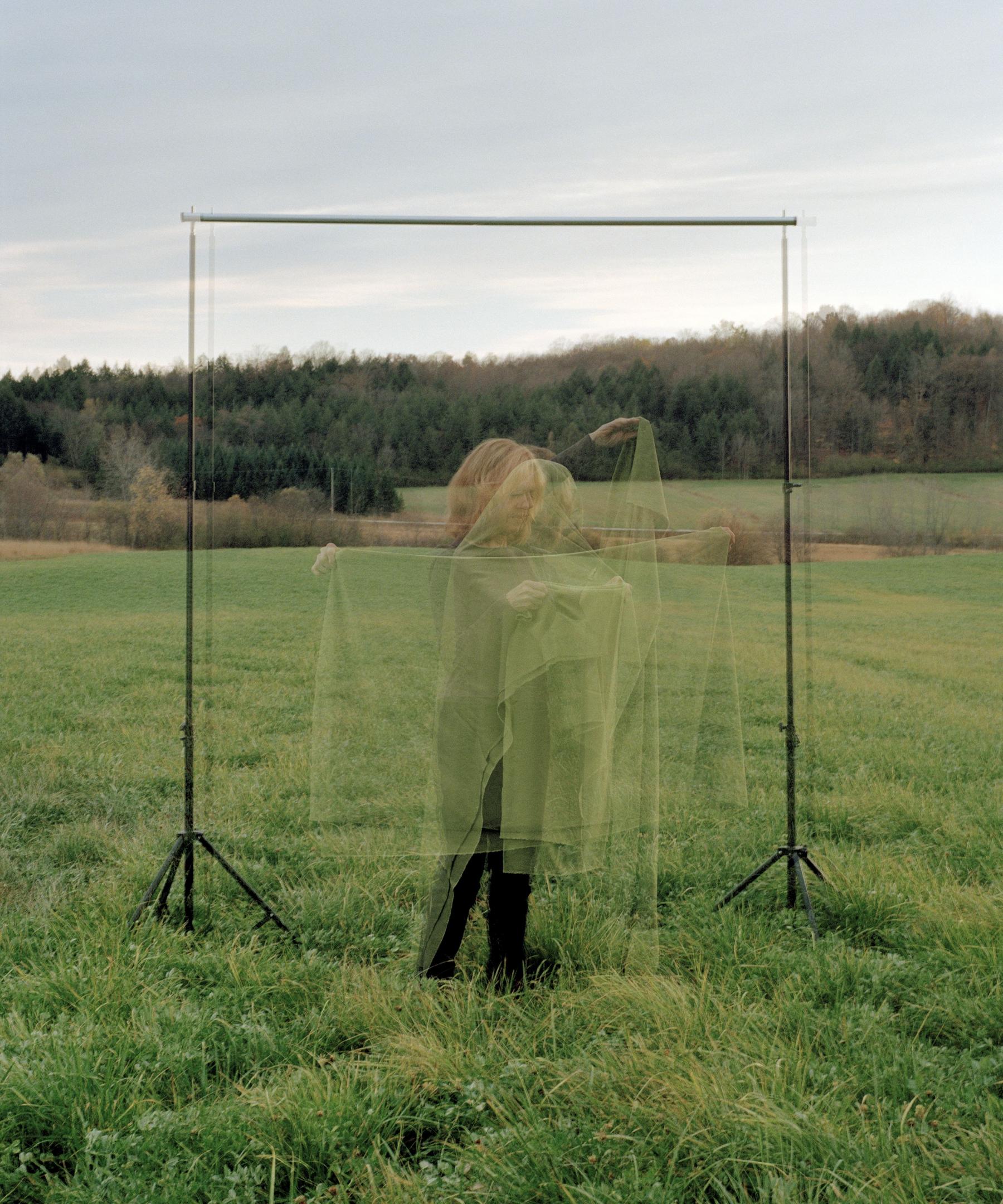
Untitled I–VIII, from Entre tes mains | In Your Hands, series of 8, (2026)
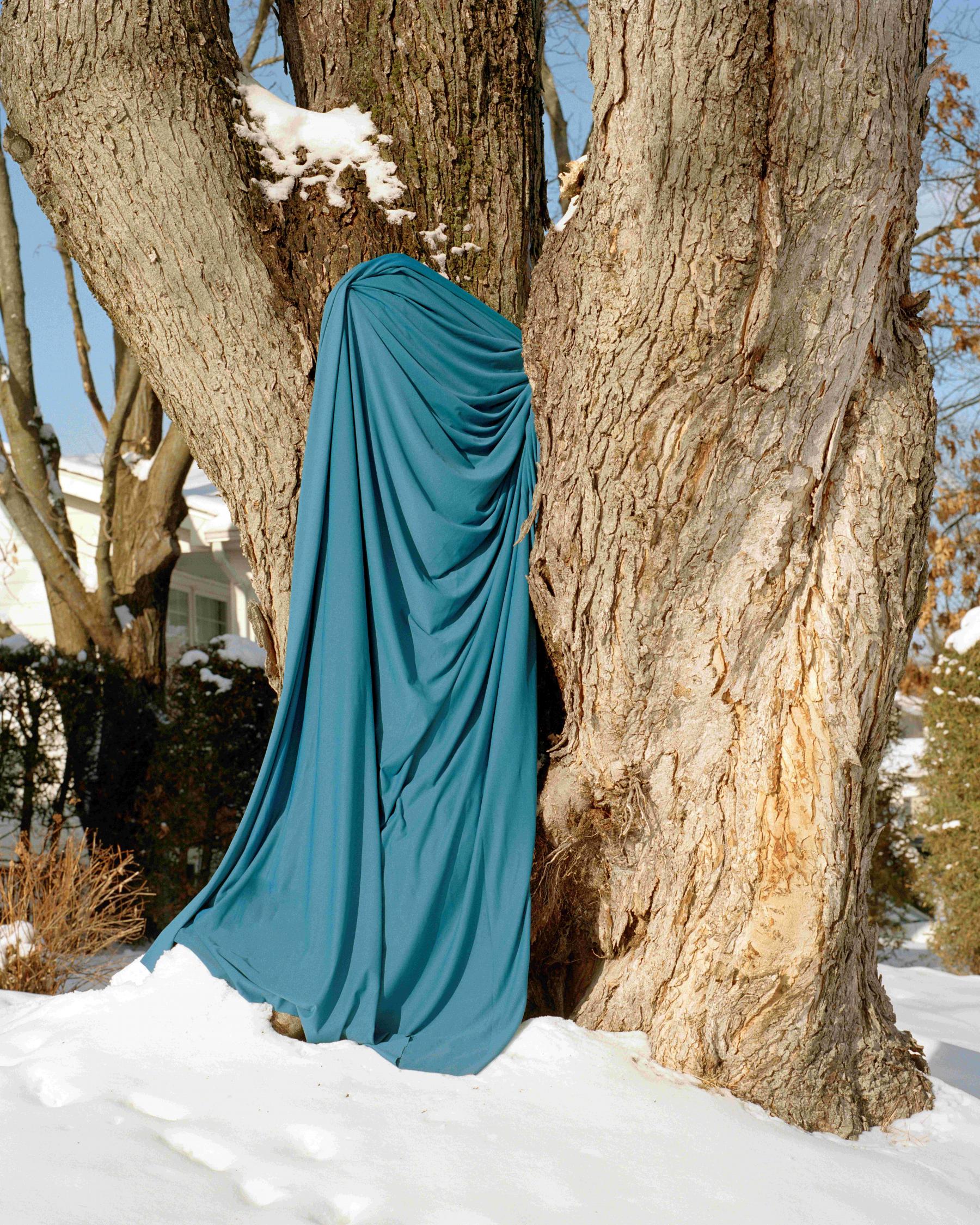
Untitled I–VIII, from Entre tes mains | In Your Hands, series of 8, (2026)
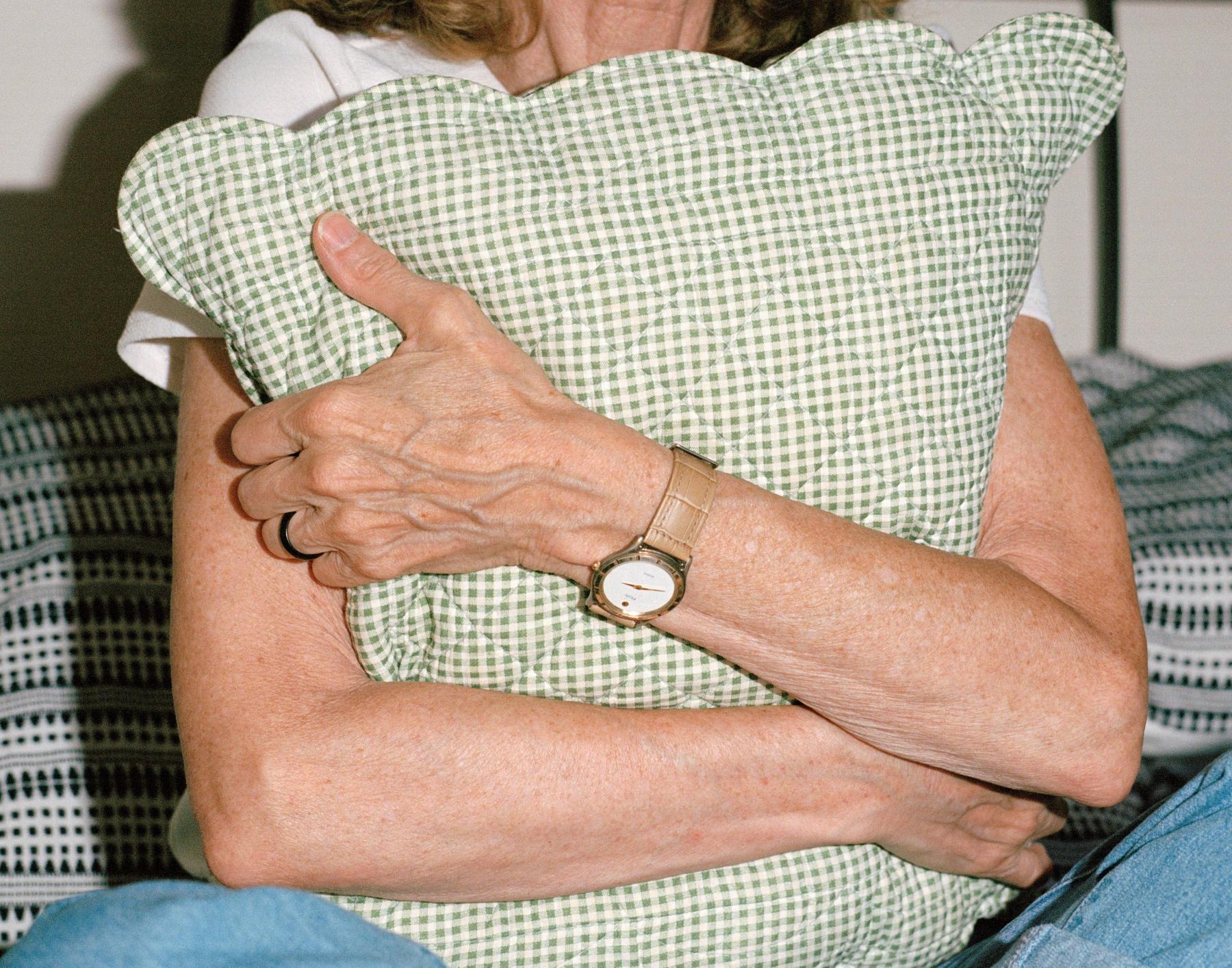
Untitled I–VIII, from Entre tes mains | In Your Hands, series of 8, (2026)
Photography borrows fragments from reality and then reforms them for us in new ways.
That's what interests me about photography: the different perspectives that people can have and bring into the image, informed by their personal experiences.
There’s a work I made called In Action (2024) that resonates with this. This image comes just before my Hidden Daughter series. It's a double exposure, so my “ghostly” hands in the images are soft and holding down or supporting my mother. Some people who saw it were very uncomfortable and would walk away from the image. Some thought it was quite scary, some thought it was someone holding on in a more loving way.
My own relationship with my mother is sort of fraught in a way that I could see how this would feel fraught for others, because as children, we are not only the recipients of care. Very often you have to do so much caretaking as a child, and especially as that relationship ages and the parent grows older, you find yourself increasingly in the caretaker role.
I think an image such as this one can emphasize the uneasy relationship around caretaking that being someone's child naturally holds—that the idea of being somebody's child, even though we are all “somebody’s child,” is not a value-free thing. We hear a lot in parenting about how you cannot “parentify” your child. You also probably shouldn't be your child's friend. To be someone’s parent presents a really unsteady tension between being the place of softness and the authority figure. And, in an ideal world, you don't have needs and don’t have to ask your kid for anything. But it's different when it's an only child and parent relationship. At least I feel this in my own relationship with my daughter.
I think there's a certain closeness that's developed through being an only child. I was raised just by my mother. My father was present, but I grew up living with my mother, so I think that our closeness is particular to that singular relationship. The rules for engagement may start to intersect before you even take on a traditional caregiver role for your parent. For example, when my mother was taking care of my grandmother, she also had a full-time job and was taking care of me. I could see that it created this beautiful connection with my grandmother that my mother can really hold on to, one that is really unique to that situation, but also it took a huge emotional and physical toll on my mom. She spent decades just taking care of people. The labour of care presents tensions that I want to explore with the work. I'm trying to portray care, not only from that obvious place of love for a person but also acknowledging that caring for someone inherently comes with anxieties, responsibilities, and even a sense of guilt sometimes.
We like to think that care is, by and large, “a good thing,” but care in itself does not always feel good. There are examples across art and philosophy and some strains of literature that explore the invisible labors of motherhood, but rarely do we see an overt exploration of the identity of being “somebody’s child.” We don't necessarily see the same emphasis placed on the labors of the child, even though our relationships with our parents are probably feeding into just about everything we do and make in the world.
I think that the role of the child is something I began to recognize during the process of the project. It started with the desire to foster our relationship at a distance, but I slowly realized that we were both finding our individuality through the project. And I guess you don't realize how much your mother can inform your identity, or how much you inform your mother's identity. I think, for a mother, I don't want to speak for her, but the word mother is characterized by the act of taking care of someone. It's always in relation to being someone's mother but that person is so much more, right? It's a lot more complex. That person has their own ambitions and experiences that we disregard with that word, mother, in itself.
I think that when the child is older, though the parent is still needed in many ways, there's the need to find your identity again, or to characterize your identity differently. And for a child, you're becoming progressively more independent and who you are is constantly being reframed.
I'm curious how this question would take shape in relation to that very early work you made, The Family Project, where you have your parents pose as though they had never broken up. I’m curious to think through this act of speculation. You pose the question “what if?” What do you think the work raised or resolved for you, if anything? Or maybe what kinds of questions were left unanswered? How does that project sit with you now, after all of this time?
It was a really significant project. It was the first collaboration I did with my parents. I was just starting to make my first artworks, and my parents weren’t used to it. They weren't really connected to the art world, so for them to have that willingness to participate, and be vulnerable with me and the camera was really important now that I look back at it. I think their generosity has become a significant part of the meaning of the project.
That project was the first time that my mother actually went inside my father's house, so it was quite a significant moment. At first, my idea was just to recreate family photos that hadn't existed and kind of represent my idealized version of unity, of family, of what I thought I was missing out on. We had two sessions and in the first session, I found it really hard to create a connection between the three of us. It was awkward. It was kind of frustrating. I questioned why I was doing it. The second time we met, it was almost a month later, and everyone had very different intentions than the first time. They were more comfortable, and I found that really beautiful conversations happened. I swear for a moment we forgot that we were even doing it for a project. It was a beautiful moment. It’s kind of when I realized the importance of this project and where I wanted my practice to go.
There's a beautiful bittersweetness when you film your parents dancing, and it's almost like in the reality of them dancing, you realize that it's an act: that what we can see as spectators is not something that exists between them in reality, and it's sad in a way.
I started being interested in body language and gestures, because in that video, there's no sound, so you're really focusing on their interaction. Same thing for the photos, you can tell there's something off about these family photos, that makes them not traditional family photos.
That awkwardness is like a haunting of what didn't happen. Not what could be, but what won't ever be. Maybe this is a good place to think about the question of speculation. I showed you the photography of Daesung Lee and the series of photographic works he made with his mother, Nirvana. The images he makes are often speculative, the photograph becomes a place for play and imagination and speculative realism that lets his mother do things that she wasn't otherwise able to do in her life. Sometimes it's kind of fantastical and gives evidence of a sort of freedom that she didn't otherwise get to have in her day-to-day life. I’m curious, if we can relate your work with his, if speculation plays a role in your practice—I think it does in Family Project for sure. In what ways are you considering documentation of the real versus documentation of something imaginative in the work you’re making?
I think there's more of a direct link with speculation in The Family Project, but looking at Lee's work, what stood out to me was the playfulness, the imaginative, collaborative aspect of it. Instead of the word speculation, I think in my work, I would substitute it with “performance.” A tangible example in in my new series called, Enlacer, Soutenir, Porter, Offrir |Grasp, Hold, Carry, Offer, where in one sequence my mother is holding a spoon, and in the other sequence my hand is holding a spoon. I gave her the task of holding the spoon in different ways, but not in its intended use. She's exploring and figuring out the gesture as I take the images and then I did it in my turn. I think it represents that we're figuring out how our roles are evolving in this relationship. There is an imaginative kind of performance happening in the construction of the photograph. I don't know if I would use the word speculation for it, but something more like creativity.
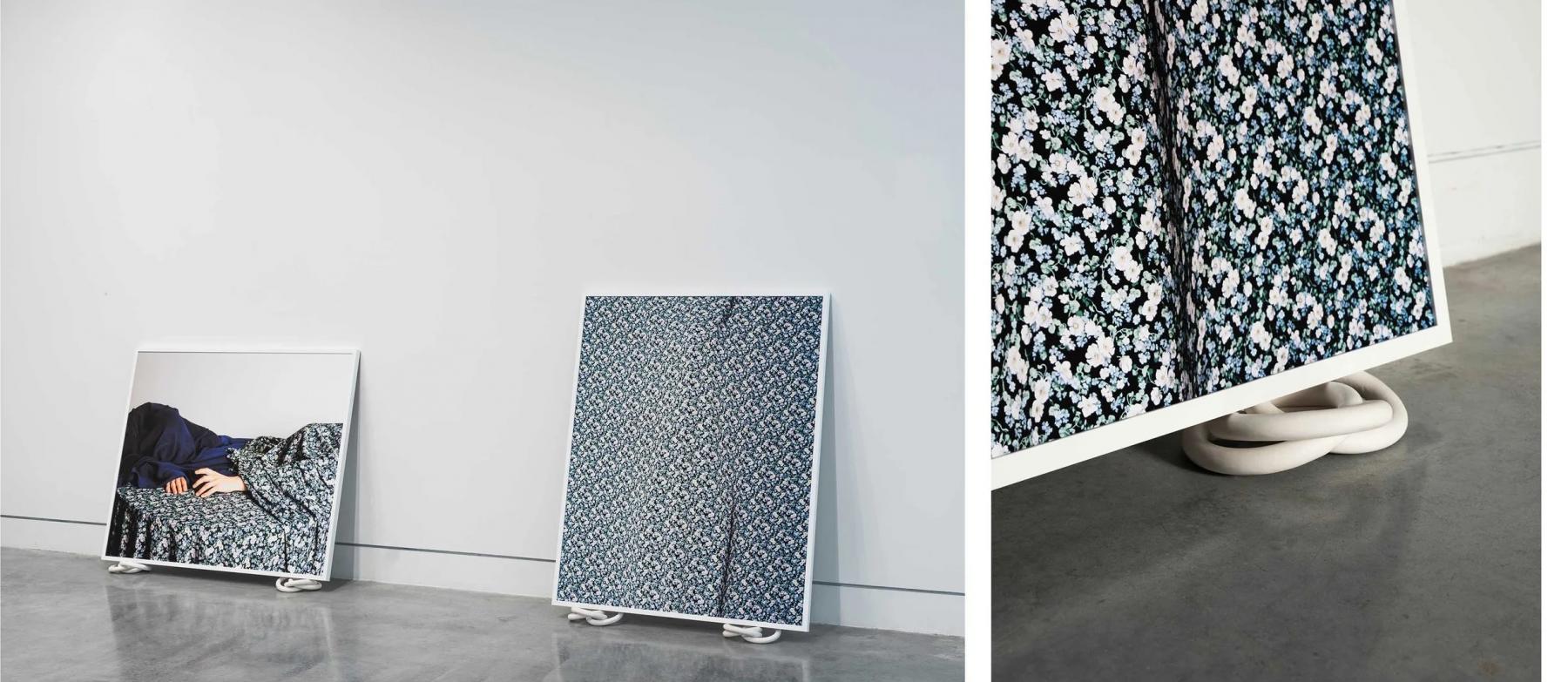
Hidden Daughter, (2025), inkjet prints, porcelain, Presented at Michael O’Brian Exhibition Commons at Emily Carr University of Art + Design
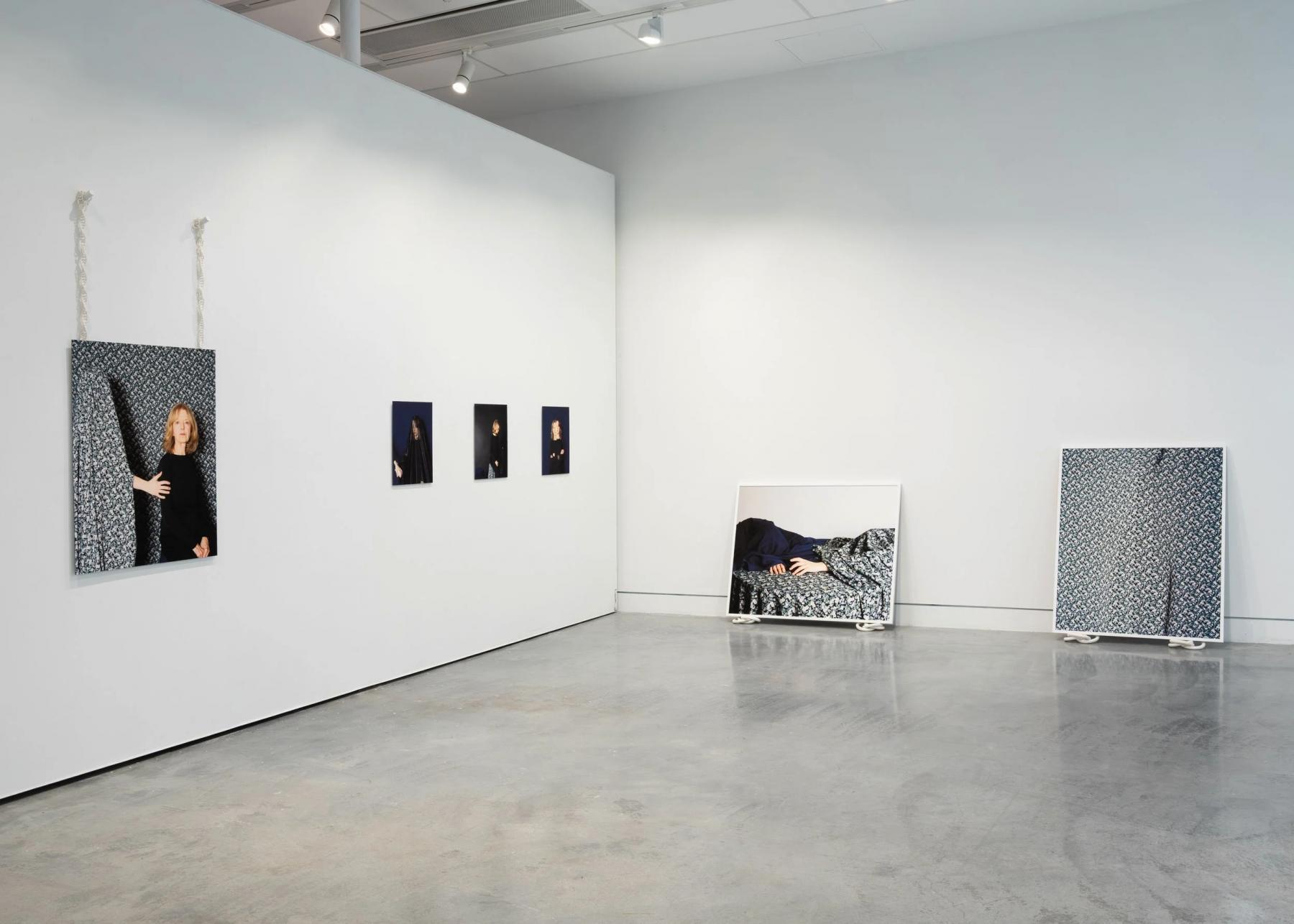
Hidden Daughter, (2025), inkjet prints, porcelain, Presented at Michael O’Brian Exhibition Commons at Emily Carr University of Art + Design
Would improvisation be a good word?
That is definitely something that I'm trying to play around with more in my photographs. In my Hidden Daughter series, the images are a lot more constructed, and still in the new images, there's more movement and playfulness. Even in the way I'm taking the images, there's more room for exploration and seeing where the experience takes the photos.
Do you think that your mom is having realizations of her role in your relationship while she's experimenting? Do you think that she's stepping more and more into her role as mother, or do you think your photographs are about honoring her individuality?
For me, it's more about our individualities, and separating us throughout the process.
With her, I think there's been an evolution of how we speak about our relationship and our roles, and we have more conversations because of the project. But I'd be curious to see if the outcome for her is as tangible. I wonder what the project is doing for her. I think that she really holds onto how the project keeps us connected and in conversation. It allows us to keep learning about each other, which I think is not something that's always present for me in our day-to-day relationship with each other. I'm not always so willing, and maybe she isn't so willing either, to “always be learning” about each other. Sometimes it feels safest and best if we can let things stay the same.
I'm learning more about her life before she had me—and it was the same way when I worked with my father. And it was an important way to share my life as an artist with them, help them to understand what it is that I do and how I think through art.
I would say that's a critical thing that most parents don't really understand—what their adult children do in life. For me, I don't know that I'm necessarily the one who's volunteering a lot of information either, and sometimes it feels best in that relationship when I can let myself still be someone's child.
I think that's where my anxiety comes from: realizing that my mother's not just there to just take care of me. That as you grow older, you have responsibility and you're thinking about the future. You owe yourself so much and it doesn't always go as you imagine it will.
The work of being alive is all that improvisational labor, and maybe if you are somebody's parent, that improvisational labor just happens because not only do you have to take care of yourself, but also you have to care for someone else and ensure their future and their safety and their happiness.
Yeah. I remember as a teenager, this specific moment when I realized that my mother doesn't have the answers to everything, and she's not invincible…realizing our parents are figuring things out as they go.
Maybe this is a good place to describe the work you made with your dad.
There are two projects I made with him. One was a collaborative project called L’être humain est fait pour s’adapter, that I made during the pandemic when my father was ill, and I gave him a camera—just a point-and-shoot analog camera. Again, it was a way to help him understand what I do as an artist and to keep our conversations going, because it was hard to do at that time of pandemic, and in times of illness as well.
I wanted to create an outlet for him so that he could focus on something else in a moment of isolation. I think it was successful, and I was able to learn more about him. It allowed me to ask my father more questions, learn about his life, and maybe to understand certain decisions that he's made in his life.
That materialized as a book that had images of his archive. He was going through his childhood photos and telling me stories. Some of those images appear in the book, as well as images he took with the camera that I gave him, just documenting his every day. He found that part quite challenging because he felt he was not doing anything interesting and I wanted to see what he ate for breakfast, his daily walks outside in the countryside. And then there were images that I took of him when I was able to be there in person.
I think that in doing the project, I realized that not all my questions would be answered. I wouldn't get all the responses that I wanted from it and that had to be okay.
Did you have a desired outcome, or were you thinking about it more like a researcher? Like, you were introducing a set of contexts or parameters and seeing what you could learn.
I think I make better work when I don't think of the outcome right away, and I'm doing it for the personal experience. With my dad—he was ill for the year that we made the project, and I ended up losing him after. As we were working on this, we knew that he was probably going to pass away, so it was a weird way of going through grief while the person was still around. It was very particular and special, and the fact that we had undertaken this whole project made my grief very different afterwards.
It's like you opened the wound early, but then you also arrived at the resolve earlier too.
There's a sense of wanting resolution and closure, and there’s limitations there as well.
I think because we've lost quite a few people in my family, I'm hyper-aware of loss and future loss and the anxieties revolving around that.
There's that need—I use the word “document” lightly—to create these moments and document them. It's just recently that I thought about The Family Project again and realized how closely related it is to what I'm doing now.
What's it like to collaborate with your mom?
I really enjoy it. It took us a lot of time to find the ways that it works for us, and what we found was that when the photo session is fun and playful and we're having a nice moment of connection, the images tend to turn out. And when we try to create an image and—you know, it's technology—sometimes things go wrong or it's not a sunny day as we expected, when we're just trying and we're not having any fun making the images, they never turn out. It kind of goes to show how the process is the important part of the project, and it actually does influence the final outcome.
At first, I wanted to see my mother as co-artist but with time it didn't seem fair to name it that way. I wanted to create an equal kind of power dynamic within the project but that's unfair because I'm still the artist, and I'm making the creative directions and basically deciding the final outcome. So, I think I see my mother now more as a collaborator, and I really value her agency. It’s why I try to emphasize the conversation and dialogue that's part of the process, but still name those roles. And I actually find it quite interesting that as we negotiate our roles within the project, it seems to parallel what we're trying to do within our relationship as mother and daughter.