
Photo by Adam Peter Johnson. © Flammarion
The French writer Constance Debré has been known to readers for her crisp, devastating accounts of sexual awakening in Playboy (2018), family dissolution in Love Me Tender (2020) and social critique in Name (2022). The narrator of that trilogy of novels shares autobiographical facts with Debré: a former criminal lawyer who has moved away from her profession, from heterosexual, bourgeois family life, and a prominent aristocratic lineage for a life of writing (and swimming). Autofiction always prompts intrigue, particularly as it probes what is usually kept quiet.
However, as Debré asserts in our conversation below, the character was not an examination of self or circumstances but a “dirty tool” to investigate what is, for her, more significant than self: the violence underlying social trappings, and whether it’s possible to escape them altogether. Surprise—it isn’t.
In her more recent work, Offenses, first published in French in 2023 and published in English this spring by Semiotext(e), Debré parts from her dirty tool to let violence speak for itself. Offenses uses multiple perspectives to briefly, brutally examine the circumstances around a young man in the Paris suburbs who murders an old woman to rob her of €450. Lean and savage, the book condemns the courts, the social order, human frailty, the murderer, and ultimately the reader for the crime. Protocoles, currently in translation, uses as its material the protocols of execution and the death penalty.
In a 2023 conversation with the autofictionalist Chris Kraus, Debré said she “wanted to hustle French literature” in its circumspection and psychological preoccupation. Still, her lack of faith and intensity of vision move in a tradition that includes Virginie Despentes, Jean Genet (whom the English translator of Offenses, Jeffrey Zuckerman, has translated) and Albert Camus. Like those writers, Debré disavows artifice by describing human cruelty, in the crude forms of violence and heartbreak, and the more sophisticated forms of exclusion, oppression and as we discuss below, turning a blind eye.
I spoke with the sharp and charming Debré by video call in Los Angeles, where she visits frequently to see friends and attend to her American publisher. We discussed the void, the continuity between her first trilogy and her more recent work, and how law and literature are the same.
What I’m trying to do in my life, with my work, is be consistent and say that something black is black. That’s all because I don’t have problems with the truth. I’m not shocked by anything, and just want to put the right words on it.
I look forward to the English translation of Protocoles. I’m wondering if you can describe the book for your readers in English in your own language?
No. No, but I will. I can say, for instance, that Protocoles is not a story. There are no characters. And—I think this is true of all literature—the material I’m using is not the subject of the book. The subject is not exactly what’s written, or its different layers of what is represented. And one thing that’s represented in that book are the many protocols of execution and the death penalty. With no explanation or judgement, it’s just something I use, very raw material. And I put this material in perspective with other things, with the world. And I believe those two resonate with one another to talk about how much we are haunted by death. But very simply, the main material is the executions.
Thank you. In your other books, there’s been one protagonist. In Offenses, there’s a new protagonist who is in dialogue with evil, as I see it, and now in Protocoles—nobody. Do you find that moving from your earlier work, through Nom to Offenses to the present day, there’s more and more discussion beyond the life of the protagonist—moving from the specifics of experience to the general?
When I used the first person—that character is not me. Well, it’s very clearly based on me, but it became a character. It’s so general—but beyond the self. And of course, I don’t know what the self is. I wouldn’t spend a minute talking to a shrink. I can’t. Any one person is interesting, because we are part of something broader and larger, so this is why I can be interested in people, even myself, and it’s probably the way I use the first person in the first books. But there was also this strength, the literary strength of the first person—which I wanted to use. And this is very strong, and it’s ambiguous and half embarrassing, but I wanted to use this dirty tool, at first.
But yes, at some point, I had the feeling that it was too limited for what I wanted to do. So in Offenses, I switched to this character that I’m approaching, sometimes from the third person and sometimes from a different first person. Sometimes it’s him, sometimes the narrative’s voice—the reader doesn’t really know. Again, in Protocoles, there is one person who speaks in first person sometimes, but I think very differently from the one I used, especially in the first three novels.
Yes, Offenses is such a chilling read. I felt very close to what I was reading, very implicated. But the first three books are more intimate—particularly the first two (Playboy and Love Me Tender). There’s expansion.
Yeah, well at some point, I think you found—at least for me—some great writers keep doing the same book again and again, and it can be fascinating. But that’s not what I’m doing.
No, but there is a through line where it seems like your work could be collected. There’s a distinction in narrator between the first two and the later one, but do you consider it your body of work as continuous? Do you take space in between projects?
Yes and no. I have to deliver books, because it’s my only source of income, and I’m not a US writer with the US contracts they have. It’s really another story in Europe. I’m not complaining, because I know it’s great to have this privilege not to do anything else. But I basically have to deliver a book every two years. And I have all those things to do around the books now.
I don’t take six months off. I’m always very anxious about what I’m going to write about, and when I have the slightest idea about how I’m going to do it, I do it until it’s done. So I don’t really take time off! But even the time when I’m working… I’m just the same and changing all the time, like every one of us. So, new interests come. I move, you know, more and more towards the direction where now, for instance, when I look at Playboy or Love Me Tender it seems so far from me. It was less than ten years ago, and it’s not at all what I’m interested in in my work anymore.
Well, maybe this pace motivated by income is developing your thoughts more quickly than otherwise!
No, but it’s true, because for me—my life, I'm sure it’s a very ordinary writer’s life. Which seems extremely slow, because I’m not doing anything. Especially because I’m not very social. Of course I have relationships with people and the world, but I’m not going out, or I’m not doing much, so I go swimming, and I do nothing for the rest of the day, basically. This very slow life is intense, and I realize that I move a lot, and I’m still moving a lot in my ideas and interests.
Can you share about the project you’re working on now?
It’s too early! But it is in continuity with… I do think every book leads me to the next. There’s a shift between Name and Offenses. As you know, I got out of the first person, or this first person made it out of me. It’s consistent in that it's more about the world. It may change because it’s very early. I know the material I want to talk about now, but I still don’t know the form it may take. But it won’t be, you know, a comeback to Playboy.
No, it seems clear that you’ve left all that behind. So much of the character in the first three novels is about having left the law, but now law for you is showing up so much in your writing. Did you anticipate that?
I always loved law, you know, because law is not different from literature. It’s just a filter, a tool to grab the whole world and everyone’s life. Then, of course, in its more violent aspects, in its very violent aspects…Violence has always interested me a lot. For Offenses, I knew I wanted to do something about what I have seen through my years as a lawyer.
It isn’t a huge surprise that it’s always stayed with you. There is so much in all your work about abandoning falsehood, revealing truth—which is often violent in your work. And you demonstrate that law is not the method to find that. Is there a method, is there a way?
What I’m trying to do in my life, with my work, is be consistent and say that something black is black. That’s all because I don’t have problems with the truth. I’m not shocked by anything, and just want to put the right words on it.
You’re not shocked because of having spent time with the justice system—first as a lawyer, and now as a writer?
I think that enhanced it—but it was something I always felt from when I was very young. Why? I believe in temperament. I think it was my temperament. And also my own parents were very frank about the world. My father was a war reporter, but also they were drug addicts. So they were not hypocritical, and it helped me see what’s beautiful and great about the world—and what I love—but also what’s not, and to see the world with its dark sides. I’m very confident about our ability to enter it—we can talk about the dark side because humanity has been able to live for so long with darkness. Each of us is able to go through these dark aspects.
The void?
Well, the void to me is something else. It’s very much in Name, probably, at the beginning. Part of my thoughts for the first three was the void as an idea, but again, it’s trying to experience this movement that’s in every philosophy: to try to understand what’s true, or what matters. How one wants to live one’s life, you know? First we have to make space, to reject things, and then eventually to bring them back. Because we think it’s fair, or it’s like Descartes’ doubt. First you say no, and then you look and make your own decisions, your own ideas.
The French word you use for void is?
Le vide.
Emptiness. That’s how I would interpret that.
In Name, you write a lot about going towards solitude but also about abandoning identity, which also resonates with this continuum in your work I’m identifying. Can you reconcile those? When I consider solitude, the identity becomes large when one is alone.
Oh yeah. In Name, one of my intentions was—I had this feeling, this thought—maybe it’s moved already since that time. We were at a time, and we probably still are, where identities were so fucking important. It was everywhere, and I thought, what are they talking about? Like, identities are not only talking about, for instance, gay identity, but family. This thing about therapy, talking to people about their childhood, or media, milieu.
I think you define it well in Name. There’s a passage towards the end: it says “I could have had an astrological sign, I could have gone two weeks to therapy…” It’s one of my favourite parts of the book, this identification of what the self is.
Yeah, so it has never been my experience of life. Yes of course I’m a woman, yes of course, for a certain number of years I had homosexual relationships and very short hair. Maybe my parents were drug addicts and my mother died and I should be traumatized. But also maybe I’m bourgeois, but not because I don’t have money. I never felt defined by my childhood difficulties, or the fact that at some point my parents had no money, or the fact that my grandfather was the prime minister, so my name is known in France. Yes, everything is true, yes, but I am none of that.
You see, so I was always feeling that the way people were talking about themselves or trying to fix themselves, or trying to find what their problem in life was through these things or the solutions to their problems. For me it’s not that. Yeah, life is difficult because it’s life, so I was into those ideas at the time.
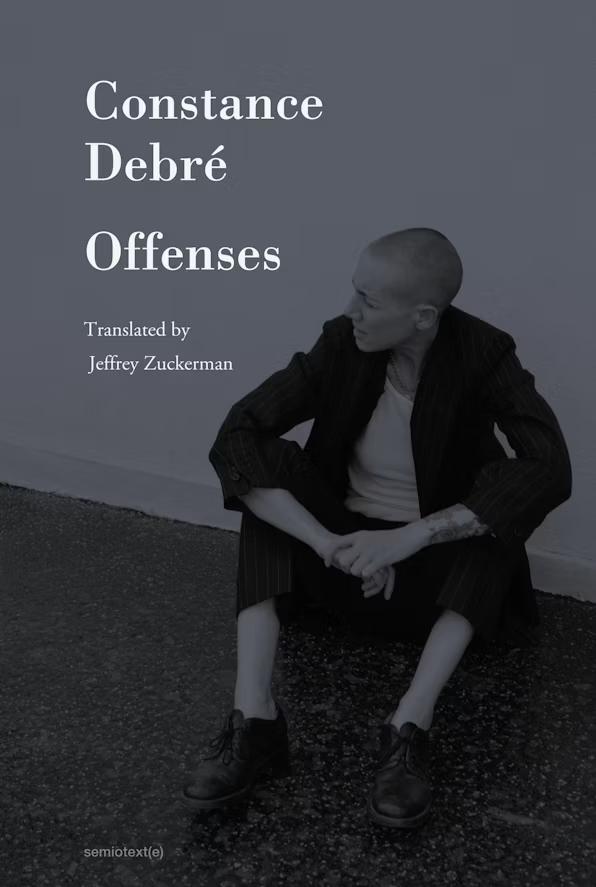
Book cover for Offenses (2026), Semiotext(e).
Yeah, and what I see more in Offenses is that we’re not necessarily as distinct as we’d like to believe. We’re more collective than we are self?
Oh yes, I should think that we’re basically all the same. It doesn’t mean that we don’t matter.
We’re no different from the murderer in Offenses?
No! And also, I’m sure we can love. Think of our lovers, our friends. I mean, it could be anyone. Really. We’re not that picky, because we’re not so different from one another.
Well that could be a beautiful idea. But it’s a terrifying one in Offenses. I read that it’s based on a real case, and it’s foreshadowed in Name. How did you arrive at that particular protagonist, on that case?
Yes, as a lawyer, I had many many cases, and many of them were more interesting, specific, weird, violent. I had clients who were terrorists, who were pedophiles. Some of them were famous. Everything was very interesting. But this one was extremely simple. You know, first it was the question of murder, which is a basic and absolute transgression: of killing someone. So I wanted to examine someone who killed someone else. It’s a question with a long tradition in literature, and a question we all have, I think. A personal fear. I’ve been thinking about murder forever. I remember with my young lawyer friends, waiting for our first murder case—in France it’s less frequent than the US apparently.
The story also reminded me of Crime and Punishment, you know? Because it was an old man stabbing an old lady for nothing. Crime and Punishment in real life. It was an echo of an idea I always had, that books are not somewhere else in the world. Fiction says something in our reality. Crime and Punishment was not something out there in some fictional space, happening in St. Petersburg, in other centuries. It’s telling us something about us.
Seeing this same story take place a few kilometers from where I was living, I wanted to use it. Also, this young man—when I opened it, the legal case, I suddenly had information about a part of the world… this guy, his childhood, his parents, his friends. This young man, this old lady. Her family, her life. It was extraordinary, because it was very simple, very banal. So sad. It was not the most violent story I’ve ever heard, or the most dramatic childhood. So banal within a certain world, which is so close to mine, and I believe ours. So close, so banal, and also so far, in a way, because it was sad. It was just gray and sad, everything. I had this feeling that everything was rotten, you know. And the victim and the perpetrator were sharing the same sad life, the same challenge.
Because I also have a feeling that wherever we are—people like me, most of the people who read my books—we live in one world, and there are people who live in another world. We know it but we don’t know it, at the same time. And I can’t not feel guilty about that.
Certainly in Toronto where I live, people are increasingly poor and desperate, and that desperation is visible and palpable. But also, there’s such a profound fascination with true crime. I don’t know if this extends to Europe, but this obsession with the psyche of the killer, where the point is made in Offenses that that’s besides the point. We live in a world perpetuating violence—so clearly present at a large scale, why would it not persist at an individual level?
There’s this idea of a vertical world that I use in Offenses and that is something I have in mind. We know it and see it every day, when you go to the grocery store and you see people living on the streets. Wherever we live, we can’t avoid that. For a second, we have pity, and then in another second, we think, oh am I going to have an avocado?
It’s a painful split.
It’s unbearable, unbearable. It’s normal, and it’s absolutely not normal. I wanted to do something with that.
The killer in Offenses, when you give him the voice, when he is the narrator, he says, “wherever you are, if you’re reading me, you’re on top. You’re the darkness, no matter what you’re consuming, or where you’re living.” It made me wonder, how much attention do you give to a particular reader? Do you have a reader in mind?
Yeah, readers are a strange thing. You’re talking to people. I’m talking to people. This is what writing is about! I’m not talking to myself. Again, I’m not interested enough in myself to do those kinds of things. So it’s part of the process, I think, too. I’m talking to the world. I’m not talking to specific readers, I don’t know who they are. I don’t care. But every sentence is in a way, an installation of words, and to be seen, it’s part of the writing itself.
Maybe it will come when I get older, but we don’t usually talk when we’re alone. So writing is the same thing. You talk with someone, or you talk to an audience when you speak. But when you write it’s the same thing. I don’t write for myself, or you know, when it’s out, the writing is between me and people.
It’s a general audience, but the audience is in mind.
Yes. I don’t think about specific readers, but yes, I think it was part of my intention with Offenses. I didn’t want to just add another book about a crime or a trial—because it’s also very much in the trial—but it’s not about that. It’s taking the readers and putting the readers within the book, and saying as myself, the writer, we are guilty. Because we benefit from the system, and the system works because there are people below us and we benefit from them. It was what I’d been pursuing through the book. And then I thought, no, we’re not just witnesses, innocent witnesses—and yes of course I know we didn’t choose to be ourselves—but we are responsible for the whole world. It’s more about this idea of responsibility, we are responsible.
We cannot say, ‘oh, this guy killed someone a few kilometers away, in the French suburb, this doesn’t talk about me, or say anything about me and my life.’
Of course, when this first person—I don’t know if it’s the young man’s voice, or it’s my writer’s voice—accuses the readers very directly, and sometimes maybe violently, I wanted to break some window. And yes I know it’s not pleasant, but it’s something I like to do in my books, and I’ve been using it a lot. I don’t mind making the readers uncomfortable at some point.
It’s very effective, very startling.
I know, I was rereading it and I thought, oh wow, okay. [laughs] But also because sometimes I like things like that to happen in real life. When someone tells me something true, or breaks this wall of fake politeness, you know? Even as a reader, when I see a book that has this moment, suddenly you're not reading to fall asleep. I think it’s worth being a little uncomfortable, it creates something.
Yes, and you’re then in conversation, rather than it being an artifact, or something to examine?
Mmm. Also you know, because the story was so banal. You know, half of all movies now are true crime, and the other half are romantic, I guess. So it’s love or murder, basically. This thing was so banal that I had to find a form which was not.
A process which continues to evolve. I have to ask you about translation, since I’m reading you in translation, whether that’s Lauren Elkin for Name or Jeffrey Zuckerman for Offenses. What is that process for you? You’ve had various translators into English and other languages. Are you very engaged, or…
No, I’m very lazy and I trust them, mostly. I’m very close to my American publisher, Semiotexte, and Hedi El Kholti, my editor. Very close. We were just on the phone before you called me. I remember that I was in LA for the translation of Nom so we went through it a bit. It has happened that I’ve worked a bit on the translation.
As for Offenses, I thought the language was a little bit more sophisticated. I was more precise, because the book is so short, and I wanted to work differently. That translation, I thought, was going to be more difficult than for the previous books. I don’t know the reasons why my publisher picks up a specific translator for each book; I don’t ask. I think Jeffrey did an excellent job. I think we discussed two sentences. As far as I can see and understand, I think it’s a beautiful job.
The language, from what I can see, is getting stripped down. People always say that you’re precise and spare, but the language is getting even barer, and it sounds like you feel he honoured this impulse.
Oh yeah. Offenses came out one year after Nom in France, so I wrote it in a few months. I could have spent another year, but I wanted this book to be very short and very dense and extremely precise.
It’s exactly the length it needs to be, I thought—the content can be hard to tolerate!
That’s exactly what my French publisher said to me about Protocoles—I said, I have so much material and when I first sent her something she said, really, with this material, it’s enough.
Yeah, well I find with all of your writing actually, it’s both very hypnotic and often quite painful as a reading experience. You're with the narrator and in sympathy with them. And then, writing at the pace you do—it must be a very focused process. It seems there must be pain and satisfaction, working with the material you choose. If you could talk about how those live together?
For me writing it? I wouldn’t say pain. It’s work, so it’s difficult, and sometimes I have anxiety because I’m not going to do exactly what I want, or I’m searching, so I have anxiety. Satisfaction—I’m very happy to do something that matters to me. And when it’s done: after thinking every day for two years that I won’t be able to, I suddenly think, oh, okay, I did it. I suddenly think, okay, within the project, it’s done. I did my best. And then comes the anxiety about the next one.