 copy.jpg)
Jack Chambers, 401 Towards London No 1., 1968-69), Oil on wood, 183 x 244 cm.
The highway is a rorschach test. Look at it, and what do you see?
In 1967, Canadian artist Jack Chambers looked at southern Ontario's 401 highway and saw it as a vessel of time.
While driving on the highway, Chambers’ interest was piqued by the scene in his rearview mirror. Behind him lay the glorious modern highway, carved gently into the sloping terrain.
In the painting 401 Towards London (1968-69), the grass is pool table green; the leaves are turning; the slow movement of geological change visible on the tilting horizon. The drivers themselves are stuck in a cycle of comings and goings. Here was the moment “where reality is so imminent that one feels he has stepped off the conveyor belt of time.”1
In a moment where everything in our daily lives feels commodified, the one thing that remains transcendental is our relationship to time. When everything can be bought and sold, ironically, the meditative motion or creeping slowness of car travel offers rare moments of reflection.
Time spent stuck in gridlock disrupts our hyper-commodified, hyper-accelerated world. Traffic can jam us into the present, and make us aware of the granular passage of time. Yet, the illusion of the highway is the illusion of convenience.
Transportation infrastructure projects have long been convenient tools of racialized displacement, capitalism, and colonialism. The highway is then an easy shorthand for modernity. On it, we are simultaneously moving en masse but atomized within our individual vehicles. We are flying at breakneck speed; we are rotting in our seats. We are forever travelling yet stuck in a flattened architecture that renders all landscapes identical. For some, the highway can represent a sense of freedom, new beginnings. It is a road to somewhere new where one can be reborn; it is the long road home. It is a nation-building project, a violent vector of colonialism. It is the concrete manifestation of alienation and ecological destruction.
For Tsuut’ina, Amskapi Pikanii, and Saddle Lake Cree multidisciplinary artist seth cardinal dodginghorse, the highway is not a place of abstract loss but a key driver in the literal displacement and loss of their ancestral home.
In 2014, dodginghorse’s family was forced from their home, where five generations had lived, for the construction of a portion of the Southwest Calgary Ring Road that runs through the Tsuut'ina Indian Reserve. This loss informed the film 210 chaguzagha tsi-tina (weaselhead road) (2018), part-archival intervention, part-documentation of the titular location before and after its destruction.2
The second part of the film, ‘home,’ consists of footage of dodginghorse’s house as it sits awaiting demolition. It is soundtracked by the speech Tsuut’ina Chief Roy Whitney gave on October 24, 2014 to nation members regarding the then-planned land transfer between Tsuut’ina Nation and the government of Alberta.
The camera pans over walls stripped bare, anticipating the incoming bulldozers and trucks. The frame lingers on childhood toys and clothes strewn across furniture and flooring.
“My heart, my compassion goes out to our members who will have to relocate and accommodate this project,” Whitney drones. “We will walk hand in hand with you in the transition to a new place and a new life for your families.”3
The audio of Whitney loops for the majority of the remainder of the film. The camera scans over beams, dusty staircases, old appliances, exercise equipment, a water heater. An ambient hum becomes increasingly louder, melding with Whitney’s voice. The distressing and hypnotic loop asserts that such loss is not simply confined to a discrete moment in time, but baked into the very fabric of the known universe. To dodginghorse, it is an existential loss.
At the end of the film, Whitney’s narration ceases to have meaning, as a disembodied snippet of him chanting “Tsuut’ina” over and over again repeats over footage of the construction site.
“I chose [to loop] this phrase because during this period of time whenever any mentions of my family were brought up in the press by Roy and Tsuut'ina officials we were the nameless "families" that had to move,” dodginghorse explained over email. “There was always an assurance of care being provided, which was not the case.”
dodginghorse then harkens the first part of the film, ‘land,’ which consists of home video footage of dodginghorse, their father, and relatives walking through the bush on their land. Then, it was covered with trees and butter yellow grass. In the film’s final moments, the land has been shredded into a sea of gravel. A question dodginghorse’s father uttered is burned onto the screen: Didn’t you say there were graves over here?
The highway is haunted by ghosts. In her book Ghostly Matters, sociologist Avery Gordon describes ghosts as “a seething presence, acting on and often meddling with taken-for-granted realities.” For Gordon, the ghost is the sign or the empirical evidence of haunting. When we follow these ghosts, they demand a reckoning with the past's "repression in the present, [...] with that which we have lost, but never had.” While watching 210 chaguzagha tsi-tina, the viewer looks at the highway and sees a road, and then one is hit with the uncomfortable feeling that this constructed reality is repressing one too many skeletons.
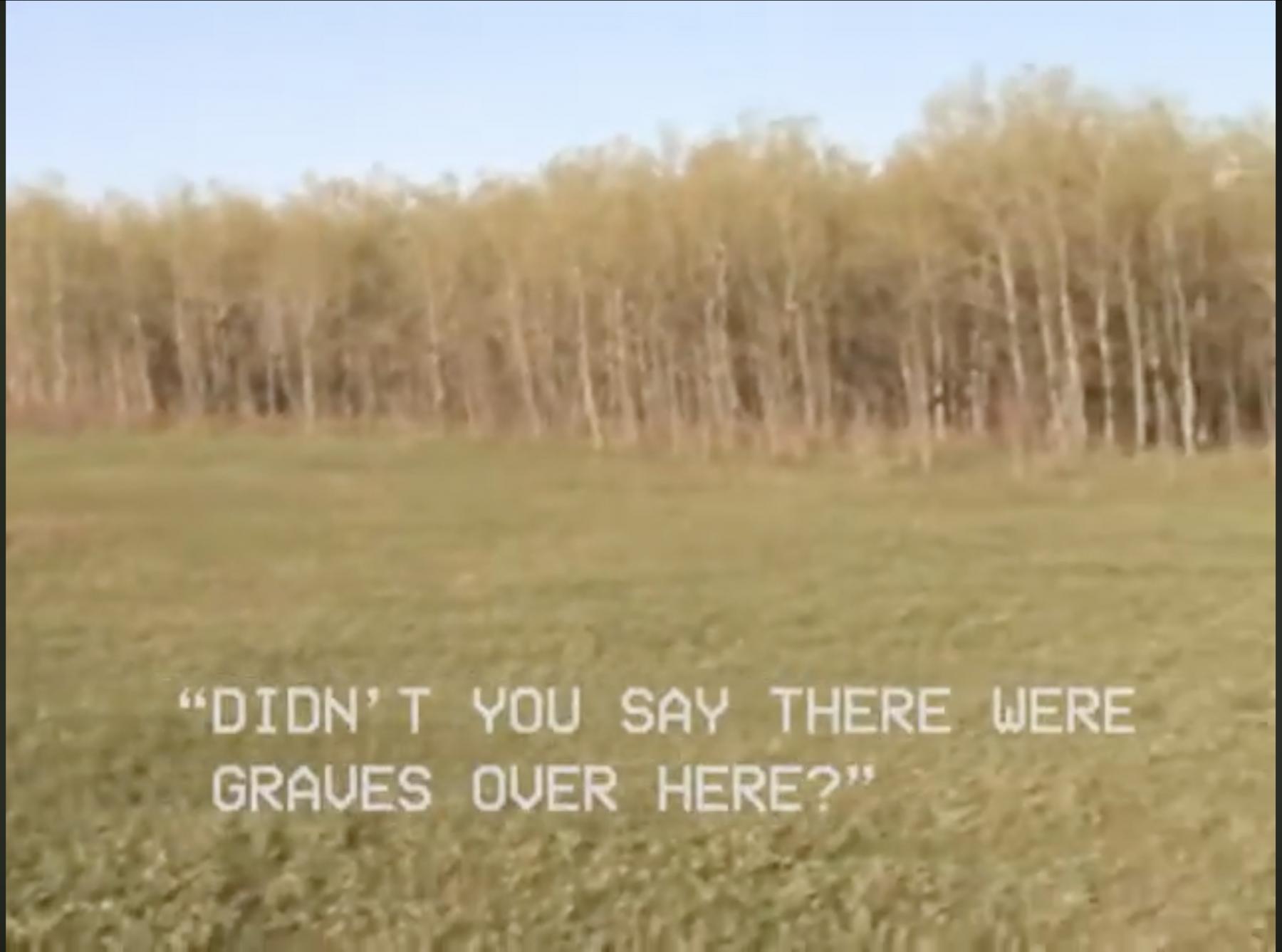
seth cardinal dodginghorse, still from 210 chaguzagha tsi-tina (weaselhead road)(2018).
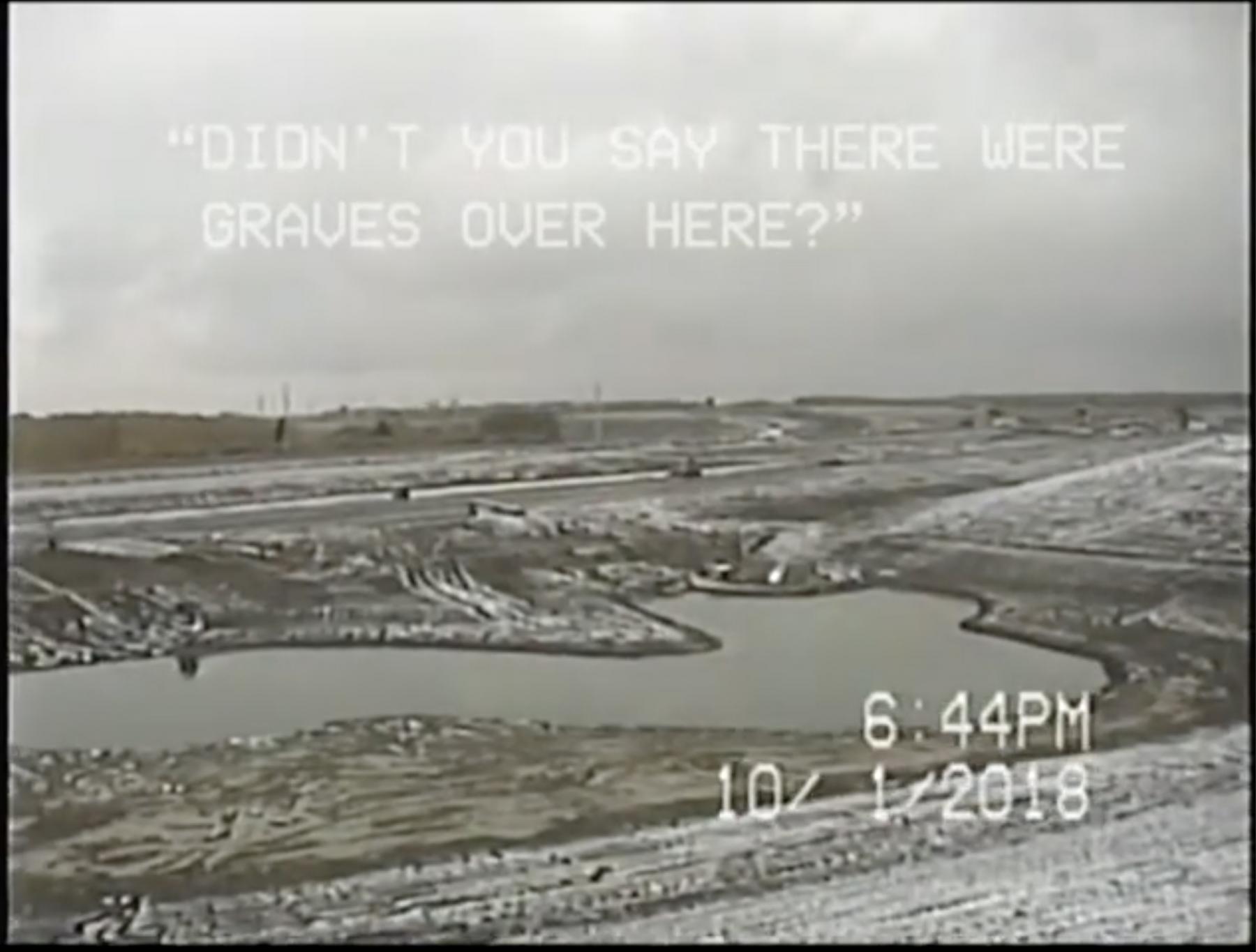
seth cardinal dodginghorse, still from 210 chaguzagha tsi-tina (weaselhead road)(2018).
When Chambers painted the 401, he was drawing from a European tradition of painting. Besides cursory comments about the iterative, state-sponsored construction of both Canadian settlement and art traditions, Chambers gave little to no recognition of the existence or history of the Attawondaron, Odawa, Ojibwe, or Anishinaabeg peoples that lived on the land for centuries.
“North America’s first import was her own settling people,” Chambers contemplated in a 1970 retrospective at the Vancouver Art Gallery. “The mannerisms of North American art lies in its repetitious efforts to become art.”
Much like the copy-and-paste-ing of European names onto Indigenous geography (the river that runs through London Ontario, Deshkan Ziibi, was renamed the Thames River by settlers), the importing of European art styles (think: Cornelius Krieghoff, London Ontario’s own Paul Peel) functions to naturalize the process of settler colonialism. In his perceptual realist practice, consciously or not, Chambers draws attention to the unreality and artifice of the environment of southern Ontario and the behemoth highways that scar its rolling hills.
Filmmaker Matthew Rankin pushes Chambers’ logic of North American art-making one step further, evoking a theatrical, expressionist style to articulate the man-made construction and illusory nature of the Canadian colonial state.
“Canada is a system, an artifice. There’s nothing naturalistic about Canada,” Rankin argued. “When you stand on the Canadian-American border, you will see space where humans have imagined a line. So what does this structure mean? Why does it exist? Should it exist?”
Rankin has explored the artifice of Canadian nationalism in The Twentieth Century (2018) and in his most recent feature film, Universal Language (2024). Universal Language exists in an alternate reality where Tehran and Winnipeg have merged into one arctic city, where Farsi is the lingua franca. As the movie follows the day in the life of a group of seemingly unconnected Winnipeggers, a core narrative subverts the traditional road movie. Rather than hitting the highway to escape one’s life, protagonist Matthew (played by Rankin), gets on a Greyhound bus in Montreal to go back to his childhood home and visit his aging mother. Reminiscent of Tom Sherman’s ‘East on the 401’ (1978), which skews the trope of the artist being pulled towards the metropolitan centre, the protagonist instead travels to the obscure edges of the country, away from the bustling core (for Sherman, Nova Scotia and for Rankin, Winnipeg).
Beyond narrative propulsion, the highway in Universal Language, similarly to 210 chaguzagha tsi-tina (weaselhead road), is a place of haunting and mourning. The frozen median in between two rushing lanes of traffic hosts the site of a monument to Louis Riel, where Massoud (played by co-writer Pirouz Nemati) and his tour observe 30 minutes of silence to honour the sacrifices of the Métis leader executed by the Canadian state. It is also the location of a small cemetery. Here, cars whip by as Matthew trudges slowly in the snow to pay respects to his fathers’ grave. The juxtaposition of funerary monuments nestled on the shoulder of a highway reinforces the sheer absurdity of neoliberal state planning and by extension, the nationalist myths used as justification. Capitalist-driven infrastructure projects isolate us from each other—traffic barriers are just one material manifestation of this.
By presenting Winnipeg through the influence of Iranian New Wave filmmakers, namely Shorab Shahid Saless and Abbas Kiarostami, it may be too generous to claim that Rankin is fully deconstructing Canada’s colonial identity. That is beyond the scope of the film. Instead, Rankin and Nemati are hell bent on championing a humanist universalism, where through the power of radical empathy, we can see ourselves in our neighbours.
Later in the film, Dara (Dara Najmabadi), the man who is now living in Matthew’s childhood home, drops Matthew off at a Tim Hortons by an off-ramp. Matthew has several hours to kill before his mother’s accidental caretaker Massoud picks him up. Not to worry, Dara assures him “there is a relaxing view of the highway. Time will pass quickly.”
Once more, the highway becomes a vessel for the passage of time. In Universal Language, time is both punisher and healer. Time has drawn Matthew away from home and only served to widen the gap he feels between him and his mother. In her old age, she can no longer recognize her own son. Time is also what has allowed him to come home to mend relations.
In front of the Tim Hortons, as cars roar by, Dara gifts Matthew candied walnuts and socks. Stunned, Matthew thanks Dara. Dara brings Matthew into a tight embrace. He says: “I have three brothers. You are the fourth.” They hold each other as cars pass.
This is the feeling I got when I saw Chambers’ 401 Towards London for the first time. It is the feeling of being very small, and being held in a long embrace by something wide and expansive.
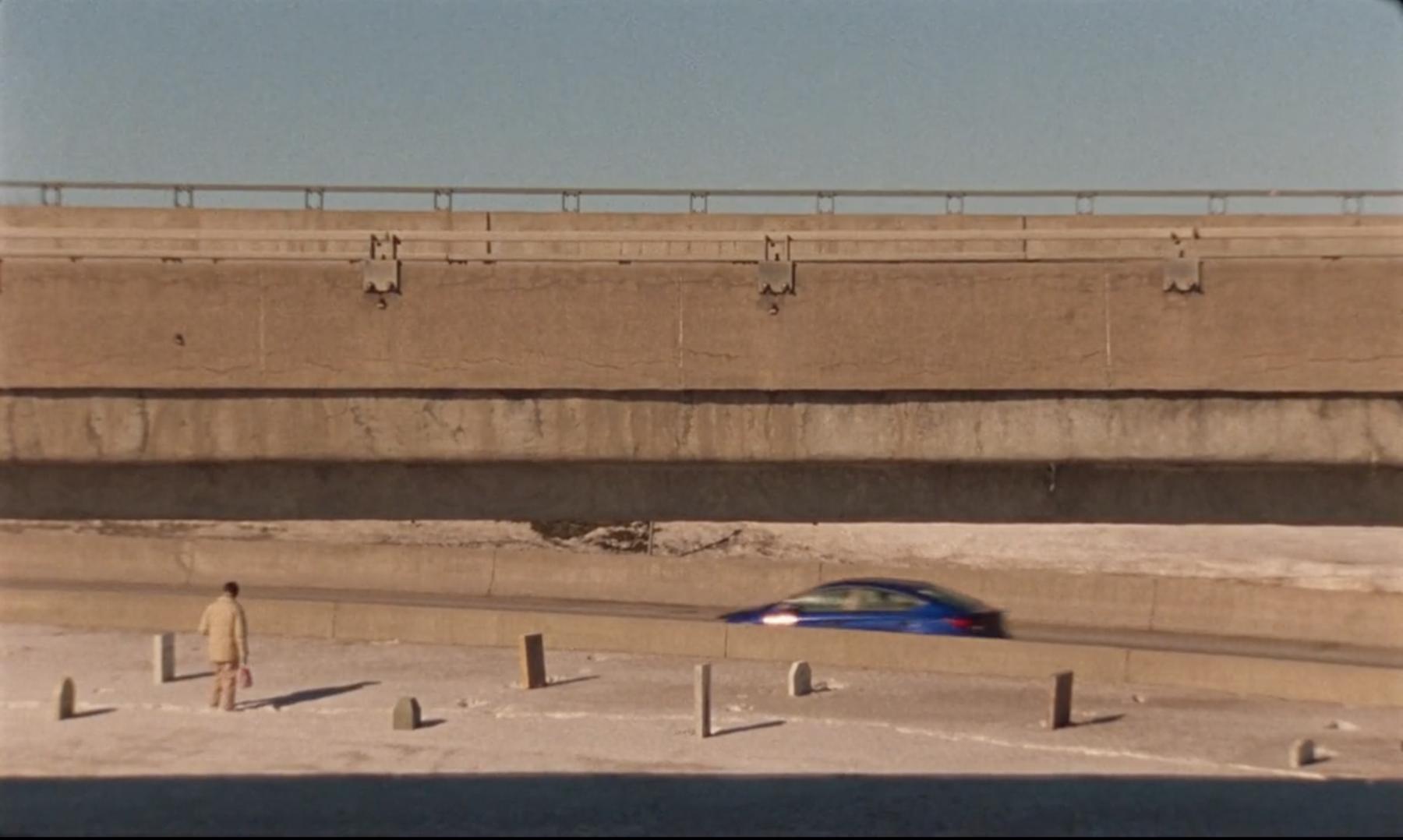
Still from Universal Language (2024). Directed by Matthew Rankin.
David Cronenberg’s Crash (1996) also presents the antidote to alienation as a long embrace by the highway—albeit with more bodily fluids. Based on the 1973 novel by British novelist J.G. Ballard, Crash follows car crash survivor James (James Spader) as he reinvigorates his sex life with wife Catherine (Deborah Kara Unger) by joining a group of symphorophiliacs—people who are aroused by automobile accidents.
Though the two films seem antithetical to each other, both Crash and Universal Language examine the pursuit of human connection in the face of deepening social alienation.
The environment of Crash is contained exclusively in cars, parking garages, and highways. James and Catherine’s apartment overlooks the 401 at its most sprawling and wide. There, post-accident, he sits and observes the passing cars through a pair of binoculars. As the couple has sex on the balcony, they hover above the masses driving on the highway, watching from a distance, but apart from the throng of traffic below.
“The day I left the hospital I had the extraordinary feeling that all these cars were gathering for some special reason I didn’t understand,” James says.
While they drive alongside traffic, James and Catherine uneasily feel a sense of Othering—that everyone else is in on something that they are not. James and Catherine are always presented as hovering just around the outskirts of mainstream society, be it on their balcony or behind the steering wheel.
James and Catherine cross paths with Vaughan (Elias Koteas), a car-crash sex cult messiah who stages historical accidents with his frenzied followers. Vaughan and his acolytes are aroused by car crashes and the injuries they produce. Scar tissue and chrome are licked with equal enthusiasm, and the anticipation of collision becomes foreplay.
“A benevolent psychopathology beckons towards us,” Vaughan proselytizes. “The car crash is a fertilizing rather than a destructive event—a liberation of sexual energy that mediates the sexuality of those who have died with an intensity impossible in any other form.”
The eroticism powered by car crashes, staged along the highway, disrupts the monotonous, overbearing status quo. Accidents become clear markers of time, punctuating an otherwise mundane and unending stream of traffic. Film scholar Emma Gibb argues that crashes in the film serve to “pinpoint a random, visceral moment of connection between two people, two objects that would otherwise never meet.”
In a world that is highly ordered and controlled, the randomness of violence snaps James and Catherine back into their bodies. The desire not only to witness, but actively partake in violence, is what draws the couple down from the high-rise condo onto street level.
The final scene echoes the graveyard scene in Universal Language. Both are shot on grassy medians: the unreachable areas between the rushing cars and concrete dividers.
Here, Catherine and James have attempted another stunt. James rear-ends Catherine, sending her car flipping into the median. As Catherine crawls out of the car, they begin to have sex on the side of the road, half-sheltered by the wreckage. Catherine begins to cry, and to comfort her, James whispers: “Maybe the next one.”
In this moment, the illusion of freedom is shattered. The logic of violence only begets more violence, and its endpoint only brings Catherine and James to the easiest exit: death. Relentlessly pursuing their death drives temporarily enables Catherine and James to delude themselves into thinking they have escaped the tyranny of the symbolic order, but ultimately this enthusiastic acceptance of violence only serves to reinforce and deepen the conditions of their alienation.
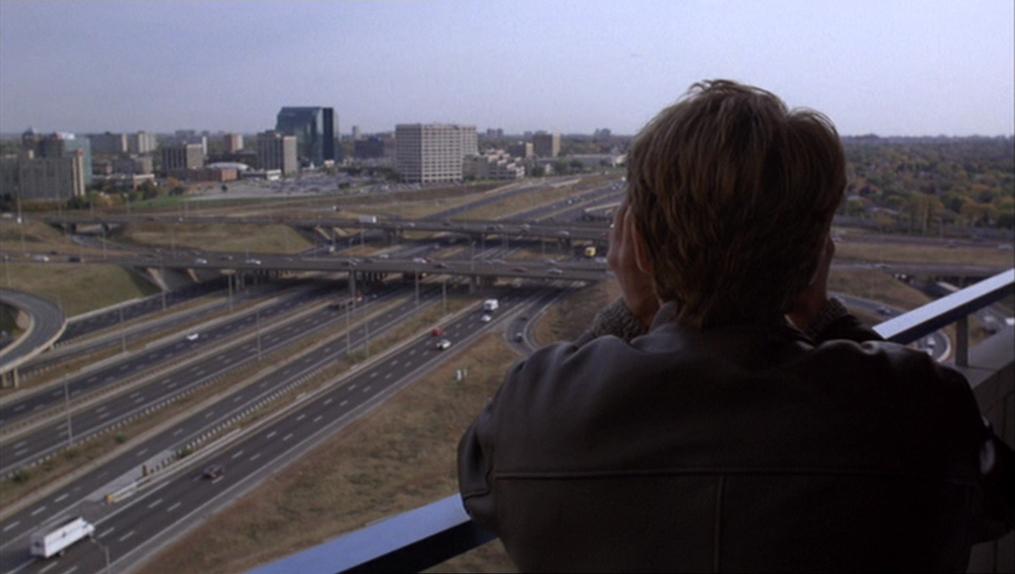
Still from Crash (1996). Directed by David Cronenberg.
The erotic fascination with automotive violence is echoed in visual artist Tom Sherman’s video art piece ‘Individual Release’ (1978)—which alters the original, unedited footage used in ‘East on the 401’ (1978). As the grainy, chopped-up dashcam footage of the 401 hypnotizes the viewer, the narrator recounts how his father would take him to the dump on weekends to inspect car wrecks. It is a social event. There are other fathers and sons. The wrecks are fresh with blood and death. “Under the seats,” the narrator recounts, “there were often single shoes, pairs of glasses, bobby pins and pennies and sometimes teeth.”
As the young boys inspect the wrecks, the fathers speculate over the fates of the drivers and passengers.
“Who was in the Buick, who was in the Ford, who was in the Plymouth, how fast was he going? Where was he coming from? Who talked to him last? What did he say when you saw him last week? Who will it be? Who will be so sorry?”
Once more, the White middle-class subject finds recreation in the spectacle of death along the highway. He craves violence and annihilation. He sees himself as both entirely separate from the violence and overtly self-identifies with the victims. In both Crash and Individual Release, the willing violence of the highway—the accidents, the road rage, the roadkill—become a means of reasserting perceived control as an actor in a wildly unjust system.
Sherman, Cronenberg, and to a lesser extent, Rankin, are all seeing the same thing as Chambers. They have all looked upon the highway, a landscape laden with destruction, and chosen to see something beautiful. This detached admiration is only afforded to the neoliberal settler subject, one who can conveniently disregard history. The settler imagination is thus founded upon visions of violence and the repression of ghosts, whether it be bodies torn to shreds or the post-war fantasy of abundance and prosperity.
When the Southwest Calgary Ring Road opened in 2020, dodginghorse disrupted the televised press conference. “For the past six years, I have had to drive and see my home be destroyed and changed every single day,” dodginghorse explained at the speaker’s podium.
At the end of the speech, dodginghorse cut their braids off as an act of mourning. In video documentation of the intervention, dodginghorse snipped, then untangled tufts of their hair, tossing it all onto the pavement.
“The history of this road, the history of my family: these will be known and these will be shared,” dodginghorse asserted. “I will always do my best to make sure that the legacy of [the road] involves my family's story and the women—my grandmothers—that came from that land.”
The Southwest Calgary Ring Road was designed to accommodate up to 100,000 vehicles per day. Every day, tens of thousands of people drive on the ring road often without considering what had been destroyed in order to make their commute five minutes faster.
When we turn our attention to liminal sites—highways, abandoned malls, junkyards—those places littered with forgotten ghosts, it is not simply enough to search for beauty in them. We must move beyond the value judgment of “beauty” and recognize how our values system has structured a world where these sacrifice zones exist, where things can be deemed ugly and disposable. We must interrogate what is uncomfortable and how we are able to simply pave over what might be seen as inconvenient.
In Universal Language, a participant on Massoud’s tour of a housing complex complains: “since when is a parking lot a site of historic importance?” In response, Massoud explains: “Many nice people lived here.”
When asked why he chose to shoot Winnipeg’s brutalist concrete housing blocks and swaths of parking garages, Rankin explained, “I wanted to shoot all of these boring spaces with the same spiritual devotion that Terrence Malick would film a sunset, and sort of fill them with meaning even though they're completely devoid of it.”
Perhaps this is a sentiment worth adopting: allowing ourselves to take a generous gaze on all that is deemed ugly and unimportant, all that is forgotten, all that we are told to forget, and fill it with meaning—rather than beauty.
This is what brings me back to Chambers.
I grew up in London, Ontario, where Chambers was born and died.4 Like him, I spent many hours on the 401, 402, and 403 highways. These highways were sites entirely devoid of meaning. Slowly, with time, they became loaded with it.
In the backseat, I could think about myself, my petty high school dramas, the visions of the future that would eventually motivate me to leave. I watched the slow creep of the suburbs, swallowing up the marshlands and farms that surrounded the city. I watched factories shutter as I drove to the beach. I drove on the Veteran’s Memorial Highway, past tattered Canadian flags draped on concrete overpasses. I drove past carcasses of deer and raccoons, and blown-up tires. I drove past anti-abortion signs and advertisements for real estate developments. Now, when I think of the road trips of my childhood, the tedious drives to visit relatives in the GTA, they are haunted by Canada’s reliance on the fossil fuel industry, militarism, and the genocide of Indigenous peoples.
In “Jack Chambers: From Camera to Paint,” Sarah Milroy describes the perspective of 401 Towards London as a wide embrace of time and its complexities: “[w]e are led to contemplate the unimaginable trajectory of the planet itself, evolving with imponderable slowness in cycles beyond our understanding. The harried business of moving from A to B is revealed as an illusion.”
Look again at the highway. What do you see?