.jpg)
Max Lawton. Photo by Ecem Lawton. Sourced via.
Thomas Mann’s distinguished translator-in-chief, John E Woods, once lamented that “Translation is an impossibility. Every language is unique to itself. So a translator tackles that impossibility anew with every author, with every sentence for that matter.” Countless other translations open with quasi-apologies like this, thinly-veiled confessions that in translation, one can only ever strive for the least worst rendering. These appeals are all too understandable. The translator’s unenviable role is to transfigure a text from one form into another—retaining some intangible essence—all the while remaining invisible. All the same, it is hard to imagine this sort of appeal from Max Lawton.
Lawton is anything but invisible, having amassed an impressive literary profile in his short career. Since 2022, he has published eight translated works, has a debut novel forthcoming from a major press (Progress, due April 2027), and has completed a Masters and PHD from Oxford and Columbia respectively. Lawton began his career in translation as an undergrad, cold-emailing the Russian cult novelist Vladimir Sorokin in 2016 with a rough translation of his controversial 1999 novel Blue Lard; telling him: “I will make you famous in the US, as big as [Roberto] Bolaño.” Since 2022, he has translated six of Sorokin’s works, fulfilling his promise of bringing the dissident writer renewed Western acclaim, and becoming something of his protégé (describing Sorokin as a “second dad”).
It seems clear that the type of literature that Lawton translates—unremitting, recondite doorstoppers—fills a certain hole in contemporary publishing. His recent translation of Michael Lentz’s neo-modernist epic Schattenfroh, a 1001-page metaphysical descent into the bowels of Germanic esoterica, received wide press coverage upon its anglophone release last fall, far beyond its muted initial release in Germany.
We began our conversation talking about his latest translation: The Beginnings, the first in Antonio Moresco’s ‘Games of Eternity’ trilogy, set for release June 23rd from Deep Vellum press. The formidably obscure novel follows an unnamed narrator’s odyssey across 20th century Italy, through life in a convent, into radical politics, finally resting in the fringes of publishing. Its fecund, imperfect ambition feels worlds apart from the measured minimalism of much contemporary literature. Lawton’s translation matches this; unlike anything I’ve read in recent memory, equal parts breathless and globby, embodying the original’s transgressive “turgidity.”
Lawton described how for experimental literature, the translating process is less like an agonising, exacting itemisation, and more like the recording of a cover album. I really caught hold of this music metaphor. It cleanly communicates the focus on capturing the essence of a work rather than a stifling fixation on each and every detail; the opening of the outer carapace of prose to get at the “pure language” beneath, as the theorist Walter Benjamin once described it. But more than this, the analogy captures the fresh, unencumbered writing present throughout Lawton’s translations. Experiencing these cover albums, listening between the lines, Lawton’s voice begins to emerge: arch, playful, always direct and palpable.
In our conversation we discussed The Beginnings, dividing time between artistic practices, the responsibility of the artist, and the elevated reception of translations in the contemporary anglosphere literary world, among much more. Lawton was warm, loquacious and more than accommodating of my stilted questioning style. I came out of our conversation more appreciative of what is lost, and what is found, in the impossible pursuit of pure language, each word anew.
I think translation is sometimes more possible than at other times, and when it's a weird book, it just needs to be a cover version in the language it's translated into.
What was your first encounter with Antonio Moresco’s writing, specifically The Beginnings?
With The Beginnings, I read about Moresco on Andrei’s blog, The Untranslated. Moresco is very well known in Italy. Before that, I had seen Distant Light around and did not read it, but I saw it. It’s a very handsome cover, a nicely designed Archipelago edition. I discovered Schattenfroh through Andrei as well. When I was reading about those books that Andrei is so into, I was enticed by Moresco. Then the first book of Moresco’s trilogy came out in French, and I read Les Ouvertures [The Beginnings] which is a bit different as a title. It's like the opening of a play, it has slightly distant resonance. But that's because Esordi [Beginnings] is a bit of a weird word in Italian. We could have translated it as, The Geneses, but that would’ve been awful. So I read Moresco and I really loved it. I mean, I liked The Beginnings a lot. And then I read Canti del Caos [Songs of Chaos] in Italian, and I was like, this is one of my favorite books ever. And then I read the third one too, which is crazy in an entirely different way.
You sent me a copy of The Beginnings back in January, and I hadn't got around to it until quite recently. I'm about a third of the way into it, and I think it's only now that I'm really finding it compulsive. You've mentioned in previous interviews the confounding awkwardness of the prose, how strange it can be—and it is, but it has this rhythm, running through these beautiful sequences so fast... Though you mention that you prefer the second book in the Games of Eternity trilogy.
Yeah, that's the one I'm working on, Songs of Chaos. I joke that it's like anal-sex Tom Clancy. It couldn’t be more different from The Beginnings. The way I talk about it sometimes is that it's like a style coming into being, it isn't standardized. Book one, The Beginnings, is indisputably, a bit turgid.
Yes.
Indisputably. And you can see him circling certain things and certain linguistic tics and certain tendencies that then in the forthgoing two parts become tighter. He'll hover around a word, this sort of word fetishism. For example, he uses sgranato, meaning the shocked one. He's fixated on these little words: sfrenato, unbridled, or sbudellato, disemboweled, but uses them in non-literal ways. It’s as though his aesthetic practice comes to be throughout the course of The Beginnings. The Beginnings was like a life novel for him, he wrote it over a long span of time. The first draft of James Joyce’s A Portrait of an Artist as a Young Man was like 1000 pages. It was called Stephen Hero, and Joyce edited the hell out of it. This is kind of like if he had published Stephen Hero unedited. That's The Beginnings.
There are some strange turns-of-phrases, like “slowly, oh-so-slowly,” comes up very often.
I exaggerate certain things because it's actually piano, piano, which means slowly, very slowly. But Francesco [Pacifico], my editor, told me at the beginning of the process: “Antonio has gotten out of Italian. You are not going to be able to get out of English in the same way.” So, it's all about the carapace of the language. A very annoying, literal-minded academic translator might be like, well, piano, piano is actually pretty normal. [Laughs] Fuck off.
How long did the translation of The Beginnings take, and what's your day-to-day process like as a translator?
Well, I’ve had a huge head start with this stuff. I started working with Vladimir Sorokin in 2016 and I was working every day, for like four or five hours usually. I'm working like six hours a day on Songs of Chaos. I worked for a long time without a publisher, and have relatively clean drafts of all of those books. And then Schattenfroh, I started working on in 2020, and Matthias Friedrich joined me as editor in 2021, and we were working on that through to 2025, but the 2024 and 2025 stages were revision mostly. I was doing The Beginnings as we were revising. I'll translate in the morning, go to the gym, and then spend a couple hours editing or revising in the evening. I don’t want to do this for that long, I have too much work right now. But it's good, and some of the books I'm going to do are even more demanding. With Moresco, there's an automatic quality to the way he writes. You don't have to give every line intense focus. What I’m doing next— translating Louis-Ferdinand Céline—you can't go fast. I’m drafting Guiginol’s Band, it’s very slow, in fact, and it's going to be a span of years.
Do you deliberately seek to translate demanding literature that really strains the boundaries of language, or is that just what you engage with?
I think these are just books I like. It wasn't a concerted decision. I find it more fun as a translator, for sure. Because if I were translating, like, Elena Ferrante, it would be like okay, I know how this is going to turn out. Whereas, as you can tell with The Beginnings, I get to be a real collaborator in the process, which is fun.
Yeah, totally.. It seems that you’ve found a lot of the books that you've been translating from Andrei’s blog. Is there a criterion that you apply when you're choosing what to translate, a certain quality or depth to the vision, or is it truly books that you’ve connected with?
I think it's like, whenever we send something to the publishing house, Vladimir will say, ‘I hope the editor reads it with their genitals.’ Whatever turns you on. So, I just translate the stuff that turns me on, what I like. It’s not a concrete metric—I'm doing Limonov for NYRB, and that's not formally innovative at all. It's written like Bukowski or something. There are a lot of different things I like. I love Knausgaard and Knausgaard is about as inattentive to the line as you can get.
The Beginnings is a novel that's completely externalized from its protagonist. It's all about the external, corporeal world. It brings to mind the recent Booker-Prize winning novel, Flesh. I don't know if you've got this comparison before.
I have Flesh right here. My mom gave it to me. I've been meaning to read it, but I haven't yet.
Yeah, I read it a few months ago. It’s good. But it is much more stylistically restrained, which is more in vogue with English contemporary literature at the moment than The Beginnings is—which is a lot more turgid, as you say, dense. What are your thoughts on… well, the state of contemporary English-language literature at the moment?
It's a good question. I just wish there were more of it. I think I have experienced the strictures of publishing first-hand, with my own books. It's fucking hard, trying to do something different from that required style. It's not just in vogue. It's like they insist upon it. I'm doing something other than that.
So, unfortunately, a lot of the books that I've enjoyed for the last little while have been by GOATs who are writing late-career stuff, William T. Vollmann, Bret Easton Ellis, Will Self. I love my friend, New Juche. I really am into him. He's a transgressive writer who has so far only come out on small presses. But his book Mountainhead is one of the best, best, best books I've read in a long time. It's amazing. There's almost nobody my age doing it. If you think about it, Josh Cohen seems like a young writer. But he’s 13 years older than me. My friend, Paul Grimstad who's in One Battle After Another. His first novel, Cold Fusion, is actually amazing. It's like, if Less than Zero were just about an autistic guy in Wisconsin. So there are people who are pushing. I'm pushing, but the stuff that like gets a lot of attention is not what I fuck with that much. Sally Rooney, I thought she tried to do something interesting in Intermezzo, and of course, her political bravery awards her enormous points for me.
A lot of good translations are coming out. I could name tons of translated books.
I think the first time I heard of you was on the One Story podcast. You mentioned there that books are always best read in their source language. I was wondering, there are always cultural nuances and elements that are untranslatable in literature, so what are the limits of your role as translator? What can you do?
Well, I think there are certain books that translate pretty cleanly. I always use Kafka as an example. Kafka translates pretty nicely. Proust translates well.
Do you think there are any translations that are even superior to the originals?
I think Baudelaire translated Poe into French. That's probably better in French.
I don't know about superior, actually. There are books that just translate pretty well and give you a very strong idea. And the correspondence of the experience of reading the translation to that of the original is pretty high. However, there are other books where you really need a writer to do it. There's this illusion of the best model of translation being an academic who works very slowly and every line contains every possible connotation of every word. In that mode, there are lots of footnotes, the style is far less important. And that just kills the kinds of books that I like. It just kills them.
It's quite a quantitative understanding. It makes me think about how some people with no real notion of what a translator does would say that language models are going to take translators jobs very soon. But, if you translate in this word-by-word, exacting way, you do leave yourself vulnerable to these kinds of reductive comments.
Yeah. I think translation is sometimes more possible than at other times, and when it's a weird book, it just needs to be a cover version in the language it's translated into. No two translations of The Beginnings will ever be alike because it's so, so, so stylized. I guess you could just not do that in translation, but that would just destroy the whole book. I mean, without the insane style, it's really not a good book. There's nothing.
Yeah. You talk about how you like to collaborate with the authors you're translating, like Moresco and Sorokin and Lentz. What’s that process like? When do you defer to their interpretation? They are the authors, but at what point is the ‘Max Lawton’ voice coming through?
I wish they were more proactive about correcting me, and I think they're just lazy—not Moresco, he’s not lazy. Moresco just doesn't know English. He would probably edit me if he knew English, because he's very sedulous and responsive about all my questions. Lentz is just lazy with it. When I try to ask him stuff he either has forgotten or is like, ‘Oh, is it question time? I don't, oh, well, I'm not sure I really want to do this.’ Vladimir tries to. Vladimir sometimes gives me very good answers, but sometimes he'll try to screw it up. Like he just wants to introduce distortion into the translated language I’m moving into.
So even when you're translating, he's trying to throw you off.
He just likes gibberish, right? So he likes to turn stuff into gibberish in translation, you know. He’s very puckish. I translated the nonfiction book by Jonathan Littell. That's probably about to come out. Jonathan is very hyperactive as an editor and wanted my English to have the same word order as the French. And then I wish Céline were still alive, man. I wish I could talk to him. There’s so much stuff in that book where I'll look in the notes, corresponding with French Céline scholars. And I'm like, what do we think this means? They're like, ‘That part, we don't actually know. It is very confusing.’
Yeah. You're forced to interpret; there's no way you can't. I like the example of cover albums. On another note, I find it so interesting how a lot of these contemporary translations seem to be better received on their Anglo release than their initial release. There's Bolaño’s The Savage Detectives, Han Kang’s The Vegetarian. Even Schattenfroh wasn’t massively well received in Germany.
I think it sold more copies in English than German.
Sure, yeah. I was interested if you had a theory about why this is. Is it the exoticness of translation, or a lack of challenging literature in English, or what…
I think the second thing is definitely part of it, yeah. Difficult, interesting literature is found in translations, not stuff that's written in English, which is a problem—I think that we should be publishing the English Schattenfroh’s, the English Morescos.
Arno Schmidt has a cult following in English. But the English Arno Schmidt today is not getting published by anyone. All these houses have given up that role. American Psycho today would not be published, or maybe published by a small, weird press, and for me, American Psycho and Infinite Jest are the two best American novels of the last 50 years. Those books are not getting published right now.
I think there is something that happens where writers are sometimes not received well at home. And maybe there’s a condescension sometimes when someone's your neighbor, someone says ‘this guy's a genius,’ it's like, no, he's my fucking neighbor. Through the lens of a guy in Germany—Lentz as seen by another German person—you can imagine what he's like, and you understand him really well. And you can imagine a whole web of signifiers around him. Whereas, if you’re American, he's just this Schattenfroh-like figure (the character, not the novel!). And same with Moresco. Moresco, if you know him in Italy, is like a kooky old uncle, but then you read him from abroad, and you're like, this man's a seer.
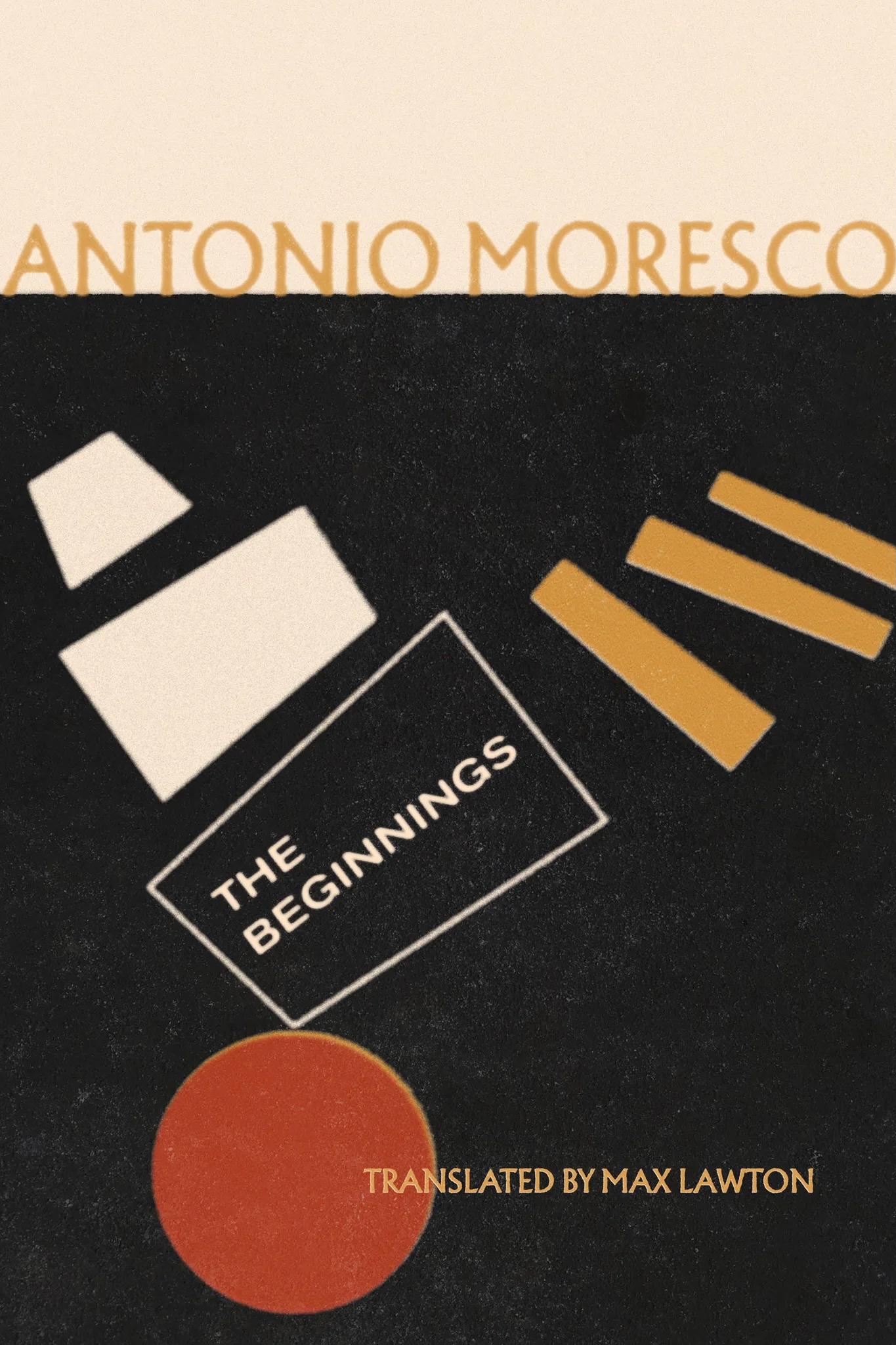
Book cover for The Beginning by Antonio Moresco, translated by Max Lawton. Deep Vellum Publishing, 2026.
I’m so fascinated by how the culture impacts the reception, through all these signifiers, expectations, what you want from your foreign and local writers.
There's a stupid thing people do sometimes where they go, well, the home reception is what's right. I see this a lot on Twitter, where it'll be like, ‘Hopscotch, we laugh at that book in Argentina.’ That doesn't matter! Whatever group of people gets something out of a book or work of literature in a way that enters the canon is equally valid. The home culture does not have a monopoly on this. In the same way that Poe was discovered in France more than he was discovered in America; or Joyce, in Ireland, oh man, nobody liked that guy, because he was, ‘Stephen Dedalus,’ thought highly of himself, was more than a bit pretentious.
Andrei and I are not just glazing foreign books at random—there’s so many fucking books in the world, so we're not going to the bookstore in Germany and just saying, what are the books that are over 1000 pages? Let's pick up every single one of these. These are just books we, at the end of the day, think are cool and have something to offer that hasn't yet been seen before in World Literature.
There is this gotcha thing about people being like, well, actually, it was barely considered anything in their home country.
‘Bolaño’s a high school writer for us in Mexico.’ It's like, cool, dude. I don't know what you want from me here. Most people don't even know how to read anymore.
Totally. I’ve seen Schattenfroh and some other demanding novels advertised or described in reviews as ‘antidotes for your shrinking attention span.’ Besides it being a tidy spin, do you think that writers have any responsibility to confront the reader in some demanding way? As artists, do they have any degree of responsibility at all?
I think you can do whatever you want. I love James Ellroy, and that's like pop trash. The Shards, you know, Bret released as episodes he was reading aloud on Patreon first. I don't think you have a responsibility to do anything. Personally, I like engaging with art in a way that isn't totally mediated by my cell phone. I'm not checking Instagram every two minutes, so it's cool. Plus, when you read, you relax, your nervous system slows down. I don't think that's a responsibility thing, you know? Again, I think of stuff purely in terms of pleasure. For me, books are like drugs. I wish people had greater attention spans. But it's not the role of art to fix that. Art can be whatever it wants to be. I love the Harmony Korine movie, Aggro Dr1ft, that's like a Travis Scott music video. It's dumb. But I love it, you know? Art doesn't have to be good for you. I love Stephen King. So I guess it's cool to the extent that the books might have those side effects, but they oughtn't to do anything. They can do whatever they want.
Yeah, I tend to agree. I’m not sure that anything meaningful can come out of giving literature this grandiose responsibility. That being said, some works of literature have an outsized impact on the wider culture. Blue Lard, as described in the blurb—and a huge part of its mythos—caused a major scandal in Russia when it was first published. A pro-Kremlin mob tore copies of the novel up and tossed them into a paper mache toilet outside the Bonnoi Theater. It's a very strange, spectacular anecdote. Reading the book, I thought, this is such an obscure, difficult text, it's crazy that it had such a cultural impact in the same vein as Midnight’s Children or Ulysses. Do you feel that in this scandal-saturated world, literature still has this power to upset and transgress on this level? Is it culturally relevant in the same way anymore?
Well in Russia, yes. With a smaller reading public, or in cultures with a lot of nationalism, literature has an outsized impact. But, more generally, literature still does have that power, for sure. American Psycho, right? That's a big one. My Struggle in Norway was very scandalous, but maybe that's a good example of Norway being sort of this closed little thing. Think of what a nuclear subject Infinite Jest is, or book bros. So, I think, yes, it does. It's not gonna be on the front page of the New York Post, but I think that literature retains an ability to start conversations, to upset, to scandalize. I don't think that's going anywhere.Of course, it's different. But I mean books are the oldest form of entertainment in a certain sense, so I don't think that there's any danger that that will go away. And we'll see what sorts of scandals are still capable of being kicked up by Songs of Chaos. Yeah, just see. It’s horrifically, horrifically, horrifically scandalous.
Going back for a moment, your mom is a playwright and an author. Did you grow up in a household surrounded by books?
Of course, my parents were very verbally driven. My mom always spoke French to me after we moved back to America. I was born in Brussels. I lived there until I was three. My parents always read to me when I was a kid, took me to Shakespeare plays. I went to Shakespeare summer camp when I was in middle school, so I'm technically a trained Shakespearean actor. The reading took off for me pretty early. It was always a transgressive thing. It's funny to think of my parents as being responsible—which they definitely are—because it was such a bother to them a lot of the time, I would really push the envelope. I read Trainspotting when I was in seventh grade, so yeah, 12 or 13, which is way too young. And that's when I read Crash, American Psycho, all those great books for someone of that age—Stephen King. I think that my taste in books and art is also partially formed as a rebellion against my parents. Back in the day, I was a little too provocative.
I feel like a lot of people's taste in literature is a rebellion from their parents’ cultural values. I was infatuated with the Beats and the whole culture of that when I was 16, 17, and the mythos, and that's been an area of romantic, rebellious interest for readers for about 70 years. Kerouac’s interesting, because he grows out of himself in later books. He's alienated from his whole image, and reading that felt like maturing with him.
Dark books, Big Sur is super dark.
Were there any literary movements that you remember being interested in?
I feel like it is a school of writers now that we could thematize in some way. Like, you know, Bret Easton Ellis. I read Chuck Palahniuk as well. I don't think he's a good writer anymore, but Irvine Welsh, he's got his good sides, David Foster Wallace and Bret Easton Ellis, shading into Thomas Pynchon and shading into Mark Z. Danielewski before that, with House of Leaves. What do we call that? It’s like avant-garde-gesturing transgressivism.
Yeah, I don't want to say post-modern, but yeah, the counter-cultural-ish, male literary movement of the 90s. There's not an equivalent I could point to now.
No, unfortunately. It sucks, because those were great books, and Chuck Palahniuk is a great writer for a high-school boy. It's not like I could read it now and enjoy it, but it does do certain things well with tempo or voice. It's imaginative. It's a book. It's a fucking book, you know?
Your debut novel, Progress, is scheduled for a 2027 release. What can you say about it?
It’s hard. It's sort of my elegy for the American infrastructure; like a funeral for the world I grew up in. It's about two guys just walking across America after an apocalyptic event. That makes it sound a little bit like The Road, but it's nothing like The Road. Will Self said: ‘The J.G. Ballard of the Drowned World and Crash meets the William S. Burroughs of The Wild Boys at the place of dead roads.’ It’s a lot of descriptions of infrastructure and violence, and I was also very influenced by the Austrian author Peter Handke at the time. It's just like a conceptual apocalypse novel, I guess. But it's really about the skin of America.
Just to go back around quickly to translation. Did you always intend to be a translator, was that something on your mind as a high school student?
Weirdly, it was. I was always interested in books from countries that I couldn’t read. And for me, translation is just a form of very, very deep reading. That's what I love about it. So, I get paid to read Songs of Chaos for six hours a day, you know? Yeah, all these books are just books I want to spend that time with, and I would never in a billion years read them as deeply as I'm going to have to now. It’s also a little bit like marriage or any other relationship where you're like, wow, I love this thing, I'm gonna dredge the depths of it and understand every last bit of it. You fall in love with it in such a deep way that also means getting rid of that initial infatuation.
I do want to do a Henry James in about 20 or 30 years—hopefully I'll be resting on my laurels a little bit—and I’ll just go back and read all my translations and compare them to the originals. I’ll see what I want to fiddle with, do it slowly.
Bit of a George Lucas.
Yeah. Just to see what I like about the books too. It's like you get so deep into it that you just don't even know…It's like you're in them, and you cannot see the forest for the trees anymore. It vanishes, like with Sorokin—I can't. I don't even know what it's like to read him as a reader anymore. And that's weird.
Yeah, you began translating Sorokin in 2016 when you were just 23—my age now. You mention this briefly in the afterword for Blue Lard, but I'd be interested in how this collaborative partnership came about.
I just got his email. I translated like, 80 pages of Blue Lard decently well—though, looking back, I was young—and I just sent them to him and said, ‘I want to be your translator: I think I can make you famous in America, like Bolaño.’ Maybe a little naive, but he was looking for a fresh start. He said he wanted a picture of me, and once he saw my face, he was like, ‘okay, we can work together.’ At the time, my Russian was pretty good, but it wasn't that good. I was at Oxford, and worked so hard translating a bunch of the stuff. That just became my job, and academia became a way of funding my job. I couldn't have lived on my translation income until I had basically finished my PhD. God is great.
Sorokin is like my second dad, in a way. I look for father figures in a lot of these writers, I think specifically with him and Will Self, we have these very close relationships. And I solicit their advice in all things. They’re very different men. But my two lit daddies.
Do you feel like the works you translate are your personal literary inspirations, or are they quite different?
I have a good membrane between them, because I've always done both, and I have a pretty specific vision of what I want to write about that doesn't really have anything to do with what I translate. The books I translate are all very outside of the world. I'm interested in being more inside of the world. My friend Drew Daniel [half of electronic music duo Matmos, John Hopkins professor] said that what Lentz and Moresco have in common is that they both create pocket universes. And I don't do that so much. My writing is very musically geared, in the sense that I'm interested in writing that interacts with the world as it is, not so removed from it.
Embedded within the contemporary world, rather than metaphysical musings, or period pieces.
Exactly, exactly. Bret's a good example. Like Bret, the way he engages with the world and interacts with the world as it is.
I heard you mention before in an interview that you don't write and translate in the same day. So, what's your writing practice? You wait until you're not translating. And how does it come to you?
I have a very rigid schedule at this point because I have so many projects for the next three or four years. So, I'll just schedule out a few months and then, like, write a book. I just gotta do it. I put that time away; these are my bookwriting days. Bill Vollmann told me that I'm ‘a graphomaniac after his own heart.’
If you type every day and spend the time and bring attention to it, at the end of the day, it's not that much, especially with the head-start I've had. So, the good thing is if you do it enough, you just do it. I remember when I was in college and even when I was first starting to write my own stuff, it would be like pulling teeth trying to write. It hurts to sit at the desk. It's painful, you don't trust yourself. Now I have the opposite problem, where I kind of want to slow myself down, not with translation, but with writing. It just comes out, and then I'm like, oh, there it is. Whereas I’m trying to be more meticulous.
Looking at your output on paper, you've got nine published translations in just four years, you've recently earned a PhD, you've got at least one upcoming novel, that's a pretty remarkable output. What drives you?
I have no idea. I mean, I would just say what Bill said, if I get to be a graphomaniac after Bill Vollmann’s heart, that's probably as good an explanation as any. Sometimes I feel a little bit saddened when people on the internet will look at me with this jaundiced gaze and try to see weird motives. Feel free to dispute the quality of my work, but I do it because I love it. I can't imagine having a real job and being a real person. This is what I've always done. This is what I do. I've always spent my time with books. It just is what it is at this point, I don't really have an explanation for it, other than it's just fate, I guess.
Would you like to continue to do translations as long as it goes, or are you looking to become more of a novelist as you go on?
I want the balance to shift in the other direction. I want to spend nine months out of the year writing slowly. Actually, this Moresco quote is so good. He said, “I'd like to be able to write calmly as writers who don't have a fucking thing to do, writers who, unlike me, have it easy, churning out some acclaimed little book every 10 years and it always gets hailed as a masterpiece. They don't have issues with money. They don't have to work themselves to the bone like 19th century writers just to make a living. I'd like to be like them. Be a real fucking stylist about it. Act all high and mighty. Work over each sentence for half a day, engraving incandescent matter with a chisel, attempting all the while to cool it down.” So I'd like to write slowly and then translate slowly every once in a while.
That does seem like the ideal.