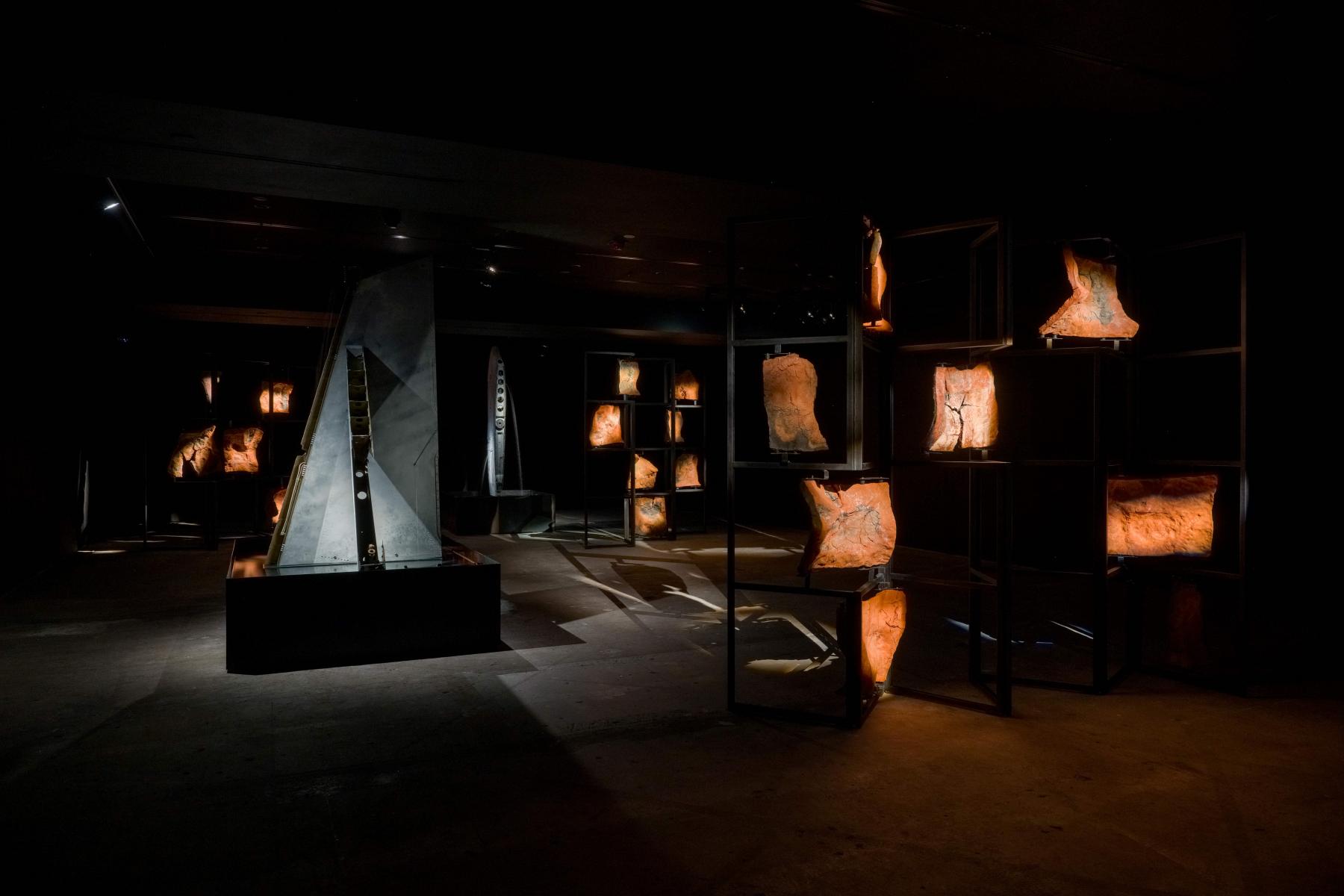
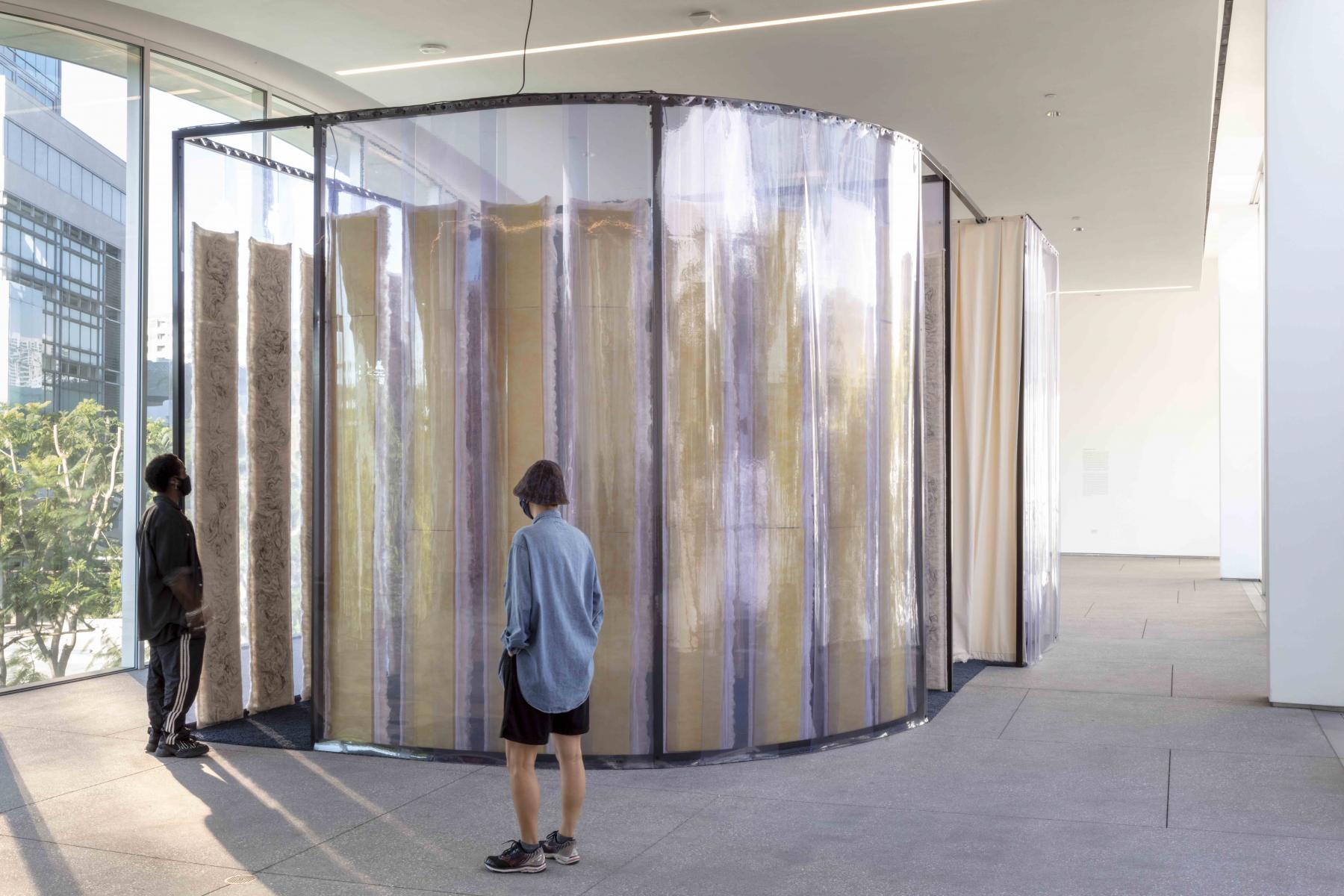
Gama, Jacqueline Kiyomi Gork at Empty Gallery Hong Kong, September 27 – November 15, 2025. Photo: Felix S.C. Wong.
Raised in Long Beach, California, amidst the industrial thrum of coastal freeways and late-night power plant emissions, the artist Jacqueline Kiyomi Gork discovered early that sound isn’t just a part of the atmosphere—it is a physical material and a mechanism of covert authority. After obtaining a BFA from the San Francisco Art Institute and an MFA in studio art from Stanford University—where they conducted research at the Center for Computer Research in Music and Acoustics (CCRMA)—Gork has spent two decades establishing a muscular, uncompromising practice in spatial art. Fusing sound, sculpture, and site-specific installation, their work has commanded deep critical respect and international renown, earning prestigious honors like the Joan Mitchell Fellowship and the Gold Art Prize, alongside exhibitions at SFMOMA, MOCA Los Angeles, the Taipei Biennial, and the Gwangju Biennale.
Gork’s work grounds itself in institutional critique, avant-garde composition, and iconoclastic subcultures. While inheriting the spatial ethos of experimental composer Maryanne Amacher—who treated sound as indistinguishable from the room around it—Gork’s work also carries the raw charge found throughout the West Coast experimental noise and underground club scenes that the artist came up in. Simultaneously, Gork's practice finds a compelling link to the early systems art of Hans Haacke. Much like Haacke's kinetic, environment-responsive pieces, Gork treats the gallery as a dynamic physical feedback loop rather than a static container—an open circuit where the viewer’s movement and agency act as a vital, unpredictable input. A DIY instinct anchors Gork's multi-directional practice, which is also founded upon investigation into the violent histories of institutional and state power, and scientific research into how sound and pressure work on the nervous system. From these inquiries, Gork has constructed tightly calibrated environments that have incorporated everything from sound-absorptive overcoats felted from human hair to soft inflatables, spatialized speaker networks, and brutalist 'Zen' fountains welded from repurposed military aircraft hardware.
Gork refuses the solemn, passive rituals of the gallery white cube, creating instead decentralized feedback systems where visitors are free from the constraints of fixed seating, optimal listening points, or a prescribed duration. By shifting power back to the listener—who navigates contrasting acoustic zones at their own pace—Gork neutralizes authoritative control, cuts through spectator fatigue, and rehabilitates listening as an active, performative act.
I spoke with Gork a week after their return from South Korea, where they presented the labyrinthine installation Not Exactly BPM (Variation Rrose) at the 16th Gwangju Biennale. We met at their live/work studio in Arlington Heights—a neighborhood in South Los Angeles stitched together by broad avenues, older wood-frame homes, and low-lying commercial blocks. Their living room was filled with research texts and books on Okinawa and Japanese history, including volumes inherited from Gork’s late grandmother. These pages help trace their ancestral map stretching from Eastern Europe to Japan—a lineage that directly informs recent installations like Gama (debuted in 2025), which explores the spectral weight left behind by the Battle of Okinawa and World War II Japanese-American incarceration camps. Ahead of our meeting, Gork reached out by text to ask whether I preferred homemade cold green tea or coffee. When I told them to decide, I arrived to find both prepared, leaving the decision entirely mine—a subtle gesture that mirrored the generous agency and choice built into their sonic environments.
In my installations, I want the audience to have agency. If a visitor doesn't like a particular sound or visual element, they can move to another zone or leave entirely. That desire to grant autonomy is why I doubled down on using specialized acoustic materials in my sculptures
You grew up in Southern California and are now based in Los Angeles. Do you think living here has given you a distinct way of listening, and has the city’s acoustic environment entered your practice in ways you recognize?
I’ve always been a listener. Around age seven or eight, after encountering some trauma, I became much more introverted and hyper-aware of my surroundings. I think I started using listening as a coping mechanism—a way to disengage, using environmental noise to create distance or direct my attention away from the more troubling things.
I grew up in Long Beach, right where the 605, 405, Route 22, and 7th Street meet. If you’re from here, you know that freeway intersection—it’s quite massive—and that was the ambient white noise I could get lost in. There was also a power plant right there that let off loud steam late at night. My parents told my brother it was “just Star Wars” so he wouldn't be scared, but I remember driving past it and thinking, “that is not Star Wars.” That was an early realization about perception—that how we perceive a sound or an object can be altered by the information we're given. It made me ask why that information was framed a certain way, and how my perception was being manipulated.
At the same time, I grew up going to the beach and spending time with family who live in Hawai’i, so the sound of the ocean will forever feel like home. Lying in bed [in Long Beach], I’d listen to the traffic and imagine it was the ocean, combining or projecting the emotional memory of a sound onto the freeway noise made that environment feel soothing and comforting. Those early acoustic experiences do feel foundational.
Los Angeles is often understood visually, through its light, architecture, freeways, and landscape. What do you think you can learn about LA by listening to it rather than looking at it?
I think the freeways and helicopters are iconic, both visually and sonically. In a different home from my childhood, I recall watching helicopters in the distance from an upstairs window. I'd watch them go by and imagine—since you couldn’t really see stars [due to light pollution]—what if those helicopters were shooting stars to wish on? It comes back to changing your perception, trying to reframe your world just by making shifts to how you take it in.
Now, living directly in a helicopter path, it’s different. When they hover, it can be annoying of course, but it’s something you just have to accept. It’s the same with the people doing donuts in the street outside. Sure, the sound is obnoxious, loud, and it stinks, but that’s Los Angeles. You can’t have this city without the raw, noisy parts. If those things really bother you, you shouldn't live here. I feel strongly about that. LA isn’t for everybody.
Before developing your practice in sound, sculpture, and installation, you trained in dance. You have since described yourself primarily as a “listener” rather than a performer. Do you see these roles in opposition to one another?
I actually see listening as a form of performance. As a receiver of information, you’re performing that act of listening, but when it comes to capital-P “performance,” I much prefer to be behind the scenes or collaborating with performers.
The only performing I really did, sound-wise, was noise music. That worked for me because it felt like I was in the room listening and experimenting right along with everyone else; there wasn’t a rigid structure. In my twenties in Oakland, playing synth and noise in an art kraut-punk band called 0th was really about community and being with friends rather than any ambition or career with it.
Did being watched as a performer have any impact on the way you position yourself within, or outside of, your installations?
It’s a good question. I think so—the watching and the being watched. You learn dance through observation: watching videos, watching other dancers, watching yourself in the mirror, and then attempting to forget the mirror. It’s a feedback loop of observing, adjusting, and watching again. In ballet, understanding what’s correct comes down to a physical feedback system—making tiny, minute adjustments to your shoulder, hip, or foot where every small tweak produces a completely different outcome.
When I started working with feedback—whether conceptually or physically by feeding sound back into itself—it just made sense. I was already so accustomed to that process of fine-tuning and seeing how a small adjustment changes the whole system. That absolutely makes sense to me. It brings about a sense of agency.
You have said that “sound is both the beginning and end point” of your work, and that many works begin with an everyday sonic experience that you then research and transform. What tells you that a particular experience contains enough of a question to pursue?
I have no idea. It’s completely intuitive—something just clicks. A question I can't get out of my head. Often it happens through a listening practice, whether intentional or not.
While I was in graduate school at Stanford University, where I studied communication technologies and computer music—a place that is so highly organized, clean, and controlled that it almost feels like Disneyland—I was walking around campus and heard one light buzzing obnoxiously. The fact that this single, uncontrolled buzz existed in such a manicured environment triggered an entire slew of ideas for an early noise piece.
It can come from anywhere, simple or complex. My very first inflatable sculpture actually started from an everyday experience while pumping gas. It’s rarely a calculated decision; an everyday disruption just catches my attention and takes root.
Pumping gas? Do you mind getting into that?
It was really early on when gas stations started installing speakers that would play ads, news, and music at the pump. I was running late, needed gas, and I remember a song by the pop singer Adele came on—one I really disliked and couldn't escape because it was everywhere at the time, so there I was, trapped at the pump and forced to listen to it.
I think that frustration triggered a deeper inquiry into pop music: What are the specific mechanisms in a pop song that trigger such a strong reaction in the nervous system? In graduate school, I had studied cognitive music theory and psychoacoustics—how tonal systems affect the body through tension and release. Experiencing that forced listening at the gas pump brought the theory onto a real-world surface. It combined the science of how sound manipulates our physiology with the frustration of daily life, and that experience really made me want to blow the concept up.
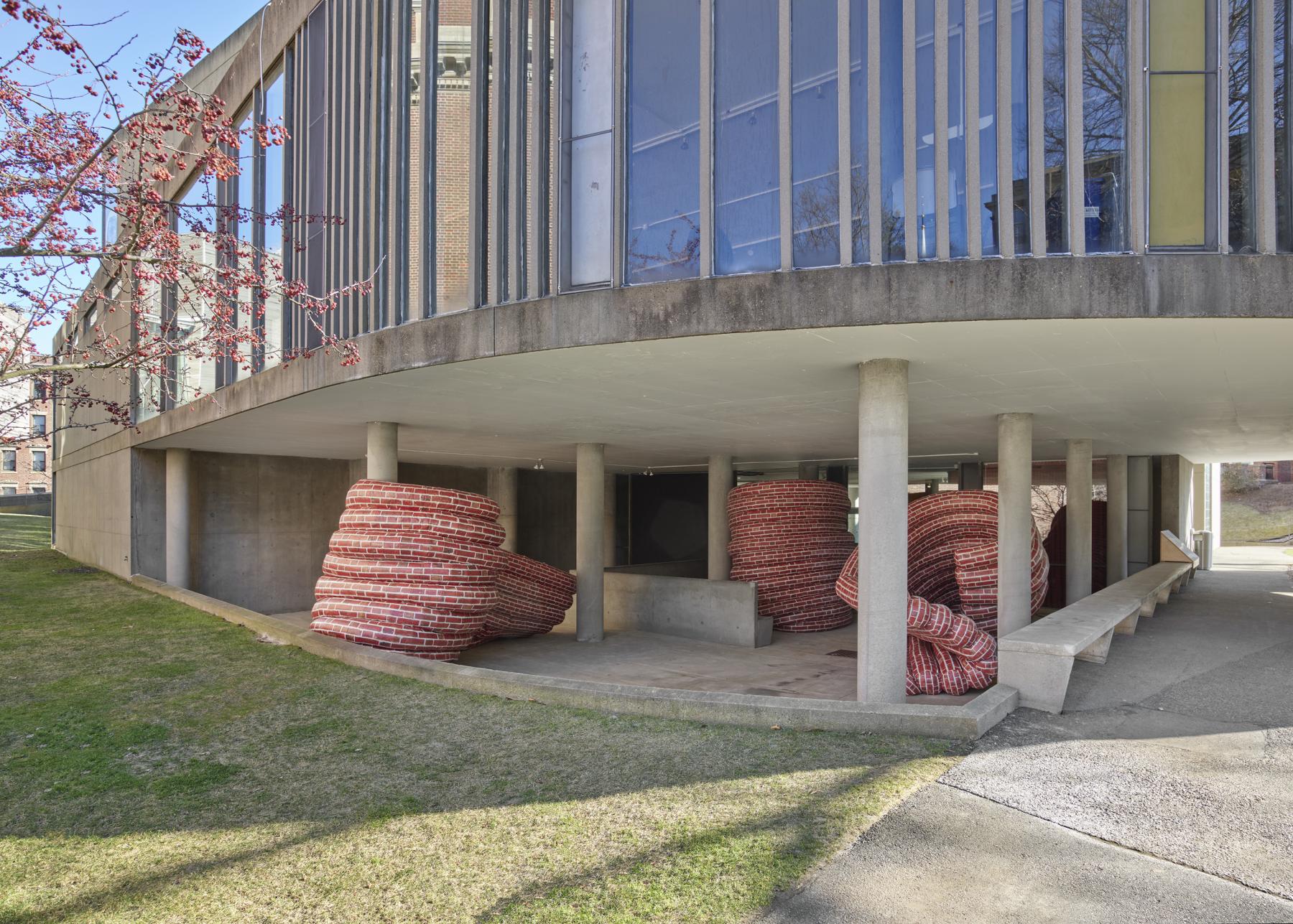
Installation view of Jacqueline Kiyomi Gork: Poems of Electronic Air at the Carpenter Center for the Visual Arts, 2024. Variations in Mass Nos. 5, 6, 7, 2024, vinyl, blowers, electronics, and speakers. Collaborators: Viola and violin, Daniel Jacobs; Cello, Zack Reaves; 3D design, Rhett LaRue. Courtesy of Carpenter Center for the Visual Arts. Photo: Julia Featheringill.
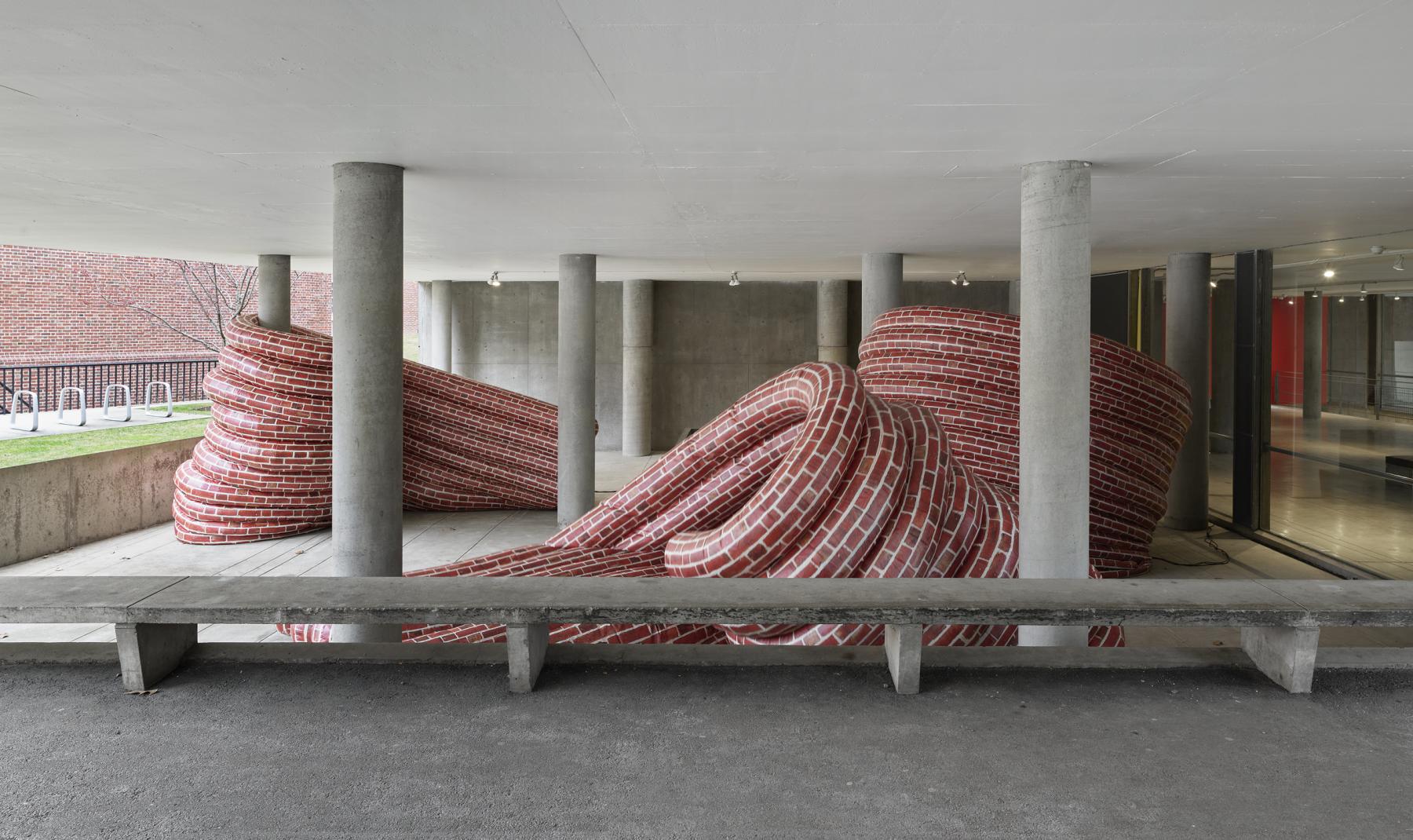
Installation view of Jacqueline Kiyomi Gork: Poems of Electronic Air at the Carpenter Center for the Visual Arts, 2024. Variations in Mass Nos. 5, 6, 7, 2024, vinyl, blowers, electronics, and speakers. Collaborators: Viola and violin, Daniel Jacobs; Cello, Zack Reaves; 3D design, Rhett LaRue. Courtesy of Carpenter Center for the Visual Arts. Photo: Julia Featheringill.
I recall in an interview with independent curator and author Micah Silver, you described this manipulation—noting that at an early age, you could identify feeling manipulated by pop music as well as cinema. I am curious how you distinguish between emotional communication and emotional manipulation?
I think it comes down to a top-down situation versus something that leaves room; space for you to insert yourself. I avoided Hollywood movies when I was a kid. I was a bit of a control freak about my emotions; having a film force me to feel a specific way didn’t feel good to me. On top of that, growing up in the 90s, I didn’t see anyone who looked like me. There weren’t a lot of queer or mixed Asian narratives in my world. I didn’t know about experimental stuff yet.
It wasn't until I went to school in the Bay Area, where my roommate worked at a video store and brought home experimental films—the French Nouvelle Vague, Bresson, Tarkovsky, etc. Those films left a lot of room for interpretation; films where I could insert myself and my own thoughts. In hindsight, I think it actually has a lot more to do with the soundtracks than acting or narrative. I still struggle with feeling overly sensitive to how music is used in narrative media. Like, I really want to watch scary movies, but the sound design is just too much for me.
That said, my relationship to manipulative media has definitely shifted over time. I mean, I started listening to country music after a recent loss.
Part of the grief process…
Yeah, totally. I just listen to country radio now in the car. [laughs]
After so many years of rigidity about what I listened to in my twenties, there’s something so funny and ironic about listening to this heavily manipulative, heartstring-tugging music while sitting in traffic on the 10 freeway—yet somehow, it fits? It just sounds good right now.
That’s funny, I’ve had a similar shift these days. I recently heard that song by Nora Jones [`“Don’t Know Why”], and thought, this… speaks to me now? I really missed an entire era of pop music, and for what? Music snobbery.
Yeah, me too, but I think it wasn’t so much snobbery as a rigid boundary—guarding what I let in as a way to control my environment.
Right. Like, I found this thing, therefore it’s allowed in. Not just taking what was being fed to the masses.
Exactly.
Getting back to that early interview with Silver. At that time, you were developing Not Exactly B-Flat. This was 2017, and the subject of Donald Trump surfaced, and you were analyzing the non-semantic, acoustic power of political speech—looking at how cadence, repetition, and his non-sequiturs could manipulate emotion with a total absence of logic.
Looking back from 2026, that focus on speech as physical affect feels almost prophetic. How has your understanding of political speech and acoustic manipulation evolved over the last decade, and do you see your current work operating in that same political space?
I explored those ideas deeply in a performance installation for the Hammer [Museum exhibition Made in L.A. 2020], which was unfortunately delayed and restricted due to the pandemic and had very limited performances. The piece was made just before the current AI models were launched. I knew I wanted to use a text generator for the work. Algorithmic and machine learning music and use of neural networks have been developed alongside sound technology since the 1950s, so it felt like a natural extension of my practice.
Working with a programmer friend using earlier GPT-2 models, we fed the system a mix of political speeches—Obama, Bush, Trump, TED Talks, and public addresses—and then trained it specifically on Trump’s cadence. At the time, this was early days and the output was maybe 20% usable, so I worked with a speechwriter to edit and format the text, feeding it back into the system to jumble and spit out again. It became a feedback loop of professional human editing and machine generation. Once the show finally opened though, I had tampered down a lot of the Trumpisms—it was getting too triggering and I did not want the piece to be about him, per se, but more about the use of this kind of manipulative language.
Before that, I had mostly worked with abstract noise, but during that period, I was really obsessed with language and structured systems of communication. Then ChatGPT-3 hit, making text generation ubiquitous overnight. While I initially loved using it to assist with programming, the rapid explosion of AI really shifted the conversation.
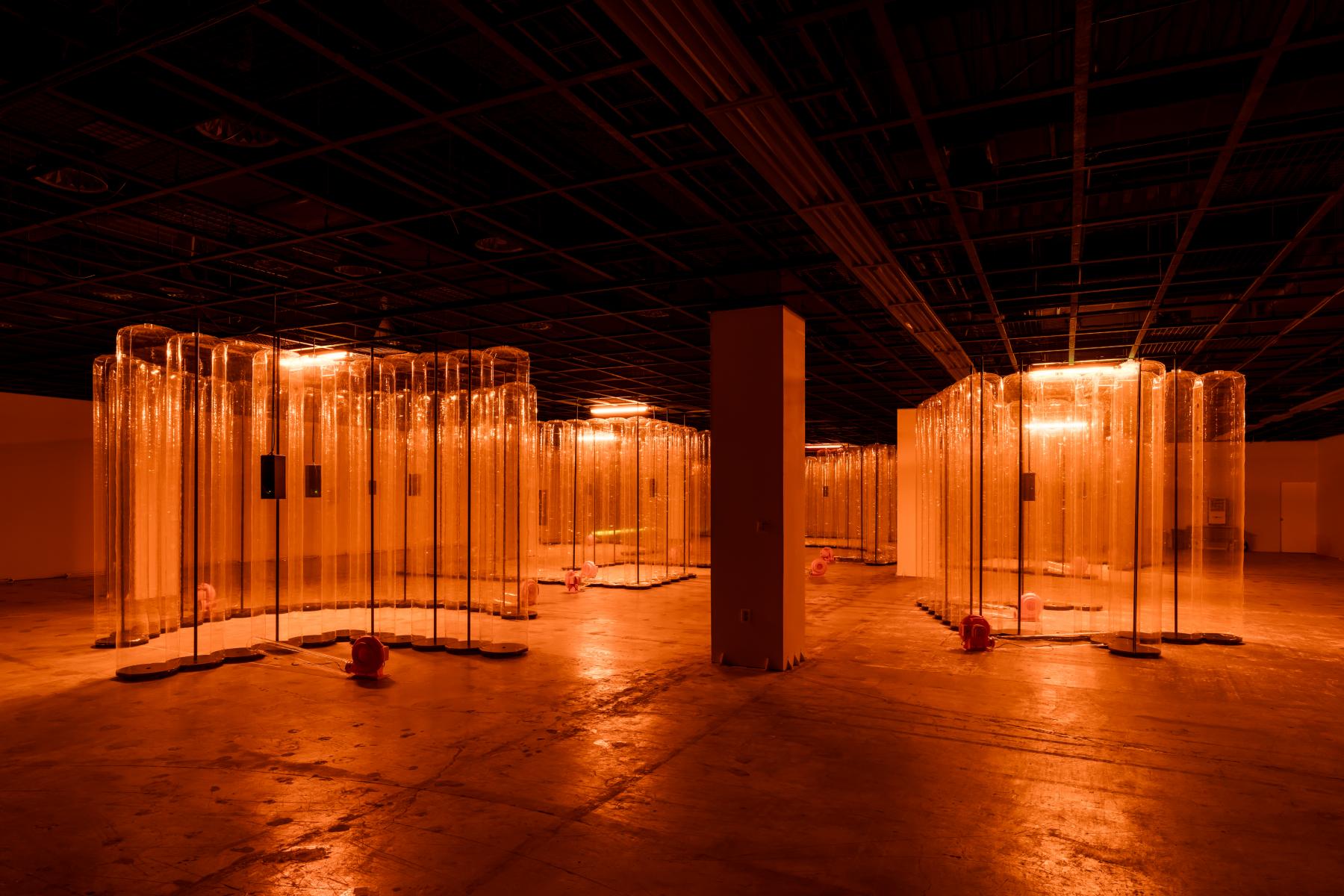
Jacqueline Kiyomi Gork, Not Exactly BPM (Variation Rrose), 2026. Installation view, 16th Gwangju Biennale, Gwangju, South Korea. Courtesy of the artist and François Ghebaly, Los Angeles, New York.
.jpg)
Jacqueline Kiyomi Gordon, Not Exactly B-Flat, 2017. Installation view, 356 Mission, Los Angeles. PVC Tarpaulin inflatable walls, Arduino and mini triggers. Sound: "A Song" excerpt. Writing and vocals: MNDR, Carolyn Pennypacker Riggs and Jon Mandabach. Producer: Mess Kid. Spacialization, arrangement and co-producer: Jacqueline Kiyomi Gordon, 9 channel. Dimensions variable.
Would you like to revisit that work now?
I definitely would, and I'd love the opportunity to really rethink the premise. We’ve moved so far beyond cognitive dissonance and acoustic cadence simply being mechanisms of emotional manipulation—those anti-semantic tools have now been fully codified into policy, daily life, and warfare. The stakes are completely different today.
Works such as Not Exactly B-Flat and its later iterations have been reconfigured for spaces with very different scales and acoustics. At what point does adapting an installation to a new space produce a new work rather than another iteration of the same one? What, if anything, must remain consistent for a work to retain its identity?
I think about it in terms of music composition: you have a score that is written, and then you have all these different ways of performing it. That's why I treat them as variations. Every time a work is reconfigured for a new acoustic environment or spatial scale or timeline, it becomes a variation of the original piece rather than an entirely distinct work.
You have recognized in past interviews that our experience of sound is shaped by the physical structure of our ears, our cultural histories, and our individual sensory and physical capacities. When composing for an installation, how do you account for these differences, and to what extent does your own mode of hearing and sensory perception serve as the starting point? In your mind, do you consider a default?
I mean, obviously, my own body and sensory perception are definitely the starting point—everything is filtered through my experiences and what I’m paying attention to, or intentionally not paying attention to.
While I like to think I create non-hierarchical spaces, these are still highly-controlled environments where I make a lot of structural decisions. However, I deliberately avoid designated sweet spots, seated theater layouts, or fixed durations. Traditional venues make me very uncomfortable. I was fortunate to come up in the punk-noise and experimental scenes in the Bay Area—places like The Compound, Recombinant Media Labs, and warehouse parties—where listening environments were still immersive, but offered choice. Even the simple freedom to choose whether to sit, stand, or face a different direction enables you to find your own place in the experience and become a better listener.
In my installations, I want the audience to have agency. If a visitor doesn't like a particular sound or visual element, they can move to another zone or leave entirely. That desire to grant autonomy is why I doubled down on using specialized acoustic materials in my sculptures. By tailoring the acoustic absorption and reflection within a room, one sound exists here while a different sound exists a few feet away. Moving your body between those sonic zones forces a subtle choice: Left or Right? Why do I prefer this sound over that one? Giving the audience an active, physical relationship to the artwork opens up space for those internal questions to emerge.
Relating to your past involvement in punk-noise and experimental scenes, humor is a real element in a lot of your work. I am curious if you see “humor” as a tool, something used deliberately, or merely a consequential element?
I think humor is a survival mechanism! [laughs]
But maybe part of that punk inheritance?
Yeah, sure. I can’t take everything so seriously. The world is too fucked up for that.
In the past, my humor came through in titles, visual irony or poking fun of modernity. For example, [for Poems of Electronic Air, 2024], I placed large clumsy inflatable walls underneath Le Corbusier's Carpenter Center. The walls slouch and fall in total disrespect to the cold cement architecture surrounding it. They also have the iconic Harvard redbrick pattern on them, something that Corbusier strictly prohibited from his design of the building. I could go into more detail about my critique of Corbusier, but I think the humor does a better job of communicating it.
But there’s darkness in the work, too. For example, something I have never shared publicly, is why I use my own hair in my Sound Blankets pieces. Hair is naturally hyper-absorptive, and I happen to have a lot of it. Because I have a hair loss condition, I have shaved my head for most of my life and previously wore wigs and extensions. I always collected the hair because it felt like a literal extension of myself, though I never quite knew what to do with it, but back in 2019, while developing new work for [a solo booth at] Frieze, I was experimenting with making felt and it finally clicked. What do you do with hair? You sell it.
It just made sense to add it into the textiles that I was showing at my first commercial art fair, but by taking a material that was so deeply personal and historically loaded and compressing it into an object, I was able to dissipate it into a new system of circulation—and, ideally, turn a profit from it—playing with value and capitalism in a dark way.
 A.jpg)
Jacqueline Kiyomi Gordon, Sound Blanket No. 13, 2022. Courtesy of the artist and François Ghebaly, Los Angeles, New York. Photo: Paul Salveson.
Made in L.A. 2020: a version. Installation view, Hammer Museum, Los Angeles. Photo: Joshua White / JWPictures.com
Hiding the critique from plain sight, therefore making it more approachable?
Yes… but I do worry sometimes. I worry about how humor functions in certain works. Last year, I started making fountains out of decommissioned military aircraft parts—specifically planes used for Cold War surveillance in the Pacific. Structurally, I was drawn to a pylon that was a bomb rack, which holds ammunition under the wing. When you stand it on end and add small spouts, it kind of looks like a peeing [Isamu] Noguchi sculpture. To me, that’s fucking hilarious, but at the same time, this material could have very easily killed people, you know?
It’s a piece I want to continue to explore. I still have remnants of airplane parts to make some new work with, so the next generation of these sculptures might be handled a little different.
It’s interesting because, to me, these fountains are like bastardized, minimalist corporatized “Zen” fountains. I titled them HNZF—which stands for Harsh Noise Zen Fountain—conceived as an acronym of search terms for a commercial product. I wanted the full title to remain unknown, just to use the acronym, though a museum eventually spelled it out on the wall label anyway… but the title is funny, I think.
And so I still have a lot of questions about those sculptures and how the humor lands. Once an artwork enters, say, the museum world or a collector's hands, you lose control over how it's framed. Navigating that tension—between subversive humor, heavy military provenance, and public interpretation—is something I’m still actively processing.
I want to ask about the experimental composer Maryanne Amacher.
Huge influence.
Was she? A direct influence? I thought I read somewhere that you came up on her work sometime after your practice started, only recognizing similarities then…
No, no, no. I learned about her in undergraduate school. I was fortunate to study with [sound artist and instrument builder] Laetitia Sonami, who is a mentor and collaborator of mine now, but was then teaching sound art at the San Francisco Art Institute. I think I was 20 when I first took her class. We learned MaxMSP, how to build electronics and controllers but also about feedback systems, Alvin Lucier, Eliane Radigue and Maryanne Amacher. Then there was also Charles Boon, a composer, who taught a history of sound art; he was more about Cage and Stockhausen.
At the time, there wasn't that much stuff out there about [Amacher]. I remember one article in an anthology of experimental composers writing about their work—[avant-garde composer] John Zorn’s Arcana anthology series—plus the Ars Electronica lecture and some bootlegs. That was it, but I was hooked. So no, she is actually a direct influence on me.
[Amacher] believed that music could not be separated from the architecture that surrounded it. I am curious if when you design an installation if there are any particular spatial or acoustic principles you do rely on, or do all aspects shift depending on circumstances you cannot fully anticipate or control?
I can't anticipate much—90% of it gets done in the space. That's why my installations take so long. If you see my studio, it's actually not that big. Because of that, everything is either made on-site or brought together on-site. And then I compose everything right there. I arrive at the space with the materials, but everything is done intuitively during the installation process.
Obviously, this must be a very time-intensive installation process with a lot of meticulous, incremental adjustments. I'm curious if you've thought about how repetition, fatigue, and mood affect your listening. Do you recognize when sustained attention has sharpened your hearing versus when it is beginning to distort it?
This goes back to Amacher a little bit. She used to live in her installations. Micah Silver actually worked with her on one of her last installations at EMPAC [the Experimental Media and Performing Arts Center], but in general, I've heard stories that she would basically just live in them. That just made sense to me. If I can, that’s how I prefer to work. Once the sculptures are in, once the acoustic sculptures or textiles are in, and once the speakers are connected and I'm ready to go, in my happy place, I would just live there for days straight if I could. I'm able to do that at Empty Gallery in Hong Kong because they built an apartment inside the gallery building. Obviously, museums don't let me do that, so it can be more frustrating to work within certain hours.
My first solo sound installation was in an apartment gallery in San Francisco [A Little Display], and that just made sense to me. It was a 20-channel sound piece with cassette tape loops, all inside a giant blanket that I crocheted speakers into. It felt really natural to be able to spend that much time on the nuance and finessing, take a nap, work on it some more.
But, yes, I do need to take ear breaks. I do need to understand that limitation, but it’s hard. Oftentimes, a piece is finished only because I get kicked out for the show to open. Literally, I had to leave the next day with Gwangju because I knew if I stuck around, I was just going to mess with it. I could just go in there with an iPad or a remote viewer on my laptop and make adjustments without stopping.
For the ICA LA [(Institute of Contemporary Art, Los Angeles)] show in 2023, unfortunately, I got COVID, so I actually couldn't finish the physical install. I had to do it all from the parking lot [laughs]… I had my laptop and I’d be on the phone with somebody inside: 'Do you hear this? Is this coming out of the speaker? Okay, how loud is it? Okay, how does it sound compared to that speaker? Is that speaker louder? Is this speaker louder?' Finally, I was able to go in at the last minute with a mask on and actually tweak it, but I really had to set most of it from the car. That was painful.
Your latest project for the Gwangju Biennale, Not Exactly BPM (Variation Rrose), works again with inflatables. What drew you to the club space as a blueprint for collective listening, and how does that inflatable architecture work for the premise?
The piece for ICA LA [in 2023] also thought about club spaces and how we navigate through those environments. For that one, it was also a clear maze, but a static design and used microphones and live audio processing for the sound. For this latest inflatable piece, I collaborated with [the techno DJ/producer] Rrose and the blower noise from the inflatables to comprise the main sound.
The blowers regulate how much air fills the inflatables, which dictates exactly how sound is obstructed. The acoustic environment shifts through a dual mechanism: the loud mechanical hum of the blowers interacts with the audio, masking it at times, while the physically inflated walls deflect and bounce the sound waves coming from the speakers. When the structures fill with air, the acoustic landscape shifts.
As I said, the audio source material is the sound of the blowers themselves. I recorded their cycles using contact, shotgun, and cardioid microphones, and sent those recordings to Rrose to build the composition. There are 21 walls in total, each one automated and controlled independently, allowing for a lot of detail over how the pressure fluctuates and how loud the system gets.
The clear walls, I assume, were deliberate. How come?
This piece has a lot to do with feeling safe in various club scenes. In Los Angeles, I don’t go to typical clubs; we have warehouses and in those warehouse spaces, the sound is never that great. That’s my biggest complaint. And it’s a lot of work—hiring security, the sound system, bar, porta toilets, etc, but the upsides are being able to book the people you want to see and support and there’s a strong community feeling.
Then there’s New York, Berlin, these other places where they have established clubs with these awesome sound systems, a real bar and actual bathrooms—I'm old, I appreciate these things—yet at the same time, I’m navigating a very different social dynamic. There are some clubs with community guidelines or rules; security making sure people are paying attention and respecting the space. But it’s not the standard, which leads to this desire: wanting to dance, wanting to feel safe, wanting to be with people, but also wanting to feel protected. You want to feel like you can just exist without some rando coming up to try to talk to you, or frat boys chanting loudly.
In a way, the clear bubbles of the installation create distinct zones so that you can be with the sound, be with that single speaker, and exist in an intimate space. To feel protected and intimate, but not separated from the crowd. You're still actively engaging with everyone else and their experiences. I can be in my own zone and watch somebody over there dancing to their own rhythm. Mind you, everything is anchored to a very specific BPM, so they aren't on a totally different rhythm than me. We're just in slightly different spaces with that same BPM.
But protected…
Yes, and it's worth noting that the rhythm of the blowers themselves is programmed with MIDI data directly in the software. They aren’t just utilities; they are treated as an instrument within the composition. There are very few instances where they just run constantly, but when they do, a distinct drone arises from the resonant frequency of the blower combining with the inflatable structure. Rrose seizes on those moments, manipulating that raw tone through the speakers and weaving it into the rhythm of the audio. But for the most part, the blowers are really pulsing—either firing in unison at varying tempos, or are highly scattered and polyrhythmic.
It’s funny—I had this very validating moment last weekend when I saw one of my favorite DJs play. It was actually at a gay circuit party, but it was Ashland Mines, [the electronic musician] who plays under the name Bobby Beethoven. We were having our own separate party behind the speakers, and every once in a while, I'd look out at the crowd... and Ashland loves to do this thing where he fucks with the audience. He really pushes what is danceable. There are moments when he plays some hardcore noise—there’s still a rhythm, but he really messes with it. And so I was watching the crowd in front of him, and at these parties, the crowd is used to a very typical kind of beat. They have this expectation of the 'dun, dun, dun.' When he would change it, you’d see all these topless sweaty bodies bopping at completely different rates, just trying to find their own rhythm in the noise.
With the Gwangju piece, there is a moment where all the inflatables are doing exactly that on their own. They are still within a rhythm, but they don't quite know where they're going. So, watching that crowd, I just thought… 'Oh my god, this is amazing.' It was a complete moment of validation for the piece.