Nour Bishouty, “Untitled/Loop” (installation view), 2026. Nour Bishouty, “Unlikely Mother” 2026, at Museo Universitario del Chopo, 2026. Courtesy: Museo Universitario del Chopo and Cooper Cole, Toronto. Photo: Ramiro Chaves
Nour Bishouty is an artist based in Toronto who works across sculpture, the moving image, works on paper, and writing. Having encountered her work at various exhibitions and screenings in Toronto including at Cooper Cole, GTA21 at the Museum of Contemporary Art Toronto, and Toronto Palestine Film Festival, and having had the fortune of discussing Nour’s work with her over the years, we decided to extend our dialogue. The following conversation was conducted during her latest solo exhibition at the Museo Universitario del Chopo in Mexico City entitled Madre Improbable (Unlikely Mother).
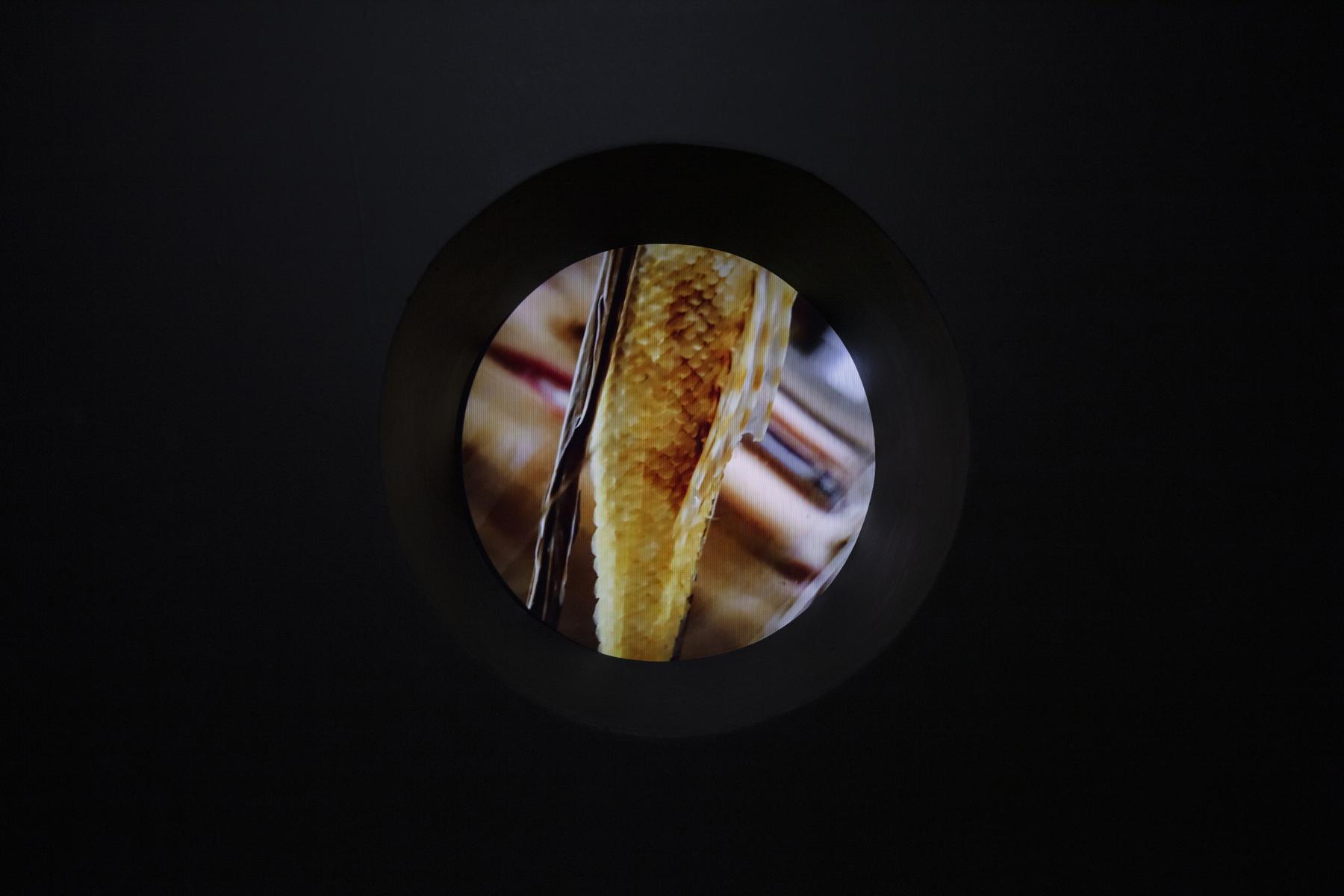
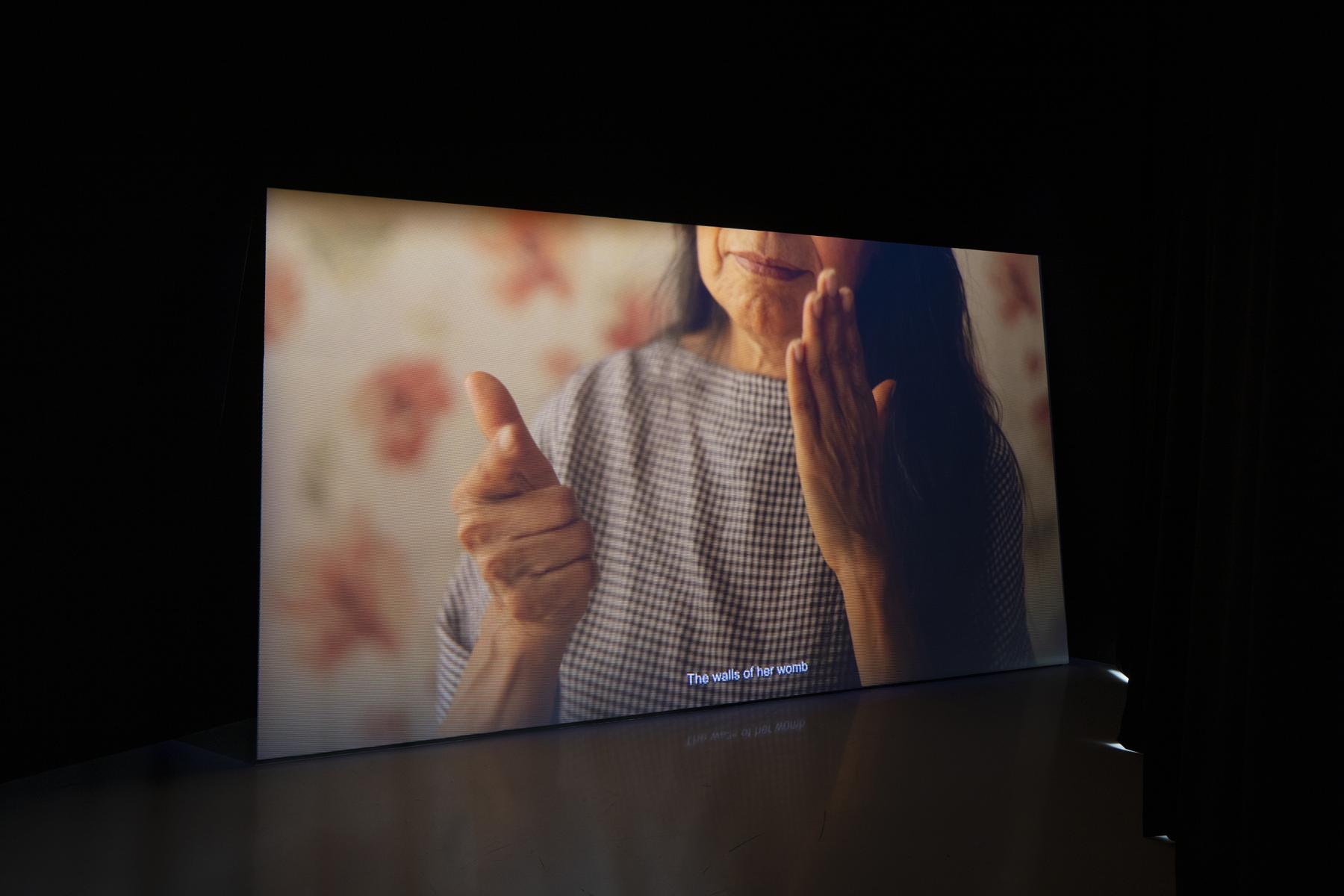
Unlikely Mother centres around two new films: Catfish Mother Puddle of Juice (2026) and Untitled / Loop (2026). The former moves between scientific language, familial narrative, and animal allegory, to consider how bodies become legible through systems of naming, classification, and description. The film is narrated by a catfish, and voiced in Spanish translated from Bishouty’s English and Arabic script. The latter draws on recorded conversations with Dr. Nathan K. Lujan, an evolutionary biologist and the Royal Ontario Museum’s Associate Curator of Fishes as he speaks about catfish. The footage plays twice, however on the second ‘loop’ the scenes are reversed. These films are presented with recent sculptures and works on paper at the Museo Universitario del Chopo.
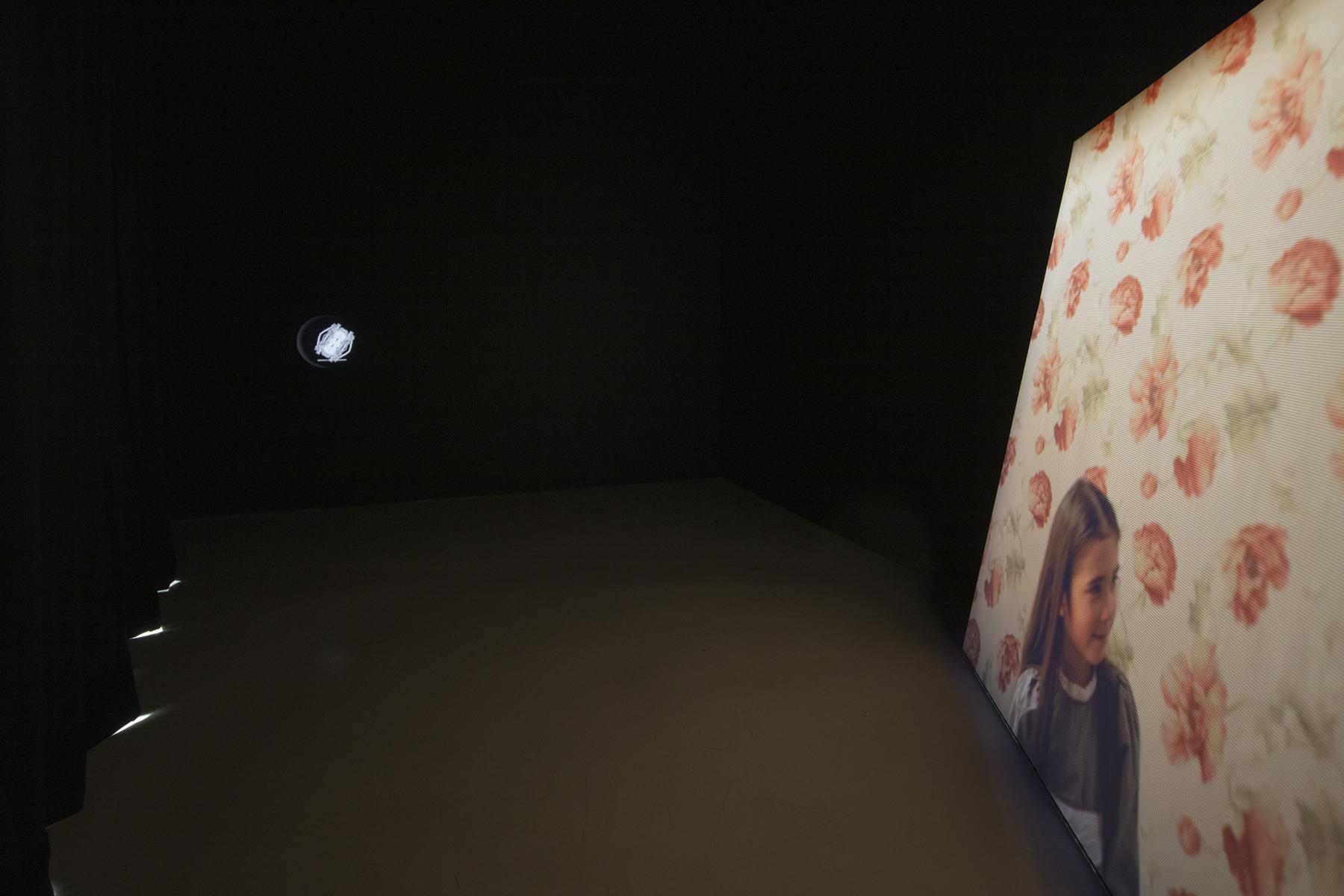
Understanding the installation provides a useful foundation for this conversation. The films are presented in a constructed ‘black box’ in the middle of the cavernous exhibition space flooded with natural light. Inside the box, Catfish Mother Puddle of Juice is projected at large scale, while Untitled / Loop is played on a small monitor set into the wall, to be viewed through a circular opening. Outside of the structure, works are hung asymmetrically on walls painted in shades of teal. Sculptures are presented on natural wood plinths, holding the work intentionally yet unobtrusively.
While this conversation focuses predominantly on this exhibition—particularly the two films—it is grounded in broader concerns that run throughout Bishouty’s practice. Her work repeatedly returns to questions surrounding the production and circulation of knowledge, the problematics of its pedagogies, and its material effects on everyday life. Bishouty considers these issues through the reconfiguring or reimagining of familiar objects, educational systems, and narrative structures. When viewing her work, the task of learning differently—both cognitively and viscerally—illuminates her critique. However, the stakes of this practice do not conclude with the revelation of Western dominance in our everyday lives, nor even the imagining of an alternative. Bishouty works with vulnerability, through practices that undercut the assumption of knowledge as mastery—by drawing with her non-dominant hand, or creating a film in a language she does not speak. It is at the transgression of this line that her work begins to border on the fantastical, while sitting squarely in a liminal ambiguity that allows us to at once escape the repetition of our grievous present, and imagine the discomfort and relief of transformation.
If I had to reduce the work to one central concern, it would be language. It is fundamentally about language as a structural force. Language situates bodies. It creates proximity and distance. It defines and diminishes. It can legitimize violence.
Nour, we decided to create and record this conversation alongside your exhibition—Madre Improbable (Unlikely Mother) at the Museo Universitario del Chopo in Mexico City, though our dialogue together has preceded and expanded beyond this project. For that reason it was a challenge for me to imagine where the best place to begin this conversation is. But as I reviewed my notes, I recalled going through another exhibition of yours, and you oriented me by saying, “any place is a good place to start.” I wrote that down. It grounded me in the spaces of our shared interests: those which question linearity, narrative, and fixed descriptions.
Unlikely Mother features two new films: Catfish Mother Puddle of Juice (2026) and Untitled / Loop (2026) amongst other video and sculptural works. In both films, you present scientific facts that float in ambiguous or surreal contexts that prevent the viewer from settling into any comfortable truth. Where is your interest in questioning established pedagogical structures rooted?
I’m generally drawn to forms that don’t strictly follow linearity, and that applies both to my own work and to the works, films, and texts that interest me. In my own work, the point is not destabilizing pedagogical structures for its own sake. In varying degrees, I think we all experience how systems of knowledge condition us to see ourselves through categories; racialized, gendered, and normalized brackets that are already waiting for us. We’ve been taught to understand ourselves as already named bodies. I think about the frameworks that make those distinctions feel real or complete, and in creating spaces where that authority can loosen. So, I don’t set out to treat scientific knowledge as false, but place it alongside other kinds of looking at the world—poetic gestures, for example—treating both as partial and contingent.
In the exhibition, this plays out spatially too. For example, the secondary film is presented as a small circular screen embedded into the wall, positioned in relation to the larger projection. It draws on scientific language more directly, but the way it’s installed complicates how that information is received. The image is constantly rotating and looping, sometimes in reverse, so it resists a fixed orientation or progression. In the circular form I’m suggesting a kind of contained system that never fully resolves. So even though the content might carry a sense of authority, the conditions of its presentation make it difficult to fully settle into.
The historical function of the collecting museum is a good example of what you have called systems of knowledge, or ‘staged knowledge,’ as its whole history is rooted in ordering, categorizing, and fixing to create an authoritative truth. This was a colonial practice from inception; the display of loot as a way of visualizing the colonial narrative. While we are now seeing critical practices that challenge this framework with art and cultural objects, I find it compelling that you have chosen to work with scientific knowledge—in this case, research about catfish—which is often perceived as complete and unquestionable.
Yes, science strives for impartiality, but it’s still shaped by hypotheses. A scientist, not unlike an artist, works through uncertainty. This becomes especially relevant to me when we consider how different “facts” (scientific, religious, political, etc) are used to justify actions. People attach themselves to whichever truth supports their position.
When we consider that, there is something liberatory about your approach of pairing facts and poetics, as if perhaps the ambiguity of this structure would lead us to a more unpredictable present, one that is less recursive and would not repeat the vile crimes against humanity we witness habitually. Does your work speculate about the future?
I think it does speculate about the future, though not in a fully articulated way. Early on, I was working with footage of my mother that I shot over the years. Unplanned, fragmentary recordings without a clear intention. At one point, I started to question (and be questioned about) why I was so focused on her hand. She has a congenital condition called Symbrachydactyly where one of her hands has no fingers, or very small boneless protrusions in their place. I challenged myself to look away from her hand, from her body. But then I started to realize that the hand is central because as an image it carries instinctual meaning for me. I would be flipping through pictures in medical books on limb difference and congenital anomalies, and notice feeling something like a misplaced sense of yearning, or vulnerability, in the same way reading a poem opens you up. That led me to consider how bodily difference is framed scientifically versus through the personal ways we perceive and make sense of the world.
Then, in studying catfish for my film, I encountered forms that scientists describe as morphologically “strange” or “anomalous.” These differences are often explained through hypotheses. For example, Dr. Nathan K. Lujan, evolutionary biologist and the Royal Ontario Museum’s Associate Curator of Fishes, introduced me to types of catfish found in the Amazon River basin with long tail filaments, the function of those filaments remaining uncertain. Researchers speculate that these filaments may function as early warning systems, allowing the fish to sense approaching predators in dark waters before the rest of the body is reached. But they can never be fully certain. And I started to see a continuity between the medical textbook and the specimen drawer. Both were places where bodily difference was named against an idea of the normal. I also became more and more conscious of the normative position my own body occupies in relation to these questions, and that distance is part of the work’s structure.
Anyway, back to the fantasy, I began to think of bodily variation as a kind of speculative possibility. What if a bodily difference is pointing to something that falls outside the limits of our human perception, something we are not yet equipped to recognize? Not a deviation, but a movement outward, a body exceeding the logic used to define it. A kind of resistance, an evolutionary drift that refuses to fully conform. Maybe this idea leans on science-fiction, which is not necessarily my interest, but it could be how my work speculates about the future. The ambiguity is not decorative for me; it interrupts the authority of pedagogical delivery (the expectation that information arrives clearly and with resolution). I think linearity is one of the key tools through which knowledge is naturalized.
Absolutely. Because we are taught a certain kind of linearity that is a story of progress, and necessarily excludes numerous histories, cultural entanglements, and forms of knowledge in order to function. Beyond that, linearity itself is neutralized so deeply in our psyche that we have to consciously unlearn our assumptions of its inevitability! So to work with ambiguity is not just a challenge but an incredibly important process.
Yes, I think that’s very true. The story of progress is in itself a made-up fantasy. It organizes time into comfortable beginnings, climaxes, winners and losers, and somehow always presents violence as inevitable within that arc. Entire histories are obliterated in the process, we're all witnesses to the brutality of those narratives. So, for me, distorting that narrative, or making space of ambiguity within it, can be a way of disturbing those inherited narrative structures and the demand that everything be quickly made coherent and resolved. We live through political realities where immense violence is justified through binaries and claims of historical necessity. We can create a fracture in those certainties.
Untitled / Loop indexes out from Catfish Mother Puddle of Juice, in that it focuses on the evolutionary aspects of catfish, an animal that acts as the narrator for the latter film. This critical zooming-in through the words of Dr. Nathan K. Lujan is at odds with your filmic approach. Presenting the footage on a small, circular video, some may see it as a microscope, but it feels more as if we are looking through a portal that maintains an uninterrupted distance, and creates a sense that we are not seeing the full picture of the information provided. I found this particularly meaningful in the context of the museum, an institution historically created to isolate objects from their context. This is not the first time you have included the museum into the scope of your address, can you speak about how the institution figures into this work?
Yes, one of the sites where I filmed, the specimen storage facility, is not publicly accessible. It is a vast, hidden archive designed to securely store and preserve sensitive research materials under controlled conditions; in the case of the fish, this means thousands of jars containing preservative solution. Access is usually restricted for safety, insurance, and operational reasons. That context matters. It’s a space of accumulation, preservation, and also control. I’m interested in how such spaces stabilize knowledge through classification and language. At the same time, I try to introduce elements that resist full comprehension, through looping, reversal, and disorientation. For example the way the works are installed is important. One film is large and central, while the other is small, circular, and embedded in the wall. It is looping, rotating, and reversing itself continuously. It creates distance and partial visibility.
Nour Bishouty, “Catfish Mother Puddle of Juice” (installation view), 2026. Nour Bishouty, “Unlikely Mother” 2026, at Museo Universitario del Chopo, 2026. Courtesy: Museo Universitario del Chopo and Cooper Cole, Toronto. Photo: Ramiro Chaves
Nour Bishouty, “Catfish Mother Puddle of Juice” and “Untitled/Loop” (installation view), 2026. Nour Bishouty, “Unlikely Mother” 2026, at Museo Universitario del Chopo, 2026. Courtesy: Museo Universitario del Chopo and Cooper Cole, Toronto. Photo: Ramiro Chaves
There is an interesting inversion here too, when you consider the Western gaze on the global majority as being viewed from a distance. In this historical relationship, the West assumes complete knowledge of a distant ‘Other’, whereas in Untitled/Loop, you are illustrating that in actuality distance creates abstraction, due to the lack of contextual entanglement. Though this fact may seem obvious, your work foregrounds the extent to which the opposite prevails. Can you speak about this choice?
There is often an assumption that distance produces objective knowledge. I'm more concerned with how distance produces abstraction; how something becomes distorted, less legible, the further it is from its conditions. The work insists on that gap rather than resolving it. The distances I produce are intentional, they appear in many forms; between scientific and embodied knowledge, mother and child, forward and backward narration. These shifts destabilize fixed positions and force the viewer to reorient.
Is including animals in your work a way of producing distance?
For many years, I’ve been returning to animal forms in my work. I’ve been thinking about animals as a way to work at the limits of language and knowledge. John Berger writes about animals as being both like and unlike us, occupying a parallel existence that we can never fully access.1 This resonates with the idea of an umwelt, the sensory and perceptual world unique to each organism. I first came across that concept through a beautiful essay about bats and fear titled Soul Blind by Larissa Diakiw that my friend shared with me. Anyway, that gap, of not being able to fully access another organism’s perceptual world, feels very important to me. The catfish in my film isn’t just a character. It serves as a way of introducing or imagining a different mode of sensing and knowing, one that does not align with the systems we are conditioned to see the world through. What I find compelling is that animals expose or complicate the limits of our frameworks. We can classify and describe them, but there is always something that escapes. That condition, where something is partially legible but never fully accessible, is very close to how I think about the work more broadly.
It acknowledges the limits of what we consider to be knowledge…
Yes, similarly, in Deleuze and Guattari’s notion of becoming-animal, the “becoming” is not about imitation or resemblance, but about entering into a different set of relations. Becoming-animal operates at the level of the molecular; affect and intensity rather than identity. This is important for me because it offers a way of thinking about proximity without appropriation. It allows the work to move toward the animal without claiming access to its position, and to remain within that space of partial connection and misalignment.
This brings my mind to the catfish who narrates Catfish Mother Puddle of Juice. What led you to this casting choice?
I first started looking at catfish because of their vernacular name, which is compound and based on analogy. It draws on visual resemblance and cultural familiarity to make the organism legible. This differs from how taxonomic names are assigned, which follow binomial nomenclature, using two-part Latin names (genus and species) to situate the organism within a hierarchical system based on scientific classification rather than appearance.
I started to get more and more interested in catfish because of their unusual physical features. Things like odontodes, which are teeth that grow on their bodies, as well as tail filaments and other forms that are considered morphologically strange. So I connected with Dr. Lujan, whose work focuses on the diversity and evolution of catfish in the Amazon basin. That connection developed into a collaboration, through a series of conversations, interviews, and visits to the specimen collections. That kind of process is quite typical in my work. I tend to follow a line of attention and see where it leads, rather than starting from a fixed position.
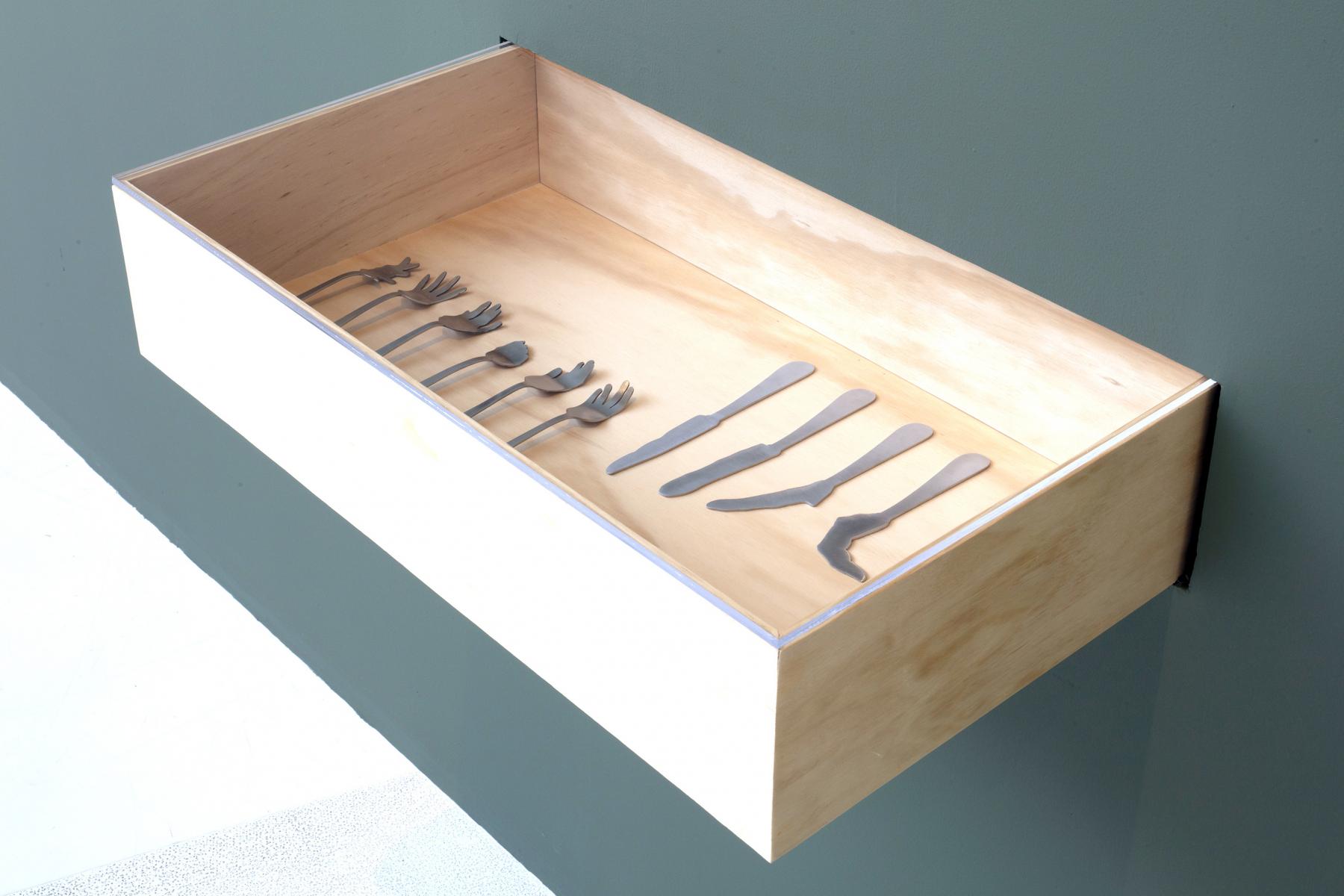
That is evident in your exhibition. There is the line between the two films as we mentioned, but there are also numerous other threads that you weave through the sculptures and works on paper. These connections are more passing and sporadic, and all reference hands. For example, shadow puppets, the tracing of hands, as well as gloves and eating utensils. However, you delicately undo the function of these objects and acts as we know them. You even created drawings with your non-dominant hand. Works like these can be completely disorienting to view, while works like Table Manners (2026)—cutlery shaped like fingers—go further by bordering on the absurd or surreal. What does it mean to use our hands differently?
I think the hand recurs as a way of insisting on its significance. In some ways, I’m maybe retaliating to the provocation that it, or more precisely its difference, should be overlooked. That we should pretend it doesn’t exist, or that there’s nothing left to say about or with hands in art. So I respond to those sentiments with a bursting of hands!
But the hand is also a site where care and control converge, and it’s just a motif that offers an opportunity for playfulness. In Table Manners (2026) and Spouts (2025), I think about the cutlery or the kettle as extensions of the body. Utensils originated as ways to mediate contact, protecting the hand while extending its function. Over time, they became tied to social status and cultural norms. For example, elaborate place settings with multiple specialized silverware pieces were historically associated with aristocratic and upper-class dining cultures, where possessing and correctly using them signaled wealth and social rank. In contrast, the act of eating with one’s hands is often to this day framed as primitive, despite being widespread and culturally embedded. I’m interested in these histories and how objects that appear neutral are shaped by systems of class and coloniality.
You expose these histories by questioning their functions, and in turn, staging new social scenarios around them. This is bodily affecting when you encounter the sculptures in person as well, it is not only working on a theoretical level.
Yes, I like that. There’s a direct body relationship there too. They are also simply objects I enjoy making. That immediacy or intuitiveness matters too.
The role of the hand, too, is entangled in social structures in your work. It is not merely a neutral instrument but an extension, or enactor of ideology. You say things like “I filmed it while the camera kept its distance” and truth is “depend[ent] on who’s writing the description.” In both these instances, as well as others, you parse out the elements that work together to create signifiers of knowledge.
The hand is such a persistent trope in art history, symbolically even worn-out. I'm still looking at it though because it can hold contradictions. And in relation to image-making and language, the hand is also part of how authority is produced. It writes the description, operates the camera, handles the evidence. So when I mention distance, or who is writing the account, I’m trying to draw attention to the fact that knowledge is always mediated through bodies, gestures, and positions of power.
Knowledge can also be mediated through fantasy. To your point, there are contradictions in this. On the one hand, when you think about how fantasy is projected onto the global majority from the West, these imagined frameworks do not only have violent, material repercussions, they also shape dominant systems of knowledge. On the other hand, fantasy allows us to imagine a world with a completely different set of frameworks. How does fantasy factor into your work?
Fantasy is a powerful device, but I use it sparingly. I’m interested in placing it beside more direct modes of address. It’s less about an escape or constructing an entirely imaginary world, and more about making small shifts in perception that transform how we understand what’s already there. For me it can reorder reality, creating fictional or speculative categories that allow me to access archives, collections, and inherited materials. It becomes a way of organizing and relating to things that might otherwise remain inaccessible. I often think of fantasy as a form of distortion, a rhetorical device I’ve returned to throughout my work.
That connects to the objects as well—the way familiar things become disorienting. There’s also a broader dimension. Your work includes everyday objects that take on fantastical qualities, alongside nonlinear atmospheres. At times during Catfish Mother Puddle of Juice I thought about Alice in Wonderland passing into another world and narrative space. What are the stakes of working this way?
Yes, I can see the Alice in Wonderland reference. The child actor in my film is constantly constructing an imaginary universe around her. In one scene, she arranges objects in a small house, and then, momentarily, transitions into an elderly figure. There’s no dramatic shift; it happens almost imperceptibly.
We can look at specific elements. For example, the rubber gloves in the film, items associated with domestic labor, take on a different role. They appear almost extraterrestrial, as if these faceless hands are shaping the scenes and perform gestures that seem communicative but remain unreadable. You begin to wonder whether they form a language. They gesture toward meaning without resolving into it. There’s a tension between familiarity and estrangement. The gloves are recognizably human, but they also feel distant, almost otherworldly. They conceal the hand while also producing gestures, both domestic and abstract.These objects operate alongside familiar forms, but they destabilize them. They prompt a reconsideration of what we think we recognize.
Nour Bishouty, “Table Manners” (detail), 2026. Nour Bishouty, “Unlikely Mother” 2026, at Museo Universitario del Chopo, 2026. Courtesy: Museo Universitario del Chopo and Cooper Cole, Toronto. Photo: Ramiro Chaves
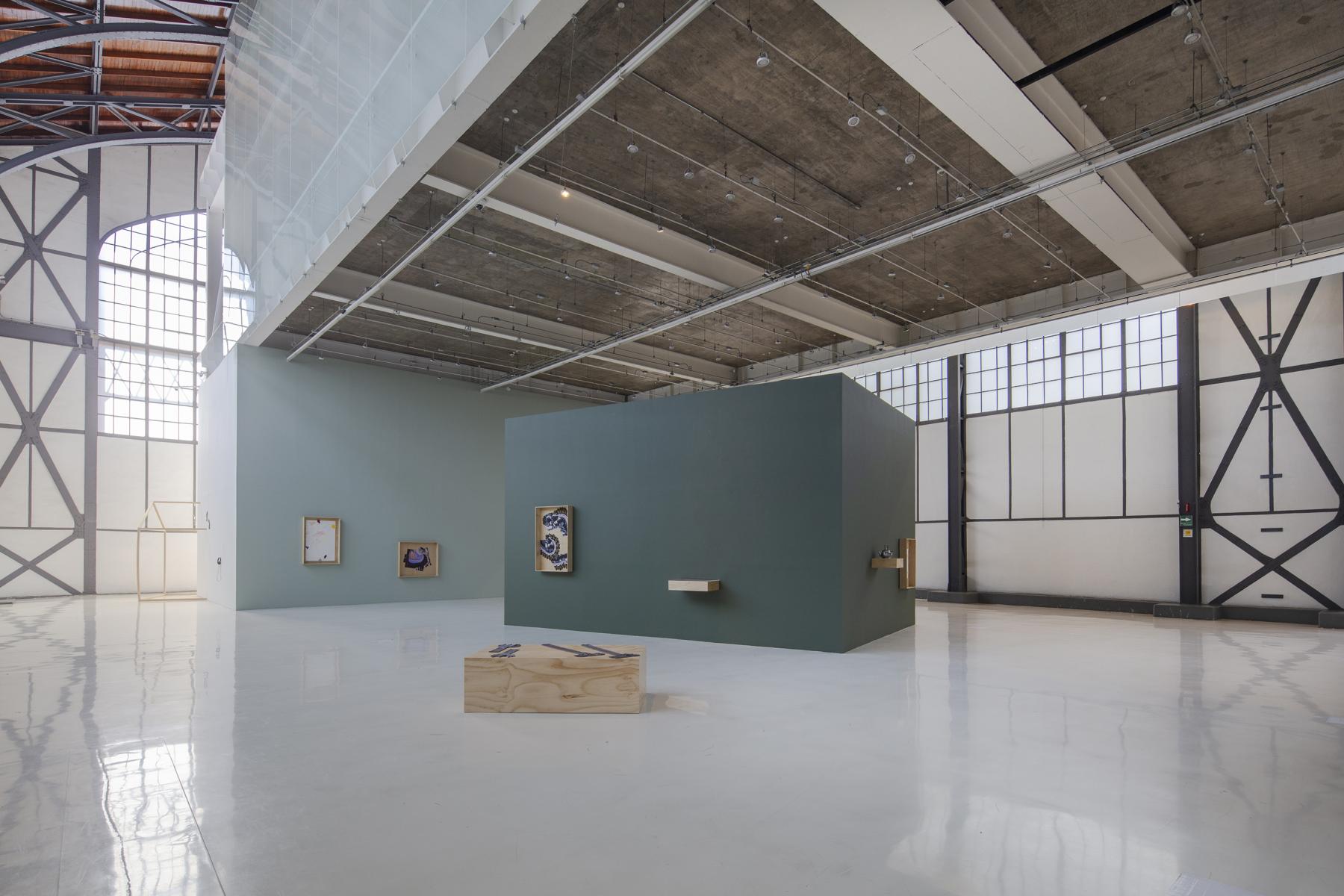
Nour Bishouty, “Unlikely Mother” 2026, at Museo Universitario del Chopo, 2026. Courtesy: Museo Universitario del Chopo and Cooper Cole, Toronto. Photo: Ramiro Chaves
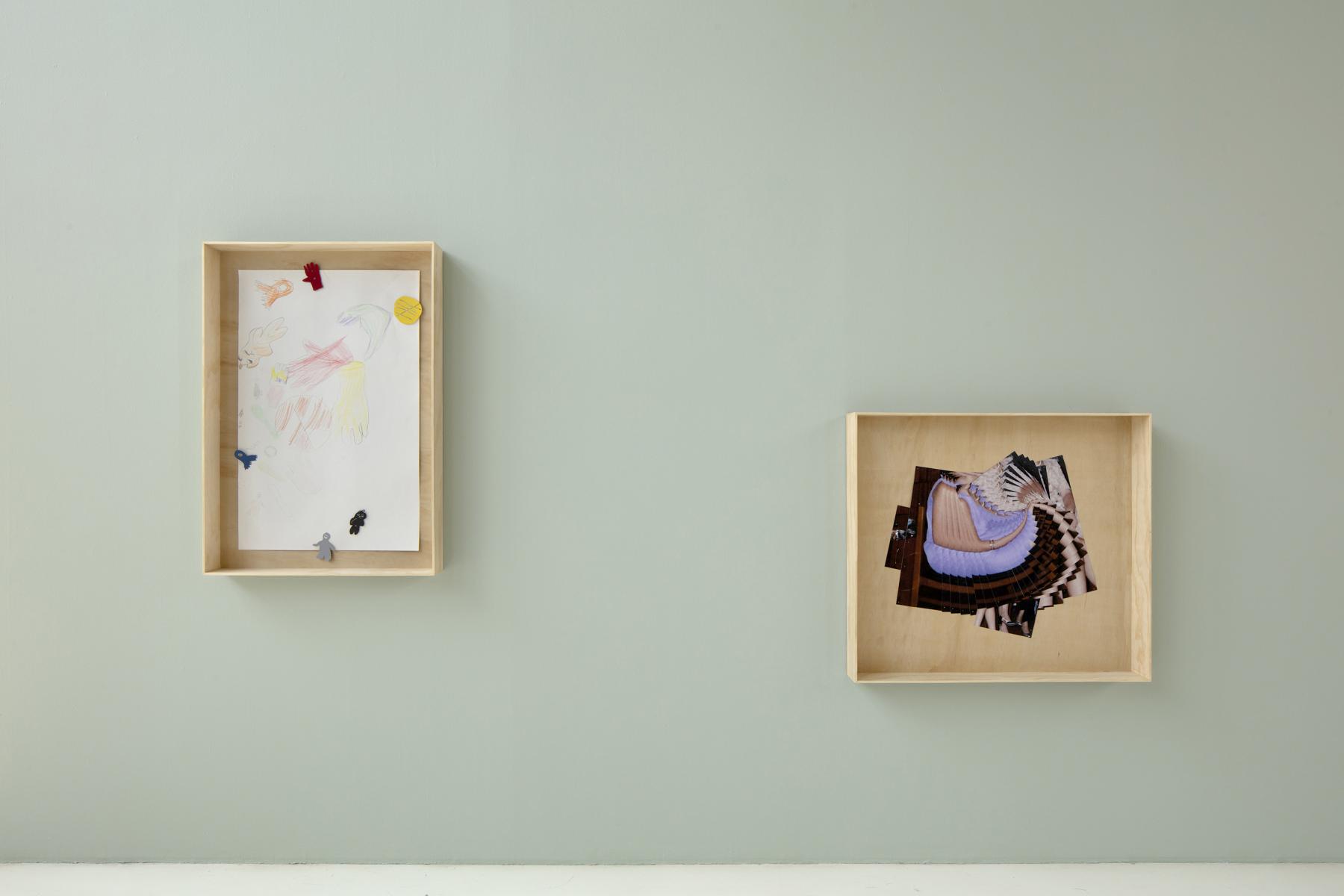
Nour Bishouty, “Unlikely Mother” 2026, at Museo Universitario del Chopo, 2026. Courtesy: Museo Universitario del Chopo and Cooper Cole, Toronto. Photo: Ramiro Chaves
Language plays such an important role in this work, we would be remiss not to discuss it. Catfish Mother Puddle of Juice, as well as MOETHER, the text Mirene Arsanios wrote in response to your film, are both in Spanish, a language that is not native or primary to either of you. On a practical level, this must have been incredibly challenging, but I also can’t help but think about how vulnerable it must feel to produce work without the linguistic tools one has mastered. This reminded me of the drawings you made with your non-dominant hand. And as with the rest of your work, this is more than a gesture; it is a scenario that undercuts the necessity of mastery to create knowledge. That you and Mirene distance yourselves from a tool you are comfortable with is a choice of material and process.
If I had to reduce the work to one central concern, it would be language. It is fundamentally about language as a structural force. Language situates bodies. It creates proximity and distance. It defines and diminishes. It can legitimize violence. Mirene’s text picks up on this point powerfully. She points out that while “human” is an animal category in scientific discourse, in political discourse, reducing someone to “animal” can justify their extermination. That shift in language carries immense consequences.
I’m interested in how meaning is constructed; how we assign names and categories. For instance, when we call something a “hand,” is that inclusive or reductive? Language functions as a container, but also as a system that enforces distinctions. This connects to taxonomy, where differences are marked through small linguistic variations; adding or altering a term. These shifts carry weight.
And the vulnerability you mentioned is crucial. I wrote the script in English and Arabic, but always intended it to be narrated in Spanish. The translation introduces a distance from my own work. With Mirene, it was similar. I initially expected her to write in English, but she chose Spanish; her mother tongue, though one she had largely lost. That decision brought a personal dimension tied to memory and loss. Writing in a language that exceeds your comfort introduces vulnerability. It’s like working with your non-dominant hand—it creates distance, but also expansion.
Yes, and drawing with your non-dominant hand or writing in a language you are not fluent in is a practical application of the frameworks you are floating in your films, which, as you say, are functional. If one is tempted to, for example, dismiss a drawing as childlike, it reveals a certain expectation, based on a narrow set of rules. Mirene points to this as well, by describing how in reality one word may take on drastically different meanings, for example ‘animal’ or ‘mother’ in the context of genocide.
Exactly. The language resists the expectation of control and fluency.
Maybe we can conclude with ‘Unlikely Mother.’ In Catfish Mother Puddle of Juice you ask, who is performing the act of mothering? In relation to the catfish, you locate mothering in a number of different spaces that nurture but are not necessarily the body of the biological mother (for ex. “a shell… or a plastic lid, discarded from above sea level”). Of the many instances of disorientation that you produce in this body of work, as a person biologically and socially enmeshed in this role, this was perhaps the most destabilizing for me!
The script gradually shifts into a more abstract and poetic register as the film progresses. In the section you’re referring to, it describes mothering as something tied to space and temporality. I was thinking about “cave spawning” in fish, where eggs are placed within protected cavities. There is something quite precise in that gesture, a shaping of space, an enclosing, a holding. I began to think of that as a kind of architectural instinct—not architecture in a formal sense, but as a way of organizing space in relation to care, protection, and duration. This is something I want to write more about one day. I started to deconstruct the idea of mothering through that lens. If mothering is understood less as a fixed identity and more as a spatial and temporal function, something that encloses, holds, or conditions a body, then it becomes less clear who or what performs it. It could be a body, but it could also be an environment, a structure, or even a gesture. The question opens outward in that sense, and also turns back toward the viewer.
I was also thinking about mothering as a social category, something unevenly expected of certain bodies and made conspicuous in its absence. It can function as desire, pressure, measure, or accusation. So in the film, mothering begins to detach from any singular figure or assigned role.
There is also an evolutionary dimension running through the film. The fish introduces itself early on as our ancestor, which places it in the position of a kind of primordial mother figure. But even that is unstable. It shifts the idea of origin away from something singular or fixed.
Ultimately, many of the works I make begin with something specific and personal, but open outward into larger questions about language, kinship, and how we recognize one another. If this body of work leaves anything behind, I hope it is a sharper sense of how bodies are made legible, and how much always remains beyond those terms.