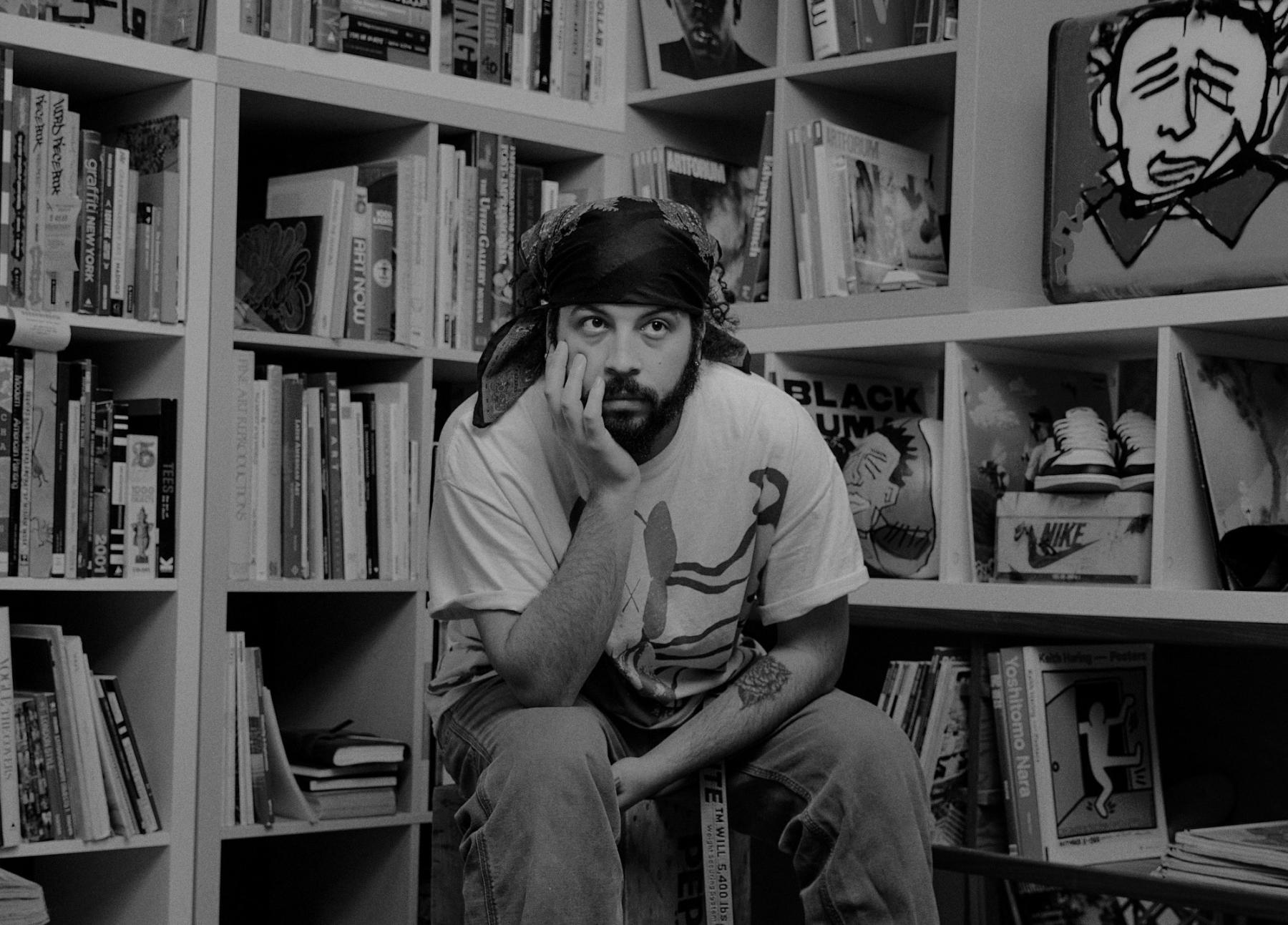
Portrait of Bistyek. Courtesy of the artist.
I met Bistyek in Winnipeg, already knowing two things about him: that he was an artist and that he was Kurdish. I introduced myself in Kurmanji, expecting that we would immediately find common ground. We did, but only to a point. Although we belonged to the same people and spoke the same dialect, our everyday language had been shaped by the different countries we grew up in. He was born in Syria; I was born in Turkey. Decades of living under different political and linguistic realities had left their mark on our Kurdish. In a strange way, our mother tongue had become almost a second language to both of us. We found ourselves searching for words, borrowing from Arabic, Turkish, and English, until, before long, we had slipped almost entirely into English—on a cold Winnipeg day, far from the mountains of Kurdistan, in the endless flatness of the Canadian prairies.
One thing that endless flatness teaches you is how to bear the flood of memories. There are no mountains to hold them back. You have to find somewhere to channel the weight of the past and the future onto a surface: sometimes a painting, sometimes a piece of wood, sometimes music. The past and the future arrive in brief, concentrated moments, melt into the present, and stretch it out, heavy and seemingly endless. Bistyek embraced this city, and the city embraced him.
On the surface, things appear to be a sunny Winnipeg summer day with flowers in your yard, until you start feeling the static slowly surrounding you, and perhaps, for the first time, a disbelief in this garden. Bistyek has been patiently making his art, leading to a major exhibition at the Winnipeg Art Gallery. The static, the seed of suspicion, grew louder as he received almost no reception, interviews, or critical writing around his exhibition. What existed outside the gallery was mostly focused on his ethnicity and where he came from, often repeating the same story with little depth and almost nothing about his art. Bistyek asked for more. He asked for interviews, criticism, and engagement with his work, and found himself questioning the art-writing scene itself.
Here, now, I am in Philadelphia, speaking with Bistyek through a screen. The coffee shop where we first met, the mountains we were both far from, the languages we could not quite make work, and the exhibition that prompted these questions are all elsewhere. What remains is the conversation.
It begins, perhaps inevitably, with home. Not the home that can be located on a map, but the one that survives the map: in language, in memory, in the people who leave and the people who remain, in the images that refuse to stay in the past. Bistyek speaks of having many homes rather than one, and of his paintings as places where different times, places, people, and versions of himself can exist together. In his work, memory does not behave itself. It does not move chronologically or respect borders. The dead can stand beside the living; a childhood cartoon can share a frame with a political symbol; Kurdistan, Syria, Lebanon, and Winnipeg can occupy the same visual space without needing to explain how they arrived there.
Perhaps this is also why the story of three colors has remained so persistent. Before he knew what those colors meant, Bistyek had already been taught that they meant something. A child drew what he loved; an adult saw something political. The slap came before the explanation. The explanation came later, followed by the questions: Who am I? Why are these colors forbidden? What does it mean to be Kurdish? Decades later, those questions became Forbidden Colours. What had once been used to discipline a child became something he placed before an audience.
There is a particular irony in that transformation. The first prohibition was an attempt to control what could be represented. The later exhibition was an insistence on representation. Between the two lies a life, but also the strange persistence of images: how a color can acquire a history, how a memory can become a symbol, how something once meant to silence you can become part of the language through which you speak.
Bistyek does not describe his work as arriving at answers. He describes himself as still searching for a voice, and then immediately questions whether such a search should ever end. His work comes from the same restlessness: from things seen and remembered, from political histories and private experiences, from childhood and migration, from people who are no longer here and from those he has only recently encountered. The medium follows the idea rather than the other way around. Painting, sculpture, mural, installation—the form is something to be discovered rather than prescribed.
And then there is the other silence: the silence around the work.
For Bistyek, the absence of critical writing became another question. Not simply why someone had not written about him, but what it means when an exhibition can occupy a major institution for months, carry years of work and personal history, and still leave so little written trace behind. He is careful to distinguish this from a demand for praise. He wants disagreement as much as recognition, criticism as much as admiration. What concerns him is the disappearance of the conversation itself.
This is where the interview eventually arrives at something larger than one exhibition or one artist. Who gets written about? Who gets documented? What makes an artwork worthy of sustained attention? What happens when writers hesitate to approach work they do not fully understand, particularly when its politics, history, or identity lie outside their own experience? And what is lost when the work remains visible for a moment but the conversation around it does not?
I do not know if this conversation answers those questions. I am not sure it should. Perhaps the point is to keep them in circulation—to move them from a coffee shop to a screen, from a classroom in Syria to a gallery in Winnipeg, from three forbidden colors to a body of work, and from the silence surrounding an exhibition back into language.
For me, being an artist isn’t about arriving at a final destination. It’s about staying curious. It’s about allowing myself to evolve without losing the values that brought me here in the first place.
A long time after we met at a coffee shop in Winnipeg, I am happy that this interview has brought us together again. I have been trying to make a tradition of beginning my interviews with a question from the Proust Questionnaire. So I would like to start with this one: How would you describe your current state of mind?
I can't believe how much time has passed since we first met in Winnipeg. I'm really glad we're reconnecting and finally doing this interview. My current state of mind is somewhere between gratitude and restlessness.
I am a grateful person. I often find myself looking back at where I was and where I am today. When I first arrived in Canada, I never imagined that one day I would be called an artist. It was never a title I chased. I didn't arrive with a plan to have exhibitions or show my work in galleries. I simply started making art because it was something I felt compelled to do.
Looking back now, many of the things I once thought were impossible have happened. I have had exhibitions, created public art, and as we speak,I have a solo exhibition at the Winnipeg Art Gallery. That means a lot to me because it was one of the first galleries I ever entered after arriving in Canada. To be exhibiting there only a few years later is something I do not take for granted. Moments like that motivate me even more.
A few years ago, I also realized something important: I have to do this without expectations. I make art because I genuinely enjoy it. I enjoy painting, I enjoy the process, and I enjoy every aspect of creating. Once I understood that, a lot of the noise disappeared. The expectations around attention, likes, comments, engagement, recognition, all of that became less important. It became just me and the work. I think that is how I will always be. Art is not something I do because of what it might bring me; it is something I do because I cannot imagine not doing it.
At the same time, I feel restless. There are so many things I want to create, so many ideas I want to explore, and so many projects I want to build. Sometimes I wonder if I will have enough time to do everything I want to do in my lifetime. That thought sits quietly in the back of my mind.
So I would describe my current state of mind as grateful, hopeful, and curious, but also impatient in a productive way. I am proud of how far I have come, but I still feel like I am only at the beginning.
You found a refuge in art and ended up in a city that seems to have embraced you. It made me think of a question that has stayed with me for a long time: How much home does a person need? Where is home for you?
I don't think home is a fixed place anymore.
For a long time, I thought home was somewhere I had lost. As a refugee, you leave places, people, memories, and versions of yourself behind. You realize that even if you return, it won't be the same place you left, and you won't be the same person either.
These days, I often say that I don't have one home, I have many homes. I believe a person can have more than one. Every place leaves something in you, and you leave something behind in return.
Today, home feels less like a location and more like a feeling. It is where I can be myself, where I can create, where the people I love are, and where I can contribute to a community. Winnipeg has given me that. It welcomed me, believed in me, and gave me the opportunity to become the person I am today. For that, I will always be grateful.
At the same time, part of my home will always exist in Kurdistan, in Syria, in Lebanon, in my memories, my family, my language, and the stories I carry with me. I don't think those parts ever leave you.
So, how much home does a person need? Maybe just enough to feel that they belong somewhere. And if they can't find it, they spend their life creating it, for themselves and for others. I think that's what I've been doing through my art.
Yes, I kept thinking about this while looking at your paintings. It almost feels like you're recreating a home, a world, not just for yourself, but for others too. It's as if you carry your home with you in your work, and belonging is no longer tied to a physical place. It made me wonder: where do all these people, animals, and memories in your paintings belong? If they could all return somewhere one day, where would that be? Is it a real place, or an imagined one?
I don’t know if all of these people, animals, and memories belong to one real place. I think they belong to the same emotional landscape. Some come from Kurdistan, some from Syria, some from Lebanon, and others from Canada. Some are people I have known, some are people I have lost, and some exist only in my imagination. Yet somehow they all find themselves living together inside the same painting.
In a way, my paintings become that place. They become a home where different times, places, memories, and identities can exist without needing to explain themselves. A child can stand next to an old man. Someone who is no longer alive can exist beside someone I met yesterday. A cartoon character can share the same space as a political symbol. That’s how memory works for me, it isn’t linear, and it doesn’t separate reality from imagination.
I don’t think belonging has to be tied to geography. As I mentioned before, I believe we can have many homes. Maybe my paintings are another one of those homes. They are places where I can gather everything I carry with me and allow it to exist together.
If all of these figures could return somewhere one day, I don’t think they would return to a country or a city. They would return to a place where they are understood, accepted, and free to exist as they are. Whether that place is real or imagined doesn’t matter to me. What matters is that, for a moment, it feels true.
This makes me want to ask you something more personal. As a Kurdish person born in Turkey, there was a chain of events that made me realize I was Kurdish and what that meant. Was there a similar moment for you?
Yes, there was. One of my earliest memories is from when I was in grade two. My art teacher gave us a homework assignment and said, “Go home and make something you love—something you do best. Bring it tomorrow and I’ll grade it.”
I remember going home and begging my mom to give me money so I could buy markers—the good, colorful ones. After a while she finally gave me some money, and I ran to a small bookstore filled with art supplies. I picked out the markers I wanted, went home, and poured everything I had into my drawing.
The next day, we all placed our sketchbooks on the teacher’s desk. He began looking through them one by one. When he opened mine, I saw his face change. He looked angry. He held my drawing up in front of the whole class and asked, “Whose book is this?”
I raised my hand, proud and excited. I couldn’t wait for him to see what I had made. But as soon as I walked up to him, he slapped me across the face. Then he wrote a big zero on the page, threw my sketchbook back at me, and told me to sit down.
I didn’t understand what I had done wrong. My friend leaned over and whispered, “Are you stupid? Why would you draw that?”
I looked down at my drawing. It was made with three colors: red, green, and yellow. I asked him what was wrong with it, and he quietly replied, “That’s the flag of Kurdistan.”
At the time, I didn’t fully understand what that meant. But something changed in me that day. A question began to grow inside me: Who am I?
As I grew older, I began to understand why those three colors had provoked such a reaction. I started noticing them everywhere—in our language, our celebrations, our clothes, and our stories. What had once been just colors became part of my identity.
Looking back now, I realize that this was one of the first moments I became aware of what it meant to be Kurdish. It’s a memory that has stayed with me ever since, and many years later it became the foundation for my exhibition Forbidden Colours. In a way, the work is my response to that day in the classroom. What was once treated as something forbidden became something I chose to celebrate, reclaim, and share openly with the world.
Thank you for sharing that. If that teacher could see Forbidden Colours today, what would you want him to understand?
I don’t think I would want him to feel guilty. I would want him to understand.
At the time, he probably thought he was punishing a child for drawing something he wasn’t supposed to draw. But what he really did was make me ask a question that stayed with me for the rest of my life: Why are these colors forbidden? That question led to another, and then another. I kept asking more questions about who I was, where I came from, why this happened, and what it meant to be Kurdish. In many ways, I’m still asking those questions today.
That moment didn’t silence me. It stayed with me, and years later it became the foundation of an entire exhibition.
If he walked through Forbidden Colours today, I would want him to see that those three colors were never something to be feared. They were part of a child’s identity, a child’s curiosity, and a community’s history.
In a strange way, I have to thank him. Not for what he did, but because that moment became one of the earliest memories that shaped me as an artist. It taught me that art has the power to ask difficult questions, and sometimes those questions stay with us for a lifetime.
I hope he would leave understanding that no child should ever be punished for expressing who they are. And I hope he would see that what was once treated as something forbidden has now become something that thousands of people have been able to see, talk about, and celebrate.
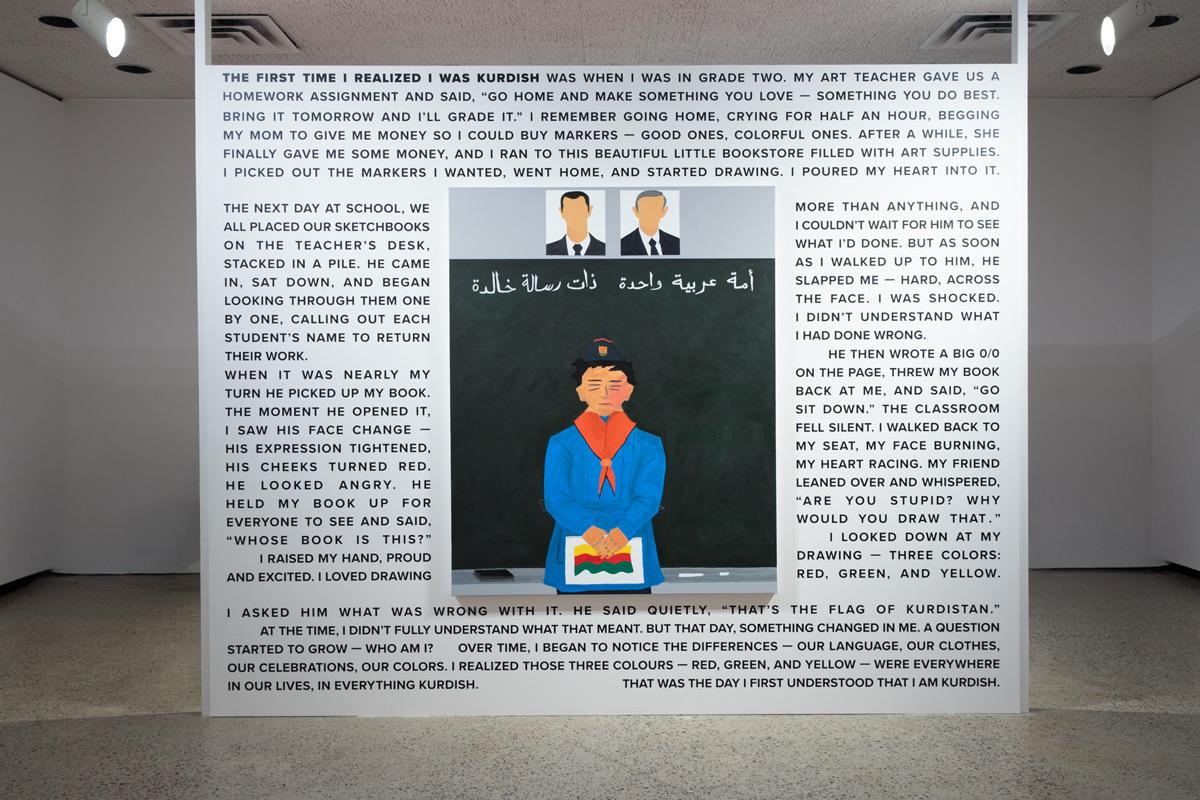
Forbidden Colours, 2025, Installation view, Winnipeg Art Gallery–Qaumajuq (WAG-Qaumajuq), Winnipeg, Manitoba, Canada. Courtesy of artist.
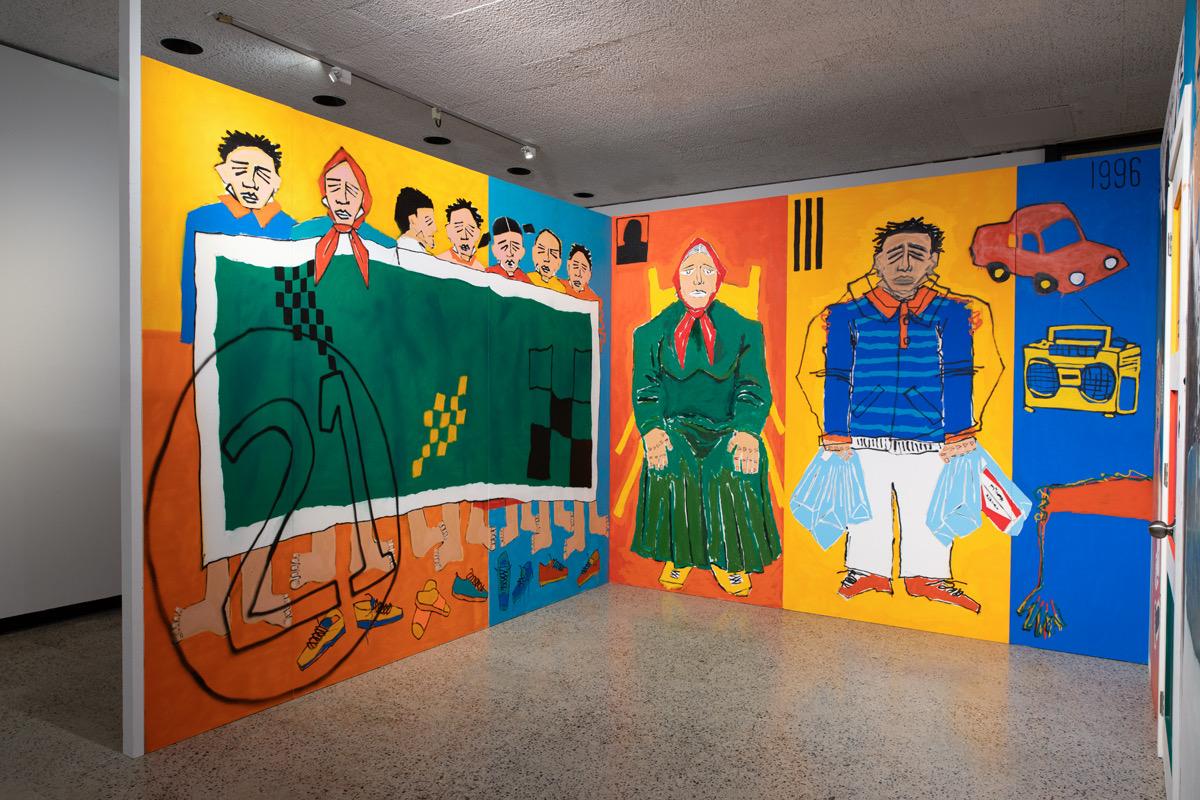
Forbidden Colours, 2025, Installation view, Winnipeg Art Gallery–Qaumajuq (WAG-Qaumajuq), Winnipeg, Manitoba, Canada. Courtesy of artist.
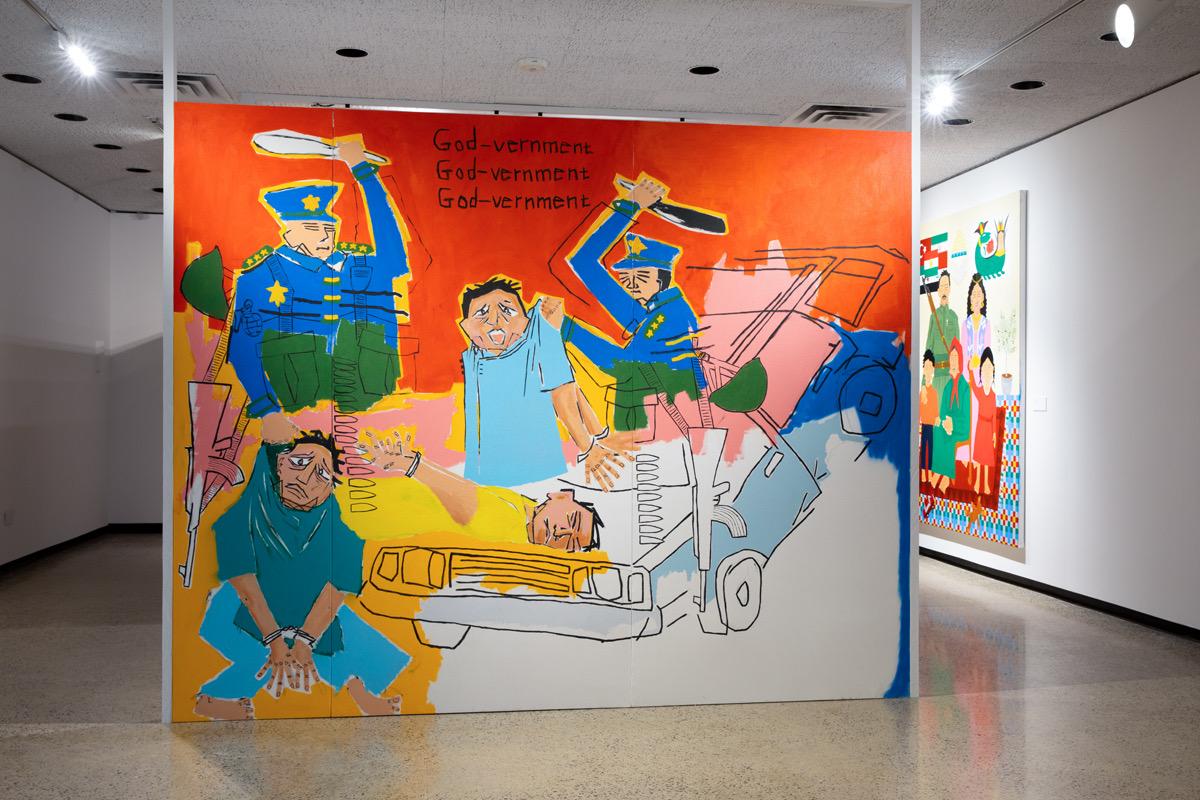
Forbidden Colours, 2025, Installation view, Winnipeg Art Gallery–Qaumajuq (WAG-Qaumajuq), Winnipeg, Manitoba, Canada. Courtesy of artist.
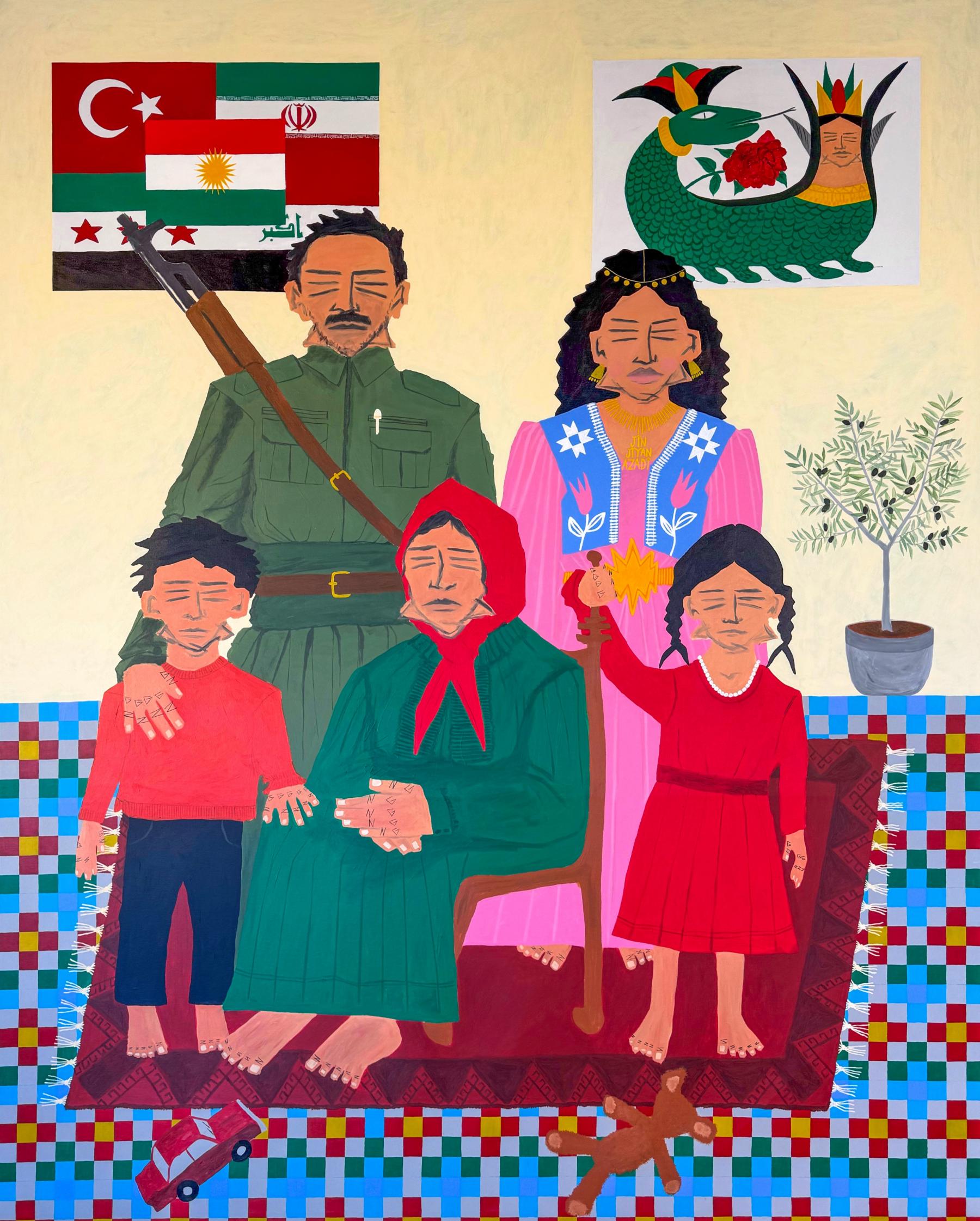
Forbidden Colours, 2025, Winnipeg Art Gallery–Qaumajuq (WAG-Qaumajuq), Winnipeg, Manitoba, Canada. Courtesy of artist.
Looking back at that moment, do you think identity is shaped by power and politics from a very early age?
Yes, I do. As children, we don’t enter the world thinking about politics or power. We simply draw, play, ask questions, and express ourselves. But sometimes politics finds us before we even know what politics is.
That moment in my classroom taught me that. I wasn’t making a political statement. I was just a child drawing with the colors I loved. Yet the reaction I received showed me that those colors meant something far bigger than I understood at the time.
Looking back, I realize that identity is often shaped by the way the world responds to you. Sometimes it is your family and culture that teach you who you are. Other times, it is the people who try to deny that identity who make you realize how important it is.
That experience didn’t make me more political overnight. It made me more curious. I kept asking questions—about history, about language, about my community, and about why something as simple as three colors could make an adult react the way he did.
Today, I see that moment as the beginning of a much longer journey. It taught me that power can shape the way we understand ourselves, but it doesn’t have to define us. We still have the ability to reclaim our stories, tell them in our own words, and pass them on to the next generation. I think that’s what I’ve been trying to do through my art.
You mentioned feeling restless, almost overflowing with ideas, projects, and things you want to create. At some point, all that energy has to find a form. How do you decide where to stop exploring and begin making? I suppose what I'm really asking is: what motivates you to express an idea in a particular way rather than another, through certain colors, forms, themes, or symbols?
For me, the idea always comes first. I don't begin by thinking, "I want to make a painting," or "I want to make a sculpture." I usually begin with a feeling, a question, or an image that stays with me. Most of the time, I simply feel the urge to make something and get it out into the world.
The majority of my work happens very naturally. I spend a lot of time in the studio just creating without overthinking. I don't always know where a piece is going when I begin, and I enjoy that process of discovering it. At the same time, there are moments when I have a very specific idea that I want to express in a particular way. In those cases, I become much more intentional about the medium, the composition, the colors, or the symbols I use.
Sometimes the answer is painting. Sometimes it becomes a mural, a sculpture, an installation, or something completely different. I don't like limiting an idea by forcing it into a particular medium. Instead, I try to let the idea decide how it wants to exist.
I don't think there is a moment when I stop exploring. Exploration is part of making. Even while I'm painting, I'm still asking questions and changing things. The work tells me when it has found its form. Until then, I keep listening.
The colors, symbols, and figures I use usually come from my own experiences and memories. Some references are very personal, while others come from places I have lived, people I have met, cartoons I watched as a child, politics, migration, or everyday life. I don't use symbols because they look interesting; I use them because they carry meaning. Even if a viewer doesn't know the exact story behind them, I hope they can feel that they belong to a larger conversation.
Curiosity is part of what keeps me making art, but it isn't the only reason. My life, everything I have experienced, everything I have been through, and all the people I have met continue to push me forward. I also carry with me the people who are no longer here and the stories that deserve to be remembered.
As a Kurdish artist, I feel a responsibility. I come from a community and a place with a long history that has often been overlooked or silenced. I carry that with me every day. It isn't a burden—it gives purpose to what I do.
At the same time, I still carry the kid I used to be. I remember telling my friends on the street that one day I was going to do what I want and I am going to be on TV. In many ways, I'm still creating for that kid. Every new project feels like I'm proving to him that it was possible all along.
And if my work can do one more thing, I hope it reminds someone else—especially a young person who comes from a background like mine—that they can do it too. If I could make it from where I started, then maybe they can believe in their own dreams as well.
Do you want the viewer to know the stories behind your symbols?
Yes and no. I don’t think a viewer needs to know every story behind every symbol to connect with the work. If a painting only works once it has been explained, then I think it has already lost some of its power. I want people to be able to bring their own experiences, memories, and emotions to the work and discover something that belongs to them.
At the same time, I’m always happy when someone wants to know more. Every symbol has a reason for being there. Nothing is placed randomly. Some references come from my childhood, some from Kurdish culture, some from politics, some from migration, and others from people I have loved or lost. They are all part of my visual language.
When someone asks about them, another layer of the work opens up. But I don’t expect everyone to arrive at the same interpretation. In fact, I enjoy the fact that different people see different things.
Once a work leaves my studio, it no longer belongs only to me. It begins a new life with the viewer. My story becomes only one of the many stories that the work can hold. I think that’s one of the most beautiful things about art.
Your work doesn't shy away from political imagery. Do you see it as protesting, or as witnessing?
I think it begins with witnessing. Most of what I paint comes from things I have lived, things I have seen, or stories that have been passed down to me. Before I can protest something, I first have to witness it. I have to understand it, carry it, and ask myself what it means.
At the same time, I don’t think witnessing is a passive act. Choosing to remember, choosing to tell a story, or choosing to make visible something that others would rather ignore can be a form of protest in itself.
As a Kurdish artist, there are parts of our history that have been erased, denied, or forgotten. Simply painting them, speaking about them, or allowing them to exist in public spaces is already an act of resistance.
That said, I don’t wake up in the morning thinking, “Today I’m going to make a political painting.” I wake up wanting to make an honest one. Sometimes honesty leads me to politics because politics has shaped my life, my family’s life, and the lives of so many people around me. I can’t separate those experiences from who I am.
So I don’t see my work as choosing between protesting and witnessing. I think it begins with witnessing, and when the truth of that experience enters the world through art, it can become a quiet form of protest. My goal has never been to tell people what to think. It is to invite them to look, to feel, and perhaps to ask questions they hadn’t asked before.
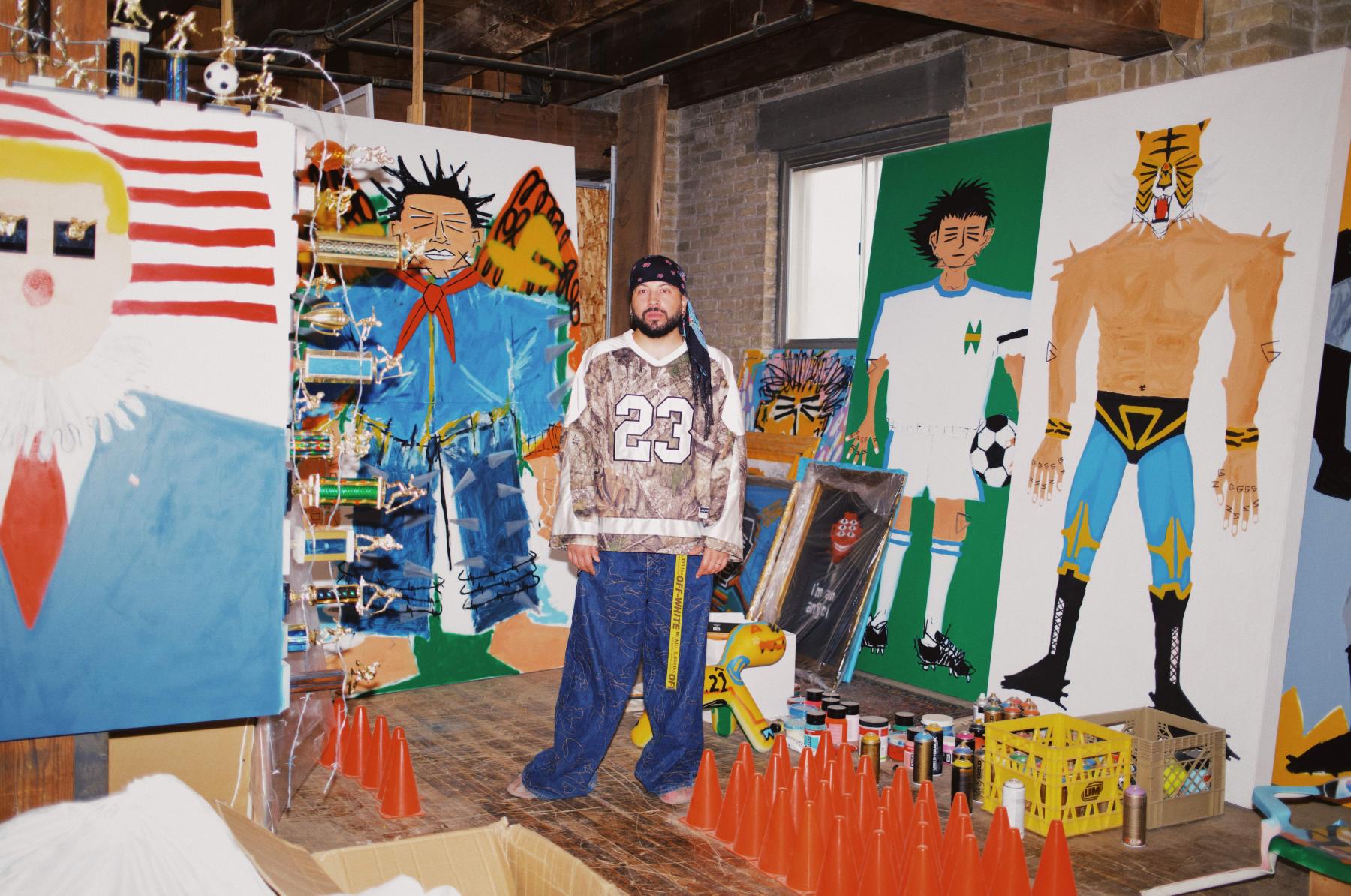
Photo of Bistyek in studio by JJ Pangan
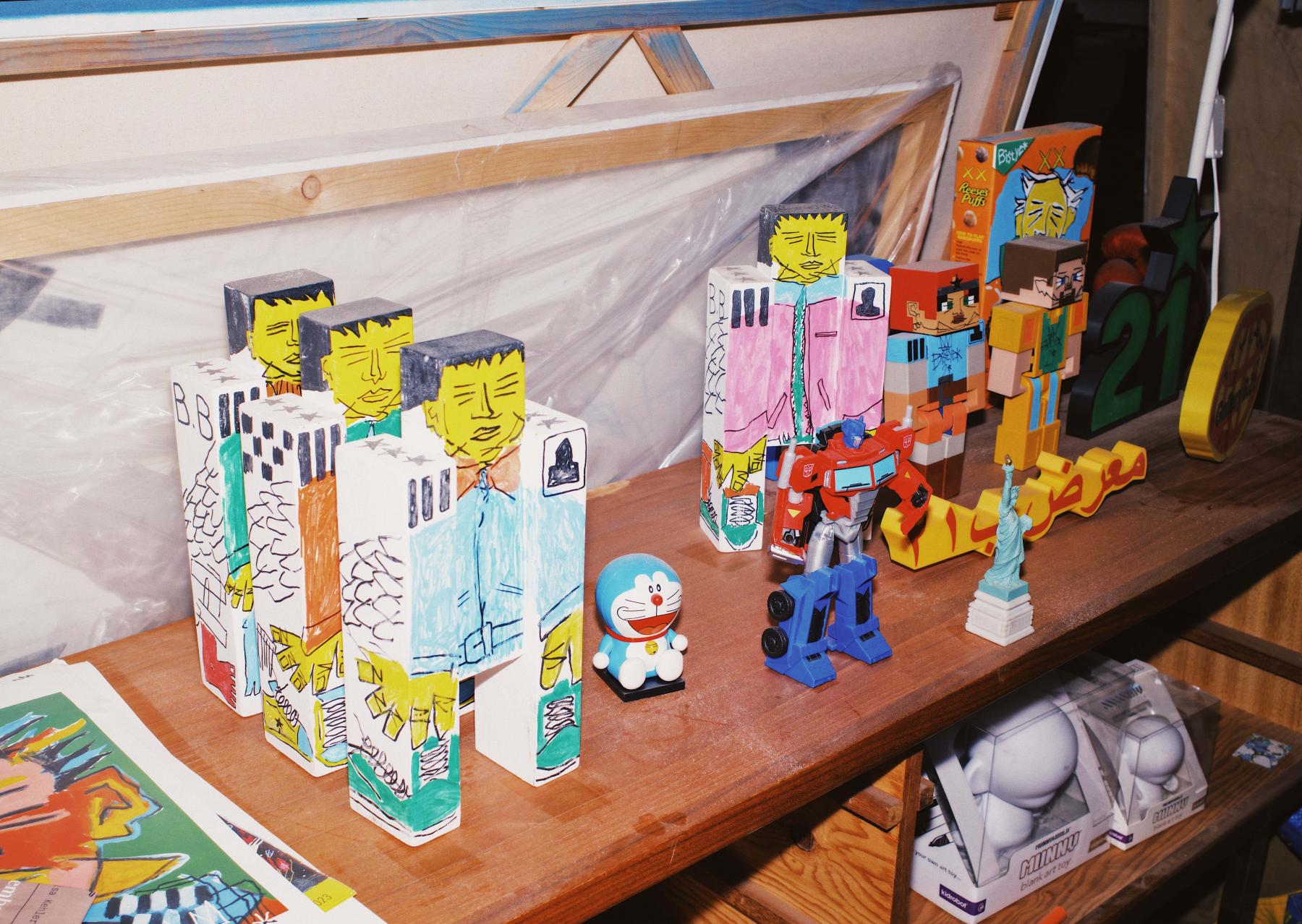
Photo of Bistyek in studio by JJ Pangan
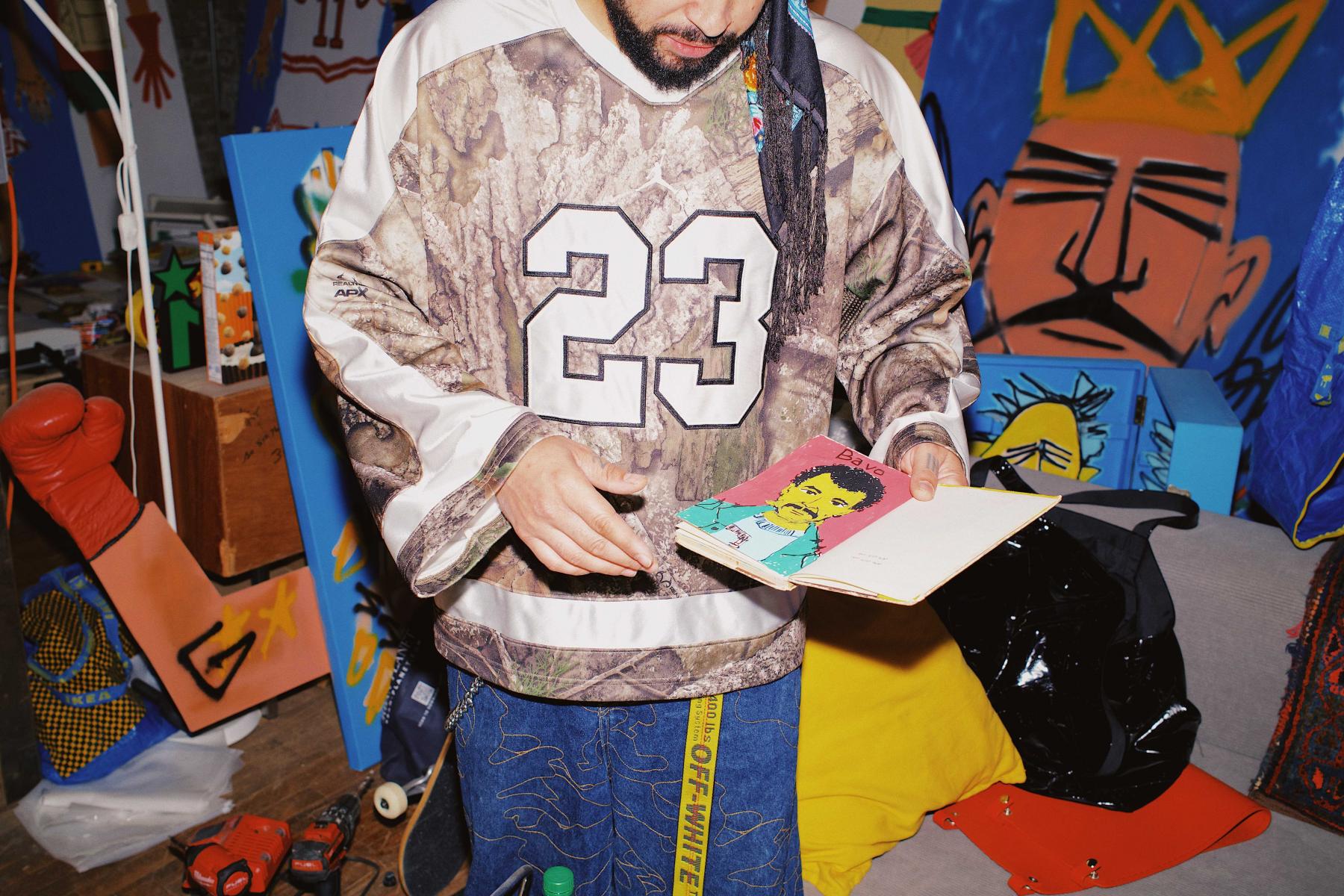
Photo of Bistyek in studio by JJ Pangan
Do you think the people you most want to reach are the ones who actually see your work?
I hope so, but I know that’s not always the case. Some of the people I want to reach the most may never step into a museum or a gallery. They may never see one of my exhibitions. That is something I think about often.
At the same time, I have learned that art has its own way of traveling. Sometimes someone visits an exhibition and shares it with their family. Sometimes a photograph of a painting reaches someone on the other side of the world. Sometimes a conversation, an interview, or a documentary carries the work further than the artwork itself.
Of course, I would love for every Kurdish child, every refugee, every person who has ever felt unseen to experience the work in person. But I also understand that isn’t always possible.
What matters to me is that the work keeps moving. If it reaches one person who feels understood, who asks a question, or who sees part of themselves in it, then it has already done something meaningful.
I don’t make art for one specific audience. I make it from a very personal place, but I hope it creates space for many different people to enter. Some will connect with the politics, others with the emotions, and others simply with the colors or the figures. There is room for all of those experiences.
Today art often feels very personal. Do you think art can still trigger collective catharsis?
I do. Maybe not in the same way it once did, but I absolutely believe it still can. Today, we often experience art individually. We scroll past it on our phones, see it for a few seconds, and move on. But when people gather in the same space and stand in front of a work together, something different happens. They begin talking, sharing memories, asking questions, or simply standing in silence. That shared experience still has power.
I’ve seen it happen during my exhibitions. People who have completely different backgrounds find themselves connecting to the same work, but for different reasons. One person sees politics, another sees family, another sees childhood, another sees loss. They don’t have to agree on what the work means for it to bring them together.
I think collective catharsis isn’t about everyone feeling the same emotion. It’s about creating a space where people can experience different emotions together. In a world that often asks us to take sides or stay divided, that feels incredibly important.
Art cannot solve every problem, but it can create moments of empathy. Sometimes that’s enough to begin a conversation. Sometimes it’s enough to make someone feel seen. And sometimes it’s enough to remind us that our stories are more connected than we realize.
For me, that’s one of the greatest responsibilities and one of the greatest gifts of being an artist.
Changing direction a bit: what artist or artwork has had the strongest influence on how you see art?
To be honest, I don’t think there has been one artist or one artwork that shaped the way I see art from the beginning.
Growing up, I didn’t have much access to museums, galleries, or books about art. My earliest influences came from everyday life. They came from cartoons and anime I watched as a child, graffiti on walls, the streets and highways I walked, the people around me, family stories, and the experience of growing up as a Kurdish kid in Syria.
As I became more serious about my practice and started exhibiting my work, I became much more curious about art history. I began buying books, visiting museums and galleries whenever I could, and spending time learning about artists from different generations. I enjoy educating myself, and I think that curiosity has become a big part of who I am as an artist.
There are many artists whose work I deeply admire. Jean-Michel Basquiat is certainly one of them, as are Keith Haring, Andy Warhol, George Condo, Pablo Picasso, Egon Schiele, Vincent van Gogh, Banksy, Henry Taylor, Takashi Murakami, and Yayoi Kusama. The list honestly goes on and on. I also admire many younger and contemporary artists who are making exciting work today. Looking at their work doesn’t make me want to paint like them; it makes me want to keep learning, stay curious, and push myself further.
What inspires me most isn’t a particular style or technique. It’s the honesty and conviction behind the work. I admire artists who created something that could only have come from them.
In the end, I think my greatest influence is still life itself. The people I’ve met, the places I’ve lived, the roads and highways I’ve traveled, the questions I continue to ask, and the experiences I’ve carried with me have shaped my work more than any single artist. The artists I admire have expanded the way I think about art, but they haven’t replaced the voice I was already searching for.
You said "the voice I was searching for." Does that search ever really end?
I don’t think so. And I hope it never does. If I ever felt like I had completely found my voice, I think I would stop growing. Every exhibition, every painting, every conversation teaches me something new about myself and about the world. My voice changes because I change.
When I look back at work I made five or ten years ago, I can still recognize myself in it, but I also see someone who was asking different questions. Today I’m asking new ones, and I imagine ten years from now I’ll be asking different questions again.
For me, being an artist isn’t about arriving at a final destination. It’s about staying curious. It’s about allowing yourself to evolve without losing the values that brought you here in the first place.
Maybe that’s why I enjoy making art so much. Every new body of work is another opportunity to discover something I didn’t know before. In many ways, I don’t think I’m searching for a final voice anymore. I’m learning to listen to it as it continues to change.
I hope that search never ends, because I think that’s what keeps both the artist and the work alive.
Speaking of the search, I think artists are always in conversation, with themselves, but also with critics, writers, and audiences. I came across your recent Instagram posts about the lack of critical writing around your exhibition. You said you were asking a question rather than making a complaint. Why do you think so little has been written about an exhibition like yours?
My exhibition was really what made me start asking that question. When I looked at everything surrounding it, the scale of the exhibition, the amount of work that went into it, a documentary about my life and artistic journey funded by the Canada Council for the Arts, the documentary later receiving Best Feature Documentary at a film festival in the Netherlands, the exhibition taking place at the Winnipeg Art Gallery, and remaining on view for eight or nine months—I found myself wondering: if a project like this doesn’t generate critical writing or thoughtful reviews, then what does?
That question wasn’t really about me. It was about what this says about the larger cultural landscape.
Because if something with these kinds of resources, visibility, and institutional support isn’t being written about, what does that mean for emerging artists? What does it mean for artists who are just beginning their careers, showing work in smaller galleries, or organizing exhibitions themselves? If we can’t make space to document and discuss projects like this, then it becomes even harder for those artists to have their work engaged with in a meaningful way.
That’s what concerned me. I wasn’t asking why people weren’t writing about me specifically. I was asking whether we’ve reached a point where serious visual art is no longer being documented the way it once was. Reviews, criticism, essays, and interviews aren’t just promotional tools—they become part of the history of the work. They preserve conversations, challenge ideas, and create a record for future artists, writers, and audiences.
I don’t think this is only happening in visual art. I’ve spoken with musicians, filmmakers, writers, and other artists who have noticed similar changes. It made me wonder whether we’re slowly losing not only spaces for criticism, but also a culture that values taking the time to engage deeply with art.
For me, the question was never about validation. It was about the health of the cultural ecosystem. If we stop writing about art, we risk losing part of the conversation that allows culture to grow.
What do you think art writing adds to a work that the artwork itself cannot?
I don’t think art writing should explain an artwork or tell people what they’re supposed to think. A strong artwork should be able to stand on its own.
What writing can do is something different. It opens another way into the work. It asks questions, offers context, makes connections, and sometimes notices things that neither the artist nor the audience had considered. It doesn’t replace the artwork, it expands the conversation around it.
I also think writing gives artworks a life beyond the exhibition itself. An exhibition eventually comes down, but essays, reviews, interviews, and criticism remain. Years later, someone who never had the chance to experience the exhibition can still understand what was made, what conversations it sparked, and how it fit into its cultural moment. In that sense, writing doesn’t just respond to art—it helps preserve it.
For me, that’s incredibly valuable because no artwork exists in isolation. Art has always been a conversation between artists, writers, curators, critics, historians, and audiences. Each person brings a different perspective, and together those perspectives create a richer understanding of the work.
I also don’t think writing is only valuable to the artist. It’s just as important for the public. Good art writing can encourage someone to spend more time with a work, to ask different questions, or to discover an artist they might never have encountered otherwise. It helps build a relationship between art and the people who experience it.
In the end, I don’t think art writing completes an artwork, and I don’t think an artwork completes the writing either. They exist alongside one another. The artwork begins the conversation, and the writing helps keep that conversation alive.
Your latest exhibition engages deeply with politics, history, and Kurdish identity. Do you think some writers may have been hesitant to engage with the work because of its political weight, or because they didn't feel equipped to write about it?
It’s possible, but I honestly don’t know. I don’t want to assume why someone chose to write—or not write—about the exhibition. It could have been because of time, resources, priorities, or something else entirely. I can’t speak for other people’s decisions.
That said, I can imagine a few possibilities. One might be that some people felt they didn’t know enough about Kurdish history or identity to write about the work with confidence. Another possibility is that work dealing with politics, displacement, or identity can sometimes make people hesitant because it’s easier to stay within subjects that feel less sensitive or controversial. Whether that’s true or not in this case, I really can’t say.
Personally, I don’t think anyone needs to be an expert on Kurdish history to engage with my work. The work comes from my experiences and my identity, but it’s also about things that are deeply human: memory, family, loss, belonging, resilience, hope, and the search for home. Those are experiences that people from many different backgrounds can connect with.
If my work encourages someone to learn more about Kurdish history or ask questions they hadn’t asked before, then I think that’s a wonderful outcome. I don’t expect people to arrive with all the answers. Curiosity is enough.
Ultimately, I hope people don’t see politics as a barrier to engaging with art. Art has always been a place where we can begin conversations, even when we don’t know everything. Sometimes asking thoughtful questions is more valuable than pretending to have complete answers. I think that’s where both art and writing are at their best.
Do you think there's a growing fear of getting things wrong when writing about politically or culturally sensitive subjects?
Possibly. I think we’re living in a time when people are more aware of how they talk about politics, identity, and culture, and sometimes that can make them more cautious. Whether that’s because they don’t feel equipped, because they don’t want to get something wrong, or for completely different reasons, I really don’t know. I don’t think it’s fair for me to assume.
What kind of art writing do you find yourself returning to? Is there a writer, critic or magazine whose work has shaped the way you think about art?
I don’t think there’s one writer, critic, or magazine that has shaped the way I think about art. I’m naturally very curious, so I read a bit of everything. If I come across an interview with an artist I admire, I’ll read it. If there’s an essay about an exhibition, I’ll read that too. Sometimes I’ll read criticism, sometimes artist statements, sometimes biographies. I’m interested in many different perspectives rather than following one particular voice.
I think what stays with me most isn’t necessarily a specific writer, but the questions they ask. Good writing doesn’t just explain an artwork, it makes me think differently about it. It encourages me to slow down, look again, and consider ideas I might have missed.
The same goes for interviews. I enjoy reading conversations with artists because they remind me that every practice is different. There’s no single way to make art or think about it, and I find that reassuring as much as inspiring.
From what you've said so far, I feel like I know the answer, but I want to ask anyway: if tomorrow someone wrote a thoughtful but deeply critical review of your exhibition, would you welcome it?
Yes, I would. Not because I expect people to agree with my work or my intentions, but because someone took the time to engage with it seriously. To me, that’s what matters.
A thoughtful review doesn’t have to be positive to be valuable. It can disagree with my ideas, challenge my decisions, or point out things I hadn’t considered. That’s part of having a public conversation about art.
What I value isn’t praise, it’s engagement. I would much rather have someone write a careful, critical review than say nothing at all. At least then the work is part of a conversation, and that’s healthy for both the artist and the broader cultural community.