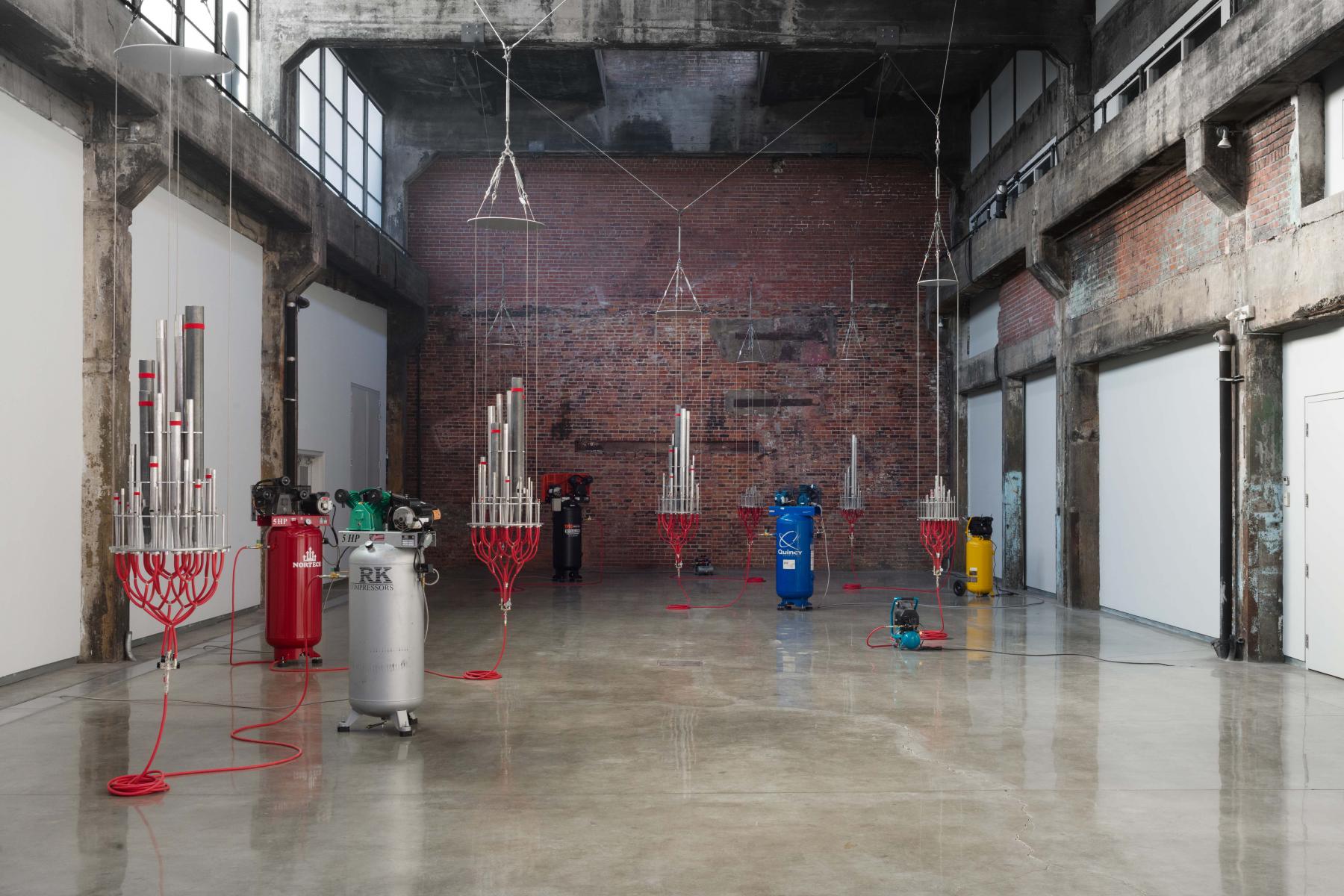
Maggy Hamel-Metsos, Simile Aria, 2025. Vue d’installation à la Fonderie Darling/Installation view at Fonderie Darling. Sound installation: air compressors, silver-plated hardware, rubber hoses, aluminum, Casavant Opus 2586 organ pipes, variable dimensions. Image credit: William Sabourin
In April of last year we—Alana Friend Lettner and M. Leander Kalil—encountered Maggy Hamel-Metsos’ installation Simile Aria at Fonderie Darling in Tiohtià:ke (Montreal). We knew very little about Hamel-Metsos; we did not yet know of her predilection for conceptual interrogations via sculptural means, nor of her various obsessions with opera divas, the Ukrainian-born Brazilian novelist Clarice Lispector, and bullfights. We knew only that she had a residency at Fonderie Darling, that she had exhibited internationally, and that we had to see Simile Aria before it was taken down, according to urgent encouragements from several of our friends.
Simile Aria featured a single repurposed church organ suspended from the ceiling of the immense room in seven isolated clusters, each of which was attached to an air compressor set on a timer. One by one, and over the course of nearly an hour, the clusters sang their disparate and highly dissonant chords. After bursting forth, each chord was surrounded by a silence that was so generous, so palpable as to seem as much a material component of the installation—as much as the organ pipes themselves. Off in its own hemisphere of the room, two tripodal contraptions, each affixed with an empty clip and a magnifying glass, stood opposite a mirror looming high on a lighting stand. Later we would find out that the clips had held photographs of opera divas and infants, and that sunlight coming in through the high windows, bouncing off the mirror, and concentrating through the magnifying glasses, had incinerated them. We were the only people in the room. Eventually, we lay down on the concrete floor and looked up at the ceiling, listening; after some time a gallery attendant approached us and, with an extreme gentleness and in a tone of voice reserved for sleeping children, informed us that the gallery was closing and that it was time for us to go.
What emerged from our encounter with Simile Aria was a correspondence with Hamel-Metsos (who is represented by the Montreal-based Eli Kerr Gallery and has a BFA in Studio Arts from Concordia University) in which the three of us exchanged letters, handwritten and hand-delivered to each other’s houses over the course of several weeks. We were driven, first, by a perception of shared interests and resonances: as a poet and student of osteopathy, one of us (Alana Friend Lettner) was compelled by the experiential and bodily aspects of the installation, and by Hamel-Metsos’ sculptural practice as a “reactionary stance towards a technocracy that flattens our corporeal experience of the world.” As a filmmaker with an interdisciplinary, architecturally influenced practice, the other (M. Leander Kalil) was compelled by its oblique musicality and its propitiation of movement through space, without becoming easily subsumed into the categories of either music or architecture. In the end, our meandering conversation touched on: material affinities and aversions; conceptual scaffoldings; stratagems of reversal; the objectification of pain and the freedom to vanish; etc. But we were also driven by a desire to sustain a sense of mystery, of tension and surprise in the process of our exchange. “I indeed willingly put myself in the tumultuous position of anticipation and revelation.” So says Hamel-Metsos, and so, in turn, say we.
In retrospect, we realized that the structure of our correspondence, which involved both spatial and temporal distance between each reply, shared a shape with Simile Aria itself: like its clusters of organ pipes, we were calling out to one another across the expanse of Montreal’s wintry cityscape. As Hamel-Metsos puts it: “Each chord is an exclamation in the void.”
— Alana Friend Lettner & M. Leander Kalil
I think of ideas as internal visions that I have to translate into a physical plane. Sometimes my ideas fail to translate directly; that's where the work takes a life of its own. Someone once said to me: If you can't get rid of it, make it a feature.
Alana Friend Lettner (AFL): What I remember most of Simile Aria was its physical impact on me. The organ pipe clusters felt so bodily in spite of their almost industrial composition, like lungs from which voices emanated. This makes me think of the mysterious in-betweenness of breath: voluntary and involuntary, conscious and unconscious. To me, Simile Aria was like this, both intentional and controlled while also allowing for something autonomic into the work. The organ pipes were abstractions of embodiments without becoming too conceptual or burdened by semantics; they really sang.
Perhaps the breath can be an analogy for making art. As you were making Simile Aria, were you consciously considering the installation as a somatic experience? I'm thinking about how we register the voices of others on not only a semantic level, but also on tonal, vibrational levels. Or were you indeed driven by some conceptual scaffolding?
Maggy Hamel-Metsos (MHM): I think that what you refer to as somatic experience is an inherent quality of sculpture—it's perhaps why I do sculpture. Sculpture is my reactionary stance towards a technocracy that flattens our corporeal experience of the world. My favourite example of this is the trading of gear sticks for buttons in a car. But the bodily aspects of Simile Aria were answers to questions entirely different. The red compressor hoses branching out like bronchi exemplified the singular vs. the multiple, the loneliness of a single voice being absorbed into the cosmos. Of course, the only true understanding I can have of other bodies is through my own body, and once you read it that way, it's endless: the tanks are the lungs; the pipes, vocal cords; the hoses, bronchi; the organ, an organ.
(Funny also that you mention the tonal and vibrational levels of voice, as I’m working on a rendering of some opera pieces, but solely through vibration—no sound.)
That being said, what's at the forefront of my thinking is indeed the conceptual scaffolding. The central thought, the core idea, of Simile Aria was to make the divine become human. Specifically, to reverse all the stratagems that make the organ divine—its endless breath, hidden blower, hidden pipes, hidden player.
I had no idea what anything sounded like up until two or three days before the vernissage. When I heard it for the first time, I was alone, it was late at night, and I burst into tears. I had been working on it for seven to eight months, and it felt like I could breathe for the first time.
M. Leander Kalil (MLK): What you experienced the night that you heard the chords for the first time strikes me as an allegory for something I sometimes feel: that upon finishing a work, I at last encounter it as something totally separate from me. Like Pinnocchio. What is your relationship to lucidity while you're working on a project? Do you like it to remain a mystery to you?
Especially as you mention your current project, in which you're taking the "heardness" out of opera pieces, I'm curious about your relationship to music. I always wondered to what extent you had "composed" these chords in a musical sense. And now I have my answer: you didn't. It's more that you were composing as a sculptor. I recently heard the composer and professor of composition Matthew King describe Stravinsky as having a talent for making "sonic objects," his distinctive, sharply defined chords, of great density and striking form. I've always thought of Anton Webern as having done something similar with isolated tones—they feel like bodies, animals that appear only as you pass by them in some nocturnal space. I think it's the severity with which you spaced out the utterances in Simile Aria, in addition to their incredible harmonic density, that leaves them, even in their sonority, as sculptures (rather than as music). As Alana said, "They really sang." But I almost imagine them like a choir that has dispersed, leaving singers or smaller groups of singers still calling out with their parts, lost.
I'm fixated on what you beautifully described as reversals of stratagems of divineness. I'm sorry to break it to you: the work has divineness! And to me, the clusters you've made are quite gothic, and, like columns shifted out of place, they form a sort of misshapen nave.
MHM: It would be a lie if I told you the clusters in Simile Aria were not sonically composed at all. I knew I wanted them to "sing out of key," but I also wanted them to try to be harmonious. I asked Maria Gajraj, Montreal-based organist and co-founder of Sapphonix Collective, to split the organ into seven distinct chords. From there, I chose the exact pitches. The non-musical feature, for me, is that there isn’t care for sequence. Each chord is an exclamation in the void.
Regarding lucidity, I indeed willingly put myself in the tumultuous position of anticipation and revelation. I love the thrill. Because often my ideas are practically unfeasible, the shape they will take is a mystery. The scale of both O.W.M.B., at Joe Project (2023), and Simile Aria made it so that I wouldn't see what I was working on until the eve of the vernissage.
I think Stravinsky and Webern still thought of what they were doing as music, but I never think about my projects in these terms. I never had the discipline for learning an instrument, so I can only use instruments obliquely. My great uncle was a renowned organist and organ-maker. But I don't think these things run in the blood. Since I have zero background in music, and because I have always wanted, deeply, painfully, to express myself in this language, it becomes about expressing the desire towards music, rather than the music itself. So in Simile Aria there needed to be a loneliness, like whales singing in the depths of the ocean. That's why there's distance between the calls. The figure of the dispersed choir you highlight is maybe my choir of whales.
Regarding divinity, there was clearly a desire to have a lightness, a hovering, levitating, celestial, sculptural quality to the pipe structures in order to counterbalance the heavy terrestrial quality of the compressors.
AFL: Like Leander, I was struck by your description of Simile Aria as enacting a reversal of stratagems that render the organ divine. It made me curious to know why you felt compelled to facilitate such a reversal—what was the root of your desire to de-divinize the organ?
The language of reversal reminds me of my recent studies of physiology and pathology. If you reverse the normal functions of any bodily system, you will end up with a pathology, an illness. The philosopher and poet Jan Zwicky writes in her book Wisdom & Metaphor: "The experience of struggling with illness is the experience of the fundamentally metaphorical nature of the self: one is, and is not, one's body." So, there is an inherent alienation or loneliness in illness. (Incidentally, there is a long tradition of illness as the precursor to divine encounter: Hildegarde von Bingen, or the mountain poet Hsieh Ling-yun.) I bring this up because earlier you mentioned a preoccupation with illness, and you also mentioned the need for the evocation of loneliness in Simile Aria, effected by the distance between the sounding of each chord. And yet to me, whatever loneliness you cultivated was offset by almost blinding moments of communion between chord and listener. It seems to me that we are rescued from loneliness by witness, by being seen.
Your comment about doing sculpture as a reactionary stance against technocracy resonates deeply with me. (I am currently studying osteopathy.) How would you characterize your relationship to tactility, to your hands?
MHM: Regarding tactility, I believe it's one of my intelligences. I grew up extremely manual. With the experience I've acquired, I feel it's very easy for me to predict what a material wants to do or not. But it makes it very hard for me to work with others, as I am just in a dance with materials, and so much of it is about feeling, being sentient and attentive.
As for the organ, I think it’s this almighty, omnipotent instrument, and I needed it to show some vulnerability by altering its functions. Maybe it's this stepping down from a state of power that lets us relate to it better. But most of all, it was a decision based on the Main Hall of Fonderie Darling. It's a very tough room to work with because it’s already so incredibly beautiful and grandiose, shaped like a church, and with very high ceilings. (At first, I wanted to show works on the ceiling so that our gazes would be redirected upwards. I like that stance, as it reminds me of the experience of the world as a child.) Some works try to compete with the divinity of that room, but I thought that my strategy would be to take something that is already divine and bring it back down to human height. Instead of us bowing in front of the organ, it bows down to us. It's like watching a loved one, who was always strong to us, in a hospital bed on artificial respirators.
I profoundly relate to what you mention about normality, pathology, and being seen. But I think we suffer in lights as much as we do in the shadows. I am quite obsessed with divas of opera who end up living the tragedies they perform. In this moment of intense, almost fetishistic, consumption of images of the pain of others, it was important to me that the chords sing and the photographs of babies and of opera singers either performing pain or being truly afflicted burn away not only when people are there but also when there are no witnesses, and that they don't suffer just for our gazes. Tragedies big or small happen every day, whether we witness them or not, and not all tragedies should be circulated in the media sphere. The pain of others is not for our entertainment. Images of exhibitions are entertainment, in a sense, but being there is wholly different.
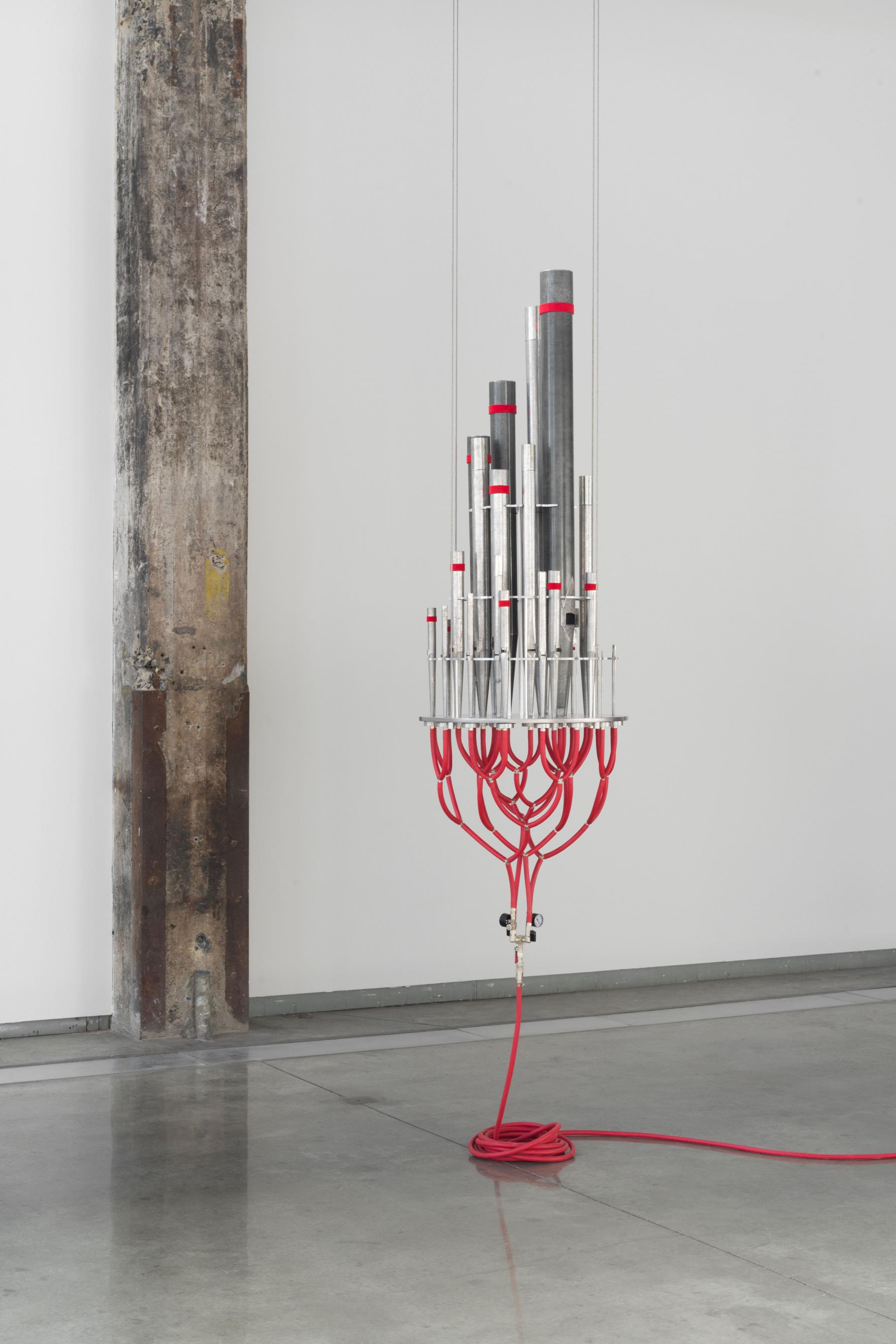
Maggy Hamel-Metsos, Simile Aria, 2025. Vue d’installation à la Fonderie Darling/Installation view at Fonderie Darling. Sound installation: air compressors, silver-plated hardware, rubber hoses, aluminum, Casavant Opus 2586 organ pipes, variable dimensions. Image credit: William Sabourin
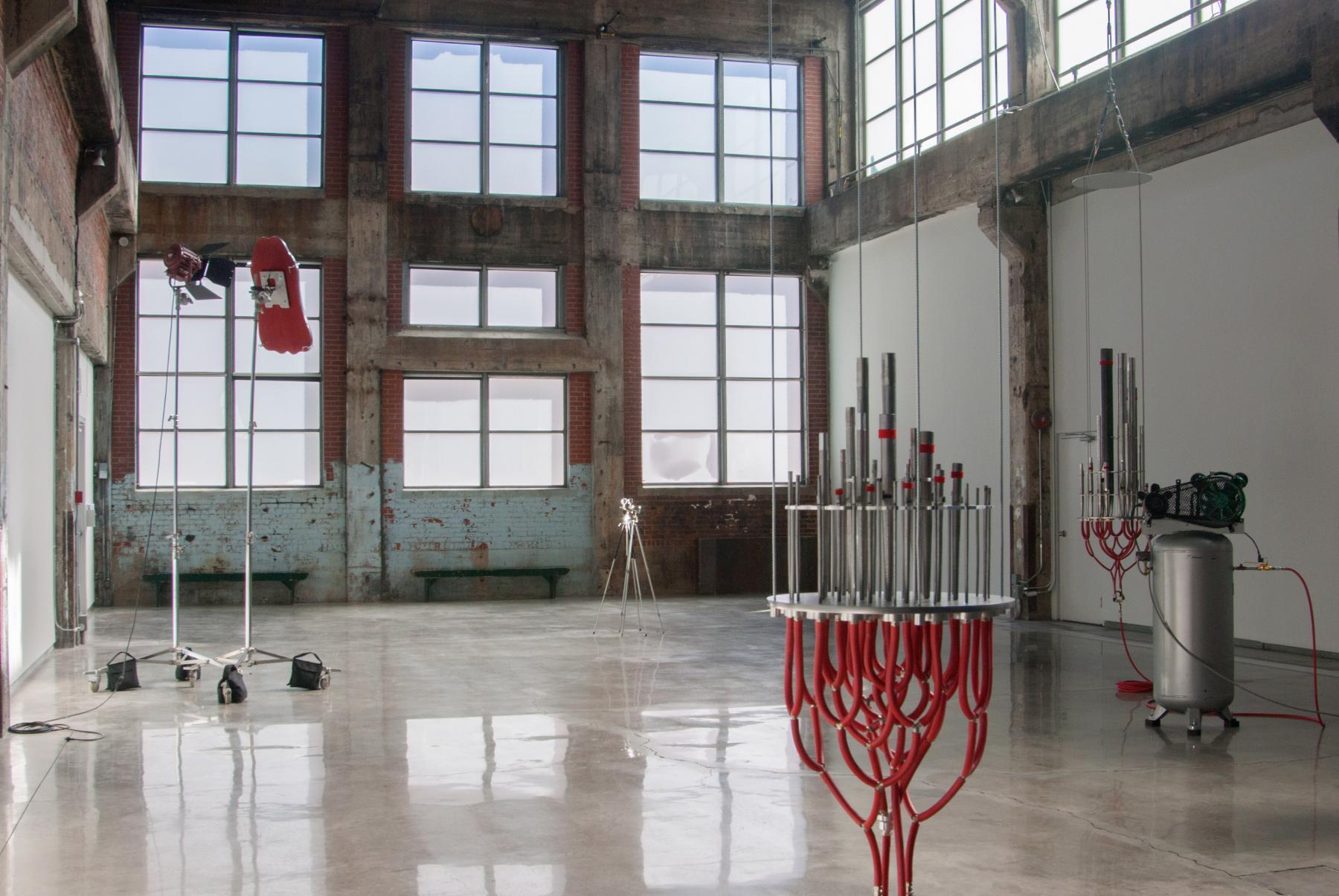
Maggy Hamel-Metsos, Simile Aria, 2025. Vue d’installation à la Fonderie Darling/Installation view at Fonderie Darling. Sound installation: air compressors, silver-plated hardware, rubber hoses, aluminum, Casavant Opus 2586 organ pipes, Variable dimensions. Image credit: William Sabourin
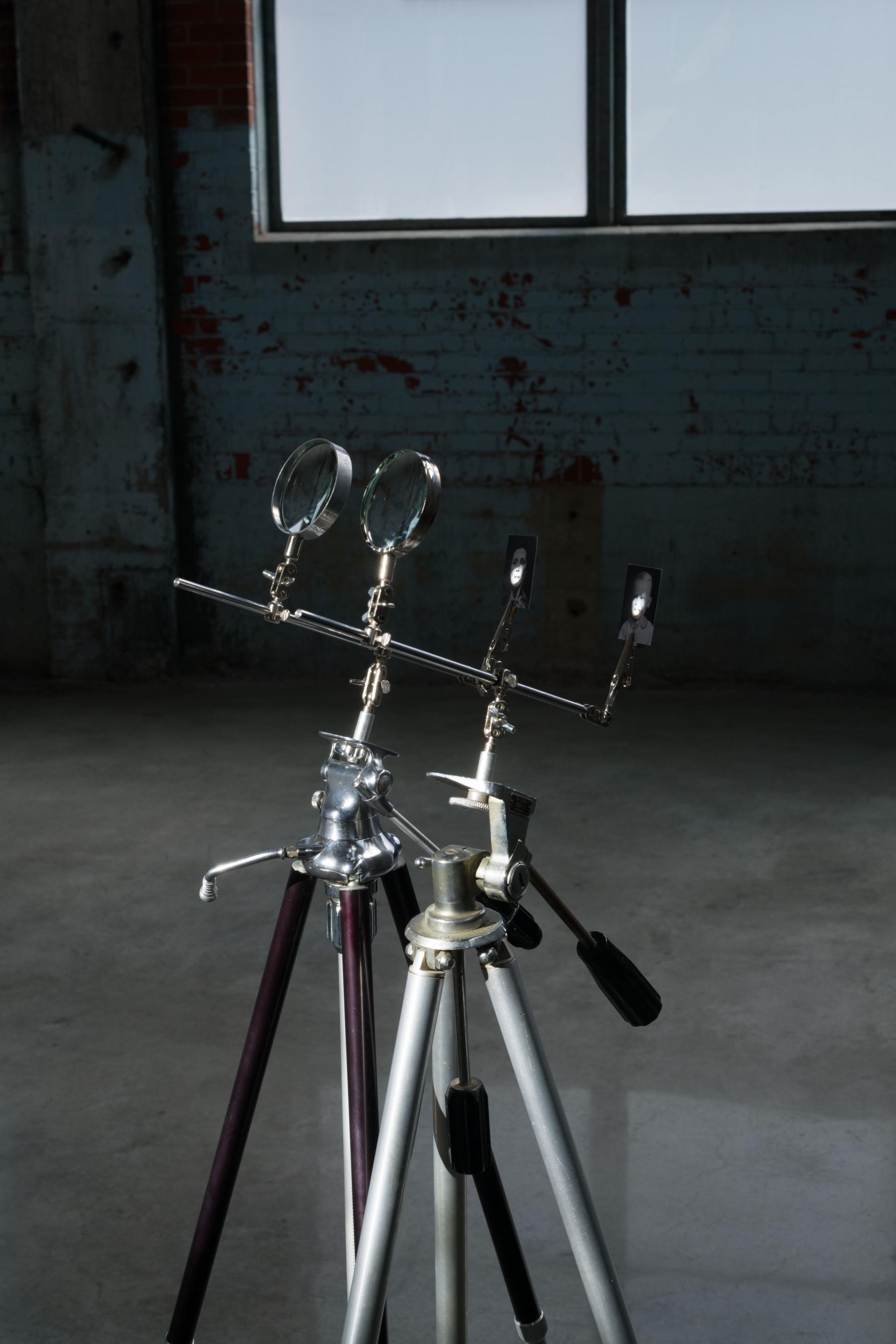
In this part of Simile Aria, the photographs held by clips in magnified sunlight will eventually combust and burn away. Maggy Hamel-Metsos, Simile Aria, 2025. Détail de l'œuvre à la Fonderie Darling/ Detail of the work at Fonderie Darling. Image credit: William Sabourin
AFL: This imperative you felt to allow the chords and the photographs in Simile Aria to exist for themselves and not only for an audience interests me, especially since part of this gesture entails their freedom to vanish. The freedom to go unseen is increasingly difficult to achieve, given the ubiquity of surveillance technologies, and yet it seems to be a critical aspect of what it means to be free. How do you negotiate your own visibility as an artist? What does it feel like for you when an exhibition opens to the public?
I like what you said about being in a dance with materials. It seems to me that your difficulty collaborating with other people arises from your fidelity to your primary collaboration with the material. Are there particular materials you share a special affinity with, or, conversely, materials you feel unable to relate to?
As a writer, language is my material, and it's very tangible and physically expressive to me. Years ago I read a theory about the origins of language that has always stayed with me. The theory goes that kinship bonds were primarily established through physical acts—of grooming, say—but as human communities became bigger, it was no longer feasible to be in a physically close relationship with everyone in the community. So language emerged as a form of touch at a distance. Whether or not this origin story is historically accurate is not so important to me, but the thesis at its core informs everything I write.
MHM: I love this theory of language emerging as a way to touch others. Some writers touch me so deeply it feels like a violation of personal space (Clarice Lispector, Anne Carson). It's always curious to see how people will interact with a work. At the opening night of Simile Aria—I never expected it—people were rushing to gather around the chord that was singing, and they formed a circle as if around a fire, or like that scene in The Grinch when they all sing around the Christmas tree. That was so touching.
Perhaps you're right about my fidelity to the material, but I also think that my difficulty collaborating with others stems from not really knowing what the fuck I am doing. When I’m handling an object or a material I’m making so many microdecisions simultaneously that it would be hard for me to explain to others in the moment, they’re just intuitive responses.
I share no affinity with anything digital or in cyberspace, but I also have no affinity with ceramics, or materials that are very malleable. I have to struggle with something more rigid, that resists, something that comes with its own limitations, story, an already-formed thing. Working with an organ, or with metal—that’s character. When the material is more malleable, like with paint or clay, the attention is too much on me, on my self.
My own visibility is something I struggle with, definitely. I find being visible exhausting. Out of self preservation, sometimes I want to be more cut-throat, but I seek communion before aversion. I understand my medium as thoughts, and being in dialogue with others is how I think, so conversations are very important to me, and exhibitions allow me to talk to so many people with so many different backgrounds.
MLK: The way you characterize your creative process as not really knowing what you are doing brings to my mind again Alana’s description of the breath. I, too, am fascinated by the interplay in artistic process (and in life broadly) between the voluntary and involuntary, will and reflex, navigation and getting lost. And I often find that the most profound synchronicities in a work are not results of conscious decisions, but more like the work putting itself together. This stuff unfolds through process, but the initial appearance of concepts, too, can happen through a similar tension between the voluntary and involuntary. Simile Aria has incredible conceptual elegance, while also being so layered in its figuration as to still be truly mysterious, like plant and animal bodies.
The way you describe your preferred materials as having a rigid character that you must reckon with could also apply to instruments, tools, that are designed to be used in a certain way, or, if it’s a musical instrument, played in a certain way. I think that your oblique use of musical instruments, arising from wanting to engage with music without having musical ability, is precisely what we hear in a lot of great music and musical practices. I find that music that searches for the secret sounds of an instrument can be quite moving, music that misuses musical techniques or structures, or misuses the instrument or plays it "broken," or plays it less like an instrument and more like a material (I have in mind the composer Ernst Reisjeger, whose cello, it seems to me, is more like a material he plays with than an instrument he plays, more like the clay itself than a throwing wheel or shaping tools). The line between instrument and material is blurry to me, and not just in music, but in general, and perhaps especially in architecture. What are your thoughts on the relationship between material and instrument?
MHM: I would be tempted to say that instruments, perhaps in addition to thoughts, are my material. It's true that I most often start with objects, vases that hold flowers, pipes that sing melodies, objects/instruments that I melt down into plaques. I like it when things do something and are not merely representational. I guess a lot of my work is also partially concerned with misusing things.
MLK: So you start with objects, instruments, and thoughts. But how do you get from there to an idea? What is the transformation between your encounter with that thing and the idea of what to do with it, or what to reveal about it in terms of what it can "do"?
MHM: I can rarely connect my ideas to an exterior factor. I mean that they come to me in half-dreaming states, and because they take place in a malleable world that does not necessarily reflect reality, they are hypotheses and questions, i.e.: Can I have a film run horizontally in a custom lightbox? Can I power an organ with air compressors? The course of these ideas is just a symptom of an unknown gastric phenomenon happening inside me, from which I get a sensation, or, in the case of Simile Aria, a vision. And things are so well digested that it's very hard to recognize or isolate an origin in this mush. I don't keep note of ideas. There has to be a manifestation. I think of ideas as internal visions that I have to translate into a physical plane. Sometimes my ideas fail to translate directly; that's where the work takes a life of its own. Someone once said to me: If you can't get rid of it, make it a feature.
.jpg)
Maggy Hamel-Metsos, O.W.M.B., 2023. Vue d’installation à Joe Project/Installation view at Joe Project. Ektachrome film, galvanized steel, spools, sprockets, plexiglas, lights, motors, hardware and a metronome, 250 linear feet. Image credit: Atlas Documentation
 copy.jpg)
Maggy Hamel-Metsos, O.W.M.B., 2023. Détail de l'œuvre à la Fonderie Darling/Detail of the work at JoeProject. Ektachrome film, galvanized steel, spools, sprockets, plexiglas, lights, motors, hardware and a metronome, 250 linear feet. Image credit: Atlas Documentation
AFL: I recognize much of what you describe in my own process. Something emerges out of the ether—a fragment of voice, a bodily gesture, a desire—and then I am compelled to follow it. Any time I try to make work from an idea or a concept that I can already articulate in advance, I know I won't ever finish it. Because, in a sense, the process is over.
What you said about making a feature of that which you can't get rid of reminds me of how I approach revisions. If there is an intractable problem in a piece, eventually I am more or less forced to consider how I can incorporate the problem, what the problem has to teach me about what the piece can do. Could you describe how, during the creation of a particular work, you made a feature of something that appeared to be a problem?
MHM: With Simile Aria, the whole show was based on something I could not get rid of, which I mentioned earlier: Fonderie Darling's Main Hall, and that includes its acoustics. It is impossible to have a conversation in that room, that's how echoey it is. So the piece was conceived to highlight this feature of the room that would have otherwise cost me tens of thousands of dollars to fix.
But more generally, I'd say these types of negotiations happen on smaller scales. In Vues de la Plaine at La Gn-o (2024), when I was reproducing the plan of St. Gall's Monastery, the chalk line was often too loaded, which created a sort of cast or halo of diffused chalk around the line. In the end, I kept these diffusions, these haloes, because they made everything seem more like bruised scars on concrete than simply architectural chalk lines—it was a sort of building stigmata.
I truly resonate with what you mentioned about knowing the outcome of a given idea—if it doesn't involve hard work and/or thrill, I’m not interested.
MLK: I'm always amazed at how there really is no substitute for the action, the play, the touching of the instrument or the material when it comes to the emergence of ideas. And in this sense, one's own work can always be surprising. Your description of hearing the sounds of the organs, as well as of the unexpected appearance of the chalk in Vues de la Plaine, seem to me like descriptions of surprises. Have you ever found yourself wrestling with a project that is manifesting in contradiction to an expectation or intention you had for it?
We've spoken about bodies, music, materials, and spaces as the provocators of your work. But I'm curious about what other features of life, the world, and culture compel you. What beyond your disciplines and mediums proper do you marvel at?
MHM: The work is just always a bit misaligned with what I had intended or expected. But that’s good—it means it speaks outside of me, beyond me. The work has its desires and paths of least resistance, and I have my own, but we do have to meet somewhere. It’s an encounter.
To your point about contradiction, I can't say. What I can say is that I am almost always deceived. But I don't give up, I keep pushing until it's at least a fair negotiation with reality. I think the struggle can be elegant and moving. Trying is beautiful in itself. A failed attempt is better than no attempt at all. Don't you both feel that way in your own work?
A lot of my aspirations come from literary figures. I love the immaterial presence of the author through writing, like a timeless spectre that appears. Then I have obsessions, which are not what one would think of as a source of inspiration; it's quite different, it's more angular and complex. Opera, bullfights, machines in general... I marvel at the process of photography but not at the photograph... What's the relation you have with the things you absolutely love and adore, especially if it's somebody else's work?
AFL: The way you describe your process as encounter, negotiation, even as passing through a kind of deception, actually reminds me somewhat of bullfighting (or the little I know of it): a blend of play and danger in which there is antagonism and elegance, moments of grace and even mortal failure. What do you mean when you describe bullfighting and other unlikely sources of inspiration as "angular"?
I very much consider writing to be a process of encounter with the world, certainly a negotiation with reality—and not just its representation, but the actual creation of an experience that a reader can inhabit and live through. Could you say more about the writers, like Lispector and Carson, with whom you have an affinity?
As for my relation to that which is other to me and which I adore, I would characterize it as tension. Simone Weil once wrote that the beautiful is that which we desire without wishing to eat it. I don't think that's true for me. Beauty for me, in the art of others, and in others, is the hunger and the satiation both, it is the experience of that opposition, neither wholly unrequited nor wholly consummated—not two, not one.
MHM: I used the term "angular" to describe the friction I experience with these obsessions. "Knots" could have been another word. It's a mixture of fascination, irritation, something that excites the neurons because of its contradictions.
I agree with you about writing that creates an experience, and maybe my literary attractions reflect that. To me, Carson, Lispector, and Jon Fosse are writers who each in their own way passed beyond the merely representational force of language. Lispector's The Hour of the Star has to be the most painful reading I've done lately, because she makes you experience emotions—disdain for others, the pathetic—at an intensity that is best kept in the fictional world. In a way, she forced me to feel those things so that I wouldn't have to feel them in real life. It was transformative. It's a Jesus type of sacrifice. I will just say this: upon having conquered an esteemed warrior, Romans would eat the heart of their enemy to possess their admired attributes.
MLK: I do feel that a real attempt is beautiful, often not in spite of its “failures” but because of them. Sometimes I will lucidly defend an aspect of my work that I know doesn't really work, by affirming its value as an incarnation of a longer-term realization that I'm not yet capable of realizing, which also puts it in a position of specialness, like mudskippers, those fish that have legs.
I adore things in tension, for example tension between epochs, like music from around 1600 (Renaissance turning into the Baroque), or the tension between grace and collapse, like the scene in Chaplin’s The Circus when the Tramp ends up on a tightrope without a safety line (a fact he only discovers after showing off a bit), and while up there is harassed and undressed by several loose monkeys. And I like to try to figure out how these tricks of tension are done, while somehow remaining under their spell.
Your description of reading The Hour of the Star reminds me of my recent experience watching Olivier's Hamlet. I found its tension, its insanity, and its lonely atmosphere almost too much for me to bear, too real. And all the while I was in wonderment at how this was being done to me.
When you make work, are you ever seeking to elicit a specific emotion? Are you one to push for levity? For gravity? For neither?
MHM: I, too, like to defend the odd parts, or that which "screeches." I used to explain what something was supposed to be, to express the complexity of the thinking behind my work, but over time I’ve stopped doing this (or I want to stop, though I am sometimes still too candid). Sometimes artists get attached, perhaps too much, to the intention, and they simply stand in front of something that was supposed to be otherwise. I was recently discussing with my friend, visual artist and performer Betty Pomerleau, how we just like to follow the viewer's lead and agree to whatever intention or interpretation they attribute to us or to our work—to a certain extent of course. It's freeing up or opening up the work, because even for us what we do is just one physical manifestation of a boundless thought.
I do think there's a clarity and simplicity to what I do, such that people often find themselves right where I was going. But even then a lot of it remains a mystery to me, too. Except in frequencies—I know when I vibrate, and I just trust it will make others vibrate the way I do. Some works just speak to you in a way that is like finding the right frequency on a radio. This has happened many times with Simile Aria, and in this sense it was truly operatic. Through the performance of my song, I touched some and for a brief moment we felt understood.