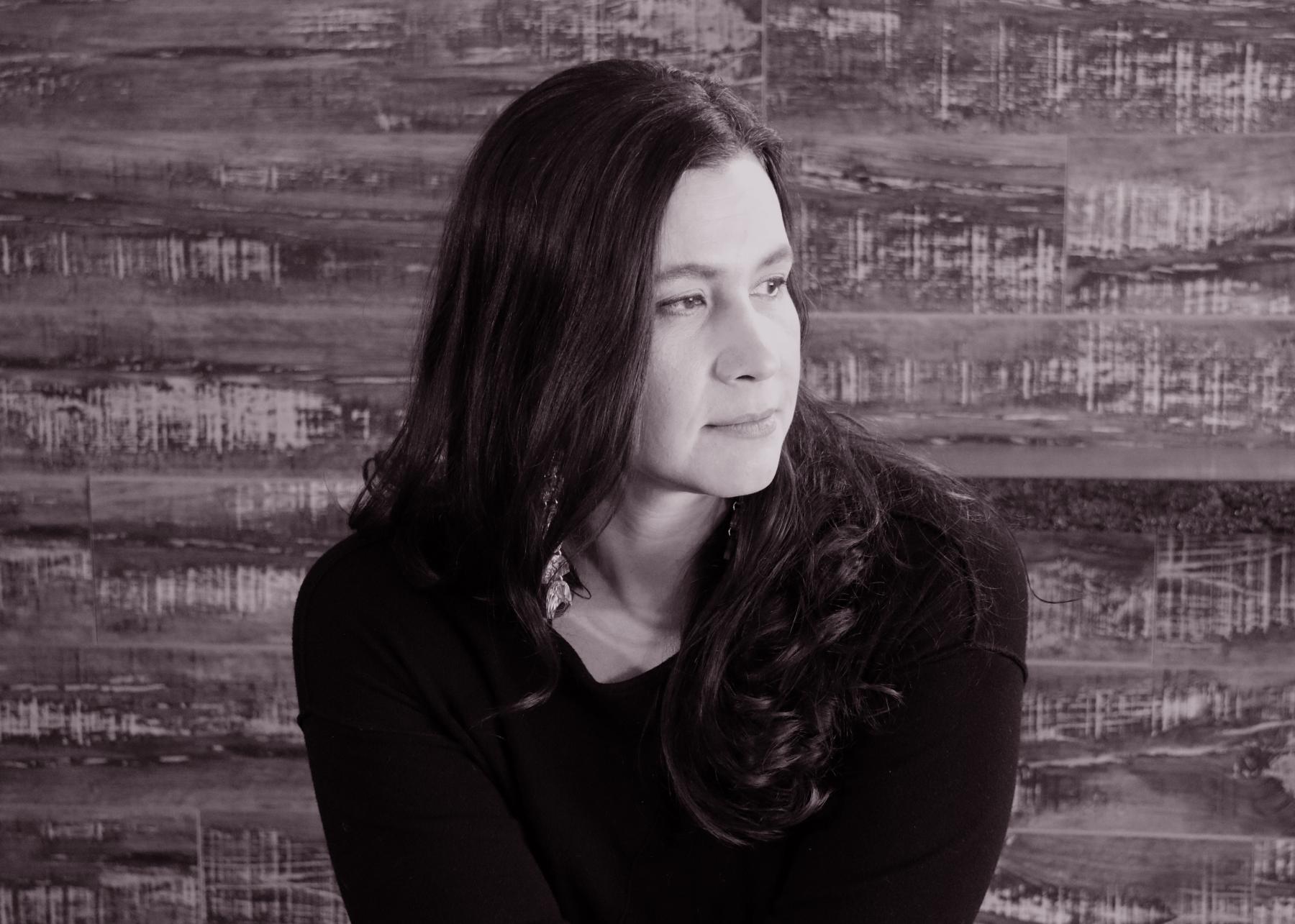
katherena vermette.
I first encountered the poetry of katherena vermette in 2012 when I was in my early twenties, hinging between different selves and trying to figure out where I belonged. I was immediately struck by the musicality, breath, and precision of her work. Her debut poetry collection, North End Love Songs (which went on to win the 2013 Governor General’s Literary Award for Poetry) felt like a permission I hadn’t known I’d needed: permission to write from the belly of my own experiences as a young white-nehiyaw woman, permission to play with the line in unexpected and surprising ways, permission to axis my life towards poetry itself.
katherena is a Michif (Red River Métis) writer from the heart of the Métis Nation, Treaty 1 territory, Winnipeg, whose books have been national best-sellers, received critical accolades and won multiple literary awards. Over the years, I have spent countless hours with her words, learning how to turn a line in a poem, how to craft voice in a story, how to honour who you are, and where you come from. I have lived inside the complex worlds of her novels: The Break, The Strangers, The Circle and real ones. I have had the privilege of teaching her graphic novel series, A Girl Called Echo, to classrooms of sarcastic teenagers, and read many of her children's books aloud to nieces and nephews.
In her third poetry collection, procession (House of Anansi, 2025), katherena brings language to the ways in which “we are only here to honour our ancestors, make space for our children, or those who come after us, and those who come before us.” Her poems serve as gentle but firm reminders to practice self-compassion and reciprocity —often drawing on embodied memory, the multiplicities of self, the witchy, the cyclical. Sectioned into four parts (“Biindigen,” “carry memory,” “make beautiful,” “Matriarchy/dreamtime”), the collection resists colonial constructs of capitalization and grammar, threading narratives of family photographs, childhood notebooks, body sovereignty and celebration together with striking enjambment and moments of white space on the page. In “behold the Matriarchs,” the musicality of the poem is guided by consonance and repetition as the speaker recounts, “that this world has never worked as either/or /only as both and all and every.”
The poems in this collection capture just that—the infinite, the everyday, the worlds held within a word. Spending time with procession had me at turns, smiling quietly to myself, taking a deep breath, and reflecting on what it means to dream like an ancestor. The opportunity to speak with katherena vermette was a dream itself. She was generously kind, funny, and thoughtful as we talked about magick, mothering the self, following the music of words, the experience of aging, and bird-watching. She spoke with me over the phone in late April, from the hammock in her backyard in Winnipeg.
Every poem has its own world, its own set of rules. [...] I really like playing in that space of the world of the poem, and making it whatever it wants to be.
You open the collection with the poem “grimoire” and invite us into the language and body of magick which reappears throughout the book. I would love to hear more about your choice to begin with this poem and how magick is embodied within the collection?
I love that question. The poem “grimoire” is a hearkening in, a calling, a casting the circle. I wanted to be witchy with procession. I was trying to find that balance between medicine and magic, the idea between Indigenous medicines and Western pagan traditions that I've brought into my work more and more as of late. “grimoire” is the first poem because chronologically, it's the first poem in the collection that I wrote. My poetry collections tend to be exactly that—collections of poems over the course of many years. “grimoire” was a poem that's been with me for years and years. When it was first published, I was a new writer and the editors chose to edit quite extensively. The version I have in this book was a reclamation of what I originally intended the poem to be. The poem itself, to me, is like its own magic, its own kind of ceremony and bringing back. It became a theme that repeats throughout the book of being new, coming into birth, coming into a new phase of life and harkening ancestors.
There’s already so much I want to unpack. I love the way you frame the poem as a reclamation. You also mentioned you tend to build your collections chronologically. Can you speak about that a bit more about that in relation to your work?
There are 6 years between the 1st and 2nd collections and almost 8 years between the 2nd and 3rd collections. They are very much a collection of poems within that time. In this poetry book, the section “Biindigen” with the Anishinaabemowin and Michif words, contains some poems that were originally published in Room Magazine in 2018. They were written with the birth of my daughter, who is 8 now, and the other sections of the books came within that 8 years which feels like a lifetime. What we all have gone through in the last eight years.
Honestly, I find that very comforting to hear. It’s a reminder that it is okay to take time to build a body of work before releasing it into the world. Something I really appreciated about this collection is the way you give language, and space on the page, to the multiplicities alive within and beyond the self. There are many “yous” alive in these poems! Could you talk a bit about the choice to use a 2nd person point of view in many of the poems?
I love the 2nd person point of view. I think there's a freedom in practising poetry with the 2nd person that is difficult with prose. It's very hard to use the 2nd person in prose without sounding didactic and argumentative. In poetry, for me, the “you” tends to be a gentler voice…so much of this collection was speaking to younger selves, my other selves, sometimes my older self. The last section of the collection is definitely speaking to my older self and the elder I hopefully get to have the privilege of being.
It’s funny when you look at yourself as a younger human, and it's not quite you anymore, but also it is you. We undergo so many metamorphoses through our lives, including physical, spiritual and mental. It felt like I was speaking to someone else and I was in a position of mothering them. I speak openly about therapy and the last eight years was a very therapy-centric era which is where many of the poems come from, but particularly the childhood poems. It felt like I was using therapeutic tools to care for that childhood self. I felt like it was a very different person and I wanted to approach her, not as an “I”, and not as a third person, but as a “you.”
I know every poet is different, but many poets write autobiographically, and it's really easy to get lost in the “I.” When you speak in 1st person, it's very myopic. You're operating in the world with blinders on so it's nice to get out of that a little bit.
That really resonates. I love that invitation of gentleness towards your younger self. Much of this collection speaks to the experience of aging. As someone walking towards midlife..
Oh gosh, you’re a baby. [laughs]
This is funny because I’m sure I will look at my past self and be like, don’t worry about that. This collection made me feel encouraged, guided, and gently reminded me what I should be prioritizing. What would you say to a younger version of yourself about aging? How have your priorities and energies shifted throughout your life?
It’s funny, I say you’re a baby with gentleness and with respect, because I feel much older. I remember through my whole adulthood, I felt old. I felt wizened; I had my 1st kid when I was 22, and thought I was so old, and now I look back on it and I realize exactly how ridiculous that was. I think we're so mean to ourselves. We're our biggest bullies and especially those of us who, when we want to achieve something or have a goal, are not perfect. There is often this push to not be messy and to somehow have arrived in adulthood as this all-knowing beast, which we never quite get to, and it's very frustrating.
It is!
It is. I mean, part of it is very typical because as I got older, I realized I was incredibly hurried. I was a very ambitious person. I had kids young. I went to school. I think a lot of my perfectionism stemmed from childhood but also I was trying to undo who I was and where I came from. I always had the idea that I had to work twice as hard for half as much. I felt that in a really deep way so I think it would be amazing to go back to my younger self and to show her what I actually did. I think that would solve a lot of the hurt that was happening in me. I was in a lot of pain for many years. We sometimes forget that it's actually an honour to get to be who we are.
So much of what you are saying circles back to the collection in terms of talking to the self. I love what you are saying about slowing down and being kind to yourself. I think about this a lot because I feel so lucky in the last ten years to have more access to my culture and the opportunity to connect more. And alongside all of that learning has also come this immense grief. It’s that grief for the younger self that at that time didn’t have access to the joy of who I was. There is a grief and a rage that comes from the possibilities of what could have been.
It’s grief that we didn’t get to be this person when we were young, or we had to get over all this stuff to get back to ceremony. That said, I also do want to honour the young person who wanted to go out and socialize because she wanted to have experiences. I think for me, it’s a perfection thing, like I want to have a perfect history also.
The perfectionism hits me hard… It's interesting because I noticed in the collection there were several moments where you write about feeling scared but doing the thing anyway. In particular, it made me think about feeling fearful about doing creative work. I would love to hear more about how you navigate feeling fearful or scared and how that's evolved over time in your career?
It changes, I think. I feel like I've always been a really fearful person, or maybe the human experience just involves being scared. When I was young, I was deathly afraid of public speaking. I was the kid in university who dropped out of a class if there was an oral presentation. It took me until I was 26 before I did my 1st poetry reading and that was terrifying. It was definitely one of those things that I practiced. And I practiced and I practiced and then, I just did it. And now I don't think about it. I trust myself and I love reading what I've written. I'm a big revisionist so by the time I'm reading something, by the time I publish something, I trust it. But if I'm not afraid of that, I'm just afraid of something else. I'm afraid every time I publish something. Right now I'm writing a book that's very different from what I've written before. And it's terrifying. I keep going back and procrastinating with research, as if I need more of it but I don't. I'm just scared. Research is great when you want to procrastinate because it can never end.
It's a practice. It's a doing. It's a revising. You do it anyway. You're gonna be scared no matter what.
Oh, I love that so much. I can really relate to that inclination towards procrastination. I respect and admire the breadth of what you’ve created throughout your career, from graphic novels to kids books. Speaking of trusting yourself and your own work, something I’ve long admired in your poetry is the way you isolate single words on a line and play with enjambment. Recently, I’ve become particularly obsessed with minimalism. Your work first awoke me to the possible density held within just a few words on the line. I'm curious to know where your poems begin and then how they evolve or change over time? What is your revision process for poetry?
It's funny that you say minimalism because I think I'm much less a minimalist than I was. I think my 1st poetry collection was definitely minimalism and then the 2nd one, River Woman was so much about rivers, they became long and winding poems, and this collection is kind of a mix of the two. I think a lot of my minimalist poems, my early poems, were really confined by precision and wanting to be exact and cutting. I was very stiff. I've gotten much looser in my poetry as I've gotten older.
In prose and in different forms, I've had different kinds of evolutions, or lack thereof. Poems to me are very musical. I've spoken with songwriters about this too. Songwriters usually start with the music and the words fit the music. I'm very much of that same gesture, but for me, the music is the words. So I usually start with words, but it's about their sound and so I follow along with the sound. Every single poem is constantly getting polished. Some more than others, some are much more frustrating, some I would argue are just constantly going, never refined and never finished, others don't take quite as long to feel like they're somewhere. It's about the sound. It's about the rhythm of the speech.
I really love to play with space. I really love to play with the line. I never like to occupy too much of the line. Very, very rarely do I like to operate on the whole line because I think in poetry, you have so many levels of different things that you can play with: the musicality, the words, the meaning, the line, the page. I like to play with all of that. I love hinging. I love foregoing punctuation whenever possible. I love playing. I have a whole layer of editing dedicated to capitalization and messing with colonial constructs of language, particularly with things that should be capitalized versus things that are. It’s tiny little things like that; you can have all of that in poetry. It's this total blank canvas that you get to throw paint on.
Every poem has its own world, its own set of rules. Some work together into a series. I tend to make everything into a series or some sort of story or narrative but you don't have to. It can just be standalone. It can just be its own thing, in ways that other kinds of writing don’t let you. You have other things to think about. So I really like playing in that space of the world of the poem, and making it whatever it wants to be.
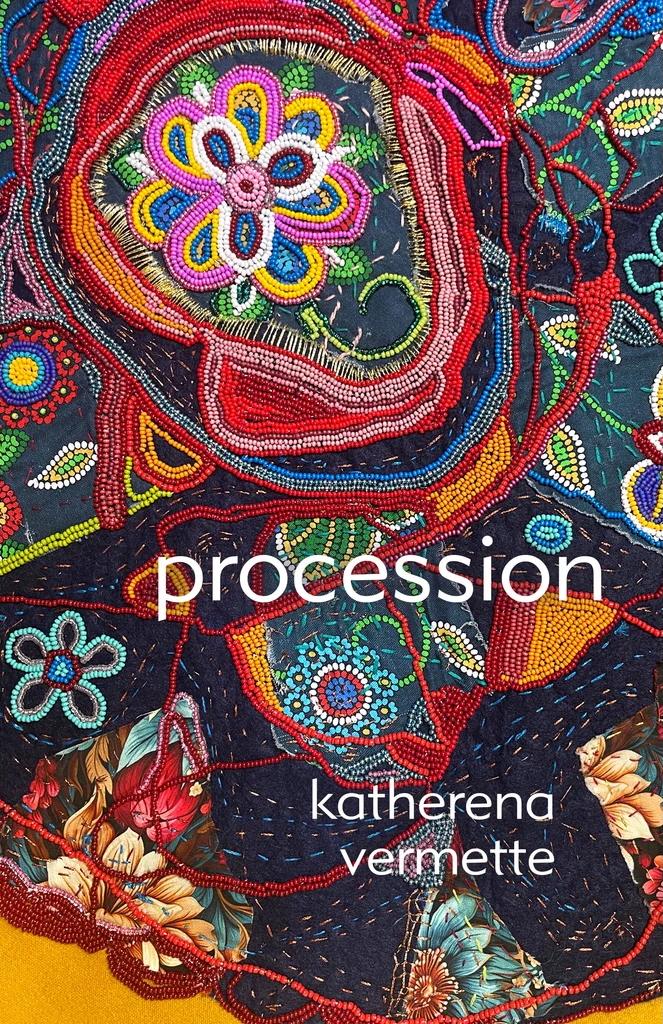
Book Cover for procession, House of Anansi Press, 2025.
It's funny you said the musicality of a poem because I often read your work aloud. I love this idea of what you shared about the world of the poem and I also think about that in terms of the world that is held inside language. The poems that open the collection really speak to this world building and offer us definitions and origins of Anishinaabemowin and Michif words. I am reflecting on the ways you spoke about intentionality around grammar, and playing with grammar. Why was it important to open the book that way? And then how did that ground the collection?
The overarching theme of the collection comes from the main poem “procession,” which is that we are only here to honour our ancestors and make space for our children, or those who come after us and those who come before us. The 1st section is about those who come after us. It's about the children. The next section is about ancestors, then I'm talking about myself in the past tense, and then I'm talking about myself in the future tense.
The 1st section is welcoming baby, because if this is a testament, or a journal of the last 8 years, then in the last 8 years, I welcomed two more children into my family. I also lost—like many, most or all of us are—a lot of people. So it was really just staying in that space. My son was born 5 days before lockdown so I was literally in this space of holding new life and welcoming newness into the world while there was so much death and dying, and mortal fear that we all felt in one way or another—some of us more than others, I don't want to discount that. Death felt like a theme. Death continues to feel like a theme in our world. And maybe it has always been there and we just see it differently.
It was this constant in between. I wanted to talk in terms of opening that, welcoming these children in because that is where it begins, even though that's also where it goes. It's this constant cyclical process. I also, as a Michif speaker, as an Anishinaabemowin speaker—and I say speaker, I'm a learner. I often get caught up with the words and the meaning of the words and how these words are so ancient, they contain whole worlds in and of themselves. And so it was really about learning them and exploring that word.
There's a poet in Newfoundland called Mary Dalton, she's a wonderful poet who explores many different themes, and she wrote these beautiful guessing game poems, where she would have a poem describe something and you would guess what it is. I remember being in an audience with her doing a reading and it was electric. She was describing a freaking apple. It was beautiful. I really was thinking in terms of the word and as we are bringing these words into the English literature, we are constantly having to translate. I want to translate because I want people to understand, but also it's an extra labour. I wanted to create these poems and explore these words, but have them be a kind of guessing game a la Mary Dalton. The titles of the poems are the word in Michif or Anishinaabemowin and the poem is the description, and through the description you get the title of the poem. Some of them work more than others. You may not be able to tell what Anishinaabemowin word it is, according to my poem, because my poem talks about one word in many different ways. You could write a book on that one word. It was exploring the fabulousness of the word without defining the word as a straight up translation, and being in love with the world in the word.
I read those poems and I went, this is so fun and brilliant. Something that I love is it also holds what you can never truly translate. Language and culture is so embodied and I feel like these poems did such a beautiful job of capturing that essence of the world that's held within a phrase, or a specific word. I also love what you said about that spirit of it being like a game. It's interactive. Learning also can be joyful and surprising. And that circles back to this ultimate feeling of hope that I had reading this collection. Ideas around the beauty of aging, and what you write in the title poem “procession” about only being here to honour your ancestors and prepare for your children.
I would also love to talk a bit about your journaling practice. In several of the poems (“you are the sky 1987,” "worldly 1989,” “make beautiful 1992”), you include early poems and questions from notebooks. I was wondering about your relationship with notebooks and journal keeping. Has that changed over the course of your life? I was curious about your decision to directly include some excerpts.
I still journal. I love journalling. In different times of my life, it's very much been a root and served a different purpose. I always have a paper journal. I'm old school. I love a moleskin with an elastic band and some ribbons inside, a place to put your pen. I think it's a great place for me to do longhand poems. For prose, which is mostly what I’m writing right now, I do a lot of ideas and a lot of patterns and big picture thinking in my journal. Whenever I'm working through something, whether that be professionally or personally, journalling can be a great tool. I think often we don't know what we're thinking until we write it down, because getting some distance can give perspective. It's like going for a walk. We often think so much better after going for a walk. Journalling is a way to do that. I think it's a great tool and I recommend it to all writers. I think there's so much to be gained there.
Totally. You mentioned you are mostly writing prose right now. I'm curious to know, do you have a poetry brain and a prose brain? Does approaching different genres feel different for you?
I think it's different. I don't know if it's a brain, definitely a different muscle. Poetry has many different demands, and definitely different speeds.
What advice would you give to a poet foraying into prose?
Poets foraying into prose…It’s always good to have some sort of a structure, and that might not be a writing class. I definitely don't think university is for everybody. I definitely don't think writing classes are for everybody. But some sort of structure because particularly with prose—-though arguably you can write a poem that takes a whole lifetime to write—-poetry tends to be faster and a little more self-sufficient. With prose, you need a support system for the commiseration alone. [laughs] It’s good to have people to bounce off, like a creative community where they might have tackled issues you're still grappling with, or you might be helping them with something else. It’s just good to know how people go through it. In my creative community, we don't necessarily even share writing that much anymore, it's more about being colleagues. Writing is so solitary, you have to find colleagues.
That makes so much sense. Thank you. In “your ancestors there,” you write, “you can see/your children/in you.” I read this as a gentle reminder about how much we can (and do) learn from children. What are you learning or have you learned from the young people in your life?
Oh my gosh, so much—everything. I have 2 kids who are in their 20s and all my nieces and nephews are in their 20s and I find that a really exciting time, as they come into adulthood. I love watching how they take care of themselves and each other. I think they are so much more with it than we were and I love watching it. I'm just in awe right now of these young people and how they show care and how gentle they are. I feel like this next generation coming up, young adults in their 20s, they’re so much kinder to themselves than we were and I appreciate that. I'm learning a lot from that.
I love that. Similarly, what have you learned or are you learning from those who came before you? And can you recall a piece of advice that has stuck with you?
I've learned so much, particularly from my grandmothers. I've been thinking a lot about them lately. I think my grandmothers would be really proud of what I accomplished and I feel incredibly indebted to them. I feel responsible for their stories as much as I feel for my own. Both of them had such amazing laughs. They had such amazing joy. They had such amazing stories and happiness. I know they had joy. Maybe more than I did. Maybe more than I do. So, you know, they're still teaching me those things. What they taught me is not to get hung up on those trauma stories, because they were not their trauma stories. I certainly can't remember them like that, and they probably love that I get to have the freedom I have. But they're still teaching me things. They're not without their teachings of me, you know.
I love that, especially considering, the final poem in your collection, “Payahtik” and that line, “it’s shit or get off the pot time / they say when I want to give up / their brown and browned faces fixed on me / their grins the wide prairie sky,” and the way those teachings are said with such love.
Right?
And grins and laughter—so often through this collection, you talk about smiles and laughter. You talk about things like your uncle’s grin, and there are so many moments of joy and gratitude and appreciation, and it's so beautiful, the way that you thread that together. I was thinking about this collection—-and with you mentioning your kids and nieces and nephews—and how beautiful it is to have this collection, to have something to share and read, in the same way that you have those photographs of your family that you wrote about in the book. These poems, in their own way, are your version of a photograph. Just to wrap up, since you brought up joy. What is calling your attention lately or what has been giving you joy?
Honestly, right now, it's about 20 degrees. It's partly sunny. I just saw a woodpecker. You know, there's a meme going around that says, “bird watching, it creeps up on you.” It's true.
That is so real.
We have woodpeckers on our street this year and my neighbours and I, we're noticing all the woodpeckers. The birds are back. I have this little kind of cubby on my porch. And a bird always chooses to make a nest there, and no bird has chosen this cubby yet, and I'm like, come on guys. I've been putting birdseed all around, like, this is the prime spot. Come and get it. It’s real life, bird watching. It creeps up on you and it becomes everything. I'm not writing a book about bird watching. Though I might. I mean, I did write bird poems before, so it's not completely out of context—but yeah, the buds are out on the trees and there is nothing more. There's nothing more. And the prairies when spring happens, it's real life. Cancel everything, just sit and stare.
Oh, I love that. I love sitting and staring. And again, you're talking about slowing down and all that good stuff.
We do too much. We do too much. I say, knowing full well, I'm not doing anything less. [laughs]. But it's like, we do too much. We do.
It is so true. That's something I love about your poetry, and something it’s really gifted me was that reminder: It's okay to slow down. It's okay to go gently. It's okay.