Purposefully disjointed and incomplete, this essay expands upon ideas originally presented at a lecture about the practice of Everlyn Nicodemus at WIELS, a contemporary art museum in Brussels, in December 2025. It poses questions central to Samudzi’s ongoing research practice—it seeks to fortify constellations of thought and praxis—far more than it attempts to offer answers.
In 2019, while working on my doctoral research about German colonialism, I spent a spring in Yerevan, Armenia. I wanted to learn more about the production of national memory in a country whose history narrativizes genocide survivorship. I also wanted to better understand the arc of German genocide from its inaugural annihilation in South West Africa (today’s Namibia), to its support for the Ottoman Turkish genocide during the First World War, to the Nazi Holocaust during the Second, to its embrace of Zionist expansionism by the Israeli state as its expressed Staatsräson—a longue durée of blood and soil brutalities occluded by an insistence on Holocaust exceptionalism.
My experience in Armenia was particularly formative because it marked the first time I meaningfully engaged artistic work that might be described as “genocide art”: works produced in the midst, aftermath, or distanced recollection of genocide experience and/or intergenerational memory. When I visited Tsitsernakaberd, the museal-memorial complex dedicated to the genocide’s victims, I encountered the paintings of French-Armenian artist, Jean Jansem. Many were ghostly white and skeletally frail; the indistinguishable living and dead intermingling with one another. In L’enfant mort, a child lies denuded and deceased while erected stones, vaguely animated by solemn and watchful ancestral faces, witness his passing. I remember being stopped in my tracks by a painting of emaciated and barely animate figures visited by the figure of Death on his pale horse from the Book of Revelation.
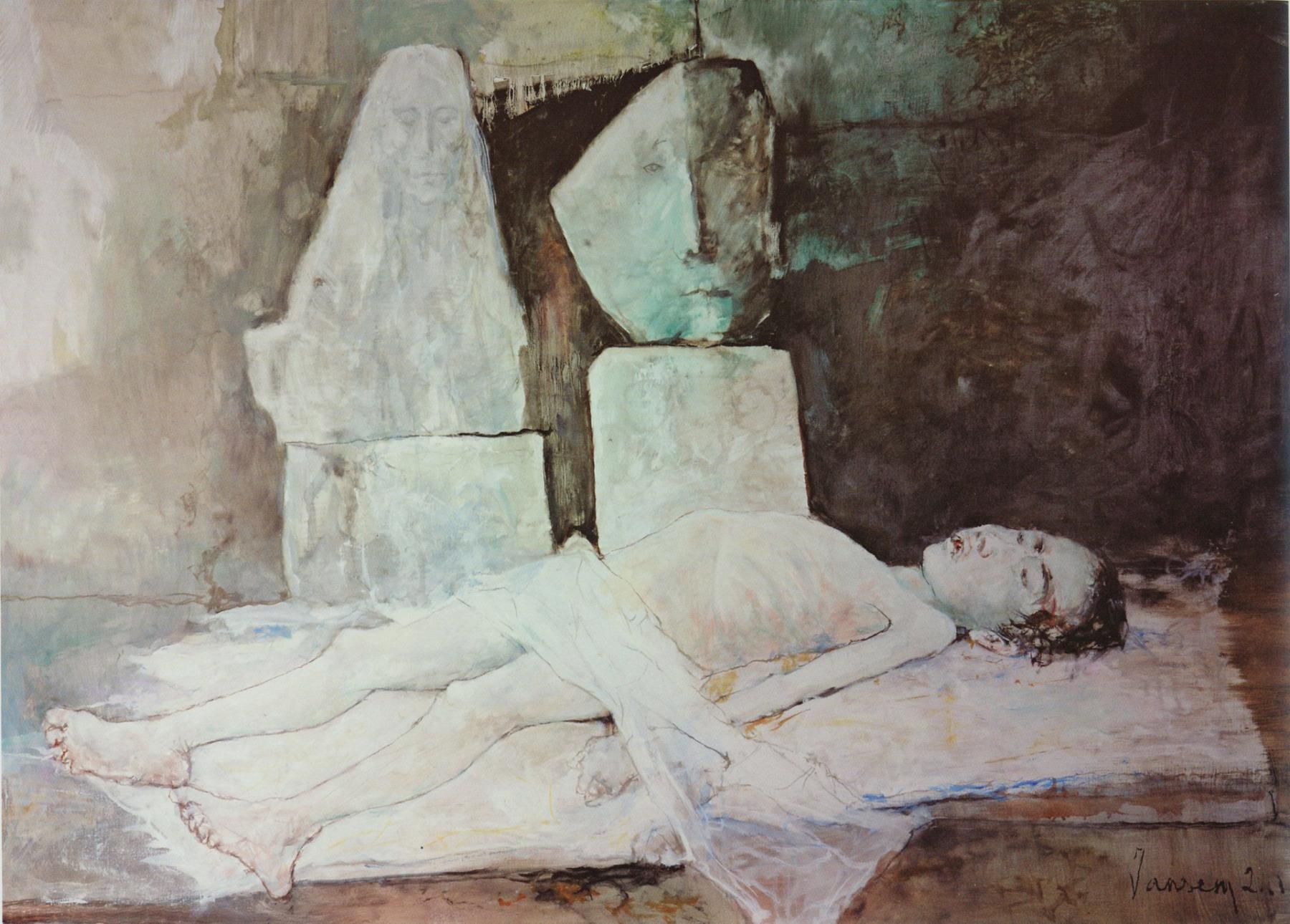
L’enfant mort, (2001), oil on cloth, H. 89 cm x W. 130 cm by Jean Jansem . Sourced Via
The funerary paintings bear titles like Scene de massacre, Etude de massacre, Deportation, Desolation, Requiem; there’s a scene of a hanged man called Martyr. They are not so much direct representations of or references to any specific massacre of Armenians as a presentation of a tableau of the atrocities literally and affectively constitutive of genocidal processuality. Deriving inspiration from the unflinching darkness of Francisco Goya and the observational paintings of Pieter Bruegel the Elder, Jansem’s aesthetics have been described as miserabilism: as an “artist of unfortunate people.” I think I disagree with the characterization.
In his book, Mourning Philology, French-Armenian literary critic and philosopher Marc Nichanian writes that “Art presents itself once as origin and a second time as mourning. And it is the origin or mourning of the same thing each time: of mythology and the gods.” The genre of genocide art entails simultaneously historical and philosophical inquiry. It challenges the representability of memory, the capacity for the survivor to reconstruct the dead witness, and the ability to give aesthetic form to a cathartic mourning—even as genocide’s obliteration of language impedes the survivor (or first or second generation descendant of the dead or the survivor) to “integrate into language the disintegration of language.”1 In the face of suffering’s alleged destruction of language, is the medium of the visual, seemingly limited only by our imaginations, subject to the same constraints on memory as speech/sound or writing?
In Yerevan, I met photographer Nazik Armenakyan whose practice insists on making visible people rendered unseen. She gave me a copy of her monograph, Survivors (2015), which pictures octogenarian and nonagenarian survivors of the genocide alongside photographs of their younger selves. In the preface, Nichanian describes the survivor image as a relic. The Catastrophe is immortalized in a particular way through Armenakyan’s portraits of survivorship. And here, as whenever possible, it is of importance that we return to local vernaculars and the grammatical lifeworlds they contain to describe mass atrocity (in Armenian, “Medz Yeghern” meaning “Great Catastrophe” was often used2) before the passage of the Genocide Convention in 1948 disciplined both language and memory in service of the standardizing practices of international law. Rather than a singular event, catastrophe, after Bedour Alagraa, is a “semiolinguistic imposition and a repeating structure,” a “structural condition, and a way of life imposed as a form of political and social domination.”3 The genocide, then, was the inauguration of a new kind of dispossessive form culminating in the establishment of the Turkish republic.4 This condition of ethnicized and national precarity can be read into, for example, the repeating image of ethnic cleansings from and cultural destruction in Artsakh in 20235 against the originary deportations, forced Islamization, and dispossession of Armenians in the 20th century.
From his consideration of the genocide, Nichanian draws out the implications of the wounding produced by genocidal violence. In his essay “Catastrophic Mourning,” he reflects on the experience of Armenian intellectual Zabel Yesayan in the aftermath of the Adana massacre in 1909, one of a series of decentralized pogroms against Armenians and Assyrians situated between the state-organized Hamidian massacres of the mid-1890s and the beginning of Armenian genocide in 1915. Yesayan went to Adana in southern Anatolia to support searches for orphans in the massacre’s aftermath, and Nichanian identifies a kind of psychic break in her correspondence following her departure long before she had completed her work. He writes that “her departure strongly resembled a flight, as though she could no longer hold up against the horror displayed by the survivors, on pain of renouncing her own self, her person, her psychical integrity.” She’s a woman of letters, yet she finds herself unable to communicate what she had witnessed. The massacre precedes The Genocide as such; she refers to it as “the catastrophe” in lower case.
Nichanian suggests her haunted testimony was written “for the author to liberate herself from the terror, from the submersion, from the too great identification with the stricken.” There is a paradox in the juxtaposition between what he describes as a monument to mourning against its interdiction. Yesayan “says the Catastrophe is unrepresentable; but from the beginning, she also gives a precise meaning to this word: it is beyond all representation for an identification.” Beyond the capacity to represent constituent parts of suffering, “The Catastrophe…obliges us to imagine more than murder, pain, and death. It calls for, it demands, an image of the totality, the sum.” And herein lies the catastrophe of The Catastrophe: “the limit of the imagination is also the limit of mourning.”
The survivor image, as in Armenakyan’s Survivors, becomes a relic. “Relic,” Nichanian explains further in his introduction, is neshkar in ancient Armenian: stripped of contemporary theological connotations, it simply refers to a remnant. Nichanian invokes Armenian writer Hagop Oshagan and his use of the word neshkareal in reference to himself and other Armenian intellectuals whose arrests and deportations marked the beginning of the genocide—they were “‘transformed into relics,’ but also ‘remain as relics in our memories.’” The survivor is also a remnant, “what remains after the death of the witness” (or, further, one “who had ‘returned from death’”). In another text, “The Sovereign, the Survivor, the Last Man,” Nichanian describes “survivor languages” as “phantomic” things that “are obliged to reflect constantly on their own status, to redefine themselves continually in relation to…the sovereignty of languages in general.”
.jpg)
Images from Nazik Armenakyan’s monograph Survivors, (2015)
.jpg)
Images from Nazik Armenakyan’s monograph Survivors, (2015)
.jpg)
Images from Nazik Armenakyan’s monograph Survivors, (2015)
Years after facilitating mass slaughter in Armenia, Europe would be the next site of Germany’s attempted realization of a racially purified geography: this would become the archetypal genocide, one to which all previous and subsequent genocides would be compared. The Holocaust in its many names—“khurbn” for “destruction” in Yiddish, “Porajmos” meaning “devouring” in some dialects of Romani language (as well as “Samudaripen,” which translates to “mass killing,” or literally “murder of all,” which is used by many Romani activists in the Balkans)—is not subject to this interdiction on mourning. Through its ascension as the paradigmatic genocidal form, there is often little quotidian curiosity about the particularities of victim community memory beyond justifications for the annihilatory permanent security operation of the Jewish state. The Jewish dead’s emergence as a universal subject is a crude cartwheeling past the existential nature of victimization: a choice to recognize Nazi extermination as a “civilizational break,” per Dan Diner, effectively positioning Nazism and racial antisemitism outside of European history and the political economies of Christian imperial racecraft. Commemorative efforts to reckon with this break, too, bear their own prescriptions and proscriptions: institutionalized border walls of memory that make their own demands of how violence ought to be described and remembered.
Take, for example, the almost totalitarian insistences made by Claude Lanzmann, director of Shoah (1985), the Hebrew word for “catastrophe” that attends specifically to Jewish persecution and resistance. The nine-hour documentary film unspools through the director’s interviews with surviving victims, perpetrators (from SS officers to implicated railway workers), and bystanders, with a focus on German-occupied Poland: the mobile gas chamber-vans at the Chełmno extermination camp, the Warsaw Ghetto, and the notorious Auschwitz and Treblinka camps. In his crusade against what he condemned as “the obscenity of the very project of understanding,” Lanzmann emphatically refused to entertain Hitler’s motivations for the Holocaust, even to the point of berating a Holocaust survivor.6 The director balked at the possibility of “creating a false archive” through dramatized accounts like Steven Spielberg’s epic Schindler’s List because any representation would be a falsifying betrayal of reality. In his book Explaining Hitler, Ron Rosembaum critically wrote that Lanzmann’s “film is not merely superior to reality […] It replaces, substitutes for, and demands the literal destruction of the merely real.” The film entailed a mystification of the real by insisting on its own visual regime by bending the rules of journalistic ethics (he multiply uses subterfuge—fake identities, a hidden camera to secretly record—to convince Nazi criminal interviewees to speak to him). It rejects the political psychological (the why) in favor of the shocking practical (the how), a lucidity and “clairvoyance” that Lanzmann self-described as being like a “horse with blinders.”
The film took eleven years to make: funders withdrew and others were irresolute in offering support because of the slowness and directionlessness of production, owed heavily to the ambivalences and struggles of the director himself. “If I’d said, ‘never again,’ or ‘love one another,’ wallets would have sprung open,” Lanzmann wrote in his memoir, The Patagonian Hare. No American Jewish funders contributed to the project. Lanzmann holds sentimentality in utter contempt with his filmic barrage of the moral-ethical entanglements of complicity, responsibility, and survivorship. His search for the truth demanded an elimination of the consolatory imagination: you are to stare at the face of the survivor and then their would-be killer, and you are to be co-witness to the existential heaviness held by the Jewish director—himself a teenaged member of the French resistance—as he struggles to metabolize, organize, and then cogently present his material and/as history itself.
The apparent incommensurability of Nazi atrocity produces an irretrievability that translates itself into a transcendence of our understood limits to human experience. The consequence of this reverent treatment of Holocaust memory as the bedrock for global genocide memory is the oblique overfamiliarity of a rote and memorized knowing without really caring to try to understand: the readily recitable expunges and evacuates the possibly utility of an aesthetics of commemoration, particularly when that memory is in turn weaponized for further genocidal aims.
The production of this subjecthood through exceptional victimology comes at a cost. Proceeding from Shivangi Mariam Raj on the logics and semiotics of rubble7—where the creation of ruin is embedded in the productive moral and political economy of nation-building—we can understand ruination and the exploitation of incommensurability as an ahistorical framing of trauma to justify victim inviolability and perpetrator infallibility. Through the materiality of rubble, she is simultaneously describing the production of metaphysical and aesthetic registers: the necessity of ruination reiterates killability and grievability, and delineates a hierarchy through which certain accounts of and attempts to communicate traumatic memory are utterly and impossibly illegible and unreliable.
Attempting to expunge and self-absolve of genocidal responsibility, the non-Jewish German citizen becomes a greater authority on antisemitism and Jewish futurity than the Jew it tried to destroy. (Furthermore, Jewish dispossession comprises much of the financial capital of the German state and the art world alike; see Moshtari Hilal and Sinthujan Varatharajah’s proposal of the phrase “people with a Nazi background.”) Likewise, the Jewish Israeli subject becomes a greater authority on Palestinian abjection in the wake of the Nakba and its establishment of the State of Israel than the Palestinian who has been transformed into the preeminent postwar existential threat and subjugated thusly as an obstacle to Jewish self-determination. The absolved German, attempting to shake off its reputation as the world’s preeminent génocidaire, becomes a hallowed arbiter of moral responsibility for genocide’s prevention. It markets a zero-sum upliftment of the Holocaust through the necessary negation of the Ovaherero and Nama genocide that preceded and informed it and the Nakba whose ongoing enactment is animated by it. The attempted extermination of the Nama and Ovaherero in German South West Africa and the ongoing attempt to destroy the possibility of Palestinian sovereignty become crucially twinned in the substrate for the generation of a colonial violence turned secular theological, juridical, and, indeed, civilizational epoch.8
_______
It is here that I begin to approach the work of Marungu, Tanzania-born and Edinburgh-based Everlyn Nicodemus, and her artistic and scholarly (and curatorial) practices. Let us, as she does, critically attend to an aesthetic ontology of trauma: as a broad cultural motif, but specifically to the psychiatric categorization of “post-trauma” (as in the pathologized manifestation of disordered behaviors after a traumatic event), the temporality of the “post-traumatic,” and how each lend legibility to degrees of suffering in the wake of experience. She emphasizes the tension between the chronological marking of the preceding “pre”-trauma and the allegedly evental “post”-trauma, offering a critique that invokes the historical longue durée of anti-black modernity. We are forced to ask, even in the face of traumatic experience, what is the distinction between pre- and post- to people embedded in structures designed to inflict continuous and debilitating (after Jasbir Puar’s debility) harm? This a genealogy documented in her epic piece Reference Scroll on Genocide, Massacres and Ethnic Cleansing (2004), an austere text-based work that also positions itself as an historical record. Its tracing, the stitching that methodically inscribes atrocities onto the 16-meter-long linen scroll, echoes the anti-linguistic muteness in which, often, all that can be mustered in the face of the monstrous shadow of violence is the utterance of the nominal as a temporal, historical, emotional, marker of time, space, and grief.
As Nicodemus writes in “Modernity as a Mad Dog,” the post-slavery and post-colonial condition each muddy the “depraved individualism” of trauma diagnoses. Her project Women of the World (1984-86) abandoned the colonialist conceits of anthropology and the privileging of the individual testimony in favor of a collectivized Third World Feminist endeavor. In line with the Combahee River Collective’s emphatic embrace of a Black feminist identity politic, Women of the World sought to counter the racist empirics of anthropology. Departing from the individuating question of what it means to be a woman, her inquiry spanned Denmark, India, and Tanzania, ultimately presenting an intersubjective painterly chorus joining together a shared gendered imaginary.
In her series, The Silence (1984), Nicodemus produces an antithesis to the post-Holocaust insistence on unspeakability and the phenomenological differend in which the horror of the singular civilizational rupture transcends our capacity for language. It simply does not, almost nothing does.9 Through an assemblage of forms carved out through a stripping of color, she opts for a grammar of shared wordlessness rather than an abyssal lack: a frame of communication predicated on the grammar that arises within and between speech or text. Against the idea that language fails in the face of catastrophe, the figuration itself produces a script that organizes collective experience through absence, silence, negation. Gabrielle Goliath’s elegiac works also settle somewhere in here; even if there are momentarily no words, there is still sound.10 It hovers somewhere around Elaine Scarry’s diagnostic in The Body in Pain where she writes that physical pain “bring[s] about an immediate reversion to a state anterior to language, to the sounds and cries a human makes before language is learned.”
.jpg)
Exhibition view of Reference Scroll on Genocide, Massacres and Ethnic Cleansing (2004) in “Everlyn Nicodemus: Black Bird” at WIELS; photo by Eline Willaert
.jpg)
Exhibition view of Tystnaden (The Silence) (1984) in “Everlyn Nicodemus: Black Bird” at WIELS; photo by Eline Willaert
As much as Nicodemus attends to the/her own traumatized Black female interiority and its projection onto her canvas, she is duly concerned with questions of figuration: Russian abstraction, textual irony, Renaissance leitmotifs, Indigenous masks, the gridded figure study, and countless other art historical references are enmeshed in her experimental painterly and sculptural forms. Owed to the ghettoizations of the racist art canon and its history, she describes how European colonialism created and named the modernist movement at the same time it foreclosed Black aesthetic possibility’s participation in modernist formations understood as solely European domains of fine arts. She describes, for example, the influence African art had on Cubism at the same time Europeans refused to recognize how African artists were utilizing and challenging modernism’s foundations.11 Because modernity and its atomic unit (the citizen) are predicated upon the extraction of a Black traumatized consciousness, modernism necessitates a Eurocentric degradation of the aesthetic capacity of the African Other even as it is the foundation of what we understand to be the modern. Portuguese enslavement of Africans in the 16th century established the European color line; Black abjection is made empirical through “white sight,” after Nicholas Mirzoeff’s theorization of racial vision as aesthetic mastery, surveillant technology, political economic and blasphemous dominion over land, sea, and sky. Through this anti-Black modernity, we are all enmeshed in this traumatized modernism, and it is through this reappraisal that she approaches a generic renegotiation of canonically unregistered trauma.
In “The Ethics of the Wound,” Nicodemus describes art as testimony, which I’m reading as an extension of Nichanian’s statement that art is mourning. In something of a challenge to the position that language can altogether be destroyed, she writes that “overcoming the inner barrier of traumatic muteness can be said to mirror, as an act of resistance, the ongoing open warfare in the outer world between silencing and witnessing.” It is not that, after misreadings of Adorno, it is impossible to write poetry after catastrophe; rather, “works of visual art containing elements that testify to trauma could be expected to show signs of an altered visual language and of a certain kind of breakdown of conventional visual narration.”
The “ethics of the wound,” she notes, is borrowed from French novelist and playwright, Jean Genet, in his own ethical formulations of the manufacturing of solidarity. Genet’s 1958 essay “Le Secret de Rembrandt” alludes to, per Carl Lavery, “a wound [that] is not just existential, a form of ontological dispossession inciting perpetual mourning,” but an ethical “catalyst that punctures narcissism and propels us to the other.”12 The wound is opaque and rather than forcing the wounded other into an explanatory revelation, “the failure of everyday language to communicate and express meaning…gets to the very core of ethics for it dispossesses the subject and forces an encounter with the ‘impenetrable singularity’ of the Other.”13
We might think of the ethics of the wound as a kind of aesthetic traumatophilia, where traumatophilia, as theorized by psychoanalyst Avgi Saketopoulou in Sexuality Beyond Consent, is a contention with trauma that “does not dismiss the negative effects suffered by traumatized persons,” but rather “puts pressure on the all-too-human impulse to overpromise the reversing of injury and moves us away from the instrumentality of cure.” Parallel to Nichanian’s description of art as mourning is the reality that trauma cannot necessarily be cured: one cannot return to a pre-traumatized state, but Nicodemus’ traumatophilic ethic of the wound enables trauma’s circulation.
In “Modernity as a Mad Dog,” so named for Oleg Kulik’s performances as a leashed and angry dog mirroring the traumatic chaos wrought by the collapse of the Soviet Union, Nicodemus argues for a “reanimating… visitation of trauma [that] may become an ever-renewable source of inspiration, acting on us in potentially transforming ways.” She describes a terrifying breakdown in response to racist persecution in France just as she had previously experienced it in Sweden. White youth with drums and trumpets and blackened faces left a decapitated carcass of a black cat on her doorstep whilst she lived in “the part of France where the Nazis had once had a death camp.” She describes the immensity of her physical reaction: vomiting blood, soiling her pants, losing consciousness. As Zabel Yesayan reached for her pen in her attempt to stabilize herself, Nicodemus reached for her drawing block, drawing again and again “a cramped woman sitting on a chair that could overturn at any moment; in front of her a black floor seems to open upon an abyss,” representing “a total loss of foothold” in an existential sense. Art critic Jean Fisher would see the works in a later exhibition, writing that “we might say the self has taken leave of its senses.”
In medicalized terms, Nicodemus describes the incident as a “typical case of catastrophic posttraumatic stress disorder of the kind that often leads to psychogenic death,” which is defined by Walter Cannon—the psychologist who coined the term “fight or flight”—as a death brought about by extreme psychophysiological shock, a fatal overstimulation of the nervous system. From this traumatic moment, an evental triggering of accumulated race-gendered traumas, emerged more work. First came The Object in 1988, and then The Wedding in 1991, the latter a staggering series of 84 paintings whereby the violence of Alsace haunted her yet again in Antwerp. In this traumatophilic mode, these paintings about “wrestling with death, and about [her] return to the space of life and to what [she] hoped was a restored Self” enabled her self-reconstitution, and in her own words, “a witnessing to [herself], driven by the need to give shape and language to confusion and chaos” in which life and death were unequally distributed realities and not pre- or anti-lingual abstractions.
 I.jpg)
The Object I, (1988) pencil and charcoal on paper
by Everlyn Nicodemus
 II.jpg)
The Object II, (1988) pencil and charcoal on paper
by Everlyn Nicodemus
 III.jpg)
The Object III (1988) pencil and charcoal on paper
by Everlyn Nicodemus
 IV.jpg)
The Object IV, (1988) pencil and charcoal on paper
by Everlyn Nicodemus
The wounded ethic is recapitulated in Adam HajYahia and Haitham Haddad’s book An Echo in Search of Its Shadow, Aesthetics of the Repressed. On the surface, an aesthetic of the repressed seems to find some common cause with the generic designation of miserabilism ascribed to Jansem’s work. Emerging from the space of generated misery, this aesthetic of the repressed poses a question about a praxis of “aesthetics exceeding the notions of equality,” which is to say, an “aesthetics of negativity, aesthetics in the negative,” per the practice of Basel Abbas and Ruanne Abou-Rahme: an insistence on inhabiting the foreclosed as “a call for awakening and activation of a repressed and dormant political subjectivity.” Jansem, in this vein, was not a miserabilist, or at least his practice cannot be simplified as such. While I do not know enough about him personally to try to presume his painterly stance, his paintings in Tsitsernakaberd similarly strike me as an insistence on Armenian sovereign being-knowing in a world in which Armenian sovereign possibility is altogether denied by genocidal (and, now, denialist) political forces. The survivor and their testimony conjoins that of descendants of survivors in communicating “generative loss as a primary formative element in the reproduction of…collectivity,”14 whether Palestinian, Armenian, or some other socially deadened people. In “The Insistence of the Scar,” HajYahia notes that writing as the disindividuated “we”—harmonizing with the “ghostly polyphony of the dead”—joins a lineage of others who have sought to [dis]articulate History as part of a “series of ongoing attempts to enact unrealized disorders.” He contends that “writing begins already in failure…to remain faithful to what language renders through its operations of abstraction and capture.” Regardless of whether or not we succeed, the impulse to insist is pathological. Refusal, imagining otherwise, Fatima Bernawi sticking her tongue out in an Israeli mugshot intended to publicly discipline, the men of Shu’afat refugee camp dressing as Odai Tamimi and thwarting Israeli attempts to capture him for two weeks “by mimicking his colonially perceived guise”15: all means, in different ways and with different stakes, of survival.