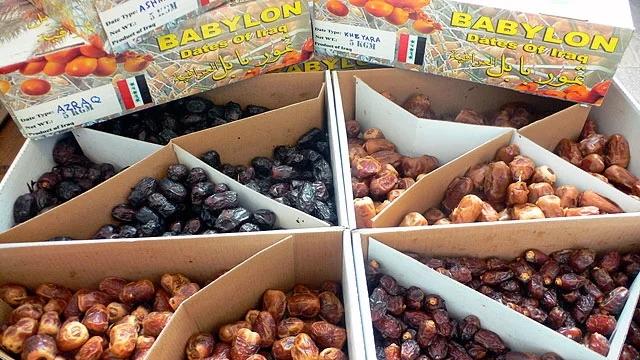
Michael Rakowitz, Return, 2004-2006. Mixed-media installation, dimensions variable.
What does it mean for a fruit to travel under conditions of war, economic duress, and genocide? For the Iraqi-American artist Michael Rakowitz, a fruit that travels is a metaphor for exile. In 2006, Rakowitz imported dates from Iraq to the United States as a part of an artistic project called Return (2004-2006). And despite the name given to the artwork, return did not mean returning to Iraq. The dates’ journey to the United States was the one-way journey of a refugee.
In this regard the dates stood in for both Rakowitz’s family as well as the millions who left the country during the U.S. occupation. Rakowitz’s family were Iraqi Jews who fled Baghdad in 1941, when Rashid Ali al-Gaylani came into power. An ally of the fascist governments in Germany and Italy, under al-Gaylani, a pogrom was instituted to target one of the oldest Jewish communities in West Asia. It led to the deaths of two hundred Jews, and hundreds of thousands more left in the following decades. Rakowitz’s maternal grandparents were among them. They first settled in Bombay, where his mother was born, and later in Long Island. Although outside of the country, Rakowitz’s grandfather, Nissim bin Ishaq Daoud bet Aziz, maintained ties to his homeland. He operated an import-export business between the United States and Iraq until the 1960s. During the U.S. invasion and occupation, Rakowitz reopened his grandfather’s business in Brooklyn. The artist provided members of the Iraqi diaspora in New York free shipping to send books, clothes, and toys to recipients in Iraq. This was “an exceptional offer at a time when the shipping and trade infrastructure in the country had completely collapsed,” he explains.
In addition to sending items to Iraq, between October and December 2006, Rakowitz began to work on importing dates from the country to the U.S. The circuitous route of this traveling fruit has been documented in a store log, a series of photographs, and a twenty-minute video composed of still images and the artist’s voiceover. The story is as follows. In October, an initial truck shipment of two hundred boxes of dates from the city of Hilla joined the four-day-long line of cars attempting to cross the Jordanian border. The dates were not allowed to enter Jordan because they did not have documentation stating that the produce was free of radiation from U.S. and British bombs dropped on Iraq in 2003. A second attempt a week later also failed after Jordanian border officials cited unnamed security issues and turned the truck away. Eventually, the truck ended up at the Syrian border, where the dates could be flown from Damascus to Cairo and onward to New York City. But after weeks in transit, and several weeks of being held in Damascus by Syrian officials demanding bribes, the shipment of dates spoiled.
At this point Rakowitz and his exporter shifted gears and decided to use DHL to move a smaller shipment of ten boxes of dates by air. After arriving in New York in mid-November, the dates were held for inspection for three weeks by U.S. Customs, the Department of Agriculture, and the Food and Drug Administration. They finally arrived in Rakowitz’s store on December 5, 2006, where people flocked to try them.
In the store, the dates were arranged on a table. A tightly cropped photograph of the display gives us some idea of what visitors saw. Dates fill the entire frame of the image. White cardboard partitions separate the different varieties: kheyara (large, amber), azraq (small, blue-black), and ibraheme (tiny, wine red). The lids of the boxes are carefully arranged above them, displaying the name “Babylon Dates Of Iraq” in bright yellow text, with stock images of date palms and bunches of fresh dates crowded in the background.
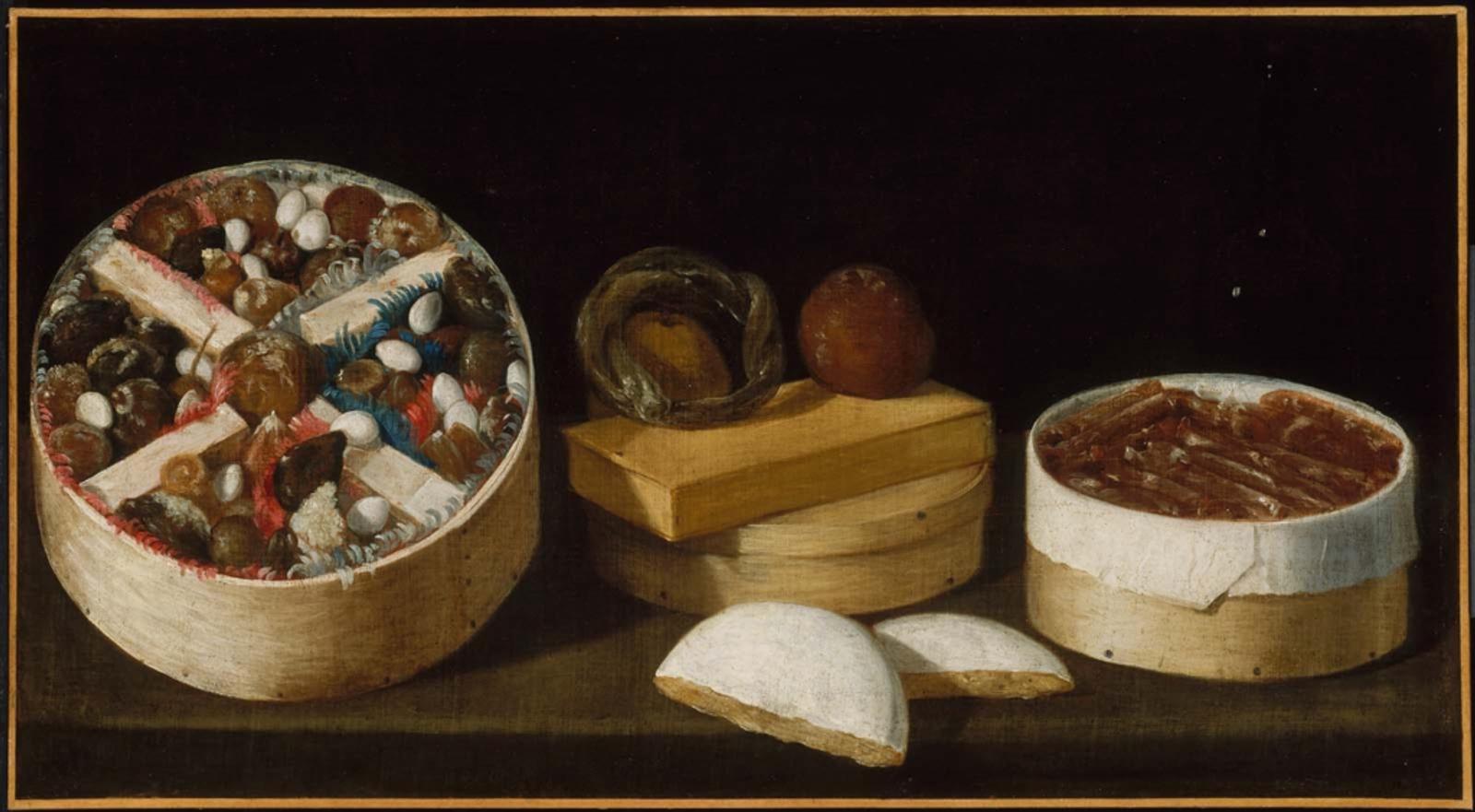
Unidentified artist, Still Life with Sweetmeats, 17th century. Oil on canvas, 39.7 x 72.1 cm. Museum of Fine Arts, Boston.
There is a resemblance between Rakowitz’s photograph of the dates and a seventeenth-century Spanish still life painting of sweetmeats and sticks of brown sugar, now in the collection of the Museum of Fine Arts, Boston. In both, fruits and candies are arranged in a shallow space. The fruits are divided in compartments in boxes with their lids beside them. In Still Life with Sweetmeats, one box is even tipped toward the viewer, as it might be held and seen in a shop.
The resemblance isn’t surprising because the function of the two images is similar. Both are displays of luxury commodities. The candied fruits in the box on the left in Still Life with Sweetmeats have been glazed in sugar. The sticks of brown sugar in the box on the right are a type of rock candy, made by shaping cooled sugar syrup into logs. In the seventeenth century, sugar was an expensive and rare commodity, grown and harvested by enslaved Africans on plantations in the Caribbean and brought to Europe by ship. Sugar’s luxury value was derived from the labor of kidnapped Africans and the time and money it took to process, refine, and transport it from the colony to the metropole. In 2006, Iraqi dates were an expensive and rare commodity too. Their rarity was due to three decades of war, environmental destruction, and economic sanctions that had decimated the date industry, killed date palm trees, and made obtaining produce from Iraq nearly impossible. The luxury value of dates was mainly derived from the time and money it took to transport them out of the country in the face of wartime disruptions.
In fact, Rakowitz spent $8,500 to import his dates, using the financial resources of the arts organization Creative Time, the Rockefeller Brothers Fund, and the New York Foundation for the Arts. The artist quipped in his store log that importing Iraqi dates made for bad business but good art. In the realm of art, the date as a commodity has been stripped of use value and given aesthetic value instead. As an aesthetic object, the date calls attention to its role in the circuits of capital, labor, and a controlled global market. In other words, as an aesthetic object, the date tells stories bigger than itself.
Looking at this photograph of the dates, I was also reminded of a painting by a young Palestinian artist living in al-Bureij refugee camp in Gaza City. The painting was part of a May 2026 exhibition called What Survival Left Behind, and hung on an exterior wall in a row alongside dozens of other paintings. There is a woman at the center of this image. She has no face. But this woman does not seem to be experiencing any sort of crisis of identity. It’s clear she is Palestinian because the painting features some of the familiar iconography of Palestinian liberation movements since the Nakba, including the fishing net pattern of a keffiyeh that encircles the woman and squat prickly pear cacti that emerge from the textured brown soil and from behind her shoulders. The power of the image is that it invites viewers who saw the painting in the refugee camp to identify with the image or to imagine any Palestinian woman’s eyes, nose, and mouth where her face should be. She stands in for the whole. Her facelessness is a site around which discussions about Palestinian identity can happen.
What interests me about the date is how it allows a similar kind of empathetic identification and imaginative conjuring. For Rakowitz, the date gave form to the estimated two million people who left Iraq after 2003. (Some related numbers: an estimated four million people were internally displaced and over half a million were killed. This, too, could be called a genocide.) His project repeatedly highlighted the similarities between the people and dates trying to leave the country in the midst of societal breakdown and political occupation. When the truck carrying the dates was turned away at the Jordanian border and had to make its way to Egypt via Syria instead, Rakowitz wrote: “The dates are now traveling the exact same path as many Iraqi refugees who are attempting to flee their country, as Egypt has become the next option after Jordan, whose borders have tightened and have become much more restricted.” When delays in Syria left the dates in too poor condition to continue to ship and sell, Rakowitz pointed out that “like so many refugees, the dates were unable to get to their destination.”
While the story Rakowitz tells about migration through the dates is compelling, I am wary about taking the comparison too far. I’m not willing to say that the dates experienced anything like fear, trauma, abuse, or violence as they left the country, or that looking at an image of dates tells us something about the experiences of refugees. After all, these dates benefit from the material privileges of being airlifted out of Baghdad by DHL with money provided by the contemporary art world.
But like the faceless woman, the date is a site around which discussions around Iraqi identity can happen. Where the faceless woman and the date differ is in how that empathetic identification happens. In the painting, viewers see the faces they want to see where the face of the woman should be. In the date, different identities, stories, and experiences come to light not through figural representation, but through the embodied process of eating.
When Rakowitz finally eats one of the dates, he finds it sweet and nutty. The people who visit the artist’s shop to eat dates find that it is a taste of history, childhood, and home. One man came to the shop to buy dates to send to a soldier stationed in Iraq who had never tried any food beyond what was served in the military canteen. It is a taste of the land being occupied. The heart of the artwork is contained in these moments when people taste the dates and have conversations with each other about their memories, political grief and anger, and hopes for the future.
For Rakowitz, a fruit that travels was a metaphor for exile. But it isn’t the date’s only meaning. In the conversations in the shop, other meanings appear. For Rakowitz’s interlocutors, a fruit that travels could mean exile and more. It contains the many narratives of Iraqi life.
∙∙∙
For an artwork called Return, “return proved impossible,” Rakowitz admitted in his store log. From the perspective of 2026, the title of the work suggests to me something different. It suggests the recurrence of violent, extractive imperialism in West Asia. The suffering, exploitation, and death are as intense today as they were twenty years ago, and earlier ventures like the Iraq War have set the ground for the current Palestinian genocide and the seizure of land and resources across West Asia as well as the criminalization of protest, the militarization of policing, and racist immigration policies in the imperial core.
This is not the place for a thorough analysis of what is different in the alignment of political and economic forces between the war in Iraq and the current wars on Palestine, Lebanon, and Iran. What can be said is that at this moment U.S. imperialism is in decline, and its economic hegemony is losing credibility. The signs of crisis, transition, and historical possibility are everywhere. A traveling date cannot solve the practical, and still unfinished, task of fighting imperialism. But it can offer personal and existential grounding. It can connect people, histories, and identities across time and space. It can generate dialogue, and with it, compassion. These are the critical tools we will need to live and work together in times of revolutionary change.